Gone are the days when customer service was just a cost centre, a department you had to have but didn’t necessarily invest in. Today, your customer service team is a powerful engine for growth. The people you hire to talk to your customers every day directly influence revenue, build brand loyalty, and determine whether customers stick around.
Why Customer Service Recruitment Is Now a Strategic Priority
For Chief Human Resources Officers (CHROs), this shift changes everything. Mastering customer service recruitment isn’t just an operational task anymore, it’s a strategic imperative that hits the bottom line. Think of it less like filling seats and more like assembling a championship sports team.
You wouldn’t just hire players who show up on game day. You’d scout for specific skills, build a deep bench, and foster a culture that breeds long-term success. Old-school, reactive hiring methods just can’t keep up. They lead to high turnover, wildly inconsistent customer experiences, and costs that just keep climbing.
This is especially true in high-growth markets. India’s Business Process Outsourcing (BPO) industry, for example, saw a massive expansion, adding roughly 7 lakh (700,000) new jobs, a 7% year-on-year jump in employment. With call centre roles making up nearly half of this growth, the battle for top talent is fierce. You can read more about India’s BPO employment trends on Fusioncx.com.
To win, you need a modern game plan.
The Four Pillars of Modern Recruitment
A truly strategic approach to hiring stands on four essential pillars. Each one is designed to help you build a resilient, high-performing team that can turn everyday customer interactions into genuine brand-building moments.
Building a modern customer service recruitment strategy requires a shift in mindset from reactive hiring to proactive talent architecture. The table below outlines the four core pillars that every CHRO should focus on to build a sustainable, high-performing team.
| The Four Pillars of Modern Customer Service Recruitment | | :— | :— | | Pillar | Strategic Focus for CHROs | | Proactive Workforce Planning | Move from just filling empty seats to anticipating future needs based on business forecasts and market trends. | | Diversified Talent Sourcing | Look beyond traditional job boards. Tap into new talent pools through employee referrals and sourcing from emerging cities. | | Robust Skills Assessment | Prioritise core competencies like empathy and problem-solving over simple resume keywords. Assess for aptitude, not just experience. | | Retention-Focused Onboarding | Design an immersive onboarding experience that fully integrates new hires into the company culture and shows them a clear career path from day one. |
By focusing on these four areas, you can transform your hiring process from a tactical necessity into a source of competitive advantage.
Ultimately, a strategic approach to customer service recruitment isn’t just about hiring people. It’s about architecting a core business function that strengthens customer experience, dramatically reduces attrition costs, and drives sustainable revenue growth.
When CHROs champion this mindset, they empower their organisations to build a customer service function that doesn’t just solve problems, it builds the business.
Building Your Team Before You Need It
Great customer service recruitment doesn’t kick off when a role opens up; it starts months, even a year, in advance. The old-school, reactive approach, hiring only when there’s an empty seat, is a bit like trying to build a ship while it’s already taking on water. This last-minute scramble almost always leads to rushed decisions, poor culture fits, and a noticeable dip in service quality that your customers feel immediately.
For CHROs, the game-changer is shifting from this reactive cycle to proactive strategic workforce planning. It means looking over the horizon and drafting a blueprint for your future team long before the need becomes urgent. You have to be the architect, not the firefighter.
This proactive mindset requires a deep dive into your business’s trajectory. You need to get granular with business growth forecasts, predict seasonal swings in customer demand, and understand how new tech, like AI in customer service, will reshape your staffing needs. For instance, you might forecast a 20% spike in customer interactions during the festive season, or realise that an upcoming product launch will demand agents with highly specialised technical knowledge.
Forecasting Your Future Talent Needs
Effective planning is about more than just hitting a headcount number; it’s about mapping out the specific skills and temperaments your team will need tomorrow. This involves a multi-faceted analysis of what’s happening both inside and outside your organisation.
This concept map shows how proactive planning forms the bedrock of a successful recruitment lifecycle, flowing naturally into sourcing, assessment, and onboarding.
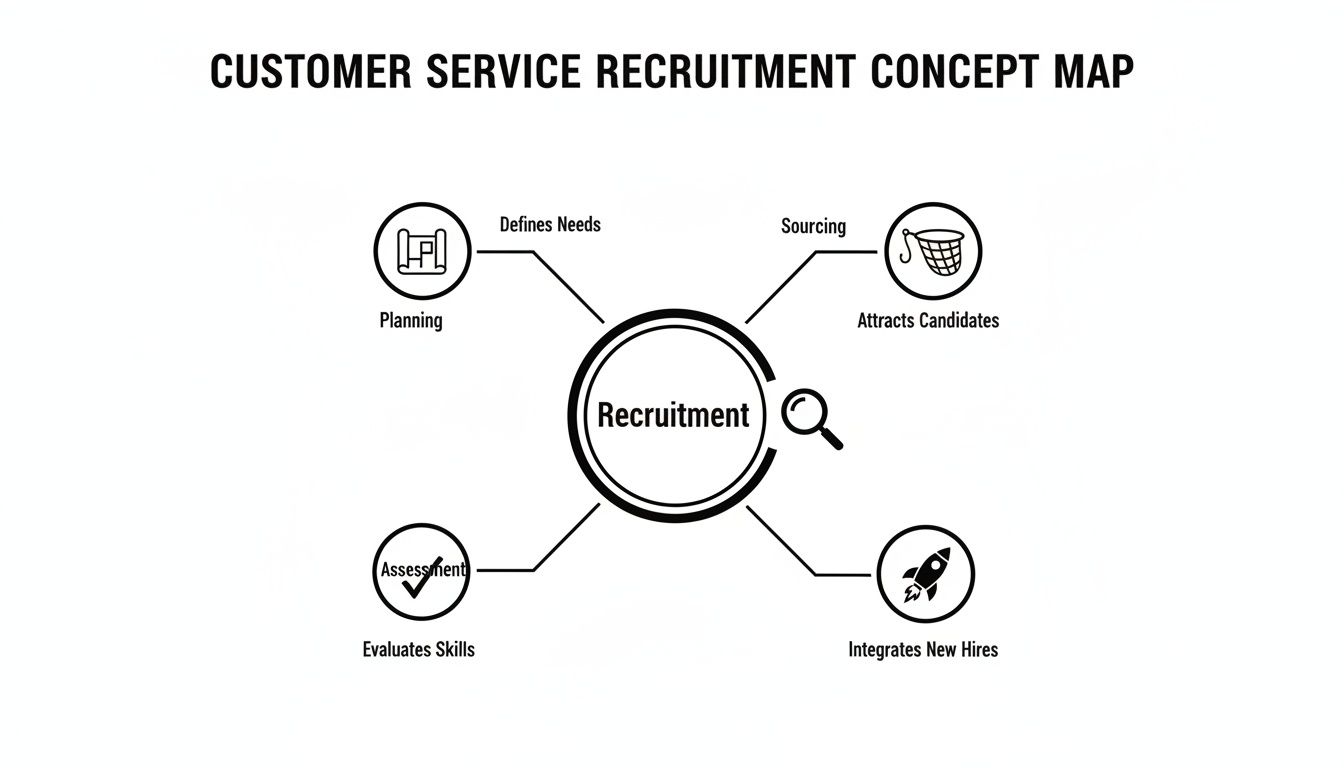
As you can see, recruitment isn’t a one-off event. It’s a connected process where each stage builds on the last, and it all starts with a solid strategic plan. This interconnectedness is crucial for building a resilient, high-performing team.
By forecasting your needs, you can start building a robust talent pipeline, ensuring you always have a ready pool of qualified candidates. Our guide on how to develop a strategic talent pipeline is a great resource if you’re looking to get started.
Strategic workforce planning transforms customer service recruitment from a cost-driven, reactive function into a value-driven, proactive strategy. It ensures that talent acquisition is always aligned with long-term business objectives, preventing service disruptions caused by staffing gaps.
This predictive approach keeps you ahead of the curve, dramatically cutting down your time-to-hire and preventing the quality erosion that inevitably comes from crisis-driven hiring.
Developing Detailed Talent Personas
Once you have a handle on your future needs, the next step is to create detailed talent personas for each role. A persona is much more than a job description. It’s a rich, detailed profile of your ideal candidate, blending skills, behavioural traits, and what truly motivates them.
Think of it like casting for a film. You don’t just put out a call for “an actor”; you look for someone with the right charisma, emotional range, and on-screen chemistry for a specific part. In the same way, your talent personas should define the unique attributes needed for different service roles.
- The Empathetic Frontline Agent: This persona would prize high emotional intelligence, active listening skills, and a healthy dose of resilience. Their core motivation is helping people, and they thrive in a supportive, team-first environment.
- The Technical Support Specialist: Here, the focus shifts to sharp analytical thinking, complex problem-solving abilities, and a real knack for explaining technical concepts in simple terms. This persona is driven by the challenge of solving puzzles and mastering product knowledge.
By mapping these personas to core competencies, you create a clear and actionable blueprint for your recruitment efforts. This ensures your sourcing and assessment strategies are perfectly targeted, attracting and identifying candidates who not only have the right skills but are also a fantastic fit for your company culture.
Finding Top Talent in Unexpected Places
Relying only on traditional job boards to find your customer service team is a bit like fishing in a small, crowded pond. You might get a few nibbles, but the real prize catches, those naturally empathetic, resilient, and service-minded professionals, are often swimming elsewhere. To attract the best, you need to cast a wider, more strategic net.
For CHROs, this means getting away from the old “post-and-pray” approach. It’s about designing a multi-channel sourcing strategy that constantly draws in high-calibre talent, not just filling seats as they become empty. The first step is to build an employer brand that truly connects with people who are passionate about service.
Your brand needs to tell a compelling story. It should explain why your company is a fantastic place to build a career in customer service. This is about more than just listing benefits; it means showing your commitment to a positive work culture, highlighting real growth opportunities, and celebrating the impact your customer service team has on the business. When your company gets known for valuing its service professionals, the best candidates will start seeking you out.
Supercharge Your Employee Referral Programme
One of the strongest, yet most underused, channels in customer service recruitment is your own team. Employee referral programmes are known for bringing in high-quality candidates who fit in faster, perform better, and stay longer. Your current top performers know exactly what it takes to succeed in their roles, and their networks are often full of people with a similar work ethic.
To turn your referral programme into a true talent magnet, it needs to be more than just a small bonus. Think about these strategies:
- Make It Rewarding: Offer significant, tiered bonuses that are paid out quickly. A meaningful incentive shows you genuinely value your employees’ recommendations.
- Keep It Simple: The submission process should be effortless. A complicated, multi-step system will put people off.
- Communicate Constantly: Keep the referrer in the loop about their candidate’s progress. Regular updates show you respect their contribution and keep the programme top of mind.
Think of your referral programme not as a passive bonus system but as an active talent acquisition engine. When you energise it with clear communication, attractive rewards, and a seamless process, you turn every employee into a dedicated recruiter for your organisation.
This creates a virtuous cycle of quality hires, which in turn helps drive down recruitment costs and lifts overall team morale.
Look Beyond the Metros
The talent landscape isn’t just confined to major cities anymore. With flexible and hybrid work models becoming the norm, your next top-performing agent could be located anywhere. This geographic diversification is a huge strategic advantage, allowing you to tap into new talent pools while also managing operational costs.
Emerging tier-2 cities are quickly becoming high-growth hiring centres. Recent data shows that cities like Coimbatore and Ahmedabad are seeing significant year-on-year hiring growth, at 24% and 21% respectively. This trend, which sees them growing nearly as fast as traditional tech hubs like Bengaluru (23%), shows a strategic shift where companies are expanding their reach to find skilled, motivated people outside of saturated markets. You can read the full trend report about India’s hiring geography on foundit.in.
Gain a Strategic Advantage with an RPO Partner
Building and managing this kind of sophisticated, multi-channel sourcing strategy requires specialist expertise, technology, and a lot of resources. For many CHROs, this is where a Recruitment Process Outsourcing (RPO) partner like Talent Hired becomes an invaluable asset. An RPO provider gives you immediate access to a scalable recruitment setup and a team of sourcing specialists who live and breathe talent acquisition. They can manage the entire process, from employer branding to running referral campaigns and tapping into new geographic markets, freeing up your internal HR team to focus on broader strategic goals.
How to Identify High-Performing Service Talent

For a long time, hiring has followed a simple formula: scan resumes for years of experience and hope for the best. But that approach is broken. A polished CV tells you nothing about a candidate’s resilience when facing an angry customer, or their empathy when trying to build a genuine connection. Today, effective customer service recruitment is about spotting natural talent, not just ticking off past job titles.
Think of it like hiring a chef. You wouldn’t hire them based on a list of ingredients they’ve used; you’d want to see them in the kitchen, tasting their food. The same logic applies here. To find truly great service professionals, you have to move beyond keywords on a document and use an assessment framework that reveals their problem-solving DNA and people skills.
This means shifting to assessment tools that actually simulate the reality of the job. By creating real-world scenarios, you can see how candidates think on their feet, manage stress, and communicate when the pressure is on. This method is far more reliable for predicting future performance and retention than any resume screen ever could be.
Simulating Real-World Challenges
To get a true measure of a candidate’s capabilities, your selection process needs to feel like a day on the job. Two of the most powerful ways to do this are through Situational Judgement Tests (SJTs) and role-playing exercises. These aren’t abstract quizzes; they’re practical, job-relevant simulations.
- Situational Judgement Tests (SJTs): These present candidates with realistic work scenarios and ask them to choose the best course of action. For instance, an SJT might describe a customer who is furious about a billing error, while a system outage prevents an immediate fix. The candidate’s answer shows you their problem-solving priorities, communication style, and ethical compass.
- Role-Playing Exercises: This takes the simulation to the next level. A trained interviewer acts as a frustrated or confused customer, giving you a live look at how the candidate performs. You can assess their tone, active listening, and ability to de-escalate a tense situation in real time.
Using these methods transforms your customer service recruitment from a guessing game into a data-backed decision. It helps you hire people who are truly built for service excellence.
Structuring Behavioural Interviews for Deeper Insights
While simulations are great for testing practical skills, behavioural interviews are your key to unlocking a candidate’s core personality. The logic is simple: past behaviour is the best predictor of future behaviour. Instead of asking hypothetical questions like, “How would you handle an angry customer?”, you ask for concrete examples from their past.
The trick is to structure these interviews to dig into the traits that really matter in a service role.
Your goal is a selection process that is not just efficient but highly predictive of future performance. By probing for specific past behaviours, you can accurately assess the foundational traits that separate good service agents from great ones.
Here are the critical traits to look for and how to frame your questions to find them:
- Empathy: Ask, “Tell me about a time you had to deliver bad news to a customer. How did you handle their reaction?” This shows you their ability to understand and connect with another person’s feelings.
- Resilience: A great question is, “Describe a particularly challenging interaction you had with a customer. What was the situation, and what did you do to stay composed?” This gets at their ability to bounce back from stressful moments.
- Problem-Solving: Frame it this way: “Walk me through a situation where you had to find a creative solution to a customer’s problem because the standard procedure wasn’t working.” This tests their critical thinking and resourcefulness.
- Emotional Intelligence: Inquire, “Can you share an instance where you recognised a customer was becoming frustrated before they said anything? What cues did you notice, and how did you adapt your approach?” This reveals their awareness of social and emotional signals.
By combining simulations with structured behavioural interviews, you build a powerful, comprehensive assessment framework. This ensures your customer service recruitment process consistently finds candidates who will not only perform well but also thrive in your company culture, ultimately leading to better business outcomes and higher retention.
Turning New Hires Into Loyal Brand Advocates

Getting your customer service recruitment right is only half the battle. All that effort is wasted if those high-potential new hires you so carefully selected walk out the door within their first year. High agent turnover isn’t just a number on a spreadsheet; it’s a huge drain on your P&L and a direct threat to the customer experience you’ve worked so hard to build.
Every time an agent leaves, you lose institutional knowledge, waste training costs, and have to start the recruitment cycle all over again. For CHROs, the final, critical piece of the puzzle is connecting the dots between onboarding, ongoing engagement, and long-term retention. It’s what separates a temporary workforce from a cultivated team of loyal brand advocates.
This means shifting your focus from a simple one-week orientation to a long-term integration strategy. The goal is to show new agents they have a real future with your company, not just a job.
Crafting a Culture-First Onboarding Experience
A truly great onboarding programme does far more than just teach new hires how to use a CRM or follow a script. It should be an immersive experience that instils your company’s customer-first culture from the very first day. Think of it less as training and more as an introduction to your brand’s way of thinking.
Of course, standard tool training is necessary, but it’s not enough on its own. A culture-first approach weaves purpose into every process. For example, when training someone on the returns process, don’t just show them which buttons to click. Tell them a story about an agent who turned a difficult return into a moment that built incredible loyalty with a customer.
A structured onboarding experience is your first and best opportunity to transform an employee into a brand advocate. It should be designed to build not just competence in their role, but also a deep, emotional connection to the company’s mission and its customers.
You can learn more about how to boost employee experience through a modern digital onboarding process in our detailed guide. This initial period really does set the tone for their entire career with your organisation.
Fostering Engagement Through Mentorship and Feedback
Once onboarding is over, the real work of engagement begins. New agents, especially in their first six months, can easily feel isolated and overwhelmed. A structured mentorship programme is one of the most powerful ways to combat this.
Pairing a new hire with a seasoned, high-performing agent gives them a safe space to ask questions they might be too hesitant to ask a manager. This relationship offers practical guidance and, just as importantly, crucial emotional support, helping them build confidence and competence much faster.
Consistent feedback is also key. Annual performance reviews are far too infrequent for a fast-paced service environment. Instead, you need to build a system of continuous feedback:
- Weekly Check-ins: Short, informal one-on-ones to talk about recent challenges and celebrate small wins.
- Real-time Coaching: Use call monitoring software to give immediate, constructive feedback right after a difficult interaction.
- Peer Reviews: Encourage team members to share positive feedback and helpful tips with one another.
This constant loop of communication helps agents feel supported and valued, directly fighting the feelings of neglect that so often lead to early turnover.
Building Clear Career Paths for Retention
Let’s be honest: the most common reason high-performing agents leave is because they see no room for growth. If they can’t picture a future with your company, they’ll start looking for one somewhere else. A key retention strategy is to build and clearly communicate attainable career paths within the customer service organisation.
This shows agents that their current role is a stepping stone, not a dead end.
- Tiered Agent Roles: Create levels like Agent I, Agent II, and Senior Agent, each with increasing responsibilities and, of course, better pay.
- Specialisation Tracks: Offer paths into more specialised roles like Technical Support Specialist, Quality Assurance Analyst, or Team Lead.
- Skill Development: Provide company-sponsored training for skills that lead to advancement, such as data analysis or project management.
By investing in these retention-focused strategies, CHROs can dramatically reduce costly attrition. This not only protects the initial recruitment investment but also builds a stable, experienced team that can deliver a consistently superior customer experience.
Using an RPO Partner to Scale Recruitment on Demand
When business is booming, seasonal demand hits, or you suddenly need to uplift the quality of your talent, your internal HR team can quickly find itself stretched thin. This is the exact moment where a strategic partnership with a Recruitment Process Outsourcing (RPO) provider becomes a CHRO’s most powerful asset. It’s a move that shifts your recruitment function from a fixed cost centre to a flexible, on-demand powerhouse.
Think of an RPO partner like a dedicated, external recruitment engine for your company. This engine can be revved up or throttled down with incredible precision, perfectly matching your hiring needs without the long-term cost and commitment of a large in-house team. Whether you need to hire 50 agents for a new product launch or 500 for the festive rush, an RPO has the infrastructure and know-how to make it happen.
This kind of agility allows your core HR team to stay focused on bigger-picture initiatives, like strengthening company culture, developing leaders, and designing retention programmes that are critical for long-term success.
Tapping into Specialised Expertise and Technology
An RPO partner brings far more than just extra hands to the table; they bring a deep well of specialised knowledge in customer service recruitment. Their recruiters live and breathe this world. They understand the nuances of finding great service talent, from assessing soft skills like empathy to knowing the pressures of a high-volume contact centre. Because they’re constantly in the market, they have real-time insights into talent pools, salary benchmarks, and what your competitors are doing.
On top of that, these partners come armed with an advanced recruitment tech stack that many in-house teams simply don’t have access to. This often includes:
- Sophisticated Applicant Tracking Systems (ATS): To seamlessly manage high volumes of candidates and deliver data-driven insights.
- AI-Powered Sourcing Tools: To unearth passive candidates who aren’t actively looking but are a perfect fit for your roles.
- Advanced Assessment Platforms: To run the kind of situational judgement tests and behavioural simulations that actually predict on-the-job success.
By working with an RPO, you get immediate access to these tools and the experts who know how to use them, which drastically speeds up your hiring and improves the quality of every single hire.
An RPO partnership isn’t just about outsourcing tasks; it’s about importing a specialised competency. It allows a CHRO to leverage external expertise to solve immediate scaling challenges, ensuring the customer service team grows at the speed the business demands, without ever compromising on talent quality.
A Seamless Extension of Your Team
The best RPO partnerships feel like a natural extension of your own brand and culture. They operate under your company’s name, ensuring every candidate has a consistent and positive experience that reflects your employer brand. The RPO team can manage the entire recruitment lifecycle, from sourcing and screening to coordinating interviews and even helping with the initial onboarding.
This integrated approach makes sure every candidate feels they are interacting directly with your company. To learn more about the strategic benefits, explore our article on the advantages of having an RPO partner to attract top talent. For a CHRO, this model means achieving scalable, high-quality customer service recruitment while keeping full brand control and freeing up your internal team for other critical business functions.
Your Top Questions Answered
Even with a solid plan in place, questions always pop up when you’re trying to get customer service recruitment just right. For any CHRO or hiring lead, having clear, practical answers to these common hurdles is crucial for keeping the team aligned and executing with confidence. Let’s tackle some of the most pressing ones.
What KPIs Should We Actually Be Tracking?
To really know if your recruitment efforts are paying off, you need to focus on the right Key Performance Indicators (KPIs). Think of them as the dashboard for your entire hiring engine.
The metrics that truly matter are:
- Time-to-Fill: This is all about speed. How long does it take you to get from a job opening to an accepted offer?
- Cost-per-Hire: This keeps you honest about your spending. It tells you how financially efficient each of your recruitment channels and processes really are.
- Quality of Hire: This is arguably the most important one. You can measure it through a new hire’s performance reviews and, critically, their 90-day retention rates.
- Source of Hire: Where are your best people coming from? This KPI shows you which channels,be it referrals, job boards, or an RPO partner, are delivering talent that sticks around.
When you track these four KPIs together, you get a full, 360-degree view of your recruitment health. It’s the best way to see what’s working, find the bottlenecks, and figure out where to put your resources for the biggest impact.
How Can We Stop Losing So Many New Hires?
High turnover in the first few months is a massive red flag. It almost always points to a gap between what was promised and the day-to-day reality of the job.
To fix this, start by giving every candidate a Realistic Job Preview during the interview. Be completely upfront about the good, the bad, and the ugly. Talk about the rewards, but don’t shy away from the real-world challenges they’ll face.
Next, make sure your onboarding isn’t just a one-day event. It needs to be a structured programme with mentorship and regular check-ins, especially during that critical first 90 days. Finally, take a hard look at your assessment process. You need to screen for traits like resilience and empathy to ensure you’re hiring for a long-term cultural fit, not just a short-term skill set.
When Is It the Right Time to Bring in an RPO Provider?
Deciding to partner with a Recruitment Process Outsourcing (RPO) provider is a strategic call, and timing is everything. It makes the most sense when your company is growing so fast that your internal team simply can’t keep up with the hiring demand.
It’s also the perfect solution for big, one-off projects, handling those intense seasonal hiring spikes, or when you need to break into a new city or country quickly. If you find yourself constantly battling long hiring times or a stream of poor-quality candidates, an RPO can bring in the specialised expertise and resources to fix the underlying issues and deliver predictable, high-calibre results.
Ready to scale your customer service team without compromising on quality? Taggd acts as a seamless extension of your HR department, providing the specialised expertise and scalable infrastructure you need to win the war for talent. Discover how our RPO solutions can transform your recruitment process.