Finding the right data talent in EdTech isn’t just a hiring headache anymore. It’s become a major strategic roadblock for many organisations. As the EdTech market explodes, the severe shortage of skilled data professionals is threatening to stall innovation, push back product launches, and ultimately, cap your company’s growth in a cut-throat space.

The New Reality of EdTech Recruiting
The educational technology sector is riding a wave of unprecedented growth, but this boom has brought a critical weakness to the surface: an intense scarcity of data talent. This isn’t just an HR issue; it’s a fundamental business risk that directly affects your ability to innovate and stay ahead. When you can’t land the right people, product roadmaps grind to a halt and strategic goals feel miles out of reach.
This talent gap creates real, tangible problems that ripple throughout the entire organisation. For CHROs, the consequences are immediate and expensive.
To put it in perspective, let’s look at the numbers defining this challenge for CHROs in India’s EdTech sector.
The EdTech Data Talent Gap at a Glance
| Metric | Statistic | Impact on CHROs |
|---|---|---|
| Market Growth Projection | Projected to reach US$29 billion by 2030 | Fuels intense, sustained competition for a limited talent pool. |
| Startup Density | ~3,000 EdTech startups, mainly in Bengaluru & Hyderabad | Creates hyper-localised “talent wars,” driving up salaries and expectations. |
| Extended Hiring Cycles | 45-60 days longer for specialised data roles | Delays critical projects and leaves key positions unfilled for longer. |
| Inflated Onboarding Costs | 20-30% higher than average | Strains recruitment budgets due to high demand and candidate scarcity. |
As the table shows, this isn’t a problem you can solve with a standard recruitment approach. The competition is simply too fierce.
The Soaring Costs of Scarcity
The market dynamics are crystal clear. India’s EdTech sector, valued at a staggering US$7.5 billion in 2024, is the epicentre of this talent war. With the majority of India’s 3,000 EdTech startups clustered in South Indian hubs like Bengaluru and Hyderabad, the demand for data scientists and AI/ML engineers wildly outstrips the available supply.
For CHROs, this translates directly to extended hiring cycles, often 45-60 days longer than average—and inflates onboarding costs by 20-30% due to the scarcity of candidates who can blend data analytics with educational applications.
This intense competition means your old talent acquisition methods just won’t cut it. You’re not only competing with other EdTech firms; you’re now fighting for the same talent as every other tech giant and high-growth startup. You can dive deeper into these EdTech hiring trends to understand the full picture.
Beyond the Balance Sheet
The true cost goes far beyond the recruitment budget. Longer hiring cycles mean critical projects get delayed, handing a head start to your competitors. Your existing teams get stretched thin covering for vacant roles, which inevitably leads to burnout, low morale, and higher employee turnover. It’s a vicious cycle.
This challenging environment demands a completely new playbook. As a CHRO, it’s time to move away from generic recruitment tactics. You need a specialised approach designed specifically to attract and secure the niche data talent in EdTech that will drive your future success. Building a winning team starts with understanding exactly where to find these professionals, what truly motivates them, and how to accurately assess their unique mix of technical and pedagogical skills.
Defining the Data Roles Your EdTech Firm Actually Needs
Generic job descriptions pull in generic candidates. It’s a simple truth. If you want to secure top data talent in EdTech, you have to get past vague titles like ‘Data Scientist’ and define your roles with surgical precision. The secret? Stop thinking about technical skills first. Instead, focus on the specific educational problems you desperately need data to solve.
Start by asking the right questions. Are you grappling with high student dropout rates in a particular course? Do you need to build an algorithm that can finally deliver on the promise of personalised learning paths? Or is your top priority to ethically handle sensitive student data and build trust with users? The answers to these questions will point you directly to the specialist you truly need.
From Business Goals to Role Profiles
The most critical first step is to map your data roles directly to your company’s objectives. Let’s say your primary goal is to boost learner engagement. You don’t just need a “data analyst.” You need someone who gets pedagogy, someone who can dive into user interaction data and pull out actionable insights that your instructional designers can actually use.
This process transforms a generic wish list into a concrete, compelling role profile. It helps you articulate not just the what (the technical skills) but, more importantly, the why (the impact on learning).
Let’s break down how to translate common EdTech goals into specific data roles:
- Goal: Improve Learner Retention. You need a Learning Analytics Specialist. This person does more than just skim surface-level metrics. They are digging into clickstream data, assessment results, and forum posts to pinpoint at-risk learners and understand why they are disengaging in the first place.
- Goal: Create Adaptive Learning Paths. Your target here is a Personalisation Algorithm Engineer. This role is heavy on machine learning skills. They build and constantly refine the models that tailor content delivery to each student’s unique needs and learning pace.
- Goal: Ensure Data Privacy and Fairness. You should be looking for an Educational Data Ethicist. This is a newer, but absolutely crucial, role for building trust. They audit your algorithms for bias, develop data governance policies, and make sure you’re compliant with all the regulations protecting student information.
These titles are so much more specific and appealing than a generic “Data Scientist.” They signal to niche candidates that you understand their unique value and have meaningful, education-focused problems waiting for them to solve.
The Hybrid Skill Set of EdTech Data Talent
The most successful data professionals in EdTech have a unique blend of technical skill and deep domain knowledge. Simply listing a few programming languages and cloud platforms in your job description won’t cut it. You have to clearly state the need for someone who has a genuine appreciation for the learning process.
The most impactful data professionals in this sector are those who can bridge the gap between complex datasets and the real-world classroom. They think like educators and build like engineers, ensuring that every data-driven feature serves a clear pedagogical purpose.
Think about the mix of skills needed for a Learning Analytics Specialist:
| Skill Category | Specific Competencies |
|---|---|
| Technical Skills | Proficient in Python or R for statistical analysis and modelling. Advanced SQL skills to query complex learner databases. Experience with data visualisation tools like Tableau or Power BI to create dashboards for non-technical folks like teachers and curriculum developers. Familiarity with cloud platforms like AWS or GCP is also a big plus for handling large datasets. |
| Domain Knowledge | A solid grasp of learning theories (like constructivism or cognitivism). Knowledge of instructional design principles and assessment methods. Crucially, the ability to interpret data through a pedagogical lens, understanding the context behind a student’s behaviour. |
This combination is what separates a great EdTech data hire from a merely good one. A candidate might be a Python wizard, but if they can’t connect their analysis back to actual learning outcomes, their impact will always be limited. You can explore a broader spectrum of responsibilities, but always bring it back to your specific needs. For more ideas, have a look at our detailed breakdown of data scientist roles and responsibilities to see how these can be adapted for the education sector.
When you craft compelling, specific job descriptions that speak this hybrid language, you attract professionals who aren’t just looking for another data job, they’re looking to make a real difference in education. This is how you start to win the war for data talent in EdTech.
Sourcing and Attracting Niche EdTech Data Professionals

Let’s be honest. The best data talent in EdTech isn’t sitting around waiting for a recruiter to call. They aren’t scrolling through mainstream job boards, hoping an opportunity just falls into their lap.
This highly specialised group is already busy solving complex problems and collaborating in niche communities that most recruiters simply don’t know exist. To find them, you need to ditch the passive, traditional sourcing methods and get proactive. It’s time for a multi-channel strategy that meets them where they already are.
That means looking beyond the usual suspects like LinkedIn and Naukri. Your sourcing playbook has to expand into the digital and academic spaces where these experts live, work, and learn. It’s about finding the talent that everyone else misses because they aren’t looking in the right places.
Go Where the Talent Lives
Top-tier data professionals who are passionate about education are already active in very specific online communities and academic circles. Instead of just blasting your job description out to the masses, you need to focus your efforts on targeted, meaningful engagement in these high-value environments.
Here are a few unconventional channels you should prioritise:
- Kaggle Competitions: Don’t just look for the winners. Search for competitions that use educational datasets, things like predicting student performance or analysing dropout rates. The people participating here are not only incredibly skilled but have a genuine interest in applying that talent to education’s biggest challenges.
- Academic Conferences: Events like the Learning Analytics & Knowledge (LAK) Conference or the International Conference on Educational Data Mining (EDM) are absolute goldmines. Your talent team needs to be there, not just to network, but to listen, learn, and identify the people asking the most insightful questions.
- Niche GitHub Repositories: Go digging for open-source projects focused on educational tools, learning analytics libraries, or adaptive learning algorithms. The contributors and maintainers of these repositories are the very builders and problem-solvers you want on your team.
Engaging in these spaces requires a different touch. It’s less about a hard sell on a job and more about building real relationships and showing that you understand and value their work.
A proactive sourcing strategy isn’t about volume; it’s about precision. By targeting the right communities, you connect with candidates who have already self-selected for their interest in the unique challenges of EdTech.
This shift in focus turns recruitment from a simple transaction into a strategic advantage. It’s about becoming a known and respected name within these niche circles long before you even have a role to fill.
Build a Magnetic Employer Brand
Your tech stack is important, but it’s not what will ultimately attract the best data talent in EdTech. These professionals are mission-driven. They want to know that their work will have a real, tangible impact on learning outcomes and student success. Your employer brand has to shout this from the rooftops.
Craft a narrative that highlights your company’s “why.” Show them exactly how your data team is directly contributing to improving education. For example, don’t just say, “We use machine learning.” Explain how: “Our ML engineers are building algorithms that help struggling students get the support they need, exactly when they need it.” This purpose-driven message is your most powerful recruitment tool.
The talent shortage is especially sharp in India’s booming EdTech sector. The market is projected to skyrocket from $750 million in 2020 to a massive $30 billion by 2030, creating a fierce battle for experts in cloud computing and analytics.
While 72% of professionals are willing to upskill, the immediate talent pipeline is thin, particularly in hubs like Delhi and Mumbai which drive over 80% of top-tier EdTech adoption. This makes a compelling employer brand absolutely essential for standing out.
Turn Your Team into Talent Ambassadors
Your current data team is your most authentic and effective sourcing channel. Period. You need to encourage them to become ambassadors for your company.
Empower them to:
- Speak at conferences and local meetups: This positions them (and by extension, your company) as thought leaders in the field.
- Publish blog posts or open-source their work: Showcasing the interesting problems your team is solving is a powerful magnet for like-minded professionals.
- Participate in online forums: Active and helpful participation in places like Stack Overflow or specific data science subreddits builds incredible credibility.
Give them the support and resources they need, and create a generous referral programme that actually rewards them for bringing in high-quality candidates. When a potential hire hears about your company’s amazing culture and impactful work directly from a peer they respect, it carries far more weight than any message from a recruiter. This is how you build a sustainable pipeline of truly niche talent.
Sure, here is the rewritten section, crafted to sound completely human-written, natural, and aligned with the provided examples.
Assessing for Impact Beyond Technical Skills
Let’s be honest. A candidate can write flawless Python code and still be a spectacular failure in an EdTech role if they can’t grasp the ‘why’ behind the data. Pure technical skill is just the ticket to the game. The real MVPs in EdTech are the ones who can draw a straight line from a data point to a student’s progress.
To find these people, you have to throw out the standard playbook of algorithm tests and SQL quizzes. Your mission is to hire people who think like educators but build like engineers. It’s a delicate balance. Get it wrong, and you’ll end up with a team of brilliant data scientists building solutions that are technically perfect but educationally useless.
The Pedagogical Turing Test
We use a powerful technique for this called the ‘Pedagogical Turing Test’. The idea is simple: can you tell the difference between a candidate’s data-driven recommendations and those of a seasoned educator? It’s a hands-on assessment that cuts right to the heart of whether they can turn raw numbers into meaningful classroom interventions.
Here’s how you can set one up:
- Give them a real dataset: Start with an anonymised dataset from your own platform. It could be anything from student engagement metrics and assessment scores to clickstream data from a specific learning module.
- Set a specific challenge: Don’t just ask for “insights.” Give them a concrete problem. For instance: “Based on this data, identify a group of at-risk students. Then, propose two actionable steps for our product team and one for our curriculum team to improve their outcomes.”
- Judge the educational value: This is the critical part. You’re not just checking their technical work; you’re evaluating the pedagogical soundness of their ideas. A weak candidate might suggest a generic push notification. A star candidate will propose something far more nuanced, like unlocking a prerequisite micro-lesson or suggesting a specific collaborative activity based on common error patterns they’ve identified.
This simple exercise is incredibly revealing. It quickly separates the candidates who just see numbers from those who see students.
The best candidates won’t just analyse the data you give them; they’ll start asking about the data you didn’t give them. They’ll want to know about the instructional context, the students’ prior knowledge, and the learning objectives. That’s when you know you’re talking to someone who thinks beyond the spreadsheet.
This kind of rigorous assessment is more important than ever. With India’s EdTech sector projected to hit a staggering $33.31 billion by 2034, the race for top data talent is on. Yet, there’s a major gap between what universities teach and what the industry actually needs, studies show that only 42.6% of graduates are considered immediately employable.
To help you get this right, we’ve put together a framework that contrasts the old way of assessing talent with a more effective, EdTech-specific approach.
EdTech Data Talent Assessment Framework
This table breaks down how to shift your assessments from a traditional, generic tech focus to one that uncovers the unique blend of skills needed to succeed in an EdTech environment.
| Assessment Stage | Traditional Approach | Recommended EdTech Approach |
|---|---|---|
| Initial Screening | Resume keyword matching for technical skills (Python, SQL, etc.). | Look for experience or projects related to education, psychology, or learning science, even if voluntary. |
| Technical Test | Generic algorithm or data structure puzzles (e.g., LeetCode-style questions). | A take-home case study using an anonymised student dataset. The problem should be open-ended and education-focused. |
| Live Coding | Whiteboarding abstract algorithms. | Paired programming on a practical problem your team has actually solved, like building a simple recommendation feature. |
| Behavioural Interview | Standard questions about teamwork and handling pressure. | Scenario-based questions: “How would you explain a complex data finding to a non-technical curriculum designer?” |
| Final Round | Presentation on a past technical project. | The ‘Pedagogical Turing Test’: Presenting their findings from the take-home case study to a panel of technical and non-technical (e.g., product, curriculum) stakeholders. |
By adopting this EdTech-centric model, you’re not just testing what a candidate knows; you’re evaluating how they think and how they’ll apply their knowledge to solve real student and teacher problems.
Structuring Real-World Technical Interviews
Even your hardcore technical interviews need to be grounded in the world of education. Ditch the generic brain teasers. Instead, use actual problems your team has wrestled with. This not only makes the assessment more relevant but also gives the candidate an honest look at the day-to-day work.
Here are a couple of examples for different roles:
- For a Personalisation Engineer: “Design a simple A/B test to see if a new adaptive learning feature is working. Walk me through your hypothesis, the key metrics you’d track, like completion time, accuracy, and student feedback and how you’d know if the results were statistically significant.”
- For a Learning Analytics Specialist: “Here’s a dataset showing how students interacted with a video lesson. Write a SQL query to find students who re-watched certain parts more than three times. What could this behaviour mean, and what would you want to analyse next?”
A consistent scoring rubric is your best friend for keeping these interviews fair and objective. Make sure it gives balanced weight across different competencies so you don’t accidentally hire someone based on their coding chops alone.
Here’s a simple rubric to get you started:
| Competency | Weighting | Key Indicators to Look For |
|---|---|---|
| Technical Proficiency | 30% | Clean, efficient code; correct use of algorithms; ability to explain technical choices clearly. |
| Problem-Solving | 40% | Asks clarifying questions; breaks down the problem logically; considers edge cases and potential pitfalls. |
| Educational Mindset | 30% | Connects the problem back to a learning outcome; uses pedagogical language; shows empathy for the learner. |
Using a framework like this completely changes the hiring conversation. You move from simply looking for coders to finding true impact players, the kind of people who can help you deliver on the ultimate promise of EdTech: improving learning for everyone.
Onboarding and Retaining Your Data Talent for the Long Term
Congratulations, you’ve secured top data talent in EdTech. That’s a huge achievement, but it’s only half the story. The real value is unlocked when you can keep these brilliant minds engaged, motivated, and committed to your mission for the long haul.
A generic, one-size-fits-all HR onboarding just won’t fly. These are mission-driven people who need to see the “why” behind their work, and they need to see it fast. Retention doesn’t start with a salary review a year down the line; it starts on day one.
Crafting a Purpose-Driven 90-Day Plan
The first three months are make-or-break. They set the entire tone for a new hire’s tenure. A successful onboarding plan for data professionals in EdTech must be built on three pillars: context, connection, and impact. It’s time to move beyond administrative checklists and truly immerse your new hire in the world of learning.
A well-thought-out hiring process actually sets the stage for this. The journey to getting an offer should already feel structured and meaningful, building confidence at each step.
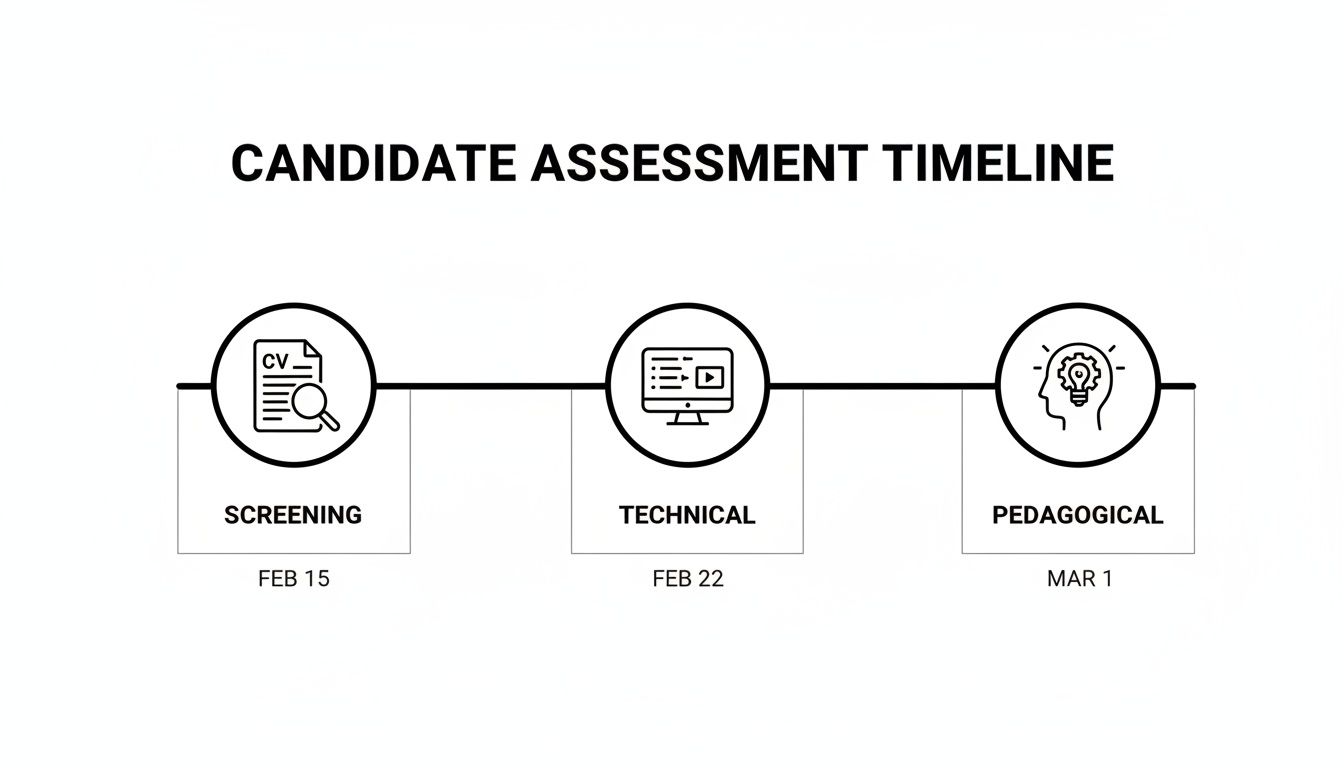
When you’ve assessed candidates on technical, practical, and pedagogical grounds before they even start, they arrive ready to contribute, not just to code.
Here’s a framework for those crucial first 90 days:
First 30 Days: Immersion and Connection
The initial goal isn’t about code commits; it’s about building empathy. Don’t just hand them a login to your analytics platform. Show them the students behind the data points.
- Pair them with a pedagogical expert: Assign a mentor from your curriculum or instructional design team. This isn’t just a coffee chat; it’s a working partnership. Their goal is to understand learning theories and the real, messy realities of the classroom.
- Immerse them in learner feedback: Have them spend significant time reviewing actual student support tickets, watching user testing sessions, or even observing live virtual classes. This direct, unfiltered exposure is absolutely priceless.
Days 31-60: First Wins and KPI Alignment
Now it’s time to connect their skills to tangible business outcomes. The key here is to help them achieve a small, meaningful win that proves their value, both to the company and to themselves.
- Assign a contained initial project: Give them a specific, low-stakes problem to solve. For instance, ask them to analyse a dataset on student engagement in a new feature and present their findings. This builds confidence and gets them comfortable with your data infrastructure without the pressure of a major launch.
- Set clear, outcome-based KPIs: Ditch the vague technical metrics. Instead of “optimise query speed,” frame their goals in terms of student impact. A great KPI would be, “Reduce the time it takes for teachers to identify at-risk students by 15%.” This makes the link between their work and your mission crystal clear.
Days 61-90: Strategic Contribution and Ownership
In the final phase of onboarding, you want to shift the dynamic from instruction to autonomy. Empower them to start thinking proactively about future challenges and opportunities.
A truly effective onboarding experience culminates in the new hire asking not, “What should I work on next?” but “Here’s a problem I’ve found, and here’s how I think we can solve it.”
This transition from a reactive task-doer to a proactive problem-solver is the ultimate sign of a successful integration. It shows they are fully bought in and ready to take ownership.
Retention Strategies Beyond the Pay Cheque
Let’s be clear: competitive compensation is table stakes. You have to pay well. But money is rarely what keeps your best data talent from answering a recruiter’s call. Purpose, growth, and impact are the real glue. Your ultimate retention tool is a culture where data professionals feel a deep, unshakable connection to the educational mission.
Here are a few powerful strategies to build that culture:
- Create a ‘Data for Good’ Innovation Lab: Dedicate real time, maybe one Friday a month for your data team to work on passion projects. Let them explore novel datasets, test new algorithms, or build prototypes to solve educational challenges they personally care about. This fosters creativity and proves your company’s commitment to impact over output.
- Build Visible Career Pathways: Data scientists are ambitious. Don’t let them see a career dead end. You need to create clear, transparent career ladders that show a path toward senior individual contributor roles like Principal Learning Scientist or Head of Educational AI. These titles signal that you value deep technical and domain expertise just as much as people management.
- Showcase Their Impact, Relentlessly: Make sure your data professionals see and feel the results of their work. When an algorithm they built leads to a 10% increase in course completion rates, shout it from the rooftops. Share testimonials from teachers and students whose lives were made better by their analysis. This constant, positive feedback loop is more motivating than any bonus.
By blending this kind of purposeful onboarding with a growth-focused culture, you create an environment where top data talent in EdTech doesn’t just want a job they want to stay and build a career.
Partnering for Success with an RPO
Trying to navigate the complex market for data talent in EdTech on your own is often a losing battle. It’s inefficient, costly, and pulls your internal team away from high-level strategic work. This is where a strategic Recruitment Process Outsourcing (RPO) partner can be a genuine game-changer, going far beyond simple candidate sourcing.
A specialised RPO acts as a true extension of your own team. They don’t just hunt for resumes; they build your entire talent pipeline from the ground up. This means they are actively engaging with niche communities online, building relationships, and creating a sustainable flow of qualified professionals who are genuinely passionate about education.
More Than Just Sourcing
The right RPO partner brings deep market intelligence to the table. They understand the very specific blend of technical and pedagogical skills required for someone to truly succeed in an EdTech role. This insight allows them to conduct initial screenings with a level of nuance your internal team might not have, filtering for candidates who really get the mission.
This kind of partnership lets you scale your hiring efforts rapidly whether you’re launching a new product or expanding into a new region all without the burden of increasing your fixed overheads.
A specialised RPO doesn’t just fill seats. They provide real-time market intelligence on compensation trends, skill availability, and competitor activity, giving you a decisive edge in the war for talent.
Choosing the Right RPO Partner
Be warned: not all RPOs are created equal. When you’re evaluating potential partners, you have to look for proven expertise specifically within the EdTech sector. A generic tech recruiter simply won’t understand the unique demands and culture of your industry.
Here’s a quick checklist to guide your evaluation:
- Proven EdTech Placements: Ask for case studies. Better yet, ask for references from other EdTech companies they’ve worked with.
- Deep Data Role Knowledge: Do they know the difference between a Learning Analytics Specialist and a Personalisation Engineer? Test them.
- Market Intelligence Capabilities: Can they provide hard data on salary benchmarks and talent distribution in key hubs like Bengaluru or Hyderabad?
- Cultural Fit Assessment: What’s their process for screening candidates who aren’t just technically skilled, but are also mission-driven and passionate about education?
Partnering with the right RPO frees your HR team to focus on what they do best: building culture, driving retention, and shaping strategy, all while being secure in the knowledge that your talent pipeline is in expert hands. For CHROs looking to make a significant impact, it’s essential to understand how recruitment process outsourcing can drive data-led hiring.
Frequently Asked Questions
When you’re trying to build a data team in EdTech, you’re bound to run into some tough questions. It’s a competitive space, after all. Based on our experience helping organisations build their dream teams, here are some straight-up answers to the queries that come up most often.
What Is a Competitive Salary for a Data Scientist in EdTech?
This really depends on location and, of course, experience.
If you’re hiring in major tech hubs like Bengaluru or Hyderabad, a mid-level Data Scientist with about 3-5 years under their belt will likely expect a salary somewhere in the ₹18-25 lakhs per annum range. For senior roles, especially for people with niche skills in machine learning or AI that apply directly to education, you could be looking at salaries well over ₹35 lakhs.
But here’s something crucial to remember: the best data talent in EdTech isn’t just chasing a paycheque. They are often incredibly mission-driven. A truly competitive offer needs to go beyond the numbers and highlight how they can make a real impact, grow professionally, and connect their work to improving how people learn.
What Are the Most Critical Skills to Look for?
Yes, technical skills like Python, SQL, and cloud platforms are table stakes. But the one skill that truly separates a good hire from a great one is the ability to turn data insights into actual teaching and learning improvements.
You need to find people who are genuinely curious about how students learn.
The most valuable candidates are the ones asking you about learning objectives and instructional design, not just about your tech stack. This “educational mindset” is what makes someone a game-changer for an EdTech team, not just another technical hire.
Also, really test their ability to explain complex data to people who aren’t data experts, like your curriculum designers or product managers. This is a non-negotiable skill. Without it, insights stay trapped in dashboards and never lead to real change.
How Can We Measure the ROI of Our Data Team?
You have to tie the ROI of your data team directly to student outcomes and business goals. Forget just tracking technical outputs.
Focus on metrics like these:
- Learner-Centric Metrics: Are student engagement levels going up? Are more students completing courses? Are assessment scores improving after a data-driven change is made?
- Business-Focused KPIs: Are you seeing a drop in student churn? Is user retention getting better? Can your teams develop new learning features faster?
When you connect your data team’s work to these core metrics, you’re not just tracking their performance. You’re building a powerful case for why their work is essential and deserves more investment.
Building a world-class data team isn’t just a good idea; it’s a strategic necessity. Taggd focuses on the RPO solutions that help you find, attract, and keep the niche talent that will push your organisation forward. Find out more about our targeted approach at Taggd.