For Chief Human Resources Officers (CHROs) in the semiconductor industry, a critical shift is underway. The real value is no longer just in the silicon itself, but in the software that makes the hardware intelligent. This has completely changed the talent game, making embedded systems expertise crucial for innovation and market leadership.
The New Battleground for Semiconductor Talent
For decades, the semiconductor industry’s talent focus was clear: the architects of the silicon. Success was all about designing smaller, faster, and more powerful chips. The war for talent was fought over hardware engineers, layout designers, and verification specialists.
But the game has changed.
Today, the competitive edge is won by the teams who can bring that silicon to life. It’s all about the complex software that manages a device’s functions, its security, and its smart capabilities. This is the domain of embedded systems. As chips become less like simple components and more like self-contained platforms, the software running on them is what truly sets them apart.
Think of it this way: a state-of-the-art processor is a marvel of engineering, but without the right embedded software, it’s like a supercar with no engine control unit. It has immense potential, but no way to actually use it. The firmware, real-time operating systems (RTOS), and embedded applications are what unlock a chip’s power in everything from electric vehicles to smart home devices.
For CHROs, this is a strategic wake-up call. Building a pipeline for embedded systems engineers is no longer a “nice to have” it’s essential for survival and growth. Your organisation’s ability to attract, develop, and retain this talent will directly determine its capacity to innovate.
The Indian Semiconductor Boom
This global trend is hitting with full force in India, which is quickly shaping up to be a semiconductor powerhouse. The country’s semiconductor consumption is projected to explode from $22 billion in 2019 to $110 billion by 2030, grabbing around 10% of the entire global market.
This expansion is being fuelled by the India Semiconductor Mission (ISM), which has pumped USD 10 billion in subsidies into the ecosystem. This has already attracted INR 1.5 trillion in investments from giants like Micron and Tata Electronics. The result? The demand for embedded systems professionals is absolutely skyrocketing, creating a massive opportunity for talent acquisition teams.
This surge means the competition for skilled embedded engineers in India is about to get fierce. Understanding the nuances of this talent landscape is the first step toward building a winning strategy. To explore recruitment tactics for this market, check out our guide on the latest semiconductor hiring trends. Mastering this new talent domain is the CHRO’s key to ensuring your company leads, not follows, in this new era.
Understanding the Modern Embedded Systems Professional
To win the race for top semiconductor talent, you first need to know exactly who you’re looking for. The boom in embedded systems has created a new kind of professional, someone who lives at the intersection of physical silicon and the software that makes it smart. Forget the dense technical jargon; let’s build a clear picture of who these critical experts are and what they do.
This hierarchy shows just how central embedded systems have become. They are the essential bridge connecting raw silicon to the value your customers experience.
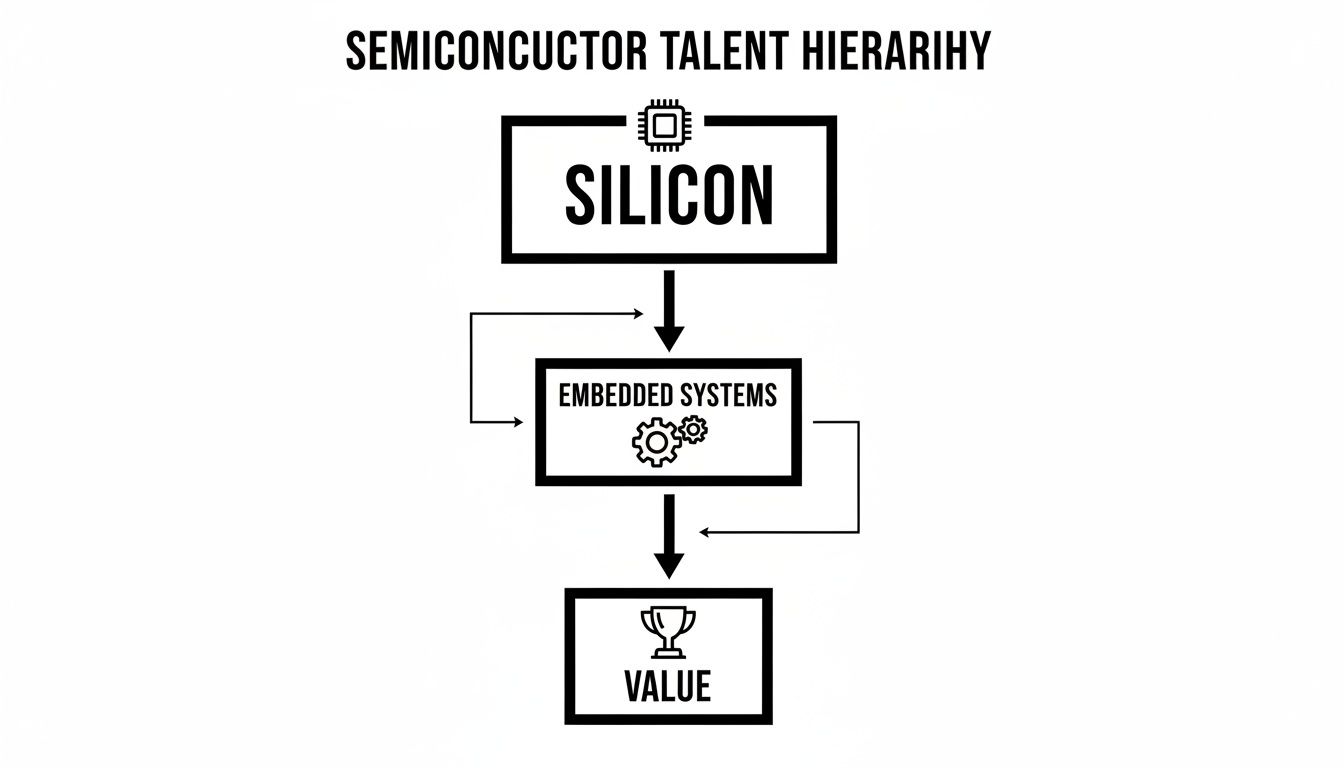
While the chip is the foundation, it’s the intelligence baked in by embedded systems that truly unlocks a product’s power and market potential. Below, we’ll break down the key job families that make this magic happen and the specific skills that separate the good from the great.
Key Embedded Systems Job Families and Core Competencies
Here’s a look at the most critical embedded systems roles in the semiconductor industry today. Understanding their distinct functions and required skills is the first step toward building a world-class team.
| Job Family | Core Function and Analogy | Essential Technical Skills | Business Impact |
|---|---|---|---|
| Firmware Engineer | The Digital Weaver. They write the essential code that brings hardware to life, like installing a building’s electrical grid and plumbing. | C/C++, microcontroller architectures (ARM, RISC-V), low-level protocols (SPI, I2C), hardware debuggers. | Ensures product stability, security, and reliability from the ground up, preventing costly recalls and security flaws. |
| RTOS Specialist | The Real-Time Conductor. They manage how tasks are executed to guarantee that critical actions happen precisely on time, every time. | Real-Time Operating Systems (FreeRTOS, Zephyr), task scheduling, memory management, interrupt handling. | Enables mission-critical products in automotive, aerospace, and medical devices where timing is a safety and functional necessity. |
| Embedded AI/ML Engineer | The On-Chip Intelligence Expert. They embed AI directly onto the silicon, moving machine learning from the cloud to the device itself. | Python, TensorFlow Lite, PyTorch Mobile, model optimisation, quantisation, understanding of hardware constraints. | Creates next-gen “smart” features, enabling faster, more private, and more efficient AI-powered products. |
Each of these roles plays a distinct but interconnected part in delivering a final product. A weakness in one area can compromise the entire system, making it crucial to source and develop talent across all three families.
H3: A Deeper Look at the Core Roles
Let’s dive a little deeper into what makes each of these professionals tick.
The Firmware Engineer: The Digital Weaver
Firmware Engineers are the ones writing the first lines of code that a chip ever runs. They operate at the deepest level of the software stack, creating the fundamental instructions that let hardware communicate with the outside world. Their code is what boots up a device, making their work absolutely foundational.
Flawless firmware directly translates to product stability and security. Their expertise prevents the kinds of hardware bugs and vulnerabilities that lead to expensive product recalls and tarnish a brand’s reputation for years.
The RTOS Specialist: The Real-Time Conductor
Next up are the Real-Time Operating System (RTOS) Specialists. Think of them as the air traffic controllers for the chip. They ensure that high-priority jobs, like deploying an airbag in a car, are never, ever delayed by less critical tasks like updating the infotainment screen.
In sectors like automotive, aerospace, and medical devices, a millisecond’s delay isn’t just an inconvenience—it can have catastrophic consequences. Their value lies in delivering the absolute predictability and reliability these high-stakes industries demand.
An RTOS specialist’s work is invisible when it’s done right, but glaringly obvious when it fails. Their mission is to guarantee the right operations happen at the right moment, without exception.
The Embedded AI/ML Engineer: The On-Chip Intelligence Expert
The newest and fastest-growing role is the Embedded AI/ML Engineer. These are the experts who are taking artificial intelligence out of the cloud and shrinking it down to run directly on a tiny piece of silicon.
This “AI at the Edge” approach is what makes modern devices feel so fast, private, and responsive. Instead of sending your voice command to a distant server, an Embedded AI/ML Engineer optimises a machine learning model to run right on your smartwatch. This is what enables features like instant voice recognition or a drone’s ability to dodge obstacles in real-time.
These engineers are creating immense business value by building the next generation of smart, responsive products. As you look ahead, understanding the top skills in demand for these AI-centric roles is no longer optional; it’s essential for your future product roadmap.
The Market Forces Demanding Embedded Expertise
The urgent hunt for embedded systems talent isn’t just another HR headache; it’s a direct result of massive global market shifts. For CHROs, getting to grips with these forces is the key to understanding why the competition for these professionals has become so fierce. Three major trends are completely changing your talent priorities, drawing a straight line from who you hire to your company’s biggest growth opportunities.
This demand isn’t happening in a vacuum. It’s being driven by technological leaps that place intelligent chips at their very centre. Let’s look at the three main drivers transforming your talent needs and making embedded software skills a non-negotiable asset.
The Automotive Revolution
Today’s cars are rapidly moving beyond being just mechanical machines. They’re becoming sophisticated data centres on wheels, a change powered entirely by semiconductors and the complex embedded software running on them. The modern car is a perfect example of how the rise of embedded systems roles in semiconductor manufacturing has become a business necessity.
Just consider the core components of a new electric vehicle (EV) or a car with Advanced Driver-Assistance Systems (ADAS):
- EV Powertrains: The battery management system (BMS) and motor controllers depend on incredibly detailed firmware to run safely and efficiently, optimising everything from range to performance.
- ADAS and Autonomous Driving: Features we now see regularly, like lane-keeping assist and adaptive cruise control, are all managed by real-time systems that must process sensor data with absolutely zero delay.
- In-Vehicle Infotainment (IVI): That rich, responsive dashboard experience is driven by embedded software integrating navigation, media, and vehicle controls into one seamless interface.
Each one of these systems requires an army of firmware engineers and RTOS specialists. A failure in their code isn’t just a minor bug; it’s a potential safety recall that could cost billions and permanently tarnish a brand’s reputation.
The Explosion of IoT and Smart Devices
The second major force is the incredible growth of the Internet of Things (IoT). From automated factory floors to connected healthcare monitors, billions of new devices are coming online, each powered by a small, intelligent chip. These aren’t just simple processors; they are complete systems that need robust, secure, and power-efficient embedded software to function.
The semiconductor industry is no longer just supplying components; it is delivering the brains for a connected world. Every smart device, whether a simple agricultural sensor or a medical wearable, needs embedded software to collect data, communicate, and act intelligently.
This trend has ignited a fire under the demand for engineers who can build low-power, highly reliable systems. In industrial settings, their work makes predictive maintenance possible, saving factories from costly downtime. In healthcare, it powers devices that monitor patients from afar, improving outcomes and reducing hospital stays.
This blend of hardware and software is also reshaping India’s economic landscape. Projections show India’s semiconductor sector, valued at USD 59.8 billion in 2025, is on track to hit USD 177 billion by 2034. This growth is fuelled by the very trends demanding embedded expertise, AI, 5G, and EVs. You can read more about the forces shaping the Indian semiconductor market and its talent needs.
The Push for AI at the Edge
Finally, the drive to embed Artificial Intelligence directly onto devices—a concept known as “AI at the Edge”—is opening up a new frontier for talent. Instead of sending data to the cloud for processing, edge AI allows products to make smart decisions locally. This makes them faster, more private, and more reliable.
This shift has created the need for a new kind of professional: the Embedded AI/ML Engineer. These experts are tasked with the difficult job of optimising complex AI models to run on chips with limited power and memory.
Think of the real-world applications:
- A smart security camera that identifies a threat on its own, without sending video to a server.
- A factory robot that spots product defects in real-time on the assembly line.
- A consumer device that responds instantly to your voice without needing an internet connection.
This on-device intelligence is a huge competitive differentiator. The semiconductor companies that can provide chips optimised for these jobs will lead the market. To succeed, you have to hire engineers who can bridge the gap between data science and the hard constraints of low-level hardware. These three forces, automotive, IoT, and edge AI, aren’t just passing trends; they are the new reality for the semiconductor industry, making the hunt for embedded expertise a central business priority.
A Strategic Playbook for Winning Embedded Talent

Understanding why you need embedded systems talent is one thing. Actually building a recruitment engine that can attract and keep these specialists is the real challenge. For CHROs, this means moving past conventional hiring tactics and embracing a multi-faceted strategy.
This is your practical guide to doing just that. It’s a playbook built on four pillars, designed to give your organisation a lasting competitive edge in the battle for embedded talent. Success will come down to a deliberate, focused effort to source, grow, and retain these critical experts.
Source Where They Live
Top-tier embedded engineers are not casually scrolling through mainstream job portals. They are passionate problem-solvers, deeply engaged in niche communities where they share their work and learn from peers. To find them, you need to be present in those same spaces.
Throwing generic job descriptions into the void is a surefire way to waste your recruitment budget. Instead, concentrate your sourcing efforts on high-impact channels:
- Open-Source Projects: Platforms like GitHub are more than just code repositories; they are living portfolios. Look for engineers contributing to relevant projects like RTOS kernels (Zephyr, FreeRTOS), embedded Linux distributions, or open-source hardware drivers. Engaging with these contributors shows you value their demonstrable, real-world skills.
- Specialised Forums and Communities: Become a part of the conversation in places like the EEVblog forums, Stack Overflow’s embedded tags, and dedicated subreddits. When your own engineering leaders participate authentically in technical discussions, they become talent magnets.
- University Partnerships: Go beyond the standard career fair. Sponsor final-year student projects, fund research labs with a focus on embedded systems, and design internship programmes that offer genuine, hands-on experience with your company’s hardware.
This targeted approach helps you connect with passive candidates skilled engineers who aren’t actively job hunting but are receptive to a compelling opportunity. This is often where the most valuable talent can be found.
Build Your Own Bench
The external talent pool for seasoned embedded engineers is limited and the competition is fierce. The most sustainable long-term strategy is to cultivate this talent from within. Many of your current hardware engineers already have a strong foundational knowledge that can be built upon.
The most reliable path to filling your talent pipeline is to create it yourself. Investing in structured upskilling is not a cost; it’s a direct investment in your organisation’s future capabilities.
Creating clear, internal career pathways for hardware-focused engineers to transition into high-value embedded software roles is a powerful retention tool. It proves you are invested in your people’s growth. Consider a formal programme that includes:
- Foundational Software Training: Offer in-house or sponsored courses in C++, Python, and data structures.
- Hands-On Hardware Labs: Provide access to development boards and real-world projects that bridge the gap between theory and practical application.
- Mentorship: Pair aspiring embedded engineers with senior experts who can guide their journey and dramatically shorten their learning curve.
This “build” strategy not only cuts down on hiring costs but also boosts employee loyalty and ensures the talent you develop has a deep, intrinsic understanding of your company’s products and architecture.
Redesign for Collaboration
The traditional walls separating hardware and software teams need to be dismantled. The rise of embedded systems roles in semiconductor firms is forcing a new, more integrated approach to work. Siloed teams are a recipe for integration nightmares, project delays, and products that feel disjointed.
As a CHRO, you are perfectly positioned to champion organisational designs that foster deep collaboration right from the start. Agile methodologies, once the exclusive domain of software development, are incredibly effective in this context. By organising small, cross-functional “squads” uniting hardware engineers, firmware developers, and application specialists on a single project you can demolish communication barriers.
When everyone shares ownership of the final product, from the silicon design all the way to the user-facing application, the result is a more cohesive and superior product. This collaborative structure also makes your company a far more attractive workplace for engineers who want to see the bigger picture and make a tangible impact.
Rethink Your Value Proposition
Finally, it’s crucial to understand what truly motivates this unique group of professionals. While a competitive salary is table stakes, it is rarely the deciding factor for a top embedded engineer. This cohort is driven by difficult technical challenges and a culture that respects deep engineering expertise.
Your value proposition must extend beyond compensation. It needs to highlight what makes your organisation a special place to solve complex problems. Emphasise things like:
- The complexity and novelty of the projects they will work on.
- A well-defined technical career ladder that allows engineers to advance as individual contributors, without being forced into a management track.
- A culture that celebrates technical mastery and grants engineers the autonomy to innovate.
By putting this four-pillar playbook into action, you can transform your talent acquisition function from a reactive cost centre into a strategic engine for business growth.
Why a Specialist RPO Is Your Strategic Advantage?
Everyone knows the playbook for winning embedded talent is tough, but it’s the execution that trips up most organisations. Trying to find elite embedded systems professionals with a generalist recruitment approach is almost a guaranteed recipe for failure. This is exactly where a partnership with a specialist Recruitment Process Outsourcing (RPO) provider gives you a serious competitive edge.
This isn’t just about outsourcing your hiring problems to an external vendor. A true specialist RPO works as a seamless extension of your own team. They bring a depth of domain knowledge that your internal HR team, no matter how skilled, would struggle to build at the speed the market demands.
Beyond the Job Board
A specialist RPO’s work starts where standard job boards and LinkedIn searches end. Their real value is their ability to tap into hidden talent networks, the ones filled with passive candidates—those highly skilled, currently employed engineers who are the real prize in this talent war.
These are the people who aren’t actively scrolling through job ads but are open to a compelling opportunity when it’s brought to them by someone who genuinely understands their work. This immediate access to a pre-vetted, high-calibre talent pool is something that can take internal teams years to build. A specialist partner has already put in the time cultivating these relationships.
Think of it this way: your internal team is fishing in a well-known, crowded public lake. A specialist RPO has exclusive access to a private, well-stocked reservoir where the best catches are found.
This targeted approach means you see fewer candidates, but the ones you do see are significantly better. It dramatically cuts down the time your hiring managers waste on unqualified interviews, freeing them up to focus on their core engineering work.
Technical Fluency and Market Intelligence
One of the biggest roadblocks in hiring for embedded systems is the technical screening. Let’s be honest, can your current recruiters confidently tell the difference between a candidate with surface-level C++ knowledge and one with deep experience in RTOS kernel development? A specialist RPO has technical screeners who not only speak the language but can properly vet these critical skills.
They can have credible conversations with top engineers, assess their experience with specific microcontroller architectures, and understand the finer points of low-level driver development. This technical fluency builds instant credibility with top-tier talent and ensures only the most qualified people get to your hiring managers.
What’s more, a specialist partner is a source of invaluable, real-time market intelligence. They provide a constant stream of insights on:
- Compensation Benchmarks: What are your direct competitors actually paying for firmware engineers with five years of experience?
- Candidate Motivations: Are engineers more interested in flexible work arrangements or a dedicated budget for new development tools?
- Competitor Activity: Which companies are ramping up their hiring, and what roles are they targeting most aggressively?
This kind of intelligence helps you fine-tune your offers and Employer Value Proposition (EVP) to be as competitive as possible, helping you win talent battles you might otherwise lose.
Freeing Your Team for Strategic Work
Perhaps the biggest upside of an RPO partnership is the strategic freedom it gives you as a CHRO. By offloading the complex and time-consuming tactical work of sourcing and screening, you empower your internal HR team to focus on what they do best.
Instead of getting bogged down in the daily grind of recruitment, your team can concentrate on higher-value strategic priorities. This could be improving employee retention programmes, strengthening your engineering culture, or developing long-term workforce plans. The right partnership helps your organisation scale hiring efficiently, meet project deadlines, and outmanoeuvre the competition in the fierce market created by the rise of embedded systems roles in semiconductor companies. As you consider this approach, you can learn more about how recruitment process outsourcing can improve hiring results in our detailed guide.
Your Most Pressing Talent Questions, Answered
Even with a solid plan, stepping into the competitive world of embedded systems talent can feel like navigating a minefield. For CHROs, lingering questions can lead to costly missteps. It’s completely normal to have doubts.
Let’s tackle those critical questions head-on. Here’s some direct guidance to clear up any confusion and help you build that winning team.
What Is the Biggest Mistake to Avoid When Hiring Embedded Engineers?
The single biggest mistake we see companies make is treating embedded engineers like any other software developer. They aren’t. Hiring them through a generic software recruitment process is almost guaranteed to fail.
These engineers possess a rare blend of hardware and software expertise. They aren’t motivated by the same things as a typical app developer. Vague job descriptions, posting only on standard job boards, and using interviewers who can’t “talk shop” at a deep technical level just won’t cut it.
This talent is drawn to complex technical puzzles and a real, physical connection to the product. To even have a chance, your hiring process needs to shout about the complexity of your projects and the high calibre of the team they’ll be joining.
How Can We Build a Sustainable Talent Pipeline for These Roles?
You can’t just “buy” a talent pipeline overnight; you have to grow it. Building a sustainable source of embedded engineers is a long-term play, moving your focus from just hunting for talent to actively cultivating it.
First, go deep with universities known for strong electronics and computer science programmes. Think beyond the annual career fair. Get involved by sponsoring final-year projects that solve a real problem your company is facing or by creating meaningful internship opportunities.
Second, turn your senior engineers into talent magnets. Encourage them to be active in open-source communities and technical forums where the best minds gather. When your own experts share what they know, they build incredible credibility for your organisation.
Finally, and this is crucial, invest in a serious internal upskilling programme. You must create clear, formal pathways for people in adjacent roles, like hardware verification or application software engineers—to move into high-value embedded positions. This is the most reliable way to secure your workforce for the future.
We Offer Competitive Salaries But Still Lose Candidates. What Are We Missing?
While a good salary gets you in the game, it’s rarely the deciding factor for top-tier embedded talent. If you’re matching market rates but still losing out, the problem is likely your Employer Value Proposition (EVP).
These engineers crave opportunities to solve novel, difficult problems and see their code have a tangible impact on a physical product. Your EVP must spotlight these elements, moving beyond just pay and benefits.
Are you showcasing your advanced tech stack? The intellectual challenge of your projects? Do you have a clear career ladder that champions deep technical mastery, not just a one-way street to management? A dedicated career track for individual contributors can be a massive draw.
Sometimes, the little things are the tiebreakers: a state-of-the-art lab, a budget for new tools, and a culture that genuinely respects and rewards engineering brilliance. These are the factors that win you the best candidates.
Is It Better to Build an In-House Team or Partner With a Specialist RPO?
For most semiconductor firms in this fiercely competitive market, a specialised RPO partnership delivers the fastest and most significant return. Let’s be frank: building an in-house recruitment team with the necessary technical depth, network, and sourcing tools to hire embedded engineers at scale is incredibly slow and expensive.
A specialist RPO partner gives you instant access to a pre-vetted pool of passive talent and priceless, real-time market intelligence. They bring technical screeners who speak the language and can accurately judge a candidate’s skills, a capability that can take years for an internal team to build.
This isn’t about replacing your HR team; it’s about freeing them up. This move lets your internal experts focus on high-value work like onboarding, culture, and retention. Meanwhile, the RPO partner hits the ground running to accelerate hiring, delivering better candidates faster. The rise of embedded systems roles in semiconductor firms has made this specialised approach more critical than ever.
At Taggd, we specialise in connecting semiconductor companies with the elite embedded systems talent needed to drive innovation. Our expert RPO solutions are designed to accelerate your hiring, reduce costs, and give you a strategic edge in a competitive market. Discover how our expertise can transform your talent acquisition strategy today.