Calculating the return on investment for an enterprise RPO engagement isn’t just about plugging numbers into a formula. It’s about building a credible story. You start by benchmarking your current recruitment costs and performance, then you measure the financial gains and subtract the RPO investment. An accurate enterprise RPO ROI calculation hinges on establishing a crystal-clear ‘before’ state to make the ‘after’ impact believable.
This process is what turns a theoretical benefit into a rock-solid business case for your CFO.
Setting the Stage for an Accurate RPO ROI Analysis

Before you can even think about projecting future gains, you need an honest, unflinching look at your present reality. Too many ROI analyses fall flat right here because they start with assumptions instead of hard data. The goal is to create a detailed, data-backed snapshot of your current talent acquisition function.
This baseline becomes the yardstick against which all RPO performance is measured. Without it, your final ROI figure is just a guess.
This initial phase is more than just number-crunching; it’s about drawing clear lines in the sand. A successful analysis always starts by defining the scope of the potential RPO partnership. Vague goals inevitably lead to vague results.
Defining Your Engagement Scope
Kick things off by asking some pointed questions to nail down which parts of the organisation will be included. Getting this clarity upfront prevents “scope creep” down the line and ensures your calculations are actually relevant.
- Which departments or business units are in scope? Is the RPO partner only handling hiring for the tech and sales teams, or is this a company-wide mandate?
- What job levels are included? Are you looking to outsource executive recruitment, high-volume entry-level roles, or everything in between?
- Are there specific geographies involved? Will the RPO cover hiring in major hubs like Mumbai and Bengaluru, or will it also need to reach into tier-2 cities?
Answering these questions ensures you and your potential RPO provider are on the same page from day one. That alignment is the bedrock of both a successful partnership and an accurate ROI model.
Gathering Critical Baseline Metrics
Once the scope is locked in, it’s time to quantify your current performance within that defined area. This means digging into your existing data to establish concrete benchmarks. Honestly, this is the most crucial part of the entire enterprise RPO ROI calculation.
You’ll want to focus on capturing these core metrics:
- True Cost Per Hire (CPH): Think beyond just agency fees. You need to include the salaries of your internal recruiters, subscriptions to job boards, technology costs (like your ATS), and, critically, the time your hiring managers spend in interviews. For example, if an internal recruiter earning ₹8,00,000 annually fills 40 roles, their salary alone adds ₹20,000 to each CPH.
- Average Time to Fill: Don’t use a single, blended number. Calculate this for different types of roles. Your time to fill for a niche software developer will be worlds apart from a customer service representative. Granularity is key here.
- Quality of Hire: This one can feel a bit fuzzy, but it’s vital. Use tangible metrics like 90-day retention rates, first-year performance review scores, or hiring manager satisfaction surveys. A low retention rate is a massive, often hidden, cost.
Capturing your “before” state is non-negotiable. It’s the difference between presenting a speculative ROI and a credible financial projection. Every piece of data you gather here strengthens the business case you will eventually build.
This meticulous groundwork does more than just feed numbers into a spreadsheet. It gives you a clear, honest assessment of your current recruitment engine’s efficiency and costs, setting a powerful and realistic benchmark for what “better” actually looks like.
Uncovering the Full Spectrum of RPO Investment Costs

To build a credible enterprise RPO ROI calculation, you have to look far beyond the management fee on the provider’s proposal. If you want to create a financial case that will actually stand up to scrutiny from your finance team, you need to account for every single expense—the obvious, the subtle, and the completely hidden.
Focusing only on the headline service fee is a classic mistake. It inflates your final ROI figure and makes the whole projection look unrealistic. A truly comprehensive analysis demands a meticulous, almost forensic, approach to identifying every cost involved in the investment.
These costs generally fall into three buckets: direct, indirect, and one-time implementation expenses. Each category is filled with items that are easy to gloss over but are absolutely essential for an honest calculation.
Mapping Out Your Direct RPO Costs
These are the most straightforward expenses, usually laid out in your RPO provider’s contract. But even here, it’s crucial to dig deeper than the main management fee.
Be sure to clarify these potential direct costs:
- Management or Service Fees: This is the core expense, often structured as a cost-per-hire, a fixed monthly retainer, or a hybrid model. For example, a fee might be 8% of the annual salary for each hire.
- Technology Licensing Fees: Your RPO partner will likely use a specific Applicant Tracking System (ATS) or other recruitment tech. Does your team need licenses to access these platforms? That’s a direct cost to you.
- Sourcing and Advertising Spend: Will you be providing a separate budget for job board postings, LinkedIn sourcing tools, or advertising campaigns? Or are these bundled into the main fee? This needs to be explicitly defined from the outset.
Failing to get clarity on these line items can lead to surprise budget requests mid-contract, creating friction and throwing your ROI tracking into chaos.
Acknowledging the Indirect and Hidden Costs
This is where many ROI calculations fall short. Indirect costs aren’t paid to your RPO provider, but they are very real expenses your organisation incurs to make the partnership work. They’re less obvious but can add up quickly.
Think about the internal resources and time your own team will be dedicating to the project.
To help you get started, here is a detailed checklist of the kinds of costs you should be looking for.
Comprehensive RPO Cost Input Checklist
| Cost Category | Specific Cost Item | Example Calculation/Note |
|---|---|---|
| Direct Costs | RPO Management/Service Fees | E.g., Monthly retainer, cost-per-hire fee (e.g., 8% of salary), or project-based fee. |
| Technology & Tool Licensing | E.g., Seats/licenses for ATS, CRM, sourcing tools paid directly by you. | |
| Sourcing & Advertising Budget | E.g., Separate budget for job boards, social media ads, recruitment marketing campaigns. | |
| Indirect Costs | Internal Team Time (Liaison) | E.g., HRBPs, Hiring Managers’ hours in meetings, providing feedback. (Hours/week * loaded salary). |
| Interviewer Time | E.g., Time spent by non-HR staff in interviews instead of their primary duties. | |
| Administrative Support | E.g., Time spent by EAs and coordinators scheduling interviews and managing logistics. | |
| One-Time Costs | Implementation & Onboarding | E.g., Internal project management time during the initial setup and transition phase. |
| Change Management & Training | E.g., Cost to develop materials + time managers spend in training on new processes. | |
| Legal & Procurement Review | E.g., Billable hours from your legal/procurement teams to review and negotiate the contract. |
This checklist isn’t exhaustive, but it provides a solid framework to ensure you’re not overlooking major cost centres that could skew your final ROI analysis.
A truly accurate RPO ROI calculation is as much about internal cost accounting as it is about evaluating the provider’s invoice. Ignoring the cost of your team’s time presents an incomplete and misleading financial picture.
By meticulously tracking these less-visible expenses, you ensure your enterprise RPO ROI calculation isn’t just optimistic—it’s grounded in financial reality. This detailed approach builds credibility and shows you’ve done your homework. It’s exactly the kind of rigour your CFO and other business leaders expect to see.
Quantifying the Real Returns of RPO

The true value of bringing an RPO partner on board goes far beyond just trimming your recruitment budget. A proper enterprise RPO ROI calculation needs to capture the full spectrum of benefits—from the easy-to-measure cost savings to the more complex, but hugely impactful, strategic advantages. It’s all about painting a complete picture of the value you’re actually getting.
The best place to start is with the tangible, hard-number wins. These are the most direct and easily defensible parts of your ROI analysis, and they often form the core of your business case. They represent immediate, measurable financial improvements that resonate with any leadership team.
Calculating Your Tangible Financial Wins
The first thing you’ll notice with a well-executed RPO partnership is the drop in direct costs. These are the straightforward savings that come from having a more efficient talent acquisition engine.
You should start by putting a number on savings in these key areas:
- Reduced Cost Per Hire (CPH): This is a primary driver of RPO ROI. By consolidating recruitment efforts and building in efficiencies, an RPO partner can dramatically lower the cost to bring on new talent. In India, for example, many mid-sized enterprises have seen CPH reductions of 20% to 40% in the first year alone as they move away from fragmented and expensive agency usage.
- Lowered Agency Fees: Simply tally up what you spent on third-party recruitment agencies over the last 12 months. A huge chunk of this spend is often replaced by the more predictable RPO model, leading to direct, substantial savings.
- Optimised Advertising Spend: RPO providers are experts in sourcing channels. They know which job boards actually deliver results and which ones are just a drain on your budget, eliminating wasteful spending on ineffective platforms.
These tangible savings are your opening argument. They’re clear, easy to calculate, and immediately understandable to financial stakeholders who want to see a direct link between investment and cost reduction.
Assigning Value to Strategic Gains
Beyond the direct cost savings, the real game-changer in your enterprise RPO ROI calculation often lies in putting a price on the “soft” or strategic benefits. These take a bit more effort to monetise, but their financial impact can easily dwarf the hard-cost savings.
One of the most powerful strategic benefits is the impact of hiring speed on business outcomes. A vacant role isn’t just an HR problem; it’s a productivity and revenue problem.
The Cost of Vacancy: Every single day a critical role sits empty, your company is losing potential revenue or productivity. Quantifying this loss turns “Time to Fill” from a simple operational KPI into a powerful financial argument for RPO.
Think about it this way: calculate the daily revenue contribution of a sales role. If a salesperson generates ₹50,00,000 in annual revenue, their daily contribution is roughly ₹13,700. If an RPO partner cuts your Time to Fill by 15 days for just ten of these roles, that translates directly to ₹20,55,000 in recaptured revenue (15 days x 10 roles x ₹13,700).
Monetising Quality of Hire and Scalability
This is where the analysis gets really compelling. A better quality of hire isn’t just a nice-to-have; it has a direct and profound financial impact on your bottom line. An RPO partner’s structured process and expertise often lead to hiring candidates who are a much better long-term fit.
Here’s how you can put a number on that:
- Productivity Gains: We all know top performers are often 50-100% more productive than average ones. If an RPO hire in a key role reaches full productivity one month sooner than your previous average, you’ve just gained a whole month of high-level output. You can monetise this based on their salary or revenue contribution.
- Reduced First-Year Turnover: First, calculate the cost of a bad hire (recruitment costs, training, lost productivity), which can be anywhere from 1.5x to 2x their annual salary. If RPO helps reduce your first-year attrition from 15% to 10% for a group of 50 new hires with an average salary of ₹8,00,000, you are avoiding significant replacement costs.
- Enhanced Scalability: Imagine your business needs to rapidly scale up a new division. An RPO partner can ramp up hiring much faster than an internal team could ever be built. The value here is the revenue you can generate by getting that new team operational months ahead of schedule.
By translating these qualitative improvements into concrete financial figures, you’re presenting a holistic and compelling case. You’re no longer just arguing for a cheaper recruitment process; you’re demonstrating how a strategic partnership builds a more productive, stable, and ultimately more profitable workforce. For a deeper dive, check out our guide on how to track and analyse the ROI of your recruiting efforts.
Putting the RPO ROI Formulas to Work
You’ve done the groundwork, carefully mapping out all your potential costs and benefits. Now it’s time for the exciting part: crunching the numbers. This is where we translate all that data into a compelling financial story that proves the value of bringing on an RPO partner.
The maths itself isn’t complicated, but precision is key. We’ll start with the fundamental formula behind any ROI analysis and then bring it to life with a real-world scenario.
The Main RPO ROI Formula
At its core, the calculation is refreshingly simple. It measures the net financial gain from your RPO engagement as a percentage of your total investment. It’s the standard, universally understood metric for profitability.
ROI (%) = [(Total Financial Benefits – Total RPO Costs) / Total RPO Costs] x 100
This formula delivers a powerful headline number. For example, an ROI of 150% tells a clear story: for every single rupee you invested in the RPO, you got that rupee back plus another ₹1.50 in net benefits.
Worked Example of an RPO ROI Calculation
Let’s move away from theory and walk through a practical example. Imagine a mid-sized Indian tech firm that needs to hire 100 engineers every year. They’ve decided to engage an RPO partner, and based on the types of costs and benefits we’ve discussed, here’s a snapshot of their numbers.
| Metric | Before RPO (Annual) | After RPO (Annual) | Financial Impact (INR) |
|---|---|---|---|
| Total Recruitment Costs | ₹1,20,00,000 | ₹85,00,000 (RPO Fees) | + ₹35,00,000 (Cost Savings) |
| Agency Spend (Eliminated) | ₹25,00,000 | ₹0 | + ₹25,00,000 (Cost Savings) |
| Revenue from Faster Hiring | – | – | + ₹40,00,000 (Value Gain) |
| Reduced Attrition Savings | – | – | + ₹30,00,000 (Value Gain) |
Now, we just need to plug these figures into our ROI formula:
- Total Financial Benefits: ₹35,00,000 + ₹25,00,000 + ₹40,00,000 + ₹30,00,000 = ₹1,30,00,000
- Total RPO Costs: ₹85,00,000
ROI (%) = [(₹1,30,00,000 – ₹85,00,000) / ₹85,00,000] x 100
ROI (%) = [₹45,00,000 / ₹85,00,000] x 100 ≈ 52.9%
Just like that, the tech firm has a solid, defensible ROI of nearly 53% to present to its leadership.
The potential for incredible returns is very real. A case study of another Indian tech firm hiring senior engineers showed how an investment of just ₹11,50,000 generated a recruitment ROI of around 1639% based on the aggregate value of the hires. That means for every rupee spent, the firm realised almost 26.7 times its investment in salary value alone. You can dive into more insights and even explore a recruitment ROI calculator to model your own scenarios.
Going Beyond the ROI Percentage
A strong ROI figure is fantastic, but it might not answer every question a CFO will have. A very common follow-up is, “This looks great, but how quickly will we get our money back?” That’s where the Payback Period comes into play.
Adding the Payback Period calculation creates a much more complete financial picture.
The Payback Period tells you exactly how long it takes for the net benefits of your RPO partnership to completely cover the initial cost. It’s a measure of risk and liquidity that financial leaders pay close attention to.
The formula is straightforward:
Payback Period (in months) = [Total RPO Costs / (Total Financial Benefits / 12)]
Let’s apply this to our tech company example:
- Total RPO Costs: ₹85,00,000
- Monthly Financial Benefits: ₹1,30,00,000 / 12 = ₹10,83,333
Payback Period = ₹85,00,000 / ₹10,83,333 ≈ 7.84 months
This result is huge. It means the company will have entirely paid back its RPO investment in just under eight months. For the rest of the year, and for every year that follows, those financial benefits are pure, positive returns for the business.
When you present both the ROI percentage and the Payback Period, you’re telling a far more robust story. You’re not just showing that the investment is profitable, but also proving it delivers value in a surprisingly short timeframe—satisfying both long-term strategic goals and short-term financial caution.
Building a Business Case That Wins Over Stakeholders
An impressive ROI calculation is a great start, but persuading leadership to actually act on it? That’s another challenge entirely. Your meticulously crafted spreadsheet needs to become a compelling story that resonates with the C-suite. This final step is all about strategic communication—turning your analysis into a catalyst for real organisational change.
The secret is to move beyond the raw data. Your audience isn’t just a faceless group of executives; they are individuals with different priorities and pressures. A one-size-fits-all presentation will almost certainly fall flat. You have to tailor your message to speak directly to the concerns and interests of each key stakeholder.
Speaking the Language of Leadership
When you step into that boardroom, your enterprise RPO ROI calculation must be framed differently for each leader. They all view business decisions through a unique lens.
- For the CFO (Chief Financial Officer): Lead with the hard numbers. Their world revolves around financial prudence, risk management, and profitability. Emphasise the ROI percentage, of course, but immediately follow it with the Payback Period. A short payback period is often more compelling than a high ROI because it signals a quick return of capital and lower financial risk.
- For the CEO (Chief Executive Officer): Focus on the big picture. While the financial case is crucial, the CEO is thinking about strategic advantage. Frame the discussion around how RPO makes the entire organisation more competitive. Highlight benefits like improved talent quality, faster time-to-market for new projects thanks to quicker scaling, and an enhanced employer brand that attracts top-tier talent.
- For the CHRO (Chief Human Resources Officer): Connect the dots back to talent strategy. Talk about how RPO frees up the internal HR team to focus on higher-value initiatives like leadership development, succession planning, and employee engagement. Emphasise improvements in core HR metrics like Quality of Hire and retention, which are central to their goals.
Understanding and addressing these distinct perspectives is non-negotiable. It shows you’ve thought through the broader business implications far beyond just the recruitment function.
Visualising the Path to Value
To make your case even more persuasive, a clear visual of your process can be incredibly powerful. This simple flowchart breaks down the core steps, from collecting the data to calculating the final payback period.
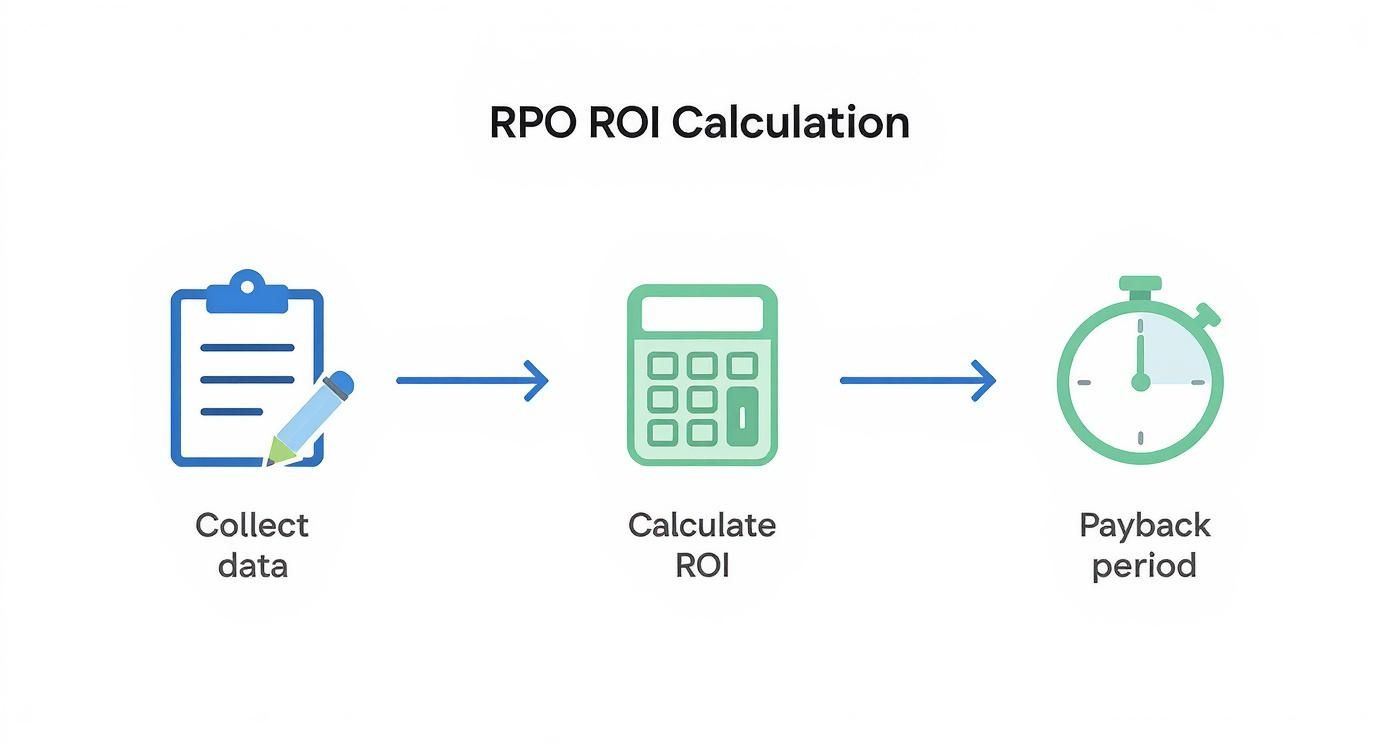
This kind of visual reinforces that your analysis is a structured, logical process, not just a set of assumptions. It builds confidence in your final numbers.
Anticipating Objections and Proving Robustness
Smart stakeholders will always try to poke holes in a proposal. Your job is to get there first. Have data-driven answers ready for their toughest questions. One of the best ways to do this is with a sensitivity analysis.
Don’t just walk in with a single ROI figure. Show how your projection holds up under different conditions. What if hiring volume dips by 10%? What if the time-to-fill improvements are only half of what you projected?
Running these “what-if” scenarios demonstrates that you’ve done your homework. It proves your business case isn’t some fragile, best-case-scenario dream. Instead, it’s a robust financial model that remains positive even if some assumptions don’t fully pan out.
This proactive approach to risk assessment builds immense credibility. It shows you’re not just a cheerleader for the project but a pragmatic business partner who has considered the potential downsides.
The benefits of RPO often become apparent quite quickly. For instance, Indian enterprises frequently see a payback period between 3 to 6 months. For a deeper look at these advantages, you might want to explore the core benefits of Recruitment Process Outsourcing.
By tailoring your message, anticipating objections with solid analysis, and framing the discussion around strategic value, you transform your ROI calculation from a simple report into a powerful tool for driving organisational change.
Getting Answers to Your Toughest RPO ROI Questions
Once you’ve crunched the initial numbers, the real questions start to bubble up. This is where the theoretical analysis meets the practical reality of running the business. Getting solid, confident answers to these common queries is what turns your enterprise RPO ROI calculation from a one-off report into a powerful, strategic tool.
Your stakeholders, especially from finance and operations, will naturally want to know how you’ll manage this ROI over time. They’ll also be keen to understand what “good” actually looks like for a company like ours.
How Often Should We Be Calculating RPO ROI?
Thinking of the ROI calculation as a one-time thing you do just to get the budget signed off is a classic mistake. If you really want to manage the partnership and get the most value out of it, you need a regular rhythm for these reviews. It’s less about proving the initial decision was right and more about optimising performance as you go.
We’ve found a two-tiered approach works best:
Quarterly Strategic Reviews: Think of these as essential check-ins. They give you a frequent pulse check on how you’re tracking against the key metrics you first baselined. This is your chance to make quick course corrections with your RPO partner if, say, time-to-fill for a key department starts to slip.
Annual Deep-Dive Reports: The annual report is the big one. This is where you pull together a full year’s worth of data and do a comprehensive ROI calculation. It’s the perfect moment to look back, reassess your goals, review the strategic impact of the partnership, and set new benchmarks for the coming year.
This cadence means you’re never flying blind. You can proactively steer the partnership towards continuous improvement.
What Is a Good RPO ROI, Anyway?
This is probably the question I hear most often, and the honest-to-goodness answer is: it really depends. There’s no single magic number that screams “success.” A “good” RPO ROI is completely contextual—it changes based on your industry, the complexity of the roles you’re hiring for, and how efficient (or inefficient) your internal team was to begin with.
For example, in India’s fast-moving IT sector, where top talent is scarce and the cost of an empty seat is sky-high, an ROI of 40-60% driven by hiring speed and quality would be phenomenal. But for a manufacturing firm focused on high-volume roles, a steady 25-35% ROI that comes from slashing cost-per-hire and streamlining processes could be a massive victory.
The real trick is to benchmark against your own “before” state and industry norms, not some generic global figure.
A strong RPO ROI isn’t just a big percentage. It’s a number that proves you’re doing significantly better than your old recruitment model and hitting the specific strategic goals you laid out from the start.
How Do You Actually Measure the ROI of Better Candidate Quality?
Now we’re getting to the heart of it. This is the trickiest part of the whole equation, but it’s also the most valuable. Being able to quantify the impact of a “better” hire is what transforms your enterprise RPO ROI calculation from a simple cost-saving exercise into a true strategic business case. You have to draw a clear line from talent quality to tangible financial results.
Here’s a practical way to tackle it:
Track Performance Metrics: Start simple. Tag every new hire from your RPO partner in your HRIS. After six and twelve months, pull their performance review scores and compare them to people hired through your old channels. If the RPO hires consistently score higher, you’ve got a powerful leading indicator of quality.
Analyse Career Progression: Are the hires from your RPO partner getting promoted faster? Are they taking on more responsibility sooner than their peers? Faster progression is a direct sign of higher potential and greater contribution. You can even put a price on this by calculating the value of filling a senior role internally versus the high cost of an external search.
Connect Hires to Business Outcomes: For roles where the metrics are clear, like sales, this is straightforward. Compare the revenue or quota attainment of RPO hires against everyone else. For non-sales roles, try using hiring manager surveys that ask them to rate a new employee’s “speed-to-productivity” on a simple 1-5 scale.
When you systematically track these data points, you can start building a powerful story. Instead of just saying you’re getting “better people,” you can say, “Our RPO hires achieve full productivity 15% faster and are 20% more likely to be rated as top performers in their first year”—and then attach a clear monetary value to that improvement.
Ready to transform your talent acquisition with a data-driven approach? Taggd can help you build a powerful RPO strategy and demonstrate its undeniable value. Discover how we deliver measurable ROI.