At the heart of it, the difference between enterprise RPO and traditional recruitment comes down to scope and partnership. Traditional recruitment is an internal, function-based activity, while enterprise RPO is a full-blown strategic partnership where an external provider takes the reins of your entire talent acquisition lifecycle.
The choice you make hinges on a simple trade-off: do you prioritise direct, hands-on control and deep cultural immersion, or are you chasing scalability, efficiency, and specialised market expertise?
Choosing Your Next Talent Acquisition Model
As a CHRO, deciding between an Enterprise Recruitment Process Outsourcing (RPO) model and a traditional in-house team goes far beyond an operational tweak. It’s a foundational decision that will shape your company’s ability to attract and keep the best people in the market. This guide is designed to go beyond the usual surface-level comparisons, giving you a proper strategic framework for this critical choice.
The real question isn’t which model is inherently better. It’s about which one is the right fit for your organisation’s current growth stage, its long-term goals, and the unique challenges you face in your market. We’ll break down the key trade-offs to help you navigate the cost structures, performance metrics, and real-world scenarios you’re likely to encounter.
Core Differences at a Glance
Let’s start with the fundamentals. While both approaches aim to hire great people, the way they get there—their structure, strategy, and overall business impact—couldn’t be more different. The traditional model gives you that direct control and cultural ownership, whereas Enterprise RPO is built from the ground up for scalability and deep, specialised expertise.
The decision to adopt an RPO model versus maintaining a traditional in-house team reflects a strategic shift from viewing recruitment as a purely internal function to treating it as a dynamic business process that can be optimised through an expert partnership.
This table cuts straight to the chase, highlighting the main differences a CHRO must weigh up in the enterprise RPO vs traditional recruitment debate. Think of it as a quick reference guide to see how each approach aligns with your bigger business objectives.
| Feature | Traditional In-House Recruitment | Enterprise RPO |
|---|---|---|
| Ownership | Fully owned and managed by your internal HR department. | A strategic partnership with an external provider. |
| Scalability | Limited. Scaling up or down means hiring or laying off staff. | Highly flexible; can scale on-demand to meet hiring surges. |
| Cost Structure | Mostly fixed costs (salaries, overheads, tech licenses). | Variable, often based on hiring volume or specific outcomes. |
| Expertise | Generalist recruiters with deep knowledge of your company. | Specialist recruiters with broad market and industry insights. |
Understanding the Two Recruitment Frameworks
To make a smart strategic call between enterprise RPO and traditional recruitment, you first have to get to grips with how each model actually works on the ground. These aren’t just slightly different ways to hire; they’re fundamentally distinct philosophies about where the talent acquisition function should sit within a business.
Traditional recruitment is the classic, do-it-yourself approach. It’s built around an in-house team that owns the entire hiring process, from the initial job posting all the way to the final offer letter. This model gives you maximum control over your brand message and keeps hiring tightly aligned with your company culture, because every recruiter is an employee living and breathing your organisation’s values.
The Traditional Recruitment Model
This model really shines when it comes to institutional knowledge. Your in-house recruiters know the subtle team dynamics, the unwritten rules of the office, and the leadership styles that define your workplace. They are genuine custodians of your brand, and they can communicate your employee value proposition with an authenticity that’s often tough for an outsider to match.
But that level of control comes with its own set of challenges. An in-house team’s capacity is fixed. When a sudden hiring surge hits, it’s difficult to scale up quickly without a long lead time to hire more recruiters. Their expertise is also often quite generalist, putting you at a disadvantage when you’re hunting for highly specialised or niche technical roles in a fiercely competitive market.
The Enterprise RPO Partnership
Enterprise Recruitment Process Outsourcing (RPO), on the other hand, is a true strategic partnership. Here, an external provider takes complete ownership of your entire talent acquisition function. This goes way beyond simple outsourcing; the RPO provider becomes a seamless extension of your company, embedding their people, processes, and tech directly into your day-to-day operations.
Enterprise RPO operates under your brand but brings an external layer of process optimisation, market intelligence, and scalable resources that an in-house team often cannot replicate on its own.
An RPO partner handles everything from sourcing and screening candidates to managing recruitment technology and even onboarding. They bring a huge amount of cross-industry expertise and give you access to vast, often pre-vetted, talent pools. This external viewpoint allows them to introduce best practices and data-driven strategies that can seriously improve your hiring efficiency and outcomes. You can dig deeper into the nuts and bolts of this model in our detailed guide on Recruitment Process Outsourcing.
This is where the core of the enterprise RPO vs traditional recruitment debate really lies. One is a function you build and own completely; the other is a strategic capability you access through a dedicated, expert partnership built for scale and high-level performance. Getting this distinction right is the critical first step toward choosing the right path for your company’s growth.
A Strategic Comparison for CHROs
Choosing between enterprise RPO and a traditional recruitment model isn’t just an operational decision; it’s a strategic one that impacts your entire organisation. As a CHRO, you need to look past the surface-level differences and dissect how each approach aligns with your long-term business goals. This isn’t about finding a universally “better” option, but about identifying the right fit for your company’s unique financial realities, growth ambitions, and operational maturity.
Let’s dive into the core differentiators that truly matter at the executive level.
Cost Structures and Return on Investment
For any CHRO, the conversation often starts with the bottom line. Traditional in-house recruitment is fundamentally a fixed-cost model. You’re paying for recruiter salaries, benefits, overheads, and annual licenses for your Applicant Tracking System (ATS) and other tools. These expenses stay on the books whether you’re hiring ten people or a hundred, which can lead to significant inefficiencies during slower hiring periods.
Enterprise RPO flips this script, introducing a flexible, variable cost structure. The pricing is usually tied directly to hiring outcomes—think cost-per-hire or a management fee that fluctuates with hiring volume. This effectively converts a fixed operational cost into a variable one, ensuring your recruitment spend is always in lockstep with actual business demand. It’s a powerful way to navigate market uncertainty and manage seasonal hiring peaks without carrying dead weight.
This financial agility is a game-changer. RPO services can drive cost savings of up to 30% by completely re-engineering and optimising recruitment workflows. A well-cited Gartner study found that companies using RPO saw 20-25% cost savings over traditional models. In a market where some reports show a staggering 74% talent scarcity for critical roles, these financial and efficiency gains are impossible to ignore.
Scalability and Organisational Flexibility
The ability to ramp your recruitment engine up or down in response to business needs is a massive differentiator. An in-house team is inherently rigid. If a new project demands a sudden hiring surge, you have to go through the lengthy process of hiring more recruiters. And when demand dips, you’re faced with the painful prospect of redundancies.
This is where enterprise RPO truly shines. It’s built for agility. An RPO partner can deploy additional expert resources almost instantly to manage a hiring spike, whether it’s for a new market entry, a major product launch, or a large-scale expansion. This on-demand scalability prevents your core HR team from getting swamped and ensures that your company’s growth is never held back by its recruitment capacity.
For a CHRO, this means RPO provides a “relief valve” for unpredictable hiring needs. It protects the organisation from over-hiring internal recruiters for temporary spikes and prevents burnout within the existing team.
This strategic flexibility is one of the core advantages of having an RPO partner to attract talent, allowing the business to seize market opportunities without getting locked into long-term fixed costs.
Quality of Hire and Time to Fill
At the end of the day, recruitment success boils down to two things: the quality of talent you bring in and how quickly you can get them on board. In-house recruiters have the home-field advantage with deep institutional knowledge, which is fantastic for gauging cultural fit. However, their external networks can be limited, and they often rely on a smaller set of sourcing channels.
RPO providers, on the other hand, bring a specialised arsenal to the table. Their recruiters are often experts in specific domains—like tech, sales, or engineering—and they come armed with vast, pre-vetted talent pools. This specialisation has a direct and measurable impact on the quality of candidates you see.
They also bring process excellence. By optimising every step from sourcing and screening to interview coordination, RPO partners can dramatically cut down the average time-to-fill. In a competitive market where the best candidates are off the table in a matter of days, this speed is a serious competitive advantage.
Technology and Data Analytics Capabilities
The final piece of the puzzle is the technology and data engine driving your recruitment function. An in-house team typically operates with a standard corporate ATS and maybe a LinkedIn Recruiter license. Their access to more advanced analytics or AI-sourcing tools is often constrained by budget limitations and competing internal IT priorities.
Enterprise RPO providers live and breathe this technology; it’s a core component of their value proposition. They make huge investments in a sophisticated tech stack that you get to benefit from. This often includes:
- AI-Powered Sourcing: Tools that proactively scan countless platforms to find passive candidates who aren’t even looking.
- Predictive Analytics: The ability to use data to forecast hiring trends and spot potential bottlenecks before they become problems.
- Candidate Relationship Management (CRM): Systems designed to build and nurture talent pipelines for future hiring needs, not just current openings.
- Advanced Reporting: Custom dashboards providing deep insights into crucial metrics like source effectiveness, diversity hiring goals, and hiring manager satisfaction.
This data-driven approach elevates recruitment from a reactive, administrative function to a proactive, strategic one. It gives CHROs the hard data needed to make informed workforce planning decisions and to clearly demonstrate the business impact of their talent acquisition strategy. This analytical firepower is a defining difference when you put enterprise RPO vs traditional recruitment side-by-side.
To help you visualise these differences, here’s a direct comparison of the two models across key strategic dimensions.
Comparing RPO and Traditional Recruitment Models
This table offers a side-by-side evaluation, helping you weigh the strategic trade-offs between maintaining a conventional in-house team and engaging an enterprise RPO partner.
| Strategic Dimension | Traditional In-House Recruitment | Enterprise RPO |
|---|---|---|
| Cost Structure | Fixed: Salaries, benefits, overheads, software licenses. Costs remain constant regardless of hiring volume. | Variable/Flexible: Often a management fee plus cost-per-hire. Aligns spending directly with hiring demand. |
| Scalability | Low: Slow to scale up (hiring recruiters) or down (redundancies). Inflexible to market shifts. | High: Rapidly scales resources up or down on demand to meet project or seasonal needs without long-term overhead. |
| Quality of Hire | Strong on cultural fit and internal knowledge. Limited by internal network and sourcing channels. | Access to wider, specialised talent pools and expert sourcers. Often improves candidate quality for niche roles. |
| Time to Fill | Dependent on internal team capacity and existing processes. Can be slow and inconsistent. | Faster: Streamlined processes, dedicated resources, and technology reduce hiring cycle times significantly. |
| Technology Access | Limited to corporate-approved tools (e.g., standard ATS, LinkedIn). Access to advanced tech can be difficult to justify. | Advanced: Access to a sophisticated tech stack, including AI sourcing, CRM, and predictive analytics, is part of the service. |
| Data & Analytics | Basic reporting from ATS. Lacks deep, predictive insights for strategic workforce planning. | Comprehensive: Provides detailed analytics on KPIs, diversity metrics, and process efficiency to inform strategy. |
| Strategic Focus | Internal team is often consumed by tactical, day-to-day hiring tasks. | Frees up the internal HR team to focus on strategic initiatives like talent management, succession planning, and culture. |
Ultimately, the choice depends entirely on your organisation’s strategic priorities. If you have stable, predictable hiring needs and a strong internal team, the traditional model can work well. However, for organisations facing rapid growth, market volatility, or the need for specialised talent at scale, the agility and expertise of an enterprise RPO partner often provide a decisive strategic advantage.
How Each Model Measures Success
To get a real sense of any talent acquisition model, you have to look at how it measures success.When you compare enterprise RPO and traditional recruitment, how each one defines and tracks success tells you everything you need to know about their strategic alignment. One is about ticking off tasks; the other is about delivering business outcomes.
An in-house recruitment team usually runs on internal Key Performance Indicators (KPIs). Think metrics like time-to-fill and cost-per-hire. These are useful, for sure. They give you a decent snapshot of how efficiently the recruitment machine is operating day-to-day.
But these KPIs often live in a vacuum. They track the activity of recruitment but don’t always connect the dots to wider business goals. A low time-to-fill is great, but does it guarantee that the new hire will be a top performer in six months? Not necessarily.
Governance Through Service Level Agreements
This is where enterprise RPO plays a different game. The entire partnership is built on a much more rigorous and legally binding framework: Service Level Agreements (SLAs). These aren’t just internal targets; they are negotiated contracts that hold the RPO provider accountable for delivering specific, measurable results.
This completely shifts the dynamic from just tracking activity to being accountable for real results. Instead of simply measuring how fast a role was filled, SLAs link recruitment performance to tangible business goals.
Common metrics you’ll find baked into RPO SLAs include:
- Quality of Hire: Often tracked through first-year performance review scores or retention rates of new employees.
- Hiring Manager Satisfaction: Regular surveys to measure the quality of service, candidates presented, and the overall smoothness of the process.
- Diversity and Inclusion Goals: Hitting specific targets for sourcing and hiring talent from underrepresented communities.
- Candidate Experience Scores: Metrics that monitor how candidates feel about the recruitment journey, which has a direct impact on your employer brand.
An SLA elevates the recruitment function from a cost centre focused on filling seats to a strategic partner held accountable for delivering talent that drives measurable business value. For any CHRO looking to boost HR’s strategic impact, this is a crucial difference.
The Strategic Impact of Performance Metrics
The way you measure performance directly shapes your strategic outcomes. In traditional models, the push for speed can sometimes lead to compromises on quality. For example, in the tech world, the average time-to-hire can drag on for 40 to 60 days. That’s a lifetime when you consider that top candidates are often snapped up in just 10 days.
An RPO partner, bound by SLAs, is incentivised to optimise the whole process for both speed and quality. It’s why RPO providers often manage to slash hiring time by 45% to 55%. We’ve seen this in action: one major bank’s RPO partnership cut its time-to-hire by 45% while also increasing offer acceptance rates by 20%, simply by delivering a better candidate experience. You can dig into more of these efficiency gains in recent industry analyses of recruitment process outsourcing.
At the end of the day, the traditional model’s KPIs answer the question, “Did we fill the job?” The RPO model’s SLAs are designed to answer a far more important question: “Did we hire the right person who will help the business succeed?” This framework of accountability ensures every recruitment effort is directly and measurably tied to the strategic goals of the company.
Making the Right Choice for Your Business
Choosing the right recruitment model isn’t about finding a one-size-fits-all answer. The whole enterprise RPO vs traditional recruitment debate is less about which is fundamentally better and more about which is the right strategic tool for your company, right now. Different business challenges demand different solutions.
Take a traditional in-house team, for instance. This model often shines in organisations with stable, predictable hiring needs. If your company’s employer brand is a powerhouse—truly unique and difficult for any outsider to fully grasp—keeping recruitment in-house ensures every candidate interaction is genuinely steeped in your culture.
This approach is also the clear winner in highly regulated or specialised industries where deep institutional knowledge isn’t just a “nice-to-have,” but an absolute must for successful hiring.
When to Choose Traditional In-House Recruitment
An in-house model gives you unparalleled control and brand guardianship, but it’s most effective under specific conditions. Stick with this path if your organisation looks like this:
- Stable and Predictable Hiring: You hire a consistent number of people each year without wild swings, making a fixed-cost internal team a very efficient choice.
- Unique Employer Brand: Your company culture is your number one recruitment asset, and you need recruiters who live and breathe it every day to convey that message authentically.
- Deep Institutional Knowledge Required: Successful hires hinge on understanding complex internal dynamics, historical context, or proprietary technical knowledge that can’t be outsourced.
When Enterprise RPO Becomes a Strategic Imperative
On the flip side, Enterprise RPO is built to thrive where traditional models often stumble, especially in fast-paced environments defined by change and scale. It’s designed to bring the agility and specialised expertise that internal teams can take years to develop.
RPO becomes the obvious choice for scenarios like aggressive global expansion, where navigating a maze of different labour laws and talent markets is mission-critical. It’s also perfect for massive hiring drives—like staffing a new tech hub or building out a sales force—where speed and access to vast talent pools are everything.
During a major business transformation that requires a complete overhaul of your talent acquisition process, an RPO partner is more than a recruiter; they are a catalyst for change. They bring proven frameworks and technology to fast-track your evolution from a tactical hiring desk to a strategic talent function.
This decision tree gives you a clearer picture of how your immediate business needs point toward the best framework for success.
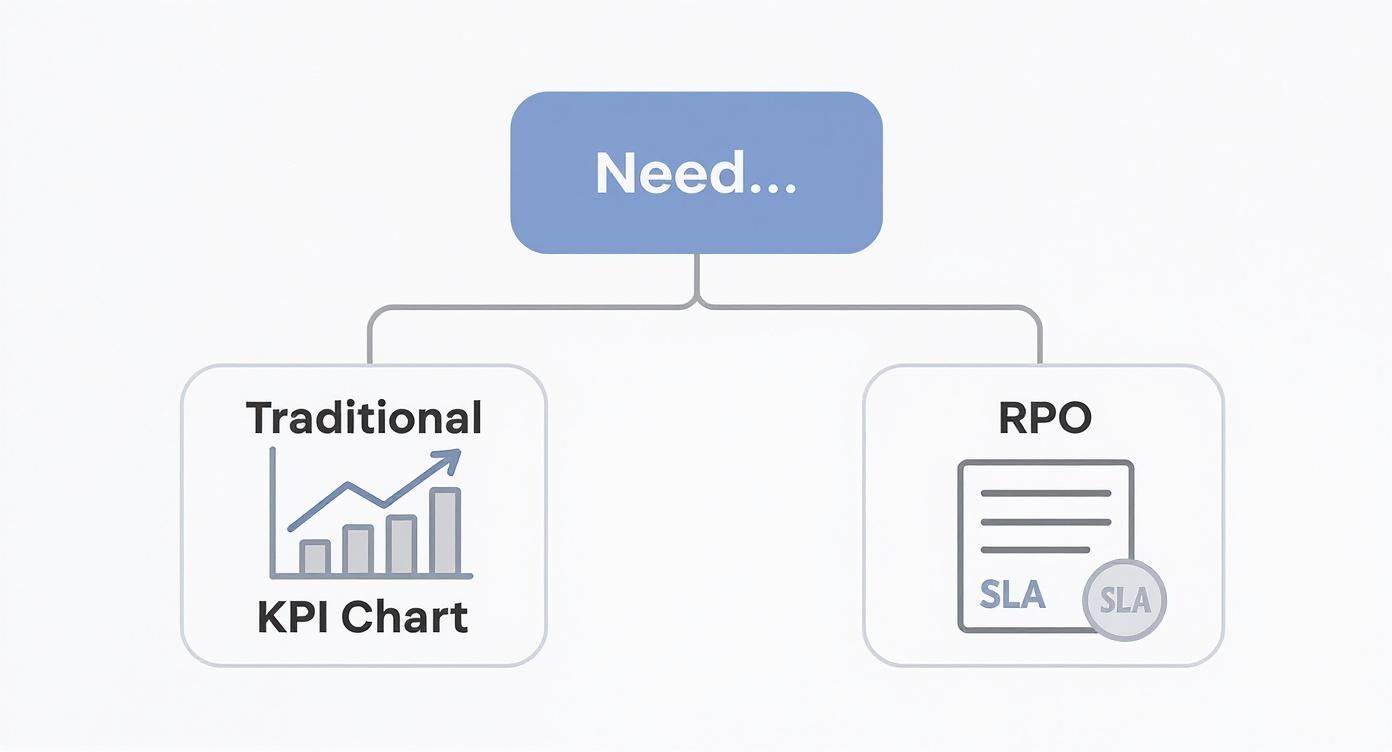
As the infographic shows, if you’re focused on tracking internal process metrics, traditional KPIs will do the job. But if what you really need are guaranteed business outcomes and strategic alignment, the SLA-driven model of RPO is a much better fit.
Leveraging RPO for Strategic Business Goals
An RPO partnership goes far beyond just filling open roles; it can be a powerful lever for hitting broader business targets. A prime example is making real, measurable progress on diversity and inclusion. RPO providers use sophisticated data analytics and targeted sourcing to tap into underrepresented talent pools, helping you build a more diverse workforce you can actually track. To get a better sense of how this works compared to other models, check out the key differences between an RPO and a staffing agency.
The market is certainly catching on. It’s projected that by 2025, 60% of companies with high-volume hiring needs will be using RPO solutions. That’s a huge leap from 45% in 2023, driven by a tough talent market and the pressure to control operational costs. Just look at the real-world impact: one prominent SaaS startup doubled its entire engineering team in only nine months by working with an RPO partner—a feat that would have completely overwhelmed its small internal HR team. It’s a perfect illustration of the scalability RPO brings to the table.
In the end, it all comes down to your strategic priorities. Are you trying to maintain a stable, culturally-embedded process, or are you trying to build a flexible, scalable talent engine that can power rapid growth? Answering that question will make the right path for your organisation crystal clear.
Aligning Your Choice with Strategic Goals
The conversation around enterprise RPO versus traditional recruitment isn’t really about picking a winner. It’s about finding the right fit. The best model is the one that directly props up your organisation’s strategic direction, financial situation, and long-term talent goals. Think of it as a calculated decision, one that tunes your recruitment engine to your company’s core business objectives.
For many companies, the traditional in-house model is still a powerhouse. It gives you unparalleled control over your employer brand and ensures every single recruiter lives and breathes your company culture. This makes it a fantastic choice for stable businesses focused on protecting a unique identity or those with consistent, predictable hiring needs where a fixed-cost structure just makes sense.
Making a Strategic Final Decision
But what happens when your strategy involves rapid growth, market disruption, or a fierce war for specialised talent? That’s where the equation flips. Enterprise RPO brings the agility, deep market knowledge, and process excellence you need to navigate these choppy waters. It effectively turns recruitment from a fixed overhead into a scalable, on-demand capability.
This strategic flexibility is a game-changer. An RPO framework lets you handle sudden hiring surges without piling on permanent staff, access sophisticated tech without the hefty capital outlay, and drive critical initiatives like diversity hiring with data-backed precision.
The right choice isn’t set in stone; it’s a dynamic decision that should evolve as your company does. As your business grows and its needs change, the best recruitment model might shift from in-house to RPO, or even a hybrid approach.
Ultimately, your decision should boil down to one central question: which model best empowers us to hit our most critical business goals over the next three to five years?
- For Cultural Preservation and Stability: The deep integration and brand guardianship of a traditional in-house team is tough to beat. It excels at maintaining consistency and reinforcing a strong, established culture.
- For Growth, Agility, and Specialisation: The scalable resources, specialised recruiters, and advanced technology of an Enterprise RPO partnership offer a clear competitive edge. It’s a model built to power expansion and master complexity.
Choosing your path is a strategic move. You need to select the model that not only fills today’s open roles but also builds the workforce your organisation needs to win tomorrow. Remember, this choice can and should adapt as your business evolves. Your talent acquisition function has to be as agile as the market you operate in.
Frequently Asked Questions
When you’re weighing up enterprise RPO against traditional recruitment, it’s natural for some big questions around control, cost, and complexity to come up. Let’s tackle the most common ones head-on to give you the clarity needed for your strategic decision.
Will We Lose Control Over Our Employer Brand with RPO?
This is a big one, and a completely valid concern. But a genuine Enterprise RPO partnership isn’t about handing over your brand; it’s about amplifying it. Think of the RPO provider as a custodian of your employer brand. They operate as a seamless extension of your company, using your branding, your voice, and your Employee Value Proposition (EVP) in every single candidate interaction.
They immerse themselves in your culture to truly get what makes your organisation tick. The secret lies in setting up strong governance and crystal-clear brand guidelines right from the start. This ensures the RPO team not only represents your company authentically but also brings their market expertise to expand your brand’s influence.
How Are RPO Engagement Costs Typically Structured?
This is where RPO really differs from the fixed overhead of an in-house team. RPO pricing is built to be flexible and tied directly to business results. The usual models you’ll see are:
Management Fee: A predictable monthly fee that covers the core management of the recruitment function, often blended with other models.
Cost-Per-Hire: A straightforward fee paid only when a role is successfully filled, linking your spend directly to hiring outcomes.
Hybrid Models: A mix of a management fee and performance-based costs, which gives you both stability and outcome-driven incentives.
This variable cost structure means your recruitment expenses can flex up or down with your actual hiring needs—a massive advantage over the fixed salaries and overhead of a traditional setup.
The core idea behind RPO pricing is a fundamental shift: you move from paying for recruitment activity to investing in recruitment outcomes. This alignment of financial incentives is what links your RPO partner directly to your strategic business goals.
What Does the Transition to an Enterprise RPO Model Involve?
Switching to an Enterprise RPO solution isn’t like flipping a switch; it’s a carefully managed project. It all kicks off with a deep discovery phase. Here, the RPO provider dives into your current processes, technology stack, and pain points.
ext comes the detailed design and implementation stage. New workflows are mapped, technology is integrated, and Service Level Agreements (SLAs) are locked in. A robust change management plan is absolutely crucial here to get your internal HR team and hiring managers on board and ready for a new, more collaborative way of working.
Can RPO Be Effective for Highly Specialised or Executive Roles?
Absolutely. While RPO is well-known for handling high-volume hiring, many providers have highly specialised arms for niche and leadership roles. For those tough-to-fill technical or executive positions, a good RPO partner brings in dedicated sourcing experts with deep networks in specific industries.
They come armed with advanced sourcing tech and market intelligence that an in-house team might not have access to. This targeted approach often leads to a higher calibre of candidates and a faster time-to-fill for critical roles, pushing back on the old idea that only traditional head-hunters can deliver at this level.
Ready to build a scalable, strategic talent acquisition function that aligns with your business goals? Taggd delivers expert Recruitment Process Outsourcing solutions designed for growth. Discover how we can transform your hiring process.