As a CHRO, you know that building scalable tech teams on a shoestring budget isn’t about just hiring smarter anymore. It’s about a complete strategic pivot. You have to move beyond traditional recruitment and embrace a multi-pronged approach that focuses on internal upskilling, diversified sourcing outside the usual tech hubs, and smart, cost-effective hiring models like Recruitment Process Outsourcing (RPO). This is how you beat the competition for those hard-to-find niche skills.
Navigating the 2026 Tech Talent Crunch
Here we are in 2026, and as a Chief Human Resources Officer, you’re right in the thick of it. The demand for specialised tech talent in hot areas like AI, cloud, and cybersecurity is absolutely surging. The problem? Your budget is under more scrutiny than ever. It’s clear that the old ways of recruiting just aren’t cutting it, they’re too slow and far too expensive for this new reality.
This leaves you with a tricky paradox. While you might be seeing a general downturn in overall tech hiring, the battle for niche, future-focused skills has become unbelievably fierce. Getting your head around this dynamic is the first real step toward building a tech workforce that’s not just cost-effective, but also resilient. This isn’t some temporary market blip; it’s a structural talent shortage, and it calls for a completely new playbook.
The Market Paradox Explained
The market right now is a mess of conflicting signals. On one side, you have a clear slowdown in the IT services sector, which has always been a massive engine for employment. But on the other, Global Capability Centres (GCCs) are expanding like crazy, hoovering up a huge slice of the high-end talent pie.
This creates a hyper-competitive landscape where finding the right skills is a real struggle, even if the total number of open roles has dropped from the peaks of a few years ago. For you as a CHRO, this means a few things:
- Intense competition for specialised roles: The talent war has shifted. It’s no longer about finding generalist engineers; it’s fought over specific, critical competencies.
- Rising salary expectations for niche skills: Even with tight budgets, the market is dictating premium pay for experts in AI, machine learning, and advanced cloud architecture.
- A need for smarter sourcing: You simply can’t rely on the same old talent pools anymore. It’s a dead-end strategy for building a team that can scale.
The core challenge for leaders today isn’t just about filling seats. It’s about acquiring specific, often scarce, capabilities without blowing your budget. Success now depends on shifting from reactive hiring to proactive talent cultivation.
A Structural Crisis in Talent Supply
The numbers really bring this structural crisis to life. In India’s hyper-competitive tech scene of 2026, a staggering 82% of employers are wrestling with a severe talent shortage, a figure that’s well above the global average of 72%. The issue is especially sharp for organisations like yours trying to build tech teams, where AI skills have become the single most difficult expertise to find. For CHROs at enterprises like those served by Taggd, this reality forces a complete rethink of how to scale on a budget. This is happening in a market where overall tech hiring has already slumped 24% year-on-year at the start of 2026. Active job openings have plummeted to levels 60% below the 2022 peak of over 260,000, which just goes to show the stark contrast between general hiring and the fierce fight for specialists. You can explore more data on the talent shortage and its impact in this ManpowerGroup report.
This situation means savvy leaders have to get strategic and adopt a more multifaceted approach. Just waiting for the perfect candidate to show up is a losing game. The focus has to shift from merely consuming talent to actively creating it. This involves a smart blend of upskilling your current workforce, building robust pipelines through university partnerships, and exploring new hiring models that give you both flexibility and top-tier quality. To get a better handle on the bigger picture, you might want to read our analysis of the top hiring trends for 2026.
Developing a Budget-Conscious Talent Blueprint
When you’re trying to build a scalable tech team on a tight budget, the old way of just chasing headcount targets won’t cut it. What you need is a sophisticated talent blueprint, a strategic document that maps the exact skills your organisation needs to grow, all while staying grounded in your financial reality.
Think of this plan as your best defence against the reactive, and often incredibly expensive, hiring decisions that can cripple a budget. Instead of immediately launching an external search for every new role, a solid blueprint forces you to look inward first. It’s about creating a detailed inventory of the skills you already have on your team and pinpointing where the critical gaps are. This is the only way to make smart, cost-effective hiring choices that directly fuel your long-term goals.
We’re currently in a strange situation that makes this even more critical: a hiring slump is happening at the same time as a severe skills shortage, all while Global Capability Centres (GCCs) are expanding at a breakneck pace.
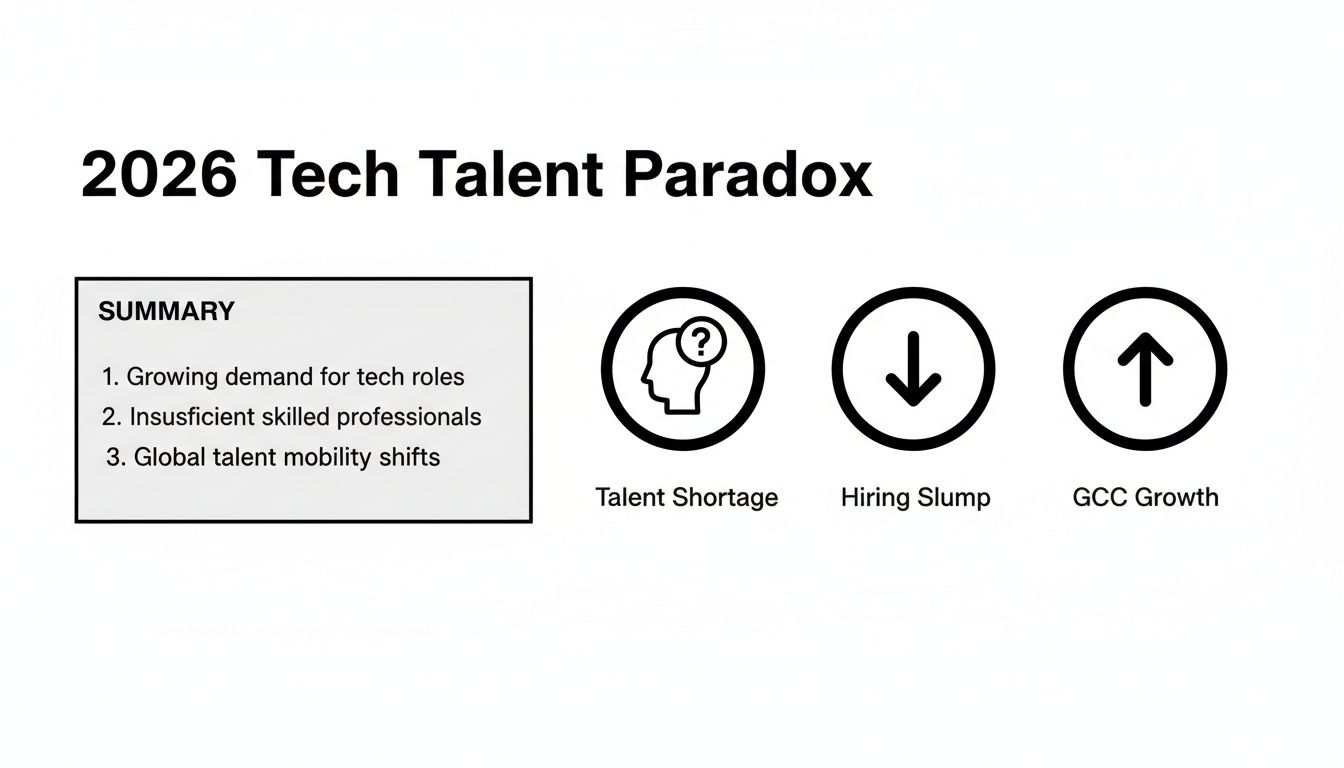
The takeaway is clear. While the overall hiring market has cooled down, the battle for specialised talent, especially within GCCs, is fiercer than ever. This just hammers home the need for a precise and strategic approach.
Conducting a Comprehensive Skills Audit
Your first move is to run a comprehensive skills audit. This isn’t just about listing job titles. It’s a deep dive into the actual capabilities of your current team. You’d be surprised what you might uncover, a software developer who’s passionate about cybersecurity on the side, or a project manager who has quietly completed several data science courses in their own time.
To find these hidden gems, you need to use a mix of methods:
- Self-assessment surveys: Ask employees to detail their primary skills, secondary talents, and what areas they’re interested in for future development.
- Manager evaluations: Partner with team leads to validate the skills your employees list and identify high-potential individuals who are ready for a new challenge.
- Project-based assessments: Look back at past project contributions. Who stepped up and showed skills that went far beyond their official job description?
This audit gives you the foundational data for your talent blueprint, painting a clear picture of your internal strengths and weaknesses.
Mapping Future Skills to Business Goals
Once you have a handle on your current capabilities, it’s time to map out the skills you’ll need to hit your future business targets. Are you planning to launch a new product powered by generative AI? Expanding your cloud infrastructure? Or maybe you’re focused on strengthening your data privacy framework?
Each of these strategic goals has very specific talent implications, and the data makes the challenge incredibly stark. India’s tech sector is staring down a staggering 90% shortage in GenAI-ready talent by 2026. This comes on top of a 55-60% deficit in cloud-native skills and a 25-30% gap in mid-senior cybersecurity roles.
With tech job openings still 60% below their 2022 peak, the pressure is on. For CHROs, this data is a wake-up call to shift away from expensive poaching wars and toward building smart, cost-efficient talent pipelines.
Your talent blueprint should work like a strategic investment portfolio. It must balance short-term needs with long-term capability building, prioritising the roles that will create the most significant business value.
Let’s say your five-year plan involves a major AI integration. Your blueprint shouldn’t just say “hire AI experts.” It should detail a multi-year strategy. This might involve hiring one senior AI architect now, while simultaneously launching an internal upskilling programme to develop five junior AI engineers from your existing talent pool.
This approach dramatically reduces your reliance on an incredibly scarce and expensive external market. By linking every single hiring and training decision back to a specific business outcome, you ensure your talent budget is always spent effectively, building the capabilities you need to win.
For more ideas, you can explore our guide on how to reduce your cost-per-hire with strategic planning.
Building a Diversified Talent Sourcing Engine

If you’re still relying mostly on job boards to find tech talent, you’re not just fishing in an overcrowded pond, you’re probably overpaying for every single catch. To build a tech team that can scale without breaking the bank, you need a sourcing engine that’s both diversified and smart about costs.
It’s about moving beyond the obvious channels and creating a steady, continuous flow of qualified candidates. I’ve seen firsthand how a powerful, multi-channel sourcing strategy gives you a massive advantage. It helps you sidestep the fierce bidding wars that now define hiring in major cities.
Tap Into Emerging Tech Hubs
The talent map of India is being redrawn right now. While the big metro cities are still key, a massive pool of skilled tech professionals is popping up in tier-2 and tier-3 cities like Pune, Jaipur, and Coimbatore.
These locations offer a seriously compelling value proposition: a growing bench of qualified talent, but without the premium salary demands you see in Bengaluru or Hyderabad. For any CHRO, this is a golden opportunity to build out scalable teams on a much lower cost base.
Setting up smaller satellite offices or, even better, embracing a remote-first policy for these regions can unlock access to talent that is both highly skilled and more affordable. The real trick is to act decisively and establish your presence before these places become just as competitive as the major metros.
This kind of geographic diversification isn’t just a “nice-to-have” anymore; it’s critical. Recent reports project a staggering 20% year-on-year increase in India’s tech vacancies for AI, cloud, and cybersecurity roles by 2026. This boom, along with talent shortages hitting 82%, is forcing leaders to get creative. Even with some dips in overall tech hiring, the pressure for specialised skills remains intense, thanks in part to Global Capability Centres (GCCs), which saw a 13% rise in openings to 17,000. You can explore more findings on this trend in the Wheebox India Skills Report.
Build a Robust Campus Hiring Pipeline
Your future high-performers are sitting in university classrooms today. Establishing a strong campus hiring programme is one of the single most effective long-term strategies for building a cost-effective talent pipeline. But this has to be more than just showing up at a career fair once a year with a branded banner.
A truly effective campus strategy means forging deep, strategic partnerships with top universities and engineering colleges. Here are some real, actionable steps to take:
- Sponsor hackathons and coding competitions: This lets you spot top-tier talent in a live, competitive environment where their skills are on full display.
- Collaborate on curriculum: Work directly with academic departments to help shape courses that align with your future skill needs, especially in fast-moving areas like AI and data science.
- Offer engaging internship programmes: A well-structured internship is your best recruitment tool, period. Think of it as a prolonged interview where you can properly assess skills, cultural fit, and work ethic.
By investing in these relationships, you build your employer brand directly with the next generation of tech talent. This creates a warm pipeline of candidates who are already familiar with and excited about your organisation.
Don’t just see campus hiring as a way to fill junior roles. Treat it as a direct investment in your future leadership. The interns you hire today could very well be your tech leads and architects in five to seven years.
Energise Your Employee Referral Programme
Your own employees are one of your most powerful and most underutilised sourcing channels. They get your culture, they understand your technical challenges, and they know what it takes to succeed in your organisation.
A high-impact referral programme can deliver top-quality candidates at a fraction of the cost of external agencies or headhunters.
To really make it work, it needs to be more than just a small cash bonus. Make the incentive meaningful and, just as importantly, celebrate successful referrals publicly. Keep the process dead simple and transparent, allowing employees to easily track the status of the candidates they referred.
This creates a virtuous cycle. Great employees tend to know other great people, and a successful referral strengthens the connection that both the new hire and the existing employee feel toward the company. It’s an incredibly powerful way to build tech teams that are culturally aligned from day one.
Optimising Recruitment with RPO and Technology

To really build tech teams without blowing your budget, efficiency has to be your north star. Smart sourcing and solid talent blueprints get you on the right track, but you’ll burn through resources and lose top candidates if your recruitment engine isn’t optimised. This is where Recruitment Process Outsourcing (RPO) and the right technology become a game-changer.
For many CHROs, the word “outsourcing” brings up fears of losing control or diluting the company brand. But a modern RPO partnership isn’t about just handing off tasks; it’s about strategic reinforcement. Think of it as embedding a specialist team within your own, one that comes armed with advanced tools and a deep talent network, all laser-focused on your specific goals.
An AI-powered RPO partner gives you instant access to a huge, pre-vetted database of talent that’s ready to hire. This alone dramatically slashes the time-consuming sourcing phase. Instead of starting from scratch with every new role, you tap into a warm pipeline, which is a key driver in shrinking your time-to-hire.
Choosing the Right RPO Model
Let’s be clear: not all RPO solutions are created equal. Picking the right model comes down entirely to your organisation’s immediate needs and long-term strategy. Understanding the different ways you can engage is critical for making a smart, cost-effective decision.
Here are the most common models you’ll come across:
- Project-Based RPO: This is perfect for specific, time-bound hiring drives. For example, if you need to staff a new tech hub with 50 cloud engineers in six months, a project-based engagement delivers the focused firepower you need to hit that target without a long-term commitment.
- On-Demand RPO: This model offers incredible flexibility for businesses with fluctuating hiring demands. You essentially get a dedicated recruiter or a small team on a monthly or quarterly basis to support your internal team during hiring peaks. It’s a way to scale your recruitment capacity up or down as business dictates.
- Fully Managed RPO: In this all-in model, the RPO provider manages your entire recruitment function from end to end. This is a deep strategic partnership that goes way beyond just filling roles, it involves process optimisation, tech stack management, and even employer branding. It’s the best fit for organisations chasing significant cost savings and efficiency gains across the board.
A great RPO partnership should feel like a seamless extension of your own team. They bring the specialised tools, data, and market intelligence, freeing up your internal HR pros to focus on high-value strategic work like talent development and retention.
Building Your Essential Recruitment Tech Stack
Technology is the engine that powers any modern, efficient recruitment function. Even if you have an RPO partner, understanding the core pieces of a recruitment tech stack helps you see where automation can deliver the biggest wins. The goal isn’t to replace human connection but to automate the repetitive, administrative tasks that bog recruiters down.
Applicant Tracking Systems (ATS) are the absolute backbone of any hiring process. A good ATS does much more than just store résumés; it automates communication, helps schedule interviews, and gives you real-time analytics on your entire hiring funnel. It ensures no candidate falls through the cracks and provides a single source of truth for all recruitment activity.
Beyond an ATS, AI-powered sourcing tools are quickly becoming non-negotiable. These platforms can scan millions of profiles across countless sources to identify passive candidates who perfectly match your criteria often uncovering talent your team would never have found on its own. This proactive approach is fundamental to building scalable tech teams on a budget because it shifts you from a reactive to a predictive hiring model.
By combining a smart RPO partnership with the right technology, you create a powerful system that drives down your cost-per-acquisition and massively accelerates your hiring speed. As you explore these options, think about how a digital RPO provider can bring together the human expertise and technological power needed for high-impact hiring. That fusion is what enables sustainable growth without the usual spike in recruitment spending.
Making Talent Retention Your Ultimate Budget Strategy
The cheapest, fastest, and most impactful hire you’ll ever make is the talented employee you already have. While optimising your sourcing and recruitment is important, forgetting about retention is like meticulously filling a bucket riddled with holes.
To build tech teams on a budget that actually lasts, you need to shift your focus inward. This isn’t just a nice-to-have HR initiative, it’s the most powerful budget strategy you’ve got.
Investing in your existing team members obviously slashes your direct recruitment costs. But the real financial win comes from continuity. When you keep a skilled employee, you hold onto their priceless institutional knowledge, maintain team productivity, and skip the significant ramp-up time a new hire always needs. In a cut-throat market, retention is your best defence against budget overruns and talent poaching.
Cultivating Internal Talent Through Upskilling
Your first move should be to treat your current workforce as your primary talent pool. With critical skill gaps in areas like GenAI and cloud engineering, looking outside is often a slow and expensive process. A smart upskilling programme turns this challenge into a huge opportunity.
Start by identifying adjacent skills within your teams. A backend developer might have the foundational logic to pivot into data engineering, or a QA analyst could show a real knack for cybersecurity. Giving them a clear, structured path to get these new skills is a direct investment in your organisation’s future.
You can make this happen through a few practical methods:
- Subsidised Certifications: Fund certifications in high-demand areas like AWS, Azure, or advanced data science. The cost of a course is just a fraction of a new hire’s salary.
- Internal Learning Hubs: Build a central repository of curated learning materials, from video courses to technical whitepapers, and make it accessible to everyone.
- Project-Based Learning: Get high-potential employees to shadow or contribute to projects that use the skills you need to build. Real-world application cements learning in a way theory never can.
Building from within sends a powerful message to your entire team: we invest in our people. This fosters a culture of loyalty and continuous learning, making your company a place where ambitious professionals want to build a career, not just hold down a job.
Designing Clear Career Paths and Mobility
A salary is what keeps an employee at a job. A clear future is what keeps them at a company. One of the top reasons tech professionals walk out the door is a perceived lack of growth opportunities. To fight this, you have to design and communicate clear, compelling career paths.
This goes way beyond a simple promotion ladder. It’s about creating a career lattice showing employees how they can move laterally into different roles, not just vertically. For instance, a senior developer might have no interest in becoming a manager but could be a perfect fit for a tech architect role.
A strong internal mobility programme is the engine that makes this happen. Make internal job openings highly visible and actively encourage your people to apply. When someone moves to a new team, it creates a positive chain reaction, opening up their old role for another internal candidate to step into. This dynamic movement keeps your talent engaged and motivated.
It’s no surprise that companies excelling at internal mobility retain employees for an average of 5.4 years, nearly double the tenure at companies that struggle with it.
Fostering Mentorship and Modern Performance Management
To spot and nurture your high-potential talent, you need the right support structures in place. Formal mentorship programmes are incredibly effective here. Pairing junior engineers with senior leads fast-tracks skill development, transfers critical institutional knowledge, and strengthens team bonds. The mentor gains leadership experience, and the mentee gets priceless guidance.
This should be paired with a modern performance management system that focuses on continuous feedback and development, not just dreaded annual reviews. Regular, informal check-ins allow managers to understand an employee’s career goals, identify skill gaps in real-time, and provide the coaching they need to grow.
By making talent retention and internal growth the cornerstone of your strategy, you create a self-sustaining talent ecosystem. This dramatically cuts your reliance on the expensive external market and builds a more resilient, motivated, and scalable tech team from the inside out.
FAQs
Even with a rock-solid strategy, trying to build a top-tier tech team without breaking the bank brings up some tough questions. As a CHRO, you’re the one in the hot seat, expected to have answers that perfectly balance cost, speed, and quality.
Let’s tackle some of the most common hurdles you’ll face in those high-stakes leadership meetings. Having clear, confident responses ready is how you get the buy-in you need for your talent strategy.
How Can I Justify an RPO Partnership on a Tight Budget?
This is a classic CFO question, and the trick is to shift the conversation from cost to investment. An RPO partner isn’t just an expense; they’re an efficiency engine. The best way to make your case is to show a clear return on that investment, proving you can achieve more with the resources you already have.
You need to build a business case that puts the real, often hidden, costs of your current hiring process side-by-side with the predictable, and usually lower, costs of an RPO.
Dig into these numbers:
- Direct Costs: Add up what you’re spending on job board ads, external agency fees, and recruitment marketing right now.
- Indirect Costs: This is the big one. Calculate the hours your internal team burns on sourcing, screening, and admin. That’s precious time they could be investing in high-impact work like employee retention and culture-building.
- Opportunity Costs: What’s the price of a critical role sitting empty for months? Factor in the delayed projects and lost market share. That number gets big, fast.
An RPO partnership isn’t about outsourcing a function; it’s about insourcing expertise and efficiency. It frees up your HR team to focus on strategic work that delivers its own significant long-term financial returns, like career pathing and leadership development.
What Is the Best First Step for Building a Talent Pipeline from Scratch?
The thought of building a huge talent pipeline from zero is overwhelming, so don’t even try. Start small and get hyper-focused.
Instead of trying to boil the ocean, pick just one or two critical, high-volume tech roles that are always a nightmare to fill. Put all your initial energy right there.
Start by meticulously mapping the talent market for just those roles. Where are these people now? Which companies employ them? What universities or coding bootcamps are producing this talent? And where do they hang out online are they on GitHub, Stack Overflow, or specific tech forums?
Once you know where they are, your goal is to build relationships, not to hire immediately. Use your employer brand to create targeted, valuable content. Host a webinar with one of your tech leads discussing a complex problem they solved. The aim is to create a “talent community” a warm pool of engaged candidates you can instantly tap when a position opens up. This will slash your future sourcing time and costs.
Should We Hire Junior Talent to Train or Experienced Professionals?
There’s no single right answer here. The smartest move is to think like an investor and build a balanced “portfolio” of talent. The right choice depends entirely on the role, the maturity of the talent market for that skill, and your organisation’s immediate needs.
For bleeding-edge skills like generative AI, experienced talent is both incredibly rare and eye-wateringly expensive. In this case, building a pipeline of junior talent is the only sustainable long-term play. The key is to pair them with a robust internal mentorship programme to get them up to speed quickly.
On the flip side, for more established but equally vital roles like cloud infrastructure or cybersecurity, hiring seasoned pros is often more cost-effective. They can hit the ground running, deliver immediate value, and even mentor others, strengthening the entire team.
Look at each role’s urgency and the external market dynamics. A strong RPO partner can even help you model the projected costs, timelines, and long-term ROI for both scenarios. This allows you to make a data-driven decision that aligns perfectly with your budget.
Ready to build your scalable tech team with unmatched efficiency and expertise? Taggd leverages AI and deep market intelligence to connect you with top-tier talent faster, helping you meet your growth targets without compromising your budget. Discover how our RPO solutions can transform your hiring strategy by visiting us.