HR analytics in hiring is all about swapping gut feelings for hard evidence. It’s the move away from instinct-based recruiting towards a smarter, data-driven function. We start focusing on solid metrics like time-to-fill, cost-per-hire, and the all-important quality-of-hire to make decisions that are not just faster, but also far more predictable.
The Urgent Case for Analytics in Modern Hiring
The CHRO’s job has fundamentally changed. It’s no longer enough to just fill open roles. Today, it’s about delivering real strategic value and building a workforce that actively pushes the business forward. In a market this competitive, relying on old habits or gut feelings is a surefire way to get left behind.
This is exactly why HR analytics has become a core business function, not just some passing tech trend.
Adopting a data-driven approach shifts your talent acquisition team from being reactive order-takers to becoming predictive business partners. Instead of just scrambling to fill roles as they open, you can start anticipating workforce needs, zeroing in on high-potential candidate pools, and fixing bottlenecks in your hiring funnel before they become major roadblocks.
From Instinct to Insight
The move from old-school recruiting to an analytics-powered engine is a massive shift in both mindset and results. It’s the difference between guessing which sourcing channel is working and knowing with certainty where your best performers are coming from. This pivot has a direct impact on the bottom line by optimising every rupee spent on recruitment and dramatically improving the quality of talent walking through your doors.
Let’s look at how this plays out in the real world. A practical way to see this shift is to compare the old, instinct-based methods with a modern, data-informed approach.
From Traditional Recruiting to an Analytics-Driven Engine
| Recruitment Function | The Old Way (Instinct-Based) | The New Way (Data-Informed) |
|---|---|---|
| Sourcing Strategy | “We’ve always had luck with this job board.” | “Data shows our top engineers come from niche community X and employee referrals.” |
| Candidate Screening | Relies on keyword matching and gut feeling about a CV. | Uses predictive analytics to score candidates based on proven success factors. |
| Interview Process | Unstructured interviews with inconsistent questions. | Structured interviews where data identifies which questions best predict on-the-job success. |
| Offer Management | Makes offers based on past salary or a general market rate. | Uses real-time compensation data to make competitive offers that reduce turndowns. |
| Success Measurement | Focuses on speed and cost (time-to-fill, cost-per-hire). | Measures long-term impact (quality-of-hire, new hire performance, retention rates). |
This table shows it’s not just about using new tools; it’s a complete change in philosophy. You move from making assumptions to making decisions backed by evidence, which has a ripple effect across the entire organisation.
Just look at the job market right now. India’s hiring landscape is seeing a major move towards strategic expansion. A recent report showed that hiring activity shot up by 15 percent year-on-year in December 2025. This signals a renewed confidence as businesses shift from playing defence to smart, strategic workforce planning. In an environment this hot, data is your most powerful asset.
The Strategic Advantage of Data
Using analytics lets you answer mission-critical business questions with cold, hard evidence. For instance, you can finally analyse your recruitment funnel to see the exact stage where diverse candidates are dropping out, or which interviewer is consistently causing the longest delays. This turns vague goals like “improve diversity” into concrete, actionable plans.
By measuring the impact of different recruitment strategies, HR leaders can finally quantify their value in a language the C-suite understands: efficiency, cost savings, and improved business performance.
This data-backed approach isn’t just about hitting HR targets; it’s about connecting every hiring activity directly to tangible business outcomes.
When you can walk into a boardroom and demonstrate how cutting down the time-to-fill for a sales role led to a measurable increase in quarterly revenue, you cement HR’s position as a strategic driver of the business. You can learn more by checking out our detailed guide on the fundamentals of analytics in hiring.
Ultimately, embracing HR analytics for hiring is no longer an option, it’s absolutely essential for building a competitive, future-ready workforce.
Building Your Foundational HR Analytics Blueprint
Diving into HR analytics for hiring without a solid plan is a recipe for disaster. It’s like building a house without a blueprint—you’ll end up with something, but it won’t be stable, functional, or what you actually wanted. A strong foundation starts by ditching vague goals like “hire better” and setting sharp, business-focused objectives.
You have to think in terms of direct business impact. Forget “improving quality-of-hire.” Your goal should be “improving new-hire performance scores by 15% in their first year.” Don’t just “hire faster”; aim to “reduce time-to-fill for senior engineering roles by 25%.” These concrete targets give your analytics work a clear purpose and make its success easy to measure.
This infographic shows the typical journey organisations take as they bring data into their hiring.
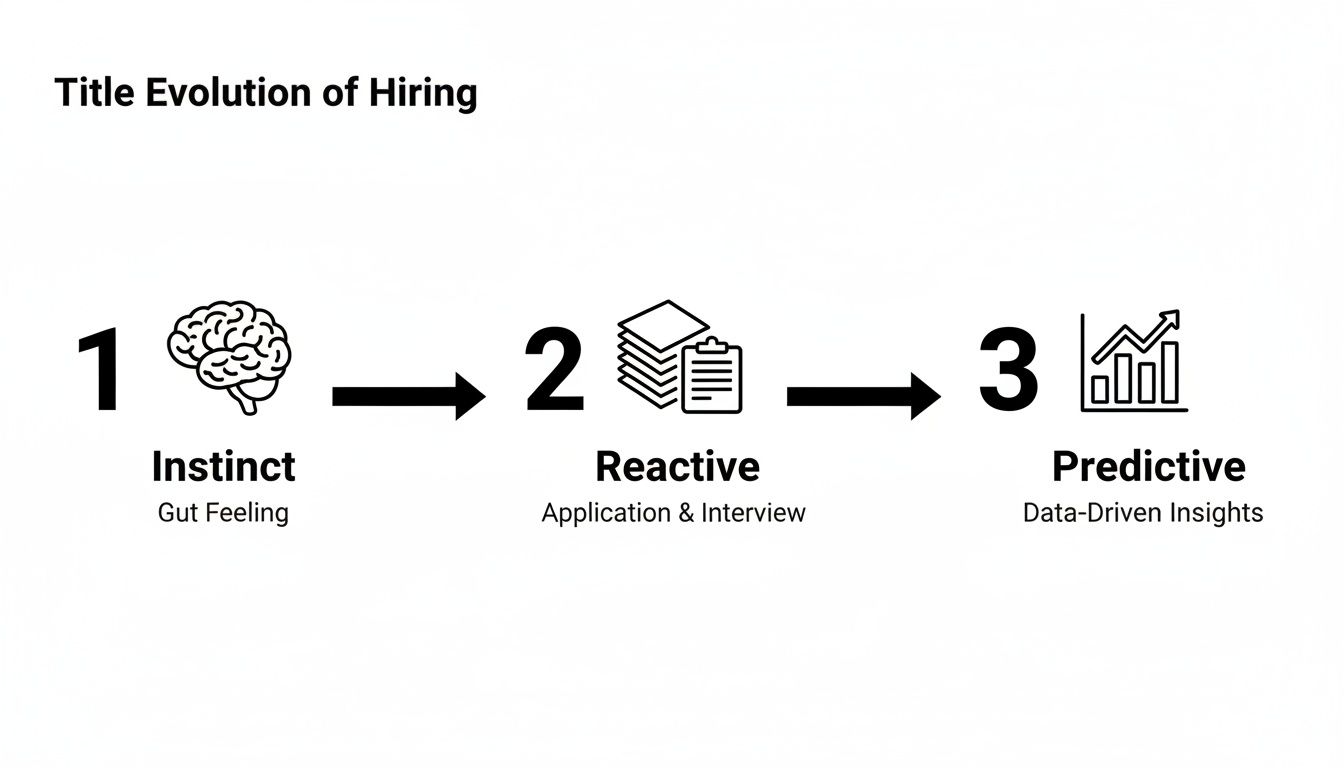
The real takeaway here is the move away from gut instinct towards using data for predictive insights. That’s the end game for any robust HR analytics strategy.
Conducting Your Data Readiness Audit
Once you know your goals, it’s time for a realistic data audit. You need to know what you’re working with. This means taking an honest look at the information you have and where it lives—whether it’s tucked away in your Applicant Tracking System (ATS), HR Information System (HRIS), or scattered across a dozen different spreadsheets.
To get a true picture of your data readiness, ask yourself these tough questions:
- Accessibility: How easily can we actually get data from our systems? Is it locked behind vendor walls, or can we pull it through APIs?
- Consistency: Are our data fields uniform? Is “source of hire” recorded consistently, or is it a mess of free-text entries?
- Completeness: What are the major gaps in our data? Do we have historical performance data for new hires that we can tie back to how they were recruited?
- Accuracy: Can we even trust our data? A quick audit might show that a huge chunk of your candidate records are incomplete or out of date.
This audit isn’t about finding perfect data. It’s about figuring out your starting point so you can decide what to fix first. Most organisations find their data is a complete mess, and that’s perfectly normal.
The goal is not to have flawless data from day one, but to identify the most critical data points needed to answer your top-priority business questions. Starting small and focused is the key to building momentum.
For instance, the growing battle for experienced professionals makes clean data absolutely critical. India’s overall hiring intent for 2026 is projected at 11 percent, with a huge spike in demand for mid-career talent. Hiring intent for candidates with 6-10 years of experience is expected to hit 28 percent, which shows exactly where the market is headed. To even compete for this talent pool, you need clean data on your sourcing channels and candidate history. You can dig deeper into these employment trends in a recent report from The Economic Times.
Establishing Your Initial Governance Framework
Data governance sounds like a corporate buzzword, but at this stage, it’s just about setting a few simple rules to make sure the insights you produce are trustworthy. Without some basic governance, you risk making big decisions on bad information, which will kill your leadership’s confidence in the whole project.
Start with these simple, foundational governance steps:
- Define Key Metrics: Create a “data dictionary” that spells out exactly what your most important metrics mean. Everyone needs to agree on how “time-to-fill” or “quality-of-hire” is actually calculated.
- Assign Data Ownership: Give someone clear ownership for each critical data set. Your TA lead might own the ATS data, while an HR business partner owns the performance review data in the HRIS.
- Establish Data Entry Standards: Put simple, non-negotiable rules in place for data entry. This can be as basic as using a standardised dropdown menu for “sourcing channel” instead of letting people type whatever they want.
These first steps create a solid base. They ensure that as your HR analytics function grows, it’s built on a foundation of reliable and consistent data you can actually trust.
With your strategic blueprint in hand, it’s time to roll up your sleeves and build the engine that will power your HR analytics hiring function. This is where you connect the dots between your data, the tools you use, and the expertise on your team.
Most CHROs get stuck on the classic “build vs. buy” question, but honestly, that’s not always the right way to frame it. It’s less about the specific software and more about its strategic fit. An effective tech choice comes down to three things: can it scale as you grow, can it talk to your other systems, and will your hiring teams actually use it? A fancy, sophisticated platform is useless if your recruiters find it too clunky for their day-to-day work.
Taming Your Disparate Data Sources
One of the biggest headaches right out of the gate is trying to unify all your scattered data. Your Applicant Tracking System (ATS) is sitting on a goldmine of candidate pipeline info, your HR Information System (HRIS) has all the employee performance data, and who knows what valuable insights are buried in spreadsheets on some recruiter’s desktop. The goal here is to create a single source of truth.
Don’t panic, this doesn’t mean you have to rip and replace every system. Modern analytics platforms are built to connect to different data sources using APIs (Application Programming Interfaces). This lets you pull information from your ATS and HRIS into one central analytics hub without getting bogged down in a painful, multi-year data migration project.
The real magic of HR analytics happens when you can finally connect pre-hire data (like sourcing channels and assessment scores) to post-hire outcomes (like first-year performance and retention). This connection is what transforms recruiting from a cost centre into a strategic value driver.
Once these systems are talking to each other, you can start answering the really interesting questions. For instance, you can finally prove whether candidates from a specific job board not only get hired faster but also stay longer and perform better. For those just starting out, exploring different workforce analytics software can open your eyes to what’s possible.
The RPO Partnership Advantage
For a lot of organisations, especially those wanting to get up to speed quickly, partnering with a Recruitment Process Outsourcing (RPO) provider is a total game-changer. This isn’t just about buying software. A good RPO partner like Taggd brings a pre-built analytics platform and a team of experts who live and breathe hiring data every single day.
This kind of partnership lets you leapfrog several stages of maturity. Instead of spending months building your own models from scratch, you get immediate access to proven analytics and a treasure trove of broader market data. Your RPO partner can benchmark your performance against industry standards, giving you context that’s impossible to get when you’re only looking at your own internal numbers.
Just look at what a modern, data-driven hiring partner’s dashboard can do.
This kind of integrated platform pulls all your key hiring metrics into one place, giving you a crystal-clear view of the recruitment funnel and its performance in real time.
Demystifying Analytics Models with Real-World Examples
“Analytics” can sound like a scary, academic term, but it really just breaks down into practical tools that solve everyday hiring problems. Let’s look at two core types of analytics and how they actually work in recruitment.
1. Descriptive Analytics: What Happened? This is the starting point for any analytics journey. It’s all about looking back at your historical data to figure out what worked and what didn’t.
- Real-World Scenario: Your team is spending a fortune across multiple job boards, but you have a nagging feeling you’re not getting your money’s worth.
- Analytics in Action: A descriptive dashboard shows that while Job Board A brings in the most applications, a whopping 70% of your actual hires came from Job Board B and employee referrals. Armed with that insight, you can shift your budget to where it delivers a real return.
2. Predictive Analytics: What’s Going to Happen? This is where things get really interesting. You start using data to forecast future trends, moving from a reactive stance to a proactive one.
- Real-World Scenario: Your company is launching a new product line in six months and needs to hire 50 new sales reps to support it.
- Analytics in Action: A predictive model crunches your historical hiring data, current market conditions, and talent availability. The model forecasts that it will take 90 days to fill these roles with your current process. This gives you a critical three-month head start to build your talent pipeline, preventing costly hiring delays right before launch.
By putting together the right mix of technology and expertise, you’re not just buying software, you’re building a powerful engine for data-driven hiring. Whether you build your stack in-house or fast-track your journey with an RPO partner, the goal is always the same: turn data into smart insights that lead to better, faster, and more strategic hiring decisions.
Turning Data Into High-Impact Decisions
All the data in the world means nothing if it just sits there. The real value of HR analytics in hiring doesn’t come from a fancy new system; it comes from translating those numbers into smart, decisive actions that solve real business problems and fuel growth. Raw data is noise. Actionable insight is power.
This is where the art of the dashboard truly comes to life. A single, generic dashboard is a recipe for failure. The high-level strategic insights your CEO needs are worlds away from the granular, real-time metrics your Talent Acquisition (TA) lead uses to manage the hiring pipeline.
Crafting Dashboards for the Right Audience
To make your data truly actionable, you have to tailor the story to the audience. Every stakeholder has different priorities, and they need to see the information that helps them make better decisions in their specific role. This customisation is what separates a pretty chart from a powerful decision-making tool.
Think about these distinct dashboard views:
- For the CEO and CHRO: This is the 30,000-foot strategic overview. It should focus purely on high-level business impact. Think quality-of-hire directly linked to business unit performance, overall recruitment ROI, and progress against strategic workforce goals like diversity and inclusion targets.
- For the TA Lead: This dashboard is all about operational health. It needs to show the entire recruitment funnel in real-time. Key metrics here are things like time-to-fill by department, cost-per-hire against the budget, and the velocity of candidates moving through the pipeline.
- For Individual Recruiters: This view is about personal performance and efficiency. It should track metrics like the number of candidates advanced through each stage, interview-to-offer ratios, and individual offer acceptance rates to help them fine-tune their own process.
When you deliver the right data to the right person, you empower them to act. The TA lead can instantly spot a bottleneck in the screening stage, while the CEO can see the direct link between hiring top sales talent and a spike in quarterly revenue.
To make this practical, you need to decide which metrics will actually answer the questions your business leaders are asking.
Essential Metrics for Your Recruitment Dashboard
This table breaks down some of the most critical metrics, what they really measure, and the strategic questions they help you answer.
| Metric | What It Measures | The Strategic Question It Answers |
|---|---|---|
| Time-to-Fill | The total number of days from when a job is opened until an offer is accepted. | Are our hiring processes efficient enough to compete for top talent in the market? |
| Quality-of-Hire | The value a new hire brings, often measured by performance ratings or retention after one year. | Are we hiring people who are actually driving business results and staying with the company? |
| Cost-per-Hire | The total cost of recruitment (advertising, tech, salaries) divided by the number of hires. | Is our talent acquisition function operating in a financially responsible and sustainable way? |
| Source-of-Hire | The channel that delivered the successful candidate (e.g., referrals, job boards, direct sourcing). | Where should we invest our recruitment budget to get the best ROI and find the highest-quality candidates? |
| Offer Acceptance Rate | The percentage of candidates who accept a formal job offer. | Is our compensation, culture, and candidate experience compelling enough to win the talent we want? |
Building a dashboard around these core metrics gives every stakeholder a clear, relevant view of recruitment performance, transforming data from a simple report into a strategic conversation starter.
The Power of Data Storytelling
Numbers on their own are forgettable. To make your findings stick and drive real change, you have to wrap them in a compelling narrative. Data storytelling is the crucial skill of communicating insights in a way that’s memorable, persuasive, and connects with people on a human level.
Instead of just stating that your screening process is now faster, show what it means. Use a simple graph that illustrates a 10-day reduction in screening time and place it right next to a chart showing a 15% increase in offer acceptance rates for critical tech roles. This simple story—”we moved faster, so we won more top candidates”—is far more powerful than a dry statistic.
Data becomes a story when it connects a problem to a solution with a measurable outcome. A good data story doesn’t just present facts; it answers the crucial “so what?” question for the business.
This narrative approach is what elevates HR from a support function to a true strategic partner. It transforms you from someone who reports on numbers to someone who explains what those numbers mean for the company’s bottom line. For those looking to master this, understanding the nuances of predictive talent analytics is a brilliant place to start.
A Real-World Scenario in Action
Let’s imagine a CHRO at a growing fintech company. Her strategic dashboard flags a worrying trend: offer acceptance rates for senior developers have cratered, dropping by 20% over the last quarter. Losing these candidates is directly stalling product development timelines and putting revenue at risk.
Drilling down, she uses a diagnostic dashboard to find the bottleneck. The data clearly shows that while the time-to-interview is excellent, the time from the final interview to the offer letter going out is averaging 12 business days, far above the industry standard of five.
The data story is simple and undeniable: “Our slow offer process is costing us the best talent.” Armed with this hard evidence, she works with finance and line managers to streamline the internal compensation approval process.
The result? The offer stage is slashed to just three days. The very next quarter, the offer acceptance rate for senior developers rebounds, and key product milestones are met ahead of schedule. That is the true power of turning HR analytics into high-impact decisions.
Embedding a Data-First Hiring Culture
So, you’ve invested in sophisticated analytics tools. That’s the easy part. The real work—the part that actually determines success or failure, is making a fundamental cultural shift. You need to move your entire organisation from one that occasionally glances at data to one that instinctively relies on it for every hiring decision.
This isn’t just about training your talent acquisition (TA) team. It’s a full-blown change management mission that has to reach every single hiring manager. Your goal is to make data-driven decisions feel less like a mandate from HR and more like a secret weapon that makes their jobs easier.
Success means dismantling that old “we’ve always done it this way” mentality. You only get there by showing them clear, undeniable proof that analytics doesn’t add complexity—it brings clarity to the messy, complicated world of hiring. This is a marathon, not a sprint. It takes consistent communication, training, and a real plan for building new habits that actually stick.
Driving Adoption Beyond the TA Team
The biggest mistake you can possibly make is keeping this new data-first approach locked within the HR department. Your hiring managers are on the front lines. If they don’t buy into this new way of working, your entire analytics programme is dead in the water.
The key is to relentlessly focus on what’s in it for them.
Instead of drowning them in a sea of spreadsheets, give them simple, actionable insights they can use immediately. Imagine handing a manager a one-page summary before an interview, highlighting the top three success predictors for that specific role based on your historical data. Suddenly, they can run a more focused, effective interview, saving them time and leading to a much better hire.
Here are a few practical ways to win them over:
- Build Simplified Manager Dashboards: Give them a clean, simple view that answers their most immediate questions. Think things like, “How is my open role performing against the company average?” or “Which channel is bringing in the best candidates for my team?”
- Shout About the Wins: When a team successfully lands a star performer by following a data-backed process, publicise it. Show everyone how analytics helped them find a candidate they might have otherwise completely missed.
- Push Insights into Their Workflow: Don’t force them to learn yet another system. If you can, push critical insights directly into the tools they already live in, like their email or calendar.
A hiring manager who sees that data can help them fill a critical role 30% faster is a hiring manager who will become your most vocal advocate. The focus must always be on making their lives easier and their teams stronger.
Establishing a Robust Governance Framework
As you start to scale your HR analytics function, data governance stops being a “nice-to-have” and becomes absolutely non-negotiable. It’s the essential framework that protects your organisation and ensures the data you depend on is accurate, ethical, and secure.
Without solid governance, you’re flying blind. You risk serious privacy breaches, introducing unintentional bias into your hiring, and, worst of all, a complete loss of trust in your data. A strong governance model isn’t about creating bureaucracy; it’s about setting up clear, sensible guardrails. Start by defining who owns and is responsible for your core hiring data.
Key Governance Pillars:
| Pillar | Core Responsibility | Why It Matters |
|---|---|---|
| Data Quality | Assigning data stewards to actively monitor and clean up key datasets (like your ATS data). | This ensures your decisions are based on solid information, not a “garbage in, garbage out” scenario. |
| Data Privacy | Setting clear, strict rules for who can access sensitive candidate data and for what purpose, ensuring full compliance. | This protects candidate privacy and shields the organisation from massive legal and reputational risks. |
| Ethical Use | Creating a review process to audit your algorithms and models for any potential bias in hiring recommendations. | This is critical for preventing analytics from accidentally amplifying historical biases in your hiring patterns. |
Think of this framework as a living document. It needs to evolve as your analytics get more sophisticated and your business needs change. It’s the foundation that allows you to use data confidently and responsibly as you grow.
Creating a Continuous Improvement Loop
Finally, a true data-first culture is never static; it’s always learning and adapting. To make sure your HR analytics hiring function stays sharp and continues to deliver real value, you must build a continuous improvement loop.
This loop is a simple, repeatable process:
- Measure: Continuously track your core hiring KPIs against the business goals you defined right at the start.
- Analyse: Hold regular review sessions (quarterly works well) with your key stakeholders to dig into what the data is telling you. Where are you winning? Where are the new bottlenecks popping up?
- Act: Based on that analysis, pinpoint specific, concrete actions. This could mean tweaking your sourcing strategy, refining your interview process, or even redesigning your analytics dashboards.
- Repeat: Implement the changes and then circle right back to step one to measure their impact.
For instance, your Q1 analysis might show that time-to-fill for your marketing roles has crept up by 15 days. You act by investing in a targeted sourcing campaign on a niche marketing platform. In Q2, you measure again to see if that action worked. This simple cycle ensures your analytics function is a dynamic engine for improvement, not just a static reporting tool.
Answering Your Toughest HR Analytics Questions
Stepping into an HR analytics hiring initiative always kicks up a lot of practical questions. It’s only natural to wonder about the real-world roadblocks before you dive in. We’ve fielded some of the most common queries from CHROs and laid out clear, direct answers to give you the confidence to push your strategy forward.
Where Do We Even Start if Our Data Is a Mess?
This is the reality for almost every organisation, so you’re in good company. The biggest mistake you can make is waiting for data perfection before you even begin. The only way to win is to start small and prove the value fast.
Don’t try to boil the ocean. Instead, pick one or two high-impact business problems you can solve. A classic example is the painfully long time-to-fill for a crucial sales team. Focus on manually pulling together only the data you need to tackle that one specific issue.
Proving a tangible win on a small scale, like cutting hiring time by 20%, builds an undeniable business case. That early success is what unlocks the investment you need for bigger data cleanup projects, new integration tools, or bringing in a partner who lives and breathes this stuff.
Once you have that first victory, you’ll have the momentum and internal support to scale your efforts across the rest of the organisation.
Do I Need to Hire a Whole Team of Data Scientists?
No, not when you’re starting out. This is a common myth that stops far too many HR leaders in their tracks. Your first move should be to upskill your current talent acquisition team to become data-literate. This just means training them to get comfortable reading dashboards and asking smart questions based on what the numbers are telling them.
Modern analytics platforms and specialised RPO partners come with built-in expertise and advanced modelling capabilities. You can and should lean on them for the heavy analytical lifting. This frees up your team to do what they do best: use the insights to engage and hire brilliant people. As your function matures and the questions you ask become more complex, you might then think about bringing on a dedicated HR analyst. But a full data science team is definitely not a prerequisite for getting major results early on.
How Do We Actually Measure the ROI of This Investment?
Measuring the return on investment (ROI) is non-negotiable if you want to keep the C-suite on board. The secret is to tie every single analytics effort directly to a tangible, measurable business outcome. Vague metrics just won’t cut it.
You need to track clear before-and-after metrics that speak the language of the business. Focus on a few key areas:
- Lower Cost-per-Hire: Achieved by using data to optimise sourcing channels and cut down your reliance on expensive agencies.
- Better Quality-of-Hire: Measured by things like 90-day retention rates or the first-year performance scores of your new hires.
- Shorter Time-to-Fill: Done by using analytics to pinpoint and smash the bottlenecks in your hiring process.
Benchmark these numbers before you roll out your analytics strategy. Being able to walk into your CFO’s office and show them a 20% drop in agency spend because your data pointed to better direct sourcing channels is a powerful and crystal-clear ROI story.
Can Analytics Really Help with Our Diversity and Inclusion Goals?
Absolutely. In fact, this is one of the most powerful and important applications of HR analytics in hiring today. Analytics lets you shift from vague goals to concrete, measurable action.
By analysing your entire hiring funnel, you can see exactly where diverse candidates are dropping out. Is it at the initial screening stage, or after the first round of interviews? Data can also be used to audit your job descriptions for biased or exclusionary language that might be putting great people off from applying.
This data-driven approach shines a bright light on the specific problem areas in your process. It allows you to roll out targeted solutions, like unconscious bias training for specific interview panels or rewriting job ads—and then measure whether they actually worked. This is how you transform your D&I efforts into a truly equitable and evidence-based strategy.
Ready to turn data into a strategic hiring advantage? Taggd combines advanced analytics with expert execution to help you build a future-ready workforce. Learn how our AI-powered RPO solutions can accelerate your journey at Taggd.