If you’re a CHRO in India’s manufacturing space, you know the old hiring playbook is broken. Trying to fill roles reactively just doesn’t work anymore. The sector is experiencing a massive growth spurt, and that’s putting immense pressure on finding skilled operations talent.
It’s time to stop chasing candidates and start building a proactive talent engine.
The New Reality of Manufacturing Talent in India
India’s manufacturing sector isn’t just recovering post-pandemic, it’s absolutely booming. For Chief Human Resources Officers (CHROs), this is both a huge opportunity and a serious challenge. The problem isn’t just finding people; it’s about scaling up recruitment quickly and efficiently without letting the quality of your hires slip.
The traditional, slow-moving hiring methods most companies rely on are cracking under the strain of this high-volume demand.
The numbers don’t lie. India’s manufacturing workforce has shown incredible resilience, climbing to 18.49 million in FY 2023. That’s a staggering 11.4% growth in just three years. The Annual Survey of Industries (ASI) adds that employment jumped by 7% year-on-year in 2021-22, adding over 935,000 workers and blowing past pre-pandemic figures.
To give these numbers more context, let’s break down the recent trends.
Key Trends in India’s Manufacturing Employment (FY 2020 – 2023)
The data paints a clear picture of a sector in overdrive. After a brief dip during the pandemic, the rebound has been swift and aggressive, creating a highly competitive market for employers.
| Metric | FY 2020 | FY 2021 (Pandemic Dip) | FY 2022 (Rebound) | FY 2023 (Surge) |
|---|---|---|---|---|
| Total Employment (in millions) | 16.60 | 16.35 | 17.37 | 18.49 |
| Year-over-Year Growth | – | -1.5% | +6.2% | +6.4% |
| Salary Growth (Average) | – | – | +8.3% | N/A |
As you can see, the growth isn’t just steady; it’s accelerating. This rapid expansion is what’s fuelling the intense competition and driving up salaries as companies fight for the same pool of skilled workers.
A Fierce War for Talent in Regional Hotspots
This explosive growth has ignited a fierce war for talent. Average salaries in the sector shot up by 8.3% in 2021-22 alone, a clear sign that companies are willing to pay a premium for skilled operational staff. And this isn’t happening uniformly across the country; the fight is most intense in key industrial hubs.
The expansion is heavily concentrated in a handful of states, creating urgent, high-volume hiring needs for any organisation with a presence there. The states leading the charge are:
- Tamil Nadu
- Gujarat
- Maharashtra
- Uttar Pradesh
- Haryana
These five states consistently dominate the ASI employment charts, turning them into battlegrounds for top-tier manufacturing talent. As a CHRO, this means you can’t rely on a one-size-fits-all strategy. You need localised hiring plans that account for regional market dynamics, salary benchmarks, and the specific skills available.
The old method of posting a job and waiting for people to apply is obsolete. In this new era, winning in manufacturing hiring means building a scalable, data-driven talent acquisition function that can predict needs and engage candidates before your competitors do.
Why Your Legacy Hiring Model Is Holding You Back
The current market exposes every flaw in outdated recruitment processes. These old methods are often manual, painfully slow, and simply can’t handle the sheer volume of applicants needed to staff a modern factory floor. They don’t have the agility to compete when top candidates are juggling multiple offers.
This guide is your new playbook. It’s designed to help you, as a CHRO, move beyond just reacting to hiring needs and start architecting a robust talent engine. By mastering workforce planning, diversifying your sourcing channels, and modernising your assessments, you can transform your hiring function into a strategic advantage that fuels, rather than stalls, your company’s growth. For a deeper look into the future of the job market, you might find our report on decoding jobs in India insightful.
Building a Scalable Workforce Blueprint
In a manufacturing sector that’s expanding at this pace, reactive hiring is a losing game. If you want to win the war for talent, you have to shift from just posting jobs to architecting a scalable workforce blueprint. Think of this as your organisation’s talent roadmap, making sure every single hire directly fuels your long-term business goals, especially when it comes to manufacturing operations.
This isn’t about basic headcount projections anymore. It involves a much deeper dive, analysing your current workforce’s capabilities and looking ahead to the skills your plants will need to thrive in the era of smart manufacturing. It’s about building a talent structure that’s designed for both scale and skill.
This process flow shows exactly how traditional, reactive hiring methods crumble under the pressure of sudden demand and increased competition.
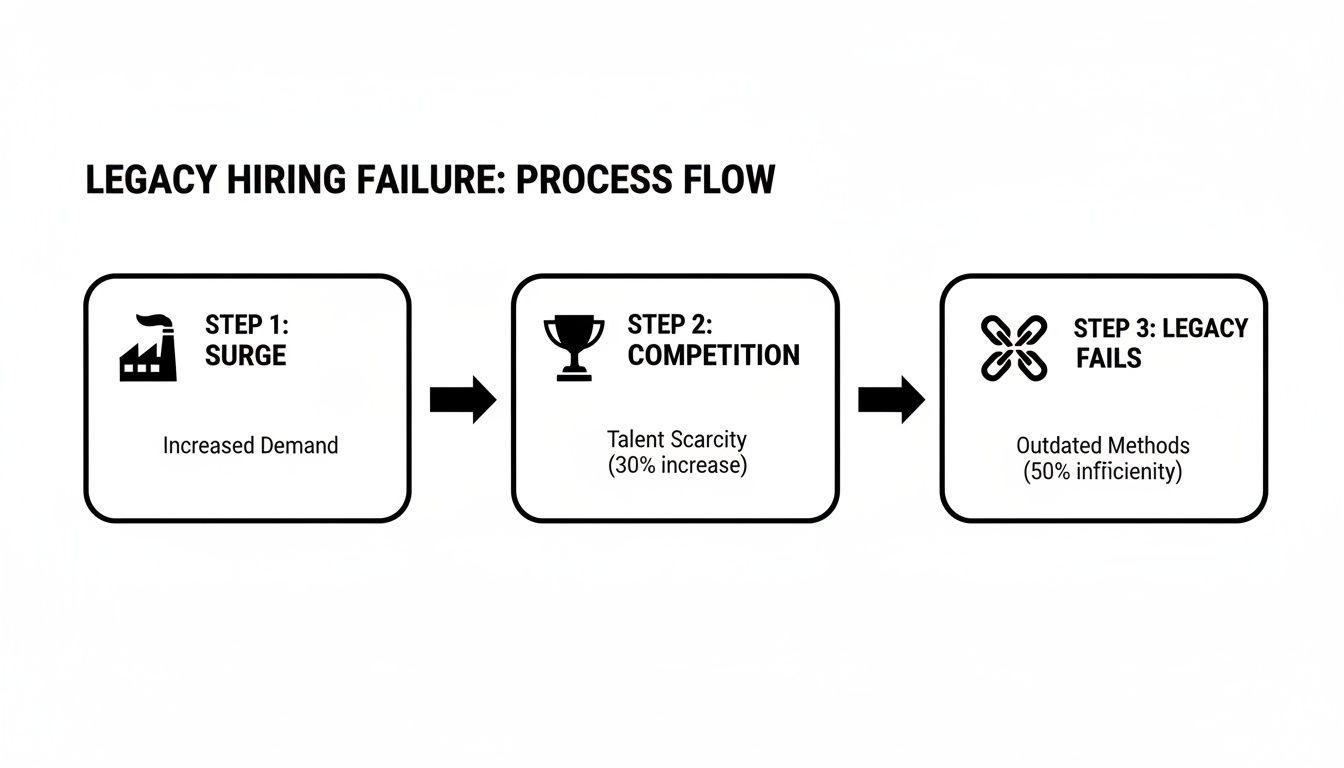
The visualisation lays out a clear chain reaction: a spike in production needs creates fierce competition for talent, which ultimately shatters outdated, slow-moving recruitment models. A proactive blueprint is the only way to avoid this breakdown.
Auditing Your Current Workforce to Identify Gaps
The very first step in building your blueprint is to get a clear, honest picture of what you already have. A thorough workforce audit gives you a snapshot of your current talent landscape, pinpointing both your strengths and the critical skill gaps that could sabotage future growth.
This is far more than just a headcount. It’s a qualitative analysis of your team’s real-world abilities. Your audit should be mapping the skills you have today against the competencies you’ll need for operational excellence tomorrow.
Here’s a real-world scenario I see all the time: a plant manager is planning to roll out automated quality control systems within the next 18 months. An audit might show that while the current team has fantastic manual inspection skills, less than 10% possess the foundational digital literacy or data interpretation skills to operate the new tech. That’s a critical gap a smart workforce plan can start closing long before it becomes a crisis.
A workforce audit isn’t about finding faults; it’s about finding opportunities. It tells you where to invest in upskilling your loyal, high-performing employees and where to target external hiring for brand-new capabilities.
For a more detailed breakdown, you can learn more about how strategic workforce planning can drive your talent acquisition strategy in our related article.
Designing Modern Competency Frameworks
Yesterday’s job descriptions simply won’t attract tomorrow’s talent. As factories become more connected, automated, and data-driven, the skills needed on the shop floor are changing dramatically. Your workforce blueprint has to include dynamic competency frameworks that reflect this new reality.
These frameworks should detail the specific, tangible skills and behaviours required for success in a digitised manufacturing environment. You have to think beyond traditional machine operation and start including competencies like:
- Automation and Robotics: Basic operation, troubleshooting, and maintenance of automated systems.
- IIoT and Data Literacy: Understanding data from connected devices to monitor performance and spot inefficiencies.
- Digital Lean Principles: Using digital tools to track workflows, report issues, and contribute to continuous improvement.
- Problem-Solving and Adaptability: The ability to diagnose issues on a complex, interconnected production line.
Architecting Career Paths That Attract and Retain
A strong workforce blueprint doesn’t just help you hire; it helps you keep the great people you bring on board. When you define clear career paths, you’re showing both candidates and current employees that your company offers a future, not just a job. In a competitive market for manufacturing talent, that’s a powerful differentiator.
For example, a new machine operator shouldn’t just see their current role. They should be able to see a clear, structured path to becoming a line supervisor, a maintenance technician, or even a process improvement specialist.
This involves a few key actions:
- Mapping Skill Progression: Clearly define what skills an employee needs to learn to move to the next level.
- Integrating Training: Link career milestones directly to specific internal or external training programmes.
- Providing Mentorship: Pair junior employees with experienced leaders who can guide their development.
By building out this blueprint, you transform talent acquisition from a reactive, costly function into a strategic driver of business success. You ensure your workforce is always ready for what’s next.
Relying on just one or two old-school hiring channels in today’s manufacturing market is a recipe for falling behind. If all you’re doing is posting on the big job boards, you’re just fighting over the same tired pool of candidates as everyone else. A truly effective hiring strategy for manufacturing operations needs to be a multi-channel affair, building a steady pipeline of talent from every possible angle.
The real goal is to create a constant flow of qualified people by meeting them where they already are. This means looking beyond the obvious and tapping into your own workforce, local communities, and smart partnerships. It’s all about building a sourcing engine that’s as dynamic and tough as your production line.
Look Inward First with Internal Mobility
Before you even start looking outside, your best talent might already be on your payroll. A strong internal mobility programme is one of the most powerful tools you have for both retention and recruitment. Upskilling your current team is faster, cheaper, and sends a clear message that your company invests in its people.
Think about it from an employee’s point of view. An operator on the assembly line sees a clear, structured path to becoming a team lead or a maintenance technician. Suddenly, it’s not just a job; it’s a career. By creating these pathways, you don’t just fill critical roles, you also give morale and loyalty a massive boost.
For example, a large automotive parts manufacturer I worked with knew they’d soon need more PLC (Programmable Logic Controller) technicians. Instead of searching externally, they launched an internal training programme for their high-performing machine operators. The result? They filled 80% of their open technician roles within a year, with employees who already knew the company culture and the production floor inside and out.
Expand Your Reach with Targeted External Channels
When you do need to look outside, casting a wide, generic net is just a waste of time and money. Your external sourcing has to be targeted and intentional. This means moving past the mainstream job sites and focusing on the channels where skilled manufacturing talent actually hangs out.
Here are some high-impact external channels to focus on:
- Specialised Manufacturing Job Boards: Platforms dedicated to industrial and technical roles will always attract a more qualified and relevant crowd.
- Vocational and Technical Institutes (ITIs): Build direct relationships with local ITIs and polytechnic colleges. You can offer internships, send your experts to give guest lectures, and run campus recruitment drives to get early access to new talent.
- Community Partnerships: Get involved with local community centres and government employment initiatives near your plant. This not only builds goodwill but also creates a pipeline of local talent, which can cut down on commute times and improve retention.
- Employee Referral Programmes: A well-designed referral programme can be your absolute best source of high-quality hires. Your current employees know what it takes to succeed at your company and can vouch for a candidate’s cultural fit.
Don’t just post a job; build a presence. Sponsoring local technical events or hosting a community open house can do more for your employer brand than a dozen online job ads.
Supercharge Your Efforts with Recruitment Process Outsourcing
For high-volume manufacturing hiring, trying to manage all these channels at once can overwhelm even the sharpest internal HR team. This is where Recruitment Process Outsourcing (RPO) becomes a strategic game-changer. An RPO partner like Taggd doesn’t just find candidates; they manage the entire recruitment lifecycle, giving you the scale, technology, and expertise you need to hit aggressive hiring goals.
This kind of strategic approach is becoming essential. Hiring in India’s manufacturing sector has sped up dramatically, with job creation jumping from 6% (2004-2014) to 15% in the last decade. As the sector keeps growing with a recent 4.8% YoY production increase noted in January 2026, the sheer volume of hiring required is immense. To learn more about this incredible growth and the future of employment in the sector, you can explore the latest findings on manufacturing job creation in India.
An RPO partner brings a few key advantages to the table:
- Scalability and Agility: You can instantly scale your recruitment capacity up or down to match production demands without adding permanent headcount to your HR team.
- Access to Technology: You get immediate access to advanced applicant tracking systems (ATS), AI-powered sourcing tools, and a pre-vetted database of talent ready to be hired.
- Market Expertise: You can tap into deep knowledge of regional talent markets, salary benchmarks, and the most effective sourcing channels for very specific manufacturing roles.
Imagine you need to hire 200 operators for a new production line in three months. An RPO partner can deploy a dedicated team of recruiters, launch a multi-channel sourcing campaign, and manage the entire screening and interview process. This frees up your internal team to focus on strategic work like employee engagement and leadership development, ensuring you hit your headcount goals without ever sacrificing quality.
Modernising Your Assessment and Interview Process

When you’re scaling up your manufacturing operations, you’re under pressure to hire fast. But rushing the process is a sure-fire way to end up with high turnover and poor performance on the factory floor. The real win comes from redesigning your interview process to be both lightning-fast and incredibly effective at spotting the best people.
It’s time to move beyond just scanning CVs and having unstructured chats. A modern assessment funnel uses a multi-stage approach, letting technology handle the high-volume initial screening so your hiring managers can focus their energy on the most promising individuals. This isn’t just about saving time; it’s about dramatically improving your ability to predict who will succeed on the job.
Designing a High-Efficiency Funnel
Building an effective hiring funnel starts with automating the top. For high-volume roles like machine operators or assembly line workers, you can use simple chatbot interactions or automated screening questions to filter for the absolute non-negotiables. Think basics like willingness to work in shifts, minimum qualifications, or a reasonable commute to the plant.
This initial automated pass ensures your team only spends time on candidates who meet the fundamental requirements. From there, the funnel needs to incorporate assessments that genuinely test for the skills that matter. The goal is to see what a candidate can actually do, not just what they say they can do.
Consider adding these powerful assessment tools to your mid-funnel:
- Gamified Assessments: These are short, engaging games that measure critical cognitive abilities like problem-solving, attention to detail, and reaction time. They feel less like a test and more like a challenge, which massively improves the candidate experience.
- Situational Judgement Tests (SJTs): Put candidates in realistic, work-related scenarios they’d face on the job. Their responses are incredibly revealing, showing you their decision-making skills, safety awareness, and how well they align with your company’s operational standards.
Implementing Competency-Based Structured Interviews
Once a candidate gets through the initial assessments, they land at the interview stage. This is where structured, competency-based interviews become your most powerful tool. Unlike a free-flowing chat, a structured interview ensures every candidate is asked the same questions and is scored against the same consistent criteria.
This approach drastically reduces unconscious bias because it forces interviewers to focus on hard evidence of skills rather than just a “gut feeling.” Training your hiring managers on this technique is essential. They need to learn how to ask probing, behavioural questions like, “Tell me about a time you identified a safety hazard on the line. What exactly did you do?”
The power of a structured process is consistency. When you evaluate every candidate for a specific role against an identical scorecard, you replace guesswork with data. Your hiring decisions become more defensible, fair, and accurate.
For instance, when hiring a maintenance technician, your structured questions should map directly to your competency framework. You’d ask about their hands-on experience with specific machinery, how they’ve handled unexpected breakdowns, and their process for documenting repairs. To take this part of your funnel to the next level, you can explore insights on elevating the interview experience with modern tools in our detailed guide.
The Final Step: In-Person Practical Assessments
For many manufacturing roles, nothing beats a final, hands-on assessment. This is your chance to see a candidate’s skills in action within a controlled environment. And it doesn’t need to be overly complicated.
Here are a few practical examples that work:
- For a Machine Operator: Ask them to perform a basic setup or a simple troubleshooting task on a training machine.
- For a Quality Inspector: Give them a set of sample parts, some good, some with known defects and have them identify and document the flaws.
- For a Team Lead: Present them with a simulated production issue and ask how they would delegate tasks and communicate with their team to get it resolved.
This final stage confirms the skills they’ve demonstrated in earlier assessments and gives the candidate a realistic preview of the job. By combining automated screening, targeted assessments, and structured interviews, you create a robust process that scales efficiently and consistently lands you the high-quality talent you need to win.
Using Data to Build a High-Performance Hiring Engine

On the factory floor, every single decision is driven by data. What gets measured gets managed, optimised, and improved. It’s time we brought that same rigorous, data-first mindset to manufacturing operations hiring.
Building a high-performance talent engine means moving beyond gut feelings and relying on hard numbers to guide your strategy. Your recruitment function should operate like a finely-tuned production line, with clear metrics tracking every stage of the process. This is how you spot bottlenecks, predict future needs with greater accuracy, and make strategic bets that pay off in quality hires.
Defining the Metrics That Truly Matter
Vanity metrics, like the sheer number of CVs you receive, are just noise. As a CHRO, your focus has to be on the KPIs that directly impact business outcomes. When you track the right data, your hiring function transforms from a cost centre into a strategic powerhouse that drives operational stability and growth.
This practical guide breaks down the essential performance indicators that every manufacturing CHRO should have on their dashboard.
Essential Hiring Metrics for Manufacturing Operations
| Metric | What It Measures | Why It Matters for Manufacturing | Improvement Strategy |
|---|---|---|---|
| Time-to-Fill | The total days from when a job is opened to when an offer is accepted. | A long time-to-fill can mean production delays, overworked staff, and missed targets. It’s a direct threat to output. | Analyse each stage of the hiring process (sourcing, screening, interviews) to identify and remove bottlenecks. |
| Offer Acceptance Rate | The percentage of candidates who accept a formal job offer. | A low rate is a red flag. It points to issues with your compensation, benefits, or the candidate experience. | Conduct exit interviews with candidates who decline offers. Use feedback to adjust your compensation strategy or interview process. |
| Source of Hire | Which channels (referrals, job boards, agencies) are delivering your best people. | Knowing your top-performing machine operators come from a specific technical institute tells you exactly where to invest your budget. | Allocate more resources to high-performing channels and experiment with new, targeted sourcing methods. |
| Quality of Hire | New employee performance, productivity, and retention over their first 90-180 days. | This is the ultimate measure of success. A high score proves your assessment process is finding people who truly fit and perform. | Align interview questions and assessments directly with the core competencies needed for success in the role. |
Tracking these KPIs isn’t just about creating reports; it’s about gaining the intelligence needed to make smarter, faster decisions that keep your production lines running smoothly.
You wouldn’t run a production line without real-time performance data. Your hiring process deserves the same level of analytical scrutiny. The goal is to create a dashboard that gives you an immediate, honest view of your recruitment health.
Navigating India’s Complex Employment Data
Making smart, long-term workforce planning decisions in India is complicated. There are often significant disparities in the official employment data, with different sources telling conflicting stories. This makes getting a clear, reliable picture of the talent landscape a real challenge.
For example, in 2022-23, supply-side (HS) data estimated there were 59.3 million paid manufacturing workers. That’s a full 36% higher than the demand-side (EES) figure of 43.5 million.
These variances show up at the state level, too. HS figures are higher in states like Tamil Nadu and Gujarat, while EES numbers are greater in Himachal Pradesh. For a CHRO trying to plan for expansion, these inconsistencies create major forecasting headaches. You can explore more about these manufacturing data discrepancies and see just how much they can impact strategic planning.
This is exactly where an RPO partner with advanced talent intelligence becomes a game-changer. By aggregating multiple public data sources and layering their own real-time hiring data on top, they can provide a much more accurate, ground-level view of the talent market.
How a Unified Data Dashboard Gives You Control
An RPO partner can deliver a unified data dashboard that pulls all your critical hiring metrics into one place. This gives you a live, transparent view of your entire hiring funnel, from the very first point of contact right through to the final offer.
This level of intelligence lets you:
- Spot Bottlenecks Instantly: See exactly where candidates are dropping off. Are they failing a specific assessment? Is the interview scheduling process too slow? The data will point you straight to the problem.
- Optimise Sourcing Channels: You can confidently double down on the channels that deliver high-quality hires and cut your spending on those that simply don’t perform.
- Improve Forecasting Precision: By using historical data and market trends, you can predict your hiring needs for the next quarter or year with far greater accuracy.
With this unified view, you’re no longer guessing. You have the actionable intelligence needed to make informed, data-driven decisions that continuously improve the efficiency and effectiveness of your manufacturing operations hiring.
Common Questions About Manufacturing Hiring
Even the best-laid hiring plans run into tough questions on the factory floor. In my conversations with CHROs, a few challenges come up again and again: How do we hire hundreds of people without our quality standards taking a nosedive? How do we justify the cost of an RPO partner? And how do we just stand out in a market this crowded?
Let’s tackle some of the most pressing questions I hear about manufacturing operations hiring with direct, no-nonsense answers.
How Can We Hire at High Volume Without Lowering Our Standards?
This is the classic tug-of-war in high-volume hiring. The trick is to stop seeing speed and quality as opposites. Instead, you need to build a system where efficiency actually drives quality.
It all starts by getting smart with the top of your hiring funnel. Use simple digital tools to automate the initial screen for the absolute non-negotiables, like shift availability or basic certifications. This instantly cleans up your candidate pool, freeing up your recruiters to focus their energy only on people who meet your baseline criteria.
From there, it’s all about practical, hands-on assessments.
- Situational Judgement Tests (SJTs): Forget CVs for a moment. Present candidates with real-world scenarios they’d actually face on the job, a minor safety issue, a quality control problem. How they respond tells you more than any work history ever could.
- Hands-On Practical Tests: For skilled roles like welders or maintenance technicians, there’s no substitute for a quick, supervised skills test. You can confirm someone’s competency in minutes, completely removing the guesswork.
This structured process ensures that even if you need 200 operators this quarter, every single candidate has been properly vetted against a consistent standard of quality.
The secret to hiring well at scale isn’t about moving faster; it’s about building an efficient, consistent process that systematically filters for quality at every single stage.
What Is the Real ROI of an RPO Partnership?
Bringing on a Recruitment Process Outsourcing (RPO) partner is a big decision, and the return on that investment goes way beyond just filling jobs. The real value is measured in agility, hard cost savings, and a massive strategic advantage.
First, let’s talk about cost avoidance. An expert RPO partner helps you dodge the huge costs of a slow hiring process, think production delays, burnout from paying overtime, and lost revenue. Their ready-to-go talent pools and optimised processes can slash your time-to-fill by 30-50%. That’s a game-changer when a new production line is sitting idle.
Second is pure scalability. With an RPO, you gain the power to ramp your recruitment capacity up or down almost instantly, without the fixed overhead of hiring more internal recruiters. In a market where demand swings wildly, that kind of flexibility is priceless.
Finally, you get access to powerful data intelligence. A good RPO gives you real-time market insights and analytics that help you make smarter decisions on everything from salary benchmarks to which sourcing channels are actually working. This data-driven approach turns your hiring function from a reactive cost centre into a proactive engine for business growth.
Ready to build a high-performance hiring engine that scales with your ambition? Taggd‘s AI-powered RPO solutions provide the technology, data, and expertise to help you win the war for manufacturing talent in India. Discover how we can transform your hiring strategy today. A CHRO’s Guide to Manufacturing Operations Hiring in 2026
If you’re a CHRO in India’s manufacturing space, you know the old hiring playbook is broken. Trying to fill roles reactively just doesn’t work anymore. The sector is experiencing a massive growth spurt, and that’s putting immense pressure on finding skilled operations talent.
It’s time to stop chasing candidates and start building a proactive talent engine.
The New Reality of Manufacturing Talent in India
India’s manufacturing sector isn’t just recovering post-pandemic, it’s absolutely booming. For Chief Human Resources Officers (CHROs), this is both a huge opportunity and a serious challenge. The problem isn’t just finding people; it’s about scaling up recruitment quickly and efficiently without letting the quality of your hires slip.
The traditional, slow-moving hiring methods most companies rely on are cracking under the strain of this high-volume demand.
The numbers don’t lie. India’s manufacturing workforce has shown incredible resilience, climbing to 18.49 million in FY 2023. That’s a staggering 11.4% growth in just three years. The Annual Survey of Industries (ASI) adds that employment jumped by 7% year-on-year in 2021-22, adding over 935,000 workers and blowing past pre-pandemic figures.
To give these numbers more context, let’s break down the recent trends.
Key Trends in India’s Manufacturing Employment (FY 2020 – 2023)
The data paints a clear picture of a sector in overdrive. After a brief dip during the pandemic, the rebound has been swift and aggressive, creating a highly competitive market for employers.
| Metric | FY 2020 | FY 2021 (Pandemic Dip) | FY 2022 (Rebound) | FY 2023 (Surge) |
|---|---|---|---|---|
| Total Employment (in millions) | 16.60 | 16.35 | 17.37 | 18.49 |
| Year-over-Year Growth | – | -1.5% | +6.2% | +6.4% |
| Salary Growth (Average) | – | – | +8.3% | N/A |
As you can see, the growth isn’t just steady; it’s accelerating. This rapid expansion is what’s fuelling the intense competition and driving up salaries as companies fight for the same pool of skilled workers.
A Fierce War for Talent in Regional Hotspots
This explosive growth has ignited a fierce war for talent. Average salaries in the sector shot up by 8.3% in 2021-22 alone, a clear sign that companies are willing to pay a premium for skilled operational staff. And this isn’t happening uniformly across the country; the fight is most intense in key industrial hubs.
The expansion is heavily concentrated in a handful of states, creating urgent, high-volume hiring needs for any organisation with a presence there. The states leading the charge are:
- Tamil Nadu
- Gujarat
- Maharashtra
- Uttar Pradesh
- Haryana
These five states consistently dominate the ASI employment charts, turning them into battlegrounds for top-tier manufacturing talent. As a CHRO, this means you can’t rely on a one-size-fits-all strategy. You need localised hiring plans that account for regional market dynamics, salary benchmarks, and the specific skills available.
The old method of posting a job and waiting for people to apply is obsolete. In this new era, winning in manufacturing hiring means building a scalable, data-driven talent acquisition function that can predict needs and engage candidates before your competitors do.
Why Your Legacy Hiring Model Is Holding You Back
The current market exposes every flaw in outdated recruitment processes. These old methods are often manual, painfully slow, and simply can’t handle the sheer volume of applicants needed to staff a modern factory floor. They don’t have the agility to compete when top candidates are juggling multiple offers.
This guide is your new playbook. It’s designed to help you, as a CHRO, move beyond just reacting to hiring needs and start architecting a robust talent engine. By mastering workforce planning, diversifying your sourcing channels, and modernising your assessments, you can transform your hiring function into a strategic advantage that fuels, rather than stalls, your company’s growth. For a deeper look into the future of the job market, you might find our report on decoding jobs in India insightful.
Building a Scalable Workforce Blueprint
In a manufacturing sector that’s expanding at this pace, reactive hiring is a losing game. If you want to win the war for talent, you have to shift from just posting jobs to architecting a scalable workforce blueprint. Think of this as your organisation’s talent roadmap, making sure every single hire directly fuels your long-term business goals, especially when it comes to manufacturing operations.
This isn’t about basic headcount projections anymore. It involves a much deeper dive, analysing your current workforce’s capabilities and looking ahead to the skills your plants will need to thrive in the era of smart manufacturing. It’s about building a talent structure that’s designed for both scale and skill.
This process flow shows exactly how traditional, reactive hiring methods crumble under the pressure of sudden demand and increased competition.
The visualisation lays out a clear chain reaction: a spike in production needs creates fierce competition for talent, which ultimately shatters outdated, slow-moving recruitment models. A proactive blueprint is the only way to avoid this breakdown.
Auditing Your Current Workforce to Identify Gaps
The very first step in building your blueprint is to get a clear, honest picture of what you already have. A thorough workforce audit gives you a snapshot of your current talent landscape, pinpointing both your strengths and the critical skill gaps that could sabotage future growth.
This is far more than just a headcount. It’s a qualitative analysis of your team’s real-world abilities. Your audit should be mapping the skills you have today against the competencies you’ll need for operational excellence tomorrow.
Here’s a real-world scenario I see all the time: a plant manager is planning to roll out automated quality control systems within the next 18 months. An audit might show that while the current team has fantastic manual inspection skills, less than 10% possess the foundational digital literacy or data interpretation skills to operate the new tech. That’s a critical gap a smart workforce plan can start closing long before it becomes a crisis.
A workforce audit isn’t about finding faults; it’s about finding opportunities. It tells you where to invest in upskilling your loyal, high-performing employees and where to target external hiring for brand-new capabilities.
For a more detailed breakdown, you can learn more about how strategic workforce planning can drive your talent acquisition strategy in our related article.
Designing Modern Competency Frameworks
Yesterday’s job descriptions simply won’t attract tomorrow’s talent. As factories become more connected, automated, and data-driven, the skills needed on the shop floor are changing dramatically. Your workforce blueprint has to include dynamic competency frameworks that reflect this new reality.
These frameworks should detail the specific, tangible skills and behaviours required for success in a digitised manufacturing environment. You have to think beyond traditional machine operation and start including competencies like:
- Automation and Robotics: Basic operation, troubleshooting, and maintenance of automated systems.
- IIoT and Data Literacy: Understanding data from connected devices to monitor performance and spot inefficiencies.
- Digital Lean Principles: Using digital tools to track workflows, report issues, and contribute to continuous improvement.
- Problem-Solving and Adaptability: The ability to diagnose issues on a complex, interconnected production line.
Architecting Career Paths That Attract and Retain
A strong workforce blueprint doesn’t just help you hire; it helps you keep the great people you bring on board. When you define clear career paths, you’re showing both candidates and current employees that your company offers a future, not just a job. In a competitive market for manufacturing talent, that’s a powerful differentiator.
For example, a new machine operator shouldn’t just see their current role. They should be able to see a clear, structured path to becoming a line supervisor, a maintenance technician, or even a process improvement specialist.
This involves a few key actions:
- Mapping Skill Progression: Clearly define what skills an employee needs to learn to move to the next level.
- Integrating Training: Link career milestones directly to specific internal or external training programmes.
- Providing Mentorship: Pair junior employees with experienced leaders who can guide their development.
By building out this blueprint, you transform talent acquisition from a reactive, costly function into a strategic driver of business success. You ensure your workforce is always ready for what’s next.
Relying on just one or two old-school hiring channels in today’s manufacturing market is a recipe for falling behind. If all you’re doing is posting on the big job boards, you’re just fighting over the same tired pool of candidates as everyone else. A truly effective hiring strategy for manufacturing operations needs to be a multi-channel affair, building a steady pipeline of talent from every possible angle.
The real goal is to create a constant flow of qualified people by meeting them where they already are. This means looking beyond the obvious and tapping into your own workforce, local communities, and smart partnerships. It’s all about building a sourcing engine that’s as dynamic and tough as your production line.
Look Inward First with Internal Mobility
Before you even start looking outside, your best talent might already be on your payroll. A strong internal mobility programme is one of the most powerful tools you have for both retention and recruitment. Upskilling your current team is faster, cheaper, and sends a clear message that your company invests in its people.
Think about it from an employee’s point of view. An operator on the assembly line sees a clear, structured path to becoming a team lead or a maintenance technician. Suddenly, it’s not just a job; it’s a career. By creating these pathways, you don’t just fill critical roles, you also give morale and loyalty a massive boost.
For example, a large automotive parts manufacturer I worked with knew they’d soon need more PLC (Programmable Logic Controller) technicians. Instead of searching externally, they launched an internal training programme for their high-performing machine operators. The result? They filled 80% of their open technician roles within a year, with employees who already knew the company culture and the production floor inside and out.
Expand Your Reach with Targeted External Channels
When you do need to look outside, casting a wide, generic net is just a waste of time and money. Your external sourcing has to be targeted and intentional. This means moving past the mainstream job sites and focusing on the channels where skilled manufacturing talent actually hangs out.
Here are some high-impact external channels to focus on:
- Specialised Manufacturing Job Boards: Platforms dedicated to industrial and technical roles will always attract a more qualified and relevant crowd.
- Vocational and Technical Institutes (ITIs): Build direct relationships with local ITIs and polytechnic colleges. You can offer internships, send your experts to give guest lectures, and run campus recruitment drives to get early access to new talent.
- Community Partnerships: Get involved with local community centres and government employment initiatives near your plant. This not only builds goodwill but also creates a pipeline of local talent, which can cut down on commute times and improve retention.
- Employee Referral Programmes: A well-designed referral programme can be your absolute best source of high-quality hires. Your current employees know what it takes to succeed at your company and can vouch for a candidate’s cultural fit.
Don’t just post a job; build a presence. Sponsoring local technical events or hosting a community open house can do more for your employer brand than a dozen online job ads.
Supercharge Your Efforts with Recruitment Process Outsourcing
For high-volume manufacturing hiring, trying to manage all these channels at once can overwhelm even the sharpest internal HR team. This is where Recruitment Process Outsourcing (RPO) becomes a strategic game-changer. An RPO partner like Taggd doesn’t just find candidates; they manage the entire recruitment lifecycle, giving you the scale, technology, and expertise you need to hit aggressive hiring goals.
This kind of strategic approach is becoming essential. Hiring in India’s manufacturing sector has sped up dramatically, with job creation jumping from 6% (2004-2014) to 15% in the last decade. As the sector keeps growing with a recent 4.8% YoY production increase noted in January 2026, the sheer volume of hiring required is immense. To learn more about this incredible growth and the future of employment in the sector, you can explore the latest findings on manufacturing job creation in India.
An RPO partner brings a few key advantages to the table:
- Scalability and Agility: You can instantly scale your recruitment capacity up or down to match production demands without adding permanent headcount to your HR team.
- Access to Technology: You get immediate access to advanced applicant tracking systems (ATS), AI-powered sourcing tools, and a pre-vetted database of talent ready to be hired.
- Market Expertise: You can tap into deep knowledge of regional talent markets, salary benchmarks, and the most effective sourcing channels for very specific manufacturing roles.
Imagine you need to hire 200 operators for a new production line in three months. An RPO partner can deploy a dedicated team of recruiters, launch a multi-channel sourcing campaign, and manage the entire screening and interview process. This frees up your internal team to focus on strategic work like employee engagement and leadership development, ensuring you hit your headcount goals without ever sacrificing quality.
Modernising Your Assessment and Interview Process
When you’re scaling up your manufacturing operations, you’re under pressure to hire fast. But rushing the process is a sure-fire way to end up with high turnover and poor performance on the factory floor. The real win comes from redesigning your interview process to be both lightning-fast and incredibly effective at spotting the best people.
It’s time to move beyond just scanning CVs and having unstructured chats. A modern assessment funnel uses a multi-stage approach, letting technology handle the high-volume initial screening so your hiring managers can focus their energy on the most promising individuals. This isn’t just about saving time; it’s about dramatically improving your ability to predict who will succeed on the job.
Designing a High-Efficiency Funnel
Building an effective hiring funnel starts with automating the top. For high-volume roles like machine operators or assembly line workers, you can use simple chatbot interactions or automated screening questions to filter for the absolute non-negotiables. Think basics like willingness to work in shifts, minimum qualifications, or a reasonable commute to the plant.
This initial automated pass ensures your team only spends time on candidates who meet the fundamental requirements. From there, the funnel needs to incorporate assessments that genuinely test for the skills that matter. The goal is to see what a candidate can actually do, not just what they say they can do.
Consider adding these powerful assessment tools to your mid-funnel:
- Gamified Assessments: These are short, engaging games that measure critical cognitive abilities like problem-solving, attention to detail, and reaction time. They feel less like a test and more like a challenge, which massively improves the candidate experience.
- Situational Judgement Tests (SJTs): Put candidates in realistic, work-related scenarios they’d face on the job. Their responses are incredibly revealing, showing you their decision-making skills, safety awareness, and how well they align with your company’s operational standards.
Implementing Competency-Based Structured Interviews
Once a candidate gets through the initial assessments, they land at the interview stage. This is where structured, competency-based interviews become your most powerful tool. Unlike a free-flowing chat, a structured interview ensures every candidate is asked the same questions and is scored against the same consistent criteria.
This approach drastically reduces unconscious bias because it forces interviewers to focus on hard evidence of skills rather than just a “gut feeling.” Training your hiring managers on this technique is essential. They need to learn how to ask probing, behavioural questions like, “Tell me about a time you identified a safety hazard on the line. What exactly did you do?”
The power of a structured process is consistency. When you evaluate every candidate for a specific role against an identical scorecard, you replace guesswork with data. Your hiring decisions become more defensible, fair, and accurate.
For instance, when hiring a maintenance technician, your structured questions should map directly to your competency framework. You’d ask about their hands-on experience with specific machinery, how they’ve handled unexpected breakdowns, and their process for documenting repairs. To take this part of your funnel to the next level, you can explore insights on elevating the interview experience with modern tools in our detailed guide.
The Final Step: In-Person Practical Assessments
For many manufacturing roles, nothing beats a final, hands-on assessment. This is your chance to see a candidate’s skills in action within a controlled environment. And it doesn’t need to be overly complicated.
Here are a few practical examples that work:
- For a Machine Operator: Ask them to perform a basic setup or a simple troubleshooting task on a training machine.
- For a Quality Inspector: Give them a set of sample parts, some good, some with known defects and have them identify and document the flaws.
- For a Team Lead: Present them with a simulated production issue and ask how they would delegate tasks and communicate with their team to get it resolved.
This final stage confirms the skills they’ve demonstrated in earlier assessments and gives the candidate a realistic preview of the job. By combining automated screening, targeted assessments, and structured interviews, you create a robust process that scales efficiently and consistently lands you the high-quality talent you need to win.
Using Data to Build a High-Performance Hiring Engine
On the factory floor, every single decision is driven by data. What gets measured gets managed, optimised, and improved. It’s time we brought that same rigorous, data-first mindset to manufacturing operations hiring.
Building a high-performance talent engine means moving beyond gut feelings and relying on hard numbers to guide your strategy. Your recruitment function should operate like a finely-tuned production line, with clear metrics tracking every stage of the process. This is how you spot bottlenecks, predict future needs with greater accuracy, and make strategic bets that pay off in quality hires.
Defining the Metrics That Truly Matter
Vanity metrics, like the sheer number of CVs you receive, are just noise. As a CHRO, your focus has to be on the KPIs that directly impact business outcomes. When you track the right data, your hiring function transforms from a cost centre into a strategic powerhouse that drives operational stability and growth.
This practical guide breaks down the essential performance indicators that every manufacturing CHRO should have on their dashboard.
Essential Hiring Metrics for Manufacturing Operations
| Metric | What It Measures | Why It Matters for Manufacturing | Improvement Strategy |
|---|---|---|---|
| Time-to-Fill | The total days from when a job is opened to when an offer is accepted. | A long time-to-fill can mean production delays, overworked staff, and missed targets. It’s a direct threat to output. | Analyse each stage of the hiring process (sourcing, screening, interviews) to identify and remove bottlenecks. |
| Offer Acceptance Rate | The percentage of candidates who accept a formal job offer. | A low rate is a red flag. It points to issues with your compensation, benefits, or the candidate experience. | Conduct exit interviews with candidates who decline offers. Use feedback to adjust your compensation strategy or interview process. |
| Source of Hire | Which channels (referrals, job boards, agencies) are delivering your best people. | Knowing your top-performing machine operators come from a specific technical institute tells you exactly where to invest your budget. | Allocate more resources to high-performing channels and experiment with new, targeted sourcing methods. |
| Quality of Hire | New employee performance, productivity, and retention over their first 90-180 days. | This is the ultimate measure of success. A high score proves your assessment process is finding people who truly fit and perform. | Align interview questions and assessments directly with the core competencies needed for success in the role. |
Tracking these KPIs isn’t just about creating reports; it’s about gaining the intelligence needed to make smarter, faster decisions that keep your production lines running smoothly.
You wouldn’t run a production line without real-time performance data. Your hiring process deserves the same level of analytical scrutiny. The goal is to create a dashboard that gives you an immediate, honest view of your recruitment health.
Navigating India’s Complex Employment Data
Making smart, long-term workforce planning decisions in India is complicated. There are often significant disparities in the official employment data, with different sources telling conflicting stories. This makes getting a clear, reliable picture of the talent landscape a real challenge.
For example, in 2022-23, supply-side (HS) data estimated there were 59.3 million paid manufacturing workers. That’s a full 36% higher than the demand-side (EES) figure of 43.5 million.
These variances show up at the state level, too. HS figures are higher in states like Tamil Nadu and Gujarat, while EES numbers are greater in Himachal Pradesh. For a CHRO trying to plan for expansion, these inconsistencies create major forecasting headaches. You can explore more about these manufacturing data discrepancies and see just how much they can impact strategic planning.
This is exactly where an RPO partner with advanced talent intelligence becomes a game-changer. By aggregating multiple public data sources and layering their own real-time hiring data on top, they can provide a much more accurate, ground-level view of the talent market.
How a Unified Data Dashboard Gives You Control
An RPO partner can deliver a unified data dashboard that pulls all your critical hiring metrics into one place. This gives you a live, transparent view of your entire hiring funnel, from the very first point of contact right through to the final offer.
This level of intelligence lets you:
- Spot Bottlenecks Instantly: See exactly where candidates are dropping off. Are they failing a specific assessment? Is the interview scheduling process too slow? The data will point you straight to the problem.
- Optimise Sourcing Channels: You can confidently double down on the channels that deliver high-quality hires and cut your spending on those that simply don’t perform.
- Improve Forecasting Precision: By using historical data and market trends, you can predict your hiring needs for the next quarter or year with far greater accuracy.
With this unified view, you’re no longer guessing. You have the actionable intelligence needed to make informed, data-driven decisions that continuously improve the efficiency and effectiveness of your manufacturing operations hiring.
Common Questions About Manufacturing Hiring
Even the best-laid hiring plans run into tough questions on the factory floor. In my conversations with CHROs, a few challenges come up again and again: How do we hire hundreds of people without our quality standards taking a nosedive? How do we justify the cost of an RPO partner? And how do we just stand out in a market this crowded?
Let’s tackle some of the most pressing questions I hear about manufacturing operations hiring with direct, no-nonsense answers.
How Can We Hire at High Volume Without Lowering Our Standards?
This is the classic tug-of-war in high-volume hiring. The trick is to stop seeing speed and quality as opposites. Instead, you need to build a system where efficiency actually drives quality.
It all starts by getting smart with the top of your hiring funnel. Use simple digital tools to automate the initial screen for the absolute non-negotiables, like shift availability or basic certifications. This instantly cleans up your candidate pool, freeing up your recruiters to focus their energy only on people who meet your baseline criteria.
From there, it’s all about practical, hands-on assessments.
- Situational Judgement Tests (SJTs): Forget CVs for a moment. Present candidates with real-world scenarios they’d actually face on the job, a minor safety issue, a quality control problem. How they respond tells you more than any work history ever could.
- Hands-On Practical Tests: For skilled roles like welders or maintenance technicians, there’s no substitute for a quick, supervised skills test. You can confirm someone’s competency in minutes, completely removing the guesswork.
This structured process ensures that even if you need 200 operators this quarter, every single candidate has been properly vetted against a consistent standard of quality.
The secret to hiring well at scale isn’t about moving faster; it’s about building an efficient, consistent process that systematically filters for quality at every single stage.
What Is the Real ROI of an RPO Partnership?
Bringing on a Recruitment Process Outsourcing (RPO) partner is a big decision, and the return on that investment goes way beyond just filling jobs. The real value is measured in agility, hard cost savings, and a massive strategic advantage.
First, let’s talk about cost avoidance. An expert RPO partner helps you dodge the huge costs of a slow hiring process—think production delays, burnout from paying overtime, and lost revenue. Their ready-to-go talent pools and optimised processes can slash your time-to-fill by 30-50%. That’s a game-changer when a new production line is sitting idle.
Second is pure scalability. With an RPO, you gain the power to ramp your recruitment capacity up or down almost instantly, without the fixed overhead of hiring more internal recruiters. In a market where demand swings wildly, that kind of flexibility is priceless.
Finally, you get access to powerful data intelligence. A good RPO gives you real-time market insights and analytics that help you make smarter decisions on everything from salary benchmarks to which sourcing channels are actually working. This data-driven approach turns your hiring function from a reactive cost centre into a proactive engine for business growth.
Ready to build a high-performance hiring engine that scales with your ambition? Taggd‘s AI-powered RPO solutions provide the technology, data, and expertise to help you win the war for manufacturing talent in India. Discover how we can transform your hiring strategy today.