Let’s be honest, attracting top talent in pharma manufacturing is a real battle right now. The winning strategy isn’t just about plugging gaps as they appear. It’s a two-front war: you need to be constantly on the lookout for new, skilled professionals while also investing heavily in the people you already have. The days of traditional hiring are over. To keep production lines running and innovation moving, we have to build talent pipelines that are as robust and reliable as our manufacturing processes.
The Widening Gap in Pharma Manufacturing Talent
For any CHRO in the pharma space, the problem is glaringly obvious: India’s pharmaceutical manufacturing industry is growing at a blistering pace, but the talent pool just can’t keep up. This isn’t a simple HR headache. It’s a direct threat to your bottom line, causing everything from production delays and compliance nightmares to missed opportunities for growth. The numbers tell a frightening story.
We’re facing a strange paradox. Job growth is exploding, yet we have a critical shortage of people with the right skills to fill these roles. Job postings in the sector are projected to jump by 48 percent, which sounds great on the surface. But the reality is that a massive 80 percent of pharma manufacturing sites in India report significant skills mismatches. It’s a clear disconnect between what the industry needs and what the talent market can offer. It’s worth exploring these strategic shifts in pharma hiring to understand what’s really happening.
Understanding the Core Challenges
This talent gap isn’t one single issue; it’s a perfect storm of several related problems hitting us all at once. Getting to the root of these issues is the only way to build a strategy that actually works.
A few key factors are driving this shortage:
- Technological Shifts: We’re moving fast toward automation, data analytics, and continuous manufacturing. These require specialised skills that many people in the current workforce simply don’t possess.
- Academic Gaps: Let’s face it, many university and college programmes haven’t evolved with the industry. They’re producing graduates who are smart, but who need a huge amount of on-the-job training before they can truly contribute.
- Global Talent Competition: Highly skilled Indian pharma professionals are a hot commodity worldwide. This “brain drain” means we’re losing our best people to international companies offering more competitive pay and clearer career paths.
The talent deficit isn’t a future problem, it’s an immediate operational risk. Every unfilled Quality Assurance or Production Supervisor role directly translates to potential compliance failures, production bottlenecks, and delayed revenue.
To put it in perspective, here’s a quick look at how these shortages directly hurt the business.
Impact of Talent Shortages on Pharma Manufacturing
The table below breaks down the primary challenges and their direct consequences on your organisation.
| Challenge Area | Direct Business Impact |
|---|---|
| Production Delays | Failure to meet production targets, leading to lost revenue and market share. |
| Compliance & Quality Risks | Increased likelihood of regulatory warnings, product recalls, and reputational damage due to understaffed QA/QC teams. |
| Innovation Stalemate | Inability to adopt new manufacturing technologies or scale up new products due to a lack of skilled personnel. |
| Increased Operational Costs | Higher expenses from recruitment fees, premium wages for temporary staff, and the cost of extensive onboarding and training. |
These impacts are real and they are happening now. Navigating this environment means getting smart about the latest pharma hiring trends. In the sections ahead, we’ll dive into a practical, step-by-step playbook designed to help you build a resilient talent strategy. One that doesn’t just fill today’s empty roles, but secures your company’s growth for years to come.
Unpacking the Root Causes of the Talent Crisis
To genuinely solve the manufacturing talent shortage in pharma, we need to look beyond the surface-level symptoms like unfilled roles and high turnover. The crisis isn’t a single problem. Instead, it’s a perfect storm of deep-rooted, interconnected issues that have been brewing for years.
Understanding why this is happening is the first real step toward building a strategy that delivers lasting results, not just temporary fixes. Several powerful forces are making it incredibly difficult to attract and retain the skilled professionals your manufacturing operations depend on. These aren’t just HR challenges; they are fundamental business risks that demand a clear-eyed diagnosis before you can even think about a cure.
Economic Pressures and Salary Compression
Let’s be direct: compensation is a huge piece of this puzzle. For years, the Indian pharmaceutical sector has been weathering some serious economic headwinds. Profitability has tumbled by 20% to 30% over the last few years, pushing many companies into aggressive cost-cutting modes.
This pressure often leads straight to salary compression, where wages for critical manufacturing roles just can’t keep up with other industries or what talent can earn abroad. You can get more perspective on the impact of profitability on talent migration from industry leaders themselves.
This financial squeeze creates an incredibly tough competitive landscape. When a talented quality assurance specialist or a skilled production technician can earn significantly more in another sector, loyalty starts to fade. We aren’t just competing with other pharma companies anymore; we’re competing with every industry that values technical expertise.
The talent crisis is fuelled by a perfect storm: declining profitability is squeezing salaries, academic programmes are misaligned with industry needs, and our top talent is being lured away by global opportunities. Ignoring any one of these root causes means your solution will ultimately fail.
This situation puts CHROs in a difficult position, trying to balance tight budgets with the absolute need to attract and keep the people who guarantee product quality and keep the lines running.
The Widening Academia-Industry Chasm
Another major driver of this shortage is the growing disconnect between what’s taught in universities and what’s actually needed on a modern pharmaceutical manufacturing floor. Many academic and technical institutes are still teaching theoretical concepts that are years, if not decades, behind current industry practices.
This creates a frustrating cycle for hiring managers. You interview bright, well-educated graduates who look perfect on paper. But when you dig in, you find they lack practical knowledge in the areas that matter most.
- Good Manufacturing Practices (GMP): New hires often have only a textbook understanding of the strict GMP regulations that govern every single aspect of pharma production.
- Modern Equipment Operation: They may have zero hands-on experience with the automated, high-tech machinery that’s now standard in many facilities.
- Data Integrity and Digital Systems: The shift toward digital batch records and data-driven quality control requires a skillset that’s rarely covered in a traditional classroom.
The result? Companies are forced to invest heavily in extensive, time-consuming on-the-job training. You’re essentially running a finishing school just to get new hires productive, which is a massive drain on resources and a serious drag on efficiency.
The Unavoidable Brain Drain
Finally, we have to confront the reality of the “brain drain.” India produces a wealth of highly skilled pharmaceutical professionals, but we struggle to keep them here. The combination of compressed domestic salaries and the promise of higher pay, more advanced technology, and clearer career paths in Western countries creates a powerful pull.
Every skilled engineer, scientist, or quality expert who leaves for an opportunity in Europe or North America creates a vacuum that is incredibly difficult to fill. This isn’t just the loss of one person; it’s a loss of potential mentors, future leaders, and priceless institutional knowledge.
This outward migration of top-tier manufacturing talent leaves the domestic industry competing for an ever-shrinking pool of experienced professionals, driving up recruitment costs and making it take even longer to fill critical roles.
A Modern Playbook for Attracting Pharma Talent
Let’s be honest. The old “post a job and hope for the best” approach is a losing strategy in today’s pharma market. If you want to solve the persistent talent shortages in manufacturing, you need a proactive game plan. This isn’t about just filling roles; it’s about building a continuous pipeline of high-quality candidates who see your organisation as the place to be.
It’s time to move beyond transactional hiring and become a talent magnet. This requires a deliberate, multi-pronged strategy that weaves together smart digital sourcing, strategic partnerships, and an Employer Value Proposition (EVP) that genuinely connects with today’s pharma professionals. It’s a fundamental shift from simply filling vacancies to actively shaping the future of your workforce.
This infographic paints a clear picture of the crisis we’re facing, low salaries, a gap between academia and industry, and a constant brain drain are the core issues. This playbook is designed to hit all three.
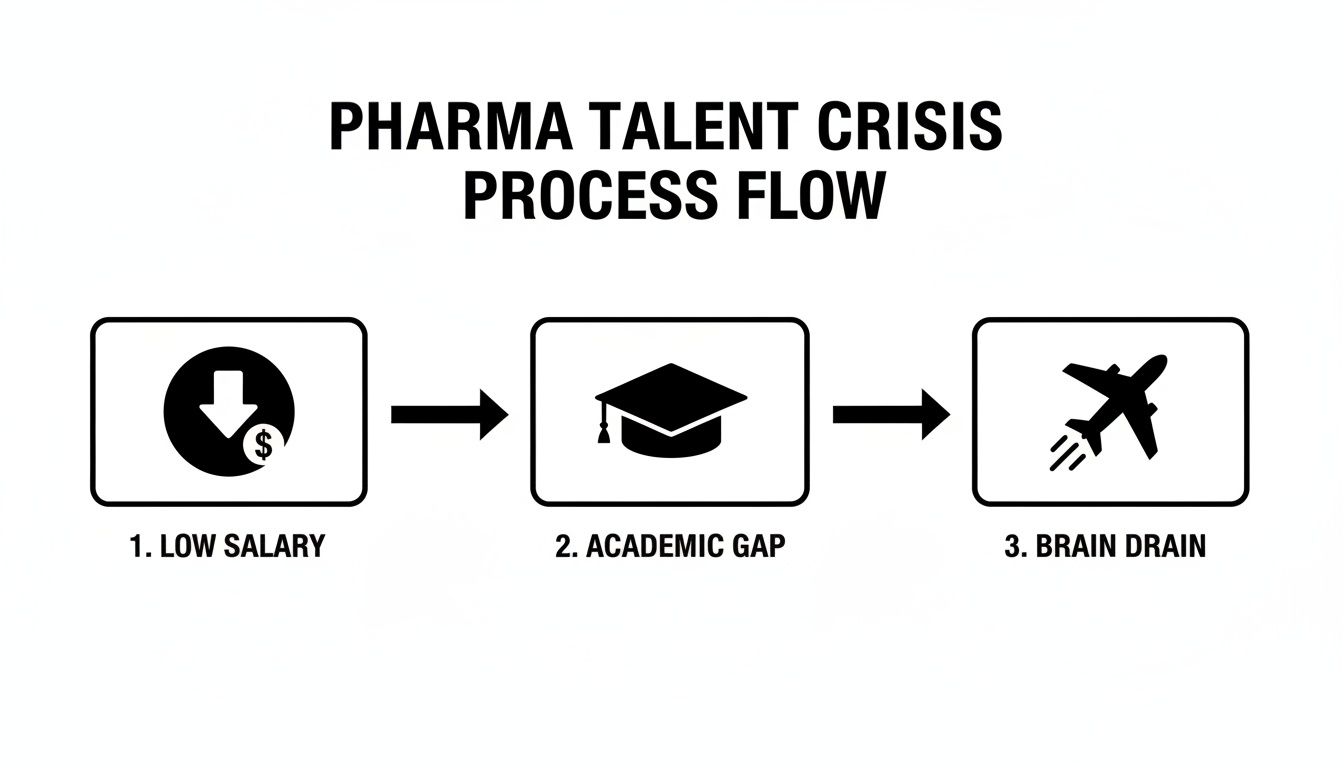
Looking at this, it’s obvious that just throwing more money at the problem won’t work. A real solution has to tackle all three pressure points at once.
Go Where the Talent Lives Digitally
Your best candidates aren’t just sitting on job boards waiting for you. They’re active in niche digital communities, discussing industry trends, sharing knowledge, and quietly exploring their next career move. You need to be there, too, and engage authentically.
- Niche Industry Forums: Find and become a regular in LinkedIn groups and online forums focused on pharmaceutical manufacturing, QA, and regulatory affairs. This isn’t just a job for recruiters; your own subject matter experts should be in there contributing to the conversation.
- Targeted Digital Sourcing: Use the advanced search filters on platforms like LinkedIn to pinpoint professionals with very specific skills, like experience in continuous manufacturing or GMP compliance for biologics. A personalised message will always beat a generic, automated one.
This digital-first approach lets you tap into the rich pool of passive candidates, the talented people who aren’t actively job hunting but are open to the right opportunity. It’s all about building relationships before you even have an open role.
Forge Powerful Academic Partnerships
A huge part of the talent shortage comes from the gap between what’s taught in a university and what’s needed on the factory floor. The most forward-thinking companies are closing this gap themselves by building deep, strategic partnerships with academic institutions.
This goes way beyond setting up a booth at a campus job fair. Think bigger:
- Curriculum Co-Development: Get involved with local universities and technical colleges to help shape their pharmaceutical sciences and engineering programmes. Have your team members serve as guest lecturers to give students real-world context on critical topics like GMP and data integrity.
- Structured Internship Programmes: Create meaningful, project-based internships that give students in quality assurance and regulatory affairs real work to do. These programmes act as a long-term interview process and create a direct pipeline for your entry-level roles.
- Sponsored Research and Labs: Offer to fund research projects or help equip a lab with modern equipment. This builds your brand on campus and gives you early access to the brightest students and their work.
When you do this right, academia becomes your long-term talent development partner, producing graduates who are far more industry-ready from day one.
Your Employer Value Proposition is the answer to a candidate’s most important question: “Why should I work for you over anyone else?” It must go beyond salary and speak directly to their desire for impact, growth, and meaningful work.
Craft an Irresistible Employer Value Proposition
To attract the best manufacturing talent in pharma, a competitive salary is just the entry fee. Your EVP is the promise you make to your people. It needs to be authentic, compelling, and woven into every touchpoint, especially your job descriptions.
So, what do pharma professionals actually want? Our research and experience show they prioritise:
- Clear Career Pathways: They need to see a future. Your job descriptions should map out potential growth, showing how a QA Analyst can become a Quality Manager, for instance.
- Innovative Technology: Top talent wants to work with modern tools, not outdated systems. Highlight your investments in automation, data analytics, and continuous manufacturing.
- Societal Impact: Never let them forget the mission. Frame their role in the powerful context of producing life-saving medicines and improving public health. For more on this, check out our guide on how to attract top talent with purpose-driven employer branding.
By embedding these elements into your recruitment messaging, you stop posting simple job ads and start creating powerful marketing tools. You begin to attract candidates who are genuinely aligned with your mission and culture, and that’s how you build a resilient talent pipeline that lasts.
Building Your Own Talent Through Strategic Upskilling
Attracting new people is a critical battlefront, but winning the war for manufacturing talent in pharma requires opening a second front inside your own organisation. Simply relying on external hiring is a slow, expensive, and ultimately unsustainable strategy. The real power move is to transform your company into a talent-producing engine, systematically developing the skilled professionals you need from the people you already have.

This “build-from-within” approach directly counters the brain drain and skills gap, creating a sustainable advantage that competitors will struggle to replicate. It’s about taking control of your talent destiny rather than being at the mercy of a volatile market.
Establish a Manufacturing Centre of Excellence
Your first move should be to centralise your upskilling efforts by establishing a dedicated ‘Centre of Excellence’ (CoE) for manufacturing talent. This is not just another training department. Think of a CoE as a strategic hub responsible for designing, implementing, and measuring all skill development initiatives across your production sites.
Its core mandate is to close the dangerous gap between theoretical knowledge and the practical, compliant realities of the GMP floor. This means creating custom training modules that address your specific operational needs and technological roadmap.
Key functions of the CoE should include:
- Curriculum Design: Collaborating with floor supervisors and quality heads to build training that directly maps to job roles and compliance requirements.
- Competency Mapping: Defining the exact skills needed for each role, from entry-level operator to senior technician, and assessing your current workforce against this benchmark.
- Trainer Development: Identifying and coaching your own internal subject matter experts to become effective instructors, ensuring the knowledge being passed down is practical and battle-tested.
By formalising this function, you shift from ad-hoc training to a structured, scalable system for talent creation. It becomes an integral part of your operational strategy, not an HR afterthought.
Accelerate Knowledge Transfer with Mentorship
One of the biggest risks in pharma manufacturing is the loss of “tribal knowledge” when veteran employees retire or leave. These are the experts who know the intricate details of a specific production line or a piece of legacy equipment, knowledge that isn’t written in any manual. A structured mentorship programme is your best defence against this loss.
This involves more than just assigning a “buddy” to a new hire. An effective programme pairs seasoned experts with promising junior employees or new recruits in a formalised, goal-oriented relationship.
Mentorship is the most effective tool for transferring tacit knowledge, the unwritten rules, instincts, and deep process understanding that separate an adequate performer from a true expert. It turns experience into a scalable asset.
For instance, a senior QA inspector with 20 years of experience could be paired with a high-potential junior analyst. Over a 6-to-12-month period, they would work together on real-world issues like deviation investigations and CAPA implementation, accelerating the junior employee’s learning curve by years. This deliberate transfer of wisdom is crucial for building your next generation of leaders and technical experts.
Foster a Culture of Continuous Learning
To truly build a sustainable talent advantage, learning can’t be a one-off event. You must foster a culture where skill development is continuous, accessible, and baked into the daily workflow. Thankfully, modern tools can make this a reality without pulling people off the floor for extended periods.
Think about using:
- Micro-learning Modules: Deliver short, 5-10 minute digital training sessions on specific topics directly to employees’ tablets or workstations. This could be a quick refresher on a specific SOP or an update on a new data integrity protocol.
- Virtual Reality (VR) Simulations: For complex or high-risk tasks, VR is a game-changer. A new operator can practise aseptic gowning procedures or troubleshoot a simulated bioreactor failure in a safe, virtual environment before ever touching real equipment. This builds muscle memory and confidence without risking product or safety.
A prime example is using VR to train technicians on a new, complex filling line. They can learn the setup, operation, and common troubleshooting steps in a simulated environment. This drastically cuts down the ramp-up time and error rates once they are on the actual line, directly impacting both efficiency and compliance. This modern approach to training shows a real investment in your people, which is a powerful factor in retention.
Partnering with an RPO for Strategic Growth
In the constant battle for talent, many pharma CHROs still see external recruitment as just another line item, a necessary cost. It’s time for a major rethink. Viewing Recruitment Process Outsourcing (RPO) as a simple vendor relationship is a huge missed opportunity.
Instead, start thinking of a specialised pharma RPO provider as a genuine strategic partner. They are an extension of your own team, bringing crucial market intelligence, sourcing muscle, and a level of scalability that even the most dedicated internal HR teams find hard to match.
This isn’t just about handing off the task of filling jobs. It’s about bringing in a partner who lives and breathes the unique demands of pharma manufacturing talent. They get the nuances of roles in quality assurance, regulatory affairs, and GMP-compliant production. This frees up your internal team from the endless, time-consuming cycle of high-volume recruitment.
With a true partner handling the entire recruitment lifecycle, from sourcing and screening all the way to onboarding, your team can finally focus on bigger-picture initiatives. Think employee retention, developing future leaders, and building an irresistible company culture. Your talent function shifts from a reactive cost centre to a proactive engine for growth.
Moving Beyond Transactional Recruiting
There’s a world of difference between a traditional recruitment agency and a true RPO partner. An agency typically gets paid per placement, which often incentivises speed over the right long-term fit. They fill a role, send an invoice, and move on. It’s a short-term, transactional fix.
A strategic RPO partnership, on the other hand, is a long-term commitment. The partner embeds themselves into your organisation, learning your culture, understanding your business goals, and operating on shared success metrics. These might include time-to-fill, quality of hire, and first-year retention rates. This alignment means they’re just as invested as you are in finding people who will not just join, but thrive.
A transactional recruiter fills a seat. A strategic RPO partner builds your future workforce. They bring dedicated sourcing technology, analytics, and market mapping capabilities that are often too costly or specialised for a single company to develop internally.
This partnership delivers far more than just candidates. It provides a constant stream of market intelligence, like what your competitors are paying and how skill demands are shifting across the industry. This data empowers you to make smarter, more strategic decisions about everything from workforce planning to your employer brand. For a deeper look, you can learn more about why RPO is the answer for filling niche roles in the pharma industry.
An RPO Partnership in Action
Let’s look at a real-world example. A mid-sized Indian pharma company was finding it impossible to staff its new biologics manufacturing unit. Their internal team was completely swamped. Critical Quality Control (QC) roles sat vacant for months, putting production validation way behind schedule. For these specialised roles, their average time-to-fill was a painful 120 days.
Everything changed when they brought in a specialised pharma RPO partner. The RPO provider immediately rolled out a multi-channel sourcing strategy that included:
- Proactive Talent Pooling: They started building a pipeline of qualified QC analysts and microbiologists before the roles were even officially open.
- Targeted Outreach: The team actively engaged passive candidates on niche scientific forums and professional networks where top talent gathers.
- University Partnerships: They built relationships with top universities to connect with promising graduates from key life sciences programmes.
The RPO partner also took over the entire screening process. Using their deep industry expertise, they conducted the initial technical assessments, which meant hiring managers only saw the most qualified, culturally aligned candidates.
The results were immediate and impressive. The company slashed its average time-to-fill for those critical QC roles from 120 days down to just 72 days, a 40% improvement. Even better, the quality of hires went up significantly, which they saw in lower first-year attrition and new employees getting up to speed much faster. This shows how an RPO partnership isn’t just about hiring faster; it’s about hiring better and more strategically to directly fuel business growth.
Of course. Here is the rewritten section, crafted to sound like an experienced human expert, following all the specified requirements for tone, style, and formatting.
Your Questions on Pharma Talent Strategy Answered
Even the most well-designed talent strategy can feel daunting to put into practice. As a CHRO, you aren’t just rolling out a new process; you’re spearheading a cultural and operational shift that’s vital for your company’s future. Let’s tackle some of the common questions and strategic hurdles that always come up when solving manufacturing talent shortages in pharma.
How Can We Justify the RPO Partnership Investment to Our Board?
Framing this conversation is everything. You need to position a Recruitment Process Outsourcing (RPO) partnership not as a cost, but as a strategic investment in growth and risk mitigation. Your board understands one thing above all else: revenue. They know that production bottlenecks and compliance failures are direct threats to it.
An RPO partner is your direct answer to the talent shortages causing those exact problems.
Build your return on investment (ROI) case around clear, tangible outcomes that speak their language:
- Reduced Time-to-Hire: Quantify what it costs the business every day a critical quality assurance or production role sits empty. Show them the revenue impact of filling those roles weeks, or even months, faster.
- Lower Cost-per-Hire: Specialised sourcing and efficient processes simply mean you spend less to acquire top-tier talent compared to relying on expensive, generalist agencies or an already overwhelmed internal team.
- Improved Retention: A huge, often overlooked, benefit of a good RPO is getting the right person in the right seat. Better fit means lower first-year turnover, which has a direct and significant impact on your bottom line.
A seasoned RPO partner also brings invaluable market intelligence to the table, helping you avoid costly hiring missteps. It’s an offensive move to secure the people you need to hit production targets and a defensive one to guard against eye-watering regulatory penalties.
Think of an RPO partnership as de-risking your talent supply chain. You’re investing in a system that guarantees a consistent flow of qualified candidates, insulating your production schedule from the volatility of the talent market.
This reframing shifts the conversation from a line-item expense to a necessary piece of your operational infrastructure, just as critical as investing in new manufacturing equipment.
Our Biggest Challenge Is Retaining Talent. How Can These Strategies Help?
This is a common and absolutely critical concern. The real insight here is that retention begins with recruitment. Every strategy we’ve discussed is designed to improve retention from the very first moment you engage with a potential employee.
When recruitment is rushed and purely transactional, you almost always end up with a mismatch. That leads directly to those costly early exits. A strategic approach, often executed with a skilled RPO partner, ensures you’re hiring for long-term cultural and role alignment, not just filling an open headcount.
Beyond that, building a robust Employer Value Proposition (EVP) is a powerful retention magnet. When you clearly articulate career pathways, learning opportunities, and the real-world impact of the work, you attract people whose personal and professional goals already line up with yours. They walk in the door with realistic expectations and a clear vision for their future at your company.
Finally, a deep investment in internal skill development and upskilling programmes is one of the most effective retention tools you have. When your team sees a clear path for growth and feels the company is investing in them, their loyalty and engagement skyrocket. It turns hiring into the first step of a long-term employee engagement strategy, not the last.
Are These Solutions Practical for Smaller Pharma Companies?
Absolutely. In fact, for a smaller or mid-sized pharma company, the negative impact of a single vacant critical role is often magnified. While you may not have the budget of a global giant, the core principles of strategic talent acquisition and development are not only practical but essential for survival and growth.
The key is to be targeted and focused. You don’t need a massive budget to get started.
- Start Small and Prove Value: Instead of a company-wide overhaul, pick your single most critical talent gap. Is it a chronic shortage of Quality Control analysts? Focus all your initial energy there.
- Localised Partnerships: You don’t need a national academic partnership. Connect with one or two local technical colleges to create a structured internship programme specifically for those QA/QC roles.
- Pilot an RPO Engagement: Try out an RPO provider for a single, notoriously hard-to-fill position. Use the measurable results, like a 30% reduction in time-to-fill, to build a powerful business case for a broader partnership.
The goal is to start with a manageable pilot, generate clear wins, and use that success to get the buy-in you need to expand. This incremental approach makes these powerful solutions accessible and incredibly effective for organisations of any size.
Ready to build a resilient talent pipeline that fuels your growth? Taggd specialises in RPO solutions for the pharmaceutical industry, connecting you with the skilled manufacturing talent you need to overcome shortages and achieve your production goals. Learn how we can become your strategic growth partner.