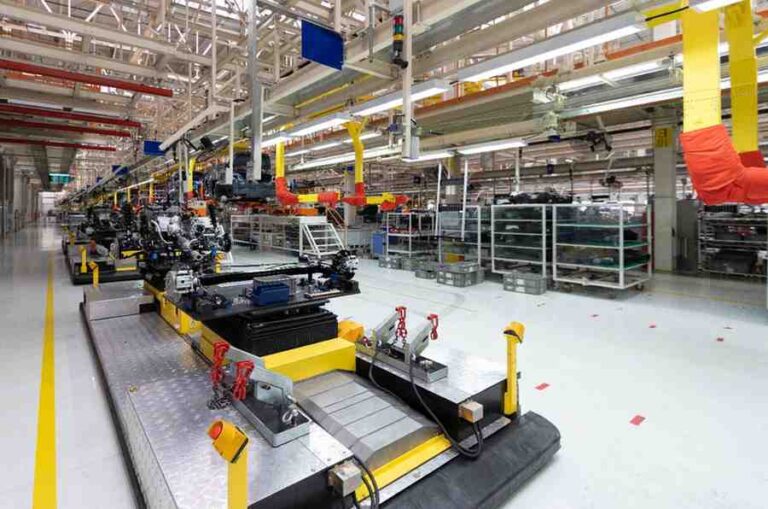
The manufacturing sector is growing, but finding the right people to power that growth is proving to be a monumental task. The real challenge and the solution is to modernise our hiring playbook. We need to move away from outdated methods and embrace strategic approaches like upskilling, recruitment marketing, and flexible staffing models to meet the demands of a tech-driven industry.
The Paradox In Modern Manufacturing
There’s a strange conflict at the heart of today’s manufacturing industry. On one side, production and consumer demand are surging ahead. On the other, the talent pipeline needed to keep the wheels turning is running dry, leaving mission-critical roles empty.
It’s like having a high-performance engine that can’t get enough fuel to run at full speed.
This paradox has become a serious bottleneck for Chief Human Resources Officers (CHROs) and business leaders. We’re seeing massive growth opportunities slip away because of a persistent talent shortage, making it almost impossible to scale operations. In fact, more than 65% of firms now say that recruiting and retaining workers is their primary business challenge.
The Widening Chasm Of Talent And Need
The gap between what the industry needs and the talent that’s available isn’t just a small crack; it’s a chasm. India’s manufacturing sector is a perfect example. The industry is booming, set to grow at a CAGR of 4.8% from 2025 to 2030 and on track to create 100 million new jobs in the next decade.
But here’s the problem: only a tiny fraction of the workforce possesses the specialised skills required on today’s automated shop floors. You can explore more data on the Indian manufacturing workforce to see just how wide this gap has become.
This skills deficit is just one of several major hurdles that traditional hiring methods simply can’t clear. This guide is designed to be a practical playbook for CHROs, moving beyond simply naming the problems to delivering real, actionable solutions.
The old approach of posting a job and waiting for applicants to roll in is broken. Success now demands a proactive, strategic approach to talent acquisition one that builds a strong pipeline, develops skills from within, and actively markets the modern manufacturing career.
To help you get started, let’s quickly break down the primary recruitment challenges you’re likely facing.
Snapshot Of Key Manufacturing Recruitment Challenges In 2026
The challenges on the factory floor are deeply interconnected, creating a complex web that can stifle growth and innovation. The table below summarises the core obstacles CHROs must navigate to build a future-ready workforce.
| Challenge | Impact On Business | Key Statistic |
|---|---|---|
| The Widening Skills Gap | Inability to operate new machinery and technology, leading to production delays and lost competitive advantage. | A potential $1 trillion loss in revenue by 2030 due to skills shortages in the US alone. |
| An Ageing Workforce | Loss of decades of institutional knowledge and leadership as experienced workers retire, creating an experience vacuum. | Nearly 25% of the manufacturing workforce is age 55 or older, with retirement rates accelerating. |
| High Employee Turnover | Increased recruitment costs, training expenses, and productivity losses due to a constant “revolving door” of talent. | Some manufacturing roles see turnover rates as high as 38%, far exceeding the all-industry average. |
| A Challenging Employer Brand | Difficulty attracting younger, tech-savvy generations who hold outdated, negative perceptions of factory work. | Less than 50% of young people perceive manufacturing careers as desirable. |
Understanding how these issues feed into one another is the first critical step. Throughout this guide, we’ll dive deeper into each challenge and provide a clear roadmap to transform your recruitment process from a reactive necessity into a powerful strategic advantage.
Why Your Current Hiring Strategy Is Failing
If your hiring feels like you’re constantly fighting fires, there’s a good reason. The old playbook post a job and wait for the perfect candidate simply doesn’t cut it anymore. Those tried-and-true methods that built your workforce a decade ago are now actively working against you, creating a chasm between what your operations need and what your talent pipeline can deliver.
To get a handle on your manufacturing recruitment challenges, you first need to diagnose where things are breaking down. It’s not just a shortage of applicants; it’s a fundamental mismatch between old tactics and the new realities of the factory floor.
This isn’t one single point of failure. It’s a series of interconnected problems running through your entire talent process. Let’s break down the real reasons your strategy is falling short.
The Great Skills Disconnect
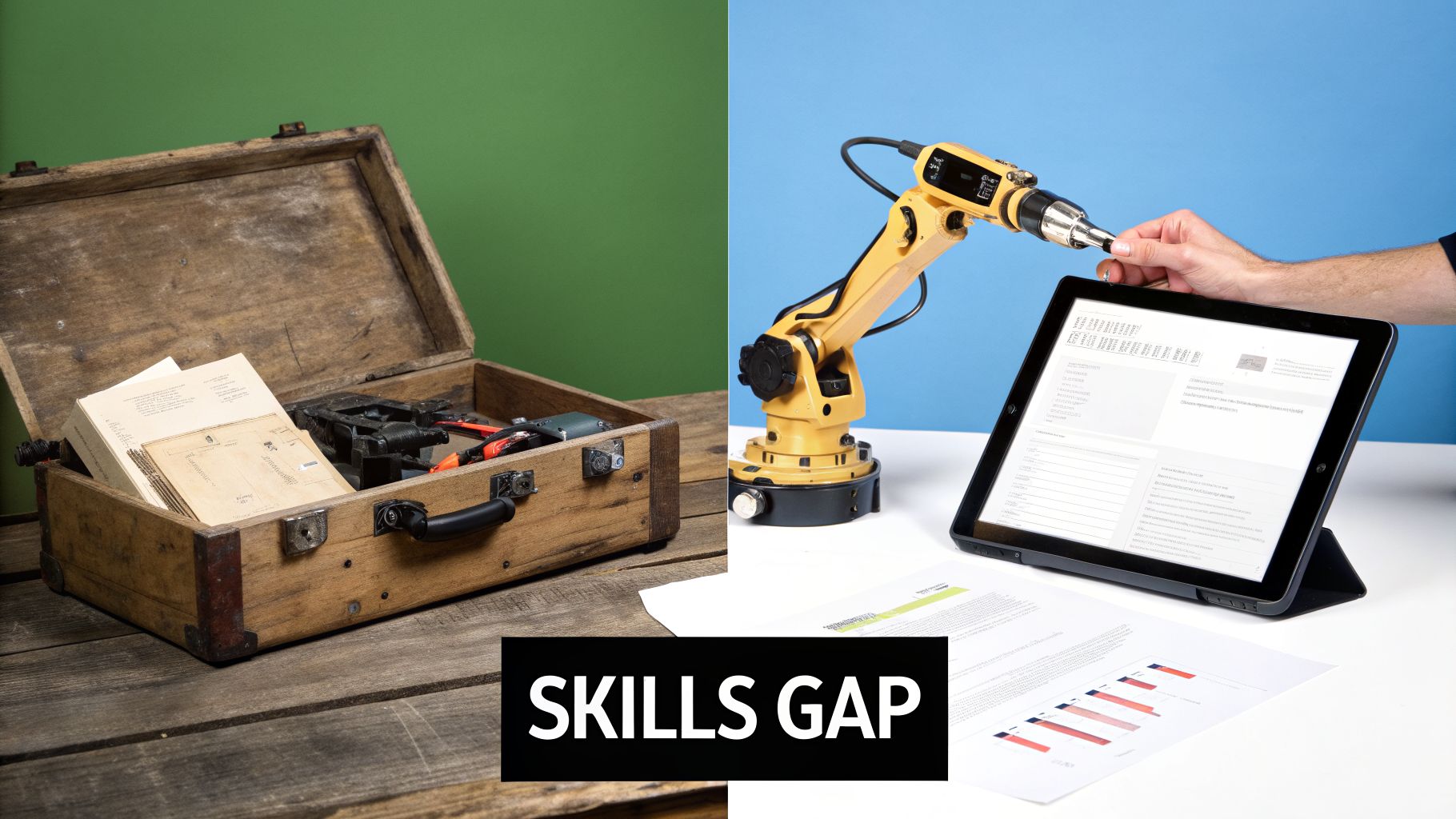
The most glaring problem is the widening skills gap. Your organisation needs people who can run and troubleshoot sophisticated machinery the kind powered by IoT and robotics. Yet, many vocational programmes are still teaching skills better suited for last-generation equipment.
Think of it this way: your factory has upgraded to high-performance race cars, but your recruitment pipeline keeps sending mechanics who only know how to fix vintage tractors. This leaves you with a tough choice: either pour money into extensive retraining or let that expensive new technology sit idle. The issue isn’t a lack of people; it’s a lack of people with the right skills from day one.
The true cost of the skills gap isn’t just the open roles. It’s the lost productivity, the stalled innovation, and the failure to capitalise on new technology that eats directly into your bottom line.
Just throwing more money at advertising to get more applicants won’t solve this. The real solution lies in building the talent you need, not just trying to find it.
The Unplanned Knowledge Drain
Another critical blind spot is the lack of a real succession plan for your ageing workforce. Many manufacturers are propped up by the deep, unspoken knowledge of veteran employees nearing retirement. When they walk out the door, they take decades of priceless experience with them, the little tricks to keep a machine running, the informal process shortcuts, and the problem-solving instincts that were never written down in any manual.
Losing these employees isn’t just backfilling a role; it’s like watching a library burn down. Without a formal way to capture and transfer this expertise, your new hires are forced to relearn painful and costly lessons, leading to more production errors and longer downtimes. Your current strategy is likely geared towards filling a vacant spot, not preserving and passing on critical knowledge.
Why Your Best People Really Leave
It’s easy to blame high turnover on pay, but the real story is often more complicated. While competitive compensation is table stakes, the factors that truly drive your skilled people away are usually baked into your organisation. This is a massive issue across India, where high worker migration plagues the manufacturing landscape.
Despite employment growing 5.92% year-on-year in FY24, factories in major industrial hubs are struggling to hold onto talent. As we’ve seen, employees frequently move on in search of better conditions, causing constant disruption to production. You can explore more insights on the Indian manufacturing sector’s growth and talent challenges on Peoplelogic.in.
Beyond the paycheque, the most common reasons good people leave are systemic:
- Rigid Scheduling: A refusal to offer any form of flexibility alienates modern workers who expect more control over their work-life balance, pushing them toward the gig economy or other industries entirely.
- Dead-End Career Paths: When employees can’t see a clear path for growth or skill development, they have zero incentive to stay. They become easy pickings for competitors who can offer them a future.
- A Stagnant Work Environment: Today’s talent wants to be part of something moving forward. A culture that resists change and fails to invest in modern tools signals that the company is falling behind, and so will their careers if they stay.
Your recruitment strategy might be getting people through the door, but if your organisation doesn’t give them a compelling reason to stay, you’re just feeding a revolving door that inflates costs and destroys morale. To fix your manufacturing workforce challenges, you have to look inward at retention just as much as you look outward at recruitment.
Building A Modern Talent Pipeline That Works
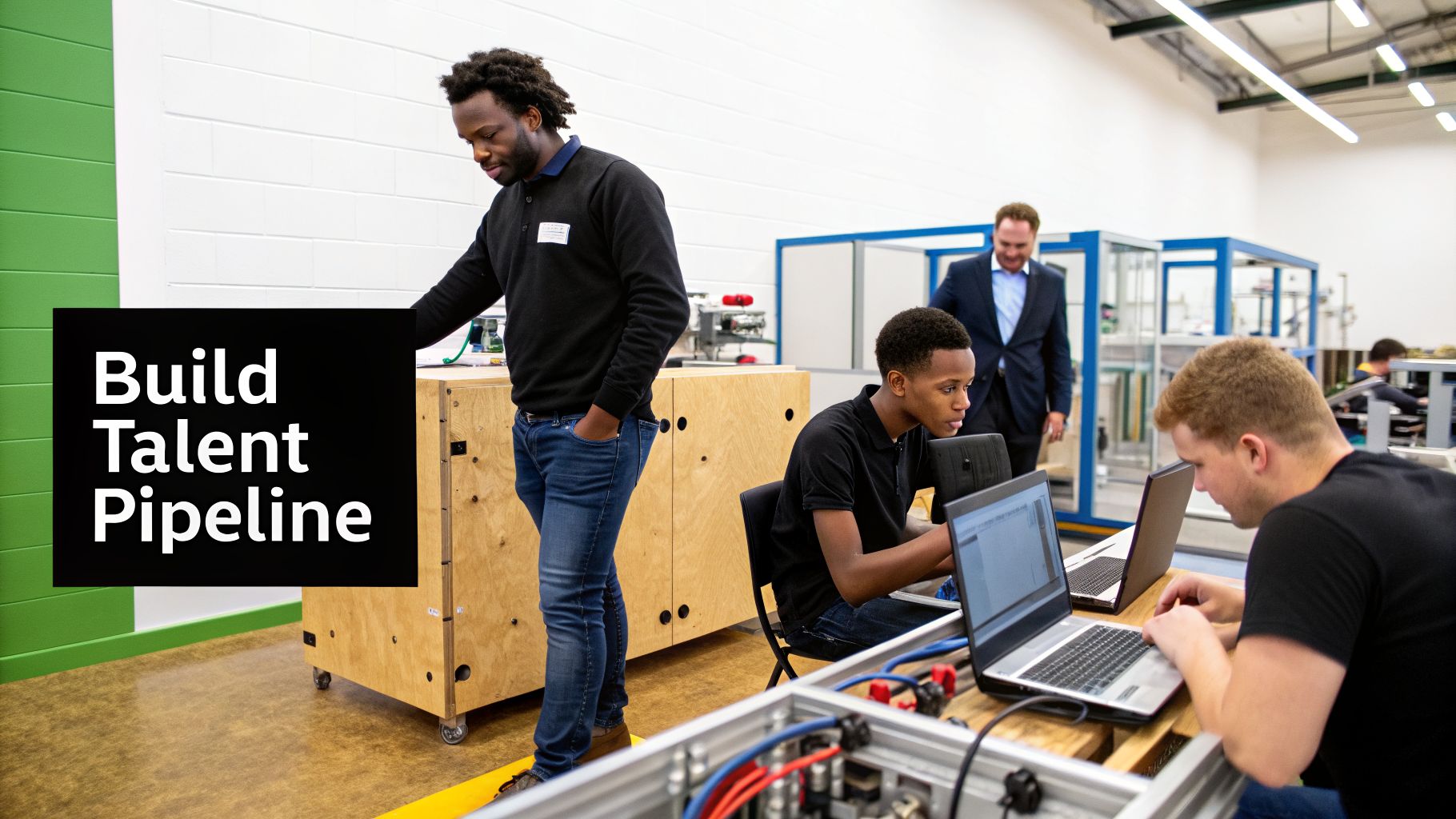
Alright, you’ve identified the root causes of your hiring struggles. That was the diagnosis. Now, it’s time for the cure. To get a handle on today’s complex manufacturing recruitment challenges, you have to stop waiting for candidates to come to you and start building the workforce you need, proactively.
Think of it as the difference between hunting and farming. The old way was to hunt for talent, a frantic search that often came up empty. The modern approach is to cultivate your own talent farm, ensuring you always have a steady supply of skilled people who are a perfect fit for your factory floor. This is your blueprint for building that farm.
The heart of this strategy is a multi-pronged attack that takes on each of the big challenges directly. From closing the skills gap with in-house training to tackling high turnover, these solutions work together to build a powerful, self-sustaining talent engine for your organisation.
Closing The Skills Gap By Building Talent In-House
The most direct way to solve the skills gap is to stop searching for non-existent “perfect” candidates and simply build your own. Creating a robust apprenticeship programme or an in-house training academy lets you mould talent to your exact specifications. This approach can turn promising candidates who have high potential but low experience into loyal, highly skilled specialists.
These programmes can take a few different forms:
- Apprenticeships: Pair new hires with your veteran employees to pass on that critical know-how before it walks out the door. This is your best defence against the brain drain from an ageing workforce.
- Internal Academies: Set up dedicated training centres that teach the specific skills needed for your advanced machinery, mixing classroom learning with hands-on practice.
- Upskilling Programmes: Give your current employees clear paths to learn new skills. This prepares them for bigger roles and shows you’re invested in their careers.
This “build-your-own” approach is a cornerstone of a healthy talent pipeline. To dig deeper into this idea, check out our detailed guide on how to develop a robust talent pipeline strategy that delivers results.
Fighting Turnover With Flexibility And A Future
High turnover is rarely just about the money. It’s usually a sign of a poor employee experience. If you want people to want to stay, you need to fix the real reasons they leave. The solution has two parts: offer flexibility wherever you can and show them a clear path forward.
Today’s workers value having some control over their lives. While assembly line work has its limits, flexible staffing models can give them more autonomy. Think about offering four 10-hour shifts, weekend-only options, or predictable part-time schedules that might appeal to students or semi-retired workers.
Retention isn’t a separate job from recruitment; it’s the final stage. A successful hire is one who stays, grows, and contributes long-term. Investing in retention protects your initial recruitment investment and builds a more stable, experienced team.
Just as important is showing employees a clear career path. When someone sees real opportunities for growth and skill development, they have a powerful reason to stick around. This is how you turn a “job” into a “career,” a critical shift for keeping your best people.
Fixing Your Brand With Modern Recruitment Marketing
You can’t attract top talent if their image of your company is stuck in the past. To fix a stale employer brand, you must actively market your company as a modern, tech-forward place to build a career. This is what recruitment marketing is all about.
It’s about more than just posting job ads; it’s about telling your story.
- Social Media Showcases: Use platforms like Instagram and LinkedIn to share high-quality photos and videos of your clean, modern factory floor and your team in action.
- Employee Stories: Feature testimonials from current employees. Let them talk about their career growth, the cool technology they get to use, and the positive company culture.
- Virtual Factory Tours: Create immersive videos that give potential candidates a look behind the curtain, busting old myths about “dark, dirty” factories for good.
A smart recruitment marketing plan is absolutely essential for changing perceptions and attracting the next generation of manufacturing talent.
The Engine Behind The Strategy: A Recruitment Partner
Let’s be realistic. Putting all of this into motion building training programmes, creating new schedules, running marketing campaigns, is a huge amount of work. This is where a specialised Recruitment Process Outsourcing (RPO) provider can become the engine that drives your entire strategy.
A great RPO partner does more than just find candidates. They help you build the entire talent infrastructure. They can manage sourcing and screening at scale, use technology to find hidden talent pools, and give you the market data you need to make competitive offers. They become an extension of your own HR team, bringing the expertise and bandwidth to turn these ideas into reality and solve your manufacturing recruitment challenges for good.
The Strategic Power of a Recruitment Partner
Bringing on a specialised recruitment partner isn’t just a tactic for filling roles faster anymore. It’s a strategic move to turn your talent acquisition from a reactive cost centre into a proactive powerhouse for your business. Think of it like this: your internal team is running the day-to-day race, keeping the engine going. A Recruitment Process Outsourcing (RPO) partner is the specialised pit crew, giving you the high-performance tools and market intelligence to win.
They don’t just work for you; they work as an extension of your organisation. This partnership brings focused expertise, new technology, and a deep understanding of the talent market right to your doorstep, things that are incredibly expensive and time-consuming to build from scratch. It’s about levelling up your entire hiring game to compete for the best people out there.
Gaining an Edge with the Right Tech
A top-tier RPO partner brings a serious technology advantage that’s miles ahead of just posting on job boards. They have access to advanced AI sourcing tools that can sift through millions of online profiles, finding those perfect-fit, passive candidates who aren’t even looking for a job but have the exact skills you need.
They also use predictive talent analytics, crunching data to pinpoint which candidates are most likely to thrive in your specific work environment and stick around for the long haul. This data-driven approach moves hiring from guesswork to a calculated science.
An RPO partner essentially gives you an enterprise-grade recruitment technology department without the huge capital investment. It’s an instant upgrade to how you find, screen, and select new hires.
This tech doesn’t just speed things up; it dramatically improves the quality of your hires and slashes the time it takes to get critical roles filled and productive.
Scalability on Demand
Let’s be honest, manufacturing has its ups and downs. One quarter you’re scrambling to staff a whole new production line, the next you’re scaling back because of a market dip. Trying to maintain a large, fixed in-house recruitment team through these cycles is a recipe for inefficiency.
This is where an RPO partner really shines. They offer scalability you just can’t get internally.
- Ramping Up: Need to hire 200 skilled technicians for a new plant opening? Your RPO partner can deploy a dedicated team of recruiters almost overnight to hit that target, saving you the headache of hiring and training temporary staff.
- Scaling Down: If the market slows, you can simply scale back the RPO service. A fixed overhead cost instantly becomes a flexible operational expense.
This agility means your recruiting firepower always matches your business needs. You avoid costly delays during growth spurts and don’t waste money during slower periods. To get a better sense of the full picture, you can learn more about the diverse benefits of recruitment process outsourcing on our blog.
Checklist for Selecting Your Manufacturing RPO Partner
Choosing the right partner is a make-or-break decision. A mismatched provider can be just as frustrating as a flawed internal process. To make the right call, you need to go in with a clear evaluation plan.
Here’s a practical checklist to help you vet potential RPO providers and find one that truly understands the unique demands of the manufacturing world.
| Evaluation Criteria | Key Questions to Ask | Desired Outcome |
|---|---|---|
| Manufacturing Expertise | Do they have a proven track record with other manufacturing clients in your sector? Can they talk specifics? | Deep, genuine understanding of your roles, safety standards, and factory floor culture. |
| Technology Stack | What sourcing and analytics tools do they use? How will they integrate with our existing Applicant Tracking System (ATS)? | Access to modern AI sourcing, predictive analytics, and a promise of seamless, hassle-free integration. |
| Cultural Alignment | Does their communication style and core values feel like a good fit for our company? | A true partnership that feels like you’ve gained a new, expert wing of your own HR team. |
| Scalability & Flexibility | How do they handle sudden spikes or drops in hiring needs? What does that process look like? | A flexible model that adapts to your business cycles without surprise fees or penalties. |
| Performance Metrics | How will you measure success? What specific KPIs will be on our weekly/monthly report? | Clear, transparent reporting on the metrics that matter, like quality-of-hire, time-to-fill, and cost-per-hire. |
By asking these sharp, focused questions, you can cut through the sales pitch. You’ll get to the heart of whether a provider has what it takes to solve your hiring challenges and deliver a return you can actually measure.
Your Implementation Roadmap and Success Metrics
Overhauling your manufacturing recruitment isn’t something that happens overnight. It’s a deliberate journey, not a one-off fix. A structured roadmap is what separates wishful thinking from a strategy that delivers real, measurable results on the factory floor. It breaks the entire process into manageable phases, preventing overwhelm and building momentum.
Think of it like commissioning a new production line. You wouldn’t just start welding pieces together without a detailed blueprint. This roadmap is your blueprint for talent acquisition, guiding you from an honest look in the mirror to full-scale optimisation.
Phase 1: Assessment and Strategy
The first phase is all about diagnosis. Before you can start applying solutions, you need a crystal-clear picture of your specific hiring pains. This means taking a deep, honest look at your current recruitment processes, performance data, and how you stack up in the market.
Key activities during this phase include:
- Auditing Current Processes: Map your entire hiring journey, from the moment a job is posted to a new hire’s first day. Where are the bottlenecks? Where do good candidates drop off?
- Analysing Historical Data: Dig into metrics like time-to-fill, cost-per-hire, and new hire turnover over the last 24 months. What patterns emerge?
- Conducting Stakeholder Interviews: Talk to the people on the ground. Get the unvarnished truth from hiring managers, recent hires, and even your long-term shop floor veterans about the recruitment experience.
The goal here isn’t just to collect data, but to form a clear hypothesis about your core challenges. This groundwork ensures that the strategies you build next are aimed at the right targets.
Phase 2: Pilot Programme and Partnership
With your challenges clearly defined, it’s time to test your solutions on a smaller, controlled scale. Launching a pilot programme lets you refine your approach, work out the kinks, and gather early proof of success before committing to a company-wide rollout. This is also the perfect time to bring in a specialised recruitment partner.
During this phase, you will:
- Define the Pilot Scope: Choose a specific department, role type, or facility to be your testing ground. For example, you might focus solely on improving how you hire skilled technicians for a single production line.
- Select an RPO Partner: Use a structured evaluation process to choose a recruitment process outsourcing (RPO) partner who genuinely understands the manufacturing sector and has the right tech and expertise.
- Launch and Monitor: Execute your new strategies within the pilot group, tracking performance closely and gathering constant feedback from everyone involved.
A pilot programme is your safety net. It de-risks the investment by providing a safe space to prove that new methods, like targeted recruitment marketing or better screening actually deliver better results.
This is how you build an undeniable business case for broader change, backed by real-world data from your own operations.
Phase 3: Scaling and Optimisation
Once your pilot has proven its worth, the final phase is to scale those successful strategies across the entire organisation. This means standardising the new processes, training your internal teams, and putting a system in place for continuous improvement. The goal is to make recruitment excellence your new standard operating procedure.
A strategic RPO partnership is the engine for this phase, bringing together the right technology, the ability to scale up or down, and deep market expertise.
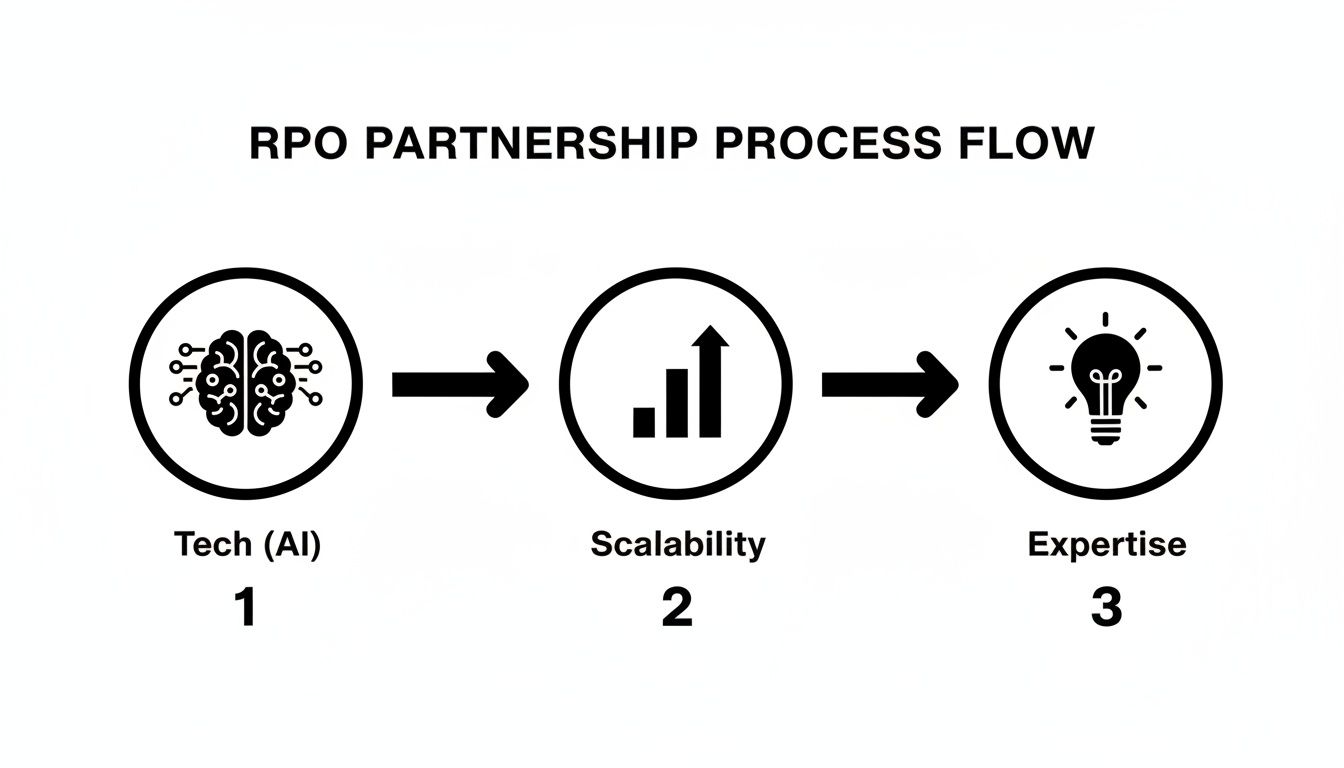
As you can see, a great partner blends smart tech and flexible scale, guided by specialised expertise, to drive results that matter.
Measuring What Truly Matters
To prove the real value of your new strategy, you have to look past the old, often misleading, recruitment metrics. Tracking the right Key Performance Indicators (KPIs) is how you show that talent acquisition is a direct driver of business outcomes.
Instead of just chasing speed, measure the real impact with these KPIs:
- Quality of Hire: This is the ultimate metric. You can measure it by tracking the 90-day performance review scores of new employees. Are they hitting their targets and fitting in? That’s a quality hire.
- Cost Per Skilled Hire: Don’t settle for a generic cost-per-hire. Isolate the total investment it takes to bring in a certified welder or a robotics technician. This tells you the true cost of acquiring business-critical skills.
- Reduction in New Hire Turnover: Track the percentage of new recruits who leave within their first six or twelve months. A falling number here is powerful proof that you’re finding and hiring people who are a much better fit from the get-go.
When you focus on these metrics, you can clearly show the ROI of your efforts and prove to the C-suite how great recruitment directly fuels the company’s bottom line.
Frequently Asked Questions
As you start to modernise your approach to tackling recruitment in the manufacturing world, it’s only natural for some practical questions to pop up. We’ve gathered the most common queries from CHROs like you to provide clear, straightforward answers that will help you navigate the strategic shifts we’ve discussed.
How Can We Justify The Cost Of An RPO Partnership To The Board?
The key is to frame it as an investment in growth and efficiency, not just another line-item cost. The most powerful argument you can make revolves around the ‘Total Cost of Vacancy’. This isn’t just about the recruiter’s fee; it’s the real, tangible impact of an empty role on your business, think lost production, overtime for overworked staff, and missed growth opportunities.
An RPO partner directly targets these hidden expenses. By filling roles faster with better-qualified candidates who are more likely to stick around, you reduce the costly churn that drains your budget and disrupts your operations.
The ROI of an RPO partnership isn’t just a number on a spreadsheet. It’s measured in lower new-hire turnover, higher productivity on the factory floor, and the strategic freedom to hit production targets without being hamstrung by a talent shortage.
Don’t forget to highlight the strategic advantages. These are the things that are harder to quantify but crucial for your long-term health: gaining access to top-tier recruitment tech without the upfront capital expense, using real-time market data to craft winning offers, and having the agility to scale your hiring up or down as needed.
Are These Recruitment Solutions Scalable For A Smaller Manufacturing Unit?
Absolutely. One of the biggest misconceptions is that solutions like Recruitment Process Outsourcing (RPO) are only for large corporations. Modern RPO is built to be flexible and scalable, which actually levels the playing field for smaller manufacturing units. You don’t need to sign up for a full, end-to-end service to see the benefits.
Think about these more flexible models:
- Project RPO: Bring in a recruitment partner for a specific, time-bound need, like staffing a new production line or hiring a team of specialised technicians.
- On-Demand RPO: Access expert recruiters only when you need them most, like during peak hiring seasons. You pay for the capacity you use, exactly when you use it.
- Technology-Only Subscriptions: Many providers now offer their powerful AI sourcing and screening tools on a subscription basis, giving your team an immediate tech upgrade without a huge investment.
This modular approach ensures you’re only paying for what you need, making it a perfectly sensible and cost-effective strategy for any size of operation.
How Does A Recruitment Strategy Help With Long-Term Retention?
A smart recruitment strategy isn’t separate from your retention efforts, it’s the very first step. It’s a simple truth: great retention starts with great recruitment. The goal isn’t just to fill an empty seat; it’s about finding the right person who will not only succeed but also stay and grow with you.
A strategic partner boosts retention in a few critical ways. First, they rely on data and sophisticated screening to find candidates whose skills, career ambitions, and values truly align with your company culture. This intense focus on “fit” dramatically cuts down on early turnover.
Second, a professional and respectful recruitment process is your first chance to make a great impression. It sends a powerful signal that you value your people from the moment they first interact with you, setting a positive tone for their entire journey with your company.
Think of your recruitment process as the front door to your company culture. A well-designed, thoughtful process attracts people who want to stay. A chaotic one often brings in people who are just as likely to leave quickly.
Beyond the hire, a great RPO partner can analyse market trends and exit interview data to give you actionable insights. They can help you spot the patterns behind why people leave and suggest targeted improvements to your onboarding, career pathing programmes, or compensation, tackling the root causes of attrition head-on. By getting the hire right from the very beginning, you naturally build a more stable, engaged, and productive workforce.
Navigating the complexities of manufacturing recruitment requires a strategic partner who understands your unique challenges. At Taggd, we combine deep industry expertise with advanced technology to build the skilled, stable workforce you need to grow. Discover how our RPO solutions can transform your talent acquisition.