For any talent leader, the choice between RPO models boils down to one simple question: are you solving a short-term hiring problem, or are you looking to transform your entire talent acquisition function for the long haul?
Think of Project RPO as a tactical, on-demand solution for specific, time-bound needs. In contrast, Enterprise RPO is a far more strategic, long-term partnership that effectively rebuilds and manages your end-to-end recruitment process.
Project RPO vs Enterprise RPO: The Fundamental Difference
Getting this distinction right is crucial for optimising your talent strategy and, ultimately, your recruitment ROI. The core difference isn’t just about the length of the contract; it’s about the fundamental business problem you’re trying to solve. The decision between project RPO vs enterprise RPO directly shapes your cost structure, scalability, and long-term talent capabilities.
Making the wrong choice can lead to major inefficiencies. Pick a project-based solution when you need systemic change, and you’re just putting a temporary plaster on a chronic wound. On the other hand, committing to a full-scale enterprise solution for a short-term hiring spike creates needless complexity and cost. For a deeper look at the core concepts, you can explore our detailed guide on everything you need to know about RPO.
This guide will demystify both approaches, helping you align your recruitment strategy with your bigger business goals. We’ll explore the specific scenarios where each model shines, from a high-growth startup in Bangalore needing to scale fast to an established conglomerate in Mumbai seeking process standardisation.
Tactical vs Strategic Intent
At its heart, the choice is between a surgical strike and a complete operational overhaul.
- Project RPO is like calling in a specialised task force. It’s deployed to hit a specific, measurable target within a clear timeframe—like hiring 50 software developers for a new product launch or filling niche roles in a new market. The focus is squarely on speed, agility, and immediate results.
- Enterprise RPO acts as a fully integrated extension of your HR department. It’s a long-term commitment designed to re-engineer your entire talent acquisition process. This means improving your employer brand, implementing new recruitment tech, and building sustainable talent pipelines from the ground up.
The decision really hinges on whether you need to fill seats or build an engine. Project RPO fills seats quickly and efficiently. Enterprise RPO builds a powerful, long-term talent acquisition engine.
To make the choice clearer, here’s a simple framework to see which path fits your immediate needs.
Quick Answer: Project vs Enterprise RPO at a Glance
Deciding between the two models can feel complex, but this table offers a high-level view to quickly determine which model might be the right fit for your business right now.
| Choose This Model… | When You Need To… | To Achieve This Goal |
|---|---|---|
| Project RPO | Fill a specific number of roles quickly or hire for a niche project. | Solve an immediate, tactical hiring problem with speed and flexibility. |
| Enterprise RPO | Build a sustainable, long-term talent pipeline and improve overall hiring quality. | Drive strategic, organisation-wide talent transformation. |
Ultimately, Project RPO is your go-to for targeted, urgent needs, while Enterprise RPO is the solution for foundational, long-term strategic improvements to how you attract and hire talent.
When to Deploy Project RPO for Tactical Wins
 Project Recruitment Process Outsourcing (RPO) isn’t about overhauling your entire talent strategy. It’s about precision, speed, and hitting specific, time-sensitive hiring goals head-on. Think of it as your tactical, on-demand recruitment squad for urgent and well-defined challenges.
It’s like calling in a specialist team for a critical operation. You aren’t revamping the entire hospital; you’re bringing in experts with a clear objective, a set timeline, and a measurable outcome. The entire model is built for quick wins, rapid execution, and tight cost control.
This is a world away from the broad, long-term goals of an enterprise solution. When you weigh up project RPO vs enterprise RPO, the project model is always the right call for isolated hiring needs that demand immediate focus without pulling your core HR team away from their day-to-day.
Ideal Scenarios for Project RPO
Project RPO truly shines in situations where agility is everything. It gives organisations the power to ramp up their hiring capacity almost overnight to meet a sudden business need, and then scale back down just as easily once the mission is accomplished.
Here are the most common situations where this model is a perfect fit:
- Rapid Team Scaling: When you’re launching a new product or breaking into a new market, you need a full team—from sales reps to software developers—on a tight deadline.
- Filling Specialised Roles: Sourcing candidates for highly niche technical or leadership roles often requires a deeper talent network and focused expertise than your internal team can spare.
- Managing Seasonal Surges: For India’s retail and e-commerce sectors, festival periods like Diwali trigger a massive need for temporary staff. Project RPO handles this surge efficiently.
- Geographic Expansion: Opening a new office or factory? Project RPO delivers the local market knowledge needed to build your foundational team from the ground up.
A great example is a fintech firm in Mumbai that needed to assemble a specialised blockchain development team in less than three months. Rather than derailing its entire HR department, it deployed a Project RPO partner to concentrate solely on this high-stakes goal, ensuring a fast, successful outcome. You can see more real-world recruitment process outsourcing examples to understand how different industries leverage this model.
The Tactical Advantages of Focused Hiring
The core benefits of Project RPO boil down to its speed, cost-effectiveness, and minimal disruption to your business. Since the scope is so clearly defined from the start, the RPO provider can jump into sourcing and screening candidates almost immediately, slashing your time-to-hire.
Project RPO is fundamentally about acquiring specific talent to achieve a specific business goal. Its success is measured by immediate impact—did we hire the right people, on time, and within budget to launch the product or complete the project?
This targeted approach brings significant cost advantages, too. The pricing is usually structured on a per-hire or fixed-project fee, making it a predictable operational expense. You avoid the much larger, long-term financial commitment that comes with a full-scale enterprise partnership.
Take a major IT company in India that was gearing up for a huge product launch. They used project-based RPO to build out their marketing and sales teams. By engaging a provider for a defined 3-6 month period, they bypassed internal bottlenecks and onboarded over 150 specialists. The result? A 20% jump in market share in the first quarter after launch.
Leveraging Enterprise RPO for Strategic Transformation

While Project RPO is brilliant for tackling specific, immediate hiring gaps, Enterprise RPO plays an entirely different game. This isn’t a quick fix or a temporary bandage. It’s a long-term, comprehensive partnership designed to fundamentally rebuild and run your entire talent acquisition function from the ground up.
Think of it as the ultimate solution for organisations that want to graduate from simply filling roles to building a sustainable competitive advantage through people. Your Enterprise RPO provider becomes a genuine extension of your company, embedding itself deep into your culture, processes, and long-term vision. The focus goes far beyond sourcing candidates—it’s about systemic change, process re-engineering, and creating a predictable talent engine. This is the core difference when comparing project RPO vs enterprise RPO.
Driving Holistic Organisational Change
The goals here are big and strategic. An Enterprise RPO provider takes ownership of the complete talent lifecycle, from initial workforce planning and employer branding right through to onboarding and analytics. This holistic approach means every single component of your recruitment process is optimised for efficiency, quality, and an outstanding candidate experience.
This kind of partnership is built to solve core business challenges through talent, such as:
- Enhancing Employer Brand: Systematically improving your reputation in the talent market so you attract top-tier candidates organically.
- Optimising the Technology Stack: Implementing and managing best-in-class recruitment tech (like your ATS and CRM) to sharpen efficiency and unlock data insights.
- Re-engineering Workflows: Redesigning outdated recruitment processes to clear bottlenecks, shrink time-to-hire, and boost stakeholder satisfaction.
- Building Predictable Talent Pipelines: Proactively sourcing and nurturing talent pools for critical roles, ensuring you have candidates ready before a vacancy even opens up.
This deep integration is one of the key advantages of having an RPO partner to attract talent in 2023, transforming recruitment from a reactive cost centre into a proactive, value-driving function.
A Partnership for Sustained Growth
An Enterprise RPO solution makes the most sense for large, complex organisations with consistent, high-volume hiring demands. Picture a multinational bank aiming to standardise recruitment across all its Indian offices, or a major IT services firm that needs to hire thousands of engineers every year. These scenarios demand a level of scale, process consistency, and strategic oversight that only a full-scale partnership can deliver.
Enterprise RPO is not about outsourcing a task; it’s about insourcing expertise. You are embedding a team of talent specialists into your organisation whose sole focus is to build a world-class, data-driven recruitment machine that fuels long-term growth.
Success isn’t just measured by cost-per-hire or time-to-fill. Instead, the focus shifts to strategic metrics like quality-of-hire, manager satisfaction, and hitting diversity and inclusion targets. The provider is held accountable for delivering continuous improvement across the entire talent function, using data to drive smarter workforce planning and predictive hiring. For any company serious about winning the war for talent, this model offers a powerful, sustainable path forward.
A Detailed Comparison of RPO Models
Deciding between Project RPO and Enterprise RPO means looking closely at how each model works, what it means for your budget, and how it fits with your long-term business goals. While both are types of recruitment process outsourcing, their real-world application and strategic value couldn’t be more different. This isn’t just about the length of a contract; it’s about matching the solution’s core design to what your company actually needs to win the talent war.
This breakdown goes beyond the surface to dissect each model across the critical areas that matter most to leadership. Getting these nuances right is the key to making a smart investment in your talent function.
Scope and Engagement Model
The most obvious difference between the two is scope. Project RPO is all about a narrow, specific focus. Think of it as a surgical strike for a particular recruitment challenge, like hiring 25 sales reps for a new regional office or filling a handful of niche tech roles.
Enterprise RPO, on the other hand, takes on the entire talent acquisition function. The provider becomes your end-to-end partner for all permanent hiring, from graduate roles right up to senior management. This is a holistic partnership aimed at transforming your hiring processes, not just filling seats.
Cost Structure and Financial Impact
How you pay for each service really tells the story of its purpose. Project RPO typically runs on a transactional or variable cost model. You might pay a fee for each successful hire or a fixed price for the whole project. This keeps it as a predictable operational expense tied directly to clear results.
Enterprise RPO is structured more like a strategic investment. The pricing usually involves a recurring monthly management fee plus a cost-per-hire. Because of the scale and long-term commitment, this per-hire cost is often lower than project-based fees. It gives you budget predictability but demands a larger, ongoing financial commitment.
Scalability and Agility
Both models offer ways to scale, but they do it very differently. Project RPO delivers tactical agility. It lets you quickly ramp up hiring for a sudden need—like a big seasonal hiring push—and then scale right back down to zero when it’s over, with no leftover costs.
Enterprise RPO provides strategic scalability. The embedded provider adjusts its resources to handle the natural ups and downs of your hiring volumes all year long. This creates stability and consistency, which is perfect for organisations with continuous but fluctuating hiring demands.
Governance and Key Performance Indicators
The way success is measured really highlights the strategic gap between these two solutions. With Project RPO, the key performance indicators (KPIs) are tactical and immediate.
- Time-to-fill: How fast were the roles filled?
- Cost-per-hire: What was the final cost for each placement?
- Submission-to-interview ratio: How many of the sourced candidates were good enough to interview?
Enterprise RPO, however, is measured against long-term, strategic outcomes that add real business value.
- Quality-of-hire: How are the new hires performing after six or twelve months on the job?
- Manager satisfaction: Are hiring managers happy with the process and the people they hired?
- Candidate experience: What’s the net promoter score (NPS) from candidates?
- Source effectiveness: Which hiring channels are bringing in the best long-term employees?
The shift in metrics is critical. Project RPO answers, “Did we fill the roles on time and on budget?” Enterprise RPO answers, “Are we building a stronger, more capable workforce that gives us a competitive edge?”
To make this comparison even clearer, let’s look at the two models side-by-side.
Project RPO vs Enterprise RPO: A Head-to-Head Comparison
This table breaks down the key operational and strategic differences between Project RPO and Enterprise RPO across nine critical dimensions for decision-making.
| Criterion | Project RPO | Enterprise RPO |
|---|---|---|
| Scope of Work | Narrow and specific; targets a defined number of roles or a single project. | Broad and comprehensive; covers all permanent hiring needs across the organisation. |
| Contract Timeline | Short-term and finite; typically lasts 3-6 months, ending when project goals are met. | Long-term and continuous; engagements are multi-year partnerships focused on sustained improvement. |
| Integration Level | Minimal integration; operates alongside your existing HR team with limited system changes. | Deep integration; becomes a fully embedded part of your HR function, often managing your ATS. |
| Cost Model | Transactional; often a fixed project fee or a cost-per-hire model. An operational expense. | Strategic; typically a monthly management fee plus a lower cost-per-hire. A strategic investment. |
| Scalability | Tactical agility; scales up for a specific need and then scales down to zero. | Strategic scalability; adjusts resources to manage fluctuating hiring volumes continuously. |
| Governance | Managed as a specific project with a clear end date and defined deliverables. | Governed as an ongoing strategic partnership with regular business reviews and continuous improvement goals. |
| Core KPIs | Tactical metrics: time-to-fill, cost-per-hire, submission-to-interview ratio. | Strategic metrics: quality-of-hire, manager satisfaction, candidate experience, source effectiveness. |
| Technology Stack | Leverages the provider’s technology, with minimal disruption to your existing systems. | Deeply integrated with (or manages) your technology stack, including your ATS and HRIS. |
| Best For | Organisations needing to solve an immediate, isolated hiring challenge without long-term commitment. | Organisations seeking to transform their entire talent acquisition function for a long-term competitive advantage. |
This distinction is central to the project RPO vs enterprise RPO debate. One provides a rapid solution to a headcount problem, while the other builds a sustainable talent engine for the entire organisation. Understanding this difference ensures you select the partner and model that will deliver the precise outcomes your business requires.
Project RPO vs. Enterprise RPO: Which One Fits Your Business Scenario?
Theoretical comparisons are one thing, but seeing the project RPO vs. enterprise RPO debate in a real-world context makes the decision much clearer. The best model isn’t about which is “better” in a vacuum; it’s about which solution is built to solve your specific challenge in the Indian market.
Let’s walk through a few distinct business cases. Each scenario shows how a company’s unique situation—be it growth stage, hiring volume, or strategic goals—points decisively toward one RPO model over the other.
Use Case 1: The HealthTech Startup Chasing Niche Talent
Imagine a Bangalore-based HealthTech startup, fresh off a Series B funding round. Their mission is to launch a new AI diagnostic tool in six months. To do that, they need to hire a highly specialised team of 15 Machine Learning Engineers and Data Scientists—roles that are incredibly tough to fill.
Their internal HR team is small and already buried in day-to-day operations. They just don’t have the deep network or technical sourcing muscle to find this talent quickly. Committing to a full-blown Enterprise RPO would be financial and operational overkill for such a focused, immediate need.
For this startup, Project RPO is the clear winner.
- Why it works: It gives them instant access to specialist tech recruiters who live and breathe the AI talent landscape.
- The key benefit: The model’s speed and tight scope ensure their hiring push aligns perfectly with the product launch timeline.
- The verdict: A short-term, tactical engagement delivers the exact expertise they need, letting them scale for a specific business goal without a long-term financial burden.
This approach is incredibly effective in India’s buzzing tech sector. In fact, a major healthcare technology firm with around 3,000 employees used Project RPO to tackle a critical shortage of niche IT talent. By bringing in a project-based partner, they worked side-by-side with their internal team to ensure every hire met strict project and compliance standards. This led to the rapid acquisition of top-tier talent, fuelling growth without the heavy overhead of a full enterprise solution. You can discover more insights about Project RPO’s impact in India.
Use Case 2: The Retail Giant Bracing for the Festive Rush
Now, think of a massive national retail chain with hundreds of stores across India. Their core, year-round hiring is stable and handled well by their in-house team. The problem? Every year before the Diwali festive season, they face the mammoth task of hiring over 2,000 temporary store staff in just two months.
This hiring surge is predictable but incredibly intense. An Enterprise RPO just wouldn’t make sense because the high-volume need is cyclical, not constant. The company doesn’t need to overhaul its entire recruitment function; it needs a massive, temporary boost in capacity.
Here, Project RPO is the ideal solution.
For businesses with extreme seasonal peaks, Project RPO acts as a powerful, on-demand capacity booster. It allows them to handle massive hiring spikes without burning out their core team or carrying costs year-round.
The retailer can bring in a Project RPO provider just for this seasonal crunch. The provider takes on everything—from sourcing and screening to interview coordination for temporary roles—freeing up the internal team to focus on permanent hires and other strategic HR work.
Use Case 3: The Multinational Bank Seeking Standardisation
Finally, let’s look at a large multinational bank with offices in Mumbai, Delhi, and Chennai. The bank constantly needs to fill high volumes of roles in finance, operations, and customer service. The bigger issue, however, is that their recruitment processes are all over the place, varying from one location to another. This leads to an inconsistent candidate experience and fluctuating quality of hire.
Their strategic goal isn’t just about filling seats. It’s about standardising their hiring process, elevating their employer brand, and building a reliable talent pipeline for the future. They need a partner to completely re-engineer their talent acquisition function.
In this case, Enterprise RPO is the only logical choice.
- Why it works: It offers the scale, consistency, and strategic oversight required to manage complex, ongoing hiring across multiple locations.
- The key benefit: The provider becomes a deeply embedded partner, driving long-term improvements in quality, efficiency, and employer branding.
- The verdict: A long-term, strategic partnership is essential for the bank to transform its talent function into a genuine competitive advantage.
An Actionable Framework for Making Your Decision
Choosing between project RPO and enterprise RPO isn’t about picking the “better” option; it’s about diagnosing your company’s specific pressures and long-term goals. The right choice becomes clear once you answer a few honest, strategic questions. To get real value, you have to move past a simple feature comparison and into a genuine needs-based evaluation.
To get started, CHROs and talent leaders should run through a series of targeted questions. The answers will quickly light up the most effective path for your unique situation.
Diagnosing Your Organisational Needs
First things first, take a hard look at the core reasons you need recruitment support. This quick internal audit will tell you if your challenges are tactical and immediate or strategic and foundational.
Ask yourself these critical questions:
- Is your hiring demand continuous or cyclical? If you have consistent, high-volume needs, you’re likely leaning towards an enterprise solution. But if you’re dealing with seasonal spikes or one-off projects, project RPO is a perfect fit.
- Are you solving an immediate headcount issue or building a long-term talent engine? For filling specific roles fast, project RPO is the right tool for the job. If your aim is to systematically improve quality-of-hire and strengthen your employer brand, enterprise RPO is the strategic answer.
- Is your budget structured for operational expenses or strategic investments? Project RPO’s transactional pricing model slots easily into operational budgets. Enterprise RPO, on the other hand, is a strategic investment with a much longer-term ROI.
This decision tree gives you a visual guide on how your needs—whether tactical, urgent, or strategic—point you towards the right RPO model.
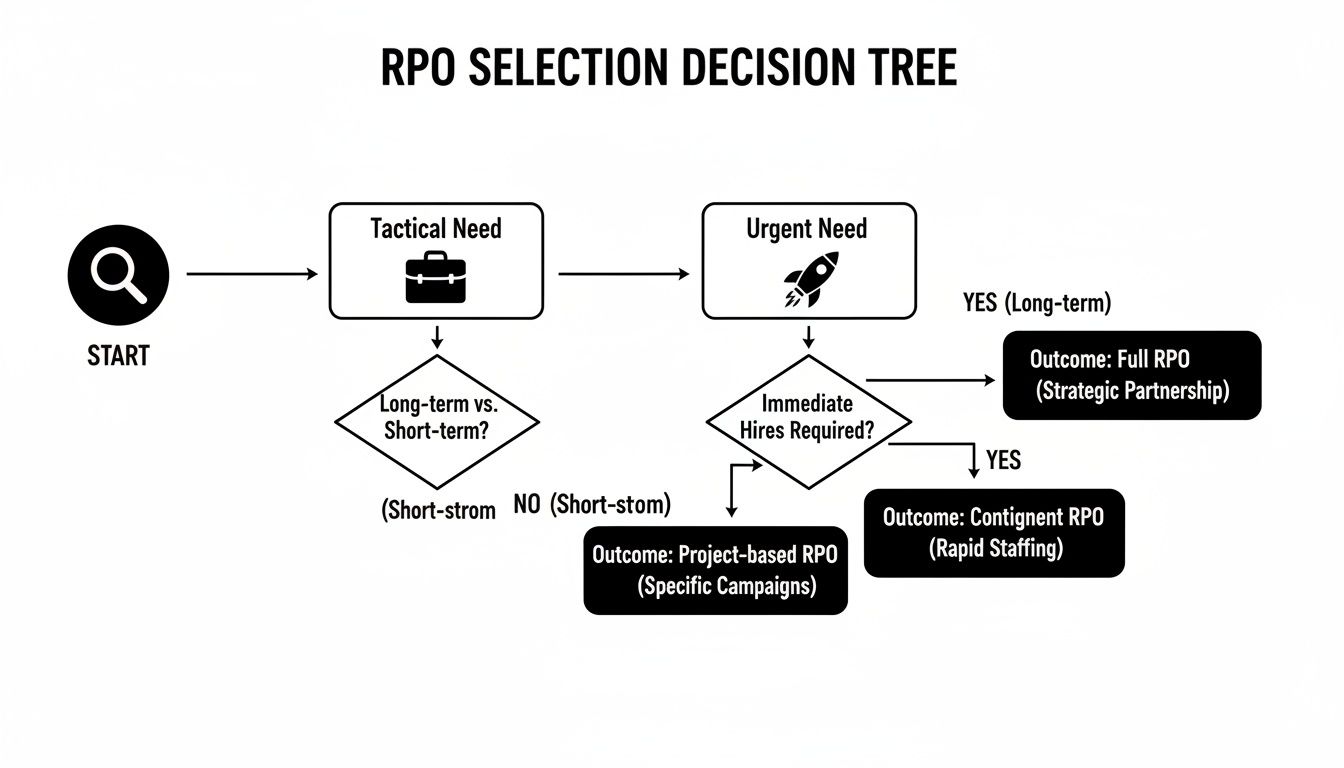
As the flowchart shows, immediate and well-defined challenges are best solved with project-based solutions. Sustained, organisation-wide goals, however, demand an enterprise partnership.
The Hybrid Path: A Pilot for Transformation
Here’s a key insight: your decision doesn’t have to be permanent. A smart, low-risk strategy is to treat a successful project RPO engagement as a pilot for a future enterprise-level partnership. This “try before you buy” approach is a great way to test a provider’s capabilities, cultural fit, and performance on a smaller, more manageable scale.
A successful project engagement builds the business case for a deeper partnership. It provides concrete data and proven results, making it easier to gain executive buy-in for a more significant strategic investment in an enterprise solution.
This hybrid model offers a scalable and controlled way forward. Take India’s retail sector, which widely uses project RPO for its festive season hiring crunch. One major retail chain in Mumbai and Delhi needed over 500 staff in just 45 days and turned to this agile model. The results were compelling: hires were made 40% faster than their in-house team could manage, and they saw cost savings between 30-50%. It’s a powerful demonstration of the model’s effectiveness for burst capacity. You can read the full analysis on RPO models and their benefits to learn more.
Answering Your Key Questions
When you’re weighing up project RPO vs enterprise RPO, a few common questions always come to the surface. Let’s tackle them head-on so you can move forward with clarity and confidence.
Can We Switch From Project RPO to Enterprise RPO With the Same Provider?
Absolutely. In fact, it’s a smart and very common strategy. Think of a project engagement as a trial run—a way to see a provider’s capabilities and cultural fit in action before you commit to a full-blown enterprise partnership.
A successful project gives you a solid foundation and, more importantly, a data-backed business case to expand the relationship. The key is to be transparent about this possibility from the start. This allows you to confirm the provider has the strategic depth to scale up and to get a clear picture of how the contract and pricing would shift.
What Are the Typical Cost Differences Between RPO Models in India?
The financial models here are worlds apart. Project RPO is usually priced on a cost-per-hire or a fixed project fee. This makes it a variable, operational expense that’s tied directly to specific hiring results.
In contrast, Enterprise RPO often involves a monthly management fee combined with a volume-based cost-per-hire. While it’s a larger, ongoing investment, this model almost always results in a lower average cost-per-hire over the long term, thanks to the efficiencies and scale you gain.
How Long Does Implementation Take for Each RPO Solution?
The setup times are quite different, and for good reason—it all comes down to the level of integration required.
Project RPO: You can get this up and running incredibly fast, often in just one to three weeks. It’s a lighter lift because it doesn’t need deep integration with your existing systems.
Enterprise RPO: This is a much more involved process, typically taking four to twelve weeks. That extra time is crucial. It’s used for in-depth discovery, redesigning processes, integrating technology with your ATS or HRIS, and most importantly, managing the change to ensure everyone is on board for a smooth transition.
Ready to solve your most pressing talent challenges? At Taggd, we deliver RPO solutions that align with your business goals. Whether you need a tactical project team or a strategic enterprise partner, we have the expertise to drive your success. Explore our services at Taggd and build your winning team today.