A TA transformation roadmap is more than just a plan; it’s your blueprint for turning talent acquisition from a reactive, administrative function into a proactive powerhouse that drives real business growth. It lays out the vision, the goals, and the practical, phased steps you need to take to upgrade your people, processes, and technology, making sure your hiring strategy is perfectly in sync with your company’s core objectives.
Why Your TA Transformation Roadmap Can’t Wait

For today’s Chief Human Resources Officer (CHRO), the conversation around talent has fundamentally shifted. This isn’t just another HR project; it’s a critical business mandate. The pressure is mounting to evolve the recruitment function from a cost centre that just fills seats to a strategic engine that fuels growth and innovation.
In a market defined by fierce skill shortages and constant disruption, sitting still is the biggest risk you can take.
An outdated, reactive TA function is a drag on your entire organisation. Slow hiring, a clunky candidate experience, and a disconnect from business needs hit the bottom line hard. Every single day a critical role remains empty, you’re not just losing productivity—you’re losing potential revenue, stalling projects, and giving your competition a head start.
Connecting TA to Core Business Objectives
To get the C-suite on board, you have to frame this transformation as a competitive necessity. Your roadmap isn’t about buying a shiny new Applicant Tracking System (ATS). It’s about empowering the business to hit its most ambitious targets.
Let’s make it real. Think about the direct connections:
- Market Expansion: Planning to enter new regions? You’ll need local talent with specific expertise. A modern TA function can build those talent pipelines before you even launch, slashing your time-to-market.
- Product Innovation: Launching a new AI-driven product demands highly specialised skills. A proactive TA strategy doesn’t wait for the job requisition; it’s already identifying and engaging top AI talent.
- Profitability and Efficiency: A well-oiled recruitment process cuts down on the high costs of long-term vacancies and expensive agency fees. More importantly, hiring the right people boosts productivity and lowers attrition, which directly impacts your profitability. Delays here are a growing concern, which is exactly why time-to-hire is the new business risk metric.
A well-crafted TA transformation roadmap does more than just improve recruiting metrics. It builds a resilient, agile workforce that’s ready for whatever comes next. It’s about getting the right people in the door, exactly when the business needs them.
Setting a Clear and Compelling Vision
Your vision is the destination for this entire journey. It needs to be ambitious enough to inspire your team but grounded in tangible business outcomes. It should clearly answer the question, “What will our talent acquisition function look like and what will it be capable of in two years?”
For instance, a compelling vision might sound something like this: “To build a data-driven, agile talent acquisition engine that proactively attracts and secures the top 10% of technical talent in our industry, becoming a recognised employer of choice and a key driver of our company’s innovation agenda.”
This vision is specific. It’s measurable. And it’s directly tied to a core business goal—innovation. It becomes the North Star for every decision you make, from choosing technology to redesigning processes. By establishing this clear direction from day one, you ensure your TA transformation roadmap has a purpose that resonates far beyond the HR department.
Auditing Your Current Talent Acquisition Function

Before you can build the future of your talent acquisition, you need a brutally honest look at where you stand today. Kicking off a TA transformation roadmap without a clear baseline is like trying to plan a road trip without knowing your starting city. This initial audit goes way beyond surface-level metrics; it’s a deep dive into your people, processes, and technology.
The whole point is to create a solid, data-backed foundation that clearly shows what’s working and what’s broken. This isn’t about pointing fingers. It’s about gaining the clarity you need to make smart, strategic decisions for the road ahead. Think of this audit as the “before” picture—it’s what you’ll use to measure the success of your entire transformation journey.
Evaluating Your Team’s Capabilities
Your people are the engine of your TA function, but do they have the right skills for tomorrow’s hiring challenges? A modern recruiter needs to be part marketer, part data analyst, and part strategic advisor. Your audit has to look past simple headcount and really assess their true capabilities.
Start by mapping your current roles against the skills you’ll need in your future-state model. You should be looking for competencies like:
- Strategic Sourcing: Are they just posting jobs and praying, or are they proactively building talent pipelines in tough markets?
- Data Literacy: Can your team actually interpret recruitment analytics, figure out which sources are effective, and make decisions based on data, not just gut feelings?
- Stakeholder Management: How skilled are they at partnering with hiring managers to define roles, manage expectations, and guide the selection process?
- Technology Proficiency: Are they getting the most value out of your ATS, CRM, and other recruitment tools, or just using the bare minimum features?
Going through this process will almost certainly highlight some critical skill gaps. This is a huge issue for many organisations in India right now. The World Economic Forum notes that while 67% of companies plan to tap into diverse talent pools, there’s a massive skills crunch on the horizon, with 63% of workers needing retraining by 2030.
Mapping the Recruitment Lifecycle
Every single step in your recruitment process either adds value or creates friction for candidates and hiring managers. Mapping out the entire lifecycle—from the moment a job requisition is raised to a new hire’s first day—is crucial for uncovering those hidden bottlenecks that kill both efficiency and the candidate experience.
Don’t just rely on process diagrams. Get your hands dirty. Try applying for one of your own jobs, talk to recent hires about their experience, and sit with hiring managers as they review candidates. This firsthand experience reveals truths that data alone will never show you.
Look for common pain points. Are there painfully long approval chains? Is communication between stages slow or non-existent? Is the application process a nightmare? How long does it take for feedback to be shared? Where do you see candidates dropping off most often? Answering these questions will point you to quick wins and shape your entire process redesign phase. A detailed human resources audit checklist can give you a structured way to tackle this evaluation.
Auditing Your Technology Stack
Finally, it’s time to take a hard look at your technology. Is your tech stack helping you win, or is it holding you back? Too many TA functions are bogged down by a patchwork of disconnected systems that create data silos and frustrate everyone who uses them.
Your audit needs to assess how effective each tool really is:
- Applicant Tracking System (ATS): Is it just a compliance database, or does it actively help your recruiters with automation and smart workflows?
- Candidate Relationship Management (CRM): Do you have a real system for nurturing passive talent, or are you starting from scratch for every single role?
- Sourcing and Analytics Tools: Are you using modern tools to find great talent and actually measure the impact of what you’re doing?
The single most important question is this: does your technology give you one single source of truth for all recruiting activities? If your team is spending more time wrestling with spreadsheets than talking to candidates, your tech stack is a liability. This audit will make it crystal clear where you need to invest to power your TA transformation roadmap.
Designing Your Future-State Operating Model
You’ve audited your current talent acquisition function and now have a clear, data-backed picture of where you stand. The next step? Architecting the future. Designing your Target Operating Model (TOM) is a cornerstone of your TA transformation roadmap, shifting you from reactive fire-fighting to proactive, strategic design.
This is about more than just shuffling boxes on an org chart. It’s about building a TA function that’s agile, scalable, and perfectly wired to your long-term business goals. The right model is deeply personal to your organisation’s culture, scale, and strategic priorities—there’s simply no one-size-fits-all template.
Choosing the Right TA Structure
First things first, let’s explore the different ways you can structure your team. Each model has its own strengths and is built for different business environments. Getting to grips with these options helps you pick and customise the best fit for your vision.
Let’s break down a few common models:
- Centralised Model: Here, a single, central team manages all TA activities. This structure is a powerhouse for driving consistency, standardising processes, and creating economies of scale. It’s ideal for organisations where a uniform employer brand and candidate experience across all divisions is non-negotiable.
- Decentralised Model: With this approach, each business unit or region gets its own dedicated TA team. This fosters incredible alignment with the business and agility, allowing recruiters to become true experts in their specific talent markets.
- Hybrid Model (Centre of Excellence): A popular choice that aims for the best of both worlds. A central “Centre of Excellence” (CoE) handles the big-picture strategic work—like employer branding, technology, and analytics—while recruiters or business partners are embedded within business units to manage the day-to-day hiring.
Before we move on, it’s worth comparing these models side-by-side to see how they stack up against different business needs.
TA Operating Model Comparison
| Model Type | Description | Best For | Potential Challenges |
|---|---|---|---|
| Centralised | A single, central team manages all TA processes, technology, and strategy for the entire organisation. | Organisations prioritising consistency, efficiency, and a unified employer brand. | Can be slow to respond to specific business unit needs; may lack deep, specialised market knowledge. |
| Decentralised | Each business unit or geographic location has its own independent TA team, reporting into the local leadership. | Large, diverse companies where business units have unique talent needs and operate in distinct markets. | Risk of inconsistent processes, duplicated efforts, and a fragmented candidate experience. |
| Hybrid (CoE) | A central Centre of Excellence (CoE) provides strategic guidance, tools, and analytics, while recruiters are embedded within business units. | Scalable organisations seeking both strategic alignment and business-specific agility. | Requires strong communication and governance to ensure the CoE and embedded teams work in sync. |
Ultimately, the goal is to choose a model that provides the right balance of control, consistency, and customisation for your organisation.
The most effective operating models aren’t set in stone. They need to be dynamic, allowing you to scale resources and pivot focus as business needs change—whether that’s for a major product launch or entry into a new market.
Redefining Roles for a Modern TA Function
A new operating model isn’t just about structure; it’s about capability. The traditional “recruiter” title barely scratches the surface of what modern talent acquisition entails. To bring your TA transformation roadmap to life, you need to think about specialised roles that reflect a more strategic function.
Consider weaving roles like these into your new TOM:
- Talent Strategists: These are the people who partner directly with your business leaders. They dig into future workforce needs, conduct market analysis, and build long-term talent pipelines for your most critical roles.
- Sourcing Specialists: True talent hunters. This team focuses purely on identifying and engaging passive candidates, using advanced tools and techniques to build rich talent pools.
- Employer Brand and Recruitment Marketing Specialists: They are your storytellers. They manage everything from social media content and career site optimisation to candidate communications, ensuring your brand message is compelling and consistent.
- TA Operations and Analytics Experts: This is the engine room of a data-driven function. They manage the tech stack, ensure data integrity, and turn recruitment metrics into insights the business can actually use.
This move toward specialisation is crucial, especially in a fast-moving talent market. For instance, India’s talent landscape is evolving rapidly. The India Skills Report 2025 flagged a 7% rise in graduate employability to 54.81%, pointing to an increasingly skilled workforce, particularly in hubs like Maharashtra and Karnataka. This kind of data proves why you need proactive talent strategies to effectively tap into this growing pool of qualified candidates. You can dive deeper into the Indian talent landscape by checking out the full report.
Integrating a Strategic RPO Partner
As you design your future-state model, you also need to decide what work to keep in-house versus what could be strategically outsourced. A Recruitment Process Outsourcing (RPO) partner can be a powerful extension of your team, not just a transactional vendor.
An RPO partner can be seamlessly integrated to:
- Manage High-Volume Recruiting: Take the pressure of repetitive, high-volume roles off your internal team so they can focus on more strategic or complex leadership positions.
- Provide Specialised Sourcing: Tap into their deep expertise and networks for niche or hard-to-fill roles where your internal team might not have the market knowledge.
- Drive Scalability: Quickly ramp your recruiting capacity up or down to meet fluctuating hiring demands without the headache and overhead of permanent hires.
By thoughtfully designing your TOM, defining modern roles, and strategically integrating partners, you create a blueprint for a high-performing TA function that’s built for whatever challenges come next.
Building Your Recruitment Tech and Data Strategy
Technology is the engine of any modern talent acquisition function. Too often, though, it’s treated like a shopping list—an ATS here, a subscription there. A genuine TA transformation roadmap requires a fundamental shift in thinking. It’s not about just buying tools; it’s about architecting an intelligent, integrated ecosystem that actually empowers your team and delivers real business value.
The goal is to move past a jumble of disconnected systems and create a seamless flow of information. When your Candidate Relationship Management (CRM) system, AI-sourcing tools, and analytics dashboards are all speaking the same language, you create a single source of truth for all your recruiting activities. This breaks down the data silos and, just as importantly, frees your team from the soul-crushing task of manual data entry.
From Reactive Metrics to Predictive Insights
For years, TA success has been measured with reactive metrics like time-to-fill or cost-per-hire. While these numbers have their place, they only tell you what’s already happened. A modern, data-driven strategy needs to focus on predictive insights that help you anticipate and shape what’s coming next.
This means putting your data to work to:
- Forecast Hiring Needs: Analyse business growth plans and attrition data to predict future talent demands. This lets you build talent pipelines before the roles even open up.
- Identify Top Talent Channels: Go deeper than just tracking application sources. Pinpoint which channels deliver the highest-quality candidates—the ones who perform well and stick around.
- Optimise Job Descriptions: Use performance data from past hires to understand which skills truly lead to success in a role, allowing you to sharpen your job descriptions to attract better-fit candidates from the start.
This leap from looking in the rear-view mirror to looking ahead is what separates a world-class TA function from an average one. You can get a clearer picture of how these pieces fit together by exploring the components of a modern recruitment tech stack.
Architecting an Integrated Tech Ecosystem
Building this ecosystem is a strategic exercise, not a procurement one. Start by mapping your entire recruitment lifecycle from first touch to onboarding. At each stage, identify the critical data points you need to capture. This clarity helps you evaluate new tech not just on its flashy features, but on its ability to integrate and contribute to a unified data model.
A well-designed tech stack should feel like a single, cohesive platform, not a puzzle with missing pieces. For instance, a candidate’s first interaction on your careers site should flow seamlessly into your CRM, where they can be nurtured. When they apply, their data moves into the ATS, and every engagement is tracked, giving you a complete 360-degree view.
The real power here isn’t just about efficiency; it’s the ability to make smarter, data-backed decisions, fast. When a hiring manager asks, “Where do our best software engineers come from?” you should be able to answer with data, not just a gut feeling.
This capability is non-negotiable in dynamic talent markets. The evolving skill landscape in India is a perfect example. Mercer’s India’s Graduate Skill Index 2025 found that while only 42.6% of graduates are considered broadly employable, a more encouraging 46.1% show readiness for AI & ML roles. This data highlights a clear gap that a predictive TA strategy can help bridge by targeting and engaging the right talent pools. You can dive into the details in the full Mercer report on graduate skills.
Building the Business Case for Investment
Finally, your tech and data strategy has to lead to a compelling business case. Securing investment means you need to speak the language of the C-suite: ROI, efficiency gains, and competitive advantage.
Frame your proposal around tangible business outcomes. Don’t just ask for a new CRM; explain how it will reduce agency spend by 15% by helping you build a proprietary talent pool. Don’t just request an analytics platform; show how predictive hiring insights will decrease first-year attrition and its associated costs. By tying every technology investment directly to a business metric, you prove that your TA transformation roadmap is not a cost centre, but a vital driver of the company’s success.
Executing Your Phased Implementation Plan
A brilliant strategy on paper means nothing without flawless execution. This is the point where your TA transformation roadmap shifts from a theoretical plan to a practical reality.
The key to getting this right isn’t a risky, all-at-once ‘big bang’ launch that throws the entire organisation into chaos. Instead, a realistic, phased rollout helps you secure quick wins, build momentum, and fine-tune your approach as you go. This agile implementation de-risks the entire transformation, allowing your team to adapt and learn while ensuring each step builds a solid foundation for the next.
Phase 1: Foundational Setup
This first phase is all about laying the groundwork. You’re not trying to boil the ocean here; the focus is squarely on establishing the core processes and technology that will underpin everything else. Think of it as building the concrete slab before you start putting up walls.
Your primary goals should be clear and manageable:
- Standardise Core Processes: Implement the most critical, redesigned recruitment workflows first. This might be as simple as standardising the interview feedback process or streamlining how hiring managers raise job requisitions. Consistency is the name of the game.
- Launch Foundational Tech: Roll out the central pillar of your new tech stack, which is likely a new Applicant Tracking System (ATS) or Candidate Relationship Management (CRM) platform. Success here is all about user adoption and a clean data migration.
- Establish Governance: Formally bring your transformation governance team together. Define roles, responsibilities, meeting cadences, and how decisions will be made.
Success in this phase isn’t measured by dramatic hiring metric improvements. It’s measured by stability and adoption. Are people using the new system correctly? Have the new standard processes actually eliminated old bottlenecks? Getting this right is non-negotiable.
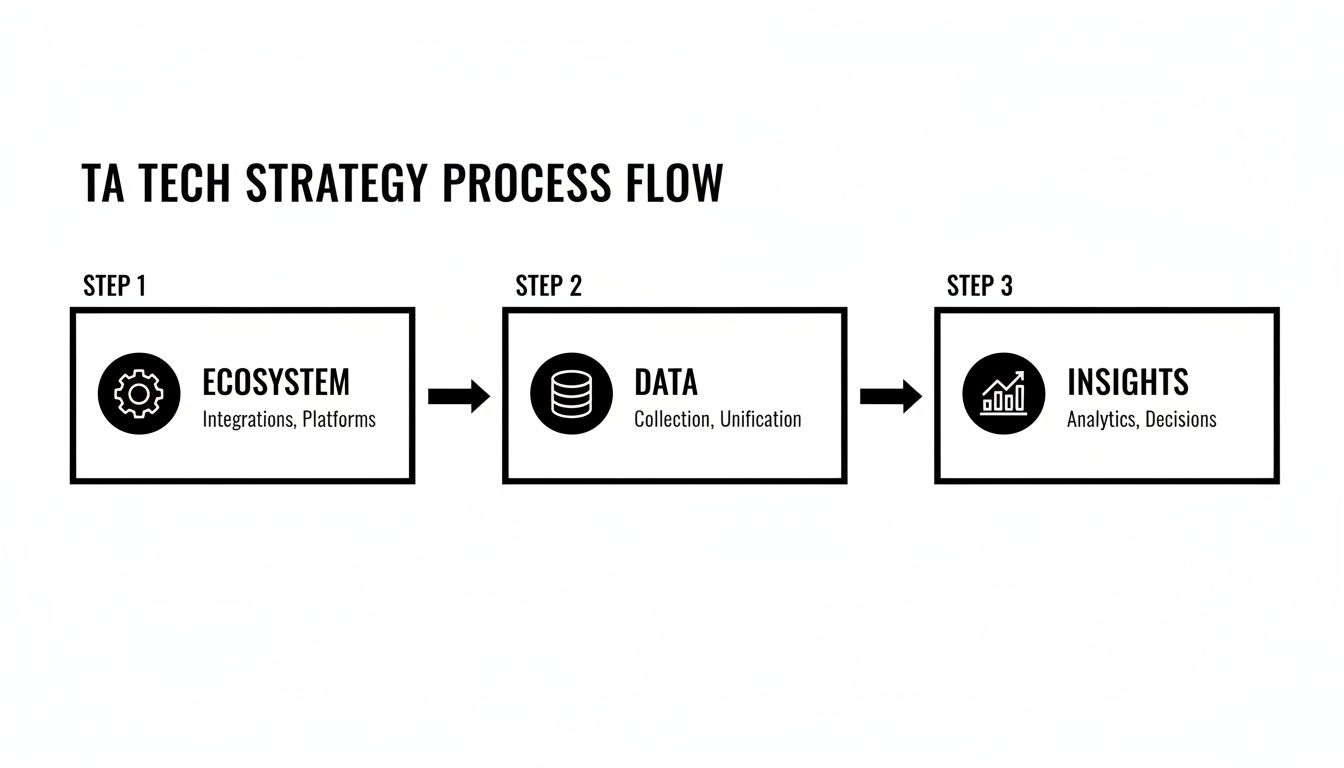
This process flow really drives home the point: without a solid tech ecosystem and clean data, any attempt to generate valuable insights is destined to fail.
Phase 2: Optimisation and Expansion
With a stable foundation in place, you can now start optimising and expanding. This is where you build on your early successes and introduce new tools and processes that deliver more tangible value to the business. The momentum from Phase 1 is your fuel now.
Your focus shifts to enhancing performance and proving ROI.
Key Initiatives for Phase 2:
- Introduce Sourcing Tools: Equip your specialist sourcers with AI-powered sourcing tools or advanced talent intelligence platforms.
- Launch Analytics Dashboards: Move beyond basic reports. Give hiring managers and leadership real-time dashboards that track key KPIs and offer actionable insights.
- Refine Candidate Experience: Roll out candidate feedback surveys (like NPS) and use that data to make targeted improvements to your communication and interview cycles.
The goal here is to show clear, measurable improvements. You should see metrics like quality-of-hire and source-of-hire effectiveness begin to trend upwards, which gives you a powerful story to tell when reinforcing the business case.
Phase 3: Innovation and Strategic Alignment
In this final phase, your TA function truly becomes a strategic partner to the business. You’ve already established efficient processes and a robust tech stack, so now you can focus on proactive, forward-looking initiatives. This is less about fixing problems and more about creating a genuine competitive advantage through talent.
Your activities will become more sophisticated and deeply woven into the overall business strategy.
- Predictive Analytics: Start using historical data to forecast hiring needs for key business units, enabling proactive talent pipelining long before a role becomes vacant.
- Employer Brand Campaigns: Launch targeted recruitment marketing campaigns to attract niche talent in new markets or for critical future skills.
- Internal Mobility Programmes: Use your TA team’s expertise and technology to build robust internal mobility platforms, which can dramatically improve retention and employee development.
This is the phase where your TA transformation roadmap fully matures. Your team is no longer just filling roles; they are actively shaping the workforce to meet future challenges. Remember, strong change management, continuous communication, and dedicated upskilling for your TA team are the threads that must run through every single phase to make sure this transformation isn’t just successful, but sustainable.
Answering Your TA Transformation Questions
When you’re steering a major talent acquisition overhaul, questions are going to pop up. It’s only natural. As a CHRO, you need straightforward answers to cut through the noise, handle obstacles, and keep the momentum going. Let’s tackle some of the most common questions we hear from leaders like you, with some direct advice to help you successfully execute your TA transformation roadmap.
How Do I Secure Executive Buy-In for a Major TA Transformation?
Getting the C-suite on board comes down to one simple thing: you have to frame this as a core business initiative, not just another HR project. Your peers in finance, operations, and sales need to see the straight line connecting a modern TA function to their own bottom-line goals.
Start by tying your proposal directly to the company’s biggest strategic priorities. If the five-year plan involves expanding into two new international markets, you need to demonstrate precisely how the current TA function will fail to support that growth. Then, show how your proposed changes will get the right local talent in the door, faster.
Use the cold, hard data from your initial audit to build an urgent business case. You need to quantify the cost of doing nothing. For instance, show that because of slow hiring, unfilled senior sales roles cost the company an estimated ₹5 crore in lost revenue opportunities last year. That gets attention.
Finally, present a clear return on investment (ROI) projection in the language your leadership team speaks fluently.
- Cost Savings: “By bringing in a CRM, we can slash our agency spend by 20% within 18 months, freeing up significant budget.”
- Revenue Impact: “Improving our quality of hire in the engineering team will cut first-year attrition, which means projects get completed faster and we get products to market ahead of the competition.”
- Competitive Advantage: “Our main rival is already using predictive analytics to pinpoint top talent. This roadmap doesn’t just close that gap—it puts us ahead.”
When you focus on tangible business outcomes, the conversation shifts from an HR cost centre to a strategic investment in the company’s future.
What Are the Most Critical KPIs to Track During a Transformation?
To prove that your transformation is actually working, you have to look beyond old-school metrics like ‘Time to Fill.’ Sure, it’s a useful data point, but it tells you nothing about whether you hired the right person. Instead, focus your measurement strategy on three key areas that directly connect TA performance to business success.
First up is Quality of Hire. This is your north star. You can get a handle on this by combining metrics like the 90-day performance reviews of new hires, first-year retention rates, and direct feedback from hiring managers. This KPI is the ultimate proof that your new approach is bringing in people who perform well and stick around.
Second, you absolutely must measure the Candidate Experience. A simple Net Promoter Score (NPS) survey sent to candidates after key moments—like the final interview or after they’ve been told they weren’t selected—can give you invaluable insight. A positive candidate experience builds your employer brand, even with people you don’t end up hiring.
Your employer brand is being shaped every single day by every person who interacts with your company, whether you hire them or not. A poor candidate experience is a brand risk you can’t afford.
Third, dig into Source of Hire Effectiveness. This is more than just seeing which channel gives you the most applications. It’s about analysing which sources—employee referrals, specific job boards, proactive sourcing—are actually delivering the high-quality candidates who become your top performers. This data is gold, allowing you to put your recruitment marketing budget where it will have the biggest impact.
What Is the Role of an RPO Partner in This Roadmap?
Think of a strategic Recruitment Process Outsourcing (RPO) partner as an accelerator for your TA transformation roadmap. They aren’t just a transactional vendor you call to fill roles. A true RPO partner is an extension of your team, bringing deep expertise, scale, and technology that can seriously de-risk and speed up your entire journey.
Right from the start, during your assessment phase, a good RPO partner provides external benchmarks and industry best practices. This helps you conduct a far more rigorous audit of where you currently stand because they bring an objective, expert view of what “good” really looks like.
Then, as you start implementing the changes, an RPO can take on high-volume or specialised hiring. This frees up your internal team to focus on the heavy lifting of change management and strategy. For example, they could run your entire campus hiring programme while your team concentrates on embedding the new operating model with senior business leaders.
In short, a partner brings the specialised know-how, proven processes, and tech stack to help you execute your roadmap faster and more effectively. They cut down the learning curve, help you avoid common pitfalls, and make sure you hit your transformation goals on time.
At Taggd, we specialise in partnering with CHROs to accelerate their TA transformation journeys. We provide the strategic support, operational excellence, and technological expertise needed to turn your vision into a high-performing reality.
Discover how our RPO solutions can power your transformation by visiting us at https://taggd.in.