Let’s be honest, effective tech support hiring has moved far beyond just filling seats. It’s now about building a strategic team that actively drives customer loyalty and, ultimately, business growth. The old ways of hiring simply can’t keep up in a world where skills in AI, cloud, and security aren’t just nice-to-haves—they’re essential.
Why Your Old Tech Support Hiring Model Is Broken

For years, many companies treated tech support as a necessary evil—a cost centre. The hiring strategy mirrored this thinking: find people with basic troubleshooting skills for the lowest possible salary. Today, that approach is a massive liability.
Customer expectations are higher than ever, and a single bad support interaction can send them running. In fact, studies show that a staggering 86% of customers will ditch a brand after just one poor experience.
The old model also fails to grasp the sheer complexity of modern technology. Your support team isn’t just resetting passwords anymore. They’re on the front lines, troubleshooting sophisticated cloud services, complex software, and AI-driven products.
The Shift from Cost Centre to Value Driver
A forward-thinking CHRO sees tech support for what it truly is: a critical moment in the customer journey. A fantastic support interaction doesn’t just fix a problem. It builds trust, reinforces your brand’s value, and can even open doors for upselling. Your hiring process has to evolve to spot candidates with this unique mix of technical skill and customer-focused thinking.
This calls for a complete change in perspective. Forget focusing solely on cost-per-hire; the new game is all about quality-of-hire. This means you need to find people who are:
- True Problem-Solvers: They don’t just follow a script. They can diagnose complex issues and think critically to find a real solution.
- Empathetic Communicators: They can translate technical jargon into clear, helpful guidance for users who are already frustrated.
- Constant Learners: They are genuinely eager to master new technologies as your company grows and changes.
The real flaw in outdated hiring models is that they’re purely reactive. They’re all about plugging an immediate hole instead of building a sustainable talent pipeline for the future. A strategic approach, on the other hand, anticipates what you’ll need tomorrow, aligning tech support hiring with your long-term business goals.
The Impact of the Evolving Skill Landscape
The demand for specialised tech talent is exploding. A recent study revealed that 50-55% of early-career workloads are now augmented by AI, which is fundamentally changing what an “entry-level” role even means. Your tech support hiring strategy has to reflect this new reality.
Traditional recruitment methods often completely miss candidates with emerging skills in cybersecurity, data analysis, or AI-assisted development. That’s a huge missed opportunity. If you’re wondering where to find these professionals, it’s worth exploring the challenges and solutions around sourcing the most in-demand tech talent.
By modernising your approach, you can attract ‘productivity-ready’ talent who can handle the challenges of today and tomorrow. This is how you turn your support team into a genuine competitive advantage.
Architecting Roles and Career Paths That Attract Top Talent
Let’s be blunt: vague job descriptions are a magnet for generic candidates and a fast track to high turnover. A winning tech support hiring strategy doesn’t start with a job post. It begins much earlier, with the careful design of well-defined roles and clear career paths that show people they have a future with you.
This isn’t just an HR box-ticking exercise. It’s how you signal to the market that you see tech support as a professional career, not just a temporary gig. Ambitious people aren’t looking for a dead-end job; they want to see a clear runway for growth, specialisation, and more responsibility.
When roles are fuzzy, new hires feel lost and undervalued. That’s a recipe for disengagement and a quick exit. By mapping out your support structure from the get-go, you set clear expectations and give your team a tangible framework for success.
From Tier 1 to Tier 3: Building a Clear Support Structure
A tiered support model is the backbone of any scalable and efficient team. It makes sure problems get to the right person with the right skills, freeing up your senior experts from being swamped with simple password resets.
Each tier needs its own distinct set of responsibilities and skills:
- Tier 1 Support (The Front Line): These are your generalists. They’re the first point of contact, gathering info and resolving common, well-documented issues. Think basic setup queries and password resets. The key skills here are top-notch communication, empathy, and meticulous documentation.
- Tier 2 Support (The Problem Solvers): When an issue is too complex for Tier 1, it lands here. Tier 2 technicians have deeper product knowledge. They dive into logs, replicate issues, and troubleshoot the tougher problems to find the root cause.
- Tier 3 Support (The Specialists): This is your highest level, often staffed by product experts or engineers. They tackle the most complex, never-seen-before issues that might even require code-level analysis or direct collaboration with the development team to fix a bug.
Once you’ve defined these tiers, the next step is building a skills matrix. This should outline the specific technical and soft skills needed for each level, all tied to your company’s tech stack. This creates a transparent roadmap showing exactly what someone needs to learn to climb the ladder.
Building Career Ladders That Keep Your Best People
A job description might get someone in the door, but a career ladder is what makes them stay. Showing a clear path for progression is one of the most powerful retention tools you have. It proves you’re genuinely invested in your people’s growth.
A career ladder transforms a support position from a simple job into a long-term career. It answers the crucial question every ambitious candidate has: “What’s next for me here?” Without a clear answer, your best talent will inevitably look for it elsewhere.
This isn’t just about moving up. Think about parallel tracks for growth. For instance, a star Tier 2 technician might not want to be a manager. They could transition into a specialist role like a “Product Support Specialist” for a key piece of software, or become a “Technical Trainer” for new hires. Our guide to effective job architecture offers more insights into structuring these pathways. This kind of flexibility is crucial for keeping skilled people engaged and motivated.
Aligning Roles with What the Market Demands
The tech scene in India is changing fast, and your role architecture has to keep up. Demand for specialised tech support roles in AI, cybersecurity, and cloud computing is exploding, with a projected 75% surge by 2025.
Software-related roles, the foundation of tech support, already make up 70% of all tech job listings. This means CHROs must prioritise hiring in these high-growth areas to stay competitive, especially as India’s ITeS sector anticipates a 20% overall job growth. By proactively designing roles that reflect these market trends, you not only attract stronger candidates but also future-proof your entire support organisation.
Mastering Talent Sourcing and Screening
Finding top-tier tech support talent means looking beyond the slow trickle of candidates from standard job boards. To really win in today’s market, you need a proactive, multi-channel sourcing strategy. That brings up a critical decision you have to make right at the start: do you build this capability in-house, or do you partner with a Recruitment Process Outsourcing (RPO) provider?
This isn’t just about the budget. It’s a strategic choice that directly impacts your hiring speed, cost, and ability to tap into specialised talent pools. An in-house team offers deep cultural alignment and understands your brand inside and out, but scaling up can be slow, and they might struggle to reach niche candidates. An RPO partner, on the other hand, brings immediate scale, deep market expertise, and ready-made talent networks, which can seriously accelerate the whole tech support hiring process.
In-House Versus RPO: A Strategic Comparison
As a CHRO, deciding between building an in-house team or bringing in an RPO partner is one of those choices that shapes the efficiency of your entire talent acquisition function, especially for high-volume roles like tech support.
Let’s break down the tradeoffs.
Sourcing Model Comparison: In-House vs RPO
| Factor | In-House Recruitment | Recruitment Process Outsourcing (RPO) |
|---|---|---|
| Speed to Hire | Can be slower, especially when scaling up or for specialised roles. | Often faster due to established processes, technology, and dedicated sourcing teams. |
| Cost Structure | Primarily fixed costs (salaries, benefits, overheads) regardless of hiring volume. | Flexible, often a mix of management fees and cost-per-hire, aligning expenses with results. |
| Talent Access | Limited to the team’s existing networks and sourcing channels. | Broader access to diverse and passive candidate pools through extensive networks and market intelligence. |
| Scalability | Scaling up or down requires hiring or reassigning internal staff, which can be slow and costly. | Highly scalable, allowing you to quickly adjust to fluctuating hiring demands without internal disruption. |
Ultimately, the right choice really depends on your company’s current maturity, hiring volume, and strategic goals. For businesses that need to build a large support team quickly or are hunting for very specific technical skills, an RPO can be a game-changer.
This flow chart can help visualise that initial decision-making process based on what kind of tech support you need.
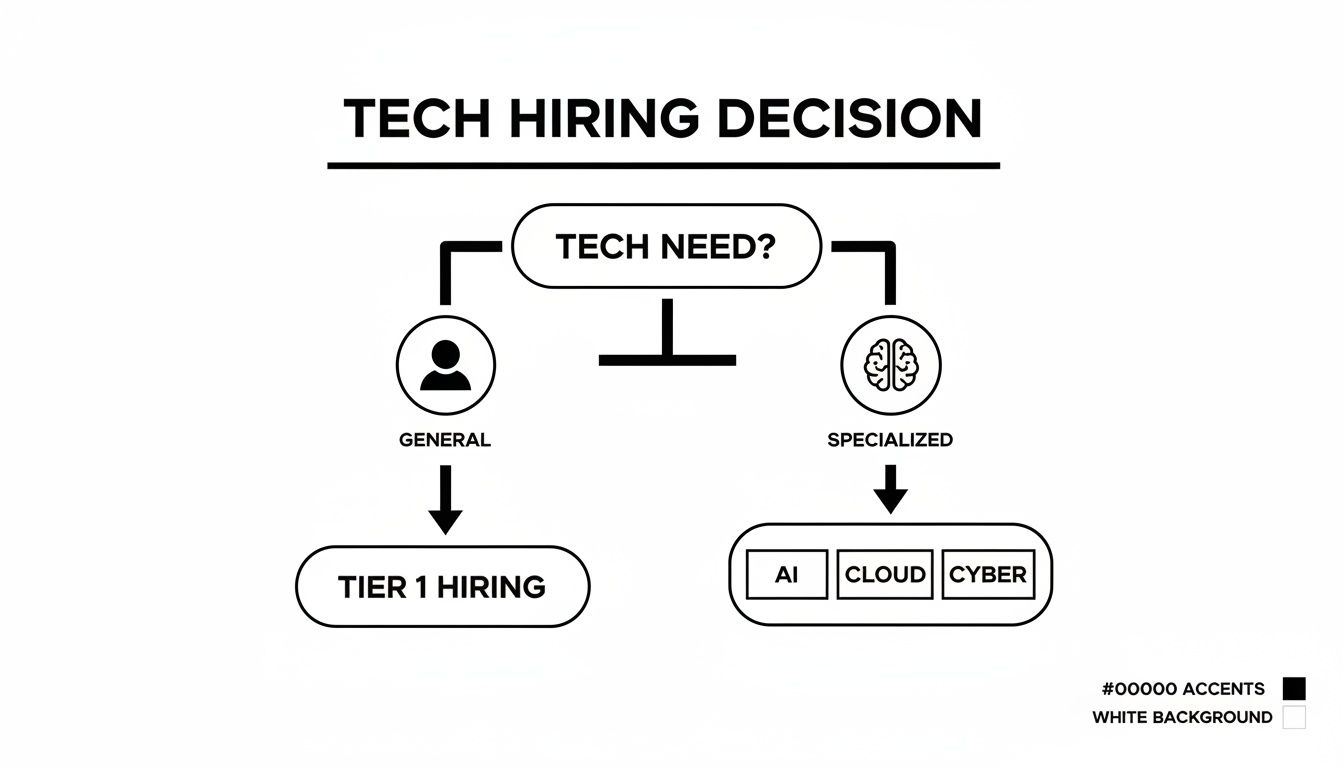
As you can see, the path diverges pretty quickly depending on whether you need generalist Tier 1 support or specialists in areas like AI or the cloud. This simple fork in the road has a huge influence on your sourcing strategy right from the get-go.
Expanding Your Sourcing Horizons
Relying only on Tier-1 cities is becoming a real bottleneck. India’s IT sector is bracing for a hiring surge in 2025, with total demand expected to hit 1.8 million roles—that’s a 16% jump from 2024. The competition is fierce, stretching the average time-to-hire to a painful 45-60 days, and often much longer for niche skills.
Smart organisations are looking beyond the metros to navigate this. Tier-2 cities like Jaipur and Indore have seen a 48% spike in IT hiring, opening up a fresh, untapped talent pool. You can read more about the booming IT job demand on economictimes.com.
This shift demands a more proactive sourcing strategy:
- Target Emerging Hubs: Actively build your presence in Tier-2 and Tier-3 cities. Think university partnerships and local hiring events.
- Leverage the Gig Economy: For project-based work or fluctuating demand, tapping into a network of freelance support professionals gives you incredible flexibility.
- Build a Talent Pipeline: Don’t just hire for today’s needs. Create talent communities and nurture relationships with promising candidates, even when you don’t have an open role for them.
You can dive deeper into these tactics in our guide to the best candidate sourcing practices for tech hiring. A diverse sourcing approach is your best defence in a tight labour market.
Screening for More Than Just Technical Skills
That initial screening call is your first and best chance to filter for the soft skills that truly define great tech support. You can teach technical knowledge, but empathy and a natural problem-solving instinct? Those are much harder to cultivate.
The most effective screening calls are not technical interrogations. They are conversations designed to uncover a candidate’s communication style, patience, and ability to think on their feet when faced with a frustrated user.
Your screening template should be built around behavioural questions that reveal these core traits. Instead of just asking, “Do you have experience with X software?”, frame it as a real-world scenario.
Example Screening Question: “Imagine a customer calls, and they’re extremely frustrated because our software just deleted an important file. They’re upset and don’t know what to do. Walk me through the first three steps you would take.”
A question like this instantly tells you more than a CV ever could. It shows you their ability to empathise, prioritise, and communicate clearly under pressure—the real hallmarks of a top-tier support professional. By refining how you source and screen, you’re not just filling roles; you’re building a robust pipeline that delivers future brand advocates.
Designing Assessments That Predict Performance

How can you be sure a promising candidate will actually thrive under the pressure of real-world support queries? A stellar CV and a smooth initial conversation are good starting points, but they don’t predict on-the-job performance. The secret is to shift your evaluation process from simple Q&As to practical, scenario-based assessments that mirror the daily grind your team faces.
This is a make-or-break step in any successful tech support hiring strategy. It’s all about creating a consistent, fair, and insightful evaluation that reveals not just what candidates know, but how they think, communicate, and solve problems when the pressure is on. This doesn’t just help you make a better hire; it also builds your employer brand by showing you’re serious about finding the right people.
Crafting Technical Assessments That Mimic Reality
The goal here isn’t to stump candidates with obscure trivia. It’s to see their troubleshooting methodology in action. Generic, off-the-shelf tests often miss the mark because they don’t reflect your unique products, customer base, or internal workflows.
Instead, build your assessments around the types of issues your team genuinely handles day in and day out. This makes the entire exercise more relevant and gives candidates a realistic preview of the job.
Try incorporating practical exercises like these:
- Ticket Resolution Simulation: Hand candidates 2-3 mock support tickets with varying difficulty levels. One might be a simple user setup question, another a more complex software bug report. Ask them to write out their exact response. This tests their technical knowledge, writing skills, and ability to show empathy.
- Live Troubleshooting Scenario: On a video call, present a hypothetical problem. Something like, “A customer reports that our app is running slowly after the latest update. What are the first five questions you would ask them?” This immediately reveals their logical thought process and whether they can gather critical information efficiently.
The most insightful assessments aren’t about finding the ‘right’ answer immediately. They’re about observing the journey. How do they handle incomplete information? Do they ask clarifying questions? That tells you far more about their potential than a multiple-choice quiz ever could.
Moving Beyond “What You Did” to “How You Did It”
While technical chops are non-negotiable, it’s often the soft skills that separate a good support agent from a great one. These qualities are best uncovered through structured behavioural questions that force candidates to share specific past experiences. A study found that 86% of customers will ditch a company after just one bad experience, which shows you just how much soft skills are worth.
Focus your questions on uncovering these core competencies:
- Patience and Empathy: “Tell me about a time you dealt with a highly frustrated or angry customer. What was the situation, and how did you de-escalate it while still working towards a solution?”
- Problem-Solving and Resourcefulness: “Describe a complex technical problem you didn’t know how to solve right away. What steps did you take to find the answer and fix it for the customer?”
- Clarity in Communication: “Think of a time you had to explain a very technical concept to a non-technical person. How did you make sure they completely understood?”
Creating a Consistent and Positive Experience
A structured interview guide is your best friend for ensuring fairness. Every candidate should be measured against the same core criteria, which helps strip unconscious bias from the tech support hiring process. Using a standardised scorecard lets interviewers rate responses objectively, not just on gut feel.
This consistency also builds a stronger employer brand. When candidates feel they’ve been through a professional, thoughtful, and fair process—even if they don’t get the job—they leave with a positive impression. An organised approach respects their time and shows you take hiring seriously, making your company a magnet for top talent.
Using Hiring Metrics to Drive Real Improvement
“You can’t improve what you don’t measure.” It’s an old saying, but it’s never been more true than in the fast-paced world of tech support hiring. Relying on gut feelings or outdated assumptions is a surefire way to drive up costs and slow everything down.
To shift from a reactive hiring function to a proactive talent engine, you have to embrace a data-driven approach. This means tracking the right Key Performance Indicators (KPIs) and setting clear Service Level Agreements (SLAs). For a CHRO, these aren’t just numbers on a dashboard; they’re the diagnostic tools that reveal bottlenecks, highlight what’s working, and give you the hard evidence to make strategic moves.
Without data, you’re flying blind. You can’t justify new investments or truly demonstrate the value your talent function brings to the table.
Core Metrics Every CHRO Should Track
To get a clear picture of your tech support hiring effectiveness, you don’t need a hundred different metrics. Just focus on a handful of critical ones that give you a complete view of the process, covering speed, cost, quality, and the all-important candidate experience.
- Time to Fill: This is the simple count of calendar days from when a job is approved to when a candidate signs the offer letter. A long Time to Fill isn’t just an inconvenience; it leaves teams understaffed and gives your top candidates plenty of time to accept an offer from a competitor.
- Cost per Hire: This one’s straightforward: your total recruitment spend (think advertising, recruiter salaries, agency fees) divided by the number of people you hired. Keeping a close eye on this helps you manage your budget and figure out which sourcing channels are actually worth the investment.
- Quality of Hire: This is arguably the most important metric of them all. It measures how well a new hire is performing after a set period, usually 90 or 180 days. You can track this through performance review scores or direct feedback from their hiring manager.
- Candidate Satisfaction Score: A simple post-interview survey can tell you volumes about how candidates perceive your hiring process. A positive experience boosts your employer brand, even with the candidates you don’t end up hiring.
Tracking these KPIs creates a powerful feedback loop. Let’s say your Time to Fill is high but your Cost per Hire is low. That might be a sign that your sourcing methods are too passive. On the flip side, a low Time to Fill paired with poor Quality of Hire suggests you might be rushing assessments and making bad bets.
The real power of metrics isn’t in tracking them individually, but in understanding how they influence one another. A strategic CHRO connects these dots to see the complete story of their talent acquisition process, identifying where a small tweak can create a significant improvement across the board.
Setting Realistic Benchmarks for the Indian Market
Data is only useful when you have context. The benchmarks for hiring tech support talent in India are unique, shaped by intense competition and specific market dynamics. The following table provides a realistic set of targets to aim for as you build out your strategy.
Key Tech Support Hiring Metrics and Benchmarks
| Metric | What It Measures | Industry Benchmark (India) | Strategic Importance |
|---|---|---|---|
| Time to Fill | Speed of the entire hiring cycle, from requisition to offer acceptance. | 30-45 days | Directly impacts team productivity and your ability to compete for top talent. |
| Cost per Hire | Total recruitment spend divided by the number of hires made. | ₹25,000 – ₹50,000 (Tier 1/2) | Essential for budget management and optimising spend on sourcing channels. |
| Quality of Hire | New hire’s performance after 90 days, based on manager ratings. | 85%+ satisfaction | The ultimate measure of hiring success, directly linked to business outcomes. |
| Candidate Satisfaction | Candidate experience measured via post-process surveys (CSAT). | 4.5 / 5.0 or higher | Crucial for building a strong employer brand and a future talent pipeline. |
Think of these benchmarks as your starting point. Your organisation’s specific needs, the complexity of the roles you’re hiring for, and your location will all influence your final targets.
The key is to establish a baseline, track your performance consistently, and use the insights to drive continuous improvement. When you do this, you transform your tech support hiring from a simple cost centre into a measurable, value-generating business function.
Turning New Hires into Long-Term Assets

Getting top talent to sign on the dotted line after a rigorous tech support hiring process feels like a major win. But the real ROI isn’t realised on day one; it’s built over the months and years they stay with you. That entire journey, from a promising new hire to a high-performing, loyal team member, hinges on a world-class onboarding experience.
Let’s be honest, a messy or rushed onboarding is one of the fastest ways to give a new employee “buyer’s remorse.” It sends a clear message: you were more focused on filling a vacancy than truly setting them up to succeed. The antidote is a well-thought-out 90-day plan that seamlessly integrates them into your culture and accelerates their path to productivity.
The First 90 Days: A Blueprint for Success
Those first three months are make-or-break. It’s where you build their confidence, forge connections, and validate their decision to join your team. A solid plan should move them from foundational knowledge to active, confident contribution.
We’ve found a phased approach works best:
- Days 1-30: Foundation and Integration. This first month is pure immersion. Get all their system access sorted out, dive deep into company culture and values, and provide intensive training on your core products and support tools. Critically, pair them with an experienced mentor or “buddy.” This gives them a safe person for those small, informal questions and helps them navigate the team’s social landscape.
- Days 31-60: Supervised Contribution. In month two, it’s time to get hands-on. The new hire should start handling live, low-complexity tickets under close supervision. This is where the training becomes real. Schedule regular one-on-one check-ins with their manager to provide feedback, tackle any challenges, and start building a strong working relationship.
- Days 61-90: Increasing Autonomy. By the final month, the training wheels begin to come off. Your new hire should be taking on a more typical workload, showing a solid grasp of your processes and demonstrating their problem-solving skills. This phase should wrap up with their first performance review, setting clear goals for the next quarter and cementing their place in the team.
Onboarding isn’t just a week-long administrative checklist. It’s a strategic process of cultural and operational integration. A great programme makes a new hire feel capable, confident, and connected—the perfect foundation for long-term retention.
Strategies for Long-Term Retention and Growth
Getting them through the first 90 days is just the start. Keeping your best tech support talent requires a continuous, deliberate effort. High turnover is almost always a symptom of stagnation and burnout, but you can get ahead of it with proactive retention strategies.
One of the most powerful tools in your arsenal is providing clear paths for continuous learning. The tech world never stands still, and your team needs to keep pace. Offer access to certifications, workshops, and training on new tools or technologies. This doesn’t just keep their skills sharp; it’s a tangible sign that you’re invested in their professional growth.
Beyond training, a fair and transparent performance incentive programme can work wonders. This doesn’t always have to be about cash bonuses. Recognition is a huge motivator. Think about creating awards like a “Customer Advocate of the Month” or celebrating team members who smash their customer satisfaction scores. When you foster an environment that actively acknowledges and rewards excellence, you build a culture where people feel truly valued and want to stay.
Answering Your Top Tech Support Hiring Questions
When you’re building a tech support team, especially in India’s buzzing market, a few tough questions always seem to surface. As a CHRO, you’re not just filling seats; you’re building a critical function. Let’s tackle some of the most common hurdles I’ve seen leaders face.
One of the biggest debates I hear is about the balance between technical chops and people skills. What should you really be looking for?
What Are the Most Critical Non-Technical Skills?
Honestly, beyond the technical know-how, the skills that truly make or break a support professional are empathy, patience, and crystal-clear communication. These are the traits that directly impact customer loyalty.
Think about it: A purely technical expert might solve the problem but leave the customer feeling frustrated. On the other hand, a candidate who can genuinely listen and show they care will keep customers coming back, even when things go wrong. These skills are much harder to teach than the ins and outs of your software.
My advice? Prioritise hiring for a sharp problem-solving aptitude and a high degree of empathy. A smart, adaptable person can pick up your specific products through a good onboarding programme, but you can’t really teach someone to be patient.
How Can We Reduce High Turnover Rates?
High turnover in support roles is a classic problem, and it’s usually a symptom of two things: burnout and a dead-end career path. If you want to keep your best people, you have to stop offering a job and start offering a career.
This means getting proactive:
- Create Clear Career Paths: Don’t let it be a mystery. Show your team exactly how they can grow, whether it’s into a senior support role, team lead, or even a different department like QA or product.
- Invest in Continuous Training: Nobody wants to feel stagnant. Keep your team engaged by helping them sharpen their skills with ongoing learning opportunities. This shows you’re invested in them.
- Foster a Supportive Culture: Burnout is real. Recognise great work publicly and build an environment where your team feels valued for more than just their ticket-closure stats.
Should We Hire for Product Knowledge or Aptitude?
This really depends on the role. For most Tier 1 and Tier 2 positions, my firm recommendation is to focus on hiring for strong technical aptitude and a logical, problem-solving mindset.
Someone who understands the core principles of how technology works can be trained on your specific products in a matter of weeks. Chasing a candidate with niche product experience for a junior role is often a waste of time and money.
However, for your highly specialised Tier 3 roles, the script flips. Here, deep, existing knowledge of your product, system, or underlying technology becomes absolutely critical.
Ready to build a world-class tech support team without the hiring headaches? Taggd specialises in Recruitment Process Outsourcing to find the talent you need, faster. Learn more at https://taggd.in.