
Crafting Your Modern Absenteeism Policy
Let’s be honest, an absenteeism policy isn’t just a document stuffed in a drawer. It’s a living part of your company culture. It clearly sets the ground rules for attendance, explains how someone should report an absence, and lays out what happens when those rules aren’t followed. This simple clarity helps your employees and gives your managers the confidence to handle attendance issues fairly every single time.
Why Your Business Needs a Clear Absenteeism Policy

When absences go unmanaged, it’s not just about one empty desk. The impact spreads. Workflows get derailed, the remaining team members feel the extra pressure, and morale can start to dip. A feeling of unfairness can easily creep in. A solid absenteeism policy isn’t about policing your team; it’s about building a foundation for a healthy, accountable work environment.
By setting out clear guidelines, you get rid of any grey areas. Employees know exactly who to call and when if they can’t make it to work. Managers have a consistent playbook to follow. This kind of transparency is key to avoiding misunderstandings and bigger problems down the road.
Protecting Your Organisation and Fostering Stability
A formal policy isn’t just for discipline—it’s about protecting the business and creating stability. Think of it as a crucial legal safeguard. It shows that your organisation applies its rules fairly and consistently to every employee, which is essential for reducing risks tied to wrongful termination claims or other legal challenges.
Beyond the legal aspect, a clear policy just makes for a more stable and predictable workplace. When everyone understands the expectations, there’s less friction and more room to build a culture based on mutual respect and responsibility.
A thoughtfully designed absenteeism policy sends a clear message to your workforce: you value consistency, fairness, and accountability. It turns a potential point of conflict into an opportunity to reinforce your company’s standards and build trust.
The Link Between Engagement and Attendance
There’s a direct, undeniable line connecting employee engagement to attendance. It’s almost always the disengaged employees who start showing patterns of unscheduled absences.
The latest data shows a worrying trend in India, where workforce engagement has taken a nosedive. A report from ADP Research revealed that engagement dropped to just 19%, a steep fall from 24% the previous year—the biggest decline seen anywhere in the world. This slump is directly tied to more people being absent and productivity taking a hit, which makes having a clear policy more critical than ever.
You can dig into more of the data on this trend and what it means for business by reviewing the findings on workforce engagement in India.
Building the Core of Your Absenteeism Policy
Drafting a solid absenteeism policy isn’t about creating rigid, unforgiving rules. It’s about building a clear and fair framework that supports your employees while protecting business operations. Think of this as the blueprint for that essential structure, starting with the fundamentals and moving into practical, day-to-day procedures.
A strong policy lives and dies by its clarity. If there’s one thing I’ve learned, it’s that ambiguity is the enemy of fairness. Your first job is to pin down exactly what an “absence” means in your organisation. This simple step cuts through confusion and makes sure everyone is on the same page from the start.
The image below gives a great overview of the key steps your team will take as you come together to review and roll out these foundational policy elements.
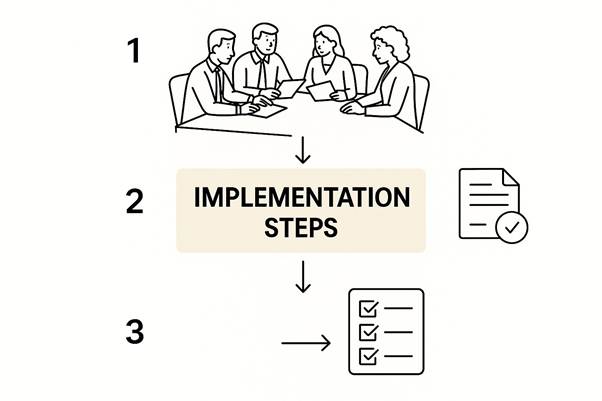
As you can see, creating a policy isn’t a solo HR task. It’s a collaborative effort that needs input from different corners of the business to ensure it’s both comprehensive and actually usable on a daily basis.
Defining Absence and Notification Rules
First things first, you need to separate the different types of absences. Your policy must clearly distinguish between planned absences, like an approved vacation, and unplanned absences, such as a sudden illness or family emergency. This distinction is critical because it allows you to set different expectations for how and when employees need to give notice.
Next, map out a dead-simple notification procedure. Don’t leave it to guesswork. Be explicit about who an employee needs to inform, the required timeframe, and the acceptable methods. For example, is a quick WhatsApp message to their manager okay, or do they need to call a dedicated HR number?
Here are the non-negotiables to spell out:
- Whom to notify: Should they contact their direct manager, a specific HR representative, or both?
- When to notify: Is it at least one hour before their shift starts? Or just as soon as reasonably possible?
- How to notify: Is a phone call mandatory? Is an official email acceptable? Or should they use your HRMS portal?
Laying out these steps removes any uncertainty. It ensures managers get the information they need in a timely manner, which gives them a fighting chance to adjust workloads and keep disruptions to a minimum. This structure is the backbone of any effective absenteeism policy.
For a quick reference, here’s a checklist of the essential components you’ll want to include as you draft or update your policy.
Key Elements for Your Absenteeism Policy Checklist
| Policy Component | Key Considerations | Example Clause Snippet |
| Definition of Absence | Clearly differentiate between planned, unplanned, authorised, and unauthorised absences. | “An absence is defined as any instance of an employee not being present for their scheduled work hours. This includes unplanned absences (e.g., illness) and planned absences (e.g., approved leave).” |
| Notification Procedure | Specify who to contact, by what method, and within what timeframe. | “Employees must notify their direct manager via a phone call at least 60 minutes before their scheduled start time for any unplanned absence.” |
| Documentation | Outline requirements for medical certificates or other proof of absence. | “A medical certificate is required for any continuous period of sickness absence lasting more than 3 consecutive working days.” |
| Disciplinary Actions | Detail the progressive disciplinary steps for unexcused or excessive absences. | “Failure to follow notification procedures will result in disciplinary action, beginning with a verbal warning and progressing to written warnings for subsequent violations.” |
| Return-to-Work | Describe the process for employees returning after a long absence, such as an interview. | “Upon returning from a medical leave exceeding 5 working days, employees are required to complete a return-to-work interview with their manager.” |
This table serves as a great starting point, ensuring you cover all the crucial bases and create a policy that is both comprehensive and legally sound.
Structuring Your Disciplinary Framework
While the goal is always to be supportive, a policy without teeth is just a suggestion. A fair, transparent, and consistently applied disciplinary framework is non-negotiable. This shouldn’t feel like a punishment-first system; instead, it should be a predictable, tiered approach for corrective action.
A well-structured disciplinary process is not about punishment; it’s about course correction. It provides a clear path for employees to understand the impact of their attendance and realign with company expectations before the issue escalates.
The process usually follows a logical progression, giving employees a chance to get back on track:
- Verbal Warning: This is an informal chat for a first-time or minor issue. It’s a supportive check-in, not a formal reprimand.
- Written Warning: If the pattern continues, this becomes a formal, documented warning that goes into the employee’s file.
- Final Written Warning: This is a more serious step, making it clear that termination is a potential next step if improvement isn’t seen.
- Termination: The last resort for continued violations after all other measures and support have been exhausted.
This progressive approach demonstrates fairness and gives people multiple opportunities to improve their attendance. It also creates a crucial paper trail, which protects the organisation from potential legal headaches down the road.
Of course, getting the right people in the door in the first place can prevent many of these issues from ever cropping up. Building a more accountable workforce from day one is a smart move, and you can explore some unique recruitment strategies to hire talent effortlessly to help with that.
Adapting Your Policy for the Indian Workforce

Let’s be honest. A standard, one-size-fits-all absenteeism policy will almost certainly fall short in the Indian context. If you want to create a framework that’s both fair and effective, you have to look beyond generic templates. It’s about considering the unique socio-economic and cultural factors that shape your workforce’s day-to-day life.
Designing a policy that actually works means moving past a purely punitive mindset. The goal is to build an empathetic structure that acknowledges real-world challenges, offers genuine support, and ultimately earns the respect and cooperation of your team.
Understanding Local Realities
India is incredibly diverse, and your employees’ circumstances can vary dramatically from one city to another. Factors like the urban-rural divide, nightmarish commutes, and significant family obligations all play a huge role in attendance patterns. An employee in a Tier-2 city faces entirely different hurdles than someone in a bustling metro.
Think about it: unreliable public transport, complex family structures, and community responsibilities can all lead to absences. A rigid, Western-style policy might unfairly penalise someone for situations completely beyond their control. A truly empathetic policy acknowledges these external pressures from the start.
Embracing Flexibility and Support
A progressive absenteeism policy should be built on support, not just scrutiny. For a workforce that often juggles professional duties with deep-rooted family commitments, flexibility isn’t a perk—it’s essential.
Consider incorporating elements that show your organisation gets it:
- Flexible Work Arrangements: Where possible, offering options like remote work or flexible hours can be a game-changer for reducing unplanned absences.
- Emergency Leave Provisions: Clearly defining and allowing for short-notice leave for genuine family emergencies builds incredible trust and goodwill.
- Support for Caregivers: Many employees in India are primary caregivers for elders or children. Acknowledging this reality shows you see them as people, not just personnel.
An absenteeism policy that fails to account for the deep social and familial ties prevalent in India is destined to be perceived as out of touch and unfair. True effectiveness comes from a place of understanding and support.
This approach doesn’t just reduce absenteeism; it’s a massive booster for loyalty and morale. It proves you see your employees as whole people with lives outside the office walls.
The Influence of Economic Insecurity
The broader economic context also shapes employee attendance. Data from the Periodic Labour Force Survey points to some of these underlying pressures. It notes India’s overall Labour Force Participation Rate is 42%, with female participation lagging significantly at 26.2%. With urban youth unemployment at a staggering 17.2%, job insecurity is a very real concern for many. Paradoxically, this stress can contribute to irregular attendance.
You can learn more about these trends in the Indian labour force. In this kind of environment, a supportive and stable policy can be a powerful anchor for your employees.
Meeting the Expectations of a Younger Workforce
As millennials and Gen Z become a larger part of your team, their expectations are shifting workplace norms. They value transparency, fairness, and a supportive work culture far more than rigid, top-down rules.
A policy that is clearly communicated, applied consistently, and offers a degree of flexibility will resonate much more strongly with this demographic. They are far more likely to respect and follow a system they see as fair and considerate of their well-being. This transforms your absenteeism policy from a disciplinary tool into a strategic asset for retention.
Rolling Out Your New Absenteeism Policy Effectively
Crafting a brilliant absenteeism policy is a major step, but it’s only half the battle. If the rollout lands with a thud—misunderstood, poorly announced, or just badly explained—the policy is practically destined to fail. A strategic, thoughtful launch is what separates a policy that genuinely works from one that just breeds confusion and resentment. The secret sauce? Clear communication, effective leadership training, and framing the whole thing in a positive light.
Your communication plan has to be more than a single all-staff email. Think about a multi-channel approach to make sure the message hits home for everyone, no matter where they are. You’ll want a mix of high-touch and digital methods to explain the what, the why, and the how of the new policy.
- Town Hall Meetings: These are perfect for introducing the policy face-to-face. You can explain the thinking behind it and tackle questions in a transparent, live setting.
- Email Announcements: Follow up with a clear, concise email that summarises the key changes and includes a link to the full policy document.
- Intranet/HR Portal Updates: Carve out a dedicated, easy-to-find space on your company intranet. This should house the full policy, a list of FAQs, and clear contact information for any follow-up questions.
This layered approach means employees hear the message multiple times through different channels, which is a game-changer for comprehension and retention.
Framing the Policy for a Positive Reception
How you frame your new absenteeism policy is absolutely critical. If you present it as just a new set of rules and punishments, you can expect employees to get defensive straight away. Instead, shift the focus of your messaging to the benefits it brings to everyone.
Emphasise fairness, clarity, and consistency. Explain that the policy exists to make sure everyone is treated equitably and that the expectations are crystal clear for the entire organisation. You can also highlight how it supports operational stability—which helps the whole team by preventing overburdened colleagues and last-minute chaos. This changes the narrative from one of control to one of collaboration.
A policy rollout should feel like a step towards a more organised and fair workplace, not a crackdown. By focusing on the “why” behind the rules—like fairness and clarity—you build understanding and buy-in from your team.
Empowering Managers for Consistent Application
Your managers are on the front line here. Their success is your success. If they aren’t confident, consistent, and empathetic when they apply the new rules, the entire structure will fall apart. This is why dedicated training for managers isn’t just a nice-to-have; it’s non-negotiable.
This training needs to be more than just a dry read-through of the policy document. You have to equip your managers with the skills to handle real-world situations.
- Role-playing difficult conversations: Give them a safe space to practise handling tricky chats about sensitive personal issues or patterns of unexcused absences.
- Recognising signs of burnout: Train them to spot when absenteeism might just be a symptom of a much bigger issue, like chronic stress or disengagement.
- Applying the rules with empathy: Teach them the fine art of enforcing the policy fairly while still being supportive and human about it.
When your managers feel empowered and prepared, they become champions for the new policy. They’re the ones who will ensure it’s applied with the consistency and empathy needed to make it truly effective, ultimately fostering a culture of accountability and mutual respect.
Using Technology for Fair and Accurate Enforcement
Still relying on manual spreadsheets and a manager’s memory to enforce your absenteeism policy? That’s a risky path, often leading to inconsistency and employee disputes. Modern technology offers a much smarter way forward, completely changing how you track, understand, and manage employee attendance. The idea isn’t just to swap paper for pixels; it’s to build a transparent, data-driven system that guarantees fair and accurate enforcement for everyone.
When you move to a digital system, you graduate from simple tracking to genuine insight. This is about using technology to spot patterns, figure out the real reasons behind absences, and offer support before small issues snowball into major problems.
Automating for Consistency and Fairness
One of the biggest wins you’ll get from technology is the removal of managerial bias. An automated Human Resource Management System (HRMS) applies the rules of your absenteeism policy the same way, every single time, for every single employee. It doesn’t play favourites, and it certainly doesn’t forget.
This level of automation ensures that warnings, leave deductions, and other consequences are triggered based on the rules you’ve set—not a manager’s mood or memory. This consistency is the bedrock of trust. It proves that your policy is fair in practice, not just in theory.
On top of that, these systems make life easier for everyone. Staff can apply for leave, check their balances, and view their attendance records with just a few clicks, creating a culture of transparency and personal accountability.
Gaining Deeper Insights Through Data
Modern attendance platforms do much more than just count heads. They provide powerful analytics that can pull back the curtain on hidden trends across your entire organisation.
- Identifying Departmental Hotspots: Are you seeing higher rates of unplanned absence in certain teams? This could be a red flag for issues like excessive workload, poor management, or flagging team morale.
- Spotting Absence Patterns: Does absenteeism spike around public holidays or consistently on Mondays? Data makes these patterns impossible to ignore, allowing you to get ahead of them.
- Connecting Absence to Performance: With integrated systems, you can start to see correlations between attendance data and performance metrics. This can help you identify employees who might be disengaged or struggling. A higher candidate offer dropout rate is another symptom of disengagement that can be addressed with better strategies right from the start. You can learn more about how to reduce your candidate offer dropout rate in our detailed guide.
The power of this kind of insight isn’t just theoretical; we can see it in large-scale public initiatives. For instance, the Indian government’s shift to digital attendance tracking showcases the immense power of accurate data.
This dashboard provides a real-time, data-backed view of workforce presence. It’s a clear move away from older, error-prone manual methods toward precise measurement and data-driven decisions. The Attendance.gov.in portal tracks real-time attendance for over 33 million active users across India, proving just how much clarity digital systems can provide at scale.
By embracing technology, you’re no longer just reacting to absences. You gain the foresight to understand the “why” behind the numbers, empowering you to build a more supportive, engaged, and productive work environment.
Common Questions About Absenteeism Policies
Even the most meticulously crafted absenteeism policy will run into real-world grey areas. Let’s be honest, you can’t predict every single scenario. Tricky situations are bound to pop up, which is why it helps to get ahead of the common questions you’ll inevitably field from both managers and employees. Think of this as your go-to guide for navigating those nuanced issues with confidence.
When you address these questions proactively, you’re sending a clear message about fairness. People will see that you’ve thought through these common dilemmas, which builds trust and makes the entire policy feel more reasonable and grounded.
Handling Leave Around Holidays
This one comes up all the time. You have an employee who consistently calls in sick right before or after a public holiday or a long weekend. This pattern, often called “sandwich leave,” can feel like a sneaky way to stretch a holiday and throws a real wrench in team planning.
To get a handle on this, your policy needs a specific clause to address it head-on.
- Require Prior Approval: State clearly that any leave directly attached to a public holiday must be approved in advance, just like planned time off.
- Ask for Documentation: For sick leave taken during these high-demand periods, it’s perfectly reasonable to require a medical certificate, even for just one day. This helps confirm the absence is legitimate.
The key here is consistency. Applying this rule across the board discourages people from gaming the system while still being fair to those with genuine emergencies. It’s all about keeping operations running smoothly during popular holiday times.
Distinguishing Absenteeism from Presenteeism
These two terms are often mentioned in the same breath, but they’re two very different beasts. Your policy needs to tackle one directly while creating a culture that discourages the other.
Absenteeism is simple: an employee isn’t at work when they’re scheduled to be. Your policy is built to manage, track, and address these physical absences.
Presenteeism, on the other hand, is much harder to spot. This is when an employee is physically at their desk but mentally checked out and unproductive. It’s often caused by illness, burnout, or personal stress. While your policy can’t directly police presenteeism, its supportive elements are your best tool against it. When you encourage employees to take sick leave when they are genuinely unwell, you’re actively discouraging them from showing up and underperforming. This is a massive factor in preventing bigger problems like a dip in team morale or even a rise in employee turnover. To understand this link better, take a look at an overview of employee attrition and how to prevent it.
Your goal is to foster a culture where taking legitimate sick leave is seen as the responsible choice—an act that protects both the individual’s well-being and the team’s overall productivity.
Taking Action with Available Leave
Here’s a common point of confusion: can you take disciplinary action against someone for excessive unplanned absences if they still have paid leave days in the bank? The answer comes down to how your policy is written.
Your absenteeism policy has to draw a sharp line between an employee’s accrued leave balance and the procedure for taking that leave. An employee might have 10 sick days available, but if they use them all without following the proper notification rules, their actions are still a violation of the policy.
The problem isn’t the absence itself; it’s the pattern of unplanned, last-minute absences that disrupts operations. If an employee’s frequent call-outs are hurting the team, you can absolutely initiate corrective action based on their failure to follow procedure, regardless of their leave balance. Just be sure your approach is legally sound by running it by your legal counsel first.
Managing absenteeism effectively starts with a solid policy and the right talent strategy. At Taggd, we specialise in Recruitment Process Outsourcing to help you build a more accountable and engaged workforce from day one. Learn how our services can support your HR goals.