
Maximize Hiring Success with Analytics in Hiring
For a long time, hiring has been more of an art than a science. Recruiters and hiring managers relied on their experience and intuition—that “gut feeling”—to make decisions. This approach, while having its merits, is a bit like trying to navigate the high seas with just a compass. It points you in a general direction, but it can’t warn you about hidden reefs or show you the fastest route.
That’s where hiring analytics comes in. It’s the practice of using data to make smarter, more effective recruitment decisions. Think of it as upgrading your compass to a full-fledged GPS, giving you the precision needed to turn your talent acquisition into a strategic advantage.
Moving Beyond Gut Feel In Talent Acquisition

The modern business world moves too fast for guesswork. Today’s talent acquisition requires a major shift from reactive hiring to a proactive, data-informed strategy. It’s about moving from simply filling seats to building a workforce that drives the business forward.
This transition from a compass to a GPS is crucial. It’s the difference between hoping you’re on the right track and knowing you are, complete with real-time performance data, optimised routes to talent, and predictive insights.
To really understand this shift, let’s compare the old way with the new.
Traditional vs Analytics-Driven Hiring Approaches
| Aspect | Traditional Hiring (The Compass) | Analytics-Driven Hiring (The GPS) |
|---|---|---|
| Decision-Making | Based on intuition, experience, and “gut feel.” | Based on objective data, trends, and predictive models. |
| Strategy | Reactive; filling roles as they become vacant. | Proactive; anticipating future needs and building talent pipelines. |
| Sourcing | Relies on familiar channels and networks. | Optimises channels based on performance data (cost-per-hire, quality-of-hire). |
| Evaluation | Subjective, with potential for unconscious bias. | Standardised and objective, using data to ensure fairness. |
| Focus | Filling immediate, open positions quickly. | Long-term workforce planning and strategic alignment with business goals. |
| Measurement | Basic metrics like time-to-fill and number of hires. | Comprehensive metrics like quality-of-hire, offer acceptance rate, and source effectiveness. |
The table makes it clear: one approach is about reacting to the present, while the other is about strategically shaping the future.
From Cost Centre To Strategic Partner
Historically, HR has often been seen as a cost centre—a necessary administrative function. But by weaving data analytics into the fabric of recruitment, talent acquisition becomes a powerful strategic partner that directly fuels business growth.
You stop just filling roles and start answering critical business questions.
By making data-driven decisions, HR teams can identify bottlenecks, optimise sourcing strategies, and improve candidate experiences. This allows organisations to move beyond guesswork and align recruitment with broader workforce planning objectives.
The impact isn’t just theoretical. A McKinsey study found that using HR analytics can lead to an 80% increase in hiring efficiency and a 25% rise in business productivity. That’s a massive competitive advantage, built by making smarter talent decisions.
The Core Of Data-Driven Hiring
Adopting analytics means you can systematically improve every single part of your recruitment funnel. You gain a deep understanding not just of who you hired, but how and why that hire was a success.
This powerful insight helps you to:
- Optimise sourcing channels: Find out exactly which platforms deliver the best candidates for the lowest cost.
- Refine job descriptions: Analyse which language and keywords attract the right kind of talent.
- Reduce hiring bias: Use objective data points to create fair and consistent evaluation processes for everyone.
- Improve offer acceptance rates: Pinpoint the factors that convince your top candidates to sign on the dotted line.
Ultimately, hiring analytics moves recruitment from a subjective art to a data-backed science. It replaces intuition with insight, empowering you to build a stronger, more resilient workforce ready for whatever comes next. This isn’t just another trend; it’s a fundamental evolution in how modern businesses win the war for talent.
So, What Exactly Are Hiring Analytics?
Let’s clear something up right away: using analytics in hiring doesn’t mean you need a PhD in statistics. It’s far simpler. It’s about shifting from gut feelings and old habits to asking sharp, specific questions and letting data guide you to the answers. This is how you move from assuming what works to knowing what works.
Think of it like giving your entire talent strategy a thorough health check-up. A doctor doesn’t just guess; they run specific tests to understand your health. In the same way, hiring analytics uses data to diagnose the real condition of your recruitment efforts. This process unfolds across three key levels, each one building on the last.
Level 1: Descriptive Analytics – What Just Happened?
This is your starting point, your foundation. It’s all about answering one straightforward question: “What happened?”
Descriptive analytics is like checking your company’s vital signs. It uses the data you already have to paint a clear picture of your past and current performance. It won’t tell you why things happened, but it gives you the unvarnished facts of the situation.
For instance, descriptive metrics can tell you things like:
- Our average time-to-fill was 42 days last quarter.
- We spent ₹50,000 in cost-per-hire for each new marketing role.
- The careers page was our top source of applications last month.
These are the hard numbers, the raw data that becomes the launchpad for any meaningful analysis. You need to know your baseline before you can even think about improving it.
Level 2: Predictive Analytics – What’s Coming Next?
Once you have a handle on what happened, the natural next question is: “What is likely to happen?” This is where predictive analytics comes into play.
Sticking with our health check-up analogy, this is the point where the doctor looks at your vitals, your history, and your lifestyle to forecast potential health issues down the road. In hiring, predictive analytics sifts through your historical data to spot patterns and predict what’s on the horizon.
Predictive analytics is about seeing around the corner. It transforms your past data into a crystal ball, letting you prepare for challenges and seize opportunities before they even arrive. It’s the shift from reacting to problems to proactively shaping your future.
This second level helps you estimate outcomes such as:
- Which candidates, based on their profiles, are most likely to say yes to a job offer.
- What the potential turnover rate might be for a specific department over the next year.
- Which sourcing channels will probably deliver the best candidates for your upcoming roles.
This kind of foresight is a true game-changer. It means you can put your resources where they’ll have the most impact and start building talent pipelines for jobs that haven’t even been created yet. This is becoming a cornerstone of corporate strategy across India. As organisations increasingly use AI-powered augmented analytics to identify high-potential candidates, the demand for skilled data analysts is skyrocketing. You can explore the future of data analytics in India to see just how big this trend is becoming.
Level 3: Prescriptive Analytics – What Should We Do About It?
This is where the magic really happens. Prescriptive analytics is the most advanced level, moving beyond predictions to answer the most critical question of all: “What should we do about it?”
This is the equivalent of your doctor handing you a personalised action plan. Based on all the tests and forecasts, it provides concrete recommendations to achieve the best possible health outcome.
In your hiring process, this looks like clear, actionable advice:
- Recommendation: “To boost the offer acceptance rate from 60% to 85% for senior developer roles, increase the salary offer by 8%.”
- Action: “Concentrate recruitment advertising spend for engineering roles on LinkedIn; it’s predicted to deliver candidates with a 20% higher success rate after one year.”
By moving through these three levels, you turn raw numbers into strategic intelligence. You start by understanding your past (descriptive), then forecast your future (predictive), and finally, get clear instructions on how to create the best version of that future (prescriptive).
The Essential Metrics for Your Hiring Dashboard

To make analytics in hiring truly work for you, you have to look beyond surface-level data. A powerful hiring dashboard doesn’t just show you a bunch of numbers; it tells a compelling story about your recruitment process from start to finish. It organises your data into strategic business areas, giving you a clear, holistic view of your performance.
By grouping metrics into four key pillars—Speed, Cost, Quality, and Experience—you can build a dashboard that delivers real, actionable insights, not just isolated data points. This approach helps you see the health of your entire talent acquisition function at a single glance.
The Speed of Hire
How fast can you actually find and onboard the right people? In today’s competitive market, speed is a massive advantage. Any delay could mean losing your top candidates to companies that move quicker.
The main metric here is Time-to-Fill. This is simply the total number of days from when a job requisition is opened until your chosen candidate formally accepts the offer. A high Time-to-Fill isn’t just a symptom of a slow process; it can point to deeper issues like poorly defined job requirements, a weak employer brand, or serious bottlenecks in your interview stages.
Another critical speed metric is Time-to-Hire, which tracks the time from a candidate’s very first contact with your company to their offer acceptance. This number directly reflects how efficient your candidate journey really is.
A lengthy Time-to-Hire almost always leads to a poor candidate experience and a higher number of drop-offs. Analysing this metric helps you find and fix the specific delays in your recruitment funnel, making sure you don’t lose your best applicants along the way.
For instance, if your Time-to-Fill is high but your Time-to-Hire is low, the problem is likely in the early stages—getting approvals or sourcing candidates. If the opposite is true, your interview and selection process is probably the holdup.
The Cost of Acquisition
Hiring is a significant business investment. Knowing exactly where that money is going is fundamental to optimising your budget and proving the ROI of your talent acquisition team.
The most recognised metric here is Cost-per-Hire. This is the total cost of all your recruitment activities (think advertising, recruiter salaries, agency fees, tech subscriptions) divided by the number of hires you made in a given period. It gives you a clear financial baseline for your hiring.
However, Cost-per-Hire alone doesn’t tell the whole story. You should also be tracking:
- Sourcing Channel Cost: This breaks down your cost-per-hire by its source, whether it’s LinkedIn, employee referrals, or job boards. It answers the crucial question: “Which channels are giving us the best return on our investment?”
- Cost of a Vacant Position: This calculates the financial loss to the business for every single day a critical role remains unfilled. It’s a powerful metric that helps build a strong business case for investing in more efficient recruitment.
The Quality of Hire
This is perhaps the most important, yet trickiest, metric to measure. Quality-of-Hire ultimately determines if your recruitment process is bringing in people who genuinely contribute to the company’s success. After all, a fast, low-cost hire is completely meaningless if the new employee underperforms.
Measuring Quality-of-Hire means pulling together several data points over time.
- Performance Review Scores: A new hire’s performance scores after their first six to twelve months are a direct indicator of their success in the role.
- Retention Rate: Tracking how long a new hire stays with the company, especially within their first year, is a strong signal of a good cultural and role fit.
- Hiring Manager Satisfaction: Simply surveying hiring managers about how satisfied they are with their new hire provides invaluable qualitative data.
When you bring these elements together into a single Quality-of-Hire score, you can directly link your recruitment activities to real business outcomes. For example, you might discover that candidates sourced through employee referrals consistently have a 15% higher Quality-of-Hire score than those from external agencies.
The Candidate Experience
In an age of glass-door transparency and online reviews, the experience you give your candidates is a direct reflection of your employer brand. A poor experience can seriously damage your reputation and scare off future applicants.
The primary metric here is the Candidate Net Promoter Score (cNPS) or a Candidate Satisfaction Score (CSAT). These are usually measured with short, simple surveys sent to candidates at different stages of the hiring process.
Other essential experience metrics include:
- Offer Acceptance Rate: This is the percentage of candidates who accept a job offer. A low rate can signal problems with your compensation packages, company culture, or the interview experience itself.
- Application Completion Rate: This measures the percentage of people who start an application versus those who actually finish it. A high drop-off rate often points to a clunky, complicated, or overly long application process.
By diligently tracking these four pillars, you can build a truly comprehensive dashboard that goes far beyond vanity metrics. This organised view empowers you to make sharp, strategic decisions, optimise every part of your recruitment, and clearly demonstrate the business value your talent acquisition team delivers.
Building a Data-Powered Recruitment Workflow
Bringing analytics into your hiring isn’t just about glancing at a few new metrics. It’s about a fundamental shift—rebuilding your entire recruitment process so that every decision, from start to finish, is guided by hard data. When you move from theory to practice, you’re not just tweaking old habits; you’re creating a data-powered engine designed to attract and secure superior talent.
This means breaking down the hiring journey into its core stages and injecting a dose of analytical thinking into each one. Let’s walk through what that looks like.
Stage 1: Data-Driven Sourcing
Sourcing is where it all begins, and it’s often a black hole for budgets spent on channels that just don’t deliver. Instead of running on autopilot or guesswork, data lets you pinpoint exactly where your best candidates are hiding.
Start by digging into your historical hiring data. The big question to ask is: “Which platforms have actually given us our most successful, long-term employees?” Compare the performance reviews and retention rates of hires from different sources—think LinkedIn, employee referrals, niche job boards, or university partnerships. You might find that while one job board sends a flood of applications, it’s the employee referrals that consistently bring in people who perform better and stick around longer.
By shifting your advertising spend from low-performing channels to the ones that truly work, you’re doing more than just cutting your cost-per-hire. You’re simultaneously boosting your quality-of-hire. This simple analytical step makes sure every rupee in your budget is working as hard as you are.
Stage 2: Smarter Candidate Screening
Screening can be a massive bottleneck. We’ve all seen recruiters lose countless hours sifting through resumes manually. Analytics can make this stage worlds more efficient and objective, freeing up your team for the strategic work that really matters.
Use your Applicant Tracking System (ATS) to analyse your past successful hires. By identifying the key skills, experiences, and qualifications that correlate with success in a role, you can build an ideal candidate profile. This profile then allows your system to automatically score and rank new applications as they come in. It’s a game-changer, ensuring the most promising candidates get to the top of the pile first and dramatically cutting down screening time. Our guide on how to hire top talent has even more strategies to speed this up.
This infographic shows how data flows through the hiring process to drive better outcomes.
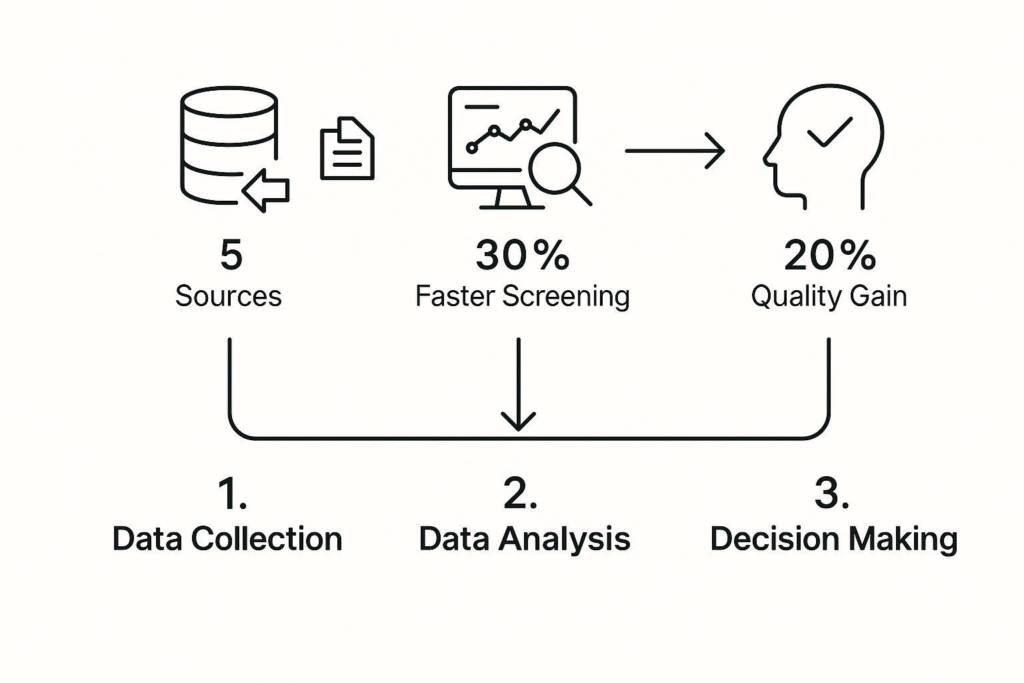
As the visual makes clear, by thoughtfully collecting and analysing data, organisations can achieve faster screening and see a real jump in the quality of people they bring on board.
Stage 3: Unbiased and Structured Interviewing
The interview is where unconscious bias can easily sneak in and undermine all your efforts to build a diverse, inclusive team. A data-first approach helps create a more structured and fair playing field for everyone.
The key is to implement structured interviews. This means every candidate for a specific role gets asked the same set of questions and is evaluated against the same pre-defined scorecard. The data you collect from this process is incredibly valuable. You can analyse it to:
- Pinpoint effective interview questions: Find out which questions are the best predictors of on-the-job success and which are just noise.
- Check for interviewer bias: Look at scoring patterns across different interviewers to spot inconsistencies and ensure everyone is applying the criteria fairly.
- Close the feedback loop: Track how long it takes for interviewers to submit their feedback, helping you speed up decisions and keep candidates engaged.
This method not only makes your interview process more defensible but also far more effective at finding the right person for the job, plain and simple.
Stage 4: Optimised Offer Management
Making the offer is your final play to land a top candidate. Getting it right is critical, and analysing your offer data is the best way to maximise your chances of getting a “yes.” Start by tracking your offer acceptance rate by department, seniority level, and even location.
A low acceptance rate is a major red flag that something is off. Dive into the data to find out why. Are your salary packages falling short of the market rate? Is there a long, painful delay between the final interview and the offer letter? By analysing feedback from candidates who said no, you can pinpoint the exact weaknesses in your offer and make data-backed adjustments to your compensation, benefits, or the overall candidate experience.
This constant feedback loop is especially critical in fast-moving fields. For example, while the Indian IT sector as a whole saw a 7% dip in hiring, the demand for AI and ML roles skyrocketed by 39%, with Global Capability Centres (GCCs) snapping up 52.6% of these tech openings. When you understand market dynamics like these through data, you can craft compelling offers that truly stand out from the competition.
Overcoming Common Hurdles in Hiring Analytics

Moving to a data-driven recruitment strategy is a massive step forward, but it’s rarely a straight line from A to B. Plenty of organisations hit a few speed bumps along the way. The first step to getting past these obstacles is knowing what they are so you can unlock the full potential of analytics in hiring.
The good news? You’re not the first to face these challenges, and there are proven ways to solve them. By tackling these issues head-on with a solid plan, you can turn your implementation into a success story instead of a source of frustration. Let’s look at the most common barriers and how to knock them down.
Dealing with Poor Data Quality
You’ve probably heard the old saying: “garbage in, garbage out.” It’s the golden rule of analytics. If your data is a mess—full of inconsistencies, gaps, or just plain wrong information—any insights you pull from it will be unreliable at best. For many HR teams, this is the very first roadblock they hit.
The problem usually starts with something simple, like inconsistent data entry across different platforms or a lack of standard processes. For example, job titles for the exact same role might be entered in three different ways, or candidate sources are recorded haphazardly. Little things like this make accurate analysis impossible.
The fix is to start small but clean. Don’t try to fix years of messy historical data all at once. Instead, pick one or two critical metrics you want to nail down, like Time-to-Fill or Quality-of-Hire for a single department. Focus all your energy on creating a squeaky-clean, consistent data collection process for just those metrics. This gives you a reliable foundation to build on.
Overcoming Resistance to Change
Let’s be honest, not everyone is going to be thrilled about a data-first approach. Hiring managers and veteran recruiters who have relied on their gut feelings for years might see analytics as a threat or just another complication. They might worry it undermines their expertise or just adds more admin work to their plate.
The key to getting them on board is to show them the value, not just demand they follow the new process.
Frame analytics as a tool that supercharges their expertise, not one that replaces it. The goal is to show them how data helps them make better, faster, and more confident decisions, making their jobs easier and more impactful in the long run.
One of the best ways to do this is by celebrating early wins. As soon as your clean data starts to deliver—maybe by identifying a top-performing sourcing channel that saves time and money—shout it from the rooftops. Offer training that focuses on the practical side of things, showing them exactly how analytics helps them build stronger teams.
Integrating Disparate HR Systems
Many HR departments are working with a patchwork of different technologies. Your Applicant Tracking System (ATS), Human Resource Information System (HRIS), and performance management software often don’t talk to each other. This digital disconnect makes getting a single, clear view of your recruitment data incredibly difficult.
Manually exporting data from different systems into spreadsheets isn’t just a time-sink; it’s also a recipe for errors. It’s simply not a sustainable way to get the real-time insights you need.
While the ideal solution is a unified talent platform that brings everything together, that’s a long-term project for most. In the meantime, you can:
- Use API Connectors: Look into tools that can automatically pull data from your various systems into a central analytics dashboard.
- Establish a “Single Source of Truth”: Pick one system—usually the ATS for recruitment data—to be the primary record. Then, enforce strict data entry rules to keep it clean and reliable.
By systematically tackling data quality, managing the human element of change, and solving your tech headaches, you can build a strong and resilient foundation for your hiring analytics strategy.
The Future of Recruitment is Analytical and Predictive
The world of talent acquisition is making a huge shift. We’re moving away from just looking in the rearview mirror and starting to look through the windshield. While it’s still vital to ask “what happened?” in our hiring, the real power now lies in forecasting talent needs and actively shaping the business’s future. This isn’t just a small change; it’s a completely new way of thinking about how we build a winning team.
At the core of this evolution are artificial intelligence and machine learning. These aren’t just buzzwords anymore. They’ve moved way beyond simple automation. Now, they can dig through mountains of data to find candidates who don’t just tick the boxes for a role today, but who are predicted to be top performers throughout their entire journey with the company.
A Strategic Focus on Employee Lifetime Value
This predictive power allows us to pivot to a far more strategic metric: Employee Lifetime Value (ELTV), right from the first handshake. Instead of getting bogged down by the initial cost-per-hire or how long it took to fill a seat, we can now model the long-term value a candidate is likely to deliver. This is a game-changer, as it ties hiring decisions directly to long-term profitability and growth.
By studying what makes our past top performers great, predictive models can flag applicants who have those same markers for success. This data-backed approach means we’re not just filling an empty chair; we’re making a calculated, long-term investment in our company’s future. This is one of the most critical hiring trends to reinvent your recruiting strategy that leaders need to get behind.
Championing Fairness and Inclusion with Data
Beyond just performance, analytics has become an essential ally in our push for Diversity, Equity, and Inclusion (DEI). By methodically examining our recruitment funnels, we can finally shine a light on and root out unconscious bias at every single stage.
Analytics gives us an objective, unbiased look at our hiring practices. It can pinpoint if certain groups are dropping off disproportionately at the screening stage or if interview scores show a pattern of bias among specific hiring managers. This allows us to make targeted changes for a much fairer process.
This ensures our hiring is not only more effective but also genuinely equitable, helping us build a richer, more diverse workforce that reflects the world we live in.
Preparing for a Data-Driven Job Market
This hunger for analytical skills isn’t just an internal priority; it’s completely reshaping the job market. Take India’s tech sector, for example. It’s projected to grow by an incredible 22% in 2025, creating around 500,000 new tech jobs in data-heavy fields like e-commerce and healthcare.
This explosion in demand makes analytics in hiring absolutely critical. It’s especially true as entry-level tech hiring is expected to jump by 40%, with skilled graduates commanding top-tier salaries right out of the gate.
Ultimately, the future of recruitment is one where data is no longer just a report we look at once a month. It’s a core strategic asset. For any leader aiming to gain a real competitive edge, embracing hiring analytics is no longer a choice—it’s a necessity.
Frequently Asked Questions About Hiring Analytics
Thinking about bringing a data-driven approach into your hiring process often sparks a few questions. Let’s tackle some of the most common ones that come up when people first start exploring analytics in hiring, so you can get past those initial hurdles and see the real-world benefits.
Where Should We Start If We Have No Data?
This is a common starting point, but in reality you probably have more data than you realise. Your Applicant Tracking System, HR Information System, and even basic spreadsheets hold valuable information waiting to be used. The trick is not to try to boil the ocean. Pick one or two high impact metrics that are simple to track. Good initial targets include:
Time to fill: How long it takes to fill a role from the day it is posted to the day an offer is accepted.
Source of hire: Where your successful hires are coming from, such as LinkedIn, employee referrals, or your careers page.
Focus on gathering clean, consistent data for these metrics. Once you build a solid process, you can start to expand. The goal is to build momentum with small, visible wins.
How Can We Measure Something Subjective Like Quality of Hire?
Measuring quality of hire feels difficult, but it is completely possible. The key is to combine a few objective data points so you get a full picture and remove guesswork.
Quality of hire is not a single number. It is a story told by multiple signals. By combining performance, retention, and hiring manager feedback, you create a metric that connects recruitment efforts to business outcomes.
A strong quality of hire score usually includes:
New hire performance: Often taken from the first performance review at six or twelve months.
First year retention: Whether the new hire stays for at least one year. High early turnover is a clear sign of a bad hire.
Hiring manager satisfaction: A simple rating, such as a 1 to 10 score, gives crucial insight.
When you combine these, you get a reliable view of what a successful hire looks like. This lets you identify which sourcing channels or interview methods bring in the best long term talent.
How Do We Ensure Analytics Help with Culture Fit?
Using analytics does not mean sacrificing the human side of hiring. In fact, data can make your culture fit assessments more objective and fair by reducing unconscious bias. Instead of relying on vague instincts, you define culture fit in clear, measurable terms.
Start by examining your top performers. What behaviours and values do they consistently show? Collaboration, initiative, ownership, or something else. Turn these traits into structured interview questions and score every candidate against them.
This approach helps you identify candidates who truly align with your core values, rather than hiring people who simply feel familiar to the interviewers.
For a deeper look, you can explore best practices for assessing and hiring culture fit candidates.
Ready to transform your recruitment from a reactive function into a strategic, data-powered engine? At Taggd, we specialise in Recruitment Process Outsourcing that embeds analytics into the core of your hiring strategy. Let us show you how to build a workforce that drives your business forward.