
Mastering Your Candidates Per Hire Ratio
So, what exactly is Candidates Per Hire?
In simple terms, it’s a recruitment metric that tells you how many applicants you had to sift through to make one successful hire. It’s a straightforward measure of how efficient your hiring funnel is, showing how well your process weeds out a large pool of people to find the one perfect candidate. A lower number here usually points to a more focused and effective hiring process.
Unpacking the Candidates Per Hire Metric

Picture your hiring process as a big funnel. At the wide top, you pour in hundreds of applications. But at the narrow bottom, only one person comes out as your new team member. The Candidates Per Hire metric is essentially the scorecard for this funnel. It tells you just how wide the top needs to be to get one successful hire out the other end.
This number is much more than just another HR statistic; it’s a vital sign for your whole recruitment strategy. It shines a light on key parts of your operation, giving you a real sense of the health and effectiveness of your talent acquisition efforts.
Why This Metric Is a Strategic Tool
Getting a clear handle on this ratio gives you deep insights into how your hiring machine is running. By keeping an eye on it, you can start asking the right questions and pinpoint exactly where things could be better.
- Sourcing Effectiveness: Are your job posts actually attracting the right kind of people? Or are they too vague, bringing in a flood of unqualified applicants?
- Job Description Clarity: Is your role description clear enough to filter for the skills you need? Or is it confusing, attracting a mismatched crowd of candidates?
- Screening Efficiency: Is your first screening step doing a good job of spotting top talent, or is it letting too many unsuitable people slip through to the next stage?
By monitoring your Candidates Per Hire, you stop just reacting to hiring needs and start building a proactive talent strategy. It lets you spot weaknesses, cut down on wasted time and effort, and make hiring decisions that are smarter, faster, and more cost-effective.
This metric is especially critical in today’s tight job market. In India, the recruitment scene is changing fast, with hiring intent expected to jump by around 19% in the coming years. This growth is mainly driven by big sectors like IT, retail, and BFSI. If you want to keep up, you can read more about the latest Indian recruitment trends.
With more and more companies fighting for the same talent, making your hiring funnel as efficient as possible is no longer just a nice-to-have—it’s absolutely essential for success.
Quick Guide to Candidates Per Hire Ratios
To make sense of your numbers, it helps to understand what different ratios might be telling you. This table breaks down what low, medium, and high Candidates Per Hire ratios typically mean for your recruitment process.
| Ratio | Potential Meaning | Key Action |
|---|---|---|
| Low (e.g., <20:1) | Highly targeted sourcing, strong employer brand, or a less competitive role. Your process is very efficient. | Double-check that you’re not being too restrictive and missing out on diverse talent. Keep doing what works. |
| Medium (e.g., 20:1 – 60:1) | A balanced process that attracts a healthy number of applicants without being overwhelming. This is often the sweet spot. | Analyse stage-by-stage drop-off rates to find small areas for improvement in your screening or interview process. |
| High (e.g., >60:1) | Sourcing might be too broad, job descriptions unclear, or initial screening is inefficient. You’re likely wasting resources. | Review your sourcing channels and job ad copy. Tighten up your initial screening criteria to filter out unqualified candidates earlier. |
Remember, these are just general guidelines. The “right” number will always depend on your specific industry, the role you’re hiring for, and the current state of the job market. Use this table as a starting point to diagnose the health of your hiring funnel.
Calculating Your Candidates Per Hire Accurately
Getting a handle on your Candidates Per Hire number is the first real step toward understanding what’s happening in your recruitment funnel. While the basic formula looks simple enough, the details are what separate a fluffy, feel-good number from a genuinely useful diagnostic tool. To get it right, you have to be crystal clear about your definitions.
The standard calculation is pretty straightforward:
Total Number of Candidates ÷ Total Number of Hires = Candidates Per Hire
The classic mistake here is fuzzy maths around what actually counts as a “candidate.” Is it every single resume that landed in your inbox, no matter how unqualified? Or is it only the people who passed that first basic screening and actually stood a chance? Whatever you decide, you have to be consistent.
To get data you can actually trust, the whole team needs to agree on one definition and stick to it for every single role you hire for.
Defining Your Candidate Pool
Let’s say you’re looking for a new marketing manager and you get 200 applications. Do all 200 go into the formula? What about the 50 who don’t have the right degree or have absolutely zero relevant experience? If you include them, you’re just watering down your data and making your sourcing efforts look less effective than they really are.
A much smarter way to do it is to only count the applicants who clear the absolute minimum, non-negotiable criteria for the job. This gives you a much cleaner, more actionable number to work with.
This simple infographic breaks down the core process for calculating and using this metric.
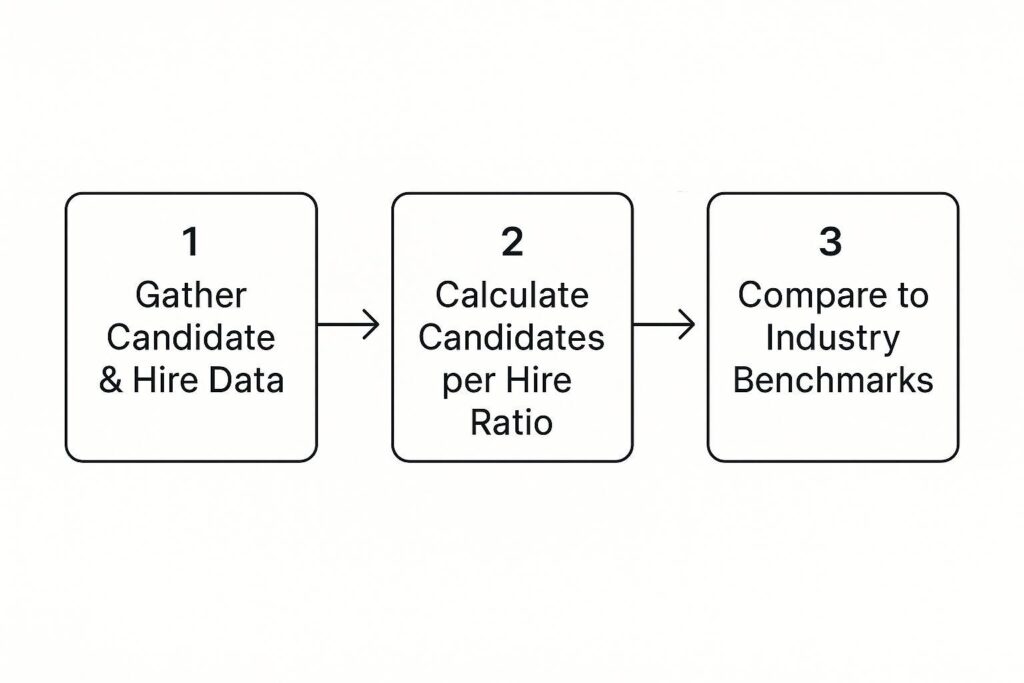
As you can see, the calculation itself is just the middle part of the story. The real value comes from starting with clean data and then comparing your results against relevant benchmarks to see how you’re really doing.
Going Deeper with Segmented Metrics
Once you’ve got the basic calculation down, you can start unlocking some seriously powerful insights by slicing up your data. Instead of looking at one big, general number, you can analyse what’s happening at different stages of your hiring process. This turns your Candidates Per Hire ratio from a simple counter into a powerful magnifying glass.
Try tracking these variations to get a clearer picture:
- Qualified Applicants Per Hire: This tells you how many candidates who actually passed your initial screen were needed for one hire. A high number here could be a red flag that your interview process is dragging on or your assessment criteria don’t quite match what the job needs.
- Interviewees Per Hire: This one is crucial. It shows how many people made it to an actual interview for every successful hire. For instance, if you’re interviewing 10 people to fill one spot, it might mean your initial screening isn’t filtering effectively, which ends up wasting a lot of your hiring managers’ valuable time.
- Source-Specific Candidates Per Hire: By calculating this for each of your sourcing channels (like employee referrals, LinkedIn, or job boards), you can see exactly where your best candidates are coming from. This is gold dust, as it shows you precisely where to focus your budget and effort for the biggest return.
When you start breaking down the numbers like this, you move beyond simple counting and into strategic analysis. You can pinpoint exactly where your process is shining and, more importantly, where it’s falling short. That’s how you make smart, data-driven improvements that strengthen your entire hiring engine.
How to Interpret Your Candidates Per Hire Ratio

Calculating your Candidates Per Hire ratio is the easy part. The real skill lies in understanding the story that number is trying to tell you. On its own, the number is just data; context is what gives it meaning.
Forget about finding a single “good” ratio that works for everyone. Chasing a universal benchmark is a fool’s errand. A healthy ratio for one role could easily be a huge red flag for another.
Think about it this way: hiring for a high-volume customer support team might mean sifting through hundreds of applicants, pushing your ratio to 75:1 or even higher. That’s perfectly normal. But if you’re looking for a highly specialised senior data scientist, the talent pool is tiny. A 15:1 ratio in that scenario would be a massive win.
The goal isn’t to judge your ratio as “good” or “bad.” It’s to use it as a diagnostic tool to understand the health of your hiring process.
Reading the Story Behind the Numbers
A high or low number isn’t inherently negative. Instead, think of it as a symptom of an underlying issue somewhere in your recruitment funnel. Pinpointing these causes is the first step toward making smart, effective changes.
A high Candidates Per Hire ratio (say, 100:1) often points to a problem at the top of your funnel. It could signal a few things:
- Vague Job Descriptions: Is your job ad too broad? If it is, you’re likely attracting a flood of unqualified or mismatched people.
- Inefficient Sourcing: Casting a wide, generic net on major job boards can overwhelm your system and bury your team in resumes.
- Weak Initial Screening: If too many unsuitable candidates are slipping past your first checkpoint, it inflates your numbers and creates a ton of unnecessary work down the line.
On the flip side, an extremely low Candidates Per Hire ratio (something like 5:1) can be just as worrying. This might mean:
- A Dangerously Small Talent Pool: Your sourcing channels might be too narrow, severely limiting your options and raising the risk of making a bad hire out of desperation.
- Overly Restrictive Requirements: Are your “must-have” criteria so rigid that you’re accidentally filtering out perfectly capable people?
- Poor Employer Brand Visibility: It’s possible that top talent simply doesn’t know you’re hiring, leading to a weak trickle of applicants.
Your ratio is a diagnostic tool. A high number points to issues with quality control, while a low number can signal a problem with quantity and reach. The goal is to find the balance that delivers a healthy slate of qualified choices without overwhelming your team.
Benchmarking Against Industry and Role
To get a true sense of your performance, you need to look beyond your own historical data and see how you stack up against relevant benchmarks.
The Indian job market is a great example of why this matters. It’s buzzing with activity, with recent reports showing that 94% of employers are planning to hire. The IT sector, in particular, is a hotbed of competition, with 37% of employers desperately searching for talent in specialised fields like AI and Machine Learning. For a closer look at these trends, you can explore the full report on India’s white-collar job market.
This competitive environment has a direct impact on your hiring metrics. If you’re recruiting for a high-demand tech role, your numbers will naturally look very different from a company hiring in a less crowded space.
Industry Benchmarks for Candidates Per Hire in India
To help you get started, here’s a look at some typical Candidates Per Hire ratios across different sectors in the Indian market. Use this as a guide to see where you stand, but remember that seniority, location, and brand recognition will also play a huge role.
| Industry | Average Candidates Per Hire | Influencing Factors |
|---|---|---|
| Information Technology (IT) | 40:1 – 80:1 | High volume of applicants for generic roles, but very niche pools for specialised skills (e.g., AI/ML, Cybersecurity). |
| Manufacturing & Engineering | 25:1 – 50:1 | More specialised skill sets required; sourcing often relies on industry networks and specific technical institutes. |
| BFSI (Banking & Finance) | 50:1 – 100:1 | Large applicant pools for entry-level roles; rigorous, multi-stage screening processes are common. |
| Retail & E-commerce | 60:1 – 120:1 | High-volume hiring for customer-facing and logistics roles, often with significant seasonal peaks. |
| Healthcare & Pharma | 20:1 – 45:1 | Highly regulated industry with strict certification and experience requirements, leading to smaller, qualified pools. |
Ultimately, context is everything. By analysing your ratio against your specific industry, the seniority of the role, and your company’s brand strength, you can set realistic goals and make strategic decisions that truly refine your hiring funnel.
Key Factors That Influence Your Hiring Funnel
Your Candidates Per Hire ratio doesn’t exist in a vacuum. It’s a dynamic metric, constantly being shaped by a powerful mix of your internal choices and the forces of the external market. Getting a handle on these drivers is the first step to taking control of your hiring outcomes.
The final number can swing wildly based on things you can control, like your sourcing strategy, and things you can’t, like a volatile job market. By breaking down each element, you can figure out exactly which levers to pull for a smarter, more efficient hiring funnel.
Sourcing Channels and Candidate Quality
Where you look for candidates has a direct and immediate impact on the quality and sheer volume of applicants you get. Casting a wide net with general job boards will almost always lead to a higher Candidates Per Hire ratio, flooding your team with a huge number of resumes of varying quality.
On the flip side, more targeted channels almost always deliver better results.
- Employee Referrals: This is often the gold standard for a reason. Candidates referred by your own team are essentially pre-vetted, resulting in a much lower, higher-quality ratio.
- Niche Job Boards: When you post on industry-specific platforms, you’re fishing in the right pond. You attract professionals who already have relevant experience, filtering out the noise from the very beginning.
- Direct Sourcing: Proactively reaching out to passive candidates on platforms like LinkedIn gives you the ultimate control over your initial talent pool.
Focusing your energy on channels that prioritise quality over sheer quantity is one of the quickest ways to bring your ratio down. For more ideas, you can explore these unique recruitment strategies to hire talent that help you tap into better candidate pools.
The Power of a Clear Job Description
Think of your job description as the most important filter in your entire hiring process. A vague or generic description acts like a wide-open gate, inviting just about everyone to apply. This inevitably bloats your applicant numbers and burns through your team’s valuable screening time.
A well-crafted job description, however, is surgical. It clearly lays out the “must-have” skills, the day-to-day realities of the job, and the type of person who will thrive in the role. This level of clarity helps potential applicants self-select, making sure only the most relevant candidates even bother to apply, which naturally lowers your ratio.
A strong job description doesn’t just attract candidates; it qualifies them. It’s your first and best opportunity to manage applicant quality before a single resume even lands in your inbox.
External Market Conditions and Your Employer Brand
You can’t ignore what’s happening outside your company walls. In a fiercely competitive talent market, you’re naturally going to face more headwinds. For example, India’s talent market is seeing intense competition right now, with attrition rates jumping to 20.3% from just 6% in previous years. This workforce shuffle forces companies to assess way more candidates just to secure the right person. You can dig into more insights about the Indian talent marketplace on RippleHire.
In these conditions, your employer brand is your best line of defence. A strong, positive brand reputation turns your company into a magnet for top talent, often shrinking the number of candidates you need to consider for each hire. Conversely, a weak or unknown brand means you’ll have to work much harder—and likely see a much higher ratio—to fill every single role.
Proven Strategies to Optimize Your Hiring Process

Knowing your Candidates Per Hire ratio is the first step, but the real magic happens when you start improving it. Whether your number is way too high or worryingly low, the end game is the same: build a recruiting machine that’s both efficient and effective. It’s all about attracting the right people without drowning your team in paperwork.
The key is turning your data into a solid action plan. This involves making smart tweaks at different stages of your hiring funnel. You’d be surprised how small changes in your job descriptions, screening methods, and candidate engagement can make a huge difference to your final numbers—and, more importantly, the quality of people you bring on board.
When Your Ratio Is Too High
A sky-high ratio usually points to a quality control problem right at the top of your funnel. It means you’re spending way too much time wading through irrelevant applications. The fix? Introduce better filters, and introduce them early.
- Refine Your Job Descriptions: Get ruthlessly specific. Ditch the generic lists of duties and clearly spell out the “must-have” skills versus the “nice-to-haves.” This simple act helps unqualified candidates screen themselves out before they even apply.
- Use Pre-Screening Questions: Set up automated questions in your application process to act as an initial gatekeeper. Simple queries about required certifications, specific years of experience, or work authorisation can instantly shrink your applicant pool to a more manageable size.
- Analyse Sourcing Channels: Dive into your recruitment data. Where are your best candidates actually coming from? If a generic job board sends you 100 applicants but only one is qualified, it might be time to move that budget to a niche platform that delivers better results.
The goal isn’t just to slash the number of applicants. It’s to boost the percentage of qualified candidates flowing into your pipeline. A sharper focus at the beginning saves countless hours of screening and interviewing down the line.
When Your Ratio Is Too Low
On the flip side, an extremely low ratio can be a red flag. It might mean your talent pool is dangerously shallow, which seriously increases the risk of making a hire you’ll regret. Here, your focus should be on expanding your reach and making it easier for great people to apply.
- Expand Your Sourcing: It’s time to look beyond your usual hunting grounds. Start actively sourcing passive candidates on professional networks, show up at virtual industry events, or build talent pipelines through partnerships with universities.
- Boost Your Employer Brand: Let’s be honest, top talent wants to work for great companies. Show off your company culture, share employee testimonials, and highlight growth opportunities on social media and your careers page. A strong, authentic brand pulls in great candidates all on its own.
- Simplify the Application Process: Nothing kills candidate enthusiasm like a long, clunky application form. Make sure yours is mobile-friendly and can be finished in just a few minutes. Research shows a difficult process can cause up to 60% of candidates to give up and walk away.
By putting these targeted strategies into practice, you can start nudging your Candidates Per Hire ratio towards a much healthier balance. For a deeper look into modern recruitment techniques, our guide on how to hire top talent and accelerate recruitment offers even more valuable insights. Ultimately, you’re working towards a hiring process that is predictable, scalable, and consistently delivers high-quality talent.
Common Questions About Candidates Per Hire
Even when you get the hang of the Candidates Per Hire metric, you’re bound to run into a few specific questions when you start using it. Let’s tackle some of the most common ones head-on.
Think of this as your quick-reference guide. It’s designed to help you troubleshoot common challenges and turn theory into confident action.
What Is a Good Candidates Per Hire Ratio?
Honestly, there’s no magic number that works for every company. The ideal ratio really depends on your industry, the job’s seniority, and how well-known your company is.
For a highly specialised engineering role, a ratio of 15:1 might be fantastic. But for an entry-level customer service position, you might be looking at 60:1 or even higher, and that’s perfectly fine.
The real goal isn’t to chase some universal benchmark. It’s about finding what’s healthy for you. You need enough solid choices to make a great hire without drowning your team in a sea of irrelevant CVs.
How Can We Reduce Our Ratio Without Losing Good Applicants?
The trick here is to focus on the quality of your applicants, not just the quantity. It’s all about being more precise at the very top of your hiring funnel so that only the most relevant candidates apply in the first place.
Here are a few ways to do that:
Write Hyper-Specific Job Descriptions: Ditch the generic lists of duties. Use precise keywords and clearly spell out the absolute “must-have” skills. This helps potential candidates screen themselves out if it’s not the right fit.
Use Targeted Sourcing: Instead of blasting your job ad across massive, general job boards, concentrate your efforts on niche platforms and industry-specific communities where your ideal candidates are already hanging out.
Implement Pre-Screening Questions: A few simple, automated questions about essential qualifications (like a specific certification or software proficiency) can weed out anyone who doesn’t meet the baseline criteria right from the start.
This approach means your team spends their valuable time talking to promising people, not sifting through stacks of unqualified applications.
Does a Low Candidates Per Hire Ratio Always Mean Efficiency?
Not at all. While a low ratio might look good on paper, it can actually be a major red flag. It could mean your talent pool is dangerously small, which limits your options and puts you under pressure to hire someone who isn’t quite right.
A consistently low ratio might mean your sourcing is too narrow, your compensation is below the market rate, or your job requirements are overly restrictive. True efficiency is having a healthy slate of qualified individuals to choose from, not just the bare minimum.
It’s also worth remembering that a low ratio doesn’t guarantee a good hire. Bringing the wrong person on board can be incredibly expensive in the long run. You can learn more by exploring these best practices for assessing and hiring a culture fit candidate to ensure your new hires really stick.
At Taggd, we specialise in optimising recruitment funnels to deliver not just candidates, but the right talent for your team. Discover how our Recruitment Process Outsourcing solutions can help you achieve a balanced and effective hiring strategy at https://taggd.in.