
Effective Corporate Recruitment Strategies to Attract Top Talent
Corporate recruitment is far more than just filling empty seats. Think of it as the strategic process organisations use to scout, attract, and hire the very best people who can help them hit their business goals. At its core, it’s a vital function that directly fuels a company’s ability to innovate, grow, and stay ahead of the curve.
Why Corporate Recruitment Is Your Competitive Edge

Let’s look at corporate recruitment differently. It’s not a simple administrative task of posting a job and sifting through CVs. It’s the engine that powers your company’s ambition. It’s like a professional sports team’s scouting unit—you’re not just looking for players; you’re meticulously building a championship-winning team ready to dominate the market.
The process covers the entire journey, from pinpointing a strategic gap in a department to seamlessly onboarding a new team member who starts adding value from day one. In today’s fast-moving business world, having a sharp, forward-thinking approach to hiring isn’t just nice to have—it’s absolutely essential.
The Strategic Importance of Modern Hiring
In a crowded market, the talent you bring on board is your single biggest advantage. Great corporate recruitment makes sure every new hire not only has the right technical skills but also fits perfectly with the company’s long-term vision and culture. Getting this right means lower staff turnover, higher productivity, and a workforce that’s genuinely engaged.
What’s more, a well-run recruitment process boosts your company’s reputation. Candidates who have a good experience—even the ones who don’t get the job—are more likely to say positive things about your organisation. A great way to amplify this is to learn how to scale your employer branding with online recruitment events, turning every interaction into a chance to build your brand.
A strong recruitment process is a direct reflection of a company’s health and its commitment to excellence. It signals to the market that you are investing in the right people to drive future success.
Navigating the Evolving Indian Job Market
The Indian recruitment scene is on the brink of significant change. By 2025, projections show a massive 15–20% growth in job opportunities, fired up by breakthroughs in AI, data analytics, and cloud computing. This boom isn’t just in tech; the manufacturing sector is bracing for a 25% jump in hiring, and the automotive industry is expecting a 20% rise.
With a 40% spike in staffing activities predicted for early 2025, it’s clear that companies are optimistic. This energy underscores just how crucial a modern recruitment strategy is.
To build a real, lasting competitive advantage in this environment, organisations have to be proactive. That means you can’t just wait for roles to open up. You need to be building talent pipelines, keeping an eye on market trends, and positioning your company as a top place to work. The next sections will lay out a clear roadmap to help you build and execute a winning corporate recruitment strategy.
Building a Modern Recruitment Strategy That Wins

A winning recruitment strategy isn’t just a happy accident; it’s a carefully built framework designed to attract and hold onto the best talent out there. It’s about moving your organisation away from the old, reactive “post and pray” method and into a forward-thinking model where you’re always cultivating talent.
To really get it right, a modern strategy needs to stand on four essential pillars. Each one supports the others, creating a system that doesn’t just fill empty chairs but actually builds a high-performing workforce. Let’s dig into what makes these pillars so crucial.
Proactive Sourcing and Talent Pipelining
The best time to find a great candidate is long before you actually need one. That’s the whole idea behind proactive sourcing. It’s all about identifying potential future hires and building relationships with them now, creating a warm pipeline of talent you can tap into the moment a role opens up.
This is more than just collecting CVs. It means engaging with passive candidates—the talented folks who are already employed and not actively looking—through professional networks like LinkedIn, industry events, and specialised online communities. The goal is to build a community that already sees you as an employer of choice.
Building a talent pipeline is like setting up a long-term savings plan for your workforce. You make small, consistent deposits of engagement and relationship-building, and it pays huge dividends when you need to make a critical hire without delay.
Compelling Employer Branding
Your employer brand is the story your company tells the world about what it’s like to work for you. It’s your reputation, shaped by everything from your company culture and values to the kind of experience you give candidates during the hiring process.
A strong employer brand acts like a magnet for A-players. It clearly communicates your unique Employee Value Proposition (EVP)—the total package of rewards and benefits an employee gets for their hard work. This story has to be authentic and consistent everywhere a candidate might find you, from your careers page to social media and employee reviews.
Think about companies like Tata Consultancy Services or Infosys. Their brands are built on decades of trust and opportunity, making them aspirational employers for millions.
Data-Driven Hiring Decisions
Gone are the days of hiring based on gut feelings alone. Modern corporate recruitment leans on data and analytics to make smarter, faster, and less biased hiring decisions. When you track the right metrics, you can spot bottlenecks in your process, make it more efficient, and actually prove the value of your recruitment efforts.
A few essential metrics you should be tracking include:
- Time to Fill: How long does it take to get from a job opening to an accepted offer? This measures your efficiency.
- Cost per Hire: This calculates your total investment in hiring someone new, which is vital for managing your budget.
- Quality of Hire: This assesses the long-term value a new hire brings, often measured by performance reviews and how long they stay with the company.
- Source of Hire: Which channels are bringing you the best candidates? This tells you where to focus your resources.
An Unforgettable Candidate Experience
In a competitive market, you have to treat candidates like customers. The experience you provide them—from their first interaction to the final decision—directly impacts your ability to hire the best people. A single bad experience can tarnish your employer brand and scare off future applicants.
A great candidate experience is built on respect, transparency, and clear communication. Keep candidates in the loop at every stage, give them timely feedback, and make sure every interaction is professional and positive. Even people you don’t hire should walk away with a good impression of your organisation.
This is especially critical in India, which ranks second globally in hiring intent for late 2024. As Gen Z is set to become 27% of the workforce by 2025, their expectations for digital communication and flexibility are reshaping hiring norms. To keep up, 67% of Indian companies plan to tap into diverse talent pools, and 30% are dropping degree requirements for skills-based hiring to attract this new generation. You can read more about the key hiring trends shaping India’s job market.
Your Step-By-Step Guide to the Hiring Lifecycle
Trying to navigate the corporate recruitment journey can feel overwhelming, but it’s a lot simpler when you break it down into a handful of clear, manageable stages. Think of this lifecycle less as a checklist and more as a strategic roadmap. It’s what takes you from realising you have a gap in the team to welcoming a productive new member.
When you master each step, your hiring process stops being a reactive chore. Instead, it becomes a proactive system for building a high-performing workforce.
This infographic breaks down the core phases you’ll encounter in the modern corporate hiring lifecycle.
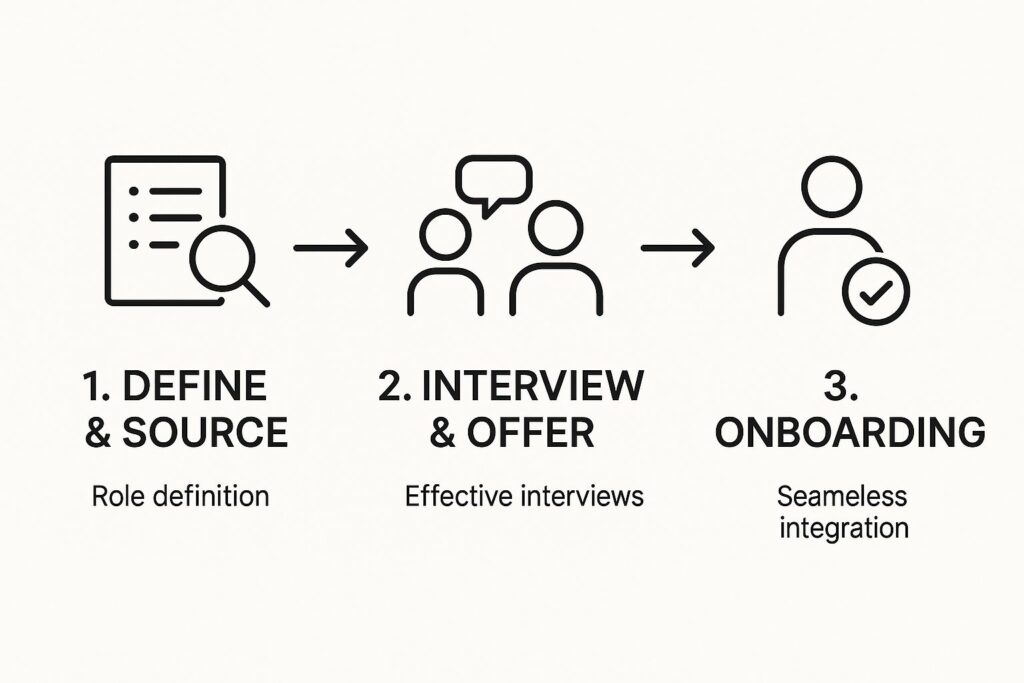
As the visual shows, success in one phase builds momentum for the next. It’s a clear reminder of just how important a seamless, well-managed process really is.
Step 1: Defining the Role and Crafting the Job Description
Before you can even think about finding the right person, you have to deeply understand the role itself. This first step is foundational; get it wrong, and you’re setting yourself up for mismatched hires and a whole lot of wasted effort. Start by sitting down with the hiring manager and key team members to define not just the tasks, but the actual business outcomes this role needs to deliver.
Look past a simple list of duties. You need to ask some critical questions:
- What problem will this person solve for the company?
- After one year, what does success in this position actually look like?
- Which skills are absolute must-haves, and which ones can be picked up on the job?
Once you have that clarity, you can craft a job description that truly sells the opportunity. Ditch the dry, internal jargon. Use compelling language that speaks directly to your ideal candidate, making sure to highlight your company culture and what makes this role unique.
Step 2: Sourcing and Attracting the Right Candidates
With a strong job description in hand, your next mission is to get it in front of the right eyeballs. This calls for a multi-channel approach. Sure, posting on the major job boards is a good start, but modern corporate recruitment goes much, much further.
Lean into your employee referral programme—it consistently delivers high-quality candidates who already have a feel for your company culture. Get active on platforms like LinkedIn to source passive candidates by engaging with them directly. Building those relationships before a role even opens is a powerful strategy for the future.
For organisations looking to scale up their talent acquisition without burning out their internal teams, understanding the advantages of having an RPO partner can be a real game-changer. These partners bring specialised expertise in tracking down hard-to-find talent.
Step 3: Screening and Creating a Strong Shortlist
As the applications start to pour in, the goal is to efficiently zero in on the most promising candidates. This is where a structured screening process is absolutely invaluable. Begin with an initial CV review to filter out anyone who clearly doesn’t meet the minimum requirements.
Next, conduct brief phone or video screens. This is your chance to assess basic qualifications, communication skills, and whether they have a genuine interest in the role. This step helps you move beyond the paper CV and get a real feel for the candidate’s personality and professionalism.
The point of screening isn’t just to eliminate people; it’s to build a high-potential shortlist where every single individual is a genuinely viable contender for the role.
Step 4: Conducting Effective Interviews and Assessments
The interview stage is your golden opportunity to truly evaluate a candidate’s abilities and, just as importantly, their cultural fit. To do this fairly, you need structured interviews where every candidate is asked the same core set of job-related questions. This is crucial for reducing bias and making sure you’re comparing apples to apples.
Use a mix of question types to get a complete picture:
- Behavioural Questions: Ask candidates to describe past situations to show how they handle specific challenges (e.g., “Tell me about a time you had to manage a tight deadline.”).
- Situational Questions: Present hypothetical scenarios to see their problem-solving and decision-making skills in action (e.g., “How would you handle a conflict with a key stakeholder?”).
- Technical Assessments: For roles that need specific hard skills, use practical tests or assignments to validate their expertise.
Step 5: Making the Offer and Closing the Deal
After careful evaluation, you’ve pinpointed your top candidate. Now it’s time to extend a compelling offer. This conversation should be handled with real care and enthusiasm, reinforcing exactly why you believe they are the perfect fit for your team.
Be ready to discuss salary, benefits, and a start date clearly and transparently. A well-prepared, formal offer letter should follow your verbal offer without delay. Remember, the best candidates often have multiple options, so keeping the momentum going and showing your excitement is key to getting them to say “yes.”
Step 6: Onboarding for Long-Term Success
The recruitment lifecycle doesn’t stop once the offer is accepted. A structured onboarding process is absolutely essential for setting new hires up for success and making sure they feel welcomed and integrated from day one.
A great onboarding programme is about more than just paperwork. It should introduce the new employee to the company culture, connect them with key people across the team, and give them the tools and training they need to become productive quickly. This final step is critical for improving employee retention and maximising the return on your recruitment investment.
Putting Recruitment Technology and AI to Work

Technology in recruitment is no longer a nice-to-have; it’s the engine driving modern hiring. The right tech stack doesn’t just speed things up—it gives recruiters back their most precious resource: time.
By automating the repetitive, admin-heavy tasks, technology lets hiring professionals step up from being process managers to becoming strategic talent advisors. This crucial shift allows them to focus on the human side of hiring: building real relationships with top candidates and partnering closely with business leaders to understand what they truly need. The goal isn’t to replace recruiters, but to supercharge their expertise.
The Rise of AI in Talent Acquisition
Artificial Intelligence (AI) is probably the single biggest game-changer in how companies find people today. Its real magic lies in its ability to sift through massive amounts of data, spot patterns, and help recruiters source and screen candidates with incredible speed and accuracy.
Think about it: AI-powered tools can scan thousands of CVs in minutes. But they do more than just match keywords. Modern AI understands context, inferring skills and potential that aren’t even explicitly listed on a resume. This kind of intelligent sourcing helps unearth hidden gems in your talent pool who might have been completely missed otherwise.
AI’s true value in recruitment is its power to handle the high-volume, low-complexity tasks. This frees up human recruiters to do what they do best: the high-touch, high-complexity work like engaging candidates, conducting strategic interviews, and negotiating offers.
Despite the global buzz about AI taking over jobs, the feeling in India is quite the opposite. A massive 72% of Indian employers are actually planning to expand their workforce in the second half of 2025. What’s more, 87% of them don’t see AI as a threat to jobs at all. In fact, 13% believe it will be a catalyst for creating brand-new, tech-focused roles. You can discover more insights about India’s hiring outlook and the positive role of AI.
Streamlining Workflows with Applicant Tracking Systems
An Applicant Tracking System (ATS) is the central nervous system for any modern recruitment team. It’s the single source of truth—an organised database for everything from posting a job and collecting applications to scheduling interviews and sending out offers.
Trying to manage a high volume of candidates without an ATS is pure chaos. An effective system brings order to the madness by:
- Centralising Candidate Data: Every CV, note, and piece of interview feedback lives in one easy-to-access place.
- Automating Communication: The system can handle automated acknowledgements and status updates, which dramatically improves the candidate experience.
- Ensuring Compliance: An ATS helps maintain proper records and follow fair hiring practices, reducing legal headaches down the line.
- Providing Analytics: It can generate reports on crucial metrics like time-to-fill and source of hire, giving you the data you need to make smarter decisions.
For businesses looking to get more from their process, understanding how our recruitment platform eases digital hiring can show you how to leverage these systems for maximum impact.
Nurturing Talent with Recruitment Marketing Platforms
In today’s market, just posting a job and hoping for the best is a losing strategy. Recruitment marketing platforms help companies shift from a reactive to a proactive approach. Think of it like customer marketing, but for talent.
These tools let you build and nurture talent communities long before you have a specific role to fill. You can create compelling career pages, run targeted social media campaigns, and manage email newsletters to keep potential candidates warm and engaged with your employer brand. When a critical role finally opens up, you’re not starting from scratch; you already have a pipeline of interested people to talk to.
Of course, technology isn’t a silver bullet. While these tools offer incredible advantages, it’s vital to be mindful of the ethical side, especially when it comes to preventing algorithmic bias. The human touch remains absolutely essential to ensure fairness, empathy, and a positive experience for everyone involved in the corporate recruitment journey.
Measuring Recruitment Success with Metrics That Matter
So, how do you actually prove your corporate recruitment efforts are paying off? In a world swimming with data, it’s all too easy to get distracted by flashy “vanity metrics” that look good on a chart but don’t mean much for the business. To show the real impact of your hiring, you have to zero in on the Key Performance Indicators (KPIs) that directly link what you do to what the business achieves.
Tracking the right numbers does more than just get your budget approved. It provides a crystal-clear, objective picture of what’s working and what’s falling flat, letting you make smart, data-driven tweaks. This shifts the recruitment team from being seen as a cost centre to a strategic partner that leadership can count on to fuel the company’s growth.
Time to Fill
One of the most foundational metrics in any recruiter’s toolkit is Time to Fill. It’s simple: this is the total number of calendar days from when a job request gets the green light to the day your chosen candidate says “yes” and accepts the offer.
Think of this KPI as a direct measure of your team’s efficiency. A lengthy Time to Fill isn’t just a number; it has real-world consequences. We’re talking about lost productivity from an empty desk and the very real risk of your top choice getting snapped up by a faster competitor. If this number is consistently high, it’s a red flag that you might have a bottleneck in your screening or interview stages that needs sorting out, fast.
Consider Time to Fill as the pulse of your recruitment process. A steady, healthy beat means things are moving along smoothly. If it’s slow or all over the place, it’s time for a check-up to diagnose and fix what’s wrong.
Cost per Hire
Next up is Cost per Hire, which calculates the total investment your company sinks into bringing a new person on board. To get this figure, you simply add up all your internal and external recruitment costs over a set period and divide that total by the number of people you hired in that same window.
What counts as a recruitment cost? It’s a mix of things:
- Fees for posting jobs on various platforms
- Salaries for your recruitment team and any agency fees
- Subscriptions for your tech stack (like your ATS)
- Travel and lodging expenses for candidates
- Bonuses for employee referrals
Getting a handle on this metric is absolutely crucial for managing your budget effectively. It tells you which of your sourcing channels are giving you the best bang for your buck and helps you build a solid business case for putting money where it will make the biggest difference.
Quality of Hire
While other metrics are all about speed and cost, Quality of Hire is focused on the long-term value a new employee brings to the table. This is, without a doubt, the most important—and also the trickiest—metric to track in the world of corporate recruitment.
Why is it so challenging? Because it isn’t just one data point. To get a real sense of quality, you have to blend several indicators together. These often include the new hire’s performance review scores after six or twelve months on the job, whether they stick around (retention rate), and what their hiring manager has to say. A high-quality hire, for example, is someone who doesn’t just meet expectations but blows them out of the water and continues to be a key contributor well past their first year.
Candidate Satisfaction
Candidate Satisfaction is exactly what it sounds like: it measures how people feel about their experience with your hiring process. The best way to capture this is through short, snappy surveys sent at key moments, like right after they apply or just after an interview.
In today’s tight talent market, the candidate experience can make or break your employer brand. A single bad experience can tarnish your company’s reputation and scare off great talent in the future. By tracking satisfaction, you get direct, actionable feedback that you can use to improve your communication, simplify your process, and make sure every single candidate—even the ones you don’t end up hiring—walks away with a positive view of your organisation.
Now that we’ve walked through the core four, let’s pull them together to see how they function as part of a holistic measurement strategy.
Essential Corporate Recruitment Metrics at a Glance
Tracking individual metrics is useful, but seeing them together shows you the complete picture. This table summarises the most important KPIs, making it clear what each one tells you and why it’s a non-negotiable part of a successful recruitment strategy.
| Metric | What It Measures | Why It’s Important |
|---|---|---|
| Time to Fill | The number of days between a job requisition approval and a candidate’s offer acceptance. | Reveals the efficiency of your hiring process and highlights potential bottlenecks. |
| Cost per Hire | The total cost of hiring a new employee, including all internal and external expenses. | Essential for budget management and calculating the ROI of different sourcing channels. |
| Quality of Hire | The long-term value a new employee brings, measured by performance, retention, and manager feedback. | The ultimate indicator of recruitment success, directly linking hiring to business performance. |
| Candidate Satisfaction | How candidates perceive their experience throughout the hiring process, typically via surveys. | Protects and enhances your employer brand, ensuring you attract top talent in the future. |
By keeping a close eye on these four areas, you’re not just tracking numbers; you’re gathering the intelligence needed to build a recruitment function that consistently delivers top talent and drives the business forward.
Frequently Asked Question
Even with the best strategy, corporate recruitment is full of tricky situations that can throw you for a loop. It happens to everyone. This section is all about tackling those common, often awkward questions that pop up, giving you straightforward advice you can use right away.
Think of this as a practical field guide. Getting a handle on these issues will sharpen your entire approach, making for a smoother process and, ultimately, better hires. Let’s dive in.
How Do We Handle a Candidate Who Has a Counteroffer?
It’s a heart-sinking moment: your top candidate just got a counteroffer. The first thing to do is take a breath, not panic. You need to get to the bottom of their motivation. Is this purely about the money, or are they genuinely looking for the growth, culture, or new challenges you offer?
Gently remind them why they started looking for a new job in the first place. Reconnect them with the specific opportunities and career path your company has on the table—the very things their current role is missing. While you could think about a slight adjustment to your offer, getting into a bidding war is a game you rarely win in the long run.
A candidate who can be swayed by a last-minute pay rise might just have their loyalty tested again down the line. It’s far better to focus on the long-term value and career growth they’ll only find with you. That’s a much stronger foundation for a lasting professional relationship.
What Is the Best Way to Reject a Candidate Politely?
Turning down a candidate is just part of the job, but how you do it says a lot about your company. The golden rule is to be respectful, timely, and as transparent as you can be without creating legal headaches. Never “ghost” a candidate. If someone took the time to interview with you, they’ve earned a response.
A personalised email is pretty standard. Keep it brief and professional, and make sure to thank them for their time. If they were a genuinely strong contender, you could offer to keep their details for future roles that might be a better fit. It’s a small gesture, but it leaves the door open and keeps the relationship positive.
A few key tips to remember:
– Be Prompt: Don’t leave people hanging for weeks. A quick rejection helps them move on with their search.
– Be Human: Ditch the cold, robotic language. A warm, professional tone goes a long way.
– Keep it General: You want to avoid giving very specific feedback that could be misinterpreted or cause legal issues. A simple, honest line like, “We’ve decided to move forward with a candidate whose experience more closely aligns with the role’s immediate needs,” is usually best.
How Long Should Our Hiring Process Take?
There’s no magic number here; the “right” amount of time varies hugely depending on the role, industry, and seniority level. That said, the goal is always to be as efficient as possible without cutting corners on quality. A hiring process that drags on and on is a sure-fire way to lose great talent to your competitors and leave a bad taste in everyone’s mouth.
For most professional roles, try to wrap up the whole cycle—from application to offer—within three to four weeks. For more senior or executive positions, that might stretch to six or even eight weeks. The only way to hit these targets is to get your hiring managers and interviewers all on the same page and committed to the timeline right from the start.
Can We Ask About a Candidate’s Salary History?
This is a big one. In many parts of India and across the globe, asking about a candidate’s past salary is either discouraged or outright illegal. The whole idea behind this shift is to promote fair pay and stop past wage gaps from following a person throughout their career.
So, instead of asking what they used to make, shift the conversation to what they expect to make. Asking, “What are your salary expectations for this role?” is a much safer, more forward-looking question. It respects the candidate’s privacy and keeps the negotiation focused on the value of the role inside your organisation, not on what they earned somewhere else. This way, you’re paying for the job and the skills, which leads to fairer outcomes all around.
At Taggd, we specialise in taking the complexity out of your recruitment process, allowing you to focus on building a winning team. Explore our Recruitment Process Outsourcing solutions today.