
External Recruitment Strategies to Hire Top Talent
When we talk about external recruitment, we’re simply talking about the process of hiring people from outside your company. It’s about casting a wider net and scouting for talent in the open market, bringing in people who offer new skills, fresh perspectives, and different experiences your current team might be missing.
Why External Recruitment Is Your Strategic Advantage

Sure, promoting from within is a fantastic way to build loyalty and morale. But relying only on your internal talent pool can, over time, lead to stagnation and groupthink. External recruitment is the strategic move that injects new energy and capabilities into your business.
This isn’t just about filling an empty chair. It’s a deliberate play to boost your company’s long-term health and stay ahead of the competition.
Think of your company like a Premier League football club. Bringing a player up from the youth academy is great for the club’s culture, but sometimes you need to sign a star from another team to gain a specific skill set and completely change the game. That star player is your external hire. They arrive with new tactics, different training methods, and a winning mentality that can lift the entire squad.
Infusing Fresh Perspectives and Innovation
One of the biggest wins from hiring externally is the immediate infusion of new ideas. People hired from the outside aren’t constrained by “the way we’ve always done things around here.” They come from different company cultures, industries, and operational setups, which helps them spot inefficiencies and opportunities that insiders might have become blind to.
This fresh perspective is a huge driver of innovation. It challenges outdated processes and sparks the kind of creative problem-solving that keeps a business agile. A new hire from a competitor might introduce a more effective sales funnel, while someone from a completely different industry could bring a revolutionary approach to customer service.
By seeking talent from outside, organisations tap into a wider candidate pool, promoting diversity and inclusion. This strategy allows them to onboard individuals with varied backgrounds and experiences, which are the building blocks of innovation.
Filling Critical Skill Gaps
Let’s be honest: sometimes, the skills your company needs to grow simply don’t exist in your current team. It could be expertise in machine learning, a specific coding language, or experience with international market entry. External recruitment is the most direct route to get those skills on board.
Trying to upskill an existing employee can be slow and might not produce the expert-level proficiency you need right now. Hiring externally gives you immediate access to specialised talent, allowing your business to pivot quickly and grab new market opportunities without a lengthy ramp-up period.
Boosting Your Employer Brand
When you successfully attract and hire top-tier talent from the outside, it sends a powerful signal to the market: your company is growing, it’s successful, and it’s a place where ambitious people want to work.
Every new hire from a well-regarded company acts as a stamp of approval for your employer brand. This creates a positive feedback loop—great talent attracts more great talent, making all your future recruitment efforts that much easier and more effective.
The Unseen Benefits of Hiring Outside Talent

Sure, filling a vacant role is the immediate task at hand. But the real value of external recruitment goes much deeper than just plugging a gap in the org chart. When you bring new talent into your organisation, you’re introducing a powerful catalyst for growth and change, often in ways you didn’t expect.
Every external hire is a chance to shake things up and challenge the “we’ve always done it this way” mentality. They walk in with a fresh set of eyes, free from the baggage of your company’s history or internal politics. This unique position allows them to question processes and assumptions that long-time employees might not even notice anymore.
A Catalyst for Breakthrough Innovation
Think of your company’s collective knowledge like a well-tended garden. Nurturing your existing plants (internal talent) is essential, but adding new species (external hires) can drastically improve the entire ecosystem’s health. These new additions bring different nutrients and strengths, preventing the soil from getting tired.
An external hire might introduce a new software methodology they used at their last company, a more efficient project management framework, or a customer service philosophy that completely transforms client interactions. Their diverse backgrounds create a richer environment for solving problems and can spark the kind of breakthrough ideas that give you a real competitive edge.
This injection of fresh thinking isn’t always about massive, disruptive changes either. It often comes in the form of small, smart improvements that, over time, add up to significant gains in efficiency and creativity.
Accessing a World of Specialised Skills
Let’s face it: sometimes, the skills you need to move forward simply don’t exist within your current team. It could be expertise in a new programming language, deep knowledge of international compliance, or advanced data analytics. In these cases, looking outside is the fastest and most direct way to get the capabilities you need.
The external talent pool is vast, dramatically increasing your chances of finding that perfect candidate with a niche, hard-to-find skill set. This approach helps future-proof your organisation, allowing you to adapt to market shifts and new technologies without the long delay of training existing staff from square one.
A successful external hire is more than just a new team member; they are a strategic asset. They bring not only their own expertise but also knowledge of competitor strategies, industry best practices, and untapped market opportunities.
This is especially true in India’s current job market, which is seeing strong momentum for external hiring. A ManpowerGroup survey for the second quarter of 2025 found that 55% of employers planned to increase their headcount, reflecting a robust net employment outlook of 43%. The IT sector was at the forefront of this trend with a 53% hiring intention, highlighting the high demand for specialised external talent. You can discover more insights about India’s hiring outlook and see how different sectors are performing.
Enhancing Your Competitive Position
When you successfully attract and land a top-tier external candidate, it sends a powerful message to the entire industry. It signals that your company is a place where talented people want to be—a dynamic, growing business that can compete for the best professionals on the market.
This positive signal strengthens your employer brand and creates a kind of magnet effect. High-calibre professionals are naturally more interested in joining a company that is visibly attracting their peers. Each great external hire makes the next one that much easier to secure, building a self-sustaining pipeline of talent.
Ultimately, a smart external recruitment strategy does more than fill roles. It builds a more resilient, innovative, and competitive company by continually refreshing your talent pool and strengthening your market position. It’s a cornerstone for any business serious about sustainable, long-term growth.
Your Step-by-Step External Recruitment Playbook
Kicking off an external recruitment drive can feel like a massive task, but when you break it down into clear, manageable steps, it all falls into place. A solid playbook takes the guesswork out of hiring, keeps things fair for everyone, and dramatically boosts your odds of finding that perfect person for the job. Think of it as your blueprint for a hiring machine you can rely on time and time again.
Each stage flows logically into the next, creating a funnel that helps you find and move the best people forward. It all starts with knowing exactly who you’re looking for and ends with an offer your top candidate can’t wait to accept.
Stage 1: Laying the Foundation
Before a single job ad is written, you need to get crystal clear on the role itself. This is, without a doubt, the most important step in the entire journey. What problems will this person actually solve? What skills are absolute deal-breakers, and which are just nice to have?
Get the key people in a room—the hiring manager, future teammates, department heads—and hammer out a detailed role profile. This isn’t just a list of duties. It should spell out the key performance indicators (KPIs), what the career path looks like, and how this role fits into the bigger picture of the company’s goals. This document becomes your North Star, guiding every decision you make from here on out.
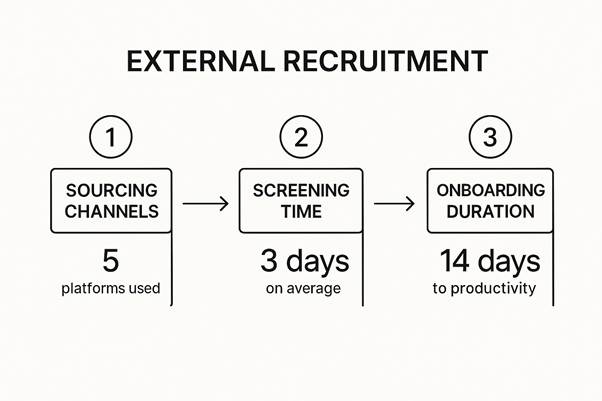
This process flow shows how sourcing, screening, and onboarding all connect. An efficient process casts a wide net at the start but quickly narrows down the field, getting new hires up to speed and productive within weeks.
Stage 2: Crafting the Job Description and Sourcing Candidates
With your role profile locked in, it’s time to turn it into a job description that grabs attention. Ditch the dry, corporate speak. Instead, write an ad that sells the opportunity, speaks directly to your ideal candidate, and gives them a real taste of your company culture.
Use clear, inclusive language and make it easy to skim. What makes your company a great place to work? This isn’t just a checklist of requirements; it’s your first sales pitch to the talent you want to attract.
Once the job description is live, the real hunt begins. Sourcing candidates effectively means using a mix of channels to get the word out:
- Corporate Career Pages: Your own website is ground zero. Anyone applying here already has an interest in your brand.
- Online Job Boards: Platforms like LinkedIn, Naukri, or Indeed are great for casting a wide net and reaching people actively looking for a new role.
- Social Media Sourcing: Go where your ideal candidates hang out. This is a fantastic way to show off your culture and connect with passive talent who might not be actively job searching.
- Employee Referrals: This is often your goldmine. Referrals come pre-vetted by people you already trust, making them some of the highest-quality hires you can find.
Stage 3: Screening and Shortlisting Applicants
When the applications start rolling in, the screening process kicks off. The goal here is simple: efficiently filter that big pool of candidates down to a manageable shortlist of the most promising ones. That detailed role profile you created earlier? It’s now your scorecard for every application that comes through.
An Applicant Tracking System (ATS) can do some of the heavy lifting by filtering for keywords and basic qualifications. But don’t underestimate the human touch—it’s still crucial for spotting potential in CVs that don’t fit the typical mould. You’re looking for people whose experience and skills really sync up with the core needs of the job.
Stage 4: Conducting Effective Interviews
The interview is where you go beyond the CV. This is your chance to really dig into a candidate’s skills, see if they’ll vibe with your team, and gauge their long-term potential. Using structured interviews—where every candidate gets asked the same core questions—is key to keeping bias out of the picture and making fair comparisons.
A good interview process usually has a few layers:
- Phone Screening: A quick chat to confirm the basics and see if there’s mutual interest.
- Technical or Skills Assessment: A practical test or small project to see if they can actually do the job.
- In-depth Interviews: Conversations with the hiring manager and the team to assess soft skills, how they solve problems, and how they’d fit into the team dynamic.
- Final Interview: A meeting with senior leadership to get the final sign-off on cultural alignment and future potential.
A great interview isn’t an interrogation; it’s a two-way conversation. It’s your chance to assess the candidate and their opportunity to determine if your company is the right fit for their career aspirations.
Stage 5: Making the Offer and Onboarding
Once the interviews are done and references checked, it’s go-time. Move fast, because the best candidates always have other options on the table. Make sure your offer is competitive, clear, and reminds them why joining your team is a great move. For a closer look at sealing the deal, you can learn about the 4 recruitment steps for a smooth hiring ramp-up in our detailed guide.
After the offer is accepted, the external recruitment process flows right into onboarding. A solid onboarding programme is what sets your new hire up for success from day one. It helps them feel part of the culture and get productive as quickly as possible, locking in that positive candidate experience and setting the stage for them to stick around for the long haul.
Choosing the Right Recruitment Channels

A successful external recruitment strategy is about more than just a slick job description. It’s about choosing the right battleground to find your talent. Think of recruitment channels like different fishing nets: a massive net cast in the open ocean (a general job board) is great for catching lots of common fish, but you’ll need a specialised lure (a niche agency) to attract a specific, rare species.
There’s simply no one-size-fits-all approach here. Using the same channel for every role is a recipe for wasted time and money. The real trick is matching the channel to the role. A junior administrative position might pull in hundreds of quality applicants from a big job board, while a C-suite role demands the quiet, targeted touch of a headhunter.
Navigating the Digital Job Market
Online job boards and your own corporate careers page are often the first stop. These platforms are the modern-day town square where active job seekers gather, making them perfect for casting a wide net.
Your careers page is your best tool for attracting people who are already curious about your brand. At the same time, massive platforms like LinkedIn and Naukri offer incredible reach, especially for entry-level to mid-management roles where the talent pool is large and actively looking. The biggest challenge? The sheer volume of applications. You need solid screening processes to handle the flood without burning out your team.
Engaging Specialised Recruitment Agencies
For those senior, executive, or highly specialised roles, bringing in a recruitment agency or headhunter can be a game-changer. They act as an extension of your own team, armed with deep market knowledge and networks you simply can’t access through public channels.
Agencies are particularly useful when you need to keep a search confidential or when you’re hunting for passive candidates—those top performers who aren’t looking for a job but are open to the right offer. It’s a bigger upfront investment, for sure, but the payoff is often superior candidate quality and a much faster time-to-hire for those critical positions. You’re paying for precision, not just volume.
A strategic external recruitment plan isn’t about using every channel available. It’s about picking the few that give you the highest chance of connecting with the right person for a specific role, optimising both cost and quality.
The Rise of Modern Sourcing Methods
Beyond the usual suspects, modern sourcing methods offer creative ways to find talent. Social media platforms like LinkedIn and Twitter, and even industry-specific forums, have become fertile ground for spotting and engaging potential candidates. This lets you showcase your company culture and build relationships long before a role even opens up.
In India, another big trend is hiring independent professionals for project-based work. A recent report on the 2025 talent-on-demand landscape found that Indian companies are increasingly bringing in freelance experts at daily rates between INR 10,000 and 30,000. This helps them speed up projects and scale their efforts, particularly in high-demand areas like digital transformation. This shift shows a growing need for specialised skills on a flexible basis.
This kind of direct sourcing takes skill and persistence, but it can deliver amazing results, especially for hard-to-fill tech roles. For more on this, check out our guide on the best candidate sourcing practices for tech hiring.
Picking the right channels boils down to a clear-eyed look at three key factors for every single role:
- Cost: What’s the budget for this hire?
- Speed: How fast do we need someone in this seat?
- Candidate Quality: What level of skill and experience is absolutely non-negotiable?
Answering these questions will help you build a multi-channel external recruitment strategy that’s not just effective but also makes every rupee count.
Choosing where to find your next great hire is a strategic decision. Each channel has its own strengths and weaknesses, and the best fit depends entirely on the role you’re trying to fill.
Here’s a quick breakdown to help you weigh your options:
External Recruitment Channels Pros and Cons
| Channel | Best For | Pros | Cons |
| Online Job Boards | High-volume, entry-to-mid-level roles | Wide reach, quick to post, cost-effective | High volume of irrelevant applications, can be overwhelming |
| Corporate Careers Page | Candidates already interested in your brand | Attracts engaged talent, builds employer brand, low cost | Limited reach, relies on existing brand recognition |
| Recruitment Agencies | Specialised, senior, or confidential roles | Access to passive candidates, expert screening, saves time | Higher cost, potential for dependency on the agency |
| Social Media Sourcing | Tech and creative roles, building talent pipelines | Direct engagement, showcases company culture, low cost | Time-consuming, requires specialised sourcing skills |
| Employee Referrals | All levels, especially roles requiring a strong culture fit | High-quality candidates, faster hiring, boosts morale | Can lead to a less diverse workforce if not managed well |
| Industry Events & Networking | Niche roles, building relationships with top talent | Face-to-face interaction, access to passive candidates | Can be expensive and time-intensive, ROI is hard to measure |
Ultimately, a blended approach is often the most powerful. By combining the wide reach of job boards with the precision of agencies and the personal touch of direct sourcing, you create a flexible and robust strategy that can adapt to any hiring need.
Dealing With Common External Hiring Roadblocks
Bringing in talent from the outside is a powerful way to grow, but let’s be honest—it’s not always a walk in the park. To get it right, you have to know what you’re up against. The most common tripwires are sky-high costs, painfully long hiring times, and the dreaded risk of a bad culture fit. If you’re not ready for them, even the most promising recruitment drive can go off the rails.
The good news? These aren’t insurmountable problems. With a bit of foresight and the right strategy, you can navigate these challenges, making your external hiring process smoother, more predictable, and far more successful.
Taming the High Cost of Hiring
One of the first things people notice about external recruitment is the price tag. When you start adding up job board fees, recruiter commissions, and all the hours your team spends sourcing and interviewing, the costs can escalate quickly. In fact, the Society for Human Resource Management (SHRM) found that the average cost to hire someone hit $4,700 in 2023.
But a bigger budget doesn’t always mean better hires. Here’s how to keep costs down without compromising on quality:
- Lean on your employee referral programme: This is hands-down the most cost-effective way to find great people. Candidates who come through referrals are essentially pre-vetted by your own team, and they usually have a much better idea of your company culture from the get-go.
- Build an employer brand that attracts talent: A strong, positive employer brand works like a magnet. When top candidates are already looking for you, you spend less on advertising and expensive sourcing tools to find them.
- Get smart about your sourcing mix: You don’t need to roll out the premium job board package for every single opening. Use free channels like social media and your own careers page for junior roles, and save the big spending for those hard-to-fill senior or specialist positions.
Shortening the Time to Fill
Nothing kills momentum like a hiring process that drags on forever. It drains your team, leaves critical roles empty, and, worst of all, you lose fantastic candidates to companies that can move faster. With the average time to fill a role now sitting at around 44 days, that’s a lot of lost productivity.
The secret to speeding things up is all about efficiency. It’s about building a process that keeps things moving from the moment an application lands to the day an offer is signed.
A slow hiring process is a top killer of great candidate pipelines. The best talent is rarely on the market for long, and a delayed decision is often interpreted as a lack of interest, pushing them toward other opportunities.
To pick up the pace, you need a more agile workflow. Start building a pool of pre-vetted talent before a role even becomes vacant. Use tools like skills assessments early on to quickly screen applicants and identify the real contenders. This data-driven approach lets you focus your energy on the most qualified people and move them through the pipeline without unnecessary delays.
Avoiding the Dreaded Bad Hire
Perhaps the biggest risk of all is hiring someone who looks perfect on paper but just doesn’t click with your team or your company’s way of doing things. A bad hire isn’t just a recruiting mistake; they can disrupt team morale, tank productivity, and ultimately cost a fortune to replace—sometimes as much as 1.5 to 2 times their annual salary.
To avoid this, you have to screen for cultural fit just as seriously as you screen for technical skills. Use behavioural and value-based interview questions to uncover how a candidate collaborates, handles tough situations, and aligns with your company’s core principles. Getting team members involved in the final interview stages is also a brilliant way to get a real-world feel for whether someone will truly fit in and thrive.
Balancing Internal and External Hiring
The smartest talent strategies aren’t about choosing between promoting from within and hiring from the outside. The real magic happens when you blend the two, creating a powerful synergy that fuels long-term growth and keeps your organisation stable.
Striking this balance means knowing when to look in your own backyard and when to cast a wider net. Each approach has its place, and mastering the timing is what separates a good talent acquisition function from a great one.
When to Prioritise Internal Promotions
Promoting from within is your best bet for roles that need a deep understanding of your company’s DNA. Think about positions where knowing the unwritten rules of the culture, navigating complex internal systems, and having established client relationships are critical for success from day one.
This is also a huge morale booster. When your team sees a real path for career growth, their loyalty and engagement shoot up. It sends a clear message: we see your hard work, and there are tangible opportunities for you right here.
You should lean on internal hiring for:
- Succession planning, especially for leadership roles where company knowledge is key.
- Filling jobs where you need someone to hit the ground running with minimal ramp-up time.
- Rewarding your top performers and showing everyone that there are clear career ladders to climb.
When an External Search Is Essential
On the flip side, an external search is non-negotiable when your business needs to bring in brand-new skills or make a fundamental pivot. If you’re breaking into a new market, adopting new technology, or trying to shake off stale thinking, an outside hire is often the catalyst you need.
Bringing in fresh blood injects new perspectives that can challenge the status quo and spark innovation. It stops the echo chamber effect and introduces new ways of working that your current team might never have considered.
A dual approach creates a thriving talent ecosystem. It leverages the loyalty and knowledge of internal staff while simultaneously fuelling progress with the fresh skills and ideas that external hires bring.
Here in India, high attrition rates often make external recruitment a flat-out necessity. The national attrition rate shot up from just 6% in 2020 to a staggering 20.3% in 2022, creating a constant scramble to fill empty seats. With 34% of employees ready to jump ship for better growth, a balanced strategy that shows clear internal paths while also bringing in fresh talent is crucial. You can discover more insights on India’s talent marketplace dynamics on ripplehire.com.
Ultimately, the goal is to build a talent ecosystem where internal mobility and external hiring work hand-in-hand. When you get this right, you create a workforce that’s resilient, dynamic, and ready for anything. For more complex hiring needs, many organisations also explore different models; our guide explains how recruitment process outsourcing can help in high-impact hiring, offering another strategic layer to your talent acquisition efforts.
Frequently Asked Questions About External Recruitment
Let’s be honest, navigating the world of talent acquisition throws up a lot of questions. When you’re thinking about external recruitment, it’s natural to wonder how it really compares to promoting from within, or how you can get a handle on the costs and timelines.
This section cuts through the noise to give you clear, straightforward answers to the questions we hear most often. We want to clear up any lingering doubts and help you build a hiring strategy that sets your organisation up for long-term success.
What Is the Main Difference Between External and Internal Recruitment?
Think of it this way: external recruitment is like opening the windows to let fresh air in. You’re bringing in candidates from outside your company, which is perfect for injecting new skills, fresh perspectives, and innovation into your teams. It’s the go-to move when you have a skill gap that can’t be filled by your current team.
Internal recruitment, on the other hand, is about nurturing the talent you already have. You’re filling roles with existing employees, which is a massive morale booster and leverages their deep understanding of your company culture. The smartest talent strategies don’t choose one over the other; they use both. External hiring brings in new capabilities, while internal hiring builds loyalty and provides clear career paths.
How Can We Reduce the Cost of External Recruitment?
Keeping costs in check is always a top priority. One of the single best things you can do is build an employer brand that people are genuinely excited about. When top talent wants to work for you, they’ll find you organically, which means you can pull back on expensive advertising.
Your employee referral programme is probably your most powerful, cost-effective hiring tool. Think about it: these candidates come pre-vetted by your most trusted people and are far more likely to be a great cultural fit right from the start.
Beyond that, investing in your in-house sourcing skills is a game-changer. The more you can do yourself, the less you’ll have to rely on pricey third-party agencies for every single vacancy, giving you much tighter control over your budget.
How Long Does the External Recruitment Process Typically Take?
The timeline for external recruitment really depends on the role and the industry you’re in. As a general rule of thumb, you can expect the entire process—from posting the job to getting a final offer accepted—to take somewhere between 30 and 60 days.
But for senior leadership positions or highly specialised technical roles, you’ll need more patience. These searches can easily stretch to 90 days or even longer. If you want to speed things up, the key is a slick, efficient process where communication is constant. That’s how you keep your top candidates engaged and stop them from dropping out.
Ready to fine-tune your hiring process and start attracting top-tier talent? Taggd offers expert Recruitment Process Outsourcing to help you build a team that wins. Learn how we can help you scale your organisation.