
Fractional Recruiting A Guide for Modern HR Leaders
Imagine hiring a top-tier VP of Talent for just a fraction of the cost, and only for as long as you actually need them. That’s the core idea behind fractional recruiting. Instead of bringing on a full-time executive, you embed a seasoned talent acquisition expert into your team on a part-time, strategic basis.
Understanding the Fractional Recruiting Model

Think of a fractional recruiter not as a temp filling seats, but as a strategic recruiting partner you have on retainer. This model gives you the high-level strategy, process improvements, and leadership of a deeply experienced professional, all without the long-term commitment and heavy overhead of a full-time executive salary. It’s an incredibly agile way for businesses—especially those scaling fast or hitting unique hiring roadblocks—to get elite-level help.
This is a world away from traditional hiring methods. It’s not about finding a temporary fix. It’s about embedding deep, specialised expertise directly into your team for a defined period to solve a specific problem.
A Partnership Beyond Placement
The whole point is to shift from the transactional relationship you get with typical contingency recruiters to a truly integrated partnership. Your fractional expert isn’t just someone sending you CVs from the outside; they become a genuine part of your team.
They dig in deep to understand your company culture, your business goals, and your long-term vision for talent. They work from the inside to build and fine-tune your hiring processes, making sure every new hire isn’t just a match on paper but a true cultural fit who can hit the ground running.
A fractional recruiter brings immediate processes and structure to your hiring without you having to build an internal recruiting function from scratch. They are builders and strategists, not just sourcers.
Key Characteristics of This Model
So, what makes this model tick? It’s all built around flexibility and strategic impact.
- Part-Time Engagement: These experts typically work a set number of hours each week or month. This allows you to dial their involvement up or down depending on your immediate hiring needs.
- Strategic Focus: Their main job isn’t just filling roles. It’s often about building a sustainable talent acquisition function, sharpening your employer brand, fixing a broken candidate experience, and offering leadership-level guidance.
- Cost-Effective Expertise: You get access to C-suite-level talent—professionals with years of industry-specific experience—at a predictable, manageable cost. You skip the hefty salary, benefits, and equity package that comes with a full-time executive.
- Flexible Commitment: The engagements are usually project-based or for a specific timeframe, like a three-to-six-month sprint. The goals are always clear and predefined, whether it’s hiring a new engineering team or creating a recruitment playbook from the ground up.
This nimble approach lets companies inject high-calibre talent strategy exactly where it’s needed most, making it a powerful tool in today’s dynamic business world.
Why Modern CHROs Are Turning to a Fractional Model
In a talent market this competitive, sticking to the old ways of hiring just doesn’t cut it anymore. CHROs are looking for more agile and strategic answers, and that’s where the fractional recruiting model is really starting to shine. It’s more than a quick fix for filling roles; it’s a way to fundamentally upgrade an organisation’s entire approach to talent acquisition.
The real appeal here is the blend of top-tier expertise with incredible operational flexibility. It directly tackles the biggest headaches modern HR leaders face, moving beyond a simple headcount reduction to offer something much more strategic: financial predictability. Forget the volatile, high-percentage fees from contingent agencies or the massive fixed cost of a full-time executive. A fractional model brings in a manageable, planned expense, giving you precise budget control while still getting elite-level talent strategy.
Unlocking Strategic Financial Control
One of the most powerful arguments for going fractional is the immediate and predictable impact it has on your budget. A full-time talent acquisition leader is a huge financial commitment—it’s not just the salary, but benefits, bonuses, and equity that all add up. For a company that’s growing or has fluctuating hiring needs, that kind of overhead can be a tough pill to swallow.
A fractional partner flips that script. It converts a large, fixed cost into a flexible, operational one. This gives CHROs a powerful lever to manage their budgets, putting resources exactly where they’re needed, right when they’re needed. It’s the end of the “feast or famine” spending cycle that so often plagues recruitment.
When you bring on a fractional expert, you’re not just hiring a recruiter. You’re investing in a strategic asset that delivers a clear ROI through better processes and higher-quality hires, all inside a predictable financial model.
Gaining Access to Elite Expertise
Beyond the numbers, the fractional model is a game-changer for accessing world-class talent. Many of the most seasoned and effective talent strategists now work this way, sharing their specialised knowledge across several organisations. For a scaling company, this is huge. It means you can bring in a professional with deep industry experience who would otherwise be completely out of reach.
This isn’t about getting temporary help; it’s about embedding deep, specialised knowledge right into your team. These experts arrive with battle-tested playbooks and processes that can instantly level up your entire hiring function.
- Niche Specialisation: Need an expert with a proven track record in a specific area, like technical recruiting or executive search? A fractional pro can step in and solve that critical challenge.
- Process Optimisation: You can bring in a leader to build or overhaul your talent acquisition infrastructure—from your applicant tracking system to your employer branding.
- Strategic Leadership: Get the guidance of a seasoned professional to help your existing HR team navigate tricky hiring landscapes and build their own skills.
This injection of expertise creates a ripple effect, strengthening your internal team long after the fractional engagement is over.
Achieving Unmatched Scalability and Agility
Business today is all about agility, and your talent function needs to keep pace. Fractional recruiting is built for this. It’s inherently scalable, letting you ramp up or dial down your recruitment efforts in perfect sync with what the business needs. Land a massive project or a new round of funding? You can instantly boost your recruiting power without the slow, painful process of hiring and onboarding new full-time staff.
On the flip side, if the market shifts or your priorities change, you can adjust the engagement just as easily, without having to make difficult layoff decisions. This flexibility is a massive strategic advantage, making sure your talent acquisition is always the right size for your current goals. This model has exploded in markets like India, especially as companies hunt for more adaptable workforce solutions. In fact, the fractional talent pool on LinkedIn in India swelled to about 80,000 professionals by 2023, a clear signal that part-time strategic expertise is in high demand. You can find more insights on the growth of fractional hiring in India on wisemonk.io.
This approach offers a more resilient and responsive way forward compared to rigid, old-school models. If you’re looking for a deeper dive into different talent strategies, you might find our guide on the advantages of an RPO partner useful.
Comparing Fractional RPO and Contingent Models
Picking the right talent acquisition partner is a high-stakes decision; it literally shapes the future of your company. The market offers a few distinct models, and each has its own rhythm and strategic purpose. Getting your head around the fundamental differences between fractional recruiting, Recruitment Process Outsourcing (RPO), and the traditional contingent search is the first step to making a smart choice.
Think of it like building a house. A contingent firm is like calling a specialist plumber for a sudden leak—they fix one specific problem, then they’re gone. An RPO provider is the big construction company building the entire housing development; they handle massive volume with incredible efficiency. The fractional recruiter? They’re the master architect who designs the blueprint, oversees the project, and makes sure the foundation is solid enough for future expansions.
This decision tree helps simplify that initial choice, guiding you toward the model that best fits your immediate needs.
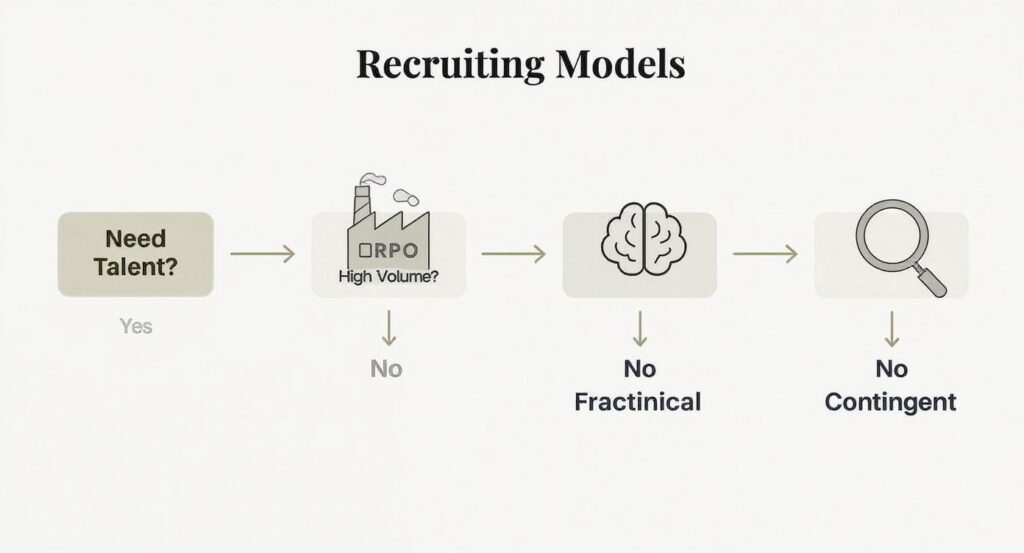
As you can see, the right path hinges on whether your main challenge is scale, strategy, or a single, hard-to-fill position. Each one is a distinct tool in a CHRO’s toolkit.
Diving Deeper into Each Model
To really understand the trade-offs, we have to go beyond analogies and look at the operational reality of each approach. The right choice comes down to things like cost structure, how deeply the partner integrates with your team, and the long-term value you’re trying to build.
A contingent search firm works on a success fee, typically charging 15-25% of a candidate’s first-year salary. Their relationship is purely transactional. They stay external, driven by one goal: fill a specific, often difficult, role as fast as possible. This model is perfect for those urgent, one-off hires where speed is everything.
A fractional recruiting partner, on the other hand, embeds right into your team. They work on a retainer or hourly model, focused on building up your internal capabilities, sharpening your processes, and giving you strategic leadership. Their success isn’t just about the hires they make, but about the sustainable talent engine they help you create.
Strategic Comparison of Recruiting Models
Recruitment Process Outsourcing (RPO) offers a completely different solution. Here, you outsource all or part of your recruitment function to a provider. RPO is built for scale, handling high-volume hiring with process-driven consistency. It’s a powerhouse for companies that need to hire dozens, or even hundreds, of people for similar roles. If that sounds like you, exploring the benefits of Recruitment Process Outsourcing services can offer more clarity.
Let’s lay these three models out side-by-side to really highlight where they differ.
Recruitment Model Strategic Comparison
This table breaks down the core differences across the criteria that matter most when you’re making a strategic decision.
| Criterion | Fractional Recruiting | Recruitment Process Outsourcing (RPO) | Contingent Search |
|---|---|---|---|
| Primary Goal | Build internal capabilities and provide strategic leadership. | Manage high-volume hiring with process efficiency. | Fill a specific, individual role quickly. |
| Cost Structure | Monthly retainer or hourly rate. Predictable operational expense. | Management fee plus cost-per-hire. Designed for scale. | High percentage fee (15-25%) upon successful placement. |
| Integration | Deeply embedded; acts as a part of your leadership team. | High integration with HR, but operates as an external partner. | Low integration; works externally and transactionally. |
| Strategic Value | High. Focuses on long-term process improvement and strategy. | Medium. Optimises process for volume but less strategic focus. | Low. Solves an immediate headcount need but adds no lasting value. |
| Best For | Scaling companies needing leadership without the full-time cost. | Large organisations with consistent, high-volume hiring needs. | Urgent, hard-to-fill, or highly specialised individual roles. |
As the comparison shows, the “best” model is entirely relative to your immediate and long-term goals.
Choosing the Right Partner for Your Goals
The table makes one thing clear: there’s no single “best” model. There’s only the best fit for your specific situation. Your decision has to be a direct reflection of your business objectives.
If your goal is to build a world-class, in-house talent function that can scale with you, fractional recruiting is designed for that purpose. If you simply need to hire 50 sales representatives this quarter, RPO is your engine. And if you desperately need one niche expert, a contingent firm is your specialist.
For example, a Series B tech startup would bring in a fractional VP of Talent to build its technical recruiting function from the ground up, define its employer brand, and hire its first ten engineers. A large retail chain opening 20 new stores would gain more from an RPO partner to manage the sheer volume of hiring for store associates. Meanwhile, a law firm that needs a new partner with a very rare specialisation would turn to a contingent search firm.
Ultimately, your choice telegraphs your strategic priorities. Are you plugging a short-term gap, managing massive growth, or investing in the long-term health of your talent acquisition function? Answering that question will point you straight to the right model.
How to Calculate the ROI of Fractional Recruiting
Getting the green light for any strategic investment means building a clear, convincing business case, and fractional recruiting is no different. While the benefits might feel obvious, you need to put numbers behind them to get leadership on board. The return on investment (ROI) from a fractional partnership isn’t just about shaving off costs; it’s a powerful mix of direct financial savings and massive long-term strategic wins.
To build a case that stands up to scrutiny, you have to look past the monthly retainer. The real value becomes clear when you stack the fractional model’s predictable costs against the steep, often hidden, expenses of traditional hiring—not to mention the opportunity cost of a slow, clunky recruitment process.
Measuring the Tangible Financial Wins
The easiest part of the ROI calculation is the direct cost you avoid. These are the hard numbers you can walk straight into the CFO’s office with, showing an immediate financial upside compared to hiring a full-time executive or paying hefty agency fees.
Start by adding up the fully-loaded cost of a full-time Head of Talent. Don’t just look at their base salary. You need to factor in bonuses, benefits, payroll taxes, and equity, which can easily tack on another 30-40%. For a senior role, this can quickly become a very significant six-figure sum each year.
A fractional recruiter flips a large, fixed capital expense into a flexible, manageable operational expense. That shift alone gives you much better budgetary control and agility, letting you scale your investment up or down as the business demands.
Next, compare this to the fees you’d pay contingency agencies. A single executive hire can cost a fortune, with typical agency fees running 20-25% of the first-year salary. If your fractional partner helps you land several key hires during their engagement, the savings pile up fast, often covering the cost of their retainer many times over.
Calculating the Strategic Value
While the hard cost savings are compelling, the strategic value is where you’ll often find an even bigger long-term return. These benefits are about building a more effective, resilient, and high-performing organisation. They might be a bit harder to put a number on, but they’re absolutely critical to the overall ROI.
One of the biggest metrics here is Quality of Hire. An expert fractional partner elevates this by sharpening your interview process, writing better role definitions, and tapping into higher-calibre talent pools. You can track this through metrics like:
- 90-day retention rates for all new hires.
- Performance review scores after the first six months.
- Hiring manager satisfaction surveys.
Another huge one is Time-to-Hire. Every single day a critical role sits empty, your company is leaking productivity and losing momentum. A seasoned fractional recruiter can dramatically shorten this cycle. For example, OYO Rooms’ journey shows how an optimised process can accelerate business growth by getting top talent in the door faster.
A Sample ROI Calculation for a Scaling Tech Company
Let’s make this real with a quick example. Picture a Series B tech company that needs to hire a Head of Engineering and five senior developers in the next six months.
- Option 1: Contingency Search
- Head of Engineering (£150,000 salary) at a 25% fee = £37,500
- Five Developers (£90,000 salary each) at a 20% fee = 5 x £18,000 = £90,000
- Total Agency Fees = £127,500
- Option 2: Fractional Recruiter
- Six-month engagement at £8,000 per month.
- Total Fractional Cost = £48,000
In this scenario, the direct, hard-cost saving is a massive £79,500. And this calculation doesn’t even touch on the added value of the fractional partner building a sustainable hiring process, boosting the employer brand, and upskilling the internal team—all benefits that keep paying dividends long after the engagement is over.
When you combine these tangible savings with the strategic impact, you have a powerful and undeniable case for fractional recruiting.
Your Fractional Recruiting Implementation Checklist

Switching to a fractional model isn’t as simple as just finding a contractor. It demands a structured game plan to make sure the partnership clicks from day one. This is about transforming a vendor relationship into a genuine strategic alliance, which calls for careful planning and deep integration.
This checklist will walk you through the essential phases, from sketching out the initial scope to getting your new partner fully embedded in the team. Following it will help you dodge the usual bumps in the road and get the most out of your investment. The first step? Moving from a vague feeling of “we need hiring help” to a set of crystal-clear objectives. If you don’t define what a win looks like upfront, the engagement will lack direction, and you’ll have no real way to measure success.
Phase 1: Define and Scope the Engagement
Before you even think about finding the right partner, you need to define the mission. This initial phase is all about creating a detailed blueprint for the engagement. The goal is to ensure both you and your future fractional recruiter are perfectly aligned on the goals and logistics right from the start.
- Set Clear Objectives: What specific problem are you hiring them to solve? Your goals must be measurable and have a deadline. For instance, are you trying to hire a five-person engineering team in Q3, slash your time-to-hire by 25%, or build a complete technical recruiting process from the ground up? Be specific.
- Scope the Work and Deliverables: Get granular on what needs to be done. Outline the expected hours per week (e.g., 15-20 hours), how long you expect the engagement to last (e.g., six months), and what the key deliverables are. This could be anything from a candidate pipeline report to a finalised interview playbook.
- Establish the Budget: Figure out your budget based on the scope you’ve just defined. Fractional recruiters usually work on a monthly retainer or an hourly rate. Having a clear number in mind helps narrow your search and sets realistic financial expectations for everyone involved.
Phase 2: Select and Onboard Your Partner
With a clear scope in your back pocket, you can start the hunt for a fractional partner who brings the right mix of expertise and cultural alignment. Treat this selection process with the same seriousness as hiring a full-time employee—after all, this person will be deeply embedded within your organisation.
Your choice shouldn’t just be based on their CV. Look for proven experience in integrating and delivering strategic value in an environment like yours.
A successful fractional partnership is built on more than just recruiting skill; it requires a deep cultural fit and an ability to operate as a trusted advisor to the leadership team.
Once you’ve made your choice, onboarding needs to be fast but thorough. Give them immediate access to all the necessary tools (your ATS, communication platforms) and documentation (company values, existing process guides). Set up intro meetings with key stakeholders, like hiring managers and the executive team, to build rapport and establish them as a true part of the team. This initial effort pays off by dramatically speeding up their impact.
Phase 3: Integrate and Measure Success
True integration goes way beyond a company email address. It’s about creating an environment where your fractional partner can operate effectively and contribute at a high level. That means setting up clear communication channels and feedback loops from the get-go.
- Set Communication Rhythms: Schedule regular check-ins—think daily stand-ups or weekly strategy sessions—to keep everyone aligned and quickly tackle any roadblocks.
- Define Success Metrics: Go back to the objectives you set in Phase 1. Track key performance indicators (KPIs) like time-to-hire, quality of hire, and candidate satisfaction scores to objectively measure how effective the engagement is.
This flexible talent model is becoming particularly relevant in India’s employment landscape as companies increasingly look for agile solutions. Despite an unemployment rate of 5.4 percent for those aged 15 and above between April and June 2025, a persistent skills gap presents a major challenge for many organisations. A fractional recruiting expert can be a powerful asset in bridging this gap by sourcing highly specialised talent. You can learn more about India’s evolving hiring trends and talent dynamics to see the bigger picture.
Answering Your Questions About Fractional Recruiting
Even when the benefits seem clear, bringing a new talent model into the fold always raises a few questions. For most HR leaders, fractional recruiting is a world away from the familiar ground of in-house teams or commission-based agencies. This section tackles the most common queries we hear, giving you straightforward answers to help you decide if it’s the right move for your organisation.
We’ll get into the nitty-gritty of what separates a true fractional partner from a simple contract recruiter, break down the typical pricing models, and share some practical advice on making them a part of your company culture. The goal here is to give you the confidence to make a smart, informed decision.
Fractional Partner or Contract Recruiter What’s the Real Difference?
This is probably the most important thing to get right. While both are outside hires, their roles and the impact they have couldn’t be more different. Mixing them up is a recipe for mismatched expectations and a partnership that just doesn’t work.
A contract recruiter is a tactical player. You bring them in to do a specific job, usually sourcing and screening for a handful of open roles. Think of them as an extra pair of hands to help you get through a hiring surge. Their main job is to execute tasks and get people in the door, fast.
A fractional recruiting partner, on the other hand, is a strategic leader. They are senior-level talent experts who embed themselves in your organisation to build, fix, or level up your entire hiring function. Their job goes way beyond just filling seats.
A fractional leader is the architect designing the blueprint for your company’s future hiring. A contract recruiter is a skilled builder working on one part of that plan. One gives you the ‘why’ and the ‘how’; the other delivers the ‘who’.
You’ll often find them taking on responsibilities like:
Building out a full-blown hiring strategy from scratch.
Getting your applicant tracking system (ATS) and other tech tools working properly.
Training and mentoring your internal HR team and hiring managers.
Strengthening your employer brand so you can attract top-tier people.
Creating interview scorecards and structured processes to lift the quality of every hire.
It’s a relationship built on
How Are Fractional Recruiting Engagements Priced?
Getting a handle on the financial side is key to building a budget and seeing the return on your investment. Unlike the hefty percentage fees you get with contingent agencies, fractional pricing is all about being predictable and transparent. The two most common ways it works are retainers and hourly rates.
A monthly retainer is what you’ll see most often. You pay a set fee each month for an agreed-upon block of hours or a specific scope of work. For instance, a common setup might be a retainer for 15-20 hours of strategic work a week. This model gives you cost certainty, which makes budgeting a breeze.
An hourly rate is another path, usually for shorter projects or one-off consultations. It offers flexibility, but it can be harder to predict the final cost if the work expands. The big takeaway is that both models turn your recruitment spend into a stable, manageable operational expense instead of a rollercoaster, success-based cost.
Can This Model Work for Executive Searches?
Absolutely. In fact, fractional recruiting can be a game-changer for high-stakes executive searches. A traditional retained firm operates from the outside, but a fractional partner drives the entire search from inside your organisation. This brings some serious advantages when you’re looking for senior leaders.
For starters, an embedded partner has a much deeper, more authentic feel for your company culture and the dynamics of your leadership team. They can talk about your organisation with a level of credibility an external agent just can’t match. They aren’t just selling a job; they’re representing a team they’re a part of.
They can also navigate the internal side of the process much more smoothly. That means everything from getting the executive team aligned on what they need in the role to prepping them for top-level interviews and managing sensitive internal chats. Having them on the inside ensures the whole process is cohesive from start to finish.
How Do You Integrate a Fractional Recruiter into Your Culture?
Getting the integration right is what unlocks the real value of a fractional partnership. If your partner feels like an outsider, they’ll never be able to make a true strategic impact. Making it work is a two-way street—it takes effort from both the fractional expert and your own leadership team.
Here are a few best practices to get you started:
Treat Them Like a Team Member: Set them up with a company email and add them to your Slack or Teams channels. Make sure they’re invited to team meetings and strategy sessions.
Make Key Introductions: Personally introduce them to your hiring managers, department heads, and the exec team. Position them as a strategic partner, not a temp, to establish their credibility from day one.
Give Them the Full Picture: Don’t just hand over job descriptions. Share your company’s mission, your long-term goals, the challenges you’re facing, and what makes your culture tick. The more context they have, the better they’ll perform.
Set a Clear Rhythm for Communication: Schedule regular check-ins and reporting cadences. This keeps everyone on the same page and creates a dedicated space for feedback and strategy tweaks.
When you treat your fractional recruiter like a true extension of your leadership team, you create an environment where they can do their best work and drive real, lasting change in your organisation.
Ready to build a world-class talent function with the strategic expertise you need, right when you need it?Taggd provides expert Recruitment Process Outsourcing solutions designed to scale with your business. Discover how our strategic approach can optimise your hiring process and deliver exceptional results at Taggd.