
Master Your Hiring Funnel for Better Talent Acquisition
Think of a hiring funnel as a roadmap that charts a candidate’s journey, from the moment they first hear about your company to their first day on the job. It’s a lot like the sales funnel used in marketing; it visualises every single step a person takes, from spotting a job opening to finally accepting an offer. Its real magic, though, is in how it makes the entire recruitment process structured, measurable, and predictable.
Why the Hiring Funnel Is Your Recruitment Compass
In a hyper-competitive job market, especially in high-volume hiring regions like India, a structured recruitment process isn’t just nice to have-it’s essential. Without a clear framework, hiring can feel like trying to navigate a ship in a storm without a compass. It becomes disorganised, wildly inefficient, and often leads to dead ends.
The hiring funnel brings that much-needed structure, transforming what can be a chaotic scramble into a system you can actually manage and improve.
This approach gives you a bird’s-eye view of the entire candidate journey, from the initial flood of applications right down to the final hire. By breaking the process into distinct stages, you can pinpoint exactly where you’re losing great candidates, figure out why, and start plugging the leaks. It stops being a guessing game and becomes a genuine, data-driven strategy.
The Core Benefits of a Structured Funnel
Adopting a hiring funnel framework delivers some immediate and powerful advantages for any organisation looking to up its talent acquisition game. The key benefits really boil down to this:
- Improved Efficiency: By weeding out unsuitable applicants early on, your team can stop wasting time and instead focus their energy on the most promising individuals.
- Better Candidate Experience: A clear, predictable process takes the anxiety out of job hunting for applicants. This leads to better communication and a much more positive impression of your company, whether they get the job or not.
- Data-Driven Decisions: When you track metrics at each stage, you can spot bottlenecks and make smart, informed choices to fix your process, rather than just going with your gut feeling.
At the end of the day, the goal of a hiring funnel isn’t just to fill an open role. It’s about creating a repeatable, scalable system that consistently attracts and lands the top talent your organisation needs to grow.
The infographic below gives a great high-level view of how professionals see the modern hiring process.
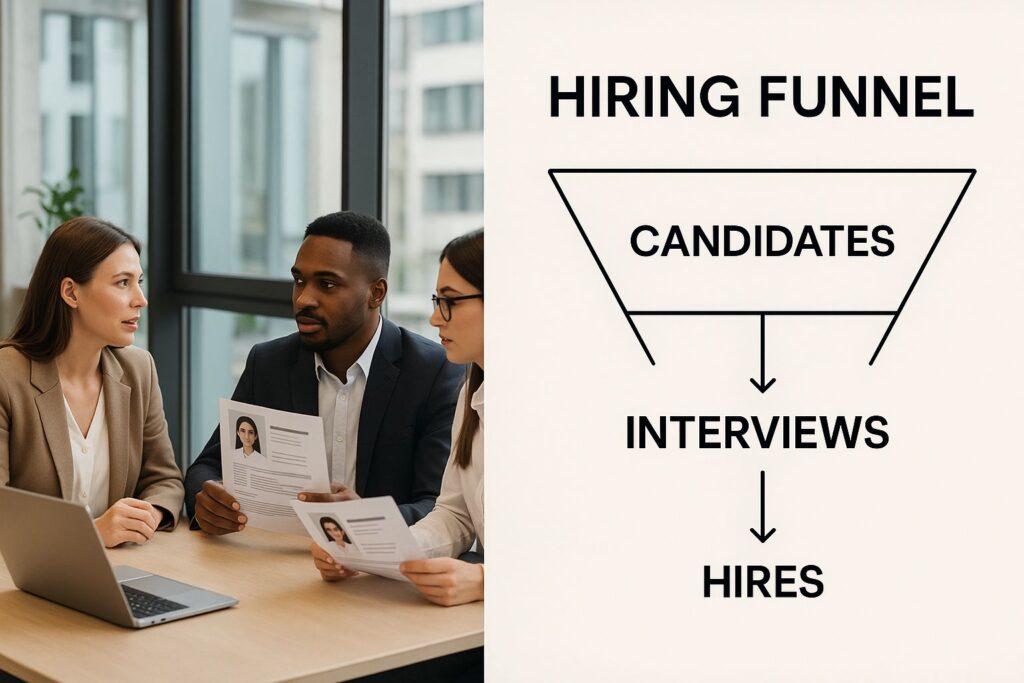
This visual really hammers home the importance of a systematic approach, where each step has a clear purpose in narrowing down the talent pool. Throughout this guide, we’ll dive deep into each of these stages, showing you exactly how to build and fine-tune a funnel that gets you consistent, quality results.
The Six Stages of the Modern Hiring Funnel
The hiring funnel isn’t some rigid, cookie-cutter model you have to follow by the book. Think of it more as a flexible framework that maps out a candidate’s journey, starting from when they first hear about you to the day they join the team. To really get a grip on how powerful this is, let’s walk through the six core stages that define modern recruiting.
Imagine a talented software developer looking for their next big career move. Each stage of the funnel is a milestone on their path to hopefully becoming a part of your company.

To give you a quick overview, this table breaks down each stage, its main goal, and the typical activities involved.
The Six Hiring Funnel Stages at a Glance
| Stage | Primary Objective | Key Activities |
|---|---|---|
| 1. Awareness & Attraction | Cast a wide net to attract a large pool of qualified candidates. | Job postings, social media promotion, employer branding, employee referrals. |
| 2. Application | Encourage interested candidates to formally apply. | Simple online application forms, mobile-friendly process, clear instructions. |
| 3. Screening | Filter applicants to identify the most promising candidates. | CV reviews, ATS keyword filtering, initial phone screens, short assessments. |
| 4. Interview | Deeply assess skills, experience, and cultural fit. | Technical interviews, behavioural questions, panel interviews, team meetings. |
| 5. Offer | Extend a competitive offer to the top candidate. | Presenting the offer, negotiation, clarifying terms, selling the opportunity. |
| 6. Hire & Onboard | Secure the new employee and set them up for success. | Offer acceptance, background checks, paperwork, structured onboarding program. |
Now, let’s dive deeper into what happens at each step of the journey.
Stage 1: Awareness and Attraction
This is the very top of the funnel, where you’re trying to catch as many relevant eyes as possible. At this point, potential candidates are just becoming aware that your company exists and has a role that might interest them. It’s all about building a strong employer brand and making sure your opportunity lands in front of the right people.
What does this look like in practice?
- Posting clear, engaging job descriptions on platforms like LinkedIn, Naukri, or other industry-specific job boards.
- Using social media to give a glimpse into your company culture and show off what makes your workplace unique.
- Tapping into employee referrals-these often bring in fantastic candidates who are already a great cultural fit.
Our software developer might stumble upon your “Senior Developer” role on a tech forum or see a post shared by one of their connections. Success here means your job ad gets noticed by a big pool of talent that actually has the skills you need.
Stage 2: Application
Once a candidate knows about the role and is genuinely interested, their next step is to formally apply. This is the first time you’re asking for a real commitment, making it a critical transition point. The mission here is simple: make applying as painless as possible so you don’t lose great people out of sheer frustration.
A clunky or ridiculously long application process is a major turn-off. In fact, research shows that nearly 60% of job seekers have bailed on an online application because it was too complicated or lengthy.
Your application form should be an open door, not an obstacle course. If it’s difficult to navigate, especially on mobile, you are actively filtering out talented candidates before you even get a chance to see their skills.
For our developer, a good experience means they can quickly upload their CV and fill out only the most essential details, without being forced to manually re-enter their entire work history.
Stage 3: Screening
With applications coming in, the funnel naturally starts to narrow. The screening stage is your first real filter, designed to help you efficiently sort through the applications and pinpoint those who meet the basic, non-negotiable qualifications for the role. This is where you begin to separate the contenders from the rest of the pack.
Common screening activities include:
- CV Review: A quick scan to check for must-have experience, skills, and qualifications.
- Automated Screening: Using an Applicant Tracking System (ATS) to filter applications based on specific keywords.
- Initial Assessments: Short online quizzes or coding challenges to validate core skills.
At this point, our developer’s CV gets a once-over, and their solid experience with the right programming languages gets them through to the next round.
Stage 4: Interview
Candidates who make it past the screening phase are invited to the interview process. This is your chance to finally get to know the person behind the CV. The interview stage isn’t usually just a single conversation; it’s often a multi-step process designed to evaluate everything from technical know-how and problem-solving abilities to communication style and how well they might fit with the team.
This could involve a quick phone chat with a recruiter, a more in-depth technical interview with the hiring manager, and maybe a final conversation with a few team members. The idea isn’t to trip candidates up but to have a real dialogue that uncovers their true potential.
Stage 5: Offer
You’ve done it-you’ve found the one! The offer stage is the moment of truth. After careful consideration, you extend a formal job offer that clearly lays out the salary, benefits, start date, and all the other important details.
But this stage is much more than just firing off an email. It’s a delicate dance of negotiation and communication. A competitive package and a personal touch are crucial here, as top-tier candidates often have multiple offers on the table. If you’re slow or unconvincing, you could lose your perfect hire right at the finish line.
Stage 6: Hire
The final stage of the hiring funnel is when your chosen candidate accepts the offer and officially agrees to join the team. But the work isn’t over yet. This stage bleeds right into onboarding, where you welcome your new hire and give them everything they need to succeed long-term.
A fantastic onboarding experience makes for a smooth transition and reassures the new employee that they made the right choice. For our developer, this means a warm welcome, a clear roadmap for their first few weeks, and all the tools and support they need to start making an impact.
Navigating Talent Sourcing Challenges in India
The top of the hiring funnel in India is a unique beast. It’s often a case of “too much of a good thing.” A single job posting, especially for a tech role, can trigger an avalanche of hundreds, sometimes thousands, of résumés in just a few days. This sheer volume puts incredible pressure on recruitment teams to sort through the noise without losing sight of quality.
This reality has given rise to a common but flawed sourcing strategy: prioritising candidates from a handful of elite institutions like the IITs and NITs. While it might seem like a smart shortcut to filter for quality, it actually creates a major bottleneck. Companies end up with a sourcing bias that blinds them to massive pools of skilled talent from other backgrounds, shrinking their chances of finding the absolute best person for the job.
The Pedigree vs Potential Dilemma
Leaning too heavily on academic pedigree makes for an inefficient and unfair hiring process. It’s surprising but true: up to 60% of entry-level tech hires at India’s biggest IT firms still come from just 10% of the country’s engineering colleges. This concentration means there’s a huge missed opportunity to connect with talented graduates from Tier 2 and Tier 3 cities who often have fantastic practical skills and are incredibly adaptable.
This old-school approach is especially problematic when you consider the size of India’s tech talent pool. With nearly five million software engineers-outpacing the U.S.’s 4.4 million-the talent is out there, but sourcing methods haven’t kept up.
The real challenge isn’t a scarcity of talent; it’s the outdated methods we use to find it. An over-reliance on an institution’s name often fails to measure what really counts: problem-solving skills, technical ability, and a drive to learn.
Shifting Towards Skill-Based Sourcing
To fix the top of the funnel, the conversation needs to change from where a candidate studied to what they can actually do. Modern, skill-based assessments are proving to be far better predictors of job success than an academic background alone. By introducing these tests early in the screening stage, companies can manage the flood of applications more effectively and uncover those hidden gems.
Adopting a skill-first mindset is key to upgrading your entire recruitment process. When you implement smarter evaluation methods, you build a stronger, more equitable hiring funnel. For some practical ideas on how to do this, check out our guide on the best candidate sourcing practices for tech hiring. This approach doesn’t just widen your talent pool; it ensures you’re judging candidates on metrics that actually translate to performance, setting a solid foundation for your whole hiring strategy.
Key Metrics to Measure Your Funnel Health
You can’t fix what you don’t measure. If you want to genuinely improve your hiring funnel, you have to move beyond gut feelings and embrace a data-driven mindset. Tracking the right Key Performance Indicators (KPIs) is like turning on the lights in a dark room-it shows you exactly what’s working and, more importantly, where things are falling apart.
By measuring your funnel’s health, you can spot leaks before they turn into major floods. Are you losing great candidates after the first interview? Is it taking an eternity to fill mission-critical roles? The right data gives you clear answers and empowers you to make surgical improvements instead of just guessing.

Essential Funnel Metrics to Track
To get a proper handle on your recruitment performance, you don’t need a hundred different metrics. Just start with a few vital ones. These KPIs will give you a solid, all-around view of your funnel’s efficiency, cost, and overall effectiveness.
Here are the absolute non-negotiables:
- Time-to-Hire: This is the total number of days from when you first post a job to the day a candidate accepts your offer. A long time-to-hire is a big risk; you could be losing your best candidates to competitors who simply move faster.
- Cost-per-Hire: This calculation rolls up all your recruitment-related expenses, think advertising spends, recruiter salaries, and agency fees and divides them by the number of people you’ve hired. It’s the ultimate report card on your financial efficiency.
- Application Completion Rate: This metric tracks the percentage of people who start an application versus those who actually hit ‘submit’. A low rate is a massive red flag, usually pointing to a clunky, over-complicated application process that’s scaring people away.
While those are foundational, the real gold is often found in the Candidate Drop-off Rate.
Calculating the drop-off rate at each stage of your hiring funnel is the single most effective way to identify your biggest bottlenecks. It tells you precisely where candidates are losing interest or getting frustrated, allowing you to focus your efforts where they’ll have the most impact.
The Critical Role of Drop-off Rates
Keeping a close eye on drop-off rates reveals a lot about the Indian hiring landscape. There’s often a huge drop between the application and interview stages. For IT roles, it’s common for hundreds to apply, but only 15-20% make it to a technical screening. This steep funnel is a direct result of massive application volumes and very strict filtering.
In fact, data suggests that up to 70% of candidates simply give up after the initial automated screening because of slow feedback or drawn-out timelines. For highly specialised roles, the drop-off is even more dramatic, with fewer than 5% of applicants ever reaching the final rounds.
To fight this, leading tech companies are now using automated scheduling tools and instant feedback systems. The results are promising, with some firms seeing their completion rates improve by 20-30%. To see more data on this, you can check out RippleHire’s deep dive into the talent acquisition funnel.
Strategies to Improve Your Candidate Experience
A leaky hiring funnel isn’t just about losing applicants; it’s a sure-fire way to lose opportunities and tarnish your employer brand. Plugging those leaks means putting a real focus on the candidate experience, shifting your process from a gruelling obstacle course to a guided journey. The aim should be to make every single interaction feel respectful, engaging, and efficient.
Get it right, and even the candidates you don’t hire can become advocates for your brand. Get it wrong, and you’ll have top talent dropping out and sharing their negative experiences with their networks. Improving this journey is a direct investment in your talent pipeline and company reputation.
Write Inclusive and Clear Job Descriptions
Think of your job description as the front door to your hiring funnel. If it’s confusing, packed with internal jargon, or uses exclusionary language, a lot of fantastic candidates won’t even try the handle.
To bring in a diverse and qualified talent pool, your descriptions need to be crystal clear about what the job actually involves. Ditch the internal acronyms and focus on the must-have skills, not a never-ending wishlist of “nice-to-haves” that can scare off perfectly capable people.
Simplify Your Application Process
Nothing makes candidates abandon ship faster than a long, clunky application process. Today’s job seekers expect a smooth, simple experience. If your application takes more than a few minutes or isn’t mobile-friendly, you’re actively losing good people.
Here are a few quick fixes to consider:
- Allow CV uploads that auto-fill the form fields. It saves candidates a ton of time and frustration.
- Only ask for the absolute essentials upfront. You can always gather more details later on.
- Make sure it works perfectly on mobile. So many candidates apply while they’re on the go.
A simpler process shows you respect the candidate’s time and will immediately boost your application completion rates.
Maintain Clear and Consistent Communication
Radio silence is one of the biggest frustrations for anyone looking for a job. Leaving candidates guessing about where they stand creates anxiety and makes your organisation look disorganised. The fix? Consistent communication.
A simple automated email confirming their application is received, or a quick update on timelines, can make a massive difference. It shows you value their effort and helps keep them engaged in your hiring funnel.
Even providing timely feedback to unsuccessful candidates is crucial. It helps maintain a positive relationship and keeps the door open for other roles down the line. The key is to set clear expectations and then stick to them. If you’re especially struggling with people dropping out after you’ve made an offer, our guide on how to reduce candidate offer dropout rate has some great advice. Using tech like chatbots and automated scheduling can also help streamline these touchpoints, ensuring no one falls through the cracks and shortening your overall time-to-hire.
Using AI to Build a Smarter Hiring Funnel
Technology is no longer just an add-on in recruitment; it’s fast becoming the engine that powers a truly modern hiring funnel. In India, where application volumes can be immense, Artificial Intelligence (AI) offers a way to manage scale without sacrificing quality. It helps create a process that is faster, fairer, and far more effective.
Instead of drowning in thousands of résumés, AI-powered screening tools can analyse and rank candidates based on their skills and experience in a matter of minutes. This level of automation frees up your recruitment team from tedious administrative tasks, allowing them to focus on what truly matters: engaging with top-tier talent and building meaningful relationships.
Automating the Top of the Funnel
The greatest and most immediate impact of AI is felt right at the initial stages of the hiring funnel. Here’s a look at how it completely transforms the process:
- Intelligent Sourcing: AI tools can proactively search for passive candidates who perfectly fit your criteria but aren’t actively applying. This can significantly widen your talent pool overnight.
- Automated Screening: Systems can instantly filter résumés, identifying the most relevant applicants based on predefined qualifications and flagging them for human review. This is an absolute game-changer for high-volume roles.
- Chatbot Engagement: AI-powered chatbots can handle initial candidate queries 24/7, answer frequently asked questions, and even conduct basic preliminary screenings, ensuring no potential applicant is left waiting.
AI doesn’t replace the human element of hiring; it enhances it. By handling repetitive, high-volume tasks, it empowers recruiters to spend more time on strategic activities like candidate engagement and final decision-making.
Driving Efficiency and Fairness
Beyond just raw speed, AI brings a new level of intelligence to the entire hiring process. Predictive analytics can analyse data from past hires to identify the key attributes that lead to long-term success in a role, helping you make smarter, data-backed decisions. It’s also a powerful tool for reducing unconscious bias, as AI models can be trained to focus purely on skills and qualifications.
This technological shift is vital in India’s booming job market. With sectors like IT and retail driving a projected 9% job market growth in 2025, the competition for top talent is intense. Digital-first industries are already using AI to cut their time-to-hire by up to 40%, giving them a significant edge. You can discover more about these trends in India’s hiring market on India Briefing.
By integrating these smart tools, you don’t just build a hiring funnel that’s efficient, you build one that’s also more equitable. For a closer look at how technology supports recruiters, learn more about how a recruitment platform eases digital hiring.
Frequently Asked Questions
Even with a solid grasp of the framework, plenty of practical questions pop up when you start putting a hiring funnel into action. Let’s tackle some of the most common ones with direct, actionable advice you can use right away.
How Can Small Businesses Use a Hiring Funnel?
You don’t need a fancy, expensive software suite to build a hiring funnel that works. In fact, small businesses can get started with simple, low-cost tools they probably already have. A basic spreadsheet is a fantastic way to track candidates as they move from one stage to the next.
Just create columns for each stage of your funnel (Application, Screening, Interview, Offer, etc.) and list your candidates in the rows. This simple setup lets you see your pipeline at a glance, calculate drop-off rates, and spot any bottlenecks-all without spending a rupee. The real key isn’t the tool you use; it’s the discipline of tracking the data.
What Is the Biggest Mistake Companies Make?
By far, the most damaging mistake is dropping the ball on the candidate experience. This usually shows up as poor, or even non-existent communication. Leaving applicants hanging, wondering about their status, creates a huge amount of frustration and can seriously tarnish your employer brand.
A negative candidate experience is a major leak in any hiring funnel. When top talent feels disrespected or ignored, they will withdraw from the process and share their negative experience with their network, making it harder to attract great people in the future.
This one issue can completely undo all the great work you’ve done at the top of the funnel. Making clear, consistent, and
How Often Should We Review Our Hiring Funnel?
A hiring funnel isn’t a “set it and forget it” kind of tool. To really get the most out of it, you need to be reviewing your metrics and processes on a regular basis. For most organisations, a quarterly review is an excellent rhythm to get into.
This cadence gives you enough time to:
– Spot trends in your data, like a creeping time-to-hire or a high drop-off rate at one particular stage.
– Assess the effectiveness of any new changes you’ve made to your recruitment process.
– Make data-informed adjustments to continuously fine-tune your funnel’s performance.
Regular check-ins ensure your hiring strategy stays sharp and responsive, adapting to both your internal needs and the shifts in the job market.
Ready to build a more efficient and effective hiring process? Taggd specialises in Recruitment Process Outsourcing, helping you optimise every stage of your hiring funnel.