
Choosing the Right Hiring Models for Your Team
Think of your hiring models as the strategic playbook for bringing talent into your organisation. There isn’t a single ‘best’ way to do it; the right approach is entirely dependent on your company’s size, where you are on your growth journey, and the specific talent you need right now. Your strategy could range from a completely in-house team to leaning on outsourced recruitment partners, and everything in between.
What Are Hiring Models and Why Do They Matter?

Choosing a hiring model is like designing the supply chain for your company’s most valuable asset: its people. It’s the operational blueprint that dictates how you find talent, how fast you can scale your workforce, and how much you invest in the process. Get it wrong, and you’ll create bottlenecks, inflate costs, and watch top candidates walk away.
A one-size-fits-all approach to recruitment is a recipe for failure. The ideal strategy for a tech startup scaling at lightning speed is worlds apart from that of a stable, large-scale manufacturing firm with predictable hiring cycles. This is precisely why understanding different hiring models gives you a serious competitive edge.
Understanding the Core Approaches
Let’s think about this in terms of logistics for a moment. Do you own your entire delivery fleet, or do you partner with specialists for certain routes or types of cargo? The same logic applies to talent acquisition. The primary hiring models each offer a distinct way to manage your talent pipeline.
- In-House: This is like owning your own fleet. You have a dedicated team of internal recruiters who live and breathe your company culture. You have complete control over the entire process, from start to finish.
- Recruitment Process Outsourcing (RPO): This is closer to outsourcing your entire logistics operation. A third-party partner manages some or all of your recruitment function, acting as a true extension of your brand in the market.
- Contingent and Retained Agencies: Think of these as your specialist couriers. You bring them in for specific, often hard-to-fill roles, paying for successful placements (contingent) or retaining them for critical, high-stakes executive searches (retained).
- Hybrid Model: Just as it sounds, this approach combines elements from the other models, creating a flexible, custom-built system tailored to your unique business needs.
Your hiring model directly impacts everything from your cost-per-hire and time-to-fill metrics to your employer brand and your ability to secure top-tier talent. It’s not just an operational choice; it’s a core business decision.
The Indian job market is a perfect example of why this strategic thinking is so crucial. In 2025, hiring is expected to surge in highly specialised fields like renewable energy, healthcare tech, semiconductors, and AI/ML. This is a significant shift from previous years, where IT and financial services dominated. You can learn more about these upcoming hiring trends in India at talentoindia.com.
This shift hammers home why a rigid, outdated model can leave a company scrambling to find the skills it needs to survive and grow. By truly understanding the different hiring models available, you can build a talent function that is agile, cost-effective, and perfectly aligned with your company’s future.
The In-House Model: Building a Talent Powerhouse

The in-house model is the most traditional way to handle hiring. It’s all about building your recruitment capabilities from the ground up, right inside your own walls. This means dedicating your own people, tech, and budget to create a team that acts as the growth engine for your entire company.
Think of this team as more than just a department. They are the guardians of your company culture.
This approach gives you an unparalleled level of command over the whole hiring journey. From that first email to the final offer letter, every single interaction is shaped by your company’s unique voice and values. Your internal recruiters aren’t just filling seats; they’re genuine brand ambassadors who intimately understand the DNA of your organisation. This deep integration is crucial for building a powerful employer brand and ensuring every candidate gets a consistent, authentic experience.
The Strategic Value of an Internal Team
The biggest win with an in-house recruiting team is their deep cultural alignment. These are people who live and breathe your company’s mission every day. They can talk about your employee value proposition with a genuine passion that agencies simply can’t fake, attracting candidates who don’t just have the right skills, but who will actually thrive in your environment.
This has a massive knock-on effect on employee loyalty and retention. When people are brought in by a team that truly gets the company culture, they’re far more likely to stick around for the long haul. There’s no jarring disconnect between what they were promised during interviews and the reality of the job, which means higher engagement right from day one.
Beyond that, an internal team builds up an incredible amount of institutional knowledge over time. They learn which universities produce the best engineers for your specific needs, what really motivates your top salespeople, and the subtle cues that signal a candidate will be a great fit. This kind of proprietary knowledge becomes a serious competitive advantage, leading to smarter, faster hiring decisions.
An in-house hiring model transforms talent acquisition from a transactional function into a strategic pillar of the business. It gives you complete ownership over the candidate experience and ensures every new hire reinforces your company culture.
Analysing the Benefits and Drawbacks
Of course, like any of the hiring models, going in-house has its own set of pros and cons. The decision to build your own team requires taking a hard look at both sides of the equation. For many, the advantages of total control and a perfect cultural fit are too good to pass up.
Key Advantages:
- Complete Brand Control: Your team ensures a consistent and authentic brand message is delivered at every single touchpoint.
- Deep Cultural Alignment: Recruiters have an innate grasp of your company’s values and team dynamics, which leads to better-fit hires.
- Long-Term Cost-Effectiveness: If you have steady hiring needs, the fixed cost of an in-house team can be much lower than paying agency fees over and over again.
- Knowledge Accumulation: Your team becomes a deep reservoir of insights about the talent market and what makes people successful within your organisation.
But this model isn’t without its challenges. It demands a significant upfront investment and continuous management. The fixed costs—salaries, benefits, recruitment tech—can really add up. For a closer look at how technology can streamline these processes, you can learn more about how a recruitment platform eases digital hiring challenges.
Potential Challenges:
- High Fixed Costs: Salaries, benefits, and must-have tools like an Applicant Tracking System (ATS) are a major ongoing financial commitment.
- Limited Scalability: An in-house team can find it hard to react quickly to sudden hiring surges or freezes, making it less agile than more flexible models.
- Risk of Insularity: It’s easy for internal teams to get stuck in their ways, potentially missing out on new sourcing strategies or overlooking diverse talent pools.
Recruitment Process Outsourcing (RPO) as a Strategic Partner

What happens when your in-house recruitment team hits a wall? Whether it’s a sudden hiring surge or the need for highly specialised talent, sometimes internal capacity just isn’t enough. This is where many forward-thinking organisations bring in another powerful hiring model: Recruitment Process Outsourcing (RPO).
This isn’t about just handing off tasks to a vendor. It’s about embedding a team of external recruitment specialists directly into your organisation’s DNA. They become an extension of your brand, managing either specific parts of your hiring lifecycle or the entire process from start to finish.
Think of it this way: if your in-house team is your company’s full-time kitchen staff, an RPO provider is like a master catering firm. You might partner with them for a single major event, or you might have them run your entire food service operation. They bring their expert chefs, specialised equipment, and established supply chains, all while operating under your brand and serving your unique menu.
This is a true strategic partnership, designed to inject expertise and efficiency right where you need it most.
The Core Advantages of an RPO Partnership
One of the biggest wins with the RPO model is instant scalability. When your company lands a huge project or decides to staff a new division, an RPO partner can ramp up hiring efforts almost overnight. This avoids the long, costly process of hiring and training new internal recruiters to meet a temporary surge.
This agility is backed by access to a much wider talent network and superior recruiting technology. RPO providers live and breathe recruitment, so they invest heavily in the latest sourcing tools, candidate databases, and analytics platforms—resources that might be too expensive for a single organisation to justify. They use these tools to find candidates your internal team might never reach, directly improving the quality of your hires.
On top of that, a well-managed RPO engagement often leads to a significant drop in your cost-per-hire. By streamlining processes and using economies of scale, these partners can deliver top talent more efficiently than a stretched internal team ever could. It helps turn a fixed cost centre into a more variable and predictable expense.
Understanding the Different RPO Models
RPO isn’t a one-size-fits-all solution. Its flexibility is a key strength, allowing you to pick a model that fits your business needs perfectly. Knowing the difference is crucial for choosing the right partner.
- End-to-End RPO: This is the full package. The provider manages the entire recruitment lifecycle, from writing job profiles and sourcing candidates all the way to onboarding new hires. It’s the ideal choice for organisations looking to completely transform their talent acquisition function.
- Project-Based RPO: Got a specific, time-bound hiring challenge? Maybe you’re launching a new product or opening a new office. Project-based RPO is the perfect fit. The partnership has a clear start and end date, focused on delivering a set number of hires.
- On-Demand RPO: This model is all about augmenting your current team. You get a dedicated recruiter (or a team of them) from the RPO provider to work alongside your in-house staff, giving you flexible capacity during busy periods.
The right RPO partnership moves beyond a simple vendor relationship. It becomes a deeply integrated extension of your HR function, driving strategic goals through targeted, data-backed talent acquisition.
Potential Hurdles and Key Considerations
While the benefits are compelling, bringing on an RPO partner requires careful thought. The most common fear is a perceived loss of control over the hiring process, which is why the selection process is absolutely critical.
You aren’t just buying a service; you are choosing a partner to represent your brand in the talent market. It’s vital to find a provider that truly understands and aligns with your company culture, values, and long-term vision. Without this cultural synergy, the partnership can feel disconnected and fail to deliver the results you’re after. For a deeper look at this, check out our guide on how RPO can support high-impact, data-driven hiring.
Ultimately, a successful RPO relationship is built on trust, transparency, and shared goals. When you get it right, it becomes one of the most effective hiring models for any dynamic and growing company.
Using Agencies for Specialised Talent Acquisition
Sometimes, the talent you need isn’t just skilled—it’s rare. For executive leadership, niche technical experts, or other mission-critical roles, casting a wide net just won’t cut it. You need a targeted, almost surgical approach. This is where recruitment agencies come in, offering one of the most specialised hiring models out there.
Unlike an in-house team geared for volume or an RPO partner managing your entire process, agencies often act as expert headhunters. They bring deep market knowledge and extensive, often hidden, networks to the table. Their real value lies in finding top-tier talent that isn’t even actively looking for a new job. Think of them as specialist partners for your most high-stakes hires.
But not all agencies work the same way. The two primary approaches, contingent and retained search, offer vastly different levels of service, cost structures, and strategic commitment. Getting to grips with the distinction is vital to making the right investment.
The Contingent Search Model for Speed and Scale
Think of the contingent model as “pay-for-performance.” It’s straightforward: you only pay the agency a fee if you actually hire a candidate they present. This model is incredibly popular for filling multiple mid-to-senior level roles where speed is the name of the game.
Because their fee is tied directly to a placement, these agencies often work with several clients on similar roles at the same time. This creates a competitive dynamic that pushes them to deliver qualified candidates quickly. It’s a numbers game, but a highly effective one when you need to fill roles like Senior Software Developers or Regional Sales Managers fast.
When to Use a Contingent Agency:
- High-Volume Roles: When you need to hire multiple people for similar positions.
- Mid-Level Positions: For roles that are important but not quite at the C-suite level.
- Urgent Needs: When time-to-fill is your most critical metric.
- Budget Flexibility: The “no placement, no fee” structure keeps upfront financial risk low.
Retained Search for Mission-Critical Hires
Retained search operates on a completely different philosophy. This is a consultative, exclusive partnership reserved for your most strategic and senior hires—think CFO, Head of Engineering, or a specialist AI researcher who could define your next product line.
With this model, you pay an upfront fee, or “retainer,” which secures the search firm’s dedicated resources. They work exclusively on your role, becoming a true extension of your leadership team. The process is far more in-depth, involving deep market mapping, rigorous vetting, and confidential outreach to top-tier, passive candidates who would never respond to a job board.
A retained search is less about filling a vacancy and more about securing a game-changing leader. It’s an investment in a meticulous, high-touch process designed to find the one person who can fundamentally alter your company’s trajectory.
This model is pretty much non-negotiable when confidentiality, seniority, and finding the absolute best fit are paramount. The commitment is mutual; the firm dedicates a partner and a research team solely to your search, ensuring no stone is left unturned.
Comparing the Two Agency Models
Ultimately, the choice between these hiring models boils down to the strategic importance of the role.
| Feature | Contingent Search | Retained Search |
|---|---|---|
| Payment Structure | Fee paid only upon successful hire. | Upfront retainer plus instalments. |
| Best For | Mid-level, multiple roles, urgent needs. | Executive, niche, confidential roles. |
| Exclusivity | Non-exclusive; agency works with many clients. | Exclusive; firm works only for you on the role. |
| Process Focus | Speed and volume of candidates. | Depth, quality, and cultural fit. |
The Indian market really brings this distinction to life. Around 80% of employers struggle to find qualified candidates, especially for advanced tech roles in AI, cloud computing, and cybersecurity. According to insights on India’s hiring intent on Statista, this talent shortage slows everything down and puts immense pressure on finding the right people.
For a standard tech role, a contingent agency might be the perfect fit. But if you’re looking for a Chief Technology Officer to lead your new AI division, a retained search is the only way to ensure you’re accessing the top 1% of available talent. For more context, it also helps to understand the differences between an RPO and a staffing agency, as these terms are sometimes used interchangeably but mean very different things.
How to Choose the Right Hiring Model
Picking the right mix of hiring models isn’t just an HR task; it’s a core business decision that will make or break your ability to grow. We’re moving past the theory now and into building a practical, actionable plan for your organisation. The best choice is never one-size-fits-all—it hinges entirely on your company’s unique context, from its growth stage and budget to its biggest strategic goals.
To get this right, you need to conduct a serious internal audit. This means digging deeper than surface-level metrics and asking some tough questions about what you truly need from talent acquisition. A scale-up dealing with unpredictable growth sprints has completely different needs than a mature enterprise with steady, predictable hiring demands.
Key Factors in Your Decision Matrix
Before you can architect your ideal talent function, you have to evaluate your business across several key dimensions. Each factor will nudge you toward certain hiring models, helping you piece together a system that’s both powerful and cost-effective.
Start by getting honest answers in these critical areas:
- Company Growth Stage: Are you an early-stage startup looking for your first crucial hires, a scale-up in hyper-growth, or an established giant focused on optimisation and finding highly specialised talent?
- Hiring Volume and Predictability: Do you hire a consistent number of people every quarter, or do your needs swing wildly with new projects and market shifts? High, predictable volume often points toward an in-house or RPO solution.
- Role Specialisation: Are you mostly hiring for generalist roles, or are you hunting for those rare, niche skill sets? The harder the talent is to find, the more you might need the deep networks of a retained search firm.
- Budget and Cost Structure: Do you prefer the predictable, fixed costs of an in-house team? Or do you need the flexible, pay-for-performance model offered by contingent agencies?
- Long-Term Strategic Goals: Is your main objective to build a powerful employer brand and internal capability, or is it to achieve maximum speed and flexibility in the market?
Answering these questions gives you the data you need to map your business needs to the right hiring model. A global enterprise, for instance, might thrive with a core in-house team for strategic roles, supplemented by a project RPO partner to handle a new market launch.
A Framework for Comparing Hiring Models
To make this complex decision a bit simpler, it helps to see how each model stacks up against your most important criteria. No single model wins in every category; they all have distinct strengths that shine in specific situations. The goal here is to find the best fit for your business right now.
This table offers a clear, at-a-glance comparison to help guide your thinking and clarify the trade-offs you’ll be making.
Hiring Model Comparison Framework
| Criteria | In-House Model | RPO Model | Agency Model | Hybrid Model |
|---|---|---|---|---|
| Control | Maximum | High (Collaborative) | Low (Transactional) | Customised |
| Cost Structure | High Fixed Cost | Variable / Fixed | High Variable Cost | Blended |
| Scalability | Low | High | Moderate | Very High |
| Brand Alignment | Excellent | Very Good | Varies | Excellent |
| Specialised Roles | Good | Very Good | Excellent | Excellent |
| Speed to Hire | Moderate | Fast | Very Fast | Fast |
This framework makes the pros and cons crystal clear. If building a deep-rooted company culture is your top priority and your hiring is consistent, an in-house model is a fantastic choice. But if you need agility and immediate access to niche talent pools, leaning on agencies or an RPO partner makes more strategic sense.
The most effective approach often isn’t about choosing just one model but about strategically blending them. The future of talent acquisition is agile, and a hybrid model allows you to create a system that is perfectly tuned to your business’s rhythm.
When it comes to picking an agency, the decision between contingent and retained search often boils down to the role’s seniority. This simple decision tree is a great visual guide for making that specific call.
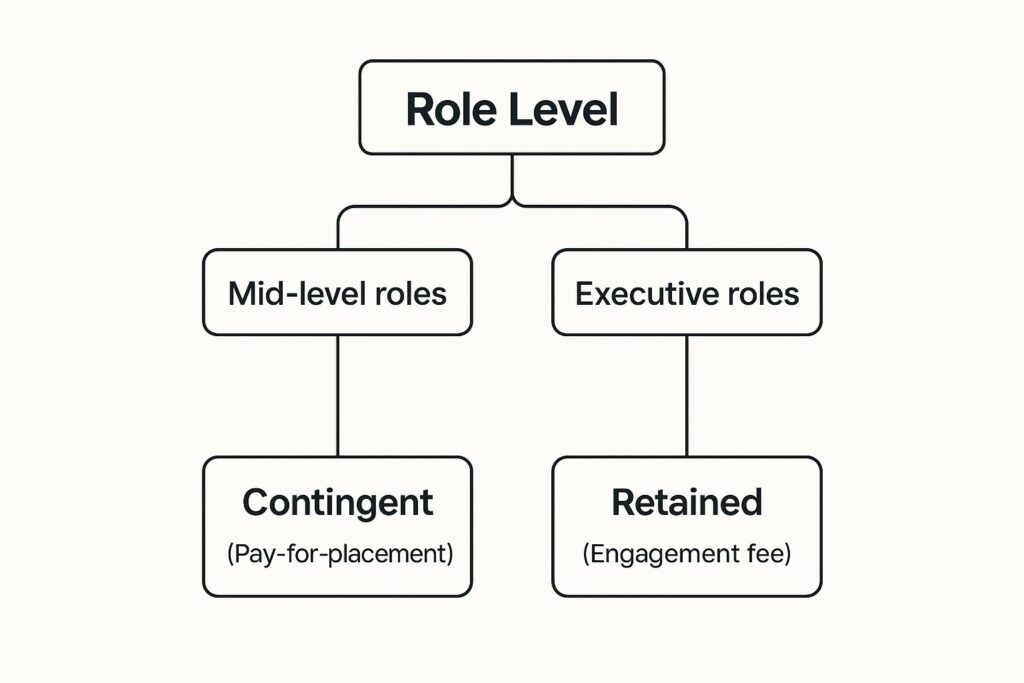
As the infographic shows, a pay-for-placement contingent model is perfect for filling multiple mid-level roles quickly. On the other hand, the upfront investment in a retained search is more than justified when you need to secure that game-changing executive.
By using this kind of structured, data-driven thinking, you can confidently select the hiring models that will not only fill your open roles today but also power your company’s growth for years to come.
Designing a Hybrid Model for Ultimate Agility
The smartest companies today know that picking just one hiring model is like having a toolbox with only a hammer—it’s limiting. The real magic happens when you stop thinking in terms of “either/or” and start building a custom approach. This is the heart of a hybrid or blended model, a modern strategy that cherry-picks the best parts of different approaches to create a talent function that’s flexible, tough, and surprisingly cost-effective.
Think of it as creating a talent acquisition ecosystem that’s perfectly tuned to your business’s unique rhythm. A hybrid model isn’t about ditching your in-house team or going all-in on outsourcing; it’s about smart integration.
Architecting a Custom Talent Function
A well-designed hybrid model is all about putting the right resources on the right challenges. It works on a simple idea: use the best tool for the job. This way, talent acquisition stops being a rigid cost centre and becomes a dynamic engine for business growth.
So, what does this look like in the real world? A common and highly effective hybrid setup might look something like this:
- Your Core In-House Team: These are the guardians of your culture. Your internal recruiters focus on what they do best—hiring for strategic leadership roles, championing your employer brand, and steering the overall talent strategy.
- An RPO Partner: When you need to scale up fast—say, staffing a whole new tech division—you bring in a Recruitment Process Outsourcing (RPO) partner. They provide the process muscle and scale required for those high-volume, specialised hiring drives.
- Specialised Agencies: For those really tough-to-fill niche roles or an urgent international hire, you tap into contingent or retained agencies. These are the specialists with the deep, specific networks you just don’t have in-house.
A hybrid model isn’t a compromise; it’s a strategic decision to build a talent function with no single point of failure. It gives you the stability of an internal team with the on-demand expertise and scale of external partners.
This blended approach means your hiring muscle can flex in perfect sync with what the business needs. In a year of aggressive expansion, you can lean heavily on your RPO and agency partners. When hiring cools down, you simply scale back the external spend, while your core team focuses on critical hires and strategic projects.
This agility is the ultimate competitive advantage in a market that never sits still. It lets you control costs with precision while ensuring you always have access to the specialised skills needed to outpace competitors and jump on new opportunities. By thoughtfully mixing and matching hiring models, you create a system that is far more powerful and responsive than any single approach could ever be on its own.
Frequently Asked Questions
When you’re looking at refining your talent strategy, a lot of questions pop up. It’s natural. Here are some of the most common ones we hear from CHROs and business leaders, along with some straightforward answers.
What’s the First Step in Changing Our Current Hiring Model?
Before you can build something new, you need to know exactly what you’re working with. The very first step is always a thorough internal audit.
Take a hard look at your current hiring performance. Dig into the numbers—what’s your average time-to-fill? What’s the real cost-per-hire? And honestly, how is the quality-of-hire for the people you brought on board recently? Pit this data against your business goals for the next 12-18 months. This simple exercise will throw your weak spots and future needs into sharp relief, giving you the solid evidence you need to decide if a new model is the right move.
How Do You Measure the ROI of an RPO Model?
Figuring out the return on a Recruitment Process Outsourcing (RPO) partnership is about much more than just comparing agency fees. To get the true picture, you need to look at a broader set of metrics that impact the entire business.
Here’s what you should be tracking:
– Cost-Per-Hire Reduction: A good RPO partnership can often knock this down by 20-30%.
– Decreased Time-to-Fill: How much faster are you getting the right people into critical roles?
– Improved Quality-of-Hire: This shows up in performance reviews and, crucially, retention rates.
– Hiring Manager Satisfaction: Are your team leads actually happy with the candidates and the process?
And don’t forget the ‘soft’ benefits. Things like a more consistent employer brand and access to better talent analytics are harder to put a number on, but they contribute massively to your long-term success.
Can We Use Multiple Contingent Agencies at Once?
Absolutely. Using a few contingent agencies at the same time is a common—and often very smart—strategy, especially when you have high-volume needs or you’re hunting for that one person with a really niche skillset.
The key is to manage it carefully. You don’t want to overwhelm your internal team or create a chaotic experience for candidates. It’s best to limit how many agencies are working on the same role. You’ll need to set up crystal-clear communication channels and make sure your terms are consistent across all partners. This ensures everyone is presenting a unified, professional front for your organisation.
Ready to see what a strategic talent partner can really do? Taggd specialises in Recruitment Process Outsourcing that drives real results.