
A Guide to Modern HR Technology in India
Let’s be honest, “HR technology” sounds a bit dry, doesn’t it? But think of it less like boring software and more like the central nervous system of your entire people operation. It’s the digital backbone that handles everything from the moment a candidate applies to their very last payslip, allowing your HR team to stop chasing paperwork and start focusing on what really matters: your people.
What Is HR Technology and Why It Matters Now

So, let’s cut through the jargon. At its core, HR technology is a strategic framework that connects every single stage of the employee journey. It’s no longer just a digital filing cabinet for storing records, which is where it all started.
Today’s HR tech has grown into an intelligent platform that actively shapes and informs business strategy. The proof is in the numbers: the global HR tech market is expected to rocket from $40.45 billion in 2024 to an incredible $81.84 billion by 2032. This isn’t just a trend; it’s a fundamental shift in how businesses operate.
To give you a clearer picture right from the start, here’s a quick rundown of the essential ideas we’ll be exploring.
Core HR Technology Concepts at a Glance
| Concept | Brief Explanation | Primary Business Impact |
| HR Information System (HRIS) | A centralised database for all employee data, from personal details to job history. | Creates a single source of truth for all people-related data, improving accuracy and efficiency. |
| Talent Acquisition Tech | Tools that automate and manage the entire recruitment process, from job posting to hiring. | Speeds up hiring, improves candidate experience, and helps find the right talent faster. |
| Performance Management | Software for setting goals, tracking progress, and facilitating performance reviews. | Fosters continuous feedback, aligns individual goals with company objectives, and boosts productivity. |
| HR Analytics | The practice of using data to make informed decisions about workforce strategy. | Turns raw data into actionable insights for better hiring, retention, and engagement strategies. |
This table is just a starting point, but it shows how interconnected these technologies are in creating a more strategic HR function.
From Administration to Strategic Asset
The real mission of modern HR technology is to elevate the HR function from a back-office administrative role to a strategic partner at the leadership table. By automating the routine, repetitive tasks, these tools free up your people to manage the company’s most valuable asset—its people—with more insight and empathy.
The less time HR spends on routine or functional tasks, the more they can focus on advancing company culture and making contributions to staffing strategies. This shift allows HR to become a true driver of organisational success.
This transformation is especially vital in India’s fast-paced and competitive market. As a business scales, the complexity of managing workforce data, staying compliant with local laws, and creating a great employee experience grows exponentially. HR technology provides the essential infrastructure to not just manage these challenges, but to turn them into a competitive advantage.
Key Impacts of Modern HR Tools
When you bring these digital tools into your organisation, the benefits are real and they spread far and wide. For Indian companies, it’s a direct path to gaining an edge by making the most of their human capital.
Here’s where you’ll see the biggest impact:
- Improved Efficiency: Forget manual leave tracking, payroll calculations, and endless onboarding paperwork. Automation slashes errors and frees up countless hours.
- Data-Driven Decisions: With centralised data, leaders get real-time analytics on everything from hiring trends to retention risks. This means smarter, more informed decisions about your people strategy.
- Enhanced Employee Experience: Self-service portals put employees in the driver’s seat. They can update their own details, access payslips, and manage their information, creating a more autonomous and modern work environment.
- Better Compliance: Keeping up with India’s intricate labour laws is a huge challenge. Modern HR platforms are built for this, automating statutory reporting and record-keeping to minimise compliance risks.
The Essential Building Blocks of Your HR Tech Stack
It’s best to think of your HR technology not as one single piece of software, but as a collection of interconnected building blocks. Each block, or module, is designed to handle a specific part of the employee’s journey with your company. When you get them all working together, you create a powerful, unified system that gets rid of friction and really boosts efficiency.
This integrated approach is what truly separates modern HR from the siloed, manual headaches of the past. Let’s break down the most crucial components that should form the foundation of any solid HR tech stack.
Talent Acquisition and Recruitment
This is where it all begins. The talent acquisition module, often driven by an Applicant Tracking System (ATS), is basically your command centre for hiring. It automates just about everything, from posting jobs across multiple platforms to screening resumes and lining up interviews.
But a good ATS does more than just shuffle applications. It crafts a positive experience for every candidate. By keeping applicants in the loop and moving them smoothly through the hiring pipeline, you start building a strong employer brand long before an offer is even on the table. If you want to dive deeper, explore our guide on the steps for digital hiring to see how the right tech can completely change your process.
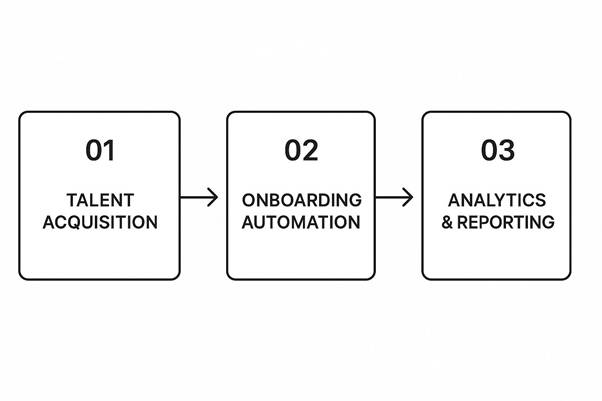
As you can see, a single action from a candidate can kick off a whole chain of automated events. This is how you create that seamless journey from applicant to a productive new team member.
Core HR and the HRIS
Once a candidate says “yes,” their information needs a permanent home. That’s the job of Core HR, which is managed by a Human Resource Information System (HRIS). Think of the HRIS as the central database—the single source of truth for all employee data.
The real magic of an HRIS is its ability to connect every other module. When it’s all integrated properly, the data captured by the ATS during hiring automatically flows into the new employee’s profile. No more tedious, redundant data entry and far less risk of human error.
This module typically handles:
- Employee Data Management: Storing personal details, contact info, job titles, and reporting lines.
- Leave and Attendance Tracking: Automating requests, approvals, and balance calculations.
- Document Management: Securely holding onto contracts, policy sign-offs, and other vital paperwork.
Getting this centralisation right is absolutely fundamental for accurate reporting and staying compliant. It’s the true backbone of your HR tech stack.
Onboarding and Payroll Integration
With the new hire’s data safe and sound in the HRIS, the system can automatically kick off the next critical steps: onboarding and payroll. A modern onboarding module takes over the whole process, sending out welcome emails, assigning mandatory training, and scheduling those all-important introductory meetings.
At the exact same time, the new employee’s details are piped directly into the payroll system. This makes sure they’re added to the payroll cycle correctly from day one, with the right salary, tax, and benefits information. This kind of seamless integration prevents the delays and mistakes that so often plague manual payroll setups, ensuring a smooth financial start for every new team member.
Performance and Learning Management
HR tech isn’t just about getting people in the door; it’s crucial for helping them grow. A Performance Management module makes it easy to facilitate continuous feedback, set goals (like OKRs), and handle formal performance reviews. It helps the whole organisation move away from those dated annual appraisals toward a more dynamic, developmental culture.
Working hand-in-hand with this is the Learning Management System (LMS). An LMS is where you host training materials, track who has completed what, and can even recommend personalised learning paths based on an employee’s role or career ambitions. When integrated, performance data can directly inform learning recommendations, helping to close skill gaps spotted during reviews.
This rapid shift towards integrated solutions is a key driver behind the market’s explosive growth. In fact, India’s HR technology sector is projected to climb from USD 1,120 million in 2024 to roughly USD 2,300 million by 2033. This surge is fuelled by the ever-increasing need for digitised, cloud-based HR platforms across businesses of all sizes.
How HR Technology Drives Strategic Business Outcomes

While automating daily tasks is a big win, the real muscle of HR technology is its ability to shift HR from a cost centre to a strategic business partner. It’s about moving the conversation past efficiency and towards real-world outcomes that impact the bottom line, market position, and long-term health of the company.
Putting money into the right HR tech isn’t just an HR project; it’s a core business move. When HR leaders are armed with powerful data and analytics, they can bring critical insights to the leadership table, helping shape decisions that affect the entire organisation.
This shift allows Chief Human Resources Officers (CHROs) to answer tough questions with data, not just gut feelings. Questions like, “Which departments have the highest turnover risk?” or “What specific skills will our workforce need in three years?” can finally be answered with confidence.
From Reactive to Predictive Decision Making
Traditionally, HR has often been on the back foot, dealing with problems as they flare up. Modern HR technology completely flips that script, enabling a proactive and predictive way of managing the workforce.
Think of your HR platform as a sophisticated early-warning system. It analyses patterns in employee data—things like attendance records, performance review scores, and engagement survey feedback—to spot potential issues long before they become full-blown crises.
This is especially powerful when it comes to keeping your best people. Instead of finding out why a star performer left during an exit interview, predictive analytics can flag employees who show signs of being a flight risk. This gives HR and managers a chance to step in with targeted retention efforts, whether that’s a conversation about career growth or some well-deserved recognition, saving valuable talent from walking out the door.
By leveraging workforce analytics, businesses can make better-informed decisions regarding recruitment, talent development, and employee retention, transforming human capital into a carefully managed strategic asset.
This proactive approach also extends to compliance. A good HR system automatically keeps up with regulatory changes, updates the necessary paperwork, and ensures all records are audit-ready. This drastically cuts down the risk of eye-watering penalties for non-compliance.
Boosting Engagement and Fostering Growth
An engaged team is a productive team, and HR tech provides the tools to build and maintain a culture of high engagement. Things like self-service portals, personalised learning plans, and channels for continuous feedback all add up to a better employee experience.
When people feel empowered and can see a clear path for growth, their loyalty to the company grows stronger. For instance, an integrated Learning Management System (LMS) can look at performance data and suggest specific training that will help an employee reach their career goals right where they are.
That level of personal attention shows the company is invested in their success, which is a massive driver for both engagement and retention. This move towards automation and strategic people management is really picking up steam across India.
A recent ETHRWorld report shows that nearly 70% of Indian companies are now automating their core HR functions. This isn’t just about new software; it’s a fundamental change in how businesses find, manage, and keep their talent. You can read more about this HR tech boom in the ETHRWorld Tech Transformations 2025 report.
Creating a Competitive Advantage
Ultimately, using HR technology strategically gives a company a clear competitive edge. A business that can hire faster, keep top talent longer, and accurately plan for its future workforce is simply in a better position to outplay its rivals.
The key benefits that lead to market leadership include:
- Improved Agility: With data-driven insights, the organisation can pivot quickly in response to market shifts, whether that means scaling up a team for a new project or reskilling employees for upcoming challenges.
- Enhanced Employer Brand: A smooth, tech-supported journey for employees, from their first interview to their retirement, helps attract the best candidates in a crowded market.
- Increased Profitability: Lower turnover, higher productivity from engaged employees, and fewer compliance headaches all contribute directly to a healthier bottom line.
By connecting people-data to business outcomes, HR technology helps leaders see their workforce not just as a resource, but as the main engine driving value and success.
A Practical Roadmap for Successful Implementation
Choosing new HR technology is exciting. But the implementation? That’s where the real work begins. It’s the moment your vision meets the cold, hard reality of day-to-day operations. A well-planned rollout can create enormous value, but a rushed one is a recipe for frustration, low adoption, and wasted investment.
Success isn’t about flipping a switch and hoping for the best. It’s about steering a significant organisational change with care and precision. The first step is to stop thinking of this as an “IT task” and start treating it like the strategic project it is. That means getting the right people in the room, setting clear goals, and communicating constantly. With a structured approach, you can turn a complex process into a manageable and successful journey.
Phase 1: Laying the Groundwork
Before you even think about talking to a vendor, the most important work happens right here, inside your own walls. This phase is all about building a rock-solid business case and getting crystal clear on what problems you’re actually trying to solve. Skipping this stage is a classic mistake that almost always leads to picking the wrong solution.
Start by doing a thorough needs analysis. Map out your current HR processes from end to end. Where are the bottlenecks? What are the biggest pain points? Talk to everyone—HR admins, line managers, everyday employees—to get the full, unvarnished picture of the challenges they face.
Next, pull together a cross-functional implementation team. This can’t just be an HR and IT show. You need people from finance, legal, and other key business units at the table. Their early buy-in and different perspectives are priceless for a smooth rollout and will help you spot roadblocks you might have otherwise missed.
Defining clear, measurable success metrics before you start is non-negotiable. Whether it’s reducing time-to-hire by 20% or boosting employee self-service adoption to 85%, these goals will be your North Star, guiding your decisions and helping you prove the project’s ROI down the line.
Phase 2: Selecting the Right Partner
With your needs clearly defined, you can now start looking for a partner. And I use the word “partner” intentionally—you’re not just looking for a supplier. A true partner will take the time to understand your specific business challenges, especially within the Indian context, and offer a solution that can grow with you.
Draft a detailed Request for Proposal (RFP) that lays out everything you need, from technical specs to your expectations for ongoing support. When you get to the demo stage, don’t let vendors just run through a generic feature list. Ask them to show you exactly how their platform solves your specific pain points.
Your evaluation checklist should include:
- Scalability: Can this platform handle your company’s projected growth over the next five years?
- Integration Capabilities: How smoothly will it talk to your existing systems, like finance or your ERP?
- User Experience (UX): Is the interface genuinely intuitive? Will it be easy for all your employees to use, not just the tech-savvy ones?
- Local Compliance: Does the vendor have a deep and proven understanding of Indian labour laws and statutory requirements?
Phase 3: Managing Change and Data
This is often the trickiest part because it’s all about people. Organisational change management is the art of getting your employees not just to use the new system, but to be genuinely excited about it. For many, this is also a good time to rethink hiring models. You can learn more by exploring our insights into digital RPO for high-impact hiring and see how technology is reshaping modern recruitment.
Create a clear communication plan that doesn’t just explain what is changing, but why. Show employees how this new tech will make their lives easier, whether it’s through instant access to payslips or a simpler way to request leave. Honesty and transparency are your best tools for building trust and overcoming resistance.
At the same time, you need a meticulous plan for data migration. This is a delicate operation that requires extreme care to ensure every piece of information is accurate and secure.
- Data Cleansing: Before you move a single byte, clean up your existing HR data. Get rid of duplicates, fix errors, and standardise formats.
- Mapping: Carefully map the data fields from your old system to the new one. One small mistake here can cause massive data integrity headaches later.
- Testing: Run several test migrations using a sample of your data. This is your chance to find and fix any issues before the main event.
- Validation: After the final migration is complete, have key users from different departments validate the data in the new system to confirm everything is accurate and where it should be.
Phase 4: Training and Adoption
The final piece of the puzzle is empowering your team to use the new system with confidence. A one-size-fits-all training session is rarely effective. You need to customise the training to fit the role. Managers, for instance, will need a very different session than general employees or HR administrators.
Offer training in a few different formats to suit how people learn—think live workshops, on-demand video tutorials, and easy-to-read user guides. Better yet, create a network of “super users” or champions within various departments. These are the enthusiastic early adopters who can provide peer-to-peer support and drive adoption from the ground up, making the entire transition feel much less daunting for everyone involved.
Future Trends Shaping Indian HR Technology
The world of HR technology isn’t standing still. Far from it. It’s constantly evolving, driven by new ideas and smarter tools that are changing the game for Indian organisations. Staying ahead of these shifts is no longer a luxury—it’s essential for attracting and keeping top talent in a fiercely competitive market.
The future is all about creating a more intelligent, personalised, and ultimately more human work experience, all powered by technology. We’re seeing a fundamental change from HR tools that just manage processes to platforms that can actually anticipate needs and offer strategic advice. This is empowering HR leaders to move from a reactive stance to a truly proactive one, shaping tomorrow’s workforce with data-driven confidence.
Let’s look at the key trends that are redefining the entire landscape.
The Rise of AI and Machine Learning
Artificial Intelligence (AI) and Machine Learning (ML) are quickly becoming the engine room of modern HR. These aren’t just buzzwords; these technologies are moving way beyond simple automation. They’re now handling complex tasks that require real nuance, completely changing how we manage talent.
Take recruitment, for example. AI-powered tools can now sift through thousands of resumes in minutes, zeroing in on the best candidates based on skills and experience, not just keywords. This intelligence also extends to employee development, where AI can analyse performance data and career goals to suggest personalised learning paths, almost like a digital career coach.
While there’s a lot of talk about AI’s impact on jobs, its real value is in how it enhances what humans can do. If you want to dive deeper into this, you can explore our article on how AI might impact your job.
AI is enabling HR to better personalise its services and the entire employee experience. The less time HR spends on routine tasks, the more they can focus on advancing company culture and making strategic contributions.
Hyper-Personalisation Through Employee Experience Platforms
The old one-size-fits-all approach to HR is dead. The future belongs to Employee Experience Platforms (EXPs), which serve as a single, digital hub for everything an employee needs. Think of it as a personalised dashboard for their entire life at the company.
From one simple interface, an employee can check payslips, request leave, find training modules, and get company news that’s actually relevant to their role. This intense focus on individual journeys is a massive trend in Indian HR, moving beyond just managing transactions to offering genuine, holistic support. It’s a game-changer for supporting teams spread across different locations.
A modern EXP typically includes:
- Integrated Communication: Centralised hubs for company news and team updates.
- On-Demand Learning: Instant access to training and career development tools.
- Wellness Resources: Tools for mental health support and wellness programmes.
- Feedback Channels: Built-in surveys and tools for continuous, open feedback.
Predictive Analytics for Strategic Workforce Planning
This is where things get really interesting. Perhaps the most powerful trend is the growing use of predictive analytics. This is where HR technology stops being a support function and becomes a true strategic partner to the business.
By analysing historical data, these systems can forecast future workforce trends, helping leaders make smart decisions before a problem even arises. Imagine being able to identify employees at a high risk of leaving, allowing you to step in before it’s too late. Or forecasting future skills gaps so you can start upskilling your team or hiring for the capabilities you’ll need in two years.
This data-first approach lets HR leaders answer critical business questions with confidence:
- Which departments are likely to face skill shortages next year?
- What’s the predicted impact of a new policy on employee morale?
- Who are our high-potential employees ready for the next step up?
By turning raw data into actionable insights, predictive analytics allows HR to not just support the business strategy, but to actively help shape it. This is the final step in HR’s journey from an administrative department to an essential driver of organisational success.
Frequently Asked Questions
Jumping into a major business investment like new HR technology always brings up some practical questions. It’s only natural. Getting your head around the specifics, especially in the Indian context, is the key to making a decision you can stand behind. Here, we’ll tackle some of the most common queries we hear from business leaders who are navigating this change.
We’ll clear up concerns from legal compliance and scalability for smaller businesses to finally decoding that confusing alphabet soup of HR software acronyms. Our aim is to give you clear, straightforward information so you can move forward with confidence.
How Does HR Technology Help with Compliance in India?
This is a big one for any business in India. Our labour laws are notoriously complex and seem to be in a constant state of flux. Modern HR tech is built to take this headache away, essentially acting as a digital compliance officer for your organisation.
These platforms are designed to automatically handle India’s specific statutory requirements. Think of things like managing contributions for the Provident Fund (PF) and Employees’ State Insurance (ESI), or handling Tax Deducted at Source (TDS) calculations with pinpoint accuracy. The software stays current with the latest legal changes, so you don’t have to burn hours tracking every little amendment.
By automating statutory reporting and keeping meticulously accurate records, HR tech dramatically cuts down the risk of human error and the painful penalties that follow. It makes sure all your required documents are generated correctly and on time, securing your company’s legal standing.
This kind of automation turns compliance from a reactive, stress-inducing chore into a smooth, integrated part of your daily operations. That’s real peace of mind.
Is HR Technology Suitable for Small Businesses?
Absolutely. It’s a common myth that powerful HR tools are just for the big players. The reality is, the boom in scalable, cloud-based solutions has made this tech incredibly accessible and affordable for small and medium-sized businesses (SMBs) all over India.
Many providers now offer modular platforms, meaning you only pay for the features you actually need right now. An SMB can easily start with the essentials—like core HR and payroll—and then bolt on more advanced functions like performance management or an applicant tracking system as the company scales up.
– Cost-Effective Models: Subscription-based pricing means you can forget about huge upfront investments in hardware or software licences.
– Ease of Implementation: Cloud solutions are typically much quicker and simpler to get up and running compared to old-school on-premise systems.
– Competitive Edge: Having this tech in your corner helps smaller companies professionalise their HR function, allowing them to compete more effectively for top talent.
For an SMB, adopting HR technology isn’t a luxury—it’s a smart, strategic move to build a solid foundation for growth and efficiency.
What Is the Difference Between HRIS, HRMS, and HCM?
Here’s a simple way to look at it:
1. HRIS (Human Resource Information System): This is your foundation. Its main job is to act as a central database, the single source of truth for all core employee data—names, addresses, job titles, salary info, and so on. The focus here is purely on data management and basic admin.
2. HRMS (Human Resource Management System): This includes everything an HRIS does, but it adds crucial talent management features to the mix. An HRMS will typically have modules for recruiting (Applicant Tracking Systems), performance reviews, and onboarding. It’s a more complete system for managing the entire employee journey.
3. HCM (Human Capital Management): This is the most strategic and all-encompassing of the three. HCM covers all the functions of an HRMS and layers on high-level strategic capabilities. We’re talking tools for workforce planning, complex compensation management, and advanced analytics. It’s a shift in mindset—treating your people not just as resources to manage, but as valuable business assets to invest in and develop.
Ready to transform your recruitment process and build a strategic advantage? Taggdoffers specialised Recruitment Process Outsourcing solutions that integrate seamlessly with modern HR technology, empowering you to find and hire the best talent faster. Discover how our expertise can drive your business forward.