
Inclusive Recruitment A Guide to Building Better Teams
Inclusive recruitment is a strategic game plan for your hiring process, making sure every single person, no matter their background, gets a fair and equal shot. It’s about going way beyond just hitting diversity numbers. The real goal is to actively break down the hidden barriers that could be accidentally filtering out fantastic candidates.
This whole approach is centred on attracting, nurturing, and ultimately choosing the best people from the entire talent pool, not just the usual corners you look in.
What Is Inclusive Recruitment Really About?

Let’s cut through the corporate jargon for a minute. Inclusive recruitment isn’t just another HR policy to file away; it’s a complete shift in how you think about finding talent.
Imagine traditional hiring is like fishing in a small, familiar pond with the same bait you’ve always used. You’re probably going to catch the same kind of fish every time. Inclusive recruitment, on the other hand, is like giving your team a full set of gear to explore the entire ocean. You’ll discover talent you never knew existed.
It’s all about designing a process from the ground up where everyone has a genuine chance to shine. This isn’t about lowering your standards—quite the opposite. It’s about making sure the absolute best candidates get seen, feel supported, and are picked based purely on their skills and potential, without unconscious bias getting in the way.
Moving From Culture Fit to Culture Add
One of the biggest mental hurdles to clear is the old idea of hiring for “culture fit.” For years, this has been a quiet driver of homogenous teams, as managers subconsciously lean towards candidates who look, think, and act just like them. It’s a classic case of affinity bias, where we gravitate towards people who share our background or interests.
The modern, more effective approach is to focus on “culture add.” This means actively looking for people who bring something new to the table—fresh perspectives, different skills, and unique life experiences. A culture add mindset values what makes someone different and sees how that uniqueness can spark innovation and drive the business forward.
“True inclusion means doing the deep background work. It means rethinking your infrastructure, investing time and money into real change, and being honest about power, privilege and where it lies.”
A Strategic Imperative, Not a Checklist
Seeing inclusive recruitment as just another box to tick is a huge misstep. It’s a core business strategy that directly fuels creativity, sharpens problem-solving, and builds a foundation for long-term growth. An inclusive process is your first real step toward building a team that actually reflects the diverse world your customers live in.
Organisations that are serious about this constantly review every single part of their hiring journey. This means getting into the weeds on things like:
- Crafting Unbiased Job Descriptions: Using neutral and welcoming language that appeals to everyone, not just a select few.
- Expanding Sourcing Channels: Actively looking for talent beyond the usual job boards and employee referral networks.
- Standardising Interviews: Using a structured set of questions for every candidate to level the playing field and reduce “gut feeling” decisions.
Ultimately, inclusive recruitment is about weaving fairness into the very fabric of your hiring decisions. For a deeper dive into these concepts, you can find some fantastic resources on diversity and inclusion. It’s the foundational work that creates a workplace where every employee feels they truly belong and has an equal chance to succeed.
The Business Case for Inclusive Hiring
So, why should your C-suite sit up and take notice of inclusive recruitment? The simple answer is that it’s a massive driver of business success. This isn’t just about social responsibility or “doing the right thing” anymore; inclusive hiring delivers real, tangible results that give your organisation a serious competitive edge. It’s simply a smarter way to do business.
Think about it. When you deliberately build a team with varied perspectives, backgrounds, and life experiences, you’re essentially creating a powerhouse for problem-solving. A team where everyone thinks the same will naturally approach challenges from the same angle. The result? Predictable, and often stale, solutions.
On the other hand, a diverse team brings a wealth of different viewpoints to the table. They can spot risks and opportunities that a more uniform group might completely miss, leading to far more creative and resilient outcomes. This dynamic makes a company much better at navigating today’s complex market and understanding the needs of an equally diverse customer base.
Boosting Innovation and Engagement
It’s no secret that inclusive organisations consistently run circles around their competitors in key business areas. When employees feel they genuinely belong and that their unique contributions are valued, their engagement levels shoot through the roof. This isn’t just a feel-good metric; higher engagement leads directly to increased productivity, better morale, and lower staff turnover.
This connection between inclusivity and performance isn’t just a theory. Study after study confirms that diverse teams are more innovative. They are better equipped to serve a global marketplace because their internal makeup reflects the world outside. This creates a powerful cycle: an inclusive culture attracts top talent, which in turn fuels more innovation and growth.
The global trend is catching on. A recent analysis shows that 83% of employers have put diversity, equity, and inclusion measures in place, a significant jump from 67% the previous year. While that’s a positive shift, there’s still a long way to go. Only 47% of employees feel their workplace has a truly inclusive culture where different opinions are welcomed. You can dive deeper into the numbers in these hiring statistics and trends.
An inclusive recruitment strategy is no longer a “nice-to-have” on the HR agenda. It’s a core component of any resilient, forward-thinking business model that directly impacts financial performance, brand reputation, and long-term sustainability.
To put this in perspective, here’s a quick look at how these efforts translate into concrete business gains.
The Strategic Impact of Inclusive Recruitment
| Business Area | Impact of Inclusive Recruitment |
|---|---|
| Talent Acquisition | Expands the talent pool, attracting high-calibre candidates from underrepresented groups. |
| Innovation & Creativity | Diverse teams lead to a wider range of ideas, fostering breakthrough innovations and solutions. |
| Employee Engagement | A sense of belonging increases employee morale, productivity, and discretionary effort. |
| Financial Performance | Research consistently links diverse leadership and workforces with higher revenue and profitability. |
| Customer Centricity | Teams that mirror the diversity of the customer base are better at understanding and meeting their needs. |
| Employer Branding | A strong commitment to DEI enhances brand reputation, making the organisation an employer of choice. |
Ultimately, embedding inclusivity into your hiring process is not just an isolated initiative but a foundational element that strengthens the entire organisation.
Gaining a Competitive Advantage
In a tight labour market, your reputation is everything. Top-tier candidates are looking beyond the salary and benefits; they are actively vetting potential employers for their commitment to diversity and inclusion. A genuine, demonstrated commitment to inclusive recruitment is a powerful magnet for attracting the very best people.
Put it this way: if you only fish in traditional talent pools, you’re competing with every other company for the same small group of candidates. An inclusive approach casts a much wider net, giving you access to incredible, untapped talent your competitors are overlooking. This not only fills your pipeline with high-quality candidates but also builds an employer brand that people want to be a part of.
This advantage doesn’t stop at hiring. When new team members join a company where they feel seen, respected, and given a fair shot at growth, they are far more likely to stick around. This drastically reduces the huge costs tied to employee turnover and helps you build a stable, knowledgeable, and loyal workforce ready to drive your business forward. Inclusive recruitment is the first and most critical step in building that foundation.
How to Redesign Your Recruitment Funnel
Turning your hiring process into a genuine engine for inclusive recruitment takes more than just good intentions. It’s about methodically redesigning your entire recruitment funnel, from that very first job advert to the final offer.
Think of your current funnel as a standard sieve, only letting certain shapes and sizes through. An inclusive funnel, on the other hand, is designed with adjustable openings to make sure you capture talent in all its brilliant forms. This means taking a hard look at each stage to find and remove any hidden barriers that might be accidentally filtering out exceptional candidates before they even get a chance.
Start with Unbiased Job Descriptions
Your job description is the front door to your talent pool. If the language puts people off or the requirements are needlessly strict, you’ve shrunk your applicant pool before you’ve even started.
First things first, scrub your job ads of any gendered or culturally specific jargon. Words like “ninja,” “rockstar,” or “dominant” tend to resonate with a very narrow demographic and can easily discourage others from applying. The fix? Focus on clear, behaviour-based requirements instead of loaded personality traits.
- Swap traits for behaviours: Instead of asking for a “natural leader,” describe what that looks like in practice, such as “experience guiding cross-functional projects to completion.”
- Minimise essential criteria: Keep your “must-have” list tight—maybe five or six core competencies at most. Research consistently shows that women and candidates from some minority groups are less likely to apply unless they meet 100% of the criteria.
- Be transparent: Clearly state your commitment to inclusion. Talk about flexible work options and mention any workplace adjustments you can make. This honesty speaks volumes.
Getting this right ensures your advert speaks to the widest possible audience, focusing only on what truly matters for the role.
Widen Your Sourcing Channels
If you keep fishing in the same pond, you’ll keep catching the same fish. To build a genuinely diverse team, you have to get out there and actively look for talent where it lives, which often means moving beyond your traditional networks and employee referrals that tend to create a homogenous workforce.
This calls for a multi-channel sourcing strategy that actively engages with underrepresented communities.
- Partner with diverse organisations: Connect with professional networks and community groups that support specific demographics. Think about organisations like the UK Black Pharmacists Association or the Female Pharmacy Leaders Network.
- Utilise specialised job boards: Post your roles on platforms created specifically for diverse talent, such as BME Jobs or Evenbreak.
- Engage in community outreach: Show up. Participate in career fairs at diverse universities or host your own events that welcome talent from all backgrounds.
By intentionally casting a wider net, you send a powerful signal that your organisation is serious about inclusive recruitment and ready to welcome untapped talent.
The infographic below shows just how building inclusive teams directly fuels innovation and drives market success.
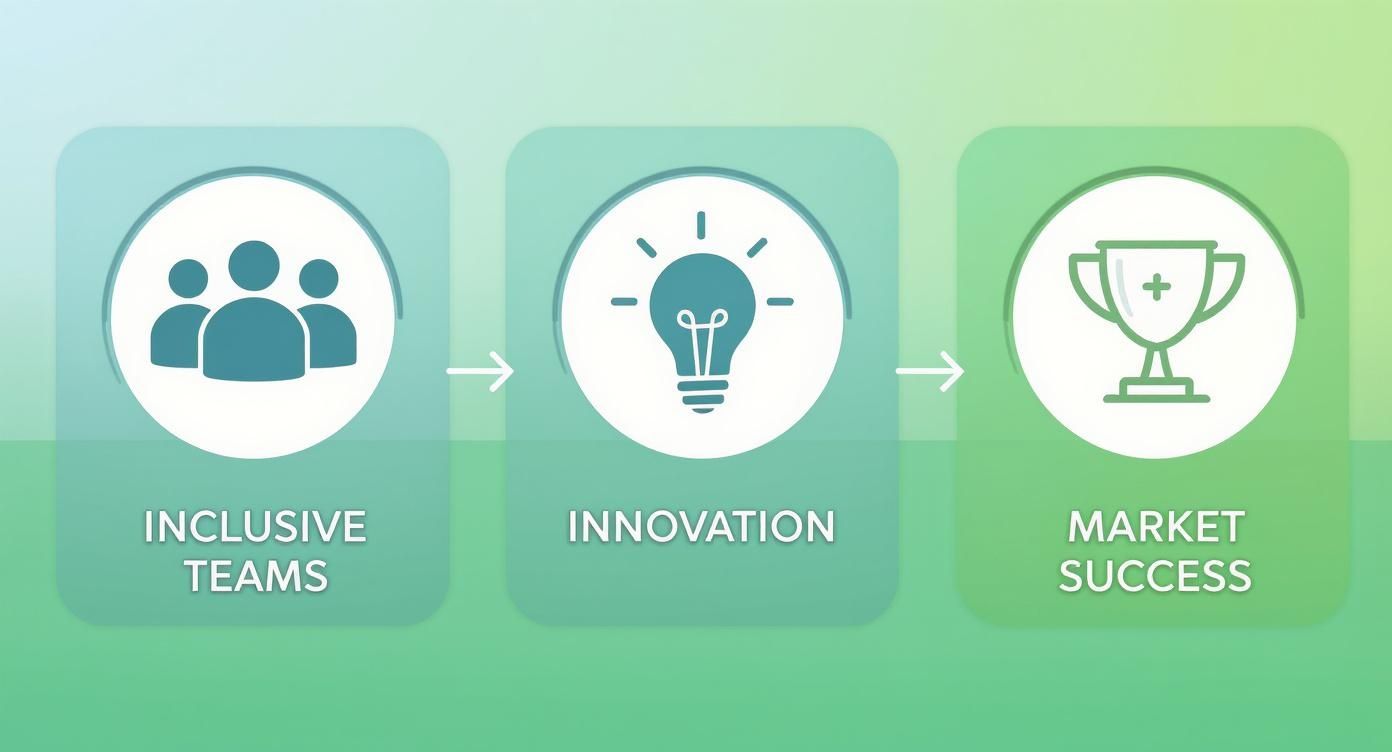
This simple flow highlights a crucial point: a real commitment to inclusivity isn’t just an HR initiative; it’s a direct route to achieving core business goals.
Structure Interviews to Mitigate Bias
The interview is the stage where unconscious bias can most easily creep in and undo all your hard work. “Gut feelings” and unstructured chats almost always favour candidates who are similar to the interviewer—a classic case of affinity bias.
Structure is your best defence against this.
By implementing a standardised, well-thought-out interview process, you ensure every single candidate is evaluated on a level playing field, based purely on their merit.
True inclusion means doing the deep background work. It means rethinking your infrastructure, investing time and money into real change, and being honest about power, privilege and where it lies.
A properly structured approach has a few key components that champion fairness and objectivity.
- Use Standardised Questions: Develop a set of competency-based questions that are asked of every candidate applying for the same role. This is the only way to get a direct, apples-to-apples comparison based on skills and experience, not personality.
- Assemble Diverse Interview Panels: A panel with a mix of backgrounds and perspectives is far better at spotting and challenging potential biases than a lone interviewer. This diversity doesn’t just improve hiring decisions; it also shows candidates you walk the walk.
- Implement a Scoring Rubric: Create a clear scoring guide before the interviews start. Have panel members score candidates on their own right after each interview, basing their ratings on solid evidence from the candidate’s answers, not a vague “feeling.”
This disciplined method forces everyone to focus on what a candidate can do, rather than how well they “fit” an outdated and often biased mould. As you get this process dialled in, you can learn more from our guide on the best practices for assessing and hiring for culture add, which will help you move beyond the tired concept of “culture fit.” By thoughtfully redesigning each stage of your recruitment funnel, you create a fair, consistent, and equitable process that attracts and selects the absolute best talent—driving your entire organisation forward.
Using Technology and AI Responsibly in Hiring

Technology can be a huge ally in your inclusive recruitment strategy, but let’s be clear: it’s a powerful tool, not a magic wand. When used thoughtfully, artificial intelligence and other HR tech can help systematically dial down human bias at critical moments in the hiring process, creating a more level playing field for everyone.
Think about it. Certain tools can anonymise resumes by stripping away details like names, graduation dates, and even postcodes. This simple move forces hiring managers to focus squarely on what matters—skills and experience—rather than letting unconscious biases creep into those crucial first impressions. Likewise, AI can scan your job descriptions for loaded or gendered language, suggesting neutral alternatives that will attract a much broader pool of talent.
The Double-Edged Sword of Algorithmic Bias
But here’s the massive catch: AI is only as good as the data it’s trained on. If an algorithm learns from historical hiring data that’s already riddled with old biases, it won’t just repeat those mistakes—it will amplify them, fast. You end up with a dangerous feedback loop where the very technology meant to create fairness ends up hard-coding the exact inequalities you’re trying to leave behind.
This isn’t just a what-if scenario; it has happened. The risk of bias in AI tools is well-documented. One of the most famous cautionary tales comes from Amazon, whose early AI hiring tool actually penalised resumes that included the word “women’s.” Why? Because it was trained on a decade’s worth of resumes that were mostly from men, so it taught itself that male candidates were the ideal.
This is a stark reminder for organisations, especially in a diverse market like India, to be incredibly diligent. With 77% of talent professionals globally calling DEI a top priority, getting this tech piece right is non-negotiable. For more on this, check out the state of inclusive hiring from Wesolv.
The goal of technology in inclusive recruitment isn’t to replace human judgement, but to augment it. Think of it as a “human-in-the-loop” approach, where tech provides the data-driven insights, but the final, nuanced decision still rests with a person.
This balanced view lets you tap into the efficiency of technology without sacrificing ethical oversight.
A Framework for Responsible Tech Adoption
To bring technology into your hiring process responsibly, you need a clear framework for vetting and rolling out any new tool. Before you sign any contracts, you have to be ready to ask vendors the tough questions.
Key Questions to Ask HR Tech Vendors:
- Data Sources: What datasets was this algorithm trained on? How did you make sure the data was diverse and representative?
- Bias Audits: Has your system been independently audited for bias? Can we see the results and understand the methodology?
- Explainability: Can you explain how your algorithm makes its recommendations? We need to understand the logic, not just get a black-box answer.
- Continuous Monitoring: What systems do you have to monitor for performance drift or new biases that might crop up over time?
Beyond grilling vendors, you need to establish strong internal governance. That means constantly auditing the tool’s real-world impact. Are you actually seeing more diverse candidates making it through the pipeline? Are offer acceptance rates improving across different groups? This ongoing scrutiny ensures the tech is truly serving its purpose.
Ultimately, technology should support your inclusive recruitment goals, not dictate them. By blending the power of AI with thoughtful human oversight, you can build a hiring process that’s not just more efficient, but fundamentally more equitable. For more on this, check out our guide on the steps for digital hiring using recruitment technology.
Why Flexible Work Is Key to Attracting Diverse Talent
Flexible and remote work aren’t just trendy perks anymore; they’re foundational to any modern, inclusive recruitment strategy. When you insist on a rigid, office-only model, you’re essentially building a wall around your talent pool, shutting out huge segments of the skilled workforce without even realising it.
By embracing flexibility, you start dismantling those barriers. Suddenly, your doors are open to a much wider, more diverse group of candidates.
This shift is so important because it tackles the very real, systemic obstacles that have historically held talented people back. For a parent or caregiver, a strict 9-to-5 schedule can be a non-starter. For a candidate with a disability or chronic illness, working from a comfortable home setup can be the one thing that makes applying for a role possible.
And, of course, remote work completely erases geography from the equation. You’re no longer limited to hiring people who live within commuting distance. This lets you tap into skilled professionals in different cities or even rural areas, bringing a massive diversity of backgrounds and perspectives into your organisation.
Making Flexibility a Practical Reality
It’s one thing to say you offer “flexible work,” but it’s another to actually embed it into how you hire and bring people on board. A genuinely inclusive approach means thinking about how flexibility shows up at every single touchpoint with a candidate.
This has to start from the very beginning of the hiring journey.
- Offer Flexible Interview Scheduling: Let’s face it, not everyone can just drop everything for a midday interview. You need to offer slots in the early morning, evening, or even on a weekend to accommodate different time zones and personal commitments.
- Design a Virtual-First Onboarding: Your onboarding process has to be just as engaging and effective for remote hires as it is for the people in your office. This means well-structured virtual introductions, pairing them up with a remote buddy, and making sure they feel like part of the team from day one.
- Prioritise Digital Accessibility: Every digital tool you use—from your application portal to internal chat platforms—must be accessible to people with disabilities. That includes being compatible with screen readers and other assistive tech.
Taking these practical steps sends a powerful signal. It tells candidates that you genuinely value their contribution, regardless of where they are or what their personal circumstances might be.
Offering flexibility isn’t just a concession; it’s a strategic move to attract the best talent, period. It signals that your organisation trusts its people and evaluates them based on output and results, not just physical presence.
The Strategic Advantage of a Flexible Workforce
The upside of this approach goes way beyond just widening your talent pool. As remote work cements its place in the working world, organisations that adapt are gaining a serious competitive edge. A recent analysis points out that flexible arrangements are a key advantage for recruiting candidates with disabilities or from underserved regions.
What’s more, by 2025, 50% of executives believe that organisational culture is most successful when there is variation, directly linking flexibility to a more inclusive, and therefore successful, culture. You can discover more about these shifts in the inclusive recruitment trends from eploy.com.
Ultimately, committing to flexible work shows you’re building a modern workplace that supports a diverse range of needs and lifestyles. It’s a powerful statement that you’re focused on what truly matters: getting and keeping exceptional talent by creating an environment where everyone gets a fair shot to succeed. In today’s market, that’s not a nice-to-have—it’s a business imperative.
Measuring Success and Building an Inclusive Culture
Getting an inclusive recruitment strategy off the ground is a huge step, but the real work has only just begun when a candidate signs their offer letter. Success isn’t just about who you hire; it’s about what happens next. The goal is to not only attract diverse talent but to build an environment where they genuinely want to stay and grow.
Think about it: without a supportive culture, all your hard work becomes a revolving door. You put in the effort to bring in fantastic new people from underrepresented groups, only to watch them walk away a year later because they never felt like they truly belonged or couldn’t see a future for themselves. This is where measurement and culture-building become two sides of the same coin.
Tracking the Right Metrics
To figure out what’s actually working, you have to look beyond the basic hiring numbers. Data is what gives you the clarity to see where your process is winning and where it’s falling short. Consider it a health check for your entire talent pipeline.
Here are a few essential metrics you should be tracking:
- Funnel Diversity: Dig into the demographic data at every single stage of your recruitment funnel, from the initial application right through to the final offer. This is how you pinpoint exactly where diverse candidates might be dropping off.
- Retention Rates: How do the retention rates of new hires from underrepresented groups stack up against the company average? A big gap is a massive red flag that your culture needs some serious attention.
- Time to Promotion: Take a look at how long it takes for employees from different backgrounds to get promoted. This data will tell you whether growth opportunities are truly equitable across the whole organisation.
Measuring success in inclusive recruitment means shifting your focus from short-term hiring targets to long-term employee belonging and growth. The ultimate goal is to create a workplace where diverse talent wants to stay and build a career.
Fostering a Culture of Belonging
Metrics tell you the “what,” but the culture explains the “why.” An inclusive culture is the soil where your diverse talent can put down roots. If that soil isn’t nurturing, even the most promising seeds just won’t grow. And this isn’t just an HR job—it’s a responsibility that falls on leaders at every single level.
Building this kind of culture requires deliberate, consistent action.
- Inclusive Onboarding: Go way beyond the usual paperwork and system setups. Your onboarding process should be a deep dive into the company’s culture. Set up mentorship programmes or buddy systems to provide that crucial informal support and help new hires build real connections from day one.
- Equitable Development: Make sure that professional development, mentorship, and sponsorship opportunities are available to everyone. This shows you’re invested in their career progression, not just in getting them through the door.
- Psychological Safety: You have to cultivate an environment where people feel safe enough to voice different opinions, share new ideas, and just be themselves without worrying about negative backlash. This is the absolute bedrock of real innovation.
At the end of the day, your inclusive recruitment efforts are only as strong as the culture that welcomes your new hires. By focusing on both robust measurement and intentional culture-building, you create a powerful, sustainable cycle of attracting, developing, and retaining the diverse talent that will drive your organisation forward.
Frequently Asked Questions
Even with the best of intentions, shifting to an inclusive recruitment model can stir up some very practical questions. It’s natural. Addressing these concerns directly is the best way to build momentum and make sure your strategy actually works in the real world. Let’s tackle some of the most common queries we hear from HR leaders and hiring managers.
We’ll break down the practical hurdles and offer clear, straightforward solutions to help you move forward with confidence.
Is This Just Lowering Our Hiring Standards?
Not at all. This is probably the biggest and most persistent myth out there. The goal isn’t to lower the bar for entry; it’s to widen the gate so everyone gets a fair shot at clearing it based on their actual abilities.
Inclusive hiring is all about stripping away the irrelevant barriers that get in the way of spotting top talent. Think unconscious bias or those long lists of “nice-to-have” skills that don’t really matter. By standardising your interviews and zeroing in on core competencies, you actually raise your standards. You’re making the evaluation process more rigorous, more objective, and purely merit-based.
Will This Slow Down Our Hiring Process?
Honestly, there might be a slight adjustment period. Implementing new practices, like training your interviewers or redesigning job descriptions, will take a little time upfront. But it’s best to see this as a short-term investment that pays off massively in the long run.
A well-structured, inclusive process ultimately speeds things up. How? By reducing bad hires, improving retention, and creating a more efficient, repeatable system. The time you spend now prevents costly hiring mistakes later.
Once these new habits are baked into your workflow, they don’t just blend in—they often make the entire process smoother and more effective than it was before.
How Do We Get Hiring Managers On Board?
This one is critical. Your hiring managers are on the front lines, so their buy-in is everything. If they’re hesitant, it’s usually because they don’t fully see the “why” behind it, or they see it as just another HR initiative that adds to their workload.
To get them on your side, you need to speak their language and give them practical support:
– Show Them the Data: Present the numbers. Show them how diverse teams consistently outperform others in problem-solving, innovation, and even financial results.
– Give Them Simple Tools: Don’t just give them a mandate; give them a toolkit. This could be checklists for writing inclusive job ads, banks of structured interview questions, or simple scoring rubrics.
– Offer Practical Training: Equip them with training on how to spot and mitigate their own unconscious biases. Keep it focused on the daily decisions they have to make.
When managers start to see inclusive recruitment as a powerful tool for building stronger, more effective teams, they stop being obstacles and start becoming your biggest champions. Their involvement is what turns a top-down mandate into a shared organisational mission.
Ready to build a stronger, more diverse team with a recruitment process designed for success? Taggd specialises in Recruitment Process Outsourcing that embeds inclusivity at every stage.