
Addressing Recency Bias in the Workplace for Fairer Evaluations
Picture this: your star player has been knocking it out of the park for eleven straight months. They’ve been brilliant. But right before their annual review, they fumble a project.
If that single, recent slip-up ends up defining their entire year’s performance in your mind, then you’ve just witnessed recency bias in the workplace firsthand.
The Hidden Cost of Recent Memory
Recency bias is a mental shortcut our brains take. We naturally give more importance to things that happened recently, which can seriously warp our judgement of the bigger picture. This is a huge problem for HR leaders and managers trying to conduct fair appraisals, make unbiased hiring decisions, and maintain team morale.
This guide will dig into what causes this bias and give you a clear roadmap to counter it. We’ll look at practical, real-world strategies to help you build a more equitable and high-performing organisation.
The goal here is simple: to create a workplace where a full year of hard work is valued for what it is, not overshadowed by what happened in the last few weeks. Getting this right isn’t just about being fair—it’s about keeping your best people.
Why Our Brains Focus on ‘What Happened Lately’

Let’s get one thing straight: recency bias isn’t some personal failing. It’s simply how our brains are wired to work. Think of your short-term memory like a spotlight—it shines brightest on the most recent events, making them seem far more important than older, perhaps equally significant, ones.
This mental shortcut pops up everywhere. It’s the manager who focuses almost entirely on a recent success during a year-end review or the hiring lead who is most impressed by the final candidate they interviewed that day. This tendency only gets stronger when leaders are managing large teams and dealing with a constant flood of information.
In Indian organisations, this effect can be particularly damaging. A minor slip-up in the last quarter can easily overshadow 11 months of solid, consistent contributions, which can tank morale and warp crucial leadership decisions. You can learn more about how leadership bias affects workplace dynamics on infoprolearning.com.
Understanding that this is our brain’s default setting is the first, most crucial step. Only then can we start building the systems and processes needed to counteract it.
How Recency Bias Sabotages Performance Reviews

Alt: How Recency Bias Sabotages Performance Reviews
Performance appraisals are ground zero for the damaging effects of recency bias in the workplace. An entire year of consistent achievement can be completely erased by a single, recent misstep. It’s a fast track to demotivated employees and broken trust.
This cognitive shortcut is a significant and widespread challenge across Indian organisations.
Managers, influenced by this very human tendency, often let recent events—both good and bad—disproportionately colour their final evaluation. An employee’s year-round hard work can be completely overshadowed by their performance in the few weeks leading up to the appraisal. For more expert insights on this bias, economictimes.com offers a deeper dive.
On the flip side, an underperforming employee might learn to game the system. A last-minute burst of productivity just before review season can secure an unfairly positive assessment.
This kind of outcome doesn’t just hurt morale; it fosters a culture that rewards short-term visibility over genuine, long-term value.
The Unfair Advantage in Hiring and Recruitment

Beyond the world of annual reviews, recency bias in the workplace can quietly tip the scales when it comes to hiring.
Think of it as a ‘candidate parade’. You interview five perfectly qualified people for a crucial role. Who often holds a distinct advantage? The final candidate. It’s simply because their answers, their personality, and their qualifications are the freshest in the hiring manager’s mind.
This subtle cognitive glitch can easily lead to overlooking a stronger applicant who just happened to interview earlier in the week. The bias can even creep in during the initial resume screening, where the last batch of CVs reviewed might get a little more careful consideration than the first.
When this happens, making the best hiring choices becomes incredibly difficult, which can lead to higher team churn and unintentionally limit your diversity efforts. A structured, conscious approach is the only way to combat it. You can explore more strategies for your career development on taggd.in.
Practical Strategies to Ensure Fair Evaluations
So, how do we actually fix this? Beating recency bias means moving away from the old-school, memory-based annual review. The real solution lies in shifting towards data-driven, continuous performance management. This simple change helps build a complete, year-long picture of an employee’s performance, swapping out hazy memories for cold, hard facts.
This isn’t just a theoretical problem; it has a very real impact on how people feel about their work and their managers.
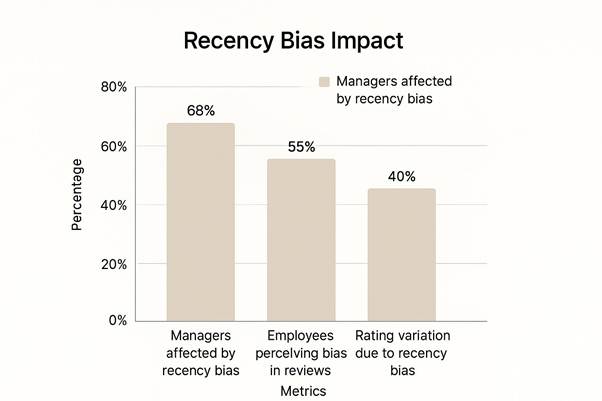
Alt: Recency Bias Impact
The numbers don’t lie. Bias is a widespread issue affecting a huge number of managers, and more than half of all employees feel its sting.
In many Indian workplaces, the root cause is often surprisingly simple: poor documentation. When there’s no consistent record to refer to, managers naturally fall back on what they remember most clearly—the recent wins and failures—instead of looking at long-term contributions. You can get a deeper look into how these biases play out during performance reviews on peoplematters.in.
Structured documentation is a great starting point, but it’s not enough on its own. It has to be paired with proper training for managers on spotting and mitigating their own unconscious biases. Interestingly, this discipline of objective evaluation doesn’t just improve reviews; it also has a positive knock-on effect when it comes to hiring a culture fit candidate, ensuring fairness right from the very beginning.
Comparing Traditional vs Modern Appraisal Systems
The table below starkly contrasts the old way of doing things with a more modern, bias-resistant approach. It highlights just how vulnerable the traditional annual review is to recency bias compared to a system built on continuous feedback.
| Feature | Traditional Annual Review | Modern Continuous Feedback System |
| Data Collection | Relies heavily on the manager’s memory of events, primarily from the last few months before the review. | Gathers data and feedback throughout the entire year from multiple sources (peers, self, manager). |
| Vulnerability to Bias | High. A single recent project, good or bad, can disproportionately influence the entire year’s evaluation. | Low. A full year of documented feedback provides a balanced view, diluting the impact of any single recent event. |
| Employee Perception | Often seen as unfair or a “last-minute cram session,” leading to anxiety and disengagement. | Perceived as more equitable and developmental, fostering trust and a growth mindset. |
| Manager’s Role | Acts as a judge, delivering a final verdict based on limited, recent information. | Acts as a coach, providing ongoing guidance and support based on real-time performance data. |
| Focus | Backward-looking, focusing on rating past performance. | Forward-looking, focusing on continuous improvement and future development. |
Ultimately, the goal of any performance system should be to provide a fair and accurate reflection of an employee’s contribution. As you can see, a modern approach is far better equipped to deliver on that promise, effectively sidelining the influence of recency bias.
Building a Culture of Objective Decision-Making
Tools and new processes are only half the battle against recency bias in the workplace. To truly win, you have to cultivate a culture that actively champions fairness and objective evaluation. This always starts at the top, with leadership modelling data-driven decisions and being totally transparent about how they get there.
It’s all about building an environment where the entire performance journey matters, not just the final sprint.
Dealing with this bias isn’t just a procedural tweak; it’s a strategic move toward a more equitable and effective organisation. Consider how recruitment process outsourcing can help in high-impact hiring driven by data to strengthen objectivity right from day one.
This is your call to action: create a workplace where every single contribution is seen and valued, all year long.
Frequently Asked Questions
Getting to grips with recency bias in the workplace is the first step toward building a fair and genuinely effective evaluation system. Let’s tackle some of the common questions that pop up when you start digging into this issue.
Is Recency Bias Always a Bad Thing in Business?
While it can feel like a helpful mental shortcut in fast-moving situations, it’s almost always unfair and counterproductive when it comes to people management. In performance reviews or hiring, it leads to skewed judgements by giving far too much weight to whatever happened most recently.
A brilliant employee might be unfairly penalised for one mistake late in the year, while an average performer gets rewarded for a single success right before their review. The goal should always be a holistic, fair assessment based on the entire period, not just a snapshot of the final few weeks.
What Is the Single Most Effective Way to Reduce Recency Bias?
If there’s one silver bullet, it’s implementing continuous documentation. Instead of trying to recall a full year’s worth of work from memory, both managers and employees should keep an ongoing log of accomplishments, feedback, and challenges as they happen.
Whether it’s a shared document, a project management tool, or dedicated HR software, the key is ensuring that evaluations are built on a complete record of evidence, not just fuzzy recollections of recent performance.
This simple habit immediately shifts the entire process from being memory-based to fact-based.
How Can I Train Managers to Spot Their Own Recency Bias?
Real, effective training has to go beyond textbook definitions. It needs to be interactive. Try running workshops with real-world scenarios where managers have to evaluate hypothetical employee profiles that are designed to trigger bias.
Push them to justify their ratings with evidence from an entire performance year, not just the last quarter. You can also introduce the idea of a “performance portfolio,” encouraging them to gather data points from multiple sources—like peer feedback, project outcomes, and self-assessments—before they even think about finalising a review. This is how you build the crucial habit of seeking out the full picture.
Ready to build an objective, data-driven hiring process that’s free from bias? Taggd can help you put strategies in place that ensure you hire the right talent based on their entire track record, not just their latest win. Explore our Recruitment Process Outsourcing solutions at https://taggd.in.