
Recruitment chatbot: Streamline Hiring and Boost Engagement
Think of a recruitment chatbot as your team’s virtual assistant, working around the clock. It takes on the repetitive, time-consuming hiring tasks like first-pass screening and scheduling interviews. This frees up your human resources team to focus on what they do best: strategic work like conducting meaningful interviews and building real relationships with candidates.
Your Guide To Smarter Hiring
Let’s be honest, the traditional hiring process can feel like a marathon for everyone involved. Recruiters are often buried under a mountain of CVs, caught in endless email chains just to schedule a single interview, and forced to answer the same basic questions over and over. This administrative slog doesn’t just drag out your time-to-hire; it also creates a clunky, frustrating experience for top talent who expect a much smoother ride.
A recruitment chatbot completely changes the game. Imagine an assistant that’s always on, ready to engage candidates the second they land on your careers page. It can instantly screen them against your essential criteria and even book interviews for the most qualified people—all without a single human click. This isn’t about replacing recruiters; it’s about empowering them. By taking the high-volume, low-strategy tasks off their plate, your team can finally focus on the human side of hiring.
Transforming Key Hiring Steps
The difference is felt almost immediately, right across the hiring funnel. Candidates no longer have to wait days for a simple response; they get answers instantly. And recruiters don’t have to lose hours to logistics; they can reinvest that time in assessing high-potential candidates and making better hiring decisions.
A quick look at the “before and after” shows just how much changes.
Comparing Traditional Hiring And Chatbot-Enhanced Hiring
This table offers a side-by-side look at how recruitment chatbots transform key steps in the hiring cycle compared with manual processes.
| Step | Traditional Process | With Recruitment Chatbot | Time Saved |
|---|---|---|---|
| Initial Screening | Manual CV review, often taking days | Instant screening based on pre-set criteria | Days |
| Candidate Q&A | Recruiters answer repetitive queries via email | 24/7 automated responses to common questions | Hours/Week |
| Interview Scheduling | Manual email exchanges to find a suitable time | Automated scheduling via integrated calendars | Hours/Week |
| Application Updates | Candidates are often left waiting for news | Proactive, real-time status updates for applicants | Hours/Week |
By automating these crucial touchpoints, you not only speed everything up but also drastically improve the experience for candidates, making your company a more attractive place to work.
This move toward automation is picking up serious momentum, particularly in fast-paced markets. In India, for instance, AI-powered chatbots are making a huge impact on the recruitment sector by accelerating hiring and improving the quality of talent matching. It’s no surprise when you see that 98% of Indian business leaders are making AI a priority and 96% of professionals are already using AI tools in their work. In this climate, adopting recruitment chatbots isn’t just an upgrade—it’s a clear competitive advantage. To learn more, check out the insights on AI’s rise in India’s hiring landscape at homans.ai.
This guide will walk you through practical best practices and real-world examples, giving you a clear roadmap to smarter, more effective hiring in your organisation.
How Recruitment Chatbots Work
Think of a recruitment chatbot as your careers page’s very own virtual assistant, one that’s on call 24/7. It’s always ready to answer questions, screen candidates, and even schedule interviews, all without any human delay.
A simple, rule-based bot acts like an interactive FAQ page. An AI-powered chatbot, on the other hand, is more like a junior recruiter that actually learns from every conversation it has, getting smarter and more helpful over time.
“The purpose of a recruitment chatbot is to boost efficiency and candidate engagement, freeing human recruiters for strategic hiring.”
Building Candidate Interaction
So, how does a chatbot understand what a candidate is asking? That’s where Natural Language Processing (NLP) comes in. It’s the technology that allows the bot to grasp everyday language, figure out what the candidate wants, and pull out the important details.
Here’s how it works behind the scenes:
- The bot breaks down the text to find keywords and understand the context.
- It uses intent recognition to figure out the candidate’s goal.
- It then uses entity extraction to grab key pieces of information, like job titles, locations, or specific skills.
For instance, a candidate might type, “When’s the next step?” The chatbot instantly understands this is about interview scheduling. This kind of seamless interaction feels far more personal and efficient than making someone hunt through a static FAQ page.
This flow chart shows exactly how a recruitment chatbot can take a candidate from application right through to the interview stage:
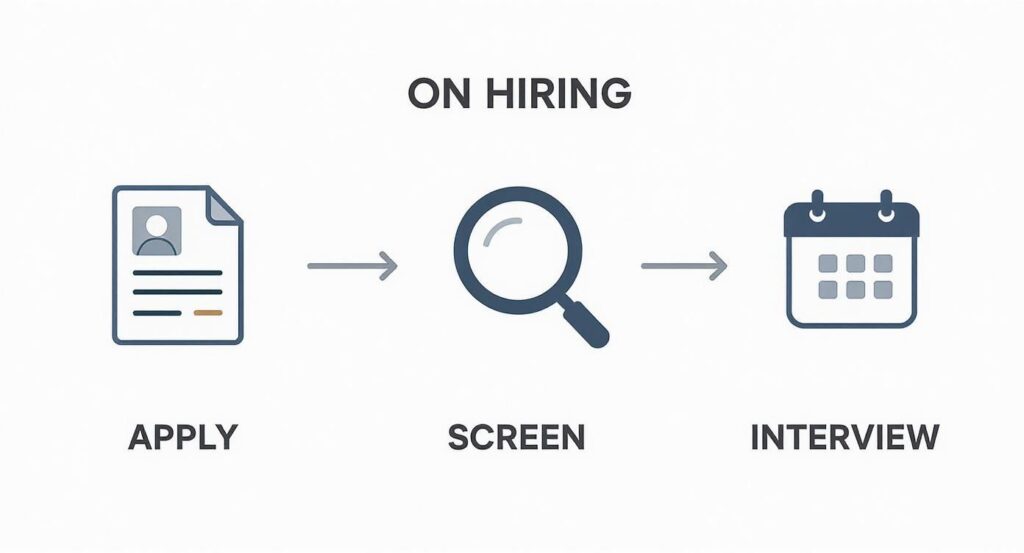
As you can see, the process is broken down into three automated stages—Apply, Screen, Interview—each designed to speed things up.
The moment a candidate applies, the chatbot gets to work screening their CV or gathering profile information. From there, it can schedule a follow-up call or an assessment based on the rules you’ve set. This automated handoff cuts down on manual work and keeps candidates in the loop with regular updates.
For a deeper dive into optimising your digital hiring processes, check out our guide on 7 Steps for Digital Hiring Using Recruitment Technology During COVID-19.
Automating Screening And Scheduling
This is where things get really smart. Machine learning allows chatbots to get more and more accurate over time. Every single interaction is a learning opportunity, helping the bot refine its ability to filter candidates based on what success looks like for a role.
The process is a continuous loop:
- The bot scores candidate responses against your ideal profiles.
- Your recruitment team validates the results and provides feedback.
- The chatbot then updates its own algorithms to improve its matching accuracy for the next time.
Scheduling is another huge win. Chatbots can integrate directly with your team’s calendars to show real-time availability. This means candidates can book a slot that works for them instantly, eliminating all that frustrating back-and-forth over email.
The results speak for themselves. Companies report that candidates experience 70% faster scheduling, and there’s a 40% drop in no-shows when chatbots handle the bookings.
As the bot gets smarter, it can even start suggesting next steps or offering helpful resources like company videos or FAQs. This kind of proactive support helps build trust with candidates and keeps the hiring momentum going strong.
Enhancing The Candidate Experience
Beyond the mechanics of screening and scheduling, chatbots can also make the conversation feel personal. By tapping into candidate data, they can adjust their tone, highlight relevant job benefits, and even share videos about your company culture.
Imagine the impact of these small touches:
- Greeting a candidate by name.
- Sharing job details specific to their preferred location.
- Providing instant salary information to set expectations from the start.
These personalised interactions create much deeper engagement. In fact, chatbots can slash the number of repetitive questions your team has to answer by up to 60% by providing tailored, instant responses.
And when a question gets too complex for the bot? A well-designed system has a structured handoff process to seamlessly escalate the conversation to a human recruiter. This hybrid approach ensures you maintain that high-touch, personal experience exactly when it’s needed most.
Monitoring And Analytics
Of course, none of this works if you just “set it and forget it.” Modern chatbot platforms provide a wealth of data, tracking key metrics like response times, candidate satisfaction scores, and drop-off rates.
Your recruitment team can use these insights to fine-tune conversation scripts and improve the entire process flow. A quick review every couple of weeks can help maintain peak performance and maximise your return. Always be evolving.
What Are the Real Benefits of a Recruitment Chatbot?
Thinking about a recruitment chatbot as just another piece of software in your HR toolkit is missing the point. It’s a strategic decision to completely reshape how you find and attract talent. The real value comes from three core improvements that tackle the biggest headaches HR leaders face every day.
These benefits don’t work in isolation. They combine to create a hiring process that’s faster, smarter, and genuinely more engaging for everyone involved. By taking over the high-volume, repetitive tasks that bog down a recruiter’s day, a chatbot frees up your team to focus on what humans do best: building relationships and making strategic decisions. This doesn’t just make them more productive; it elevates their role within the organisation.

Driving Operational Efficiency
One of the first things you’ll notice is a massive jump in operational efficiency. In a traditional hiring setup, recruiters can spend up to 40% of their time buried in administrative work like sifting through CVs and playing email tennis to schedule interviews. A chatbot automates all of that, allowing your team to handle a much larger volume of applicants without letting quality slip.
Imagine screening thousands of CVs in minutes, not days. The bot can instantly filter candidates based on your non-negotiable criteria—things like location, years of experience, or specific certifications. What lands on your recruiter’s desk is a pre-vetted shortlist of the most promising people. This alone can slash the average time-to-hire by as much as 50%, which is a huge advantage in a tight talent market.
Then there’s the scheduling headache. Instead of the endless back-and-forth, the chatbot simply integrates with hiring managers’ calendars and lets qualified candidates pick a time that works for them. Just like that, a major bottleneck is gone, and the entire process speeds up.
Realising Significant Cost Reduction
All this newfound efficiency leads directly to big cost savings. Every hour your recruiters get back from admin work is an hour they can spend sourcing top-tier candidates, building talent pipelines, and engaging with people who can make a real difference to the business. This strategic shift fundamentally lowers your cost-per-hire.
Think about the financial domino effect:
- Reduced Administrative Overheads: Less time spent on manual screening and scheduling means lower labour costs tied to each hire.
- Lower Advertising Spend: When you fill open roles faster, you don’t need to keep paying for expensive job board ads for weeks on end.
- Improved Recruiter Productivity: By handling the top of the hiring funnel, the bot allows a single recruiter to manage a much larger pipeline of applications with ease.
This isn’t just about trimming the budget. It’s about reinvesting it. The money you save on tedious manual work can be put towards more impactful HR initiatives, like strengthening your employer brand, funding learning and development programmes, or investing in advanced talent analytics.
By automating the top of the funnel, a recruitment chatbot allows your team to focus their expertise where it matters most—building relationships with top-tier candidates who will drive the business forward.
Enhancing the Candidate Experience
In the war for talent, the candidate experience is your secret weapon. A slow, impersonal, or unresponsive hiring process can seriously damage your employer brand and scare off the very people you’re trying to attract. A chatbot makes sure every single applicant gets a professional and engaging experience from the moment they connect with you.
It starts with being available 24/7. The best candidates are often passive job seekers, browsing opportunities after hours or on weekends. A chatbot is always on, ready to answer their questions, take their application, and guide them through the first steps, no matter the time of day. That instant response shows you respect their time.
The impact is clear and measurable. Career portals using chatbots see incredible engagement, including 95% more leads and a 40% increase in completed job applications. The conversations feel so natural that in India, 73% of candidates can’t tell if they’re talking to a chatbot or a human recruiter. This creates a consistently positive and efficient journey for every single applicant. You can dive deeper into these numbers by checking out these chatbot statistics and insights on MasterOfCode.com.
Ultimately, a better candidate experience strengthens your employer brand. It positions your organisation as modern, efficient, and candidate-focused—a long-term asset that pays off long after a single position is filled.
To put it all in perspective, let’s look at a side-by-side comparison of how a chatbot transforms key hiring metrics.
Recruitment Chatbot Impact on Key Hiring Metrics
The table below breaks down the practical differences between a traditional hiring process and one augmented by a chatbot, highlighting the direct impact on efficiency and candidate engagement.
| Hiring Metric | Traditional Process | With Recruitment Chatbot | Potential Improvement |
|---|---|---|---|
| Time-to-Hire | 30-45 days on average, with significant delays in screening and scheduling. | 15-20 days, with instant screening and automated scheduling. | Up to 50% reduction. |
| Cost-per-Hire | Higher due to extensive recruiter time spent on administrative tasks and longer ad spend. | Lower due to automation of repetitive tasks and faster role fulfillment. | 20-30% reduction. |
| Candidate Engagement | Low, with slow response times and inconsistent communication. | High, with 24/7 availability, instant responses, and consistent updates. | 95% more leads captured. |
| Application Completion Rate | Lower, as candidates often abandon long, cumbersome application forms. | Higher, as the chatbot guides candidates through a simple, conversational process. | 40% increase. |
| Recruiter Productivity | Limited by manual capacity for screening and communication. | Significantly increased, allowing recruiters to manage larger talent pools. | Recruiters focus 90% of their time on strategic tasks. |
As you can see, the improvements aren’t just marginal—they represent a fundamental shift in how talent acquisition operates. By automating the transactional elements of recruiting, chatbots empower HR teams to become more strategic, efficient, and ultimately, more successful in securing the talent their organisation needs to thrive.
Practical Recruitment Chatbot Use Cases

It’s easy to think of a recruitment chatbot as a single-function tool, but that’s selling it short. Think of it more as a versatile assistant that pitches in at every single stage of your hiring funnel. When you really get to grips with its practical applications, you start to see exactly where this technology can make a real difference, completely reshaping the candidate’s journey from their first click to their final feedback.
These real-world examples show how a chatbot slots right into your existing workflows. It’s not about disruption; it’s about enhancement—a powerful one that works for you around the clock.
Engaging Candidates at the Top of the Funnel
That first interaction a potential candidate has with your company? It’s everything. A recruitment chatbot makes sure that initial touchpoint is instant, helpful, and genuinely engaging. You end up capturing interest that you might otherwise have lost for good.
Picture this: a highly skilled professional is browsing your careers page at 10 PM on a Tuesday. Without a chatbot, they might fire off an application and wait days for a reply, or more likely, just click away. With a chatbot, their experience is worlds apart.
- Instant FAQ Resolution: The bot can immediately answer their questions about company culture, benefits, or your remote work policies. This gives them the clarity they need to take the next step.
- Proactive Candidate Sourcing: You can even deploy bots on platforms like LinkedIn to start conversations with passive candidates about relevant open roles.
- Event Registrations: Got a virtual career fair coming up? A chatbot can handle all the registrations, send out reminders, and answer event-specific questions, giving your attendance numbers a nice boost.
This immediate, 24/7 availability means you never miss a chance to connect with top talent, no matter when they decide to start their search. Your careers page goes from being a static brochure to a dynamic, conversational front door to your organisation.
A well-implemented chatbot at the top of the funnel acts as a digital brand ambassador, making a strong first impression and guiding promising candidates deeper into your talent pipeline.
Automating the Mid-Funnel Screening Process
Once you’ve got a candidate’s interest, the mid-funnel is where a recruitment chatbot really starts to flex its muscles in terms of efficiency. This stage is traditionally a massive time-sink, bogged down by manual screening and scheduling. A chatbot turns it into a smooth, automated workflow.
The bot essentially becomes your first-line interviewer, taking care of the high-volume tasks that eat up a recruiter’s day. This frees up your team to focus their expertise where it truly matters: evaluating qualified, pre-vetted candidates.
Here’s how it plays out:
- Automated CV Screening: The bot can parse resumes and applications in seconds, instantly checking for deal-breakers like missing certifications, not enough years of experience, or specific technical skills.
- Pre-Screening Interviews: It can run through a quick “knockout” interview, asking foundational questions to make sure candidates meet the basic job requirements before ever speaking to a human.
- Seamless Interview Scheduling: By plugging directly into hiring managers’ calendars, the bot lets qualified candidates book an interview slot in real-time. No more endless email tennis trying to find a time that works.
Think back to that candidate who applied at 10 PM. By the time your team logs on in the morning, the chatbot has already screened their qualifications, run a quick pre-screening chat, and scheduled them for an interview with the hiring manager for later that week. All of that, done overnight, without anyone lifting a finger.
Supporting the Bottom of the Funnel
Even after the main interviews are done and dusted, the chatbot’s job isn’t over. It continues to add value by keeping candidates in the loop and tidying up the final steps of the hiring and onboarding process. This ensures a positive experience right through to their first day.
At this stage, the bot’s role shifts from assessment to support. It’s all about keeping up the momentum and reinforcing the candidate’s decision to join your company.
- Gathering Post-Interview Feedback: The bot can automatically follow up to ask candidates about their interview experience. This gives you priceless data for improving your process.
- Handling Onboarding FAQs: For the candidates you hire, the chatbot can become an onboarding buddy, answering all those common questions about paperwork, first-day logistics, and company policies.
- Sending Status Updates: It proactively sends updates to candidates still in the running, which cuts down on their anxiety and shows that you value their time, even if there are delays.
By automating these final touchpoints, the recruitment chatbot guarantees a consistent and professional experience for every single applicant. It strengthens your employer brand and sets the stage for a great employee journey from day one. It closes the loop, making sure no candidate ever feels like they’ve been left in the dark.
Implementing Your Recruitment Chatbot
Bringing a new piece of technology like a recruitment chatbot into your hiring process isn’t just a technical task; it’s a strategic move that needs careful thought and planning. To get it right, you need a clear, step-by-step approach that lines up what the chatbot can do with what your company actually wants to achieve in talent acquisition.
Think of it like building a house. You wouldn’t just start laying bricks without a detailed blueprint, would you? In the same way, launching a chatbot without a solid plan can lead to a messy candidate experience and a lot of wasted time and money. The trick is to move methodically from the big picture strategy to the practical, on-the-ground execution.
Step 1: Define Your Primary Goals
Before you even start looking at different chatbot vendors, you need to answer one crucial question: “What problem are we actually trying to solve?” The answer to this will shape every single decision you make from here on out. A recruitment chatbot can do a lot of things, but trying to make it do everything at once is a surefire way to fail.
Zero in on one main objective to give your project a clear sense of direction. Some common goals include:
- Reducing Time-to-Hire: Is your biggest headache a slow, drawn-out screening and scheduling process? If so, your chatbot should be set up to automate these stages as aggressively as possible.
- Improving Candidate Engagement: If you’re losing great talent because of a clunky, unresponsive process, your focus should be on creating a helpful, brand-aligned conversation that keeps candidates interested.
- Lowering Cost-per-Hire: Are administrative tasks eating up your budget? The goal here is to automate as many of the high-volume, low-impact tasks as you can.
- Increasing Application Volume: If you notice a lot of people visit your careers page but don’t apply, a chatbot can make the application process much simpler, turning more visitors into actual applicants.
Having a single, primary goal acts as your north star for the entire project, guiding everything from how you write the chatbot’s scripts to how you measure its success.
Step 2: Choose the Right Platform
Once you know what you’re aiming for, you can start looking at different chatbot platforms. It’s important to remember that not all solutions are created equal. You need something that not only solves your immediate problem but can also grow with your organisation down the line.
A huge factor here is integration. Your chatbot absolutely must connect smoothly with your existing Applicant Tracking System (ATS) and other HR software. This ensures data flows seamlessly between systems, preventing your team from having to juggle a bunch of disconnected tools. Always check if a vendor offers pre-built integrations for the specific tech you already use. To get a better sense of how a cohesive system works, learn more about how a unified recruitment platform eases digital hiring.
A powerful recruitment chatbot is more than just a conversational tool; it’s a central hub that should integrate flawlessly with your entire HR ecosystem to automate workflows and provide a single source of truth for candidate data.
Step 3: Map and Script the Candidate Journey
This is the creative part where you design the actual conversations your chatbot will have. Start by mapping out the ideal candidate journey from start to finish. Pinpoint every touchpoint where the bot will interact with an applicant, from the first “hello” on your careers page to scheduling the final interview. Each step should feel logical and genuinely helpful.
When writing the scripts, focus on good conversational design. The language should match your employer brand—whether that’s professional and serious, or friendly and energetic. Ditch the corporate jargon and write in a way that sounds natural and human.
Don’t forget to plan for when things get tricky. What happens when a candidate asks a question the bot doesn’t know the answer to? A well-designed chatbot has a clear plan for this, smoothly handing the conversation over to a human recruiter without making the candidate feel frustrated.
Step 4: Test and Refine Thoroughly
Never, ever launch a chatbot without putting it through its paces first. This testing phase should involve real users—ideally, a mix of your own recruiters and even a small group of external candidates. The whole point is to find any confusing conversational paths, technical bugs, or gaps in the bot’s knowledge before it goes live.
During testing, pay close attention to:
- Accuracy of Information: Is the bot giving out correct details about job roles, benefits, and company policies?
- Conversational Flow: Does the conversation feel natural, or does it feel clunky and hit dead ends?
- Integration Performance: Is data moving correctly between the chatbot and your ATS?
Gather feedback from everyone who tested it and use those insights to tweak the scripts and logic before the big launch. This back-and-forth process is crucial for making sure you deliver a smooth experience for candidates from day one.
Step 5: Launch and Continuously Optimise
Your job isn’t over once the chatbot is live. In fact, the launch is just the beginning. The most successful chatbot implementations are the ones that are constantly being improved based on real-world data and analytics.
Keep an eye on key metrics like candidate satisfaction scores, application completion rates, and how many questions the bot successfully answers on its own. Use this data to spot areas for improvement. Are candidates often getting stuck at a certain point in the conversation? It might be time to rewrite that part of the script. This data-driven approach ensures your recruitment chatbot continues to evolve and deliver value long after its initial launch.
Measuring Recruitment Chatbot ROI
Justifying any new tech investment means you have to show its return, and a recruitment chatbot is no exception. For HR leaders, proving its value is about more than just saying things feel more efficient. You need to build a solid business case with real numbers that show cost savings, faster processes, and better hires.
This is how you translate a chatbot’s performance into a language the entire C-suite understands. It’s all about connecting those automated chats directly to bottom-line results and a stronger position in the talent market.
Calculating Cost and Efficiency Gains
The most straightforward way to measure ROI is by looking at the hard costs you’re cutting. Start by figuring out your current cost-per-hire and how many hours your team spends on repetitive, manual tasks every week. A recruitment chatbot hits these numbers directly.
- Cost-Per-Hire Reduction: Automation cuts down the time recruiters spend on manual screening and scheduling, which lowers the labour costs for every single new hire. Getting people in the door faster also means you’re not paying for job board ads for weeks on end.
- Time-to-Fill Improvements: By handling the top of the funnel automatically, chatbots can seriously shorten the hiring cycle. A faster time-to-fill means those critical roles become productive much sooner, preventing disruptions to the business.
- Increased Screening Throughput: Your team can suddenly manage a much larger volume of applicants without needing to hire more recruiters. This makes your whole talent acquisition function more scalable and cost-effective.
These are the kinds of tangible metrics that build a strong foundation for your business case. They don’t just show money saved; they prove you’re building a more productive and agile recruitment engine. For companies looking to really optimise their talent acquisition costs, understanding how to leverage recruitment process outsourcing for high-impact hiring can add another layer of valuable insight.
A simple formula to get started is: ROI (%) = [(Financial Gain – Investment Cost) / Investment Cost] x 100. Your “Financial Gain” should include things like saved recruiter hours and lower advertising spend.
Assessing Quality and Brand Impact
Beyond the balance sheet, a recruitment chatbot adds huge value by improving the quality of your hires and strengthening your employer brand. These benefits might feel a bit softer, but they’re critical for long-term success and absolutely can be measured.
Look at metrics like candidate satisfaction scores (CSAT), which you can gather from simple surveys after a candidate interacts with the bot. Higher scores mean a positive experience, and that directly leads to a stronger employer brand and a better offer acceptance rate. Don’t stop there—track the quality of hire by looking at the performance reviews of employees sourced through the chatbot after they’ve been on the job for six to twelve months.
This forward-looking approach is quickly becoming non-negotiable. The India chatbot market is expected to grow at a compound annual rate of 20.43%, a surge driven by the demand for automation that cuts operational costs and makes for a better user experience. You can dig into a detailed analysis of the Indian chatbot market growth at imarcgroup.com. Investing in a recruitment chatbot today isn’t just about efficiency; it’s about positioning your company as a modern, tech-forward employer that top talent wants to work for.
Frequently Asked Questions
Even with all the benefits laid out, bringing any new tech into your process is bound to raise a few questions. Let’s tackle some of the common queries HR leaders have when they’re thinking about bringing a recruitment chatbot on board.
Will It Replace Human Recruiters?
Not a chance. A recruitment chatbot is there to support your team, not replace it. Think of it as a super-efficient assistant that handles the high-volume, repetitive stuff—like initial screening, answering FAQs, and getting interviews on the calendar.
By automating those tasks, your human recruiters are freed up to focus on what they do best. They can spend more time building real relationships with top candidates, conducting meaningful interviews, and making those crucial, strategic hiring decisions that require a human touch.
How Does It Integrate With Our ATS?
This is a big one, and the good news is, modern chatbot platforms are built for this. Most offer pre-built connections for popular Applicant Tracking Systems (ATS) and HRMS platforms like Workday or Taleo using APIs.
This ensures all your candidate data flows smoothly and automatically between systems, without any manual entry. When you’re looking at vendors, always ask to see case studies related to your specific ATS. That’s the best way to confirm you’re in for a straightforward setup.
A well-designed recruitment chatbot doesn’t create data silos; it connects your existing HR technology stack, making your entire process more efficient and data-driven without adding manual work for your team.
Can We Customise The Chatbot’s Personality?
Absolutely. In fact, this is one of its most important features. You can—and should—tailor the chatbot’s tone of voice and language to be a perfect match for your employer brand.
You can script its conversations to reflect your company’s unique culture. Whether you’re formal and professional or more friendly and energetic, the chatbot can embody that personality. This ensures every single candidate gets a consistent and authentic experience that reinforces your brand from the very first hello.
What If A Candidate Asks A Complex Question?
A smart chatbot always has a backup plan. If it comes across a question it can’t answer, it doesn’t just hit a wall.
Instead, it’s programmed to trigger a seamless handoff to a live recruiter. This could be an email notification, a support ticket, or even giving the candidate the option to schedule a call directly. This hybrid approach guarantees no candidate is ever left hanging.
Ready to see how a recruitment chatbot can transform your hiring process? Taggd offers expert recruitment process outsourcing solutions to streamline your talent acquisition.