
Recruitment ROI (Return on Investment) measures the value a new hire generates compared to the total cost of hiring them. It helps organizations evaluate whether their recruitment strategy delivers measurable business returns in terms of productivity, performance, and retention.
Mastering Recruitment ROI for Your Business
Let’s talk about Recruitment ROI. In simple terms, Recruitment ROI, or Return on Investment, is a way to measure the value a new hire brings to your company against what it cost to find and hire them. It’s a powerful metric that helps you see your hiring budget not as a necessary expense, but as a strategic business investment that should deliver real, measurable returns.
What Is Recruitment ROI and Why It Matters
Imagine your hiring budget is like an investment in new factory machinery. You wouldn’t buy a critical piece of equipment without expecting it to boost production, improve efficiency, or drive more revenue, right? It’s the same with people. Every rupee you spend on recruitment is an investment in human capital, and you should absolutely expect it to deliver a significant positive return for the business.
When you start tracking recruitment ROI, your whole outlook on hiring changes. It stops being about just filling an empty seat. Instead, it becomes a strategic mission to find people who will actively contribute to the company’s bottom line, bring fresh ideas to their roles, and drive long-term growth.
This mindset forces you to take a much closer look at your entire hiring process.
Beyond Filling Vacancies
A healthy, positive recruitment ROI is a clear sign that your hiring engine is running smoothly. It tells you that you’re not just hiring bodies; you’re hiring the right people—individuals who click with your company culture, get up to speed quickly, and stick around for the long haul. This has a ripple effect across the entire business.
High-quality hires, which are the direct result of an ROI-focused strategy, pay off in several important ways:
- Increased Productivity: Top performers don’t just meet expectations; they often exceed them, giving a direct boost to team and company output.
- Lower Turnover Costs: A great hire who fits the role and culture is far more likely to stay. This drastically cuts down the huge costs of constantly having to replace people. Some studies estimate that replacing an employee can cost anywhere from one-half to two times their annual salary.
- Enhanced Company Culture: Bringing in people who genuinely align with your core values makes your work environment stronger, lifting morale and team engagement.
Ultimately, recruitment ROI is the definitive answer to the question, “Is our hiring strategy actually working?” It cuts through the fluff and provides a clear, financial justification for all your talent acquisition efforts.
Understanding and actively working to improve this one metric is fundamental for any company that wants to grow sustainably. It gives you the data-backed insights needed to tweak your processes, spend your budget smarter, and build a workforce that becomes a genuine competitive advantage.
This foundation is crucial as we dive deeper into exactly how to calculate, track, and boost your own recruitment ROI in the sections to come.
How to Calculate Recruitment ROI (Formula & Example)
Figuring out your recruitment ROI might sound complex, but it boils down to a pretty simple business idea: what did you gain versus what did you spend? For hiring, this means stacking up the value a new employee brings against the total cost it took to find and hire them.
When you start putting real numbers to your hiring efforts, you can finally see what’s working, what isn’t, and where your budget is making the biggest splash. It’s how you shift recruitment from being seen as just a cost centre to a strategic function that drives real value.
The visual below maps out this straightforward, three-step journey from a hiring investment to genuine business growth.
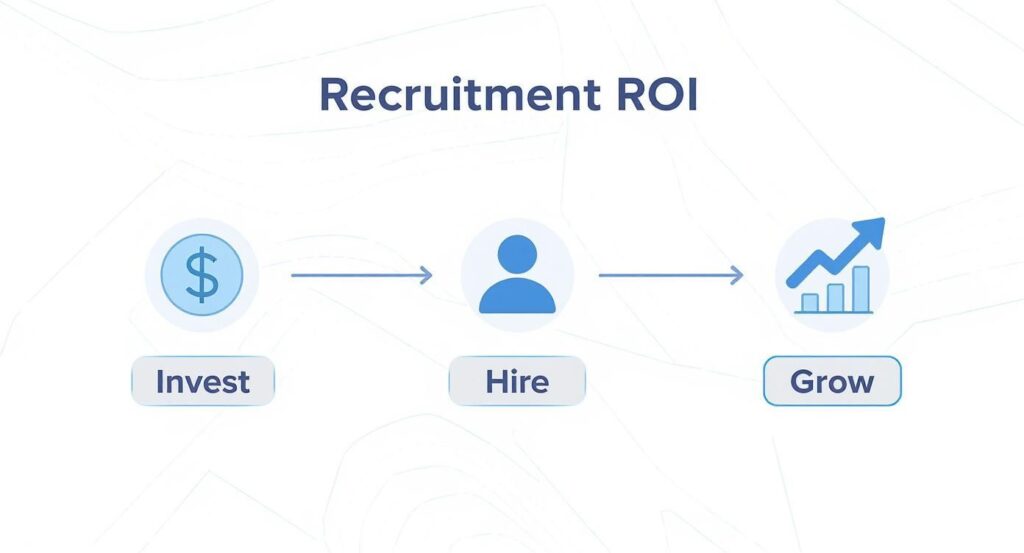
This flow really clarifies how a smart investment in talent brings in a successful hire, who then helps fuel the company’s growth, bringing the ROI cycle full circle.
Tallying Your Total Recruitment Investment
First things first, you need to get a handle on every single cost tied to a hire. This is about more than just the obvious bills. A proper calculation means digging into both the direct and the not-so-obvious indirect costs.
Direct Costs (The Obvious Spenders):
- Advertising: Fees for posting on job boards, running social media campaigns, and any other promotions.
- Agency Fees: The bills from external recruitment agencies or headhunters you’ve partnered with.
- Technology: Subscriptions for your Applicant Tracking System (ATS), video interview software, or assessment tools.
- Travel and Expenses: Any costs for flying candidates in for interviews or for your recruiters to attend career fairs.
Indirect Costs (The Hidden Spenders):
- Internal Time: The salaries of your HR team and hiring managers for every hour spent sourcing, screening, interviewing, and making a decision. This is often the biggest hidden cost and the one most people forget.
- Onboarding and Training: All the resources and time poured into getting a new hire productive and comfortable in their role.
- Administrative Overheads: The cost of background checks, paperwork, and other administrative tasks that come with a new hire.
Quantifying the Value of a New Hire
Now for the trickier part: measuring the “return.” The value a new employee brings isn’t always a clean number, but you can get a good estimate. The idea is to assign a monetary value to their performance and their overall impact.
A common way to do this is to take the new hire’s first-year salary as a starting point and then adjust it based on their performance rating. For instance, a top performer might be valued at 150% of their salary, while an average performer sits at 100%.
The Recruitment ROI Formula: (Value of New Hire − Total Recruitment Costs) / Total Recruitment Costs × 100 = Recruitment ROI (%)
Let’s walk through a real-world example. Say you hire a new software developer. Your total recruitment costs, all in, come to ₹2,50,000. The developer’s annual salary is ₹15,00,000. After their first-year review, they’re rated as a high performer, which your company values at 120% of their salary (₹18,00,000).
Plugging this into the formula: (₹18,00,000 – ₹2,50,000) / ₹2,50,000 × 100 = 620% ROI.
That’s a powerful number. It tells you your investment delivered a return over six times its original cost. In the expanding Indian job market, this kind of value-driven hiring is becoming essential. With 56% of companies looking to grow their teams, the focus has to be on making sure every new hire delivers a solid return. You can read more about India’s growing job market on The Economic Times.
Key Recruitment Metrics That Influence ROI
Your final recruitment ROI percentage is the headline number, but several key performance indicators (KPIs) are the real story behind it. Think of it like a doctor checking your vital signs; these underlying metrics help you diagnose the health of your hiring process and show you exactly where things can be improved. They are the individual threads that, when woven together, determine the strength and success of your entire talent acquisition strategy.
Each metric gives you a different angle on your hiring effectiveness, covering everything from speed and cost to the long-term value each new employee brings to your organisation.

Let’s break down the most critical metrics that directly shape your hiring returns.
Time to Fill
Time to Fill is simply the number of calendar days from when a job is officially opened to when a candidate accepts the offer. This isn’t just about speed for speed’s sake; it’s a direct indicator of your operational efficiency and can have a real impact on your bottom line.
A long Time to Fill can leave critical teams short-staffed, delay important projects, and burn out existing employees who are picking up the slack. For instance, a vacant sales position doesn’t just represent a hiring cost—it means lost sales opportunities every single day the role sits empty. Getting this number down means your teams get the talent they need faster, keeping productivity and momentum high.
Cost per Hire
This metric is the foundational “investment” part of your ROI calculation. Cost per Hire (CPH) adds up all your internal and external expenses related to filling a role and then divides that total by the number of hires you made in that period.
These costs usually include things like:
- External Costs: Job board fees, recruitment agency commissions, advertising spend, and assessment tools.
- Internal Costs: The time your recruiters and hiring managers spend on interviews, screening, and onboarding, translated into salary costs.
A high CPH can quickly eat into your recruitment ROI, even if you end up hiring a fantastic candidate. By tracking this metric, you can see which sourcing channels give you the best bang for your buck and where your budget is being spent most effectively. Improving hiring metrics is a key focus for many organisations; for example, you can see how OYO Rooms experienced a big lift in hiring metrics by optimising their processes.
Quality of Hire
This might just be the most important metric of all. Quality of Hire (QoH) measures the actual value a new employee brings to the company. While it’s a bit trickier to put a number on, it directly determines the “return” on your investment. After all, a low-cost, fast hire who underperforms or doesn’t fit the culture will deliver a very poor ROI.
Quality of Hire is the ultimate proof of a successful recruitment strategy. It shows you’re not just filling seats, but adding individuals who actively contribute to business growth, innovation, and a positive culture.
So how do you measure it? You can combine a few key data points after someone has been hired, such as:
- Performance Reviews: Looking at their scores from first-year appraisals.
- Ramp-Up Time: How quickly they get up to speed and reach full productivity.
- Hiring Manager Satisfaction: Gathering direct feedback from their manager on their performance and fit.
New Hire Retention
Finally, New Hire Retention tracks the percentage of new employees who stick around after a specific period, usually the first year. High turnover among new hires is a massive drain on your ROI. It basically means your entire initial investment just walked out the door, and you have to start the expensive hiring process all over again.
Strong retention rates are a clear sign that you are hiring the right people for both the role and your company culture. This ensures your investment continues to pay dividends long into the future.
How to Improve Recruitment ROI
Knowing your recruitment ROI is one thing, but the real magic happens when you start actively improving it. Boosting your return isn’t about throwing more money at the problem; it’s about making smarter, more efficient hiring decisions that deliver long-term value. By fine-tuning a few key areas, you can dramatically increase the impact of every rupee spent on bringing new talent through the door.
Think of these strategies not as a massive, complex overhaul, but as targeted adjustments that pack a punch. From crafting a magnetic brand to smoothing out the candidate experience, each tactic gets to the heart of what drives hiring ROI. The goal is simple: attract and keep top-tier talent without letting your budget spiral.
Build a Powerful Employer Brand
Your employer brand is essentially your company’s reputation as a place to work. It’s what candidates think and feel about you. When that brand is strong and positive, it acts like a magnet, pulling in high-quality candidates all on its own. This naturally cuts down your reliance on expensive job ads and recruitment agencies, which directly slashes your Cost per Hire.
It’s a simple truth: when people want to work for you, they’ll find you. This kind of inbound interest often brings in candidates who are a fantastic cultural fit and are genuinely excited from day one.
To start strengthening your brand:
- Showcase Your Culture: Use your website and social media to tell real stories. Share what your employees are up to, highlight team events, and give a genuine peek into what makes your workplace special.
- Encourage Reviews: A healthy, active presence on platforms like Glassdoor offers the kind of authentic social proof that candidates trust.
- Create Valuable Content: Position your company as a thought leader. Share insights from your industry experts through blogs, articles, or webinars to show you’re at the top of your game.
Optimise the Candidate Journey
A clunky, slow, or confusing application process is probably the quickest way to lose a great candidate. Let’s be honest, top talent has plenty of options, and they won’t stick around if they feel their time is being wasted. Every single candidate who drops out of your process is a sunk cost and a missed opportunity, chipping away at your recruitment ROI.
A seamless candidate experience is not just about being polite; it’s a critical business function. It reflects your company’s efficiency, respect for people, and overall brand integrity, directly influencing your ability to secure the best talent.
Streamlining this journey is absolutely essential. Take the time to map out every single touchpoint, from the moment they click “apply” to the final offer. Look for the friction points. Sometimes, simple fixes like making your application forms mobile-friendly, sending clear updates about next steps, and giving prompt feedback can make a world of difference and drastically reduce drop-off rates. These small improvements ensure the money you spend attracting candidates isn’t just leaking away through a poor process.
Leverage Employee Referral Programmes
Don’t overlook the recruiting powerhouse you already have: your current employees. An employee referral programme is a fantastic way to tap into their professional networks, encouraging them to recommend talented people they know and trust. These candidates often come pre-vetted for cultural fit and, more often than not, stick around longer.
Hires who come through referrals typically have a much lower Cost per Hire because you get to bypass those expensive sourcing channels. What’s more, they tend to get up to speed faster and perform better, directly boosting the “return” side of your ROI equation. For more inspiration, you can explore other unique recruitment strategies to hire talent that will give you a competitive edge.
Using Technology to Supercharge Your Recruitment ROI

Let’s be honest: manual recruitment processes are not just slow, they’re expensive. In a tight hiring market, technology is probably the most powerful tool you have for boosting your recruitment ROI. Thinking of the right tools as an expense is a mistake—it’s a strategic move to make your entire hiring engine faster, smarter, and far more cost-effective.
At the heart of this shift are modern tools like an Applicant Tracking System (ATS). Think of an ATS as the command centre for your entire hiring operation. It takes care of the repetitive tasks, keeps candidate data organised, and dishes out the analytics you need to make better decisions. This frees up your recruitment team to focus on what really matters: connecting with top candidates instead of drowning in paperwork.
The Real Power of Automation and Data
The true value of recruitment tech isn’t just about being faster; it’s about directly improving the metrics that define your hiring ROI. When you automate the early stages of your hiring funnel, you can slash your hiring cycle time and bring costs down significantly.
Features like AI-powered screening can sift through thousands of applications in minutes to pinpoint the best-qualified people, while automated messaging keeps applicants in the loop. This kind of efficiency is a game-changer. In India, companies adopting tech-driven hiring solutions are seeing a direct link to a stronger recruitment ROI. In fact, businesses using an ATS often see their time-to-hire drop by 40% to 55%, which can translate into annual savings of around ₹12,00,000 to ₹18,00,000.
Investing in an ATS is one of the clearest paths to a higher recruitment ROI. It replaces guesswork with data, brings order to chaotic workflows, and gives your team the edge to secure top talent before your competitors even have a chance.
Streamlining the Entire Hiring Funnel
But the impact of technology goes well beyond just that initial screening. A solid recruitment platform enhances every single step of the candidate’s journey. This creates a smooth, positive experience that makes your employer brand shine.
Think about how a modern platform can help you:
- Centralise Communication: All your chats with candidates and feedback from hiring managers live in one organised, easy-to-find place. No more lost emails.
- Improve Collaboration: Teams can share notes and feedback on candidates instantly, which speeds up decision-making dramatically.
- Generate Insights: You can track key metrics like where your best hires are coming from (source of hire) and how long it takes to fill a role, helping you fine-tune your strategy over time.
By bringing these tools into your process, you build a hiring machine that’s not just more efficient, but also driven by solid data. You can learn more about how a modern recruitment platform eases digital hiring and strengthens your overall strategy.
Frequently Asked Questions
Diving into recruitment ROI can bring up a few questions. That’s perfectly normal. Getting these sorted out clears up any confusion and gives you a solid footing to start tracking this crucial metric with real confidence. Let’s tackle the most common hurdles, from when to calculate your ROI to what a “good” number actually looks like.
Getting these fundamentals right is what separates a meaningless number from a genuine insight. It’s how you turn your ROI calculation into a powerful guide for your entire hiring strategy.
How Often Should We Calculate Hiring ROI?
There’s no single, magic answer here—the right timing really depends on your hiring pace and business cycles. A company hiring hundreds of people a quarter will have a different rhythm to one hiring for a few key roles a year.
A good, practical approach for most businesses is to calculate it on a quarterly or semi-annual basis. This schedule gives you enough data to see real trends taking shape, but it won’t bury you in constant analysis. It also slots in nicely with other regular business reporting.
That said, you should absolutely calculate ROI for specific, high-stakes hiring drives. If you’re launching a new tech division or scaling your sales team, measuring the ROI for that specific initiative will tell you exactly how effective that campaign was.
What Is a Good Recruitment
What Is a Good Recruitment ROI Benchmark?
This is the big one, the question everyone asks. The honest answer? A “good” recruitment ROI is completely contextual. It shifts dramatically depending on your industry, the types of roles you’re hiring for, and how established your company is. A fast-growing tech startup will have very different figures compared to a stable manufacturing firm.
The most important benchmark is, without a doubt, your own past performance. The real goal is to see a consistent upward trend in your ROI over time. If you hit 250% last year and you’re at 350% this year, you’re winning. That’s the progress that matters.
Instead of chasing an elusive, one-size-fits-all industry number, focus on improving your own baseline. Any positive ROI means your hires are adding more value than they cost to bring on board, and that’s always a victory.
How Can Small Businesses Measure ROI with Limited Resources?
It’s a common myth that you need expensive, sophisticated tools to measure recruitment ROI. Many small businesses feel they can’t track it, but you can get started with simple, powerful methods that don’t cost a fortune.
The key is to focus on straightforward metrics that are easy to keep an eye on. You don’t need complex software to get a clear picture of how effective your hiring is.
Here are a few practical steps to get you started:
– Use Simple Spreadsheets: A basic spreadsheet is all you need to track your direct hiring costs (like job ads or freelance recruiter fees) and the new hire’s salary. It’s simple, but it works.
– Focus on Key Performance Indicators (KPIs): Tie the measurement to the role. For a new salesperson, track the revenue they generate in their first six months. For a developer, you could track the number of major features they successfully ship.
– Lean on Manager Feedback: Never underestimate the value of structured feedback from hiring managers. A simple scoring system can help you quantify a new hire’s performance and contribution, giving you a solid “quality of hire” metric.
By keeping the approach simple, even the smallest teams can gain powerful insights into their recruitment ROI. It’s about making every single hiring decision a more strategic one
Ready to transform your hiring from a cost centre into a strategic growth driver? Taggd specialises in Recruitment Process Outsourcing that delivers measurable ROI. We help you find top-tier talent efficiently, so you can focus on building your business.