
Your Guide to a Recruitment ROI Calculator
A recruitment ROI calculator is a fantastic tool for putting a number on your hiring efforts. It shows you exactly how much value your new hires bring to the table compared to what you spent to find and recruit them. This simple calculation completely flips the script on recruitment, turning it from a necessary expense into a value-driving function by speaking the language of the business: financial metrics.
Moving Recruitment From a Cost Centre to a Value Driver
For far too long, recruitment has been stuck with the reputation of being a cost centre. It’s the department that spends money on job boards, pays agency fees, and runs ad campaigns. But that view is incredibly shortsighted and misses the bigger picture entirely. When you start tracking recruitment ROI, you fundamentally change that narrative.
Suddenly, your hiring function isn’t just about filling seats; it’s a strategic powerhouse. The focus shifts from simply completing a task to making calculated investments in talent that will directly fuel business growth and innovation.

Why ROI Matters More Than Ever
In today’s competitive talent market, understanding your recruitment ROI isn’t just a nice-to-have—it’s a critical business necessity. Having a solid grasp of this metric empowers you to make data-backed decisions that really resonate with the C-suite. You can confidently justify budgets, showcase your team’s value, and draw a direct line between quality hires and bottom-line results.
This data-driven approach allows you to answer the tough questions:
- Which of our sourcing channels actually deliver the highest-quality candidates for the lowest cost?
- Is our interview process efficient, or is it costing us valuable time and money?
- How does the performance of new hires stack up against the investment we made to bring them on board?
By measuring ROI, you’re not just counting heads or tracking expenses. You are quantifying the strategic impact of your talent acquisition strategy, proving that every rupee spent on hiring is an investment in the company’s future success.
Understanding the Core Components
At its heart, the recruitment ROI calculation is pretty straightforward. It’s all about balancing two key elements: costs and value.
Recruitment Costs cover all the expenses you rack up during the hiring process. This includes the obvious direct costs like advertising fees and recruiter salaries, but also the indirect costs, like the time your hiring managers spend in interviews instead of on their primary duties.
Value of Hires represents the contribution new employees make once they’re part of the team. This can be measured through performance metrics, revenue generated, productivity gains, or even the strategic value they bring. When you can show that this value far outweighs the costs, you’ve built a powerful case for your recruitment strategy. Just look at the success of companies like OYO Rooms; optimising hiring metrics can lead to major business lifts, a story you can dive into in our case study on how OYO Rooms experienced a big lift in hiring metrics.
A Practical Look at ROI in India
Across India, the push to quantify the business value of hiring is growing fast. A practical way to do this is to look at both recruitment expenses and the economic value of new hires based on their compensation.
For example, say a recruiter invests INR 75,000 to hire two software engineers, each with an average annual salary of INR 1,000,000. The total return in salary value is INR 2,000,000. Dividing this return by the cost gives you a recruitment ROI of roughly 26.7. That means every rupee invested yields about INR 26.7 in salary value—a powerful indicator of your recruiting efficiency and profitability.
Gathering the Data for an Accurate ROI Calculation
A recruitment ROI calculator is only as good as the data you feed it. To get a trustworthy result that genuinely reflects your hiring performance, you need to pull together accurate, comprehensive inputs. Think of it like a chef preparing ingredients before cooking—getting this stage right is the secret to a perfect final result.
The entire process boils down to tracking two key categories of information: everything you spend (Recruitment Costs) and everything you gain (New Hire Value).
Uncovering the Full Spectrum of Recruitment Costs
When you start adding up costs, it’s all too easy to just grab the obvious expenses from invoices. But a real ROI calculation goes much deeper. You have to account for both direct and indirect costs to paint a complete financial picture of your hiring engine.
Direct costs are the tangible, out-of-pocket expenses. These are usually the easiest to track down.
- Job Board Postings: Fees paid to platforms like LinkedIn, Naukri, or Indeed.
- Recruitment Agency Fees: The commissions you pay external agencies for successful placements.
- Advertising Campaigns: Your budget for social media ads, search engine marketing, or other promotional pushes.
- Technology Subscriptions: Costs for your Applicant Tracking System (ATS), skills assessment tools, or other HR tech.
Indirect costs, on the other hand, are the hidden expenses that often get overlooked but can seriously inflate your total investment. The biggest culprit here is almost always time.
The hours your team spends on recruitment are not free. Every hour a hiring manager or an engineer spends interviewing is an hour they aren’t spending on their primary, revenue-generating tasks. Accurately estimating this is critical for a real ROI figure.
To put a number on this, you can figure out a blended hourly rate for everyone involved in hiring and multiply it by the time they spend screening résumés, conducting interviews, and holding debrief sessions. Don’t forget to factor in administrative overhead and onboarding expenses too.
Defining and Measuring New Hire Value
This is often the trickier side of the equation. “Value” can feel subjective, can’t it? But you can absolutely quantify it by focusing on tangible metrics that show a new hire’s actual contribution to the business. The goal is to move beyond gut feelings and attach real numbers to performance.
Here are some practical ways to measure the value your new hires bring to the table:
- First-Year Performance Ratings: Correlate performance review scores with a new hire’s source or the process they went through. High-performing hires deliver more value, plain and simple.
- Productivity Benchmarks: For roles like sales, this is straightforward—just track the revenue they generate. For other roles, you can use metrics like project completion rates, production output, or customer satisfaction scores.
- Quality of Hire Score: This is a composite metric that pulls together several data points—like performance, retention, and hiring manager satisfaction—into a single score. It gives you a fantastic, holistic view of a new hire’s success.
- Time to Productivity: How long does it take for a new employee to get up to speed and become fully effective? A shorter ramp-up time means a much faster return on your investment.
Before we get to the calculator itself, it’s worth having a checklist of all the data points you’ll need. Gathering everything upfront makes the calculation process much smoother.
Essential Data Points for Your Recruitment ROI Calculator
| Metric Category | Specific Data Point | Example/Note |
|---|---|---|
| Direct Costs | Job Board Fees | Total spend on platforms like LinkedIn, Naukri, etc. |
| Direct Costs | Agency Fees | Commissions paid for successful placements. |
| Direct Costs | Advertising Spend | Budget for social media, PPC, and other ad campaigns. |
| Direct Costs | Tech Subscriptions | Costs for your ATS, assessment tools, and other HR software. |
| Direct Costs | Employee Referral Bonuses | Payouts for successful referrals from current employees. |
| Indirect Costs | Recruiter Salaries/Time | Portion of recruiter salaries allocated to this role/project. |
| Indirect Costs | Hiring Manager Time | Calculated hourly cost multiplied by hours spent interviewing. |
| Indirect Costs | Interviewer Time | Same calculation for all other team members involved. |
| Indirect Costs | Onboarding Costs | Trainer salaries, materials, and administrative setup costs. |
| New Hire Value | First-Year Revenue/Productivity | Revenue generated (sales) or equivalent productivity value. |
| New Hire Value | Performance Rating | Score from the first annual review (e.g., 1-5 scale). |
| New Hire Value | Quality of Hire Score | Composite score combining performance, retention, etc. |
| New Hire Value | Time to Full Productivity | Number of months it takes the new hire to become fully effective. |
With these data points in hand, you have a solid, defensible foundation for your calculations.
To effectively gather all this, especially in a fast-paced environment, many organisations rely on integrated systems. Understanding how our recruitment platform eases digital hiring can offer some great insights into making this data collection process smoother, which in turn makes your ROI calculations both easier and more accurate.
By meticulously tracking both the full spectrum of costs and the measurable value, you create a solid foundation for your recruitment ROI calculator. This detailed approach ensures the final number isn’t just a vanity metric but a powerful tool for making strategic decisions.
How to Calculate Your Recruitment ROI
Once you’ve gathered and organised all your data points, it’s time to put them to work. This is the moment we translate your recruitment efforts into a clear, powerful financial metric. While the core formula for a recruitment ROI calculator is surprisingly straightforward, it gives you a profound insight into your hiring effectiveness.
Here’s the fundamental equation you’ll be using:
(Value of Hires – Recruitment Costs) / Recruitment Costs * 100 = Recruitment ROI %
Let’s quickly break that down. You’re simply subtracting your total investment from the total value gained. Then, you divide that net gain by your original investment. Multiplying by 100 converts it into a percentage, which is the standard way to express any return on investment.
A Realistic Calculation Scenario
To see how this works in the real world, let’s move beyond the abstract formula. We’ll walk through a realistic example from a fictional Bengaluru-based tech company we’ll call “InnovateSoft.” Imagine they’ve just hired a team of five new software developers.
InnovateSoft has been meticulous, tracking all the associated costs and establishing a system for valuing its new hires.
Total Recruitment Costs Breakdown
First, let’s tally up every single expense tied to hiring this team of five developers over a three-month campaign.
- Job Board & Ad Spend: ₹2,25,000 on LinkedIn Premium slots and some targeted ads.
- Recruiter & HR Time: A portion of two recruiters’ salaries plus HR admin support, which they’ve calculated at ₹4,50,000.
- Hiring Manager & Interviewer Time: The estimated cost of time for engineering managers and senior developers involved in screening and interviews comes to ₹3,00,000.
- Technology Costs: A fraction of their annual ATS subscription allocated to this specific campaign is ₹75,000.
- Referral Bonuses: Two of the hires came from internal referrals, triggering bonus payouts of ₹1,00,000.
When you add all of that up, the Total Recruitment Costs for these five hires is ₹11,50,000.
Total Value of Hires Calculation
Next up, InnovateSoft needs to calculate the value these five developers are expected to bring in their first year. For this, they use a conservative model based on the average revenue generated per engineer on their teams.
- Average First-Year Value per Developer: ₹40,00,000
- Number of Hires: 5
Multiplying these figures gives them a Total Value of Hires of ₹2,00,00,000.
The goal isn’t to find a perfect, flawless number for ‘value,’ but to establish a consistent and defensible metric. Whether it’s based on revenue, productivity, or a quality-of-hire score, consistency is what allows you to track trends and measure improvement over time.
With both sides of the equation ready, we can now plug them into the recruitment ROI formula.
This infographic lays out the core components that feed into the final ROI calculation.
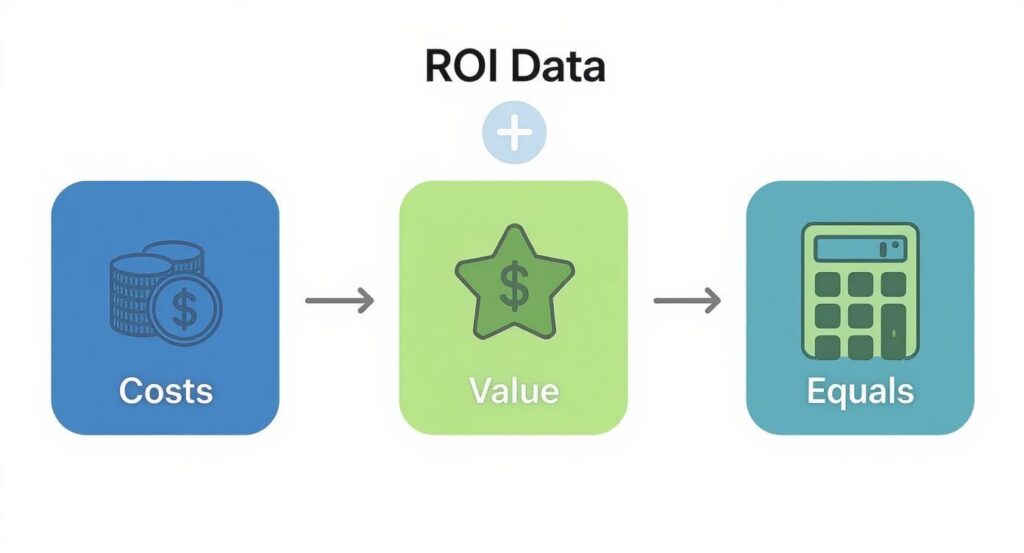
This flow from costs to value is the essential journey every recruitment investment takes to produce a real return.
Putting It All Together
Now for the final step—the calculation itself.
- Subtract Costs from Value: ₹2,00,00,000 (Value) – ₹11,50,000 (Costs) = ₹1,88,50,000 (Net Value)
- Divide Net Value by Costs: ₹1,88,50,000 / ₹11,50,000 = 16.39
- Convert to Percentage: 16.39 * 100 = 1639%
The final recruitment ROI for InnovateSoft’s hiring campaign is an impressive 1639%. What does this actually mean? For every single rupee they invested in the recruitment process, they generated ₹16.39 in value from their new hires within the first year.
This powerful number does more than just look good on a report. It proves the strategic value of the talent acquisition function, justifies the budget spent, and provides a clear benchmark for future hiring initiatives. This is how you transform the conversation from recruitment being a cost centre to a critical driver of business growth.
Interpreting Your ROI to Make Smarter Decisions
So, you’ve calculated your recruitment ROI. That’s a huge step, but the number itself is just the starting line. The real magic happens when you dig into what that percentage actually means for your business. A raw ROI figure without any context is like a single piece of a puzzle; you can’t see the full picture until you know how it fits with everything else.
Think of your ROI as a health check for your hiring engine. A high number is fantastic, but you need to know why it’s high to replicate that success. A low number is a warning light, but which specific part of the process is sputtering? This is where you move from just having a metric to having a powerful tool for strategic planning and getting better every quarter.
What Is a Good Recruitment ROI?
It’s one of the first questions every leader asks: “Is our ROI any good?” The honest answer? It depends. There’s no magic number, no universal benchmark for a “good” recruitment ROI, because context is king. What’s stellar for a tech company might be just average for a manufacturing firm.
Several factors will shape what a strong ROI looks like for you:
- Industry: A high-margin sector like pharmaceuticals or enterprise software can justify spending more to land top-tier talent because the potential return is enormous. On the flip side, a lower-margin industry like retail or hospitality will naturally operate on a different scale.
- Role Seniority: The ROI for hiring a new Chief Financial Officer will look completely different from the ROI of hiring a class of graduate trainees. The CFO’s value is strategic and plays out over the long term, while the trainees’ value is often measured in more immediate productivity gains.
- Company Size: A startup could see a massive ROI from a single game-changing hire. For a large multinational, the focus is more on the aggregated ROI across thousands of hires and achieving consistent, incremental gains.
The most powerful way to judge your ROI isn’t against some generic industry standard, but against your own track record. Your number one benchmark should always be your organisation’s past performance. This lets you track real progress, identify trends, and see the true impact of your hiring strategies.
Benchmarking for Actionable Insights
Once you stop chasing a mythical “perfect” ROI, you can start using your data for what really matters: improvement. Benchmarking is what turns your ROI from a score into a story.
Start by benchmarking internally. How does this quarter’s ROI compare to the last? What about year-over-year? Did your ROI take a hit after you rolled out that new applicant tracking system? Did it jump after you launched the new employee referral bonus? This historical context is your most valuable asset for making smart bets in the future.
Next, you need to segment your data. A single, company-wide ROI number hides the most interesting details. A powerful recruitment ROI calculator lets you drill down and analyse your performance by:
- Department: Is the ROI for your sales team miles ahead of your engineering team? This could signal anything from a more efficient hiring process to different ways of measuring a new hire’s contribution.
- Hiring Manager: You might find that some managers are just better at picking candidates who become top performers, leading to a much higher ROI. That’s not a problem; it’s a coaching opportunity waiting to happen.
- Sourcing Channel: Are the hires coming from employee referrals generating a better return than those from job boards? This kind of data tells you exactly where to put your recruitment budget for the best results.
The Nuances of Different Hire Types
It’s also crucial to remember that not all hires are created equal when it comes to ROI. In the Indian corporate landscape, for example, the hiring approach and the candidate’s experience level create vastly different ROI profiles.
Virtual hiring, for instance, dramatically cuts down on overheads like travel and accommodation costs. A junior hire will need more ramp-up time and training, which adds to the initial costs and pushes out their break-even point. In contrast, a senior hire might come with a hefty relocation package, sometimes anywhere from ₹15 lakh to ₹75 lakh, but they’ll hit the ground running and start adding value much faster. You can find out more about how these factors shape the financial return of employee onboarding.
By understanding these nuances, you can set realistic expectations and fine-tune your recruitment strategies. The goal isn’t to have the same ROI across the board, but to achieve a consistently positive and improving ROI that aligns with the specific goals you have for every single role and department.
Practical Strategies to Boost Your Recruitment ROI
Knowing your recruitment ROI is one thing; actively improving it is where the real work begins. The good news is that moving this number in the right direction doesn’t require a complete demolition and rebuild of your entire hiring process. Instead, you can get significant gains from a series of focused, high-impact strategies that either cut your costs or boost the value of your hires.
Let’s walk through some actionable strategies that have a direct effect on the ROI equation. These aren’t just theories—they are practical steps you can start implementing today to build a more efficient and effective hiring engine.

Leverage Technology to Drive Efficiency
In the modern hiring landscape, recruitment technology is your best friend for trimming the ‘cost’ side of the ROI calculation. By automating the repetitive, time-sucking tasks, you free up your recruiters to do what they do best: build relationships and make sharp, strategic hiring decisions.
Think of your Applicant Tracking System (ATS) as more than just a digital filing cabinet. Put its automation features to work screening résumés for keywords, scheduling interviews, and sending out template communications. This one change can shave countless administrative hours off the process, directly lowering your indirect costs per hire.
AI-powered sourcing tools are another game-changer. These platforms can scan millions of profiles across the web to find passive candidates who perfectly match your criteria, which drastically cuts down the time and effort your team spends on manual sourcing.
Optimise the Candidate Experience
Let’s be blunt: a poor candidate experience doesn’t just tarnish your brand—it actively costs you money. When your top candidates drop out of the pipeline because of slow communication or a clunky application process, you’re left with a less qualified talent pool. That means spending more time, effort, and resources just to find a suitable replacement.
To fix this, it’s time to map out the entire candidate journey from their point of view.
- Simplify Applications: Is your application form mobile-friendly? Can a candidate realistically complete it in under five minutes? Every unnecessary field you ask them to fill is another reason for a great candidate to give up.
- Communicate Proactively: Silence is the enemy. Even a simple automated email confirming you’ve received their application or giving a rough timeline is far better than nothing. Keeping candidates in the loop shows you respect their time and keeps them engaged.
- Gather Feedback: Use simple surveys to ask candidates about their experience, whether they got the job or not. This feedback is absolute gold for spotting the bottlenecks and friction points you might not even realise exist.
When you improve the candidate experience, you reduce drop-off rates. That means your initial sourcing efforts deliver a much higher return, boosting the efficiency of your entire recruitment funnel.
Strengthen Your Employer Brand
A powerful employer brand is a magnet for top talent, attracting high-quality candidates to you organically. When people genuinely want to work for your company, your reliance on expensive job board ads and recruitment agency fees plummets. This is hands-down one of the most effective long-term strategies for lowering recruitment costs.
Focus on telling authentic stories. Showcase your company culture with real employee testimonials, behind-the-scenes videos, and blog posts that celebrate your team’s successes. In today’s market, a well-maintained careers page and an active, professional social media presence aren’t just nice-to-haves—they are essential brand-building tools.
An investment in your employer brand today is a direct investment in reducing your recruitment spending tomorrow. It builds a steady pipeline of inbound applicants, meaning you spend less to attract more qualified people.
Implement Structured Interviews
Improving the ‘value’ side of the ROI equation is all about making better, more consistent hiring decisions. Structured interviews are an incredibly powerful tool for this, as they systematically replace “gut feelings” with a more data-driven approach.
Here’s how it works: in a structured interview, every candidate for a given role is asked the exact same set of predetermined questions, in the same order. Their answers are then evaluated against a pre-defined scoring rubric. Study after study has shown this method is a far better predictor of on-the-job performance than old-school, unstructured chats.
This approach not only ensures fairness and reduces unconscious bias, but its biggest impact on ROI comes from the dramatic improvement in quality of hire. Better hires are more productive, stay with the company longer, and deliver more value over their tenure—directly increasing your return.
For organisations looking to scale this kind of data-centric approach, understanding how Recruitment Process Outsourcing can drive high-impact hiring provides a valuable framework.
Common Questions About Recruitment ROI
As you start weaving this powerful metric into your talent acquisition strategy, you’re bound to have some questions. This isn’t just about theory; it’s about putting the recruitment ROI calculator to work in the real world, with all its messy details and moving parts. Let’s tackle some of the most common queries I hear from leaders, so you can start using this data with confidence.
These aren’t textbook answers. They’re direct, practical insights for organisations ready to build a more data-driven hiring culture.
How Often Should We Calculate Our Recruitment ROI?
Getting the timing right is crucial. You want ROI to be an active tool, not just a historical report card. A good rhythm to get into is calculating your ROI both quarterly and annually.
Quarterly check-ins are perfect for taking the pulse of specific hiring campaigns. They let you see the impact of that new sourcing channel or a recent process tweak, allowing you to make adjustments on the fly.
An annual calculation, on the other hand, gives you that all-important big-picture view. This is where you assess your overall hiring effectiveness year-over-year and set your strategic goals. For an even deeper dive, try calculating ROI on a per-role or per-department basis, especially for those critical or high-volume hiring sprints.
What Are the Biggest Mistakes to Avoid?
The formula itself is straightforward, but a few common slip-ups can completely undermine your results. Just being aware of them is half the battle.
Here are the most frequent mistakes I see:
– Forgetting indirect costs: This is the big one. Overlooking things like interviewer time or administrative overhead is the quickest way to get a misleading, artificially high ROI.
– Using inconsistent data: If one team measures ‘quality of hire’ differently from another, or you change your value metrics mid-year, you’re comparing apples to oranges. Your trends will be meaningless.
– Focusing only on cost-cutting: An obsession with lowering costs can lead you down a dangerous path of cheap but poor-quality hires. These ultimately destroy value and tank your long-term ROI.
If there’s one massive error to avoid, it’s treating the ROI calculation as a one-and-done report. Its real power is only unlocked when you use the insights to kick off a cycle of continuous improvement in your recruitment function.
Can a Recruitment ROI Calculator Work for Small Businesses?
Absolutely. In fact, it might be even more important for them. The core principle of measuring what you get back from what you put in is universal, no matter your company’s size. For a small business, the ripple effect of a single fantastic hire—or a single terrible one—is often felt far more intensely.
You don’t need a fancy, complex system to begin. A small business can start with a simplified calculation, focusing on metrics that are easy to track. You could begin by simply tracking direct ad spend against a new hire’s direct revenue contribution or their billable hours.
The key is to start tracking something. Even if it isn’t perfect right away, this initial data gives you a baseline. From there, you can refine your approach and make progressively smarter hiring decisions as your business grows and you get better at collecting data.
At Taggd, we specialise in building data-driven recruitment strategies that maximise your return on talent investment. Discover how our Recruitment Process Outsourcing solutions can help you measure and improve what matters most. Learn more at Taggd