A Practical Guide to Implementing Automation in Indian Organizations
Executive Summary
India has crossed a threshold. According to Deloitte’s State of AI in the Enterprise 2026 report, 40% of Indian enterprises have reached significant or full AI deployment, compared to roughly 28% globally. EY’s AIdea of India: Outlook 2026 confirms that 24% of Indian leaders are already deploying agentic AI, and 91% prioritise deployment speed. Yet for all this momentum, HR remains one of the last functions to move from AI curiosity to AI conviction.
That gap is closing fast. This whitepaper traces the journey of AI in HR from its rule-based origins to the agentic systems now reshaping Indian recruitment. It offers decision-makers a practical view of what has changed, what still slows hiring down, and what the next generation of intelligent recruitment will demand. It is written for CHROs facing pressure on cost-per-hire, CFOs asking where the ROI is, and CTOs who need to ensure that any AI introduced into talent systems is secure, compliant, and defensible.
How We Got Here — The Evolution of AI in HR
The Rule-Based Era (2010–2017)
A decade ago, “AI in HR” meant an Applicant Tracking System that filtered resumes against a list of keywords. If a job description asked for “Python” and a candidate’s resume said “Py3”, the system rejected them. Recruiters worked around the limitations by manually re-screening everything the machine had touched. Technology was meant to save time, but it often added a second layer of review.
The issue was simple: these systems had no understanding of context. A “project manager” in construction is not the same as one in IT, and a resume from a candidate in Coimbatore with ten years on a cement plant could not compete with a polished Gurgaon CV for the same role. India’s hiring market, with its unusual diversity of languages, educational institutions, and career paths, was particularly ill-served by keyword matching.
The Machine Learning Wave (2018–2022)
The next wave arrived when machine learning began to pattern-match at scale. Platforms could now rank candidates based on historical hiring data, predict attrition, and score resumes using statistical models. For the first time, HR had predictive analytics at its fingertips.
But this phase surfaced a new problem: bias. Amazon’s now-famous 2018 internal AI recruiting tool discriminated against graduates of all-women’s colleges because it had been trained on historical hiring data that favoured men. Research published by Brookings in 2025 showed that even when explicit identifiers are removed, AI models can infer gender and social identity from names, locations, and word choice, and continue to discriminate. A controlled experiment published in 2026 found AI recruitment systems showed rating variations of up to 8.2% based on protected attributes. For Indian enterprises, this is not theoretical. GCCs pushing for 40–45% women representation targets by 2026 cannot afford algorithmic bias working in the opposite direction. A model that quietly deprioritises certain colleges, regions, or name patterns will blow a hole through diversity goals that took years to build.
The Generative AI Moment (2022–2024)
Then came generative AI. ChatGPT, launched in late 2022, changed what enterprises expected from machines. Suddenly, AI could write job descriptions, draft outreach emails, summarise resumes, and answer candidate questions in natural language. According to SHRM’s 2025 data, AI adoption in HR doubled in a single year, from 26% to 43%. By 2024, 87% of recruiters reported using AI across the recruiting process, particularly for skill tests and assessments.
But generative AI, for all its fluency, remained reactive. It produced outputs when prompted. It did not act. A recruiter still had to ask it to screen a resume, draft an email, or summarise an interview. The tool was faster than the human, but it was still waiting for the human to press go.
The Agentic Shift (2025–2026)
Which brings us to now. Agentic AI, sometimes called AI agents, does not wait. According to Gartner, 40% of enterprise applications will embed task-specific AI agents by the end of 2026, up from less than 5% in 2025. The global AI agents market reached approximately USD 7.6–7.8 billion in 2025 and is projected to exceed USD 10.9 billion in 2026.
The difference is one of autonomy. Earlier AI tools were reactive: they screened a resume when asked. Agentic AI is proactive. It identifies a gap in the talent pipeline, finds candidates, sends personalised outreach, schedules a screening call, and flags results, all without a human trigger at each step. Companies implementing agentic AI workflows report 30–50% faster time-to-hire, with some high-volume teams seeing efficiency improvements of up to 70%. BCG’s Creating People Advantage 2026 report, drawing on 7,000+ HR and business leaders across 115 markets, found that 50% of companies expect agentic AI to have high or transformational impact on their organisations in the future. That is the market signal. The question is no longer whether agentic AI will reshape HR. It is whether Indian enterprises will build for it or be caught flat-footed.
What Agentic AI Actually Brings to the Table
Before we go further, it is worth pausing to define what agentic AI does that previous generations of technology did not. The language around “AI” has become loose enough that CFOs are right to be sceptical. The best way to make it concrete is to walk through the recruitment funnel itself, from sourcing to interviewing, and show where agentic AI changes the work.
Across the Recruitment Funnel: What Agentic AI Actually Does
Sourcing: Traditional sourcing means a recruiter types Boolean strings into a database, scrolls through results, and manually shortlists. Agentic AI treats sourcing as a continuous background activity. It understands the role context (not just keywords), searches across multiple databases and professional networks simultaneously, and
builds candidate pools that reflect real fit rather than surface matches. AI sourcing has expanded candidate pools by an average of 340% while reducing sourcing time by 67%. Critically, 40% of viable mid- and junior-level candidates come from sources that traditional ATS keyword tools miss entirely. For sectors like EPC and manufacturing, where niche experience matters more than polished CVs, this shift is decisive.
Profile Screening: Keyword-based screening fails because it cannot tell the difference between a candidate who wrote “led a team” and one who actually led a team. Agentic AI screens with context. It cross-references claims against third-party data, flags inconsistencies between resume content and professional footprint, and produces a structured assessment of fit against the role rather than a keyword match score. Semantic search finds 60% more relevant profiles than Boolean queries and reduces false-positive rates by 62%. For high-volume hiring pipelines, this is where hours collapse into minutes.
Candidate Outreach: Outreach is the most repetitive, least rewarding part of a recruiter’s day. Agentic systems personalise outreach at scale based on candidate profile, role context, and timing signals. They follow up automatically, adjust tone based on candidate responses, and escalate to a human recruiter the moment the
conversation moves beyond standard questions. No candidate waits three days for a reply. No recruiter spends four hours a day writing variations of the same message.
Interview Scheduling: The back-and-forth of scheduling is pure operational overhead. Agentic systems coordinate across candidate availability, hiring manager calendars, and panel requirements, book the slot, send confirmations, handle rescheduling, and update the ATS, all without human intervention. What used to take two days of coordination now takes minutes.
First-Round Interviews: This is the newest and most consequential capability. Modern agentic systems can conduct structured first-round interviews over voice, in conversations that candidates cannot distinguish from a human recruiter. Think of it as a ChatGPT or Claude built specifically for HR and recruiters, except it does not
just answer questions in a chat window. It picks up the phone, runs the conversation, asks context-sensitive follow-up questions, assesses communication quality, captures structured notes, and hands a complete interview summary to the human recruiter the same day. For volume hiring in FMCG sales, manufacturing shopfloor,
EPC site roles, or GCC early-career pipelines, this collapses two weeks of scheduling and screening into hours. Candidates also report higher satisfaction: no waiting for callbacks, no rescheduling ping-pong, and a consistent experience regardless of which slot they pick. Transparency is essential: candidates must be told upfront that
they are speaking with an AI recruiter, both as an ethical baseline and as DPDP aligned consent practice.
Shortlisting: Shortlisting is where human judgement traditionally had to sift through fifty screened candidates to pick ten. Agentic AI produces a ranked, explainable shortlist with traceable reasoning for every candidate: the specific signals that drove the recommendation, the skill matches, the verified experience, and the risk flags.
The recruiter reviews a decision, not a dataset. Pipeline Intelligence: Throughout the funnel, agentic systems generate real-time intelligence: where candidates are dropping off, which sourcing channels are producing the best fits, how market depth compares to hiring demand, and which hiring managers are slowing the process down. This turns recruitment data into workforce planning signal, which the CHRO can take to the CFO and the CEO.
The Force Multiplier Argument
The most important thing agentic AI does for a recruiter is not take work away. It is to remove the work that was never the point of the job in the first place. A senior recruiter at a large Indian enterprise typically spends 60 to 70% of their day on operational execution: Boolean searches, screening calls, scheduling logistics,
follow-up emails, status updates, and ATS hygiene. That leaves roughly 30% for the work that actually creates hiring outcomes: deep candidate conversations, hiring manager calibration, offer negotiation, and strategic workforce advisory.
Agentic AI inverts that ratio
When sourcing, screening, outreach, scheduling, and first-round interviews are handled by intelligent agents, the recruiter’s day shifts from execution to decision making. The same recruiter who previously closed 4 to 6 positions a month can now close 10 to 15, because they are no longer the bottleneck on operational tasks. This
is what force multiplication actually looks like: not a bigger team, but a team that operates at a higher altitude.
Where Humans Still Own the Work
Voice-based agents and autonomous workflows do not mean the recruiter disappears. They mean the recruiter shows up where they are most valuable. Final-round interviews, leadership and executive hiring, sensitive culture
conversations, difficult offer negotiations, hiring manager advisory, and strategic workforce planning all remain human-owned. Agentic systems handle the funnel volume. Recruiters handle the calls that decide the outcome. The best systems know the difference and hand off cleanly, with full context passed to the human the moment the conversation needs them.
At Taggd, agentic AI is being embedded across every stage of this funnel, from intelligent sourcing and contextual screening to voice-based candidate engagement, structured interview coverage, and continuous pipeline intelligence. The result for clients is measurable: reduced screening hours, more structured interview coverage, improved first-time-right hires, faster closures, and a significant lift in positions closed per recruiter per month. The recruiter’s job does not disappear. It becomes sharper, more strategic, and more scalable.
Why This Matters for Indian Enterprises Right Now
The Cost Reality
India’s hiring economics have shifted sharply. The average cost-per-hire for senior roles now ranges between INR 2 lakh and INR 12 lakh, with turnaround times extending beyond 60 days for leadership positions. Time-to-hire across the Indian market sits at 35–45 days on average, and 73% of Talent Acquisition leaders say filling roles has become more difficult. For an enterprise running 500 hires a year, a 15-day reduction in time-to-hire translates into several crores of recovered productivity.
The mis-hire cost is worse. The India Decoding Jobs Report 2026 notes that bottom quartile hires consume three to four times the management time of top-quartile hires, effectively reducing management capacity by 25–30%. The real cost is not the hire. It is the mis-hire discovered three years later.
The Sector Picture
The pressure is not evenly distributed. Some of India’s most important sectors are experiencing simultaneous hiring surges and talent shortages.
FMCG and Consumer Durables: The sector recorded a 6% rise in entry-level hiring in the past six months, with hiring intent projected to grow 7% in FY27. Nearly 23% of fresher roles are now concentrated in e-commerce operations, social commerce, data analytics, and digital marketing. Rural India contributes over 40% of premium
product sales, creating demand for last-mile sales and distribution talent at a scale that manual hiring cannot service.
Auto and Auto Ancillaries & Heavy Engineering: India’s manufacturing sector already employs 27.3 million people, and will need to fill 500,000+ new Industry 4.0 jobs as smart factories move mainstream. Attrition currently ranges between 40 45% in several manufacturing clusters. The global manufacturing workforce is
expected to fall short by 7.9 million people by 2030, threatening USD 607 billion in revenue.
GCCs: India’s Global Capability Centres are expected to create 4.25 to 4.5 lakh jobs this year and reach one million by 2030. GenAI and LLM hiring demand has surged 300% year over year, and 72% of GCC leaders cite upskilled talent shortage as a top priority per NASSCOM.
EPC: Hiring in India’s EPC sector surged 51% since 2020, adding 2,27,000 professionals in the last four quarters. The sector is projected to generate 25 million+ jobs by 2030. Yet 60% of vacancies target professionals with more than six years of experience, creating acute gaps in commissioning, protection, BMS, and BESS engineering roles.
Pharma: The sector is transforming from manufacturing-led to R&D-led, with 23 of the world’s top 50 pharma companies running GCCs in India. Niche roles in biotech R&D, regulatory affairs, and digital therapeutics command 10–20% salary premiums. Telangana’s INR 36,000 crore pipeline alone could unlock over 50,000 direct jobs.
Oil & Gas and Power (Thermal & Renewables): India’s core and energy sectors account for 40.27% of the Index of Industrial Production, with 12% hiring intent projected for FY27. 63% of power companies expect hiring growth tied to capacity expansion and grid upgrades. The steel industry alone is projected to scale from 148 million tons in 2025 to 300 million tons by 2030.
Each of these sectors has a common thread: the demand for specialised talent is rising faster than the traditional recruiting model can deliver. Human recruiters, however skilled, cannot source, screen, and schedule at the pace these hiring curves require. Agentic AI is not a nice-to-have for these sectors. It is the bridge between talent demand and talent availability.
What Decision-Makers Actually Ask About Agentic AI
Ambition and anxiety sit side by side in every boardroom we walk into. The questions below are real, taken from conversations with CHROs, CFOs, and CTOs across India. They fall into six categories.
1. With everyone using AI to polish their resumes, how do we verify a candidate is not inflating their CV?
This is the defining integrity question of 2026. Generative AI has made every resume look like the work of a top-quartile candidate. The answer is not to reject AI-written resumes. It is to shift verification earlier and deeper in the pipeline.
Next-generation recruitment platforms do not trust the resume as a standalone artefact. They cross-verify claims against third-party data, LinkedIn histories, and structured pre-screening conversations that probe for accomplishment evidence rather than polished prose. They flag inconsistencies between claimed experience and conversational depth. They collect reviewable evidence of accomplishments, not just keywords.
For CHROs, this means moving verification upstream so that by the time a hiring manager meets a candidate, integrity has already been established.
2. What kind of change will we actually see in shortlist quality?
This is the ROI question in a different suit. Shortlist quality is measurable. It shows up in selection ratios, first-round interview pass rates, offer-to-join ratios, and retention at six, twelve, and eighteen months.
Enterprises that have deployed recruitment intelligence systems report substantial lifts. AI sourcing has expanded candidate pools by an average of 340% while reducing sourcing time by 67%. Semantic search finds 60% more relevant profiles than Boolean queries and reduces false-positive rates by 62%. Critically, 40% of viable mid- and junior-level candidates come from sources that traditional ATS keyword tools miss entirely.
The honest answer to CHROs: shortlist quality improvement is visible within two to three hiring cycles if the system is properly calibrated to your role architecture and industry context. It is not visible overnight, and it is not a one-time lift. It compounds.
3. How do we make sure AI is not accidentally filtering for the wrong things?
This is the bias question, and it is the single most important governance conversation a CHRO can have with their technology partner.
The answer has three parts. First, any AI deployed in recruitment must be trained on representative, verified data rather than scraped historical hiring patterns. Second, the system must be auditable: every decision should be explainable in plain language. Third, human oversight must be structural, not symbolic. The recruiter must be able to see, query, and override any agent action.
Under India’s Digital Personal Data Protection Act, 2023, and the DPDP Rules 2025 (notified November 13, 2025), full compliance is required by May 13, 2027. Any automated decision-making system that touches candidate data will need documented data flows, consent management, breach protocols, and retention policies. Enterprises using recruitment AI that cannot produce this documentation will carry direct liability as Data Fiduciaries, regardless of whether the processing
is done by a vendor.
4. If a hiring manager pushes back on a pick, can we actually explain why the AI chose them?
Explainability is not optional. Gartner notes that over 40% of agentic AI projects are at risk of cancellation by 2027 if governance, observability, and ROI clarity are not established.
A credible agentic recruitment platform must offer what the industry now calls traceable reasoning: for every shortlisted candidate, the system should be able to produce the specific signals that drove the recommendation. “She matches the role because of X certification, Y years of relevant project experience, and Z verified skill overlap.” If the system cannot produce this trail, it should not be deployed in a regulated enterprise environment.
5. How does agentic AI change our team structure?
This is the CTO and CFO question rolled into one. The honest answer is that it does change structure, but not by eliminating recruiters. It shifts what recruiters do.
ADP’s 2026 HR Trends Guide describes the new equilibrium well: “Agentic AI unlocks new frontiers of automation, coordinating multistep work and adapting to real-world variability. Human oversight provides purpose and guardrails, clarifying objectives, approving critical actions and reviewing impacts.”
In practice, this means recruiters move from executing to deciding. Sourcing, initial screening, outreach, interview scheduling, and logistics can be handled by intelligent agents. Recruiters spend their time where human judgement genuinely matters: deep conversations with senior candidates, calibration meetings with hiring managers, diversity and culture assessment, offer negotiation, and strategic workforce planning. The ratio of recruiters to hires does not stay flat. A team that previously handled 30 hires a month per recruiter can handle substantially more, with higher quality, once operational load is offloaded.
6. Do we get cost benefit if agentic AI brings better and more supplies?
Yes, but it compounds across multiple lines, not just one. Direct recruitment costs (agency fees, job board spend, tool licenses) may shift but not always drop. The larger gains sit in three places.
First, time-to-hire compression. A 30% reduction on a 45-day average time-to-hire is 13.5 days of recovered productivity per role, worth several lakhs for mid-level and senior roles.
Second, quality-of-hire improvements reduce early attrition and mis-hire costs. Pre qualified talent pools and verified shortlists cut the rehire cycle dramatically. Third, recruiter capacity multiplies. At an average recruiter cost of INR 12–18 lakh annually, doubling their output without doubling the team is direct EBITDA impact.
For a company hiring 1,000 people a year, conservative estimates put the blended savings at 18–25% of total talent acquisition spend, with the upper band reaching 35% for high-volume sectors like FMCG and manufacturing.
The Data, Security, and Compliance Framework
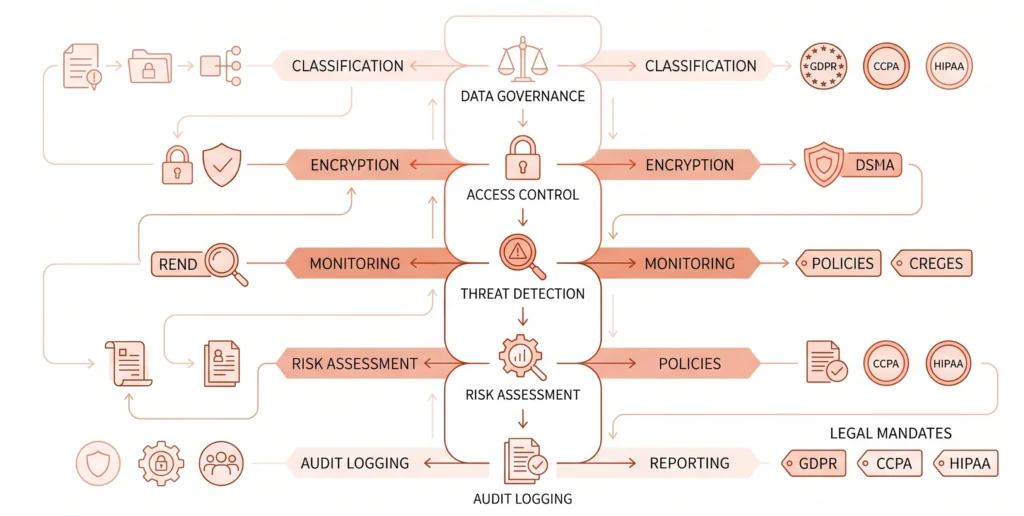
This is where most agentic AI conversations collapse in Indian boardrooms. And they should, because data security is the number one client concern. Any serious implementation must address six pillars before the first line of code runs.
Personal Information Data Handling Policy: Every category of candidate and employee data (resumes, interview recordings, assessment scores, reference checks) must be classified, with access rules for each class. Under the DPDP Act, the employer remains the Data Fiduciary even when a vendor processes data on their behalf.
Data Retention and Deletion: The DPDP framework requires defined retention periods. Indefinite storage of rejected candidate data creates liability. Systems must support automated deletion workflows triggered by retention policy.
Data Handling Training: According to EY’s India Privacy Readiness Survey, HR, finance, and operations teams how the lowest awareness of DPDP obligations, despite handling the most personal data. Learning and Development must own the rollout of structured DPDP training for every HR team member.
Same-Industry Client Data Leakage Policy: When a single recruitment partner works with competing clients, candidate data firewalls become contractual and technical requirements. Any agentic system deployed must demonstrate tenancy isolation and audit logs that prove no cross-client bleed.
Audit Framework: The EY survey found that 83% of Indian organisations have not begun comprehensive DPDP implementation, and 81% have not updated privacy policies. A working audit framework with documented data processing activities, third-party processor identification, and breach-response protocols is now a board level expectation.
Law of the Land Compliance: India’s DPDP framework is only one layer. Sector specific regulations (RBI’s FREE-AI framework for financial services, MoHFW data rules for healthcare, SEZ and GCC incentive-linked compliance) all intersect with recruitment data handling.
Globally, only 36% of organisations have a centralised approach to agentic AI governance. In India, where 94% of enterprises expect AI spending to increase, the governance deficit is widening faster than the deployment velocity. This is exactly where enterprise liability accumulates.
A Practical Roadmap for Indian Enterprises
For CHROs, CFOs, and CTOs planning a 12-month agentic AI adoption path, the sequence matters more than the ambition. The enterprises that have succeeded, from TCS to Infosys to HDFC Bank, followed a pattern: start narrow, prove value, pair technology with workforce redesign, then scale. The roadmap below applies that
pattern to recruitment.
Quarter 1: Foundation and Readiness
Before deploying any agentic capability, the groundwork has to be laid across four fronts.
Map the hiring pain: Identify the three highest-volume, highest-pain hiring pipelines in your organisation. For FMCG, this is often frontline sales. For manufacturing and EPC, shopfloor and site engineering. For GCCs, early-career tech talent. For pharma, R&D and regulatory roles. These become your pilot candidates. Conduct a DPDP gap assessment: Only 48% of Indian organisations have initiated this, and the May 13, 2027 deadline is less than eighteen months away. Map candidate data flows, identify third-party processors, document retention policies, and flag gaps. This exercise will surface issues that need fixing regardless of whether you deploy agentic AI.
Align the leadership coalition: Agentic AI cuts across HR, IT, Legal, and Finance. A CHRO who tries to deploy it without CTO and CFO sponsorship will stall at the first integration or procurement conversation. Board-level sponsorship is not optional for a technology that touches candidate data, automates decisions, and reshapes team structure.
Define the workforce redesign question upfront: Before the technology lands, answer the question TCS, Infosys, and HDFC Bank answered: where will the recovered recruiter capacity go? Strategic sourcing? Executive hiring? Workforce planning partnership with business leaders? If this is not decided in Quarter 1, the organisation
will default to cost-cutting conversations by Quarter 3, which is the wrong outcome.
Quarter 2: Controlled Pilot
Deploy on one role family: Run agentic capabilities in parallel with existing processes, not as a replacement. The goal is comparison, not immediate substitution.
Start with the lowest-risk, highest-volume capability first: Typically this is intelligent sourcing and scheduling, which are operationally heavy but decision light. Voice-based candidate screening comes next, once the sourcing flow is stable. Reserve final-round interviews, leadership hiring, and culture assessment for humans from day one. This sequencing matches how the most mature deployments globally have rolled out, and it keeps risk contained while value builds.
Communicate transparently with candidates: Any voice-based interview must disclose upfront that the candidate is speaking with an AI recruiter. This is both an ethical baseline and a DPDP-aligned consent practice. Candidates respond better to transparency than they do to surprise.
Measure eight metrics, not six: Time-to-hire, cost-per-hire, shortlist quality, offer-to-join ratio, 90-day retention, and recruiter satisfaction are the standard.
Add two more for agentic pilots: candidate experience scores from AI-led interactions, and interview-to-shortlist accuracy (how often the AI’s recommended shortlist aligns with the human recruiter’s post-review judgement).
Run bias audits on every shortlist produced: Not sampled. Every one. Bias in AI systems is a governance failure, not a technology flaw, and it needs structural review from day one.
Quarter 3: Scale with Reskilling
Expand to 2–3 more role families: Based on pilot learnings at this stage, the question is no longer whether the system works, but whether your team is ready to work with it.
Build the recruiter reskilling programme: This is the TCS lesson, applied to HR. If recruiters are not actively being trained to do higher-value work, the organisation will not realise the gains. Reskilling should cover: strategic sourcing and talent market intelligence, hiring manager advisory, candidate assessment depth, workforce planning partnership, and AI oversight and auditing.
The ratio matters: Infosys reskilled 2.2 lakh employees alongside its automation rollout. Your recruiter team needs the same treatment at its own scale. Integrate agentic outputs into workforce planning: The data an agentic system generates (market depth, skill availability, time-to-fill by role and region, competitive hiring intensity) is strategic gold. Put it in the hands of business leaders, not just the TA team. This is where the CHRO shifts from functional lead to strategic partner.
Address change resistance directly: Deloitte found only 44% of employees support major organisational change today. Recruiters are employees. If they believe the technology is there to replace them, adoption will fail. If they
experience it as leverage, adoption compounds.
Quarter 4: Institutionalise and Measure
Formalise governance: AI audit cadence (quarterly at minimum), escalation paths for overrides, documented bias review protocols, and Data Fiduciary compliance documentation aligned to the DPDP framework. This is what turns a pilot into an operating capability.
Measure EBITDA impact, not just HR metrics: Recovered recruiter capacity has a rupee value. Reduced time-to-hire has a rupee value. Improved quality-of-hire and lower early attrition have a rupee value. Present these to the board in financial language, not HR language. For a company hiring 1,000 people a year, the blended savings typically fall in the 18–25% range of total talent acquisition spend, reaching 35% for high-volume sectors like FMCG and manufacturing.
Plan the next wave: By the end of Quarter 4, the organisation should have a clear view of what is next: expansion into leadership hiring workflows, integration with internal mobility, predictive workforce planning, or cross-functional deployment into onboarding and early-tenure retention. Agentic AI in HR does not stop at
recruitment. Recruitment is just the highest-ROI entry point.
What Good Looks Like at the End of Twelve Months
A recruitment function that has matured well along this roadmap will show four characteristics by the end of the year. First, measurable improvement across all eight pilot metrics, with bias audit reports that stand up to external review.
Second, a recruiter team visibly doing higher-value work, with career paths that reflect the new skill profile. Third, a governance and compliance posture that is DPDP-ready ahead of the May 2027 deadline, not scrambling toward it. And fourth, a board that sees talent acquisition as a strategic capability linked to business outcomes, not a cost centre to be optimised.
This is the outcome TCS, Infosys, and HDFC Bank achieved in their respective domains. Extending the same discipline to recruitment is not a speculative bet. It is the clearest operational playbook available in Indian enterprise HR right now.
The Road Ahead
The recruiter of 2027 will not be the recruiter of 2022. The best ones will not compete with AI. They will direct it. They will spend less time sifting CVs and more time in the conversations that actually change business outcomes: briefing hiring managers on market reality, advising candidates on career fit, shaping workforce strategy alongside the CFO.
The enterprises that win this decade will be the ones that redesign recruitment as a joint capability of human judgement and intelligent automation. Agentic AI is not replacing the recruiter. It is finally giving the recruiter the leverage they have been missing for twenty years.
Automation handles execution. Humans handle decisions. That is what a modern Indian recruitment engine looks like. And for CHROs, CFOs, and CTOs building the next five years of their talent strategy, it is no longer a question of whether to build it. It is a question of how fast.