Hiring for business development used to be about one thing: filling an open seat. Today, that old model is broken. Simply getting someone in the door is no longer enough. To win, you need to strategically engineer sustainable growth for your enterprise, and that starts with completely rethinking how you find and hire your revenue-generators.
This means moving past outdated recruitment tactics and embracing a modern, data-driven framework. It’s a shift that turns your hiring function from a simple cost centre into a powerful competitive advantage.
The New Reality of Enterprise Business Development Hiring
For Chief Human Resources Officers (CHROs) in India, the ground has completely shifted. Finding elite business development talent, the kind of people who can crack open new markets and forge unbreakable client relationships has become incredibly challenging. The old methods just don’t work anymore.
Relying on personal networks or just sifting through whoever happens to apply is a reactive game that almost always ends in a costly mis-hire. The result is a revolving door of talent and a string of missed revenue targets. Today’s market demands a far more proactive, deliberate, and data-informed approach.
From Cost Centre to Growth Engine
A modern framework for hiring business development professionals is all about precision and predictability. It’s a system that starts long before you write a job description and extends well beyond the day an offer is accepted. The entire goal is to build a repeatable engine that identifies, assesses, and onboards people who are practically guaranteed to drive revenue.
This evolution from a traditional to a modern hiring framework involves a few critical changes in thinking.
The table below breaks down the shift from outdated, reactive tactics to a strategic, RPO-enabled framework that truly drives business growth.
Modern vs. Traditional Business Development Hiring
| Hiring Stage | Traditional Approach | Modern Framework (RPO-Enabled) |
|---|---|---|
| Role Definition | Generic job descriptions based on past roles. | Precise competency models mapped to specific business outcomes. |
| Sourcing | Post-and-pray on job boards, rely on inbound applications. | Proactive, data-driven sourcing using talent intelligence to find passive candidates. |
| Assessment | Unstructured interviews based on gut feel and resume review. | Structured interviews, scorecards, and real-world case studies to predict performance. |
| Key Metrics | Focus on speed: time-to-fill and cost-per-hire. | Focus on impact: time-to-productivity and revenue contribution. |
| Onboarding | Basic orientation and administrative paperwork. | Strategic ramp-up plan focused on accelerating revenue generation. |
This isn’t just about using new tools; it’s a fundamental change in mindset. It’s about building a predictable system for talent acquisition that directly fuels your company’s bottom line.
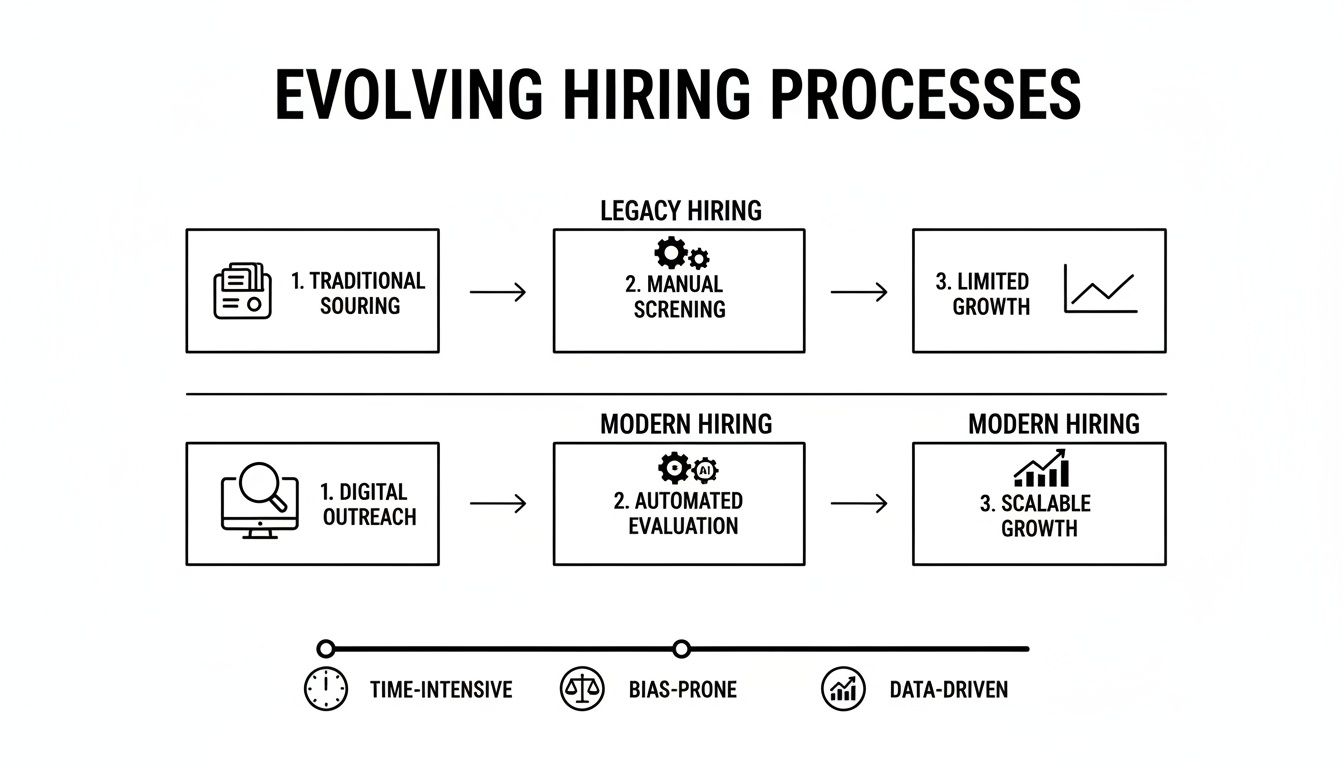
The key takeaway here is the move from manual, intuition-based decisions to a technology-backed, systematic process that ensures every hire aligns with strategic business goals. This transformation is no longer a “nice-to-have” it’s a necessity in a fiercely competitive market.
In fact, the Indian staffing and recruitment market is projected to skyrocket from US$ 18.06 billion in 2022 to US$ 48.53 billion by 2030. This explosive growth underscores just how critical strategic talent acquisition has become.
Partnering with a tech-forward Recruitment Process Outsourcing (RPO) provider like Taggd realigns your entire hiring process. It connects every stage, from defining the right competencies to measuring post-hire performance to ensure your business development team becomes a true revenue-generating engine.
This playbook gives you a comprehensive framework to make that happen. For any CHRO looking to build a superior talent function, the strategies we’re about to cover are critical. To get more context on the forces shaping talent acquisition, explore our insights on the latest hiring trends shaping the future of recruitment.
Defining Your Ideal Business Development Profile
Great business development hiring starts with a simple, but surprisingly tough, question: what does “great” actually look like for your organisation? If you’re still relying on generic job descriptions, you’re already behind. The first real step is to build a competency framework that can actually predict who will succeed on the job and help you dodge those costly mis-hires. This is where you stop talking in vague business goals and start building a tangible profile of the person you need.
Instead of throwing around fuzzy terms like “strong communicator,” a solid profile ties essential skills directly to the business outcomes you’re after. For instance, if your goal is to break into a new enterprise market, your profile has to prioritise real-world competencies like strategic account planning, complex deal negotiation, and a proven track record of building C-level relationships from scratch.
Getting this initial definition right is the foundation of your entire hiring strategy. If you get it wrong, every step that follows from sourcing to interviewing will be misaligned. You’ll end up hiring someone who looks great on paper but just can’t deliver the revenue impact you desperately need.

Hunter vs. Farmer: The Critical Distinction
One of the most common pitfalls I see is companies failing to distinguish between two fundamentally different sales profiles: the “Hunter” and the “Farmer.” Both drive revenue, absolutely. But their skills, their motivations, and the environments where they thrive are worlds apart. Mixing them up is a classic mistake that sets a great professional up for failure.
Hunters are your quintessential new business generators. They live for the thrill of the chase, prospecting for new logos and kicking down doors in untapped markets. They are incredibly resilient, persistent, and genuinely excel at cold outreach and starting conversations where none existed before.
Farmers, on the other hand, are master relationship builders. They shine when it comes to nurturing and expanding existing accounts. Their strength is in strategic account management, sniffing out upsell and cross-sell opportunities, and embedding themselves as trusted advisors to your clients. They cultivate long-term value from the seeds the hunters plant.
So, how do you know which one you need? Your immediate business objectives will give you the answer.
- When to Hire a Hunter:
- You’re pushing into a new geographic market or industry vertical.
- You’re launching a new product and need to build a customer base from zero.
- Your growth has flatlined and you need a fresh pipeline of net-new logos, fast.
- When to Hire a Farmer:
- You have a solid base of key accounts with major untapped growth potential.
- Customer churn is creeping up and you need to lock in client retention and satisfaction.
- Your main goal is to increase the lifetime value (LTV) of your existing customers.
Mistaking one for the other is a recipe for disaster. A hunter will get bored and disengaged in a role that’s all about account management, while a farmer might not have the aggressive drive needed to consistently land new leads in a cutthroat market.
Building Your Competency Framework
Once you’ve locked in your primary objective and the ideal profile (Hunter or Farmer), it’s time to build a detailed competency framework. Think of this not as a job description, but as a structured scorecard for your entire evaluation process. It’s the list of skills, behaviours, and knowledge a candidate absolutely must have to win in the role.
A strong framework for a senior business development role needs a healthy mix of hard and soft skills. For example:
- Strategic Thinking: The ability to map out and execute long-term account or territory plans that directly align with company revenue targets.
- Financial Acumen: Deeply understanding a client’s business model, their P&L, and exactly how your solution delivers a clear, undeniable return on investment.
- Complex Negotiation: Proven experience leading multi-stakeholder negotiations for six or seven-figure deals, navigating the maze of procurement, legal, and executive sign-offs.
- C-Level Engagement: A demonstrable track record of building and keeping relationships with senior executives inside your target accounts.
- Resilience & Grit: A history of overcoming major obstacles, pushing through long sales cycles, and staying motivated even when faced with constant rejection.
This level of detail is what keeps your recruitment process focused and objective. An RPO partner uses deep talent intelligence to benchmark these competencies against what the current market can actually offer. This data-driven approach stops you from chasing a “unicorn” candidate who doesn’t exist and grounds your entire hiring strategy in reality.
Strategic Sourcing for High-Impact Talent
Let’s be honest. The very best business development leaders, the ones who consistently smash their targets, aren’t scrolling through job sites. They’re far too busy delivering results for their current company. This means your traditional “post and pray” hiring strategy will only attract the talent that’s available, not necessarily the talent you actually need.
To build a real pipeline of top performers, you have to go on the offensive. This isn’t about just posting a job; it’s about building a talent map that shows you where the real experts are, long before they even think about making a move. It requires a more patient, multi-channel approach focused on where these professionals gather, network, and prove their worth.
You need to be present where the real industry conversations are happening.
Beyond the Obvious Sourcing Channels
While LinkedIn is a non-negotiable tool in any recruiter’s arsenal, it’s also the most crowded and noisy. To get a real edge, you have to diversify. A truly effective strategy weaves together several channels to find those hidden gems who perfectly match your competency framework.
- Industry Forums and Communities: Think niche online forums, private Slack groups, or professional association message boards. These are absolute goldmines. It’s where top professionals go to debate challenges, celebrate wins, and show off their expertise in real-time. Simply monitoring these spaces reveals who the genuine thought leaders are.
- Competitor Intelligence: Make a habit of tracking your competitors’ top performers. Who’s consistently winning awards, speaking at conferences, or getting quoted in industry news? This isn’t about aggressive poaching; it’s about identifying the benchmark for excellence and building a long-term map of the best talent in your space.
- Professional Networks and Referrals: A structured referral programme is a great start, but you can go deeper. Encourage your own leaders to tap into their “second-degree” networks, the people their most trusted contacts recommend. This often uncovers high-calibre candidates who aren’t on anyone else’s radar.
Building a pipeline this way is a long game. It’s about relationships first. For a deeper dive into these methods, you can explore our detailed guide on sourcing passive candidates.
The Art of High-Impact Outreach
Once you’ve identified a potential star, your first message is everything. Senior talent gets dozens of generic “exciting opportunity” emails every single week. Yours has to cut through that noise by being personal, insightful, and respectful of their time.
Your message must prove you’ve done your homework. Reference a project they recently led, an article they wrote, or a talk they gave. This tiny bit of personalisation shows you have a genuine interest and separates your message from automated spam.
The key is to frame the conversation around a potential career move and the impact they could make, not just a job description. Your outreach must answer the one silent question every top performer has: “Why should I even talk to you?”
A strong outreach message, for instance, focuses on the challenge and the potential for a huge win. You might highlight the chance to build a new territory from the ground up, lead a strategic entry into a new market, or solve a complex problem that has the whole industry stumped. This is what appeals to the ambition that drives high-achievers.
Tapping into New Talent Hubs
The talent landscape in India is also decentralising. While the major metros are still key, we’re seeing huge growth in tier II cities. This shift demands a much more sophisticated approach to talent mapping and sourcing, and it’s where a tech-driven hiring partner becomes essential.
Recent data paints a clear picture. While Hyderabad saw an impressive 35% growth in hiring among tier I cities, the real story is in the emerging hubs. Cities like Jaipur (40%), Indore (38%), and Mysuru (36%) are showing explosive growth, creating brand-new pockets of high-potential business development talent. You can review the full hiring trend report from The Economic Times to see this nationwide expansion for yourself.
Trying to source talent across such a diverse geography with a purely manual approach is next to impossible. This is where a partner with an AI-powered platform and a deep candidate database gives you a serious advantage. A system like this can map talent against your specific competency model, flagging high-potential individuals wherever they are and ensuring you never miss the chance to engage a future star.
Designing a Bulletproof Assessment Framework
Sourcing great talent is only half the battle. Now comes the part where, let’s be honest, most business development hiring processes fall apart: separating the charismatic talkers from the actual revenue drivers. A slick presentation and a confident interview don’t always translate to hitting quarterly targets. You need a structured, objective framework to predict on-the-job performance before you make an offer.
This means moving away from those unstructured, “gut-feel” interviews. We’ve all been there, and we’ve all been burned by them. Instead, you need a system that rigorously tests the core competencies you’ve already defined. A truly effective assessment is built on two pillars: structured behavioural interviews and a realistic, job-specific case study.

Building Structured Interview Guides
A structured interview is your first line of defence against hiring bias. It’s simple, really: every candidate gets asked the same core questions, allowing you to compare their responses on a level playing field. The questions themselves have to be behavioural, designed to pull out real-world examples of past performance, not just theories.
So, instead of a hypothetical like, “How would you handle a difficult negotiation?” dig for specifics.
- “Tell me about the most complex deal you’ve ever closed. What were the biggest obstacles, and how did you navigate them?”
- “Describe a time you had to build a relationship with a key stakeholder from scratch. What steps did you take, and what was the outcome?”
- “Walk me through a situation where a promising deal went sideways. What did you learn from that experience?”
These questions force candidates to provide concrete evidence of their skills. It’s about what they did, not what they would do. This is a key part of ensuring you are hiring for the right skills, though culture fit is just as important. For more on that, check out our guide on the best practices for assessing and hiring a culture fit candidate.
The Power of a Balanced Scorecard
To make this process even more objective, every interview needs to be paired with a competency scorecard. It’s a simple tool that lists your key competencies, like strategic thinking, financial acumen, or resilience—and allows interviewers to rate the candidate on a scale (say, 1-5) for each.
A scorecard helps you objectively evaluate candidates against key competencies during interviews. It turns subjective feelings into data-backed insights.
Sample Business Development Competency Scorecard
| Competency | Definition | Rating (1-5) | Interviewer Notes/Evidence |
|---|---|---|---|
| Strategic Thinking | Ability to analyse markets, identify opportunities, and develop long-term growth plans. | ||
| Relationship Building | Skill in creating and nurturing high-value relationships with key stakeholders. | ||
| Financial Acumen | Understanding of financial metrics, deal structuring, and commercial implications. | ||
| Resilience & Grit | Ability to persevere through setbacks and maintain motivation during long sales cycles. | ||
| Communication | Clarity and persuasiveness in both written and verbal communication. |
The most important part of this scorecard is the “Evidence” column. It forces the interviewer to write down specific examples from the candidate’s answers that justify their rating. This simple step moves the evaluation from a subjective “I liked them” to a data-backed decision.
An RPO partner like Taggd can be instrumental here. They don’t just help design these scorecards; they train your hiring managers on how to use them effectively, ensuring consistency across all interviews and reducing the impact of individual bias.
This structured approach is particularly important in today’s talent market. As India’s employability has risen to 56.35%, up significantly from previous years, the workforce is more skilled than ever. This shift, driven by digital fluency and AI adoption, means you have a larger pool of qualified talent to assess, making objective evaluation critical. For more on this trend, you can explore the full report on India’s rising employability on Times of India.
Designing a High-Fidelity Case Study
While interviews test past behaviour, a case study simulates future performance. This is where you can truly see a candidate’s thought process in action. The key is to make it realistic. Don’t give them a generic puzzle; give them a challenge they would genuinely face in their first six months on the job.
Example Case Study Prompt for a Senior BD Role:
“Our company is looking to enter the automotive manufacturing sector in Western India. Our primary solution is an AI-powered supply chain optimisation platform. You have 48 hours to prepare a 15-minute presentation outlining your initial 90-day go-to-market plan. Your plan should identify three target accounts, outline your initial outreach strategy, and define what success looks like in the first quarter.”
A prompt like this tests multiple competencies all at once:
- Strategic Thinking: Can they analyse a new market and form a coherent plan?
- Research Skills: How well do they identify and prioritise potential accounts?
- Communication: Can they present their ideas clearly and persuasively?
Of course, evaluating the case study requires its own scorecard. This ensures you’re judging the output against a consistent set of criteria, not just the polish of the presentation.
An RPO partner adds immense value by managing this entire assessment process. They handle scheduling, distribute materials, collect feedback through consolidated scorecards, and provide a unified summary to the hiring team. This frees up your leaders and ensures every candidate gets a fair, consistent, and professional experience, leading to faster, more confident hiring decisions.
The job of hiring great business development talent doesn’t end when the offer letter is signed. In many ways, that’s where the real work begins. The first 90 days are a critical window. It’s your chance to set a great hire up to generate revenue quickly, or watch them get lost in a sea of admin tasks and unclear expectations.
A structured onboarding plan is the bridge between a promising candidate and a high-performing team member. For a business development role, that plan has to be laser-focused on one thing: getting them to revenue as fast as possible. Without it, you’re just setting yourself up for a slow, frustrating ramp-up that burns both time and money.

Building a 90-Day Revenue Ramp Plan
The most effective onboarding frameworks break the first quarter down into 30-day chunks. Each phase should have a distinct focus and clear, measurable milestones. This gives your new hire much-needed structure and provides leadership with a clear view of their progress.
Remember, the goal isn’t just to teach them about the company. It’s to arm them with everything they need to start building a pipeline and closing deals.
Days 1-30: Immersion and Internal Networking
The first month is all about absorption. The only goal here is for the new hire to soak up everything they can about the product, the customer, the internal machinery, and the key people who will help them get deals across the line.
- Product Mastery: Set up deep-dive sessions with your product managers and engineers. By the end of this, your new hire should be able to articulate the solution’s value proposition, key differentiators, and common use cases in their sleep.
- Customer Voice: Have them listen to recorded sales calls, pore over case studies, and shadow customer success managers. They need to understand the client’s pain points from the client’s own perspective.
- Internal Network Building: Schedule one-on-one intro meetings with leaders from marketing, product, legal, and finance. A BD pro’s success often hinges on their ability to navigate the internal landscape to get things done.
At the end of 30 days, the new hire should deliver a mock sales presentation to a panel of internal stakeholders. Think of this as a crucial checkpoint to validate their understanding before you let them loose on real prospects.
Days 31-60: Activation and Early Pipeline Generation
The second month is where learning turns into doing. With their manager’s guidance, the new hire should start actively engaging with the market and laying the foundation for their sales pipeline.
Key activities during this phase include:
- Territory Planning: They should finalise and present their territory or account plan. This plan needs to identify the low-hanging fruit and outline long-term strategic targets.
- Shadowing and Co-Selling: It’s time to move from passive listening to active participation. Have them co-lead discovery calls and initial meetings alongside a seasoned team member.
- Initial Outreach: They should begin targeted outreach to a pre-approved list of prospects. The goal here isn’t to close deals just yet, but to start conversations and book those first critical meetings.
By day 60, the most important metric for success is the number of qualified first meetings they have booked. This shows they can take what they’ve learned and use it to generate genuine interest in the market.
Days 61-90: Ownership and Performance
In the final month of the ramp plan, the training wheels come off. The new hire should be operating with more and more autonomy, taking full ownership of their pipeline and moving prospects through the sales cycle.
The objective for this period is clear: demonstrate the ability to build and manage a pipeline independently. The focus shifts from activity metrics (like calls made) to outcome metrics (like qualified opportunities created and pipeline value).
By the end of their first quarter, they should have a tangible pipeline of qualified leads and be actively managing several real opportunities. This is the first concrete proof of their potential to hit revenue targets.
Moving Beyond Traditional Hiring Metrics
For far too long, talent acquisition has been measured by efficiency stats like Time-to-Fill and Cost-per-Hire. While these are useful for managing operations, they tell you absolutely nothing about the quality or impact of the hire. For a role as critical as business development, you need to track metrics that are tied directly to business outcomes.
The single most important metric is Time-to-Productivity. For a business development hire, you can define this as the time it takes for them to generate a qualified pipeline equal to three times their salary. This metric shifts the focus from simply filling a seat to making a profitable hire.
An RPO partner can be invaluable here. Through clear Service Level Agreements (SLAs), they can provide detailed analytics not just on Time-to-Productivity, but also on the 90-day success rate and the first-year revenue contribution of new hires.
This level of transparency holds the entire business development hiring process accountable to real business results, making sure your talent function isn’t just efficient, but verifiably effective. It transforms recruitment from a cost centre into a strategic partner in growth.
FAQs
When you’re hiring for business development, a lot of questions pop up. It’s a specialised field, and getting it right means understanding its unique challenges. We hear these questions all the time from CHROs and talent leaders, so let’s get into some straight, actionable answers.
What’s the Real Difference Between a BDR and an SDR?
This one trips up a lot of people, and getting the distinction right is vital for defining your roles properly. Think of it this way: a Business Development Representative (BDR) is your hunter. They’re focused purely on outbound prospecting, actively digging up cold leads and building a new sales pipeline from scratch.
A Sales Development Representative (SDR), on the other hand, usually manages inbound leads. These are prospects who’ve already raised their hand by engaging with your marketing efforts—maybe they filled out a form on your site or downloaded a whitepaper. While many companies are starting to blend these roles, knowing the core difference helps you decide: do you need someone to generate new demand, or someone to handle the interest you already have?
How Long Does It Really Take to Hire a Good BD Professional?
There’s no magic number, but for a senior business development role in India, a well-managed hiring process should take between 45 to 60 days. This is from the day you open the position to getting a signed offer back.
If you’re moving much faster, you might be cutting corners on your assessments. But if the process drags out past 60 days, you risk losing your top candidates to competitors who move more decisively.
A few things can stretch or shrink this timeline:
- Role Seniority: Leadership roles just take longer. You need more interviews and have to align with more stakeholders.
- Market Competition: In hot sectors, you have to move fast because the best people have multiple offers on the table.
- Internal Holdups: Slow feedback from hiring managers and messy scheduling are the usual culprits for delays.
The goal isn’t just speed; it’s efficiency. An RPO partner can streamline the logistics, keeping things moving without ever compromising the quality of your interviews.
How Should We Set Up Pay for Business Development Roles?
For BD roles, compensation almost always has a variable piece tied to performance. In the Indian market, a 60/40 or 70/30 split is pretty standard. This means 60-70% of the total pay is a fixed base salary, with the other 30-40% coming from variable pay for hitting specific targets.
These targets need to be crystal clear and easy to measure. Most of the time, they’re tied to metrics like:
- Number of qualified meetings booked
- Value of new pipeline generated
- Revenue closed from their efforts
Setting a realistic On-Target Earnings (OTE) is what attracts top performers. Do your homework and benchmark against similar roles in your industry and city. This ensures your offer is competitive enough to land the kind of high-impact talent you’re looking for.
Can We Actually Test for ‘Grit’ and ‘Resilience’ in an Interview?
Yes, you absolutely can. But you won’t get there by asking a direct question like, “So, are you resilient?” You need to dig for proof with behavioural interview questions. Forget hypotheticals and ask candidates to talk about specific things that have actually happened to them.
For example, try asking: “Walk me through a time a deal you were sure was going to close fell apart at the very last minute. What did you do next?”
How they answer that question will tell you so much more about their ability to bounce back than a generic question ever could. When you combine questions like this with a tough case study, you get a much more complete and honest picture of a candidate’s true character.
Ready to stop chasing talent and start building a predictable revenue engine? Taggd‘s RPO solutions combine deep market intelligence with a tech-driven framework to help you hire elite business development professionals who deliver results from day one. Learn how we can transform your hiring process.