Chief AI Officer: AI has quietly crossed a line. What began as experimentation inside analytics teams is now influencing decisions that shape revenue, risk, hiring, compliance, and customer trust. Algorithms screen candidates, recommend pricing, forecast demand, flag fraud, and guide operational planning. These decisions no longer sit at the edges of the business. They sit at the core.
Yet in many organizations, accountability for AI remains fragmented. The CTO focuses on platforms and architecture. The CDO manages data governance. Product leaders run use cases. Legal teams react when concerns arise. HR feels the impact through workforce change but rarely owns the strategy.
Here’s the problem. When ownership is distributed, responsibility is diluted.
This is why boards and CEOs are introducing the Chief AI Officer (CAIO) role. Not as another technology title, but as a C Level Executive charged with aligning AI capability to business outcomes, managing risk, and preparing the workforce for continuous change. The CAIO brings coherence to decisions that can no longer be left to experimentation.
What Is a Chief AI Officer?
A Chief AI Officer is the executive accountable for how artificial intelligence is adopted, governed, and scaled across the organization. The role combines strategy, governance, leadership, and workforce alignment.
Unlike traditional technology leaders, the CAIO does not manage infrastructure or data in isolation. The role exists to answer harder questions:
- Where should AI be used and where should it not?
- Which use cases deliver measurable business value?
- How do we prevent bias, adverse impact, and compliance failures?
- How do we prepare teams to work alongside intelligent systems?
In practice, the CAIO works across the organization, partnering with the CEO, COO, CHRO, CIO, legal, and business heads. The mandate is enterprise-wide, not functional.
Why Organizations Are Creating the Chief AI Officer Role?

Most companies do not hire a CAIO because they want to innovate faster. They hire one because complexity has started to outpace control.
Several forces drive this shift.
AI Has Become Business-Critical
AI now influences revenue forecasting, pricing strategy, hiring funnels, customer segmentation, and fraud detection. These are not experimental decisions. They affect profit, reputation, and compliance.
Risk Has Increased
As AI touches sensitive data and human decisions, organizations face exposure to data breach, bias, and regulatory scrutiny. Without a clear compliance framework, risks surface late and often publicly.
Talent and Capability Gaps Are Visible
Advanced tools do not guarantee adoption. Skill gaps, resistance to change, and unclear ownership slow impact. AI becomes shelfware without leadership alignment and workforce readiness.
ROI Is Under Pressure
Boards increasingly ask how AI spend translates into productivity, revenue per employee, or cost efficiency. Dashboards alone do not answer these questions.
At this stage, AI becomes an organizational challenge, not a technology one. That is when the Chief AI Officer enters the picture.
Roles and Responsibilities of Chief AI Officer
The work of a CAIO spans strategy, governance, execution, and leadership influence. It is less about building models and more about building clarity.
Enterprise AI Strategy
The CAIO defines how AI supports long-term business goals. This includes prioritizing use cases, setting investment thresholds, and aligning AI initiatives with OKRs and strategic initiatives. Rather than chasing trends, the CAIO ensures focus. Not every problem requires AI, and not every AI project deserves scale.
Governance and Compliance
Responsible AI is a leadership responsibility. CAIOs establish guardrails around data usage, model transparency, bias mitigation, and accountability. This protects the organization from adverse impact and reputational damage. Governance also creates confidence. Teams move faster when boundaries are clear.
Cross-Functional Alignment
AI cuts across silos. The CAIO works with cross functional teams spanning product, engineering, HR, operations, and legal. The role connects priorities, resolves conflicts, and ensures decisions move in one direction.
Workforce Readiness
AI changes how work gets done. CAIOs partner closely with CHROs on reskilling, upskilling, and workforce planning. This includes identifying roles at risk, redefining job architecture, and supporting internal mobility.
Measurement and Outcomes
Success is tracked through KPIs, balanced scorecards, and people analytics. The focus remains on outcomes: productivity, quality of decisions, time to productivity, and risk reduction.
Chief AI Officer vs CTO vs CDO
As AI becomes central to business decisions, overlap across leadership roles is inevitable. What separates the Chief AI Officer, CTO, and CDO is not capability. It is ownership of decisions.
Chief Technology Officer (CTO)
The CTO is responsible for the technology foundation. This includes platforms, systems, architecture, security, and reliability. When AI initiatives scale, the CTO ensures models can be deployed, integrated, and run at enterprise grade. The focus stays on how technology works, not on whether AI should be used in the first place.
Chief Data Officer (CDO)
The CDO owns data as an asset. This role ensures data quality, governance, privacy, and analytics capability. For AI to function well, inputs must be accurate, compliant, and trusted. The CDO’s responsibility ends once data is usable and governed. The role does not decide AI priorities or business impact.
Chief AI Officer (CAIO)
The CAIO owns AI outcomes. This includes deciding where AI creates value, how risk is managed, and whether adoption is delivering measurable results. The CAIO connects technology, data, business goals, and workforce readiness. When AI decisions affect customers, employees, or compliance, accountability sits here.
How These Roles Work Together?
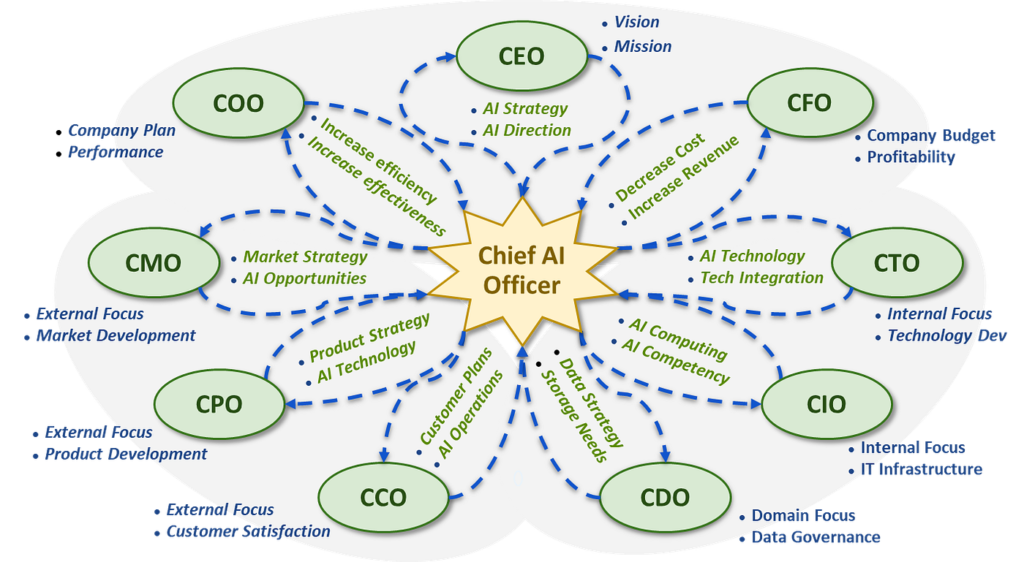
Key Skills That Define a Strong Chief AI Officer
Strong Chief AI Officers are not defined by tool expertise alone. The role demands a balanced skill set that connects business priorities, technical reality, governance, and leadership influence. Grouping these skills makes it easier to evaluate candidates meaningfully.
Strategic and Business Skills
At the core, a CAIO must connect AI capability to business value. This means translating models and automation into outcomes such as revenue per employee, productivity gains, cost efficiency, or risk reduction. Strong candidates show comfort setting priorities using performance metrics and ROI logic, not enthusiasm or trend pressure. They can explain why certain AI initiatives move forward while others do not.
Technical and Data Fluency
A Chief AI Officer does not need to micromanage engineering teams, but must understand how models, data pipelines, and deployment constraints work in practice. This fluency allows the CAIO to challenge assumptions, assess feasibility, and guide investment decisions. The ability to question outputs using analytics in hiring, forecasting, or delivery is often a key differentiator.
Governance and Risk Management
Responsible AI is a leadership responsibility. Effective CAIOs are deeply aware of bias, explainability, data privacy, and regulatory expectations. They design guardrails that prevent adverse impact before issues surface. This includes balancing innovation with reputational risk, compliance exposure, and long-term trust.
Leadership and Influence
AI adoption depends less on authority and more on credibility. Successful CAIOs drive change through alignment rather than mandate. They work across decentralized teams, manage resistance, and guide leaders through ambiguity. Change management, stakeholder confidence, and clear communication often matter more than technical depth.
When Does a Company Need a Chief AI Officer?
Most organizations do not wake up one morning and decide to hire a Chief AI Officer. The role becomes necessary when AI activity starts to outgrow organizational readiness.
A common signal is when AI pilots multiply across teams but outcomes remain inconsistent. Proofs of concept exist, tools are in place, dashboards look promising, yet business impact is hard to explain. AI activity increases, but decision quality does not.
Another trigger is talent friction. Even with strong platforms and vendors, adoption slows because of a visible skill gap. Teams struggle to operationalise models, managers lack confidence in outputs, and time to productivity stretches longer than expected. Workforce analytics may highlight the issue, but no one owns the solution end to end.
The need becomes more pressing when AI begins to influence sensitive areas such as hiring decisions, pricing logic, customer experience, or regulatory compliance. At this stage, AI is no longer a support tool. It shapes outcomes that affect trust, fairness, and brand reputation.
Finally, leadership expectations change. Boards and CEOs stop asking what AI can do and start asking what it is doing. Predictable results, risk control, and measurable value matter more than experimentation. Organizational readiness, not innovation speed, becomes the constraint.
This is the moment when AI requires executive ownership. The Chief AI Officer enters not to accelerate experimentation, but to bring clarity, accountability, and direction.
How Companies Are Hiring Chief AI Officers Today?
Hiring a Chief AI Officer is proving harder than many organizations expect. The role is new, but the consequences of getting it wrong are familiar. Slow adoption, unclear ownership, and AI initiatives that never move beyond pilots.
One of the most common issues is unclear job architecture. Many organizations start a CAIO search without agreeing on what success actually looks like. Is the role expected to build capability, manage risk, drive revenue impact, or all three? Without clarity, executive recruitment efforts attract candidates with strong technical depth but limited enterprise influence, or strategic thinkers with little exposure to operational AI.
Internal promotions often face a different challenge. Leaders from data science, product, or IT backgrounds may have deep domain knowledge, but competency mapping reveals gaps in governance, stakeholder influence, or change management. AI leadership at scale demands a broader view than functional excellence alone.
Traditional tech hiring models also fall short. Resume-led screening tends to reward tool familiarity and past titles, while missing leadership maturity, risk judgment, and the ability to operate across decentralized teams. As a result, quality of hire suffers, even when time to fill looks reasonable.
Organizations that succeed approach CAIO hiring as niche hiring, supported by talent intelligence and rigorous candidate assessment, rather than as a standard executive search.
This is where a structured approach to leadership hiring becomes essential. Taggd works with organizations to hire Chief AI Officers and other CXO roles by starting with clarity, not candidates. Every search begins with deep role discovery, aligning on business outcomes, governance expectations, leadership mandate, and long-term impact. This helps avoid one of the most common pitfalls in CAIO hiring: searching for skills without defining success.
Through its dedicated CXO and leadership hiring practice, Taggd combines deep India-specific market intelligence, rigorous candidate assessment, and hands-on ownership across the search lifecycle. The focus goes beyond technical expertise to evaluate leadership maturity, decision-making under complexity, and the ability to influence across decentralized teams. This ensures senior hires are not just capable specialists, but leaders who can shape strategy, culture, and sustainable value creation.
What to Look for When Hiring a Chief AI Officer
Evaluating a Chief AI Officer requires a different lens than most C-level roles. A CHRO-led checklist often works best.
Strong candidates demonstrate proven experience driving AI adoption at scale, not just running isolated initiatives. They can explain how AI moved from pilot to production, where resistance emerged, and how adoption was sustained.
Decision-making ability during continuous change is another critical signal. AI environments evolve quickly, and strong CAIOs remain effective without rigid playbooks. They show comfort navigating uncertainty while maintaining governance and direction.
Partnership with HR matters more than many organizations anticipate. The best CAIOs work closely with CHROs on reskilling, talent development, and workforce planning. They understand that AI success depends as much on people capability as on models.
Behavioral interviews, scenario-based discussions, and leadership assessments are often more revealing than technical evaluations. Signals around leadership development potential and succession planning matter, especially for organizations viewing the CAIO as a long-term role rather than a transitional one.
This approach aligns CAIO hiring with strategic HRM, not just technology staffing.
If you’re planning to hire, the job description below can help align stakeholders on what the Chief AI Officer role should truly own.
Chief AI Officer Job Description
The Chief AI Officer (CAIO) is a senior leadership role responsible for defining, governing, and scaling artificial intelligence across the organization. The role exists to ensure AI initiatives deliver measurable business value while managing risk, ethics, and long-term capability building.
Unlike purely technical leadership roles, the CAIO operates at the intersection of strategy, technology, people, and governance. The focus is on outcomes, not experimentation.
Key Responsibilities
- Define the enterprise-wide AI vision aligned with business strategy and long-term goals
- Prioritise AI use cases across functions based on impact, feasibility, and risk
- Establish governance frameworks for responsible AI, including bias, explainability, and compliance
- Partner with technology, data, product, legal, and HR leaders to drive coordinated execution
- Oversee AI adoption across the organization, ensuring tools move from pilots to scale
- Track performance using clear metrics tied to productivity, efficiency, risk reduction, or revenue impact
- Guide leadership teams through AI-driven change, supporting decision-making during uncertainty
Required Skills and Capabilities
- Strong strategic judgment and ability to translate AI capability into business outcomes
- Solid understanding of AI systems, data pipelines, and limitations without micromanagement
- Experience managing risk, compliance, and ethical considerations in AI deployment
- Ability to lead through influence across decentralized and cross-functional teams
- Comfort operating in ambiguity and making decisions with incomplete information
Ideal Background
- Senior leadership experience in AI, data, technology, or digital transformation roles
- Exposure to enterprise-scale AI initiatives rather than isolated projects
- Proven ability to work closely with CEOs, CHROs, CTOs, and other C-level executives
- Track record of driving adoption, not just innovation
What Success Looks Like in the Role
- AI initiatives are aligned with clear business priorities
- Leadership teams trust AI-driven insights in decision-making
- Governance risks are identified early and managed proactively
- Teams are equipped and confident to work alongside AI systems
- AI investments show sustained impact rather than short-lived experimentation
How Taggd Helps Organizations Hire the Right Chief AI Officer?

Hiring a Chief AI Officer is a strategic recruitment decision, not a sourcing exercise. Role clarity, evaluation rigor, and long-term fit matter more than speed.
Taggd supports CAIO hiring by combining executive recruitment expertise with deep niche hiring capability. Searches begin with role definition, helping CHROs and CEOs align on mandate, reporting structure, and success metrics before candidates enter the picture.
Through talent intelligence, Taggd assesses not only availability, but also leadership maturity, governance mindset, and strategic depth across sectors. This ensures shortlists reflect enterprise readiness, not just resume strength.
Candidate evaluation goes beyond credentials. Structured candidate assessment frameworks help identify how leaders think through AI prioritisation, risk trade-offs, and organizational change. The focus stays on improving the quality of hire rather than simply closing roles.
Positioned as a partner in strategic recruitment, Taggd helps organizations build AI leadership that delivers clarity, confidence, and long-term value.
The Future of the Chief AI Officer Role
The Chief AI Officer role is still evolving, but its direction is becoming clearer. As AI moves deeper into everyday decision-making, CAIOs will increasingly shape how organizations think, not just how they operate.
One visible shift will be cultural. AI changes how trust is built inside organizations. When employees understand how decisions are made, when bias is addressed early, and when accountability is clear, adoption improves. CAIOs will play a central role in defining these norms and embedding responsible decision models into daily workflows.
AI leadership is also moving toward permanence. What began as a response to rapid technological change is fast becoming a core C-suite function, similar to how digital or people leadership evolved over time. As AI influences revenue, risk, and workforce design, executive ownership will no longer be optional.
Companies that invest early in strong AI leadership tend to mature faster. They build workforce readiness through reskilling and clear role design, reduce resistance to change, and earn greater trust from customers, employees, and regulators. Over time, this trust becomes a competitive advantage that is difficult to replicate.
FAQs
What is the role of a Chief AI Officer?
A Chief AI Officer is responsible for defining and governing how artificial intelligence is used across the organization. The role focuses on aligning AI initiatives with business goals, managing risk and compliance, and ensuring adoption delivers measurable outcomes.
Is a Chief AI Officer different from a CTO?
Yes. While the CTO focuses on technology platforms and system reliability, the Chief AI Officer owns AI decisions, outcomes, and enterprise-level risk. The CAIO decides where and why AI should be used, not just how it is implemented.
What skills should a Chief AI Officer have?
Strong CAIOs combine strategic judgment, technical and data fluency, governance awareness, and leadership influence. The role requires comfort with ambiguity, decision-making during continuous change, and the ability to drive adoption across decentralized teams.
How do companies hire a Chief AI Officer?
Organizations typically hire CAIOs through executive recruitment and niche hiring approaches. Successful searches rely on talent intelligence and structured candidate assessment to evaluate leadership maturity, governance mindset, and long-term fit, rather than tool expertise alone.
What is the salary of a Chief AI Officer?
Chief AI Officer compensation varies by industry, company size, and AI maturity. It is typically aligned with senior CXO pay and reflects the role’s strategic and governance responsibility.
What recruitment challenges do organizations face when hiring a Chief AI Officer?
Common challenges include unclear role definition, limited availability of qualified leaders, and difficulty assessing enterprise leadership and governance capability beyond technical expertise.
Can recruitment for C-level roles like Chief AI Officer be outsourced?
Yes. Many organizations partner with executive search firms to manage C-level hiring, especially for emerging roles where market mapping, assessment, and confidentiality are critical.
Ready to turn talent acquisition into a strategic growth lever? Taggd helps organizations scale confidently with high-volume hiring and RPO solutions built for today’s talent market. Discover how the right hiring model can strengthen your workforce and support long-term growth.