Enterprise RPO, or Recruitment Process Outsourcing, isn’t just about hiring help. It’s a full-blown strategic partnership where an organisation hands over the keys to its entire recruitment function to a specialised provider.
This goes way beyond simply filling open roles. An Enterprise RPO solution becomes a deeply integrated part of your business, managing everything from sourcing and screening candidates to handling onboarding and the tech that powers it all.
Think of it this way: An Enterprise RPO provider acts as the master architect for your company’s talent infrastructure, designing, building, and managing it for long-term success.
What is the Real Enterprise RPO Meaning

When many business leaders hear “outsourcing,” their minds jump to offloading tasks to cut costs. But the true enterprise RPO meaning is something else entirely. It’s not about transactional, fill-the-seat recruiting; it’s a long-term commitment to turning your talent acquisition into a powerful business driver.
Let’s use an analogy. Your internal HR team might be a group of skilled builders, fantastic at putting up individual rooms (filling single roles) whenever you need them. An Enterprise RPO partner, on the other hand, is the architect and general contractor for the entire skyscraper.
They don’t just build; they design the blueprint, manage the supply chains (candidate pipelines), oversee all the crews (recruiters), and guarantee the final structure is built to last and ready for future growth. The RPO provider becomes a seamless extension of your own team, woven into your company’s culture and strategic plans.
Beyond Transactional Hiring
What really sets Enterprise RPO apart is its proactive, strategic focus. Instead of just reacting to open requisitions, the RPO partner works shoulder-to-shoulder with your leadership. They help forecast future talent needs, build strong candidate pipelines before you need them, and actively strengthen your employer brand in the market.
This forward-thinking approach means you have the right people ready to go before a critical need even arises. A comprehensive Enterprise RPO partner typically manages:
- End-to-End Process Management: Overseeing every single stage, from defining the job profile and sourcing candidates to making the final offer and handling onboarding.
- Technology Stack Optimisation: Implementing and managing crucial tools like Applicant Tracking Systems (ATS), Candidate Relationship Management (CRM) platforms, and analytics dashboards.
- Employer Branding: Actively marketing your company as an employer of choice to attract top-tier candidates, including those who aren’t even looking for a job.
- Data and Analytics: Delivering detailed reports on key metrics like quality-of-hire, cost-per-hire, and which sourcing channels work best to guide smarter decisions.
An Enterprise RPO solution transforms talent acquisition from a reactive, administrative function into a proactive, strategic powerhouse that directly fuels business growth and innovation.
This strategic model has really taken off in India. The Indian RPO market hit a value of roughly $1.2 billion in 2022 and is expected to grow at a compound annual growth rate (CAGR) of about 15% through 2032. This surge is driven by a growing demand for scalable, tech-powered hiring solutions. You can dive deeper into these trends with comprehensive insights about the RPO market report.
This growth signals a huge shift in how large organisations view talent acquisition—not as a cost centre, but as a critical competitive advantage. To get a better handle on the basics, you can explore our complete guide on recruitment process outsourcing.
The Real Advantages of Bringing in an Enterprise RPO Partner

While saving money is often the conversation starter, the true power of an Enterprise RPO partnership lies much deeper. It’s not just about trimming costs; it’s about building a more adaptable, competitive, and future-proof workforce. The benefits create a ripple effect across the entire business, touching everything from daily operations to long-term strategy.
Think about this scenario: your company needs to hire 500 specialised cloud engineers in a single quarter for a make-or-break product launch. Even the most talented internal team would likely be overwhelmed by that demand. This is precisely where the core benefits of Enterprise RPO come into focus, starting with its incredible ability to scale.
An RPO partner gives you the agility to ramp your recruitment capacity up or down almost on demand, whether you’re responding to market shifts or project deadlines. This flexibility means you can chase growth opportunities without being weighed down by the heavy fixed costs of a large, permanent internal recruitment team.
Raising the Bar on Talent Quality and Sourcing
One of the biggest impacts you’ll see is a clear improvement in the quality of people you hire. Enterprise RPO providers bring a level of sourcing expertise and tech-savviness that most in-house teams simply can’t replicate. They live and breathe the talent market.
Their dedicated teams use sophisticated sourcing methods and have access to huge candidate networks, including the all-important passive talent pool—those high performers who aren’t actively looking but are open to the right conversation. This proactive approach instantly widens your reach far beyond what you’d get from just posting on job boards.
Here’s how they directly boost your hiring results:
- Specialised Recruiters: You get access to recruiters who are genuine specialists in your field, whether that’s technology, finance, or manufacturing.
- Data-Driven Sourcing: RPO partners don’t guess. They use analytics to pinpoint the most effective sourcing channels and fine-tune their strategy to attract the absolute best candidates.
- Faster Hiring: With efficient processes and dedicated resources, critical roles get filled much faster, which means less downtime and fewer project delays. In fact, the Recruitment Process Outsourcing Association reports that RPO programmes can slash time-to-hire by up to 55%.
An Enterprise RPO provider doesn’t just fill roles; it acts as a talent intelligence hub, feeding crucial market data back into your business to help shape your overall corporate strategy.
Turning Your Employer Brand into a Magnet for Talent
In a tight talent market, your company’s reputation is everything. A single bad recruitment experience can tarnish your employer brand and turn off great candidates for years to come. An Enterprise RPO partner makes sure every single candidate interaction is professional, consistent, and positive.
This sharp focus on the candidate experience turns your hiring process into a powerful branding machine. By ensuring clear communication and a smooth journey from start to finish, the RPO provider strengthens your reputation as an employer of choice. Over time, this makes it far easier to attract elite talent.
To learn more, you can dive into the critical strategies for digital RPO for high-impact hiring and see how modern approaches amplify these benefits. Ultimately, this strategic partnership frees up your HR leaders to concentrate on core business goals like employee development and retention, knowing the talent pipeline is in expert hands.
How Does Enterprise RPO Stack Up Against Other Hiring Models?
To really get what Enterprise RPO means, you first have to understand what it isn’t. Too many companies lump all their external hiring help into one big bucket, and that’s a real mistake. The difference between Enterprise RPO, Project RPO, and a typical staffing agency is as big as the gap between having a long-term wellness coach and just rushing to the emergency room when something breaks.
A staffing agency is purely transactional. You’ve got an empty seat, they send you a few CVs to fill it, and that’s where the relationship ends. It’s a reactive, quick fix for an immediate headache.
Enterprise RPO, on the other hand, is a proactive, strategic partnership. It’s built for the long haul, designed to improve your organisation’s overall talent health. The provider doesn’t just fill roles; they become a true extension of your business, managing the entire talent acquisition function from start to finish. This can include everything from workforce planning and tech stack management to strengthening your employer brand and even handling onboarding, all to build a strong, sustainable talent pipeline.
Comparing the Scope and Strategic Fit
The real difference comes down to how deeply the partner is integrated into your business and the breadth of what they do. A traditional staffing agency works on the outside looking in, with almost no say in your internal processes or long-term people strategy. Their main goal is speed.
Project RPO sits somewhere in the middle. It’s perfect for specific, time-bound goals, like hiring the entire team for a new product launch or staffing a brand-new office. It’s more strategic than just calling an agency, but it has a clear start and finish line.
Enterprise RPO is the whole package.
The heart of an Enterprise RPO partnership is end-to-end responsibility. Your provider takes full ownership of the recruitment lifecycle, making sure every hire and every process is directly tied to your bigger business goals.
This deep-seated partnership allows the RPO provider to fine-tune your processes, raise the bar on candidate quality, and feed you priceless market intelligence—benefits you simply won’t get from a transactional hiring model.
A Guide to Talent Acquisition Models
Choosing the right hiring support really boils down to what you need right now. Are you just trying to fill one urgent role? Or are you looking to build a world-class, scalable talent function that will carry you into the future? Your answer will point you in the right direction.
Here’s a simple table to help you see the key differences at a glance:
| Model | Scope | Strategic Integration | Best For |
|---|---|---|---|
| Staffing Agency | Transactional, focused on filling individual roles quickly. | Low. Operates externally with minimal process involvement. | Immediate, short-term hiring needs or temporary staff augmentation. |
| Project RPO | Manages recruitment for a specific project or business unit with a clear timeline. | Medium. Integrates for the duration of the project, often adopting some internal processes. | Time-bound initiatives like new office launches or seasonal hiring surges. |
| Enterprise RPO | A continuous, long-term partnership managing the entire recruitment function. | High. Becomes a seamless extension of the client’s HR and leadership teams. | Large organisations seeking to transform their entire talent acquisition strategy. |
When it comes down to it, Enterprise RPO is for companies that see talent as more than just a resource to be found. It’s for leaders who know that their people are the ultimate competitive advantage—something to be nurtured and developed. It’s a shift from just filling today’s open jobs to strategically building the workforce you’ll need to win tomorrow.
A Roadmap for Successful RPO Implementation
Making the leap from the idea of an Enterprise RPO to a fully functioning, value-adding partnership isn’t something that happens overnight. It requires a clear, well-thought-out plan. This isn’t just about signing on the dotted line; it’s a fundamental overhaul of your entire talent acquisition function. Getting it right depends on a carefully managed implementation that brings your internal teams on board, sets crystal-clear expectations, and builds a solid foundation for a long-term win.
The whole process can be broken down into a series of logical phases. Each step builds on the last, helping you avoid the common traps that can sink an RPO partnership before it even gets going. It all starts with getting everyone on the same page internally and moves methodically towards a state of operational harmony.
This diagram helps visualise how different hiring solutions, from basic staffing to a full-blown Enterprise RPO partnership, offer deeper levels of strategic partnership.
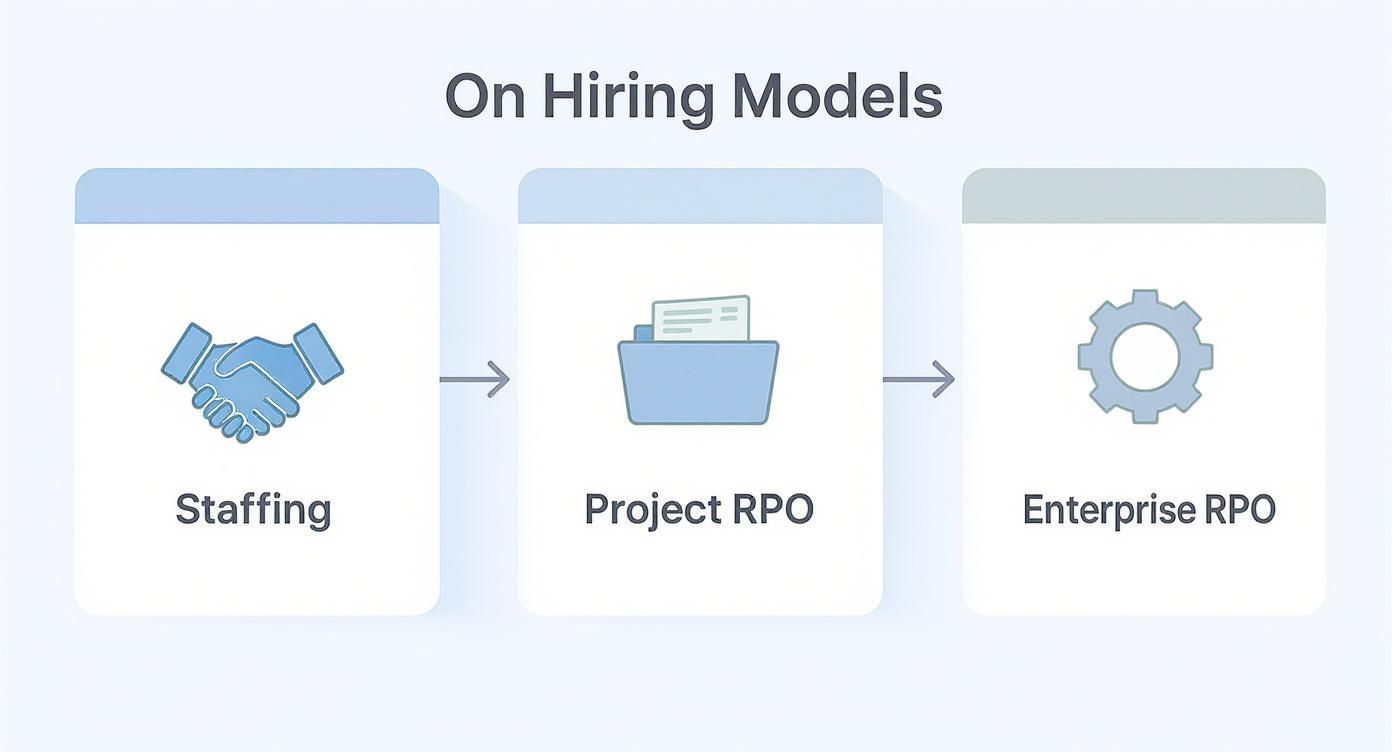
As you can see, there’s a clear progression. Enterprise RPO sits at the top as the most embedded and strategic talent solution for organisations with complex, large-scale hiring needs.
The Discovery and Design Phase
Your first move is to build a rock-solid business case. This means taking a hard look at your current recruitment numbers, identifying the real pain points, and forecasting what your hiring will look like down the road. It’s absolutely crucial to get buy-in from all the key players—from the C-suite right down to your hiring managers—by showing them the strategic value that goes way beyond just cutting costs.
Once you’ve got the green light, the hunt for the right partner begins. You need a provider who not only has the credentials but also truly gets your industry and, perhaps most importantly, your company culture. A cultural clash is one of the quickest ways for an RPO relationship to go sour.
In this phase, you and your chosen partner will roll up your sleeves and:
- Define Clear Objectives: Nail down specific, measurable goals. What does a successful partnership look like in 12 months?
- Map Existing Processes: Get your current recruitment workflows down on paper. This will shine a light on bottlenecks and quick wins.
- Develop Service Level Agreements (SLAs): Hammer out concrete SLAs for critical metrics like time-to-fill, quality of hire, and hiring manager satisfaction. This keeps everyone accountable.
Deployment and Change Management
With the blueprint signed off, it’s time to go live. This stage covers the technical side of things, like integrating systems (your Applicant Tracking System, for example) and the official launch of the RPO team’s work. But the real make-or-break element here is managing the change internally.
A successful RPO implementation is as much about managing people and perceptions as it is about managing processes. Proactive communication is essential to ensure your internal teams view the RPO provider as a supportive partner, not a replacement.
Here in India, large enterprises are embracing RPO at a rapid pace, driven by the intense pressure to hire better and faster. The Indian RPO market is getting more sophisticated, zeroing in on high-quality, specialised hiring in hot sectors like IT and BFSI. By 2025, the top RPO companies in India are already using AI and advanced analytics to get ahead. As you can read about how Indian businesses are leveraging RPO services for success, this market maturity shows just how vital a robust implementation plan is to unlock the full potential of your partnership.
Measuring the True Impact of Your RPO Partnership
Success in an Enterprise RPO engagement is about so much more than just filling roles quickly. To really grasp its value, you need to shift your perspective from purely operational numbers to the strategic outcomes that actually move the business forward. It means looking beyond the obvious metrics to measure what truly matters.
Of course, things like time-to-fill and cost-per-hire give you a useful starting point, but they don’t paint the full picture. The real power of a genuine Enterprise RPO partnership shines through when you start looking at more sophisticated key performance indicators (KPIs) that link your hiring efforts to the long-term health of the organisation.
Moving Beyond Transactional Metrics
A strategic RPO partner helps you define, track, and improve the KPIs that have a direct line to business performance. These advanced metrics give a much clearer view of the partnership’s value and are exactly what you need to demonstrate a solid ROI to your leadership team.
Key strategic KPIs to focus on include:
- Quality of Hire: This is arguably the most important metric of all. You can measure this by looking at performance review scores, promotion rates, and how long new employees stay with the company after their first year.
- Hiring Manager Satisfaction: We’re talking about simple, regular surveys to see how happy internal managers are. Do they feel they’re getting high-quality candidates? Is the process smooth? Are they getting the consultative support they need from the RPO team?
- Candidate Experience Scores: A positive experience for candidates, measured through post-interview surveys, directly boosts your employer brand. This is true even for the people you don’t end up hiring.
A strong governance framework is the engine that drives a successful RPO partnership. It transforms the relationship from a simple vendor transaction into a powerful strategic alliance fully aligned with your business objectives.
This framework is all about clear communication and holding each other accountable. Typically, it involves regular, structured meetings like Quarterly Business Reviews (QBRs) where both teams sit down to analyse performance data, tackle challenges, and align on strategy for the next quarter. A joint steering committee, made up of senior leaders from both your company and the RPO provider, ensures the partnership stays locked in on high-level business goals.
This kind of collaboration ensures your RPO provider isn’t just another supplier, but a partner deeply integrated into your success. To see how this plays out in practice, you can learn more about how recruitment process outsourcing can help in high-impact, data-driven hiring. By focusing on these strategic measures and building a strong governance structure, you unlock the full potential of what an enterprise RPO meaning truly represents for your organisation.
Bringing Enterprise RPO to Life: Real-World Scenarios
Theory is great, but let’s talk about what this actually looks like on the ground. Seeing Enterprise RPO in action, solving the kind of complex challenges that keep CHROs in India up at night, is where its value really clicks.
Picture a fast-growing fintech firm in Mumbai that’s just landed a massive funding round. The board has set an ambitious goal: double their entire technology team in just six months. The catch? They can’t afford to lower their incredibly high bar for talent. Their internal HR team is sharp, but they simply aren’t built for that kind of sudden, high-volume hiring blitz for niche skills.
This is the perfect moment for an Enterprise RPO partner to come in—not as a simple recruiter, but as a strategic architect for their entire talent function.
From Overwhelmed to Overperforming
Instead of just posting jobs and waiting, the RPO provider embeds a dedicated team of tech-savvy recruiters who live and breathe the software engineering talent market. They bring advanced sourcing tools and a ready-made network of top-tier candidates. They get to work building a proactive talent pipeline, running targeted employer branding campaigns to attract passive candidates, and taking ownership of the whole interview and offer process.
By handing over the entire recruitment engine, the fintech firm doesn’t just manage to hit its hiring targets; it blows past them. They build a world-class tech team ahead of schedule, allowing them to fast-track product development and grab a crucial advantage in a competitive market.
This isn’t just a one-off success story; it’s a growing trend. As of 2024, the Enterprise RPO segment made up a huge 62.3% of the total recruitment outsourcing market in India, showing just how dominant this model has become. This boom is being fuelled by the relentless demand for specialised skills in sectors like IT and finance.
For instance, one health-tech company recently used an RPO partner to fill notoriously difficult data science roles in just 30 days—a process that used to drag on for months with their internal team. You can dive deeper into the Indian RPO market landscape on gminsights.com.
This shift from reactive hiring to a proactive, strategic partnership is the very essence of Enterprise RPO. It’s about turning talent acquisition from a support function into a powerful engine for business growth.
Common Questions About Enterprise RPO
Deciding to bring in an Enterprise RPO partner is a big move, and it’s natural to have questions. Leaders often wonder what it really means for their teams, their budgets, and their control over the hiring process. Let’s tackle some of the most common concerns head-on.
Will We Lose Control of Our Hiring Process?
Absolutely not. This is probably the biggest myth out there. The idea that RPO means handing over the keys to your company’s talent strategy is completely off the mark.
In a true Enterprise RPO partnership, you keep full control over what matters most: the final hiring decisions, who fits your culture, and the overall strategic direction. Your RPO partner acts as an extension of your own team, handling the heavy lifting of the recruitment process while you steer the ship.
Think of it this way: You are still the captain, setting the course and the final destination. Your RPO partner is the expert crew, managing the engine room and sails to get you there much faster and more efficiently than you could alone.
Is This Only for Huge Global Companies?
Not anymore. While Enterprise RPO is a perfect fit for massive, multinational hiring needs, it’s also incredibly valuable for a wider range of organisations.
We’re seeing mid-sized companies and high-growth businesses with steady, significant recruitment demands (often 50-100+ roles a year) get huge benefits. If your business needs to scale its talent acquisition without cutting corners on quality, an Enterprise RPO solution is definitely something you should be looking at.
Ready to transform your talent acquisition into a strategic powerhouse? Talent Hired – The Job Store Private Limited delivers customised RPO solutions that drive growth and build world-class teams. Learn how we can architect your talent future.