For any CHRO today, fast hiring solutions have moved from the “nice-to-have” list squarely into the “must-have” column. It’s about weaving together smart tech, data-led sourcing, and nimble processes to land top talent in days, not months. This isn’t just an HR initiative; it’s a core strategy that directly fuels market competitiveness and organisational resilience.
Why Speed Is the New Standard in Talent Acquisition
In today’s market, the speed of your hiring process isn’t just another KPI—it’s a critical business advantage.
The old, slow, and traditional ways of recruiting are fast becoming relics. They simply can’t keep up in a candidate-driven market where the best people are off the market in a flash. The pressure on CHROs is huge because snapping up skilled professionals before the competition does is now directly tied to business survival.
This isn’t just about filling roles faster. It’s a strategic move to build a more resilient organisation. Delay hiring for a key tech role, and you might just stall a product launch. A slow process for a sales leader translates directly to lost revenue. These aren’t just HR headaches; they are serious business risks.
The Real Cost of Slow Hiring
Every single day a key position sits empty, the organisation feels it. The impact goes way beyond an empty desk, creating a ripple effect that touches everything from team morale right through to the bottom line.
Think about the key impacts:
- Lost Productivity: Your current team gets stretched thin, leading to burnout and a drop in output as they try to cover the gap.
- Spiralling Recruitment Costs: Drawn-out searches rack up expenses from advertising, recruiter time, and endless interview cycles, pushing the cost-per-hire through the roof.
- Competitive Disadvantage: Your dream candidate today could be your competitor’s star employee tomorrow. Losing great people to faster rivals is a direct hit to your market position.
As a CHRO, you have to start seeing time-to-hire as a business risk metric. Every day you shave off the hiring cycle is a direct investment in your organisation’s ability to adapt and succeed. You can find a deeper dive into why time-to-hire is the new business risk metric in our detailed guide.
Market Pressures Forcing a Change
The talent market right now is defined by fierce competition and a massive demand for specialised skills. This has put candidates in the driver’s seat. They have more options and far less patience for long, bureaucratic hiring processes.
A perfect example is what’s happening in India’s tech sector. By 2024–2025, companies were grappling with major time-to-hire challenges, with attrition rates hovering around 18–20%, trapping them in a constant cycle of rehiring. This kind of environment forces CHROs to look for technology-first hiring partners to slash timelines and get a handle on rising costs.
To truly understand why a shift is necessary, it’s helpful to see the old and new models side-by-side.
Comparing Traditional vs Agile Hiring Models
This table breaks down the fundamental differences between the sluggish, conventional approach and the fast, modern solutions needed today.
| Hiring Component | Traditional Model (Slow) | Agile Model (Fast) |
|---|---|---|
| Process Focus | Linear, rigid, sequential steps | Iterative, flexible, parallel workflows |
| Sourcing Strategy | Reactive (post and pray) | Proactive (talent pipelines, continuous sourcing) |
| Technology Use | Basic ATS, manual tracking | Integrated tech stack (AI, automation, CRM) |
| Candidate Experience | Long, impersonal, poor communication | Fast, engaging, personalised communication |
| Decision-Making | Centralised, slow consensus | Decentralised, empowered hiring managers |
| Time-to-Hire | 60-90+ days | 15-30 days |
| Metrics | Cost-per-hire, applications received | Quality-of-hire, time-to-fill, candidate NPS |
The contrast is stark. The agile model isn’t just a tweaked version of the old way; it’s a complete rethink of how talent acquisition should function.
Ultimately, fast hiring solutions aren’t just about improving efficiency. They’re a direct response to fundamental shifts in the market. Adopting a nimble, agile approach is the only way to ensure your organisation remains the top choice for the high-calibre talent you need to win.
Diagnosing Your Current Hiring Bottlenecks
Before you can jump into fixing things, you need a brutally honest look under the hood of your current recruitment process. I’ve seen it time and again: leaders rush to implement a shiny new solution without understanding the real problem. It’s like trying to fix an engine without knowing which part is broken. You end up wasting time, money, and valuable political capital on changes that don’t address the root cause of the delay.
Many organisations get fixated on the time-to-fill metric, but this high-level number often hides more than it reveals. A 60-day time-to-fill doesn’t tell you why it took so long. Was the delay in sourcing? Screening? Or did it get stuck in final offer negotiations? To get real answers, you have to map the entire journey, from the second a hiring manager hits ‘submit’ on a requisition to the moment a candidate signs their offer.
This is the classic squeeze many CHROs face—market pressure exposes slow internal processes, which in turn creates significant business risk.
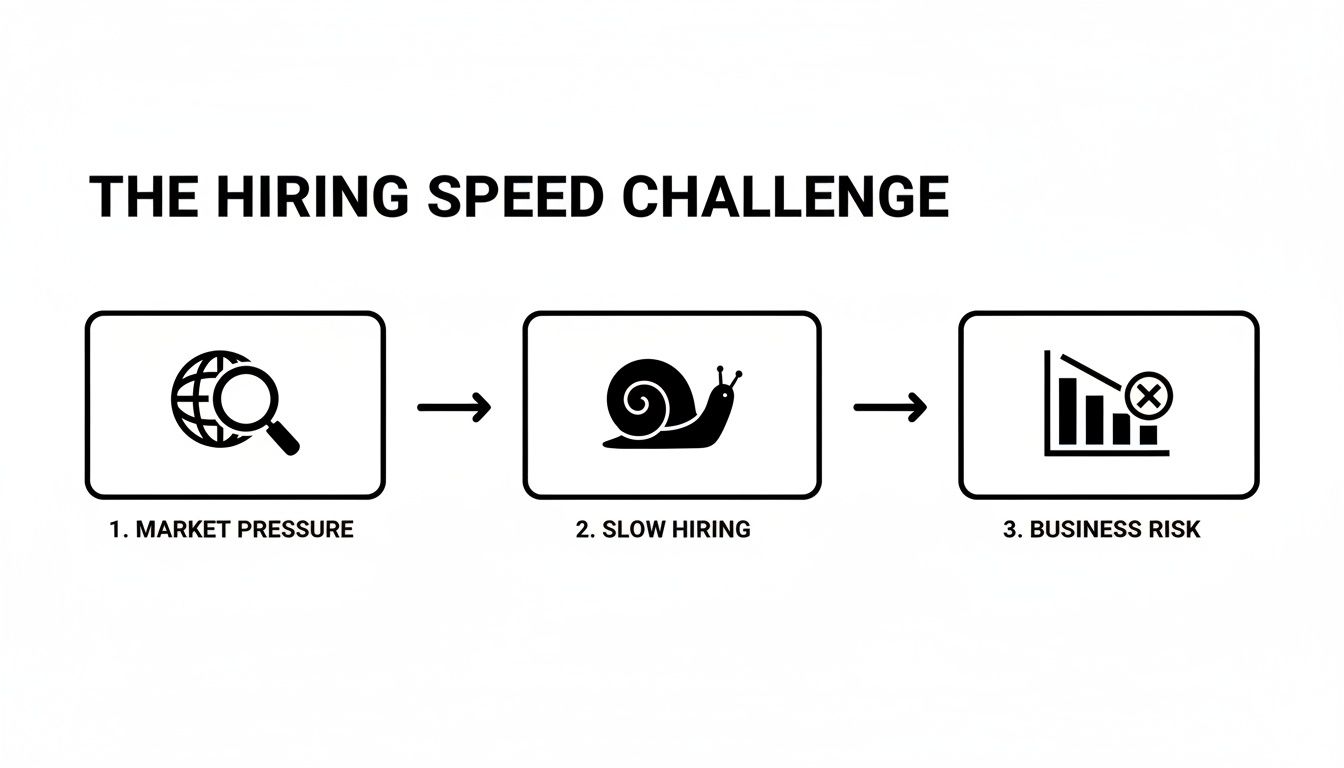
This simple flow shows a clear cause-and-effect chain. External market demands will always expose internal weaknesses, and slow hiring directly impacts your organisation’s stability and growth.
Digging Into the Data With a Process Audit
Your first practical step is to create a detailed process map. Don’t just assume you know every step from your office. Get your recruiters, hiring managers, and even some recently hired employees in a room—their perspectives are invaluable for getting a complete picture. Document every single touchpoint, handover, and decision point.
Once it’s all mapped out, you can start analysing the time spent in each stage. This is where time-in-stage, a far more insightful KPI, comes into play. It measures precisely how long a candidate sits in each phase of your pipeline, instantly revealing those hidden friction points.
For instance, you might find that your team screens applications within 48 hours (great!), but then those same candidates sit for an average of 10 days waiting for a hiring manager’s review. That’s not a sourcing problem; it’s an internal communication and accountability issue. Or perhaps you discover that scheduling interviews takes a full week—a delay that can easily cost you top talent who are interviewing with more nimble competitors.
Following the Clues: Candidate Drop-Off Rates
Another crucial diagnostic is your candidate drop-off rate at each stage. Where are you losing the most people? If you see a high drop-off after the initial screening, it could point to a mismatch between your job descriptions and the actual role.
But if a significant number of candidates withdraw after the first interview? That’s a massive red flag. It might signal problems with the interview experience itself or a lack of engagement from the hiring managers.
Look closely at these common bottleneck areas:
- Application Review: Are applications just languishing in your ATS without a prompt review?
- Scheduling Delays: Is the back-and-forth of coordinating multiple interviewers’ calendars creating a major time lag?
- Feedback Collection: How long does it take for interviewers to submit feedback so a decision can actually be made?
- Offer Approval: Is your offer process bogged down in bureaucracy, involving far too many stakeholders?
Pinpointing these delays is not about assigning blame. It’s about gathering the data-driven insights you need to build a compelling business case for change—whether that means investing in new tech or completely redesigning workflows.
A thorough diagnosis is the foundation of any successful fast-hiring strategy. By understanding exactly where your process is failing, you can target your efforts and resources far more effectively. This data-first approach gives you the ammunition to justify investments in automation, RPO partnerships, or process re-engineering.
For more ideas on optimising your workflows, check out our guide to streamline your entire recruitment process for maximum efficiency. Think of this self-assessment as the essential first step toward building a truly agile and responsive talent acquisition function.
Building Your High-Velocity Hiring Tech Stack
In modern recruitment, technology isn’t just a background player; it’s the engine driving the entire operation. For any CHRO serious about building a high-velocity hiring machine, the right tech stack is simply non-negotiable.
This is about graduating from a basic Applicant Tracking System (ATS) that just hoards résumés. The goal is a truly interconnected ecosystem—one that automates tedious workflows, sharpens decision-making, and creates an experience candidates will actually appreciate.

Ultimately, you want to eliminate the manual, low-value tasks that bog down your talent acquisition team. This frees them up to focus on what really moves the needle: building genuine relationships with top-tier candidates. This is a crucial piece of the puzzle for any effective fast hiring solutions for CHROs, where technology becomes your biggest accelerator.
The Foundation: A Modern Applicant Tracking System
Think of your ATS as the central nervous system of your entire hiring operation. A clunky, legacy system will create bottlenecks at every turn, but a modern one should actively clear the path.
Here’s what you should be looking for in an ATS:
- Workflow Automation: Does it automatically move candidates to the next stage? Can it send out polite rejection emails and nudge hiring managers for feedback without manual intervention?
- Advanced Communication Tools: It should enable personalised, bulk email and even SMS campaigns. This is key for keeping candidates warm and informed.
- Seamless Integrations: Your ATS must connect effortlessly with other critical tools, like assessment platforms and video interviewing software, creating one undisputed source of truth.
Without a solid ATS, any attempt to speed up hiring is like building on sand. You’ll just end up with data silos and a whole lot of frustration.
AI-Powered Screening for Speed and Precision
Let’s be honest: sifting through hundreds, sometimes thousands, of applications for a single role is one of the biggest time-sinks in recruitment. This is precisely where AI-powered screening and assessment tools are an absolute game-changer. These platforms can chew through résumés, cover letters, and application data in minutes, surfacing the most qualified candidates based on criteria you define.
This isn’t about replacing human judgment; it’s about supercharging it. AI can hand your recruiters a high-quality shortlist almost instantly, letting them spend their valuable time engaging with the best fits, not just filtering out the noise.
This approach is quickly becoming the norm. With over 70% of Indian enterprises reporting tech skills shortages by 2025, it’s no surprise they are turning to AI-driven screening and digital platforms to scale hiring fast.
By automating the top of the funnel, you can shrink the time from application to first contact from days to mere hours. In a market where top candidates are juggling multiple offers, that speed is a massive competitive advantage.
For a deeper dive into assembling the right set of tools, our complete guide on building your ideal recruitment tech stack offers a fantastic framework.
Eliminating Friction With Scheduling and Interview Tools
Interview scheduling can be a logistical nightmare. The endless back-and-forth emails can easily delay the process by a week or more. Automated scheduling tools completely erase this friction.
It’s a simple but powerful process:
- Recruiters define availability based on the hiring team’s calendars.
- Candidates get a link and pick a time slot that works for them. No more email tag.
- The meeting is automatically booked on everyone’s calendar, complete with video conference links.
Similarly, integrated video interviewing platforms—both live and asynchronous (one-way)—offer huge efficiency gains. Asynchronous interviews, where candidates record answers to preset questions on their own time, allow your team to review a much larger pool of first-round talent than traditional phone screens ever could.
These tools aren’t just about convenience. They’re about collapsing the timeline between a candidate showing interest and having a meaningful conversation. When you remove these administrative hurdles, you show respect for the candidate’s time and keep the momentum going—which is absolutely critical for locking in in-demand talent.
Rethinking Sourcing for Speed and Scale
In this market, just posting a job and waiting is a surefire way to lose the talent war. The most effective fast hiring solutions for CHROs are built on proactive, relentless, and data-backed sourcing. It’s a complete mindset shift from passively receiving applications to actively hunting for the right people.
Think of the old model like fishing with a single line and hoping for a bite. The new approach is about creating a well-stocked, self-sustaining ecosystem where you always have access to the talent you need, exactly when you need it.

This means cultivating active talent pipelines—curated pools of pre-vetted, engaged candidates for your most critical roles. When a position opens, you aren’t starting from zero; you’re tapping into a warm network ready to go.
Moving Beyond Traditional Job Boards
Job boards still have their place, but making them your primary source is a recipe for slow, reactive hiring. High-velocity sourcing demands that you meet talent where they already are, using multiple channels.
Consider these high-impact alternatives:
- Targeted Social Media Campaigns: Go beyond just posting on your company’s page. Use platforms like LinkedIn to run laser-focused ad campaigns aimed at professionals with specific skills, in specific industries, or even at your direct competitors.
- Niche Online Communities: Your ideal software developer probably isn’t scrolling through job portals. They’re likely active on GitHub, Stack Overflow, or a specialised Slack community. Engaging authentically in these spaces builds credibility and helps you spot passive talent.
- Data-Driven Employee Referral Programmes: It’s time to modernise your referral programme. Instead of a passive system, use data to prompt employees with smart suggestions. For example, “We’re hiring a Product Manager. Do you know anyone at your previous company with these skills?”
This proactive strategy creates multiple inbound streams of talent, cutting your dependency on any single, slow-moving channel.
To illustrate, let’s look at how different modern sourcing channels stack up in terms of speed and quality.
Effectiveness of Modern Sourcing Channels
A look at the typical speed and quality outcomes from various modern sourcing channels.
| Sourcing Channel | Average Time-to-Source | Typical Candidate Quality | Best For Roles |
|---|---|---|---|
| Talent Pipelines | 1-5 days | Very High | Critical, high-volume roles (e.g., Sales, Engineering) |
| Smart Referrals | 5-10 days | High | Roles requiring strong cultural fit, mid-senior level |
| Social Media Campaigns | 10-20 days | Medium to High | Niche skills, competitive markets, employer branding |
| Niche Communities | 15-25 days | Very High | Highly technical or specialised roles (e.g., AI, DevOps) |
| Traditional Job Boards | 25+ days | Low to Medium | Entry-level, generalist roles |
As the data shows, a multi-channel strategy that prioritises pipelines and referrals is objectively faster and yields better candidates than relying on job boards alone.
The Untapped Potential of Emerging Talent Hubs
One of the most powerful levers for faster hiring is simply looking in new places. The explosion of remote and hybrid work has untethered talent from the usual metropolitan hubs, creating incredible opportunities for companies willing to expand their search.
This trend is particularly powerful in India, where there’s a well-documented shift by employers to tap into Tier-2 and Tier-3 cities between 2024 and 2025. This strategic expansion is unlocking vast new talent pools. With location no longer the barrier it once was, companies can accelerate onboarding significantly. You can find more insights on these IT and non-IT hiring trends in India.
By combining this geographic expansion with remote assessment technologies, you can engage and evaluate candidates anywhere in the world. This dramatically cuts logistical delays and widens your talent net exponentially.
This isn’t just about finding more candidates; it’s about finding high-quality people in less competitive, often lower-cost markets. That’s a strategic advantage that directly fuels faster, more scalable hiring.
Building and Nurturing Your Talent Pipeline
An active talent pipeline is your single most valuable sourcing asset. It’s a living database of individuals who are already familiar with and interested in your company. Building it takes consistent effort, but the payoff in hiring speed is enormous.
Here’s a practical way to get started:
- Identify High-Priority Roles: First, focus on positions that are frequently open or critical to business operations, like sales representatives, customer support agents, or software engineers.
- Capture Silver Medallists: Don’t let great candidates slip away. Tag the excellent runner-up candidates from previous roles in your ATS and add them to a dedicated talent pool for future opportunities.
- Run Proactive Sourcing Campaigns: Dedicate recruiter time to sourcing for pipeline roles even when there are no open jobs. The goal is to build relationships before the need becomes urgent.
- Engage Consistently: Keep your pipeline warm with targeted content. This could be a quarterly newsletter, invitations to webinars, or articles relevant to their field. The goal is simple: stay top-of-mind.
This long-term, relationship-focused strategy ensures that when a vacancy opens up, your recruiters have a pre-qualified, engaged list to contact immediately. This can slash the sourcing phase from weeks down to just a few days.
Implementing a Strategic RPO Partnership
When you’re facing a mountain of open roles or hunting for those rare, specialised skills that could overwhelm your in-house team, bringing in a Recruitment Process Outsourcing (RPO) partner can be a game-changer. This isn’t just about offloading your recruitment problems. A genuine RPO partnership is a strategic extension of your own team, one that deeply understands your culture and business goals to deliver faster, better hires.
For companies scaling up, launching new divisions, or expanding into new territories, an RPO brings the kind of instant expertise and capacity that could take years to build internally. It stands out as one of the most direct and effective fast hiring solutions for CHROs who need both speed and scale without letting candidate quality slip.
Identifying When an RPO Makes Sense
Deciding to work with an RPO provider is a major strategic call. It’s a move that makes the most sense when you’re up against specific, recognisable business challenges that are stretching your current talent acquisition function to its limits.
Does your organisation find itself in situations like these?
- Rapid Expansion: You have to hire 100+ sales reps next quarter for a new product launch. Your current team of five recruiters just doesn’t have the bandwidth.
- Niche Skill Scarcity: You’re building out a new data science unit and need 20 AI specialists with hard-to-find expertise. Your generalist recruiters don’t have the networks or the deep technical knowledge to find them.
- Inconsistent Processes: Your hiring process is a bit of a mess, varying from one department to another. This leads to a confusing candidate experience and unpredictable hiring results. An RPO can step in to standardise and streamline these workflows across the entire organisation.
For CHROs in India, the current market makes this decision even more critical. With 18–20% attrition in key sectors, a hiring surge expected across BFSI, IT, and healthcare in 2025, and the widespread use of AI tools, outsourcing has become a vital tactic. It’s about meeting your quarterly workforce targets and keeping cost-per-hire in check without compromising on quality. You can find more insights on these enterprise hiring solutions on Taggd.in.
Choosing the Right RPO Partner
Let’s be clear: not all RPO providers are the same. A successful partnership depends entirely on finding a partner that truly gets your industry, your specific needs, and your company culture. You have to look beyond a simple transactional relationship.
Here’s what to focus on when you’re making your choice:
- Industry and Domain Expertise: Do they have a proven history of hiring for roles in your sector? A provider with deep tech hiring experience will understand the nuances of finding great software engineers far better than a generalist.
- Cultural Alignment: This is non-negotiable. Your RPO partner is the face of your employer brand to candidates. They must understand and live your company’s values to create an authentic and positive experience for every applicant.
- Technology and Data Capabilities: A modern RPO partner should bring a serious tech stack to the relationship. Ask about their ATS, AI sourcing tools, and analytics dashboards. They need to give you real-time data on the metrics that matter.
- Scalability and Flexibility: Can they ramp their services up or down as your hiring needs change? A flexible model means you aren’t stuck paying for resources you don’t need during quieter hiring periods.
A strategic RPO partnership is built on trust and transparency. It should feel like you’ve added a specialist wing to your own team, one that is fully invested in your success and accountable for delivering measurable results.
Building the Business Case for RPO
To get the green light from your executive team, your business case needs to be built on solid, quantifiable benefits. Don’t just talk about “hiring faster.” You need to frame the investment in terms of its direct impact on the bottom line.
Your business case should really hammer home these points:
- Cost Savings: Yes, there’s an upfront cost, but a good RPO can dramatically lower your overall cost-per-hire. Think about the money saved on agency fees, reduced advertising spend, and the productivity boost from filling critical roles more quickly.
- Improved Quality of Hire: The best RPO providers have sophisticated sourcing tech and access to much larger talent pools. This means you get access to better candidates who are more likely to be a great long-term fit for your company.
- Increased Agility: An RPO gives you the power to react to market opportunities or sudden business shifts with incredible speed, allowing you to scale your workforce up or down on demand.
By positioning RPO as a strategic tool for business growth—not just another recruitment cost—you can build a compelling case that will get the entire C-suite on board.
Measuring Hiring Velocity and Driving Improvement
Rolling out fast hiring solutions for CHROs isn’t a one-and-done project. It’s an ongoing journey. To keep the momentum going, you have to look beyond simply plugging in new tools. The real secret to long-term success is building solid feedback loops and nurturing a culture that lives and breathes data-driven optimisation. This means creating a performance dashboard that shows you more than just how fast you’re hiring—it needs to show you how well you’re hiring.

Sustainable speed is built on a relentless drive to get better. It demands that you track the right metrics to understand what’s working, what isn’t, and where your next big opportunity for acceleration lies.
Building Your Performance Dashboard
Your dashboard needs to be the single source of truth for hiring performance. Let’s move past vanity metrics and focus on what actually impacts the business. Don’t clutter it. Zero in on the KPIs that truly matter for speed and quality.
Here are the essentials:
- Time-to-Hire by Department/Role: This metric immediately flags which business units or role types are dragging down your average. A bottleneck in engineering hiring will have completely different root causes than one in the sales team.
- Time-in-Stage Analysis: You absolutely must track how long candidates are sitting in each step of your pipeline. If you see a pile-up where candidates are waiting 10+ days for feedback after an interview, you’ve found a clear, actionable problem to attack.
- Quality-of-Hire: This is the ultimate balancing act. Are you hiring fast, or just hiring fast and well? Track 90-day performance reviews or first-year retention rates for new hires. Speed is pointless if the people you bring on board don’t perform or stick around.
- Source-of-Hire Effectiveness: Get granular. Analyse which channels—be it referrals, direct sourcing, or job boards—are delivering the best candidates in the shortest amount of time. Then, double down on what works.
The Power of Service Level Agreements
To keep up the pace and ensure everyone is accountable, formalise your expectations with Service Level Agreements (SLAs). And no, these aren’t just for your external vendors. They are incredibly potent tools for aligning your internal teams and driving the right behaviours.
An SLA transforms a vague goal like “let’s hire faster” into a concrete commitment. It creates shared ownership between recruiters and hiring managers, making everyone accountable for their part of the process.
Set crystal-clear SLAs for those critical handoffs:
- Hiring Manager Feedback: 24-48 hours to give feedback after an interview. No exceptions.
- Recruiter Shortlist Delivery: 72 hours to present the first slate of qualified candidates once a role is approved.
- Offer Approval Turnaround: 24 hours for final sign-off once a candidate has been selected.
These agreements strip away ambiguity and make sure everyone knows exactly what’s expected of them to keep the gears turning. They are the operational backbone of any high-velocity hiring function.
For CHROs in India, deploying fast hiring solutions effectively means embracing the practices that top-tier vendors and enterprise hiring platforms champion—things like geo-targeted sourcing and remote assessment centres. These strategies are proven to slash time-to-hire by tapping into otherwise hidden candidate pools and enabling rapid, scalable onboarding. Ultimately, this boosts hiring velocity and makes the entire process more cost-efficient. You can find more insights on IT and non-IT hiring trends in India to stay ahead.
At the end of the day, continuous improvement is the engine of a successful fast-hiring strategy. By consistently measuring performance, holding teams accountable with clear SLAs, and using data to sharpen every step, you can build a talent acquisition function that is not just fast, but sustainably fast—giving your organisation a powerful and lasting competitive edge.
Common Questions About Fast Hiring Solutions
Even with the best roadmap in front of you, it’s only natural to have a few questions. When you’re talking about changing something as fundamental as hiring, addressing these concerns head-on is the best way to get everyone aligned and moving in the same direction.
How Do We Maintain Quality While Hiring Faster?
This is probably the number one concern I hear from CHROs. There’s a persistent fear that speeding things up means cutting corners and letting quality slip. But that’s a myth.
Fast hiring isn’t about skipping crucial steps; it’s about making those steps smarter and more efficient. Think about it: by using AI-powered screening to instantly shortlist the most relevant candidates and automating the tedious admin work, you’re not taking your recruiters out of the picture. You’re freeing them up to do what they do best—engage with top-tier talent.
Instead of your team sifting through 500 applications just to find a handful of good ones, they can now jump straight to engaging the top 25 prospects flagged by your system. This means more time for deeper, more insightful conversations and interviews. The outcome? A better quality of hire, not a worse one.
What Is the Best Way to Get Stakeholder Buy-In?
Getting your leadership team and hiring managers on board isn’t about HR theory; it’s about speaking their language—the language of business impact. Use the data from your process audit to show them precisely where the bottlenecks are costing the company time, money, and top candidates.
Here’s a powerful tactic I’ve seen work time and again: frame the discussion around competitive advantage. Don’t just talk about internal efficiency. Show them data on how quickly your direct competitors are snapping up talent for similar roles. Suddenly, it’s not just an HR project; it’s a strategic move to win in the market.
To seal the deal, propose a pilot programme. Pick a single department or a specific role and aim for a quick, measurable win. Nothing builds confidence like a real success story. These early victories will be your most powerful tool for rolling out the changes across the entire organisation.
Ready to accelerate your hiring and build a more agile talent function? Taggd can help. See how our strategic RPO solutions can transform your entire recruitment process. Explore our services at Taggd.in.