Internal mobility isn’t just a buzzword; it’s the practice of moving your employees into new roles and opportunities right within your own organisation. For a long time, this was seen as a “nice-to-have” HR function. Today, it’s a core business strategy for holding onto your best people, plugging critical skills gaps, and building a more adaptable, resilient workforce.
Why Internal Mobility Is Now a Business Imperative
CHROs are currently facing a perfect storm: employee turnover is high, and at the same time, bringing in fresh talent from outside is getting slower and tougher. Relying only on external recruitment to fill important roles just isn’t a sustainable strategy anymore. The focus has to shift inward, turning the challenge of talent retention into a proactive, strategic advantage.
This is exactly where a well-thought-out internal mobility program becomes essential. It’s about creating clear, structured pathways for your people to grow their careers without having to look elsewhere. And it’s not just about climbing the ladder.
The Scope of Modern Mobility
True internal mobility is multi-directional and offers a variety of growth paths:
- Vertical Moves: The classic promotion—moving up to a role with more responsibility.
- Lateral Moves: Shifting to a different team or function. This is a fantastic way for employees to broaden their skill sets and get a more complete picture of the business.
- Project-Based Roles: Temporary assignments on key projects. These are goldmines for skill development and help break down those rigid departmental silos.
- Mentorship Opportunities: Pairing seasoned leaders with up-and-coming talent. This is crucial for passing down institutional knowledge and nurturing the next generation of leaders.
This modern approach recognises that careers aren’t always a straight line up. By providing different options, you empower employees to design their own career journey, which is a massive driver of engagement and loyalty.
Responding to Escalating Attrition
The pressure to get internal mobility right is especially intense in the Indian market. The war for talent has pushed employee churn to unprecedented levels. Just look at the numbers: the attrition rate in India shot up to 20.3% in 2022. That’s a huge jump from only 6% back in 2020. This staggering 238% increase in just two years is a wake-up call that demands an immediate and strategic response from every CHRO.
A high attrition rate is often a symptom of a much deeper problem—usually, it’s a perceived lack of growth opportunities. Internal mobility tackles this root cause head-on by making your current employees your first and best choice for new roles.
To get a better handle on this challenge, it helps to compare the two main approaches to filling roles.
Internal Mobility vs External Hiring: A Strategic Comparison
For CHROs in India navigating today’s economic landscape, the decision isn’t just about filling a vacancy. It’s about making a strategic choice that impacts culture, cost, and long-term capability. The table below breaks down the key differences.
| Factor | Internal Mobility | External Hiring |
|---|---|---|
| Time-to-Fill | Significantly faster. Candidates are already in the system and familiar with the culture. | Much slower. Involves extensive sourcing, screening, multiple interview rounds, and notice periods. |
| Cost-per-Hire | Substantially lower. Eliminates external agency fees, advertising costs, and extensive background checks. | High. Includes recruitment fees (often 15-20% of salary), advertising, and extensive onboarding expenses. |
| Cultural Fit & Risk | Low risk. The candidate’s work ethic and cultural alignment are already proven. | High risk. There’s always a chance a new hire won’t adapt to the company culture, leading to early turnover. |
| Employee Engagement | Boosts morale and engagement. Shows employees there’s a clear path for growth within the company. | Can lower morale. Existing employees may feel overlooked, leading to disengagement and potential attrition. |
| Institutional Knowledge | Preserves valuable knowledge. Key insights about processes, clients, and internal networks stay within the organisation. | Erodes institutional knowledge. Every time an experienced employee leaves, their unique knowledge walks out the door. |
While external hiring will always be necessary to bring in new skills and perspectives, a heavy reliance on it can be a costly and risky game. A balanced strategy that prioritises internal talent first is far more sustainable.
Ignoring the rising attrition trend is an expensive mistake. The cost of replacing an employee isn’t just about the recruitment fee; it includes lost productivity, the time it takes for a new hire to get up to speed, and the slow erosion of your company’s collective knowledge. For a closer look at this, check out our guide on understanding and preventing employee attrition.
Ultimately, putting money and effort into your internal mobility program is a direct investment in the stability and future growth of your organisation. It sends a powerful message to your workforce: we see your potential, and we’re committed to your success here. This shift in mindset—from simply buying talent to actively building it—is what separates the resilient, thriving organisations from the ones left constantly playing catch-up.
Architecting Your Internal Mobility Framework
A successful internal mobility programme doesn’t just happen. It’s built on a solid, thoughtfully designed framework that acts as the backbone for your entire initiative. Without this structure, any effort to move people around the organisation will feel chaotic and reactive, rather than strategic.
The very first piece of the puzzle is creating a comprehensive skills taxonomy. Think of this as the DNA of your workforce—a detailed catalogue of all the skills, competencies, and capabilities your employees currently have. This goes far beyond simple job titles. We’re talking about a granular inventory of what your people can actually do, from “Python programming” to “financial risk modelling.”
To build this, you’ll need to roll up your sleeves and work closely with department heads. The goal is to break down every single role into its core skills. It’s this foundational work that later allows powerful AI tools to intelligently match an employee’s profile to a new opportunity they might never have considered on their own.
Building Your Job Architecture
With a clear picture of your skills landscape, the next logical step is to construct a robust job architecture. This is the structural blueprint that organises every role in the company into logical job families and levels. A clear architecture demystifies career progression and shows employees exactly how they can grow within the organisation.
A well-defined job architecture brings much-needed consistency to job titles, levelling, and even compensation across different departments. It ensures that a ‘Senior Analyst’ in Finance holds a comparable level of responsibility and skill requirement to a ‘Senior Analyst’ in Marketing. This kind of clarity is absolutely essential for making both lateral moves and promotions feel fair and transparent to everyone.
This is how you turn a high-attrition problem into a strategic mobility solution.
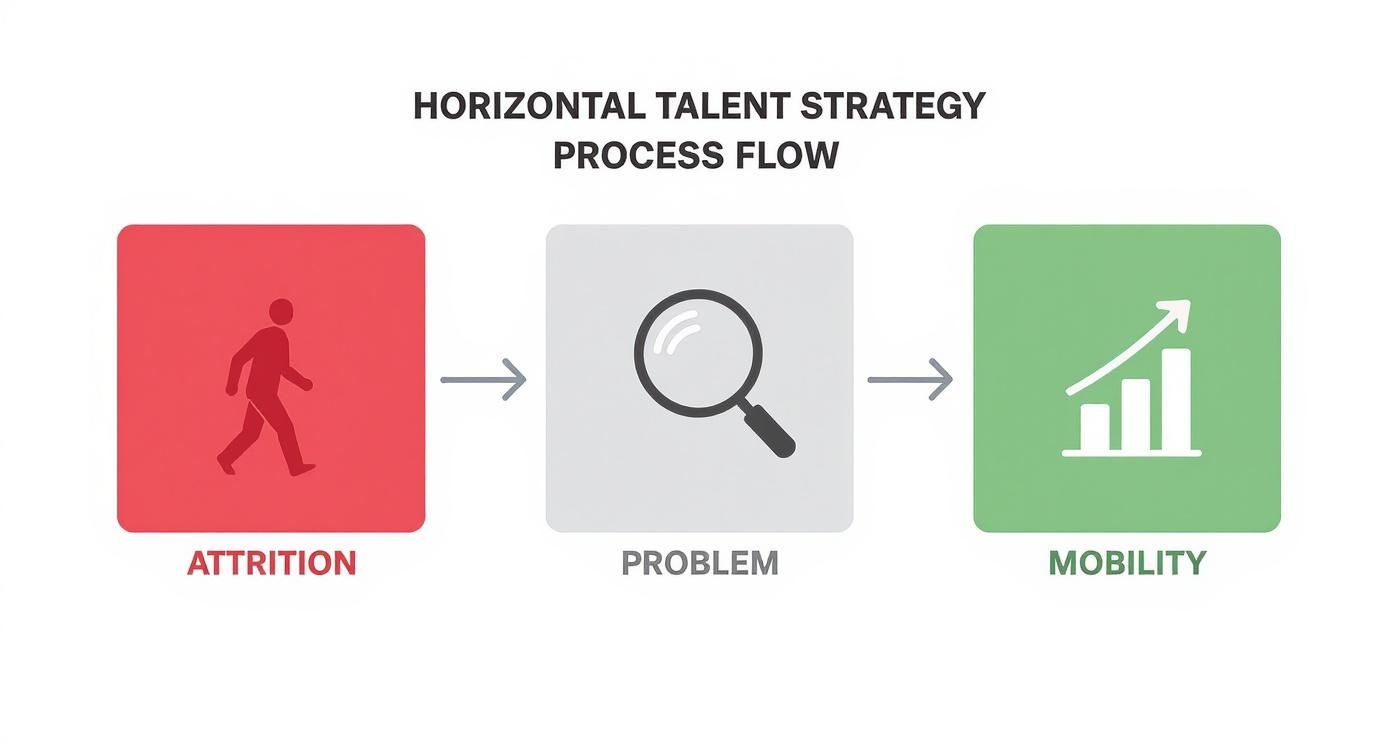
This visualisation really captures the shift from reactively losing good people to proactively creating internal pathways for them to grow and stay.
Mapping Transparent Career Pathways
Once your skills taxonomy and job architecture are in place, you can start mapping out transparent career pathways. These are the visible routes your people can take to advance. It’s not just about showing them the next rung on the ladder; it’s about revealing a whole web of potential moves—up, sideways, and even into short-term special projects.
Let’s take a large financial services firm in Bengaluru, for instance. A traditional career path might show a Customer Service Representative moving up to a Senior Representative, and then maybe a Team Lead. A modern, mobility-focused approach, however, would illuminate many more possibilities:
- Lateral Move: That same representative could leverage their deep product knowledge to shift into a Junior Product Specialist role in a different team.
- Upskilling Path: They might pursue company-sponsored data analysis certifications and transition into an entry-level Risk Analyst position.
- Project-Based Gig: They could join a six-month project to help launch a new digital banking app, gaining valuable tech and project management experience along the way.
These pathways need to be clearly documented and easy for everyone to access, ideally through a dedicated talent marketplace or internal careers portal. Transparency is everything here. People need to see what’s possible before they’ll feel motivated to go after it.
A career path shouldn’t be a ladder; it should be a jungle gym. Offering multiple routes for growth and exploration is far more engaging and ultimately builds a more agile, cross-functional workforce.
Pinpointing and Bridging Skill Gaps
An essential part of this framework is conducting a continuous skills gap analysis. By constantly comparing the skills you have (from your taxonomy) with the skills you need to hit future business goals, you can spot critical gaps early. This transforms your Learning and Development (L&D) team from a generalist provider into a truly strategic business partner.
If your analysis reveals a growing need for machine learning expertise but you have a surplus of manual data processors, your L&D team can get to work designing targeted reskilling programmes. This proactive approach is far more cost-effective than laying off one group while simultaneously trying to hire another externally. In fact, research shows that external hires can cost 18-20% more than promoting from within.
Defining Clear Mobility Processes
Finally, the entire framework is held together by clear and simple processes. Ambiguity is the enemy of adoption. Every single employee needs to understand the rules of engagement for internal mobility.
Your process should clearly define:
- Eligibility Criteria: How long must someone be in their current role before they can apply for another? A good starting point is often 18-24 months.
- Application Process: How does an employee officially raise their hand? Is it a confidential application through a talent marketplace, or does their manager need to be notified first?
- Interview and Selection: Internal candidates deserve the same professional courtesy as external ones, which means structured interviews and timely, constructive feedback.
- Transition and Handover: What is the standard notice period for an internal move? How will the handover to their old team be managed to ensure business continuity?
By standardising these steps, you create a fair and equitable system that builds trust. When employees believe the process is transparent and unbiased, they are far more likely to engage with your internal mobility programs, transforming your company into a true talent incubator.
Securing Buy-In and Driving Adoption
An internal mobility programme, no matter how perfectly designed, is destined to fail without widespread support. Let’s be clear: a successful rollout isn’t about launching a new policy. It’s about leading a fundamental cultural shift.
This change management effort has to start at the top, but it can’t stop there. It must cascade through every level of the organisation, especially engaging the line managers who are the true gatekeepers of talent.

To win over senior leadership, you have to speak their language. Frame the initiative not as an HR project, but as a core business strategy. Your entire narrative needs to be built on a foundation of data-driven arguments that connect directly to the bottom line and long-term organisational health.
Crafting a Compelling C-Suite Narrative
Your pitch to the leadership team needs to be sharp, strategic, and laser-focused on tangible outcomes. This is the time to drop the HR jargon and concentrate on the metrics that actually matter to them.
- Lead with ROI: Quantify the savings. Show them a side-by-side comparison: the high cost of external recruitment—agency fees, advertising, longer onboarding—versus the significantly lower cost of placing someone internally.
- Highlight Retention Metrics: Showcase how internal mobility is a direct weapon against attrition. Present hard data showing that employees with clear growth paths are far more likely to stay, preserving invaluable institutional knowledge.
- Future-Proof the Workforce: Position the programme as a strategic tool for building skills proactively. Explain how it allows the company to build the capabilities it will need tomorrow, rather than scrambling to buy them from the outside.
A powerful case study can be your most effective tool here. Detail a recent, painful example where a critical role sat open for months, delaying projects and costing money. Then, illustrate how an internal candidate could have filled that gap quickly and effectively.
Overcoming Manager Resistance
Honestly, the biggest barrier you’ll likely face is at the middle-management level. Many managers, particularly those with high-performing teams, are prone to ‘talent hoarding.’ They’re terrified that losing their best people will crush their team’s output and reflect poorly on them. Addressing this fear head-on is critical.
The key is to realign their incentives. You have to transform them from talent hoarders into talent champions. This requires a potent mix of clear communication, revised performance metrics, and dedicated training.
Manager success should not be measured by how many top performers they can keep, but by how many leaders they can develop and export to the rest of the organisation. This mindset shift is non-negotiable for a thriving mobility culture.
To make this real, consider introducing new KPIs for managers that explicitly reward them for developing their team members for their next roles. Publicly celebrate managers whose direct reports successfully move into new internal positions. This sends a powerful signal that developing people is a valued leadership competency.
Developing a Continuous Communication Plan
Securing that initial buy-in is just the first step. To truly embed internal mobility programmes into your company culture, you need a sustained and vibrant communication plan. The goal is to make internal growth a constant, visible, and celebrated part of the employee experience.
Your plan should use multiple channels and hammer home a consistent message:
- Launch with a Bang: Kick off the programme with a company-wide announcement from the CEO to signal its strategic importance.
- Showcase Success Stories: Regularly feature employees who have made successful internal moves. Put them in newsletters, town halls, and on your internal social channels.
- Integrate into Performance Reviews: Equip managers to discuss career aspirations and internal opportunities during their regular check-ins.
- Promote Open Roles: Make it incredibly easy for employees to see what’s out there, ideally through a centralised talent marketplace.
Despite these efforts, many organisations still struggle with adoption. In India, for instance, employees are 1.0x more likely to leave their company than to make an internal move. This tells us there’s a critical gap in visibility and encouragement. This highlights the need for a communication strategy that doesn’t just inform but actively encourages people to participate.
Ultimately, your communication should reinforce a simple, powerful message that resonates with what younger generations want from work. To get a better handle on this, you might be interested in our article on what Millennials and GenZ expect from employers in India. By making mobility a visible and celebrated norm, you create a culture where your best people see a long and rewarding future with you.
Choosing Technology to Power Your Mobility Engine
Let’s be honest, modern internal mobility runs on technology, not spreadsheets. To truly get your program off the ground and create an experience employees actually want to use, the right tech stack is non-negotiable. It’s the engine that takes your mobility framework from a static document and turns it into a living, breathing talent ecosystem.
At the very heart of this ecosystem is the AI-powered talent marketplace. These platforms are a world away from the internal job boards of the past. Instead of making employees hunt for opportunities, they proactively match people to roles, projects, mentorships, and even short-term gigs based on a real understanding of their skills, experience, and what they want to do next.
This proactive matching is the real game-changer. It surfaces opportunities that employees might never have considered on their own, breaking down the usual departmental silos and revealing hidden career paths. This is how you shift from a passive, reactive system to one that actively cultivates and directs your internal talent pipeline.
Evaluating Your Platform Options
When it comes to picking the right technology, you generally have two main paths you can go down. Each has its own set of pros and cons.
- Integrated HCM/HRIS Modules: Many large Human Capital Management systems offer internal mobility or talent marketplace modules. The big win here is seamless integration—all your employee data is already in the system, which can make the initial setup much simpler. The flip side? These modules can sometimes feel less specialised and might lack the sophisticated AI matching algorithms you’d find in a dedicated platform.
- Standalone Talent Marketplaces: These are specialist platforms built from the ground up for one thing: internal mobility. Their strength is in their powerful skills-based matching, superior user experience, and often more agile development. The main thing you need to check is how well they can integrate with your existing HR systems to create a unified flow of data.

This just shows that effective talent management—including internal mobility—sits right at the intersection of performance, learning, and recruitment. It’s all powered by a central technology platform that brings everything together.
Key Features to Scrutinise
As you look at different technologies, try not to get distracted by flashy bells and whistles. Zero in on the core functions that will actually drive adoption and deliver real value.
The best technology feels invisible to the user. It should make career exploration intuitive and empowering, not feel like another piece of corporate software they are forced to use. A clunky user experience is the fastest way to kill adoption.
Your evaluation process should be rigorous. Don’t just sit through a canned presentation. Insist on live demos using your own sample data, not just the vendor’s perfect scenarios. Talk to other CHROs who have implemented the solution. The right choice will become a cornerstone of your talent strategy for years to come.
Crucial Evaluation Criteria for Your Next Platform
When you’re assessing potential vendors, you need to dig deep into these specific areas to make sure you’re making a sound investment.
- Skills Inference Quality: How does the platform actually build and maintain its skills data? Does it use AI to pull skills from CVs, performance reviews, and project histories, or is it all on the employee to manually enter everything? The strength of the platform is directly tied to the quality of its skills intelligence.
- User Experience (UX): Is the interface clean, modern, and genuinely easy for employees to navigate? A consumer-grade experience is essential. If it isn’t as easy to use as LinkedIn, your people simply won’t engage with it.
- Integration Capabilities: How easily can the platform connect with your core HRIS, Learning Management System (LMS), and other tech you already use? Look for robust APIs and a proven track record of successful integrations with systems like yours.
- Analytics and Reporting: The platform absolutely must provide you with a clear dashboard of key mobility metrics. You need to be able to track internal fill rates, measure the programme’s impact on retention, and spot skills gaps in real-time.
Choosing the right technology is about more than just buying software; it’s about investing in the infrastructure that will power your company’s growth from within. This tech-driven approach is also a key component of modern talent acquisition. For more insights, learn about how our recruitment platform eases digital hiring and see how these principles apply across the talent lifecycle. By selecting a platform that truly understands skills and empowers employees, you create a powerful engine for continuous development and retention.
Measuring Success and Demonstrating Business Impact
An internal mobility programme without clear metrics is just a feel-good initiative. To get the C-suite on board and secure ongoing investment, you absolutely have to prove its strategic worth. This means going way beyond simple participation rates and rigorously measuring how it moves the needle for the business.
Think of it as building a compelling dashboard that draws a straight line from your programme’s activities to real financial and operational wins. The goal is to translate HR-speak into the language of the boardroom. When you can confidently show leadership how mobility is cutting costs, slashing hiring times, and keeping your best people around longer, the conversation shifts from a cost-centre discussion to a strategic investment review.
Core KPIs for Your Mobility Dashboard
Start by tracking a handful of Key Performance Indicators (KPIs) that tell a clear, powerful story. These metrics give you a solid, holistic view of your programme’s health and impact.
- Internal Fill Rate: This is your north star metric. It’s simply the percentage of open roles filled by your own people versus external hires. A steadily rising internal fill rate is the most direct sign of a healthy internal talent pipeline.
- Time-to-Fill (Internal vs. External): Track how many days it takes, on average, to fill a role with an internal candidate compared to someone from the outside. That difference—often weeks, sometimes months—translates directly into productivity gains and slashes vacancy costs.
- Cost-per-Hire Savings: This one really hits home with the finance team. Calculate the all-in cost of an external hire—think agency fees, advertising spend, extensive background checks—and stack it up against the minimal cost of an internal move. When you multiply this difference by your internal fill rate, you get a powerful ROI figure that’s hard to ignore.
These initial metrics build a strong quantitative case for just how efficient and cost-effective your internal mobility programs are.
Linking Mobility to Broader Business Outcomes
To really elevate your analysis, you have to connect these HR-centric KPIs to the bigger business outcomes that the entire leadership team cares about. This is where you show that internal mobility isn’t just an HR win; it’s a massive win for the whole organisation.
Take a hard look at the impact on employee retention. Analyse the turnover rates for employees who’ve made an internal move versus those who haven’t. The data is consistent here: employees at companies that champion internal mobility stick around for much longer. One LinkedIn report found they stay for a 41% longer tenure—that’s a statistic that gets attention.
A successful internal mobility programme fundamentally changes your employee value proposition. It shifts the entire narrative from “What job can I get here?” to “What career can I build here?” This shift is the single most powerful retention tool you have.
And it doesn’t stop there. Dig into the link between internal moves and engagement scores. Do employees who participate in mobility opportunities report higher satisfaction and engagement in your annual surveys? Connecting your programme to a boost in morale and discretionary effort adds a powerful qualitative layer to your data-driven story.
Here’s a quick look at the kind of metrics you should be tracking to build that comprehensive picture of your programme’s ROI.
Key Metrics for Measuring Internal Mobility ROI
| Metric Category | Specific KPI | How to Calculate | Business Implication |
|---|---|---|---|
| Recruitment Efficiency | Internal Fill Rate | (Number of Internal Hires / Total Hires) x 100 | Indicates reliance on and strength of the internal talent pipeline. |
| Cost Savings | Cost-per-Hire (Internal vs. External) | (Total External Recruitment Costs / # of External Hires) vs. (Total Internal Mobility Costs / # of Internal Hires) | Demonstrates direct financial savings from reduced agency fees, advertising, and onboarding. |
| Speed & Productivity | Time-to-Fill (Internal vs. External) | Average days from job posting to offer acceptance for internal vs. external candidates. | Shows reduced vacancy time, leading to less productivity loss and faster team integration. |
| Talent Retention | Employee Turnover Rate (Movers vs. Non-Movers) | Compare turnover rates for employees who have made an internal move vs. those who haven’t. | Proves mobility’s impact on retaining key talent and reducing costly attrition. |
| Employee Engagement | Engagement Scores | Analyse survey data, comparing scores of employees who have participated in mobility vs. those who haven’t. | Links mobility to higher morale, motivation, and discretionary effort. |
| Performance Impact | 90-Day Performance of New Hires | Compare performance ratings of internal movers vs. external hires in their first three months. | Highlights how internal hires ramp up faster and contribute to business goals more quickly. |
Tracking these metrics consistently will give you the evidence you need to not just defend your programme, but to champion it as a core business driver.
Building a Compelling ROI Analysis
Your final step is to package these metrics into a compelling Return on Investment (ROI) story for the board. This isn’t just about dumping data into a spreadsheet; it’s about weaving a narrative of value creation.
The financial upside of a mobile workforce isn’t just a local phenomenon. The full India Skills Report projects that cross-border talent mobility could add a staggering USD 500 billion to the global economy by 2030, with India playing a central role. When companies master internal mobility, they unlock massive potential.
Your ROI framework should be crystal clear. For example, show how a 10% increase in your internal fill rate directly translated to ₹X crores in saved recruitment fees and Y days of recaptured productivity from faster hiring. By quantifying the impact in concrete financial terms, you secure the buy-in needed to not just sustain your internal mobility efforts, but to scale them for the future.
Common Questions About Internal Mobility Programmes
Even with the best-laid plans, rolling out an internal mobility programme will always surface some tricky questions and unique hurdles. As a CHRO, having thoughtful, clear answers ready is crucial for keeping momentum and building trust in the new system. Let’s tackle some of the most common questions that pop up.
How Do We Prevent Managers From Hoarding Top Talent?
This is the big one. It’s probably the most common and deeply ingrained challenge you’ll face. The fear of losing a high-performer can lead managers to subtly—or not so subtly—block their team members from exploring new opportunities.
To really solve this, you need a multi-pronged strategy that shifts the entire culture. It’s not about owning talent; it’s about developing it.
First, you have to change what it means to be a great manager. Weave talent development directly into their performance metrics. Start publicly celebrating leaders whose team members successfully move into new roles across the business. Make it a badge of honour.
Next, bring everything into the light. A well-designed talent marketplace makes it incredibly difficult for managers to hide opportunities or hoard skilled people. When everyone sees what’s available and who has the right skills, the system itself encourages movement.
Finally, set some clear ground rules. A common best practice is to set a time-in-role policy. For instance, any employee who has been in their role for 18-24 months can freely explore internal roles without needing their manager’s permission first. This empowers your people and establishes a clear company-wide standard.
What Is the First Step If We Have No Formal Programme?
Starting from a blank slate can feel overwhelming. The secret is to start small, aim for a few early wins, and build from there. Don’t try to boil the ocean with a massive, company-wide launch right out of the gate.
Your first move should be to pick one critical department and really understand its skills landscape. Run a skills inventory to get a basic map of the capabilities you have. At the same time, sit down with that department’s leaders to identify their biggest talent headaches and what skills they’ll need down the road.
Armed with that data, you can start manually facilitating a few high-impact internal moves. Maybe that data-savvy marketing analyst gets a chance to move into a junior business intelligence role. The success stories from this small pilot, backed by real data on cost savings and faster hiring times, become the fuel for your business case to build a broader, tech-supported programme.
The goal of a pilot isn’t perfection; it’s proof. A handful of successful, well-documented internal moves are far more persuasive to leadership than a hundred-page strategy document.
How Does Internal Mobility Differ From Succession Planning?
It’s easy to mix these two up, and while they should absolutely work in tandem, they serve very different purposes. Confusing them can lead to a mobility programme that’s too narrow and ultimately ineffective.
Think of it this way:
- Succession Planning is a targeted, top-down strategy. Its focus is narrow: identifying and grooming a small pool of high-potential individuals for specific, mission-critical leadership roles. It’s all about mitigating risk and ensuring the business can continue without disruption. It answers the question, “Who will lead our key teams tomorrow?”
- Internal Mobility is a broad, democratic process for everyone. It’s about empowering every single employee to take charge of their career by making all kinds of opportunities visible—promotions, lateral moves, project gigs, and even mentorships. It answers the question, “How can we help all our people build a meaningful, long-term career right here?”
In short, succession planning secures the future for a few key positions. A strong internal mobility programme, on the other hand, builds a dynamic and resilient talent ecosystem for the entire organisation, driving engagement and growth at every level.
Ready to build a resilient workforce and stop losing your best people to the competition? The experts at Taggd specialise in recruitment process outsourcing that helps organisations like yours build powerful internal talent pipelines. Learn how we can help you design and implement a strategy that drives retention and growth. Discover more at https://taggd.in.