Workforce planning for India’s burgeoning pharma exports is more than just a buzzword; it’s about creating a proactive talent strategy that keeps pace with blistering global demand. This means a fundamental shift away from reactive hiring. We need a predictive model that anticipates the skills we’ll need tomorrow, especially for those highly regulated markets. It’s about building a solid pipeline of specialists in manufacturing, quality, and regulatory compliance to meet our ambitious growth targets.
The Talent Challenge Behind India’s Pharma Export Boom

India’s pharmaceutical sector is on an absolute tear, with a clear mandate to expand its global footprint. For Chief Human Resources Officers (CHROs), this export boom isn’t just a business headline; it’s a direct call to action. The days of simply filling roles as they become vacant are long gone. To sustain this momentum, you need a forward-looking talent strategy that doesn’t just react to market shifts but gets ahead of them.
The numbers are pretty staggering. India’s pharmaceutical exports recently shot up 9.4% to hit $30.47 billion in FY25, and the industry is gunning for double-digit growth by 2026-27. This mirrors what’s happening at home, where the sector is expected to more than double from $60 billion to $130 billion by 2030. All this growth requires a massive influx of skilled talent to fuel our export ambitions.
Moving Beyond Reactive Hiring
Let’s be honest. For a long time, many HR functions in pharma have been stuck in a reactive cycle. We scramble to find talent only after a new production line gets the green light or a market entry is finalised. This old way of working creates expensive delays, forces compromises on talent quality, and puts crucial export timelines at risk.
A reactive hiring model in a high-growth export environment is like trying to build an airplane while it’s already on the runway. Proactive workforce planning is the design phase, it ensures you have the right crew, skills, and numbers ready before takeoff.
The real challenge is that the type of demand is changing. India’s export success increasingly depends on our ability to break into and serve highly regulated markets like the United States and Europe. This shift is creating an urgent need for professionals with specialised skills that are both scarce and in high demand.
The New Skill Imperative for Global Markets
As Indian pharma companies climb the value chain, our talent needs are becoming far more sophisticated. Just having a large workforce isn’t the win it used to be. Now, it’s all about having the right workforce. This means cultivating deep expertise in several key areas that are absolutely critical for success:
- Advanced GMP Compliance: You need people with proven experience navigating the strict standards of the US FDA, EMA, and other international regulators. This is non-negotiable.
- Data Integrity and Digitalisation: Proficiency in managing digital records and ensuring data integrity across the board, from manufacturing to quality control is now a core competency.
- Specialised Manufacturing: As export portfolios diversify beyond simple generics, skills in sterile manufacturing, biologics, and complex formulations are becoming essential.
- Regulatory Affairs: A deep bench of professionals who can expertly handle the complex and constantly changing regulatory submission processes in different countries is vital for timely market access.
For CHROs, the mission is clear: we have to translate these market projections and skill demands into a concrete human capital strategy. This is about embracing the nuances of strategic workforce planning in the pharma industry and building a system that can predict needs, pinpoint gaps, and develop talent before we’re in a crisis. It’s a powerful shift from being a support function to becoming a central driver of business growth, ensuring your organisation has the people power to turn ambitious export goals into reality.
Aligning Talent Demand with Export Composition

Guesswork in hiring just won’t cut it anymore, not with India’s phenomenal export growth on the line. To build a team that can actually deliver on those ambitious global targets, your hiring strategy must be a direct reflection of what you’re shipping out the door. This means moving away from generalised recruitment and adopting a data-first approach to talent forecasting.
It’s time to get granular. Instead of simply forecasting a need for “more scientists,” the first step is to dissect your company’s export portfolio. What’s the mix? How much of your revenue comes from formulations versus biologics, Active Pharmaceutical Ingredients (APIs), or vaccines? This breakdown is the bedrock of your entire talent demand model.
A deep dive into national export data offers a powerful starting point. Formulations and biologics are the clear frontrunners, making up a massive 79.26% of India’s total pharma shipments in FY25. For any CHRO, that single statistic is a huge clue. It signals an urgent need for talent in formulation development, sterile manufacturing, and packaging to maintain quality across more than 200 global markets. You can explore India’s export landscape in more detail to see how your own company’s direction stacks up.
Translating Product Mix into People Strategy
Once you have a clear picture of your product mix, you can start modelling your talent needs with far greater precision. Let’s say your five-year plan projects a 15% growth in sterile injectable exports to the US market. That isn’t just a sales target; it’s a direct order for HR.
This specific growth target translates directly into a need for:
- Sterile Manufacturing Technicians: People who are experts in aseptic techniques and isolator technology.
- Quality Assurance (QA) Specialists: Professionals with deep experience in US FDA regulations for sterile products.
- Packaging Engineers: Experts in container closure integrity and anti-counterfeiting for vials and pre-filled syringes.
- Regulatory Affairs Managers: Individuals with a proven track record of successful ANDA filings for injectables.
By linking concrete business goals to a specific list of roles and skills, you transform your recruitment budget from a generic expense into a targeted investment. You stop searching for “quality professionals” and start pinpointing the people with the exact experience needed to support your most profitable export lines.
Your export pipeline and your talent pipeline are two sides of the same coin. A surge in demand for biologics must trigger an immediate, proportional surge in your sourcing strategy for biochemists and cell culture specialists not just a vague call for more R&D staff.
This methodical approach ensures every hire is strategically sound and directly supports the company’s bottom line. It’s the difference between building a workforce by accident and designing one on purpose.
Mapping Export Product Categories to Critical Talent Needs
To put this into action, you need a clear map that connects your main export categories to the specific job roles that drive them. This isn’t just a spreadsheet; it’s a practical guide for your talent acquisition team, ensuring they understand why certain roles are so critical to business success.
The table below breaks down India’s top pharma export categories and pinpoints the specialised talent that CHROs must prioritise.
| Export Product Category | Approximate Export Share | Primary Skill Sets Required | Critical Job Roles to Hire |
|---|---|---|---|
| Drug Formulations & Biologics | 79% | Formulation development, aseptic processing, QA/QC, packaging technology, regulatory compliance (USFDA, EMA) | Formulation Scientist, Sterile Production Manager, QA/QC Analyst, Packaging Engineer, Regulatory Affairs Specialist |
| Active Pharmaceutical Ingredients (APIs) | 12% | Process chemistry, chemical engineering, GMP compliance, analytical chemistry, supply chain management | Process Chemist, Chemical Engineer, QC Chemist, API Production Supervisor, SCM Executive |
| Vaccines | 5% | Immunology, cell culture, virology, bioprocessing, cold chain logistics, large-scale manufacturing | Vaccine R&D Scientist, Bioprocess Engineer, Quality Control (Biologics) Manager, Cold Chain Logistics Manager |
| Ayush & Herbal Products | 3% | Phytochemistry, herbal extraction, standardisation techniques, traditional medicine knowledge | Herbal Formulation Scientist, Phytochemist, Quality Control (Herbal) Specialist, R&D Head (Ayurveda) |
Think of this as a starting point. Customise it based on your company’s unique product portfolio and growth ambitions. This kind of detailed mapping is a cornerstone of effective workforce planning and will ensure your talent strategy is perfectly aligned with India’s growing pharma export opportunities.
Building a Future-Ready Pharma Skills Taxonomy

Let’s be honest, most job descriptions are gathering dust. In a pharma market that’s rapidly expanding into complex, highly regulated territories, clinging to traditional job titles is like using an old paper map to navigate Mumbai’s changing streets. It just won’t work.
It’s time for a shift in mindset. We need to move beyond static roles and embrace a more fluid, practical concept: the skills taxonomy.
This isn’t just another HR buzzword; it’s a core business strategy. A skills taxonomy breaks down every job into its essential competencies. Suddenly, you don’t see a list of titles; you see a dynamic pool of capabilities. This granular view is the only way to truly understand your workforce’s strengths and, more critically, where your skill gaps are hiding.
Shifting from Job Titles to Core Competencies
The first move is to change the questions you ask. Stop asking, “Do we have enough Quality Assurance Managers?” Instead, ask, “Do we have the right level of expertise in US FDA data integrity audits?” The first question is vague; the second one gives you a clear, actionable path forward.
To get started, think about the broad capability clusters that fuel your export business. In my experience, they almost always fall into two buckets: technical skills and enabling skills.
- Technical Skills: These are the non-negotiables. Think of them as the bedrock of your export success, the hard skills directly linked to R&D, production, and compliance.
- Enabling Skills: These are what many call “soft skills.” They are the essential competencies that allow your technical experts to collaborate, innovate, and lead. They’re the glue holding it all together.
Thinking in these clusters helps organise your planning and ensures you’re building a well-rounded team, not just a group of isolated technicians. This very approach is central to building a resilient pharma workforce that can pivot as fast as the market does.
Mapping High-Impact Technical Skills
Once you have your clusters, it’s time to get specific. Sit down with your functional heads from R&D, Manufacturing, and Quality. Urge them to look beyond today’s urgent tasks and project the skills they’ll need in the next three to five years, based on your target export markets.
For the Indian pharma export landscape, your list of high-impact technical skills will likely include:
- Regulatory & Compliance: Deep expertise in specific international standards like EMA and MHRA, advanced Good Manufacturing Practices (GMP), and data integrity protocols.
- Sterile Manufacturing: High proficiency in aseptic processing, isolator technology, and lyophilisation, especially for injectables and biologics.
- Biopharmaceutical Processes: Solid knowledge of cell culture, upstream and downstream processing, and protein characterisation.
- Data Analytics & Digitalisation: Competency in using statistical software for quality control, applying AI in process optimisation, and managing digital batch records.
A skills taxonomy is not a static document. It’s a living map of your company’s capabilities. It must be reviewed quarterly and updated based on new market entries, tech shifts, and evolving regulations.
This detailed map acts as an early warning system. If your pipeline shows a surge in biologics but your taxonomy reveals a shortage of cell culture expertise, you know right now that it’s a priority for hiring or upskilling. No more waiting for a crisis to hit.
Integrating Essential Enabling Skills
What good is a brilliant scientist who can’t collaborate with the production team? Global pharma exports are far too complex for silos. Success demands more than technical brilliance; it requires strong enabling skills that drive teamwork and agility.
Your taxonomy must capture these crucial competencies.
| Enabling Skill Category | Specific Competencies | Why It Matters for Exports |
|---|---|---|
| Collaboration | Cross-functional teamwork, influencing without authority, stakeholder management. | Ensures smooth handoffs between R&D, manufacturing, and regulatory teams to meet tight export deadlines. |
| Adaptive Problem-Solving | Root cause analysis, risk assessment, creative solutioning. | Empowers teams to quickly resolve production or compliance issues without derailing shipments. |
| Global Mindset | Cross-cultural communication, understanding of international business etiquette. | Critical for effective communication with international regulators, partners, and clients. |
By mapping both technical and enabling skills, you create a complete, holistic picture of your workforce. This powerful tool will inform everything you do—from recruitment and training to succession planning—ensuring your talent strategy is perfectly synchronised with the real-world demands of India’s pharma export boom.
Designing an Agile Sourcing and RPO Strategy
In a market this hot, where every pharma company is chasing the same niche talent, the old “post and pray” recruitment method just won’t cut it. It’s a guaranteed way to fall behind. To really power India’s pharma export boom, you need a smarter, multi-channel sourcing strategy. It’s about building a talent acquisition function that can actively hunt, engage, and land the specialised professionals your export business relies on.
Let’s be honest, just using job boards is a waste of time for critical roles. The best candidates, especially those with rare skills in regulatory affairs or sterile manufacturing, are almost always passive. They aren’t scrolling through job sites. You have to go out and find them, which means diversifying how and where you look for talent.
Adopting a Multi-Channel Sourcing Approach
Think of your sourcing plan like a well-balanced investment portfolio. You wouldn’t put all your money in one stock, so why rely on just one recruitment channel? A truly effective strategy integrates several streams to keep a steady flow of high-quality candidates coming your way.
You have to tailor your channels to the talent you’re after. A seasoned Regulatory Affairs Manager with US FDA submission experience isn’t looking in the same places as a fresh graduate for your lab.
Here’s a mix that we’ve seen work time and again for our pharma clients:
- Specialised Industry Networks: Go beyond a simple LinkedIn search. Get active in the niche forums and online groups where professionals in pharmaceutical quality, manufacturing, and R&D are actually talking shop.
- Strategic University Partnerships: Generic campus job fairs are a thing of the past. Start collaborating with top-tier pharmacy and engineering colleges. Create bespoke internship programmes or sponsor specific research projects. This doesn’t just build your employer brand; it creates a direct pipeline of fresh, promising talent.
- Employee Referral Programmes: Your own people are your best recruiters. A well-designed and properly incentivised referral programme can bring in brilliant candidates who already understand your culture and are vouched for by a trusted source.
- Targeted Digital Campaigns: Use programmatic advertising to run laser-focused campaigns. You can target professionals with very specific skills or even those working for key competitors.
This multi-pronged effort ensures your sourcing engine is always humming, building talent pools even when you don’t have an immediate role to fill. It’s all about playing the long game.
Leveraging Recruitment Process Outsourcing as a Strategic Advantage
For many pharma companies, managing this kind of complex, always-on sourcing strategy in-house is a massive drain on time and resources. This is exactly where Recruitment Process Outsourcing (RPO) becomes a powerful strategic tool. A good RPO provider isn’t just another vendor; they become a true extension of your internal HR team, bringing deep expertise and immediate scale.
An RPO partner can manage the entire recruitment lifecycle—from sourcing and screening to offer management, or just the parts you need help with. The biggest win? You get instant access to a team of specialist recruiters who live and breathe the pharma talent market. They already have the networks and the know-how to find those incredibly hard-to-fill niche roles. For any CHRO building a workforce to capture India’s pharma export opportunity, this can be a total game-changer.
An RPO partnership can transform your talent acquisition from a fixed overhead into a scalable, variable function. It gives you the power to ramp up hiring for a new market entry or product launch without the long-term cost of a large internal team.
But, and this is crucial, choosing the right RPO partner is everything. A generic provider simply won’t get the nuances of GMP compliance or the specific demands of a pharmaceutical organisation. As you can explore in our guide on filling niche roles in the pharma industry with RPO, success hinges on finding a partner with proven, hands-on experience in the pharma sector.
Setting Up Your RPO Partnership for Success
To get real value from your RPO, you must treat them like a strategic partner from day one, not just a transactional supplier. This all starts with crystal-clear communication and meticulously defined expectations.
Begin by establishing a rock-solid Service Level Agreement (SLA) that goes way beyond basic metrics. You need to define Key Performance Indicators (KPIs) that are directly tied to your business goals.
| KPI Category | Essential Metrics to Track | Why It’s Critical for Pharma Exports |
|---|---|---|
| Speed & Efficiency | Time-to-Fill Critical Roles, Time-to-Shortlist, Sourcing Channel Effectiveness. | Reduces costly project delays and ensures your export production lines are staffed and running on schedule. |
| Quality of Hire | First-Year Retention Rate, Hiring Manager Satisfaction Score, Performance Ratings of New Hires. | Ensures the talent isn’t just filling a seat but is actively contributing to long-term growth and compliance. |
| Cost & Value | Cost-per-Hire (broken down by role seniority), Agency Spend Reduction. | Provides a clear ROI on your RPO investment and demonstrates financial prudence to the rest of the business. |
By setting these clear benchmarks, you build a framework for accountability and continuous improvement. Regular review meetings are non-negotiable. Use them to discuss performance, tackle challenges head-on, and recalibrate the strategy as your export market demands shift. This collaborative approach is what ensures your RPO partner isn’t just filling jobs, but is actively helping you build the agile, highly-skilled workforce needed to win in the global pharma market.
Of course. Here is the rewritten section, crafted to sound like an experienced human expert, following all your specific style, formatting, and content requirements.
Driving Retention and Upskilling for Sustained Growth
Getting the best people through the door is a huge win, but it’s really just the starting line. In the high-stakes, fast-moving world of pharma exports, what truly sets you apart is your ability to keep and grow that talent.
Losing good people, especially in specialised roles, is more than just an inconvenience. It can derail critical project timelines, put quality at risk, and directly benefit your competitors. A robust workforce plan must go beyond just recruitment; it needs a powerful strategy for retention and continuous development.
Creating Targeted Upskilling Programmes
The skills needed to compete in the global pharma market are a moving target. What’s considered advanced today will be the standard tomorrow. To keep your team—and your business—ahead, you need to invest in upskilling that directly addresses the future of pharma exports.
Forget generic, off-the-shelf training. Your programmes must be laser-focused on the specific challenges of this market. For a quality assurance professional, this could mean moving beyond standard GMP training to areas like:
- AI-Driven Quality Assurance: Training on using machine learning models to predict batch deviations before they even happen.
- Continuous Manufacturing Processes: Upskilling for the shift from traditional batch production to continuous flow, which demands new expertise in process control and real-time analytics.
- Evolving International Regulations: A deep-dive workshop on the latest data integrity guidelines from the US FDA or new environmental standards from the EMA.
By focusing on these forward-looking skills, you’re not just training an employee; you’re future-proofing your entire export pipeline. It’s a clear signal to your team that you’re invested in their long-term career.
In today’s pharma export race, the most valuable team members aren’t just experienced—they’re adaptable. Building a culture of continuous learning isn’t just a perk; it’s a core strategy for survival and growth.
Fostering a Culture of Growth and Mentorship
Beyond formal training, one of the most powerful retention tools you have is a clear path for career progression. Talented people will leave if they feel they’ve hit a glass ceiling. As an HR leader, it’s your job to build transparent career ladders that show them exactly what’s next.
This means actively mapping out potential career journeys. A promising Formulation Scientist, for instance, shouldn’t only see “Senior Scientist” as their next step. Show them a path that could lead to Head of R&D, a cross-functional move into Regulatory Strategy, or even an international assignment.
Pairing these pathways with a structured mentorship programme makes them even more powerful.
- Connect high-potential junior staff with seasoned veterans who can offer invaluable advice and guide them through complex projects.
- Try reverse mentoring, where tech-savvy junior employees can help senior leaders get up to speed with new digital tools or analytics platforms.
These initiatives build strong bonds and a culture of shared knowledge, making your organisation a place where people feel genuinely supported and can see a real future for themselves.
Looking Beyond the Pay Cheque
While competitive pay is table stakes, it’s rarely the main reason a high-performer stays. In the pharma sector, the real drivers of loyalty are often far more intrinsic.
| Retention Driver | Actionable Strategy for HR Leaders | Why It Matters for Pharma Exports |
|---|---|---|
| Meaningful Work | Clearly connect individual roles to the mission of improving global health. Celebrate key wins, like a new drug approval in a regulated market. | Reinforces the purpose behind stringent quality demands, boosting motivation when the pressure is on. |
| Professional Growth | Fund key certifications, sponsor attendance at international conferences, and create dedicated time for innovation projects. | Ensures your team stays at the forefront of pharmaceutical science—a critical competitive advantage. |
| Work-Life Balance | Implement flexible work policies where possible and actively monitor workloads to prevent burnout, especially during intense project phases. | Reduces costly turnover and maintains high performance, particularly in roles tied to tight export deadlines. |
Ultimately, building a resilient workforce for the global stage is not a one-time project; it’s a continuous investment. By making upskilling, mentorship, and a people-first culture your priority, you create an organisation that doesn’t just attract the best—it becomes the place where the best want to build their careers.
Measuring the ROI of Your Workforce Plan
Let’s be honest. A brilliant workforce plan that never leaves the PowerPoint deck is just a missed opportunity. To make a real impact, your strategy needs to be implemented, measured, and constantly fine-tuned. This is where you connect your talent initiatives to the hard business outcomes your board and CEO actually care about, proving the tangible return on your efforts.
For HR leaders navigating India’s booming pharma export scene, this means speaking the language of business: growth, market share, and profitability. A data-driven approach isn’t just a nice-to-have anymore. It’s how you secure buy-in, justify budgets, and keep your talent pipeline perfectly aligned with ambitious global goals.
A Phased Rollout for Maximum Impact
Trying to launch a massive workforce plan all at once can feel like boiling the ocean. The secret is to take a phased approach, building momentum and gathering data along the way to prove its value.
- Start with Executive Buy-In: Kick things off with the ‘why’. Don’t just present HR metrics; present a clear business case. Show exactly how your workforce plan supports the company’s export strategy. For example, explain how filling specific skill gaps will fast-track entry into new regulated markets, or how better retention in the QA team reduces the risk of costly batch rejections. Use the data from your demand forecast to make the need feel urgent.
- Run Targeted Pilot Programmes: Don’t try to change everything overnight. Pick one or two critical areas to pilot your new plan. Maybe it’s the R&D team working on a new biologic, or the manufacturing unit for a sterile injectable line targeting the US market. This lets you test your models, gather data, and refine your process on a smaller, more manageable scale before a full rollout.
- Scale and Integrate: Once your pilots show success, use those stories and data to build a compelling case for a company-wide expansion. The ultimate goal is to integrate workforce planning into the annual business planning cycle, making it a fundamental part of how the organisation thinks about its future.
Building Your HR Dashboard for Export Growth
To prove the ROI of your workforce plan, you need to track more than just traditional HR numbers. Your dashboard has to tell a story that links people analytics directly to business performance.
Think of it as tracking both leading indicators (your HR activities) and lagging indicators (the business results).
Here are the essential KPIs you should have on your radar:
- Time to Fill Critical Roles: This is huge. A long vacancy for a Regulatory Affairs Head can delay a market submission by months, directly hitting your revenue. You absolutely must track this for your most vital export-related roles.
- Quality of Hire: It’s not about just filling seats. How are your new hires performing after six or twelve months? A high-quality hire in a technical role should have a faster ramp-up time and make fewer errors, which is a direct contribution to productivity.
- Skill Gap Reduction Rate: Use your skills taxonomy as your starting point. Track how your hiring and training programmes are closing identified gaps in crucial areas like EMA compliance or bioprocess engineering. Showing a 20% reduction in a key skill gap over a year is a powerful proof point for your strategy.
- Retention of High-Potential Talent: Keep the people who matter most. Specifically track the turnover rate for individuals in critical export-facing roles or those you’ve identified as future leaders. High retention in this group is a direct sign of a healthy talent strategy.
Your workforce plan isn’t just an HR exercise; it’s a strategic asset. The goal is to create a clear line of sight from a single hire to an increase in export volume. When you can show that reducing ‘Time to Fill’ by 15 days accelerated a product launch and captured an extra $2 million in sales, your plan’s ROI becomes undeniable.
Connecting the Dots to Business Outcomes
The final, and most critical, step is to link your HR dashboard directly to core business KPIs. This is how you show the real-world impact of your workforce planning, especially for India’s growing pharma exports.
This simple flow shows how talent investment turns into tangible growth.
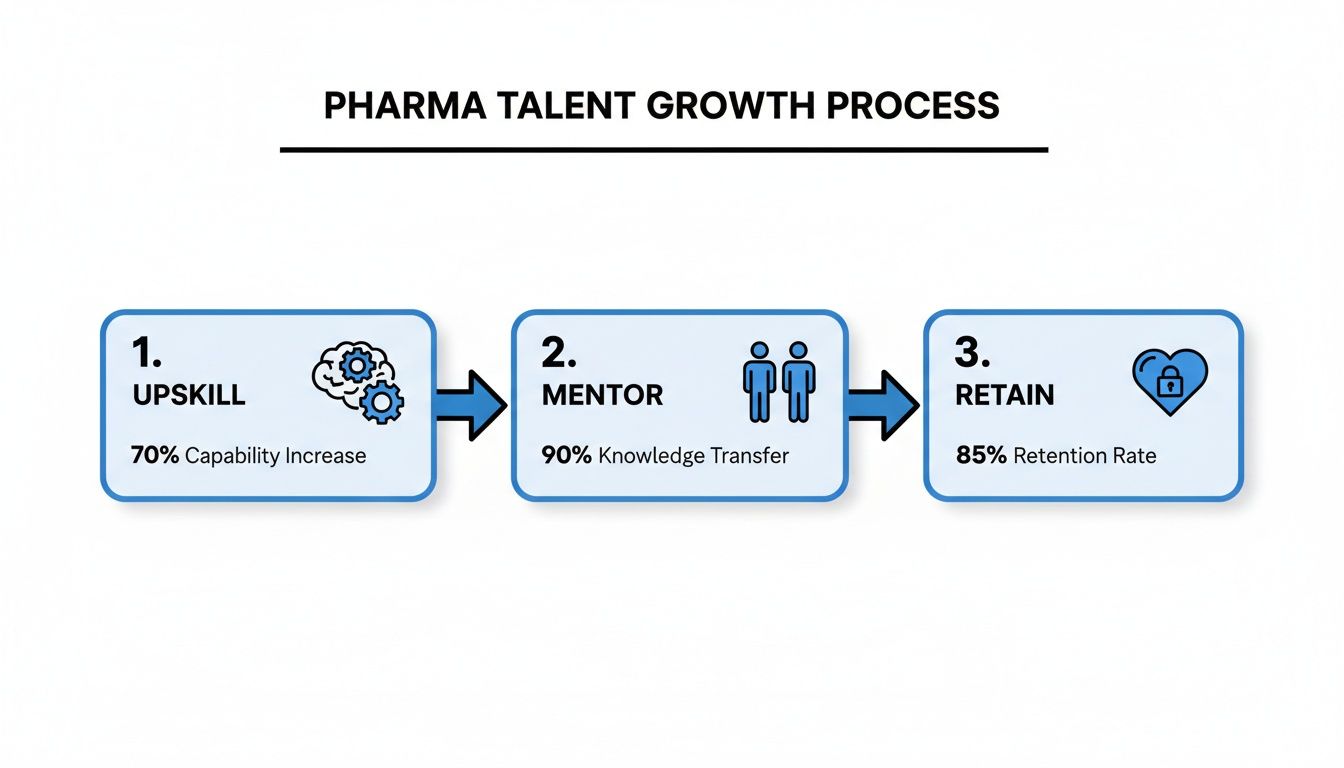
As the visual highlights, it’s a continuous cycle. Upskilling, mentoring, and retaining your people is the engine that drives sustained business performance.
Work with your business leaders to create a joint dashboard. For instance, map the “Skill Gap Reduction Rate” for your manufacturing team directly against the “Batch Success Rate” and “Export Volume Growth” for that same product line. When you can point to a clear positive correlation, as skill gaps close, production quality and output rise, you have irrefutable proof of your plan’s success.
This kind of data-driven storytelling transforms the HR function from a cost centre into a true strategic partner, proving that investing in the right people is the most powerful way to fuel India’s pharmaceutical export ambitions.
Your Top Pharma Workforce Planning Questions, Answered
As a CHRO, you’re on the front lines of turning India’s pharma export ambitions into reality. It’s a complex mission, and naturally, some tough questions pop up again and again. I hear them all the time from HR leaders.
Let’s cut through the noise and tackle some of the most common challenges you’re probably facing right now.
What Are the Most Critical Skills We Need to Hire for Immediately?
Forget generic job descriptions for ‘R&D’ or ‘Quality’. To win in highly regulated export markets, you need to get incredibly specific. The demand isn’t just for good people; it’s for specialists with proven track records in very particular areas.
Right now, your hiring focus should be laser-sharp on professionals with hands-on experience in:
- Regulatory Affairs: You absolutely need people who have successfully navigated submissions to the US FDA and EMA. This isn’t a ‘nice-to-have’; it’s the price of entry.
- Quality Assurance & Control: Look for individuals who are obsessed with data integrity. These are the people who have built and defended quality systems during intense international audits and come out unscathed.
- Sterile Manufacturing: As biologics and complex generics become the stars of the export show, expertise in aseptic processing and sterile injectable production has become one of the hottest commodities in the talent market.
- Formulation & Development (F&D): Your pipeline is only as strong as the scientists behind it. Prioritise those with a background in developing the complex generics and novel biologics that will define your high-value export portfolio.
And don’t overlook the softer skills. As your teams collaborate across continents, things like sharp cross-cultural communication and robust project management are the glue that holds your global strategy together.
How Can We, as a Smaller Pharma Company, Compete for Talent with the Giants?
This is a big one. The truth is, you can’t out-spend the major players, so don’t even try to compete on salary alone. You have to change the game and offer something they can’t.
Instead of just matching their pay packages, redefine your value proposition. Focus on what makes your organisation a better place to build a career:
- Offer Real Impact and Autonomy: In a smaller, nimbler company, a talented scientist isn’t just a cog in the machine. They get to own projects from start to finish. Sell them on the opportunity to see their work make a visible, tangible difference to the business.
- Foster an Agile Culture: Many top performers are tired of the bureaucracy and rigid hierarchies of massive corporations. A dynamic, collaborative, and fast-paced environment can be a powerful magnet for talent that feels stifled.
- Provide a Clearer, Faster Growth Path: In a growing company, leadership opportunities open up much faster. Show ambitious candidates a clear, accelerated runway for their career.
Think of it this way: the large players offer a cruise ship, stable and resource-rich. You’re offering a speedboat, fast, exciting, and the chance to be at the helm. Attract the talent that wants to steer.
You can also build a reputation as a specialised centre of excellence in a niche therapeutic area. This will attract passionate, highly skilled professionals who want to be experts in their field, not just another number in a giant’s headcount.
What’s the True First Step to Building a Strategic Workforce Plan?
Before you open a single job requisition or draft a skills matrix, your first step has to be getting out of the HR bubble. A workforce plan that isn’t directly tied to the business strategy is, frankly, a waste of time.
Your very first move is to sit down with your CEO, COO, and Head of Strategy. This needs to be a deep-dive session focused on getting a data-driven, brutally honest picture of the company’s 3- to 5-year export roadmap.
In that meeting, your mission is to pin down the answers to these questions:
- Exactly which international markets are we targeting for entry or expansion?
- What new products, especially complex generics or biologics, are in the pipeline for those specific markets?
- What are the precise growth volumes and revenue targets we’re aiming for with each key export product?
This business data is the non-negotiable foundation of your entire workforce plan. It’s what allows you to shift from reactive hiring to proactive, predictive forecasting. With these inputs, you can finally model your future talent demand and see exactly where your most critical skill gaps will be.
Ready to build the agile, high-performing team your export ambitions demand? Taggd specialises in Recruitment Process Outsourcing for the pharmaceutical sector, connecting you with the niche talent needed to thrive in regulated global markets. Learn how our expert RPO solutions can accelerate your growth.