
Optimizing Your Applicants Per Opening Ratio
The total number of applications a job receives is a critical talent acquisition metric. More than just a simple count, applicants per opening acts as a vital sign for the health of your entire hiring process, signalling everything from your brand’s strength to the clarity of your job descriptions.
What Does Your Applicant Count Really Mean?
Think of the applicants per opening metric like a doctor checking a patient’s vital signs. A high or low number isn’t inherently “good” or “bad”; instead, it’s a diagnostic signal that tells you where to investigate further. It’s the first clue, prompting you to ask deeper questions about your talent attraction, your position in the market, and how effective your job postings really are.
A surprisingly high number might seem like a win, but it could mean your job description is too broad, attracting a flood of unqualified candidates. On the flip side, a very low count might signal that your compensation is below market rate, your employer brand is weak, or your requirements are far too restrictive.
Expert Recruitment Process Outsourcing (RPO) partners use this metric as a starting point to diagnose issues. It helps them fine-tune your strategy for better, more efficient outcomes.
The Story Behind the Numbers
The number of applicants for any given role is heavily influenced by what’s happening in the wider market. For instance, India’s job market has seen a massive surge in applications recently, intensifying the competition for every single opening.
In just one recent quarter, a job platform recorded a staggering 18.1 million applications—a 30% year-on-year increase. This surge highlights a dynamic, growing market, but it also underscores the challenge for employers to manage high volumes and for candidates to stand out. You can learn more about these employment trends and what they mean for hiring.
This data proves that what’s considered a “normal” applicant volume can change in a heartbeat. That’s why understanding the context behind your numbers is absolutely essential.
Benchmarking Across Industries
Your industry plays a huge role in defining what a typical applicant count looks like. A role in a high-supply field like education will naturally attract a very different number of candidates than a highly specialised tech position.
The chart below shows the average applicants per opening across three major industries.
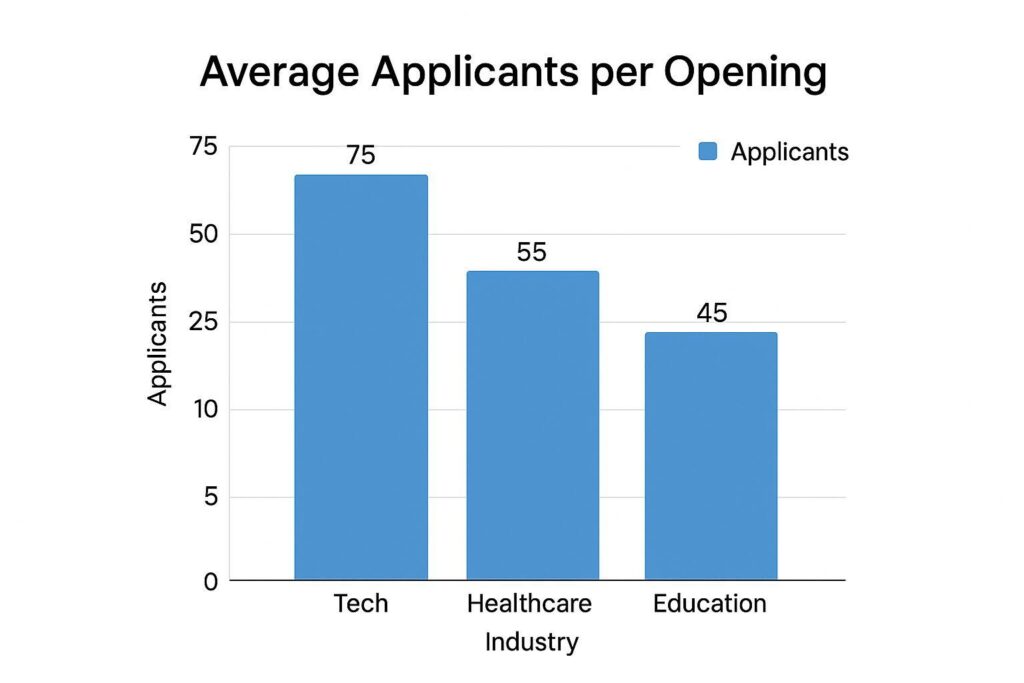
This visualisation clearly shows that tech roles receive the highest volume of applications, while education receives the lowest among these sectors. This kind of insight helps calibrate your expectations and informs your sourcing strategy. You can also gain an edge by understanding who the best companies to work for are and learning from their employer branding tactics.
This table can help you quickly interpret what your applicants per opening ratio might be telling you about your hiring process.
A Quick Guide to Your Applicants Per Opening Ratio
| Ratio Range | What It Could Mean | Next Steps to Consider |
|---|---|---|
| Too Low | Your role might be too niche, under-compensated, or poorly advertised. Your employer brand might also need a boost. | Review job description for clarity and appeal. Conduct a salary benchmark. Re-evaluate your sourcing channels. |
| Just Right | The job description is likely clear, compensation is competitive, and you’re reaching the right audience. | Focus on optimising the screening and interview process to identify the best-fit candidates efficiently. |
| Too High | The job description could be too generic, attracting many unqualified applicants. The role might also be posted on too many irrelevant job boards. | Refine the job description to be more specific. Target your job board postings more carefully. Implement better pre-screening tools. |
Remember, these are just starting points. The key is to use the number as a trigger for deeper investigation, not as a final verdict.
Key Takeaway: Your applicants per opening ratio is not a standalone grade for your recruitment efforts. It’s a compass that points your talent acquisition team toward areas that need attention, optimisation, or celebration. Use it to start a conversation, not to end one.
How to Calculate Applicants Per Opening Correctly

If you want to trust your data, you have to get the calculations right. This means going beyond a quick glance at your applicant tracking system (ATS). You and your RPO partners need a consistent, clear framework to rely on, otherwise, you risk making big decisions based on shaky insights.
At first glance, the formula seems simple enough. Just take the total number of applicants and divide it by the total number of job openings you had in a certain period.
The Basic Formula: Applicants Per Opening = Total Number of Applicants / Total Number of Job Openings
So, if you got 1,000 applications for 20 different roles in one quarter, your applicants per opening would be 50. This gives you a high-level snapshot, but the real value is hidden in the details.
Defining Your Terms for Accuracy
The hardest part of this calculation isn’t the division; it’s agreeing on what actually counts as an “applicant” and an “opening.” When these definitions are fuzzy, your results can get skewed, leading to poor strategic moves. To build a foundation of data you can stand on, you must set some ground rules first.
Think about these critical questions to sharpen your approach:
- What makes someone an applicant? Is it a person who just clicks “apply,” or do they need to complete the entire application to be counted?
- How do you sort your candidates? Should you separate internal applicants from external ones? This can tell you a lot about your internal mobility programme versus your external brand appeal.
- What about duplicate applications? If one candidate applies for five different jobs, are they counted as one unique applicant or five separate entries?
Answering these questions helps you create a standardised measurement framework. It’s the only way to ensure that when you compare this metric month-over-month, you’re truly comparing apples to apples.
Handling Tricky Scenarios
Let’s be honest, real-world recruiting is rarely neat and tidy. Some roles just don’t fit into a simple formula and require their own specific rules for calculation.
1. Evergreen Roles These are the positions that are always open, like sales representatives or customer service agents. Because they don’t have a clear closing date, they can easily inflate your “total openings” number if you aren’t careful.
- Solution: Don’t count an evergreen role as one long, continuous opening. Instead, treat each new hire as a closed requisition. If you hire five sales reps in a quarter, you’ve filled five distinct openings for that role. This method gives you a much more accurate picture of your actual hiring activity.
2. Internal vs. External Applicants Lumping internal and external candidates into the same calculation can really muddy the waters. A high number of internal applicants tells a story about your company culture and career paths. A high number of external ones says something completely different about your employer brand and market reputation.
- Solution: Calculate the applicants per opening metric separately for each group. This gives you two distinct, powerful insights: one into your internal talent pipeline and another into your reach in the external market.
By setting these clear, consistent rules, you and your RPO partner can build a dataset that isn’t just accurate—it’s loaded with actionable insights. This disciplined approach transforms a simple number into a powerful tool for making confident, evidence-based decisions about your entire talent strategy.
Understanding What Drives Your Application Numbers
Have you ever looked at a job post and wondered why one gets a flood of applications while another gets crickets? It’s not just luck. The number of applicants per opening you see is the direct result of a complex mix of forces, almost like a marketing campaign. Your job opening is the ‘product,’ and how you package and promote it has a massive impact on who shows up.
Getting a handle on these drivers is the first step in moving from just watching the numbers to strategically influencing them. While your RPO partner is fantastic at diagnosing the root causes, it’s vital that you understand the core factors at play, both inside and outside your company. This knowledge empowers you to work together and make smart, effective changes.
External Forces Shaping Your Talent Pool
You don’t recruit in a bubble. A whole range of powerful external factors can dramatically swing the number of people applying for your roles, and often, they have nothing to do with your company or the job description itself. Think of these as the market currents that can either fill your sails or leave you completely stranded.
Key external drivers include:
- Economic Climate: When the economy is strong and unemployment is low, there are simply fewer people actively looking for jobs. This can naturally lead to a lower number of applicants. On the flip side, during a downturn, more people are on the hunt, and application numbers often swell.
- Industry Trends: Is your industry booming or contracting? A growing sector often means fierce competition for the best talent. A declining one might see a surplus of available candidates, but they may not have the future-focused skills you need.
- Regional Competition: Your local talent market is a huge piece of the puzzle. If you’re hiring in a major tech hub alongside global giants, you’re in for an intense fight. But if you’re recruiting in an emerging Tier 2 city, the dynamic and applicant volume could be completely different.
The Indian job market is a perfect real-world example of these forces in action. Projections show serious hiring growth, with one report suggesting the overall job market could expand by 9% in a single year. This boom is even more pronounced in sectors like IT, which was estimated to grow by 15%. While this signals incredible opportunity, it also creates a major supply-demand imbalance, cranking up the competition for talent across the country. You can dive deeper into how India’s job market growth impacts recruitment.
Internal Factors You Can Control
While you can’t change the economy, you have a surprising amount of control over internal factors. These are the levers you and your RPO partner can actually pull to directly influence your application numbers. This is the ‘packaging’ and ‘promotion’ of your job opening.
Your employer brand is your reputation as a place to work. It’s the story people tell about your company when you’re not in the room. A strong, positive brand acts as a magnet for top talent, often increasing your application volume without any extra effort.
Think about it: how are you presenting your company and the specific role to the world?
- Employer Brand: Do people see your company as a great place to work? A powerful employer brand, built on a positive culture and great employee experiences, naturally attracts more—and better—applicants.
- Compensation and Benefits: Is your pay package competitive for your industry and location? Today’s candidates do their homework. Offering a salary that’s below the market rate is one of the fastest ways to scare off qualified people.
- Job Description Quality: Your job description is your number one sales pitch. If it’s vague, packed with jargon, or just plain uninspiring, you’ll either attract the wrong people or nobody at all. Clarity, honesty, and a compelling tone are non-negotiable.
- Sourcing Strategy: Where and how you post your jobs matters immensely. Are you using the right channels to reach the right people? Just throwing a post on a generic job board won’t cut it for highly specialised roles. For those, you often need to tap into passive candidate pools. For more on this, check out our guide on how to recruit passive candidates for those tough-to-fill positions.
By carefully looking at both these internal and external elements, you can start building a clear picture of why your applicants per opening metric is what it is. This diagnostic approach lets you make strategic moves to attract the right number of the right people, turning your recruitment from a game of chance into a well-oiled, well-managed process.
Shifting Your Focus from Quantity to Quality

It’s easy to get swept up in the excitement of a high number of applicants per opening. A flood of CVs can feel like a major win, but experienced HR leaders know this is often just a vanity metric. What good are 200 applicants if only two of them are actually qualified for the job? This is where we need to make a critical pivot—from chasing pure volume to prioritising genuine quality.
An expert RPO provider is your partner in making this shift. Their strategy isn’t just about getting more applications; it’s about attracting the right ones. This changes your entire hiring funnel, turning it from a wide-mouthed net that catches everything into a powerful magnet that pulls in only the best-fit talent.
The Sieve vs. The Magnet Analogy
Think about your hiring process in one of two ways. It can be a sieve, where you pour in a huge volume of candidates and spend countless hours sifting through them to find the few gems hidden in all the noise. This approach is exhausting, inefficient, and frankly, very expensive.
Or, your process can be a magnet. This method uses precision and strategic attraction to pull the right candidates towards your roles from the very beginning. It takes more strategy upfront, but the result is a smaller, highly concentrated pool of top-tier talent, which saves an incredible amount of time and resources later on. In a magnetic system, a lower applicant count is actually a sign of incredible efficiency, not failure.
Introducing Qualified Applicants Per Opening
To really measure how well a magnetic hiring process is working, you need a smarter metric. This is where Qualified Applicants Per Opening (QApO) comes into play. This KPI looks past the simple headcount of total applicants and focuses only on the number of candidates who meet the absolute must-have criteria for a role.
Tracking QApO gives you a true picture of your sourcing health. A high applicant count with a low QApO signals a problem—your job posts are attracting the wrong crowd. On the other hand, a modest applicant count with a high QApO shows your strategy is hitting the mark perfectly.
By shifting your main focus from Applicants Per Opening to Qualified Applicants Per Opening, you stop celebrating noise and start rewarding precision. This simple change can completely reframe how you and your RPO partner define success.
Practical Steps to Boost Applicant Quality
Moving from a quantity-first to a quality-first mindset isn’t just a change in thinking; it involves specific, actionable changes to your recruitment process. RPO experts put these strategies in place to act as a powerful filter, discouraging mismatched candidates while attracting the ideal ones.
1. Sharpen Your Job Descriptions Vague language attracts vague, unqualified candidates. Instead of using generic buzzwords, be crystal clear about what is a non-negotiable requirement versus what is simply “nice to have.”
- Weak: “Strong communication skills.”
- Strong: “Must be able to present complex technical data to non-technical stakeholders in weekly review meetings.”
This level of detail helps candidates self-select out if they aren’t a good fit, saving everyone a lot of time. It clarifies expectations right from the start and sets a professional tone.
2. Implement Smart Pre-Screening Questions Let your application form do the initial filtering for you. You can use mandatory “knock-out” questions to automatically screen out people who don’t meet the baseline requirements.
- Do you have the required PMP certification? (Yes/No)
- Are you authorised to work in India without sponsorship? (Yes/No)
- This role requires travel up to 30% of the time. Are you able to meet this requirement? (Yes/No)
If a candidate answers “No” to a deal-breaker question, they are automatically filtered out. This allows your recruiters to focus their energy only on those who meet the fundamental criteria.
3. Target Niche Communities The best talent isn’t always hanging out on the big, mainstream job boards. RPO partners are pros at finding and engaging with niche online communities, professional forums, and industry-specific groups where top performers gather. By posting your role in these targeted spaces, you reach a pre-qualified audience that is far more likely to be a match.
This strategic move away from volume for volume’s sake leads to a more efficient, cost-effective, and ultimately more successful hiring process. It proves that a lower number of applicants per opening can, in fact, be the clearest sign of a winning recruitment strategy.
Using Geographic Trends to Your Advantage

The best talent isn’t always hiding in the biggest, most crowded cities. In fact, a national hiring strategy that only ever looks at the usual metro areas is leaving a massive opportunity on the table. As more companies get comfortable with flexible work, hiring is becoming much more decentralised, opening up brand new, untapped talent pools all over the country.
This geographic shift is a strategic advantage just waiting to be claimed. For any role that can be done remotely or in a hybrid setup, looking beyond the typical Tier 1 cities can completely change your applicants per opening metric for the better. Instead of fighting for a sliver of attention in an oversaturated market, you can become the employer everyone wants to work for in an emerging one.
A smart RPO partner uses this location-based data to give you a real competitive edge. They dig into emerging job markets to find those hidden gems, helping you balance your applicant numbers and get your hiring costs under control.
Discovering New Talent Clusters
This idea of decentralised hiring isn’t some far-off future trend; it’s happening right now. The way hiring patterns are shifting across India is directly impacting the applicants per opening in these growing job markets.
A recent report on “Cities on the Rise” from a major professional network shows that job openings in Tier 2 and Tier 3 cities are booming, especially in sectors like tech, finance, and pharma. This signals a huge decentralisation of hiring away from the traditional metros, which is creating new talent clusters. While competition is still fierce nationally, this spread of opportunity creates fresh competitive ground and helps even out the applicant load. You can explore India’s top emerging cities for job seekers in the report and see what it means for your own strategy.
This movement of both talent and jobs is redrawing India’s entire employment map, and with it, the regional numbers for applicants per opening.
By proactively targeting these up-and-coming cities, you can access skilled professionals who are eager for great opportunities closer to home, often facing far less competition from other employers.
Adapting Your Strategy for Regional Dynamics
Knowing these talent pools exist is one thing. Actually engaging them effectively is a whole different ball game. A one-size-fits-all approach to recruitment marketing just won’t cut it. To really succeed, you and your RPO partner have to adapt your sourcing and messaging to fit the local dynamics.
This means tailoring your entire approach to connect with the local culture and what candidates in that area are looking for.
- Localised Employer Branding: Shine a light on the parts of your company culture that appeal to candidates looking for better work-life balance—a key reason many are moving away from the megacities.
- Targeted Sourcing Channels: Don’t just rely on national job boards. Focus on regional platforms, local professional networks, and university partnerships in these emerging hubs.
- Competitive Local Compensation: Make sure you benchmark salaries specifically for these cities. While the cost of living might be lower than in the metros, you still need to offer a competitive package to attract the best people in that specific market.
This kind of data-led approach is at the core of modern talent acquisition. For a deeper look at this, you might find our guide on how RPO can help in high-impact, data-driven hiring useful.
By tapping into these geographic trends, you can turn what seems like a challenge into a powerful strategic move. This proactive method helps you find incredible talent, improve your applicants per opening ratio, and build a more resilient, geographically diverse workforce.
Common Questions About This Hiring Metric
Even when you’ve got a solid grip on the basics of the applicants per opening metric, a few practical questions always seem to pop up. Getting these sorted is the key to turning a high-level concept into a real, on-the-ground hiring strategy. Let’s tackle these common queries and reinforce the big idea: it’s all about quality, not just quantity.
What Is a Good Benchmark for Applicants per Opening?
Honestly, there’s no single magic number. What’s considered “good” is completely shaped by the industry, the role’s seniority, and even its location.
A highly specialised tech role might be a massive win with just 10-20 qualified applicants. On the other hand, an entry-level position in a major city could easily pull in over 100 applications, and that would be perfectly normal.
The best move? Track your own data over time. This helps you build a reliable internal baseline that’s specific to your company. More importantly, always compare your total applicants per opening against your “qualified applicants per opening.” That’s where you’ll find the real measure of your efficiency. An RPO partner can also be a goldmine here, offering industry-specific data to help you set expectations that are actually realistic.
How Can We Get Fewer Unqualified Applicants?
If you’re drowning in CVs from candidates who just aren’t the right fit, the most effective fix starts right at the source: your job description.
Be ruthlessly clear and specific. Spell out the absolute must-have skills, the non-negotiable experience, and the core responsibilities. Vague language is an open invitation for a vague and mismatched talent pool.
Another powerful tool is adding mandatory “knock-out” questions to your application form. These are simple, yes/no questions about your minimum requirements that can automatically filter out candidates who don’t make the cut.
For instance, asking “Do you have the required XYZ certification?” or “This role is based in Pune; are you able to work from this location?” allows candidates to self-select out. It’s a simple step that can save your recruitment team countless hours of sifting through irrelevant applications.
Does a Low Applicant Count Mean My Strategy Failed?
Not at all. In fact, sometimes a low applicant count is the clearest sign of a brilliant, highly targeted recruitment campaign. A low number is only a problem if it fails to produce any suitable candidates.
Think of it this way: getting only 15 applications for a senior leadership role is a huge success if 10 of them are qualified enough for an interview. That’s a far more efficient and cost-effective outcome than wading through 200 applications just to find five good ones.
Always look at your applicants per opening alongside other key metrics like quality of hire and time to fill. That’s how you get the complete picture of your hiring success.Ready to transform your recruitment from a numbers game to a strategic advantage? Taggd specialises in data-driven RPO solutions that focus on attracting high-quality talent, not just high volume. Learn how our expertise can refine your hiring process.