
ATS Evaluation Your Guide to Smarter Hiring
An Applicant Tracking System (ATS) evaluation is, at its core, the process you follow to assess, compare, and ultimately choose the right recruitment software for your business. It’s a deep dive to ensure the platform you pick actually lines up with your hiring goals, plays nice with your existing tech, and gives you a solid return on investment by making your recruiters’ lives easier and improving the candidate experience.
Why a Strategic ATS Evaluation Matters More Than Ever

Let’s be blunt: choosing an ATS is a high-stakes decision. Get it wrong, and you’re looking at lost candidates, compliance nightmares, and a team of frustrated recruiters. A misstep here directly hurts your ability to attract and hire the best people.
In India’s fiercely competitive talent market, where employer hiring intent is expected to jump by 19% year-over-year in 2025, an ATS isn’t just a nice-to-have anymore. It’s mission-critical. The financial stakes are massive, with millions potentially lost in productivity from hiring delays. A methodical evaluation is simply indispensable. You can learn more about the evolving ATS landscape in India to see just how fast things are changing.
This isn’t about just ticking boxes on a tech wish list. It’s about building a rock-solid business case for a system that delivers tangible results and gives you a real competitive edge.
Assembling Your Evaluation Committee
First things first, you need to get the right people in the room. A successful ATS evaluation starts with a cross-functional team. This isn’t just an HR project; it’s a business decision. Pulling in people from across the company ensures the system you choose actually works for everyone, from the recruiters in the trenches to the IT folks managing security.
Your goal here is simple: gather diverse perspectives to avoid blind spots.
Bringing together the right people from the start is crucial. Each role brings a unique and necessary viewpoint to the table, preventing costly mistakes and ensuring the final choice is a true organisational fit.
Key Focus Areas for Your ATS Evaluation Committee
| Team/Role | Primary Focus in ATS Evaluation | Example Requirement |
|---|---|---|
| Talent Acquisition | Day-to-day usability, workflow efficiency, candidate management, reporting capabilities. | “The system must allow for bulk emailing and automated status updates to candidates.” |
| Hiring Managers | Ease of use for reviewing CVs, providing feedback, and viewing candidate pipelines. | “I need a simple, intuitive dashboard where I can see all my open roles and applicants in one place.” |
| IT Department | Security protocols, data privacy (especially GDPR/DPDP), and integration with existing systems (HRIS, payroll). | “The ATS must have robust APIs to connect seamlessly with our existing HRIS, SAP SuccessFactors.” |
| Finance/Procurement | Total cost of ownership (TCO), contract terms, scalability, and calculating potential ROI. | “We need transparent pricing with no hidden fees for user licences or data migration.” |
By including these key stakeholders, you build a comprehensive picture of what the business truly needs, not just what one department wants.
A classic mistake is letting one department—usually HR—run the ATS evaluation in a silo. When you bring IT and hiring managers into the process from day one, you head off major roadblocks during implementation and make sure the tool you pick actually gets used.
Defining Your Goals and Must-Have Features
Before you even glance at a single vendor website, your committee needs to agree on what success looks like. Vague goals like “improve hiring” won’t cut it. You need to get specific and set measurable objectives.
Are you trying to slash your time-to-hire? Dramatically improve the candidate experience? Or perhaps boost your diversity hiring metrics? Get clear on your primary objective.
Now, translate those big-picture goals into a list of non-negotiable features. Think about the daily headaches and frustrations your teams face with your current process. What absolutely has to change?
- Goal: Cut time-to-hire by 25%.
- Must-Have Feature: An automated interview scheduling tool that syncs directly with Outlook or Google calendars.
- Goal: Improve the quality of shortlisted candidates.
- Must-Have Feature: AI-powered resume parsing that can accurately score and rank candidates based on our specific job criteria.
- Goal: Boost candidate engagement and reduce drop-offs.
- Must-Have Feature: A branded, mobile-first careers page and customisable, automated communication templates for every stage.
Doing this foundational work upfront transforms your search from a simple software comparison into a strategic business decision. It sets the stage for choosing a system that will genuinely empower your entire organisation.
Building Your Vendor Shortlist Without the Overwhelm
So, you’ve got your evaluation committee on the same page and a clear picture of what you need. Now comes the hard part: facing the incredibly crowded Applicant Tracking System marketplace. It’s easy to feel paralysed by the sheer number of options out there.
The trick is to move from a wide net to a manageable shortlist with a clear plan. This isn’t about finding every possible ATS on the planet; it’s about finding the right few to investigate deeply. A focused approach saves your team from demo fatigue and keeps the whole process from derailing.
Tapping Into Trusted Networks and Unbiased Reports
Before you even look at a vendor’s glossy marketing brochure, talk to real people. The best insights almost always come from peers who have already walked this path.
Reach out to your professional network, especially other HR leaders in your industry. Ask them what systems they’re using, what they love about them, and—most importantly—what they wish they’d known before signing on the dotted line.
At the same time, dig into independent industry reports from analyst firms like Gartner, Forrester, or Fosway Group. These reports offer structured, objective comparisons and are a great way to quickly get a sense of the market leaders and up-and-coming innovators.
- Peer Reviews: Connect with CHROs on professional networks to get candid, unfiltered feedback on their ATS experiences.
- Industry Analysts: Use reports to understand vendor strengths, weaknesses, and market reputation from an unbiased viewpoint.
- Sector-Specific Forums: Look for vendors who have a proven track record in your specific industry, whether that’s manufacturing, tech, or healthcare.
This initial legwork should help you assemble a “long list” of about 10-15 potential vendors. This is your starting point for the real filtering.
The Power of the Request for Information (RFI)
With your long list in hand, it’s time to make the first cut. A Request for Information (RFI) is the perfect tool for the job. It’s far less formal and time-consuming than a full-blown Request for Proposal (RFP) and is designed to get you high-level answers, fast.
Keep your RFI short and sweet, focusing on your absolute must-haves. Ask vendors to simply confirm if they meet the non-negotiable requirements you identified earlier. This might be anything from specific integrations and compliance certifications to core workflow features.
The RFI acts as a swift, effective filter. If a vendor can’t meet your foundational needs, you can disqualify them early, saving everyone a huge amount of time. This simple step can easily cut your long list in half.
The whole point here is to weed out any vendors that are an immediate non-starter. This is a crucial step in focusing your team’s energy where it actually matters. For more on using tech to refine hiring, check out our guide on the essential steps for digital hiring using recruitment technology.
Creating a Scoring Matrix for an Objective Shortlist
Once the RFI responses roll in, you should be left with a much smaller, more qualified group of about 4-6 vendors. This is your official shortlist. Before you dive into time-intensive demos, you need an objective way to rank them.
This is where a scoring matrix becomes your best friend. Work with your evaluation committee to assign a weight to each of your key requirement categories (e.g., Recruiter Experience, Integration Capability, Reporting). Then, score each shortlisted vendor against these criteria based on their RFI responses and your own research.
Here’s a simplified example of what this could look like:
| Evaluation Criteria | Weighting | Vendor A Score (1-5) | Vendor A Weighted Score | Vendor B Score (1-5) | Vendor B Weighted Score |
|---|---|---|---|---|---|
| Core Workflow Automation | 30% | 4 | 1.2 | 5 | 1.5 |
| HRIS Integration | 25% | 5 | 1.25 | 3 | 0.75 |
| Analytics & Reporting | 20% | 3 | 0.6 | 4 | 0.8 |
| Candidate Experience | 15% | 5 | 0.75 | 4 | 0.6 |
| Security & Compliance | 10% | 4 | 0.4 | 4 | 0.4 |
| Total Score | 100% | 4.2 | 4.05 |
A structured approach like this pulls personal bias out of the equation and gives you a data-driven foundation for what comes next. It creates a clear, defensible ranking and helps you decide which vendors to invite for a full demo, ensuring your team’s time is invested wisely.
Running Vendor Demos That Reveal the Truth
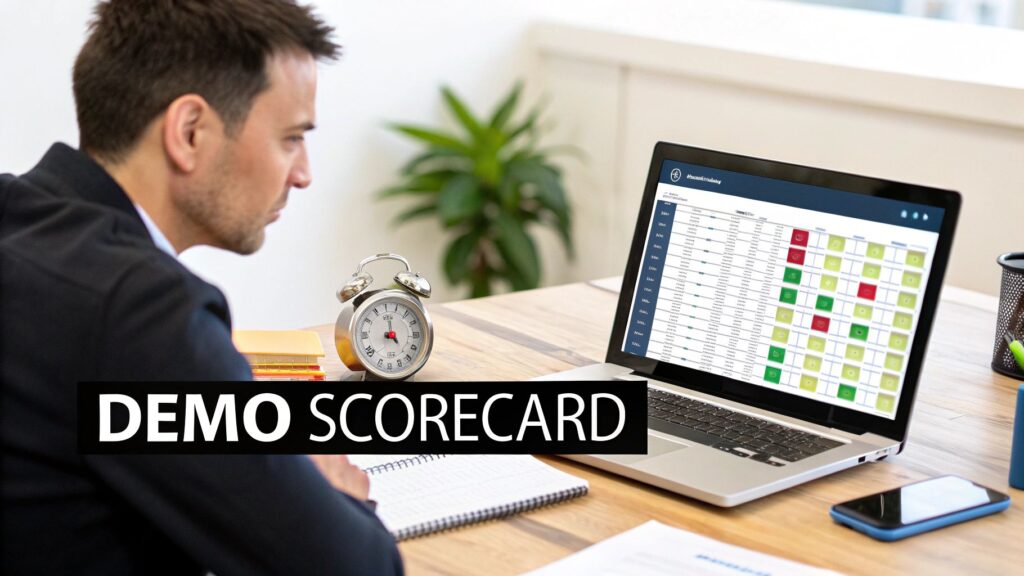
This is it—the moment of truth. The vendor demo is where the polished sales pitch collides with the messy reality of your day-to-day hiring. A slick presentation can easily hide a clunky interface or rigid workflows, so your job is to take the wheel and see how the system really performs under pressure.
Don’t let them give you the standard, pre-packaged tour. This is your chance to see how the platform handles the unique quirks and demands of your company’s recruitment process. You need to insist that they customise the demo using your actual job descriptions and real-world hiring scenarios.
Setting the Stage for an Insightful Demo
Before the demo even kicks off, send the vendor a clear agenda. More importantly, give them a set of specific, scenario-based tasks you expect them to perform live. This completely changes the dynamic. You’re no longer a passive audience; you’re an active assessor.
This approach forces them to show, not just tell. You’ll see the system in action, tackling your genuine problems, rather than just clicking through a highlight reel of its flashiest features.
Here are a few scenarios you should absolutely insist on seeing:
- The High-Volume Rush: Ask them to show how a recruiter would screen 50+ applications for a popular role, shortlist the top ten candidates, and fire off personalised rejection emails to everyone else—all in under 15 minutes.
- The Scheduling Nightmare: Present a complex panel interview scenario. Get them to schedule a meeting with four internal stakeholders (all in different time zones) and one external candidate. Watch how the tool juggles calendar conflicts and sends out confirmations.
- The On-the-Go Hiring Manager: Have them demonstrate a hiring manager reviewing a candidate’s profile, leaving specific feedback on their CV, and pushing them to the next stage—all from their mobile phone.
Getting this granular is non-negotiable. The ATS market in India is exploding, driven by a serious need for smarter recruitment tech. Projections point to a compound annual growth rate (CAGR) of 7.2% from 2025 to 2033, with the market expected to hit USD 0.50 billion by 2033. This growth is all about AI-powered screening and analytics, which makes a rigorous demo more critical than ever. You can dig into the full research about the expanding Indian ATS market to get a better sense of the trends.
The Power of a Demo Scorecard
To keep your evaluation objective and consistent across different vendors, you need a demo scorecard. It’s a simple but powerful tool that ensures every member of your evaluation team is grading each platform against the same criteria. This is how you remove personal bias and ground the decision in hard evidence.
Your scorecard should directly reflect the priorities you set out at the very beginning of this process. It turns subjective feelings like, “I liked the look of it,” into measurable, comparable data points.
A classic mistake is letting demo feedback become a free-for-all conversation. Without a scorecard, the loudest voice in the room often dictates the outcome. A structured scoring system makes sure that critical factors—like the recruiter’s user experience, reporting flexibility, and the candidate journey—are all given the weight they deserve.
The table below gives you a solid starting point for the kinds of questions to include in your RFP and to really push on during the demo. These will feed directly into the categories on your scorecard.
Essential RFP and Demo Questions for Vendors
To really understand what each system can do, you need to ask the right questions. This checklist will help you probe vendor capabilities and see past the sales pitch during your RFPs and live demos.
| Category | Sample Question | What You’re Looking For |
|---|---|---|
| Recruiter Workflow | “Show us how a recruiter can build a talent pipeline for a future role using candidates from a past requisition.” | Evidence of proactive sourcing tools, smart tagging, and a searchable talent pool. It can’t just be a static database. |
| Candidate Experience | “Walk us through the entire application process on a mobile device for a candidate with a multi-page CV.” | A fast, intuitive, and genuinely mobile-first application process. Look for accurate CV parsing and minimal data entry. |
| Reporting & Analytics | “Create a custom report showing the source-of-hire for our top three performing departments in the last quarter.” | Real flexibility in the reporting engine. You want to see if you can build what you need without calling support. |
| System Integration | “Demonstrate how your ATS syncs interview feedback with our HRIS and how candidate data is passed for onboarding.” | A live demo of a key integration, not just a promise. Look for smooth, bi-directional data flow and real-time updates. |
By preparing these kinds of scenarios and using a scorecard, your team can move far beyond the slick presentation. You’ll be gathering the concrete proof needed to compare vendors on a level playing field and make a confident decision—one based on how each system will actually perform for your organisation. This rigorous approach is the final, most important filter in your ATS evaluation.
Navigating Technical Integrations and Security Audits

A powerful Applicant Tracking System can feel like the centre of your talent universe. But an ATS that operates in a silo is a black hole for efficiency.
Its true value is unlocked only when it connects seamlessly with your entire HR technology ecosystem, from your core HRIS to payroll platforms and third-party assessment tools. This isn’t just a “nice-to-have” feature; it’s a fundamental requirement.
Without smooth integrations, your team is stuck manually transferring data, which is a recipe for errors, delays, and a fragmented view of your people operations. This is where your IT team becomes a crucial partner in the evaluation, shifting the focus from recruiter-facing features to the system’s technical backbone.
Assessing Integration Capabilities
The first move is to map out your existing HR tech stack. Identify every single system the new ATS will need to talk to. A typical setup often includes an HRIS like SAP SuccessFactors or Workday, a payroll provider, and perhaps tools for background checks or skills assessments.
Once you have your map, you can start asking vendors the tough questions about their API (Application Programming Interface) capabilities. A robust, well-documented API is the hallmark of a system built for connectivity. It’s what allows different software to communicate reliably.
Here are the critical areas to dig into:
- API Flexibility and Documentation: Ask for their API documentation. Is it clear, comprehensive, and easy for your developers to understand? A vendor that’s hesitant to share this is a major red flag.
- Pre-built Connectors: Do they offer off-the-shelf integrations for the major platforms you already use? Pre-built connectors can dramatically slash implementation time and costs.
- Data Synchronisation: Get clarity on whether data flows one-way or bi-directionally. For example, when a candidate is hired, you want their data to automatically populate their new employee profile in your HRIS without anyone lifting a finger.
A common pitfall is just taking a vendor’s word that they “integrate” with your other systems. Insist on seeing a live demonstration of a key integration, preferably with a system you currently use. This is the only way to verify the data flow is as seamless as they claim.
Scrutinising Security and Compliance Protocols
In an era of increasing data privacy regulation, the security of your candidate data is non-negotiable. A data breach linked to your ATS can lead to severe financial penalties and cause irreparable damage to your employer brand.
The Indian Digital Personal Data Protection (DPDP) Act, much like GDPR, places strict obligations on how organisations handle personal information. Your ATS evaluation must include a thorough security audit led by your IT and legal teams. Remember, you’re not just buying software; you’re entrusting a vendor with highly sensitive data.
Start by creating a security checklist. This ensures you evaluate each vendor consistently and can compare different platforms objectively.
Your Essential Security Audit Checklist
- Data Encryption: Confirm that all data is encrypted using strong, up-to-date protocols, both “at rest” (stored on servers) and “in transit” (moving across networks).
- Compliance Certifications: Look for recognised certifications such as ISO 27001 (for information security management) or SOC 2. These third-party audits provide independent proof of a vendor’s security posture.
- Access Controls: How granular are the user permissions? You need the ability to define roles (recruiter, hiring manager, admin) and restrict access to information on a need-to-know basis.
- Data Residency: Find out where your data will be stored. For compliance with Indian regulations, it’s often best for data to be hosted within the country.
- Incident Response Plan: Ask the vendor to walk you through their process for handling a security breach. What are their communication protocols and steps for fixing the issue?
Ultimately, a strong recruitment platform should not only make your workflows more efficient but also act as a fortress for your data. Making sure your potential ATS can both integrate flawlessly and protect your data is a critical step toward a successful partnership and a secure hiring future.
Decoding Pricing Models and Calculating the Real ROI
An ATS evaluation isn’t complete until you look past the initial quote and understand the true cost of the system. Vendor pricing is rarely a simple, one-size-fits-all number. It’s a complex puzzle of different models, sneaky add-ons, and long-term commitments that can seriously throw your budget off track if you’re not careful.
The sticker price is just the tip of the iceberg. To get a clear financial picture, you have to dig into how vendors structure their costs and what might be hiding in the fine print.
Unpacking Common ATS Pricing Structures
Most ATS vendors use one of a few core pricing models. Getting your head around these is the first step to comparing your options on a level playing field. It shows you how the cost will scale as your company grows.
- Per Recruiter/Seat Model: A popular option where you pay a monthly or annual fee for each user—be it a recruiter, hiring manager, or admin. It’s predictable, sure, but it can get pricey fast if you have a large or fluctuating hiring team.
- Per Employee Model: Some vendors link their pricing to the total number of employees in your company. This model can be quite cost-effective for smaller businesses, but it means you need to forecast your budget carefully as you scale your workforce.
- Pay-Per-Job-Opening/Hire Model: With this one, you pay based on the number of active job postings or successful hires made through the system. This offers flexibility if your hiring needs vary, but budgeting can become a nightmare during periods of rapid growth.
The most common mistake I see is assuming the monthly subscription fee is the final cost. Always press vendors for a complete breakdown of potential charges. Ask about one-time setup fees, data migration costs, and fees for extra training or premium support. These “hidden” costs can easily inflate your total investment by 20-30% or more in the first year alone.
Calculating the Total Cost of Ownership
To truly understand the financial commitment, you need to calculate the Total Cost of Ownership (TCO). This isn’t just about the subscription fee. It includes every single expense tied to implementing and maintaining the system over its lifespan, which is typically three to five years.
Your TCO calculation should absolutely factor in:
- Subscription Fees: The core licence cost, based on their pricing model.
- Implementation Costs: The one-time charges for setup, configuration, and moving your data over.
- Training Expenses: Fees for getting your team up to speed and any ongoing training modules.
- Integration Fees: The costs to connect the ATS with your existing HRIS, payroll, or other critical systems.
- Support and Maintenance: Any charges for premium support packages or ongoing upkeep.
This comprehensive view prevents nasty budget surprises down the line and gives you the real number to present to your finance team.
Forecasting Your Return on Investment
But calculating the TCO is only half the story. To get that crucial executive buy-in, you need to prove the system’s value by forecasting its Return on Investment (ROI). This means modelling how the ATS will directly improve key recruitment metrics and translating those improvements into pounds and pence.
Start by quantifying the efficiency gains. For instance, if a new ATS can slash your time-to-hire by 10 days, what’s the value of that reclaimed productivity? If it automates manual tasks and saves each recruiter five hours a week, what’s the financial impact of that time? It’s not just theory; surveys show that 76% of Indian recruiters believe AI in an ATS speeds up hiring by quickly finding top talent. You can discover more insights about AI’s impact on Indian recruitment on imarcgroup.com.
Building a powerful ROI model means linking the ATS directly to business outcomes. For companies looking to optimise their hiring strategy further, exploring how recruitment process outsourcing helps drive data-driven hiring can provide additional valuable perspectives. When you build a strong financial case based on both TCO and ROI, your ATS evaluation transforms from a simple expense request into a compelling strategic investment proposal.
Making the Final Call and Planning for a Smooth Launch
You’ve sat through the demos, the technical deep dives are complete, and you’ve heard what current users have to say. Now comes the moment of truth: consolidating everything you’ve learned into a confident, data-backed decision. This is where you pivot from investigation to decisive action.
Bringing all these moving parts together needs a structured approach, otherwise, it’s easy for personal biases or the ‘wow’ factor from a flashy demo to cloud your judgement. This is where a decision matrix becomes your best friend. It’s the perfect tool to objectively weigh each vendor’s performance against the criteria you established from the very beginning, turning subjective feedback into a clear, comparable score.
Using a Decision Matrix for Objectivity
Your matrix should be a living document that pulls in data from every stage of your evaluation. The key is to assign a weight to each category based on what truly matters to your business. For instance, if your tech stack is complex, integration capabilities might be weighted much higher than the user interface.
- Demo Scores: Plug in the averaged scores from your evaluation committee’s scorecards.
- Technical Audit Results: Give each vendor a rating based on their security posture, compliance standards, and how smoothly they’ll integrate with your existing systems.
- Cost vs. ROI: This is where you factor in the full Total Cost of Ownership (TCO) and the potential Return on Investment you mapped out earlier.
- Reference Checks: Add a qualitative score here. Did the feedback from their current customers give you confidence, or did it raise red flags?
Following this methodical process gives you a defensible final recommendation. It makes that final conversation with leadership to secure approval a whole lot easier.
The goal isn’t just to pick a winner; it’s to select a long-term partner. The matrix ensures your final choice is aligned with strategic business goals, not just the features that impressed you most on the day.
Planning for a Successful Launch
Let’s be clear: signing the contract is the starting line, not the finish line. A brilliant ATS evaluation can fall flat if it isn’t followed by a well-planned implementation. I’ve seen it happen—a botched launch undoes all the hard work, leading to low user adoption, frustrated recruiters, and a system that never lives up to its promise.
This infographic breaks down the core financial pieces that should inform both your final decision and your implementation budget.
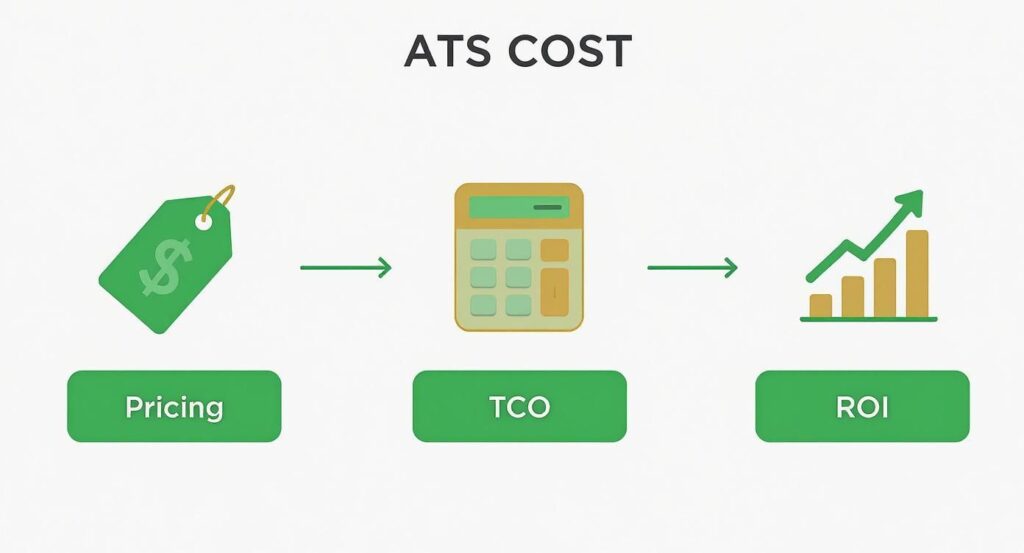
Getting a firm grip on these financial pillars is absolutely crucial for justifying the investment and setting realistic expectations across the business. As soon as you’ve made your choice, your focus should immediately shift to creating a detailed implementation roadmap with your new vendor partner.
A few key steps you can’t afford to skip:
- Establish a Project Timeline: Work hand-in-hand with the vendor to set realistic milestones. Get dates in the diary for data migration, system configuration, and user training.
- Define Team Roles: This isn’t just an HR project. Appoint a dedicated project manager and clearly outline the responsibilities for key people from HR, IT, and any other business units who will be heavy users.
- Develop a Communication Plan: Keep everyone in the loop. Stakeholders need to know about progress, timelines, and what to expect during the switch. No surprises!
- Prepare for a Pilot Programme: Before you go live company-wide, think about launching the ATS with a single department or location first. It’s the perfect way to iron out any kinks in a controlled environment.
A thoughtful evaluation that ends with a meticulous implementation plan ensures the system you’ve chosen doesn’t just meet expectations, but actually empowers your team for years to come.
Still Have Questions About Your ATS Evaluation?
Even with the most detailed plan, a few questions always pop up. It’s natural. Let’s tackle some of the most common queries we hear from CHROs and HR leaders as they get close to the finish line.
How Will We Get Our Old Data Into the New System?
This is the big one, and it’s often glossed over until it’s too late. When you talk to vendors, you need to get specific about data migration.
A reliable partner won’t just move your data; they’ll have a structured plan for it. This means mapping old fields to new ones, cleaning up inconsistent entries, and validating everything to make sure your candidate records, notes, and histories are intact. Don’t let them get away with vague promises. Ask to see a detailed project plan for migration.
A huge mistake we see is treating data migration like a simple admin task. It’s a core technical challenge. If your data is a mess on day one, your shiny new ATS will be practically useless for everything from searching candidate pools to generating accurate reports.
How much should we really involve our hiring managers?
The short answer? A lot. Get them involved early and keep them in the loop.
Hiring managers are the system’s primary users. If they don’t like it, they won’t use it, and adoption will fail. Simple as that. Bring them into the demos and ask for their honest feedback on usability. Does the system actually make their lives easier when it comes to reviewing CVs or giving feedback? Their hands-on perspective is priceless.
And the pressure for these systems to perform is only growing. White-collar hiring in India climbed by about 9% year-on-year as of April 2025. What’s more telling is the massive 42% jump in AI-focused roles, which puts even more pressure on having an intelligent ATS. You can read more about how AI is shaping the future of Indian hiring and why this decision matters so much.
Ready to transform your hiring strategy with a partner who understands your challenges? At Taggd, we specialise in Recruitment Process Outsourcing that delivers results. Learn how we can help you build a world-class talent function.