
Mastering Digital Recruitment in a Modern Era
At its core, digital recruitment is all about using technology to find, attract, assess, and hire people. Think of it as moving the entire hiring process online, using everything from social media and job boards to intelligent software to manage the journey from start to finish.
The Shift to Digital Recruitment Explained
Welcome to the new world of talent acquisition. If old-school hiring was like fishing with a single line in a vast ocean, hoping for a random bite, then digital recruitment is like using satellite imagery and advanced sonar to find entire schools of the exact fish you’re looking for. This isn’t just a minor update; it’s a completely different way of building a winning team.
This move to a digital-first approach has rewired every single step of the hiring journey. It begins the moment a job is posted and follows right through sourcing candidates, screening them, conducting interviews, and even welcoming them aboard. This evolution isn’t happening in a bubble—it’s a direct answer to some powerful changes in the market.
Key Drivers Behind the Digital Transformation
Several big-picture trends have pushed digital methods to the forefront, making them less of a choice and more of a necessity. These drivers mirror bigger shifts in how we all work and what today’s professionals expect from a potential employer.
Here are a few of the biggest motivators:
- The Rise of Remote and Hybrid Work: When your team is scattered across cities or even countries, traditional face-to-face hiring just doesn’t work anymore. Digital tools are the only way to connect with talent, no matter where they are.
- Demand for Specialised Skills: Finding people with very specific, in-demand skills means you have to cast a much wider net. Digital sourcing lets recruiters zero in on professionals with niche expertise, even if they aren’t actively job hunting.
- Expectations of a Modern Workforce: Today’s candidates, particularly the younger generations, are used to smooth digital experiences. They expect a fast, easy, and transparent application process. A clunky or paper-based system can turn off top talent before they even hit “apply.”
Making this shift successful requires more than just buying new software. It calls for a strategic change in mindset, one that’s focused on building a hiring function that is efficient, engaging, and guided by data. Understanding the core steps is key to a smooth transition. For a detailed walkthrough, you can explore our guide on the 7 steps for digital hiring using recruitment technology.
By moving to digital recruitment, companies can tap into a broader, more diverse talent pool and dramatically shorten their time-to-hire. In a competitive market, that speed is a serious advantage. It’s about working smarter, not just harder.
In the end, a digital-first approach is no longer optional—it’s essential for staying competitive. It allows organisations to be more agile and effective in the race for top talent, ensuring they have the skilled teams they need to thrive.
Building Your Digital Recruitment Strategy

A truly effective digital strategy isn’t about just buying the latest software. It’s about weaving technology into a cohesive, forward-thinking plan. Think of it like building a house. You wouldn’t just order a pile of bricks and hope for the best, would you? You need a detailed blueprint that shows how the foundation, walls, and roof all connect to create a solid, lasting structure.
In the same way, a powerful digital recruitment plan is built on four essential pillars. Get these right, and you’ll create a system that consistently attracts, engages, and holds onto top-tier professionals. Your hiring function will transform from a cost centre into a genuine competitive advantage.
Craft a Magnetic Online Employer Brand
Your employer brand is simply your reputation as a place to work. In the digital age, this reputation is formed long before someone even thinks about applying. It’s visible in your company’s LinkedIn page, the unfiltered employee reviews on Glassdoor, and the stories you share across social media.
A strong online brand acts like a magnet for talent. This is especially true for passive candidates—those brilliant people who aren’t actively looking but are always open to a career-defining opportunity. Your brand is your chance to communicate your culture, values, and mission, connecting you with professionals who are a natural fit.
Use Data to Make Smarter Hiring Decisions
Gut feelings can be helpful, but data gives you the map. Modern recruitment platforms are treasure troves of information that can completely reshape your hiring outcomes. By getting a handle on the right metrics, you can shift from just reacting to open roles to proactively acquiring the talent you’ll need tomorrow.
Here are a few key analytics to start with:
- Time-to-Hire: How many days does it take to fill a position, from posting the job to getting an acceptance?
- Cost-per-Hire: What’s the total investment needed to bring a new person on board?
- Source of Hire: Which channels—job boards, referrals, social media—are actually delivering your best candidates?
- Candidate Satisfaction: How do applicants really feel about their experience with your process?
Tracking this data helps you spot bottlenecks, double down on what’s working, and fine-tune your approach over time. This shift is gathering serious momentum. For instance, the adoption of digital recruitment platforms in India is on an accelerated path, with a reported 30% year-over-year increase in usage.
This boom is being driven by a laser focus on data-backed hiring and improving the quality of new hires. You can get more insights on how Indian markets are evolving in the 2025 hiring outlook.
A data-informed strategy doesn’t replace human judgement; it sharpens it. It gives leaders the confidence to make bold decisions backed by clear evidence, improving both efficiency and hiring quality.
Design a Seamless Candidate Experience
The candidate experience is the sum of every interaction a person has with your company during the hiring process. Every single touchpoint matters, from the moment they first click “apply” to the final offer. A clunky, slow, or confusing process is a massive red flag for top talent, who nearly always have other options on the table.
So, what does a superior candidate experience look like?
- It’s Simple: The application should be mobile-friendly and take just a few minutes, not a half-hour.
- It’s Transparent: Candidates should always know where they stand. No more black holes.
- It’s Respectful: Every single applicant, whether hired or not, deserves to be treated with professionalism.
Think of it as customer service for your future team members. A great experience strengthens your employer brand, even among the candidates you don’t end up hiring.
Employ Automation for Efficient Sourcing
Finally, bringing in automation and artificial intelligence (AI) is about freeing up your recruitment team to focus on what humans do best: building relationships. AI-powered tools are brilliant at handling repetitive, high-volume tasks with incredible speed and accuracy.
For example, these tools can scan thousands of profiles to pinpoint candidates who match your exact criteria or handle the initial screening of résumés. This doesn’t take the human element out of hiring. It just redirects it to where it has the biggest impact—engaging with promising people and conducting meaningful, insightful interviews. That kind of efficiency is absolutely essential if you want to scale your hiring efforts without letting quality slip.
Your Essential Digital Recruitment Toolkit
Moving from a high-level strategy to actually hiring people means you need the right tools in your corner. A modern digital recruitment toolkit isn’t about collecting the most software; it’s about getting the right software to work together, creating a well-oiled hiring machine. Let’s break down the core technologies that fuel today’s most effective recruitment teams.
Think of your toolkit like a Formula 1 pit crew. Each person has a specific, vital role—one handles the tyres, another the fuel, a third cleans the visor. They all work in perfect sync to get the car back on the track as fast as possible. In the same way, each piece of recruitment tech solves a particular problem. When you get them working together, your entire hiring process becomes faster and far more competitive.
Applicant Tracking Systems: The Central Hub
At the very heart of any digital hiring setup is the Applicant Tracking System (ATS). This is your command centre, the single source of truth for every vacancy and every candidate who applies. Its main job is to automate and organise the administrative grind of recruitment that, for decades, has been a massive time-sink for HR teams.
An ATS is the answer to chaos. Without one, recruiters are drowning in spreadsheets, email chains, and CVs scattered across different folders. With an ATS, everything is in one place. It handles job postings, funnels in applications, and keeps a clear record of where every candidate is in the hiring process. A solid ATS also keeps you compliant and gives you the raw data you need for meaningful analytics.
Candidate Relationship Management: Building Talent Pipelines
While an ATS is reactive—managing people who have already applied—a Candidate Relationship Management (CRM) system is proactive. It’s all about building and nurturing relationships with potential candidates, often long before a specific job even exists. This is absolutely critical for attracting “passive talent”—those high-performers who aren’t actively job-hunting but are open to the right opportunity.
Imagine you spoke with a brilliant engineer six months ago, but the timing just wasn’t right. A CRM keeps that connection warm. It lets you build talent pools, send out targeted updates about your company culture or exciting new projects, and keep promising people engaged. When the perfect role finally opens up, you don’t start from scratch; you have a pipeline of interested, pre-vetted candidates ready to go.
This visual shows the simple, connected stages that these tools support, from the moment a job is posted to making the final offer.
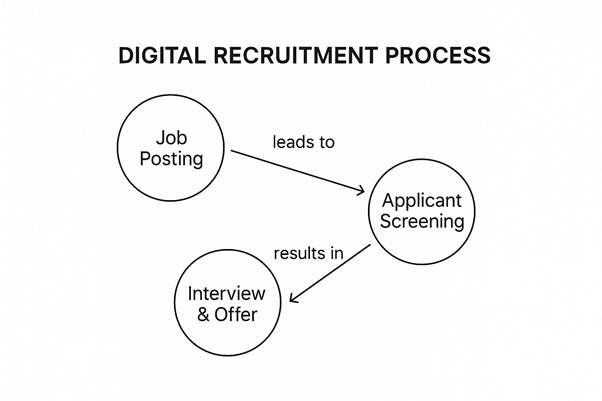
As the infographic shows, these digital tools create a structured, logical flow, turning what can be a complex and messy process into a series of manageable steps.
AI Sourcing Platforms: Finding Needles in Haystacks
Sourcing is often the most time-consuming part of recruitment. AI-powered sourcing platforms have completely changed the game by automating the search for qualified candidates across the entire web, from professional networks like LinkedIn to niche industry forums. They act like incredibly intelligent search engines, understanding context to find people who match even the most complex criteria.
These platforms solve the problem of limited reach. A human recruiter can only look in so many places at once. An AI tool, on the other hand, can scan millions of profiles in minutes, serving up a curated shortlist of top prospects. For companies needing to fill highly specialised roles, these tools are invaluable for uncovering talent that would otherwise stay hidden. To see these capabilities in practice, you can explore how our recruitment platform eases digital hiring.
Video Interviewing Tools: Assessing Talent Anywhere
With the explosion of remote and hybrid work, video interviewing tools are now non-negotiable. They generally come in two flavours:
- Live Video Interviews: These are direct replacements for in-person meetings, enabling real-time conversation between the candidate and the hiring team.
- Asynchronous (One-Way) Interviews: Here, recruiters send a set of questions, and candidates record their answers on their own schedule.
Asynchronous interviews are a real game-changer for initial screening. They let hiring managers review dozens of candidates in the time it would take to do just a few live calls. This standardises the first-round assessment and massively speeds up the shortlisting stage.
These tools eliminate the logistical headaches of scheduling and travel, instantly opening up your talent pool to a global scale. They offer flexibility for both candidates and recruiters, making the whole process more convenient and accessible for everyone.
To see how these new methods stack up against the old ways, let’s compare them side-by-side.
Comparing Traditional vs Digital Recruitment Methods
The table below breaks down the key differences between old-school and modern hiring approaches, highlighting the shifts in everything from speed to candidate experience.
| Recruitment Aspect | Traditional Method | Digital Method |
| Sourcing | Manual searches on job boards, relying on incoming applications and referrals. | Automated AI sourcing across the web, proactive outreach to passive candidates via CRM. |
| Screening | Manual review of every CV, often taking days or weeks to create a shortlist. | Automated screening with an ATS, AI-driven shortlisting based on key skills. |
| Interviews | In-person meetings, creating scheduling and travel-related delays. | Flexible video interviews (live and asynchronous), reducing time-to-hire. |
| Candidate Experience | Often slow and impersonal with limited communication (“black hole” effect). | Fast, transparent, and engaging with regular automated updates and a personal touch. |
| Data & Analytics | Limited data, usually tracked in spreadsheets, making reporting difficult. | Rich, centralised data from an ATS, providing deep insights for process improvement. |
Ultimately, choosing to integrate these core digital technologies isn’t just about modernising; it’s about building a powerful recruitment engine capable of delivering top talent, time and time again.
Navigating India’s Unique Talent Landscape
A global approach to digital recruitment will only get you so far. India’s talent market is its own unique ecosystem, shaped by its enormous scale, incredible diversity, and breakneck economic growth. Applying a one-size-fits-all strategy here is like using a city map to navigate a dense forest—the tools just aren’t right for the terrain.
To succeed, you have to adapt your digital methods to fit the specific opportunities and challenges you’ll find in India. Here, technology isn’t just about efficiency; it’s a fundamental necessity for managing the sheer volume and variety of the country’s talent pool.
The numbers alone tell a compelling story. India’s digital recruitment sector is booming, with forecasts pointing to a 15-20% increase in job opportunities. This surge, powered by advances in AI, machine learning, and cloud computing, is set to create around 500,000 new job openings across major sectors.
Managing High-Volume Campus Hiring
One of the most distinct challenges in India is the sheer scale of campus recruitment. It’s not uncommon for major companies to assess thousands, or even tens of thousands, of graduates from universities all over the country in a very short time frame. Relying on traditional, manual processes is simply out of the question.
This is where digital tools become indispensable. Automated assessment platforms can run online tests for a massive number of candidates at the same time, while video interviewing software makes initial screenings far more efficient. A tech-driven approach like this ensures a fair, standardised process that can handle immense volume without completely overwhelming your HR team.
For Indian organisations, mastering digital campus hiring isn’t just a competitive edge—it’s a fundamental operational requirement. It’s the only way to build a sustainable pipeline of entry-level talent at the necessary scale.
Sourcing Niche Talent and Bridging Skill Gaps
While India has a vast talent pool, it also faces significant skill gaps, particularly in specialised tech fields. Finding a data scientist with specific industry experience in Bengaluru or a cybersecurity expert in Pune requires a much more targeted approach.
Digital sourcing platforms are absolutely crucial for this kind of precision hiring. They allow recruiters to move beyond generic job boards and pinpoint professionals with niche skills, regardless of their location. This capability is vital for closing the gap between industry demand and available talent, a challenge highlighted in the India Skills Report 2023.
Adapting to the Gig Economy and Tier-II Cities
The world of work is changing fast in India. The gig economy is expanding at an incredible rate, and top-tier talent is increasingly found in Tier-II and Tier-III cities, not just the major metros. Any successful digital recruitment strategy has to account for these shifts.
- Gig Worker Integration: Digital platforms make it much easier to find, onboard, and manage freelancers and project-based workers, helping companies build more agile teams.
- Geographic Reach: Virtual hiring processes break down geographical barriers, opening up the rich talent pools emerging in cities like Jaipur, Lucknow, and Coimbatore.
By leaning into these digital methods, organisations can build a more distributed, diverse, and resilient workforce that truly reflects the modern Indian talent market. It’s no longer just about finding people; it’s about connecting with the right talent, wherever they might be.
A Roadmap for Digital Transformation in HR
Knowing the right strategy is one thing, but actually putting it into practice is a completely different ball game. Shifting to a fully digital recruitment model isn’t something you can do overnight; it requires a deliberate, well-thought-out plan.
Think of it like building a house. You need a solid foundation, a clear blueprint, and a project manager to oversee everything. Without that roadmap, even the best intentions can quickly turn into chaos and pushback from your team.
This action plan breaks the whole process down into four manageable phases. It’s designed to walk you through everything, from figuring out where you stand today to getting the new system up and running, ensuring the change is a smooth one for the entire company.
Phase 1: Audit Your Current State
Before you can build anything new, you have to get a brutally honest look at what you’re working with right now. The first step is a deep dive into your existing recruitment processes, technology, and the skills your team currently has.
Start by asking some tough questions:
- Process Bottlenecks: Where are candidates getting stuck or just giving up? Is your application process a ten-page novel? Are people waiting weeks for feedback?
- Technology Gaps: What tools are you actually using? Are you still running your entire operation on spreadsheets and a shared email inbox? Do any of your systems actually talk to each other?
- Team Skills: Does your recruitment team have the know-how for modern digital sourcing, data analysis, or even just learning new software?
This audit gives you a clear baseline. It’s not about pointing fingers; it’s about identifying the real problems you need your digital strategy to solve.
Phase 2: Secure Stakeholder Buy-In
Let’s be clear: this isn’t just an HR project. It’s a business-wide initiative. For this to work, you need everyone from the C-suite to the heads of finance and IT on your side. They need to understand why you’re doing this.
Take the findings from your audit and build a solid business case. Don’t frame this as a cost—frame it as an investment that will pay dividends.
Focus on the outcomes that leaders actually care about. Show them how a digital approach will slash your time-to-hire, bring down recruitment costs, improve the quality of people you bring on board, and give the company a serious edge in the talent market.
Getting this communication right from the start is non-negotiable. When your stakeholders see the strategic value, they stop being obstacles and start becoming your biggest champions.
Phase 3: Select the Right Technology Partners
With your goals set and your leadership on board, it’s time to pick your tools. This is a massive decision, so don’t rush it. You’re not just looking for the platform with the flashiest features; you need a partner who gets your unique challenges and can scale with you as you grow.
Create a shortlist of vendors, but don’t make the decision in a vacuum. Get your team involved in the demos. They’re the ones who’ll be in the trenches with these tools every day, so their feedback is gold. Look at things like ease of use, how well it integrates with your existing systems (like your HRIS), and what kind of support and training they offer.
This technological backbone is especially crucial in markets facing a real talent crunch. In India, for example, there’s a huge shortage of IT professionals with advanced digital skills in AI, cybersecurity, and data analytics. One report found that 66% of Asia-Pacific respondents view this talent scarcity as a direct threat to their business, a pressure felt intensely across India’s booming tech industry. The right digital tools are your best bet for navigating this, a topic you can learn more about by exploring India’s IT talent shortage.
Phase 4: Manage Change and Train Your Team
This last step is where most transformations either succeed or fail. It’s all about the people. The most brilliant tech platform in the world is completely useless if your team doesn’t know how—or doesn’t want—to use it.
Start with clear, transparent communication. Explain how these new tools will make their jobs better, not harder. Show them how it will free them from tedious admin work so they can focus on what really matters: building relationships with great candidates.
Then, invest heavily in proper, hands-on training. This isn’t a one-off webinar. Provide ongoing support, create a space for them to ask questions and give feedback, and be patient as they get used to the new way of working. When you invest in your people, you’re ensuring your new digital recruitment engine will run smoothly for years to come.
The Future of Hiring and Recruitment

If you think digital recruitment has come a long way, just wait. The strategies we’re using today are really just laying the groundwork for what’s next. We’re on the cusp of an era that’s far more intelligent, immersive, and intensely personal. To keep a competitive edge, leaders need to look beyond current best practices and start preparing for a hiring environment that will feel completely different.
The future isn’t just about making our current processes faster; it’s about rethinking how we connect with people. We’re moving away from casting a wide net and towards building genuine, one-on-one relationships. Over the next five years, a few key developments will completely reshape how we find and hire talent.
The Rise of Hyper-Personalisation
Let’s be honest: generic, mass emails to candidates are already on their way out. The future is all about hyper-personalisation, where every single touchpoint is shaped for the individual. We’re talking about communication that’s tailored to their specific skills, career goals, and even how they prefer to be contacted.
Picture an AI that doesn’t just find a great software engineer, but also writes an outreach email that mentions a specific open-source project they contributed to. It would then suggest a role that perfectly matches the career path they’ve outlined on their profile.
This kind of customisation shows you’ve done your homework and see them as a person, not just a CV. It shifts recruiting from a numbers game to a relationship-building exercise, and that’s how you get the best people to respond.
Immersive Experiences with Virtual Reality
The interview itself is also due for a serious upgrade. While video calls have become the norm, virtual reality (VR) is poised to take assessments to a whole new level. It’s about creating interactive environments that feel real.
Think about the possibilities:
- Virtual Office Tours: A candidate in another country could walk through your workspace, meet avatars of the team, and get a real feel for the company culture.
- Realistic Job Simulations: Instead of asking a candidate how they’d handle a difficult situation, you could put them inside a simulated one and see their skills in action. This offers far more insight than a standard Q&A.
VR provides a richer, more meaningful way to gauge both skills and cultural fit, giving everyone a much clearer idea of whether it’s the right match.
As AI becomes more integrated into hiring, ethical considerations are paramount. Organisations must prioritise fairness, transparency, and accountability to build trust with candidates and avoid perpetuating biases.
Predictive Analytics for Workforce Planning
Perhaps the biggest strategic change will come from predictive analytics. Right now, most recruiting is reactive—a role opens up, and we scramble to fill it. But what if you could forecast your hiring needs with stunning accuracy?
By feeding business growth plans, market data, and employee turnover rates into an analytics engine, HR teams can predict which roles will be most critical in six, twelve, or even eighteen months. This lets recruiters get ahead of the game.
They can start nurturing relationships and building talent pipelines for key positions long before a job requisition is ever created. It’s a shift from reactive filling to proactive planning, and it’s a massive competitive advantage.
Frequently Asked Questions
It’s completely normal to have questions when you’re rethinking your approach to hiring. Let’s tackle some of the most common ones that come up as leaders move towards a more modern, digital recruitment model.
How Do I Actually Measure the ROI of Digital Recruitment?
It’s tempting to just look at the cost of new software, but the real return on investment (ROI) comes from tracking the impact on your business’s bottom line and efficiency. You need to connect the dots between your tech spend and tangible results.
A few key performance indicators will tell the story:
– Shorter Time-to-Hire: Every day a role sits empty, it costs the business. Tracking how much faster you fill positions is a direct measure of productivity gained.
– Lower Cost-per-Hire: Think about the hours your team spends on manual tasks or the money spent on recruitment agencies. Automation and direct sourcing can dramatically bring this number down.
– Better Quality of Hire: This is the big one. Are the people you’re hiring through digital channels performing well? Are they staying with the company? Tracking performance reviews and retention rates for new hires gives you a clear picture of quality.
– Higher Candidate Satisfaction: A smooth, positive application experience boosts your employer brand, making it easier and cheaper to attract top talent in the future.
When you can present these metrics, you’re not just talking about a new system; you’re building a powerful business case for your entire talent strategy.
Is Automation Going to Replace My Recruiters?
Not at all. The goal isn’t to replace recruiters but to supercharge them. Think of automation as a highly efficient assistant that handles all the tedious, repetitive work that recruiters get bogged down in.
AI and automation are brilliant at sifting through thousands of profiles and handling the initial screening. This frees up your human experts to do what they do best: build relationships, have meaningful conversations, gauge cultural fit, and truly sell your company to the best candidates.
The real aim is to automate the administrative grind so you can elevate the human touch. When technology handles the grunt work, your recruiters can focus on the high-impact, strategic activities that actually win talent.
What’s the Very First Step to Take?
Before you even look at a single piece of software, stop and take a hard look at your current recruitment process. The single biggest mistake is buying a tool before you truly understand the problem you’re trying to solve.
Start by asking some honest questions: Where in our process are we losing the best candidates? How many hours are wasted on manual data entry? Which steps feel clunky or slow? This self-audit will expose the real bottlenecks and pain points.
The real aim is to automate the administrative grind so you can elevate the human touch. When technology handles the grunt work, your recruiters can focus on the high-impact, strategic activities that actually win talent.
Ready to build a powerful talent pipeline and attract top performers? Taggdprovides expert Recruitment Process Outsourcing solutions to help you win the war for talent. Learn how we can help you build a magnetic employer brand.