
A CHRO’s Guide to Summary Dismissal in India
Summary dismissal is one of the most serious actions an employer can take. It’s a high-stakes move, reserved for only the most severe cases of employee misconduct, allowing for the immediate termination of an employment contract without any notice or pay in lieu of notice.
The Core Concept of Summary Dismissal

Think of the employment relationship as a bridge built on a foundation of mutual trust. Most employee departures are like a planned, orderly crossing—this is your standard termination with a notice period. A summary dismissal, however, is like hitting the emergency demolition button. It’s a drastic, instant action you take when an employee’s behaviour has so completely destroyed that bridge that keeping them on for even one more day is unthinkable.
This ultimate form of termination is legally justifiable under one specific condition: gross misconduct. This isn’t about an employee who’s struggling with performance or who bends a minor rule. We’re talking about actions so serious they fundamentally tear up the employment contract from the employee’s side.
Understanding Gross Misconduct
So, what exactly counts as gross misconduct? It’s any act that completely shatters the trust and confidence you have in an employee, making it impossible to continue the working relationship. While every situation is unique, the classic examples include:
- Theft or fraud: Any dishonest act that hits your company financially or damages its reputation.
- Workplace violence or threats: Behaviour that puts the safety of colleagues at risk.
- Wilful insubordination: A deliberate and serious refusal to carry out a lawful and reasonable instruction.
- Severe breach of policy: A critical violation of company rules, like leaking sensitive company data or a major safety infraction.
The key principle here is that the employee’s action is so damaging that it justifies skipping the standard notice period entirely. This is precisely why a summary dismissal is such a high-risk decision. If your organisation gets it wrong, you could be facing serious legal blowback, including a claim for wrongful dismissal.
A summary dismissal should never be a knee-jerk reaction. Even when the misconduct seems blatant, it must be the end result of a calculated, evidence-backed decision made only after a fair and thorough investigation.
How It Differs From Standard Termination
Understanding the difference between a summary dismissal and a regular termination is critical. To make this clear, let’s break down the key distinctions.
| Aspect | Summary Dismissal | Standard Termination |
|---|---|---|
| Reason | Gross misconduct only. | Performance issues, redundancy, minor misconduct, or mutual agreement. |
| Notice Period | None. The employment ends immediately. | Required. The statutory or contractual notice period must be given. |
| Payment | Only accrued wages and benefits up to the termination date. No pay in lieu of notice. | Full pay during the notice period or a lump sum payment in lieu of notice. |
| Process | Requires a robust and fair investigation to prove gross misconduct. | Follows a standard process, which may include performance improvement plans or consultation. |
| Risk Level | High. Carries a significant risk of a wrongful dismissal claim if not handled perfectly. | Low to moderate. Procedural fairness is still required, but the legal bar is different. |
A standard termination, whether for poor performance or redundancy, provides a buffer for both sides to adjust. A summary dismissal offers no such cushion.
Recent labour reforms in India, such as the Industrial Relations Code 2020, aim to clarify these processes. They balance the employer’s need for decisive action with strong employee protections by clearly outlining the grounds for termination. This framework reinforces that employers must always be able to prove “cause” for any dismissal, making a fair, justifiable, and procedurally sound process more important than ever. To ensure you’re fully compliant, it’s wise to explore the detailed legal framework of employment termination in India.
Navigating India’s Employment Termination Laws

To pull off a summary dismissal without landing in legal hot water, you first need a solid grasp of India’s layered employment laws. This isn’t a single rulebook. Think of it as a complex web of central and state-level legislation that dictates how and when you can end an employment relationship. Acting without this knowledge is like trying to navigate treacherous waters without a map—you’re bound to hit a rock.
The legal landscape is primarily shaped by two types of laws: central acts that apply nationwide and state-specific acts that add another layer of complexity. For any CHRO, understanding how these two interact is the first step toward making termination decisions that will actually hold up.
The Great Divide: Workmen and Non-Workmen
The single most critical distinction in Indian employment law is how employees are classified: are they ‘workmen’ or ‘non-workmen’? This one factor completely changes the rules of the game for any termination, especially a summary dismissal.
A ‘workman’ is generally defined under the Industrial Disputes Act, 1947, as someone doing manual, unskilled, skilled, technical, operational, clerical, or supervisory work. The key thing to remember is that this category specifically excludes people in managerial or administrative roles.
On the other hand, ‘non-workmen’ are those who fall outside this definition—think managers, administrators, and senior executives. Their employment is governed more by their individual contracts and the Shops and Establishments Act of their particular state.
This isn’t just a technicality; it has massive practical consequences.
- For Workmen: Terminations are heavily policed by the Industrial Disputes Act, 1947. This law lays down strict procedures for any dismissal, even for clear misconduct, and provides strong protections against being fired arbitrarily.
- For Non-Workmen: The terms in their employment contract and the state’s Shops and Establishments Act carry more weight. While they still have protections, there’s generally more flexibility here compared to the ‘workman’ category.
Get this classification wrong, and an otherwise justified termination can be deemed illegal, opening your organisation up to serious legal and financial trouble.
Key Legislation You Must Know
While there are many laws on the books, a few key pieces of legislation are the bedrock of termination rules in India. Every HR leader needs to know what they are and what they do.
The Industrial Disputes Act, 1947 This is the big one for ‘workmen’. It demands a fair and just process for any disciplinary action, which absolutely includes dismissal for misconduct. It also governs large-scale dismissals or retrenchments, requiring employers to follow rules like ‘last in, first out’ and pay specified severance. To get a better handle on these requirements, you can discover more insights about termination and severance pay in India.
Shops and Establishments Acts These are state-level laws that regulate working conditions in most commercial businesses. They often have specific rules about notice periods, termination processes, and final payments, primarily for ‘non-workmen’. If your company has offices in multiple states, you have to be compliant with each separate Act—what works in Maharashtra might not fly in Karnataka.
Even in the face of blatant misconduct justifying a summary dismissal, the law demands procedural fairness. The core legal principle of audi alteram partem—”let the other side be heard”—is non-negotiable.
This principle guarantees that no one can be condemned without a fair chance to tell their side of the story. For CHROs, this is a crucial takeaway: even if you catch an employee red-handed, holding a formal enquiry is a procedural must. Skipping this step is one of the quickest ways to have a summary dismissal overturned by a court, no matter how serious the misconduct was.
Defining Gross Misconduct For Lawful Dismissal

The entire concept of summary dismissal lives and dies by one crucial idea: gross misconduct. A bit of standard misconduct might just earn an employee a formal warning or a spot on a Performance Improvement Plan. But gross misconduct? That’s a different beast entirely.
It’s an act so severe that it completely shatters the trust and confidence that form the bedrock of the employer-employee relationship. Think of the employment contract less as a legal document and more as a pact of mutual faith. Gross misconduct is the employee taking a match to that pact. It’s such a fundamental breach of their duties that keeping them in the workplace for even one more day becomes impossible.
For a CHRO, knowing how to confidently identify these acts is the only way to carry out a legally sound summary dismissal and sidestep the massive risks of a wrongful termination claim.
The Litmus Test For Gross Misconduct
So, what’s the line that separates everyday misbehaviour from gross misconduct? The key question you always need to ask is this: Does this act irrevocably destroy the employer’s trust in the employee? If the answer is a firm “yes,” you’re almost certainly in summary dismissal territory.
The action has to be so serious that it effectively repudiates the contract of employment. In simple terms, the employee has, by their own hand, torn up the agreement. This is precisely why you can bypass the standard notice period—their behaviour shows they have no intention of honouring their end of the deal, especially the implied duties of trust and good faith.
Concrete Examples That Justify Dismissal
Vague definitions won’t do you any good when the stakes are this high. Let’s get practical and look at concrete behaviours that are almost universally seen as gross misconduct. Each one of these strikes right at the heart of the employment relationship.
- Theft, Fraud, or Dishonesty: This is probably the most clear-cut case. An employee caught stealing company property, faking expense reports, or engaging in fraud for their own gain is directly attacking the company. Trust isn’t just damaged; it’s gone.
- Workplace Violence or Serious Threats: Any physical assault, credible threat of violence, or behaviour that makes others feel unsafe is an absolute red line. You have a legal and moral duty to provide a safe workplace, and tolerating this kind of behaviour simply isn’t an option.
- Wilful Insubordination: This goes far beyond just disagreeing with a manager. We’re talking about a deliberate, outright refusal to follow a lawful and reasonable instruction that is clearly part of their job. It’s a direct challenge to the authority needed to run the business.
- Severe Breach of Health and Safety Rules: Knowingly ignoring critical safety rules, especially in a setting where it could cause serious injury or even death, is a classic example. It demonstrates a reckless disregard for their own well-being and that of their colleagues.
- Intoxication at Work: Showing up to work under the influence of alcohol or non-prescribed drugs is a non-starter. It impairs judgement, kills productivity, and poses a serious safety risk to everyone around them.
It is crucial to remember that the burden of proof rests with the employer. You must be able to demonstrate that the misconduct occurred and that it was serious enough to warrant summary dismissal.
This is where having crystal-clear, well-communicated company policies becomes your strongest defence. When you spell out what constitutes gross misconduct in your employment contracts and employee handbooks, you leave no room for doubt or argument.
Of course, the best strategy is to build a team that respects these boundaries from the outset. Understanding how Global Capability Centres (GCCs) in India can attract and hire the best talent is a great place to start building a foundation of integrity in your workforce.
To make this even clearer, the table below breaks down common acts of gross misconduct and explains exactly why they justify such a severe response.
Examples of Gross Misconduct
| Act of Misconduct | Justification for Summary Dismissal |
|---|---|
| Fraudulent Activities | Fundamentally violates the duty of good faith and trust; causes direct financial or reputational harm to the company. |
| Physical Violence | Creates an unsafe work environment for all employees, violating the employer’s duty of care and destroying team morale. |
| Serious Data Breach | A wilful or grossly negligent leak of confidential company or client data represents a catastrophic breach of trust and can have severe legal and financial repercussions. |
| Sabotage of Company Property | Deliberately damaging company equipment, data, or operations is a direct attack on the business and its ability to function. |
Ultimately, defining these actions clearly and applying your policies consistently is a CHRO’s most powerful tool in navigating a summary dismissal correctly. It elevates the decision from a subjective judgement call to a defensible, policy-driven action.
Executing a Defensible Dismissal Process
Even when you have an open-and-shut case of gross misconduct, a flawless reason can be completely undone by a flawed process. The legal principle of natural justice isn’t just a friendly suggestion; it’s a strict requirement under Indian labour law. For a summary dismissal to hold up in court, the procedure you follow is every bit as critical as the justification itself.
Think of it like this: the gross misconduct is the charge, but your internal process is the trial. An accusation alone, no matter how serious, simply isn’t enough. You have to prove your case through a procedure that is fair, transparent, and meticulously documented. Getting this wrong can lead to a court overturning the dismissal, which could mean reinstatement orders and hefty back pay, even if the employee was clearly in the wrong.
This procedural roadmap is your playbook for a defensible dismissal, ensuring every step you take is compliant and built on a foundation of fairness.
The Preliminary Investigation
The moment you learn about potential gross misconduct, the clock starts ticking. Your first move should be a swift but thorough preliminary investigation to get the basic facts straight. This isn’t about reaching a final verdict; it’s about figuring out if there’s enough smoke to suggest a fire.
The goal here is to gather initial evidence quickly and without causing a scene. This could involve:
- Securing physical evidence like CCTV footage or damaged company property.
- Reviewing relevant documents, such as financial records or email chains.
- Taking confidential statements from anyone who witnessed the incident directly.
Based on what you find, you’ll decide whether a formal disciplinary process is even necessary. If the preliminary evidence is strong, you’re ready for the next critical stage.
Issuing the Show-Cause Notice
Once you’ve established a prima facie case—meaning you have enough evidence on the face of it—you must issue a formal show-cause notice to the employee. This is a non-negotiable legal document, not just a casual email. It officially puts the employee on notice about the specific allegations against them.
A show-cause notice is the employee’s first formal chance to understand the charges. Vague accusations won’t cut it. The notice must detail the specific misconduct, point to the company policies that were broken, and include copies of any evidence you’ve gathered.
The notice also needs to state clearly that the alleged misconduct is serious enough to potentially lead to summary dismissal. Crucially, you must give the employee a reasonable amount of time (usually 24 to 48 hours) to provide a written explanation. This step is a cornerstone of the audi alteram partem principle—the non-negotiable right to be heard.
The Domestic Enquiry: A Mini-Trial
If the employee’s written response is unconvincing or they fail to address the allegations, the next step is to hold a domestic enquiry. This is your organisation’s internal trial. Its sole purpose is to examine the evidence, hear from all sides, and give the employee a full and fair chance to present their case before an unbiased decision-maker.
To keep the enquiry impartial, the enquiry officer must be someone completely uninvolved in the preliminary investigation. This could be a manager from a different department or even an external consultant. The process has to be meticulous. It’s often said that a fair process can save a weak case, while a sloppy one can destroy a strong one. While it’s a daunting task, a strong process starts with strong people. Improving your ability to accelerate recruitment and hire top talent can build a more robust HR team capable of managing these complex situations.
The infographic below shows the typical flow of a formal proceeding, mirroring the structured approach needed for a solid domestic enquiry.
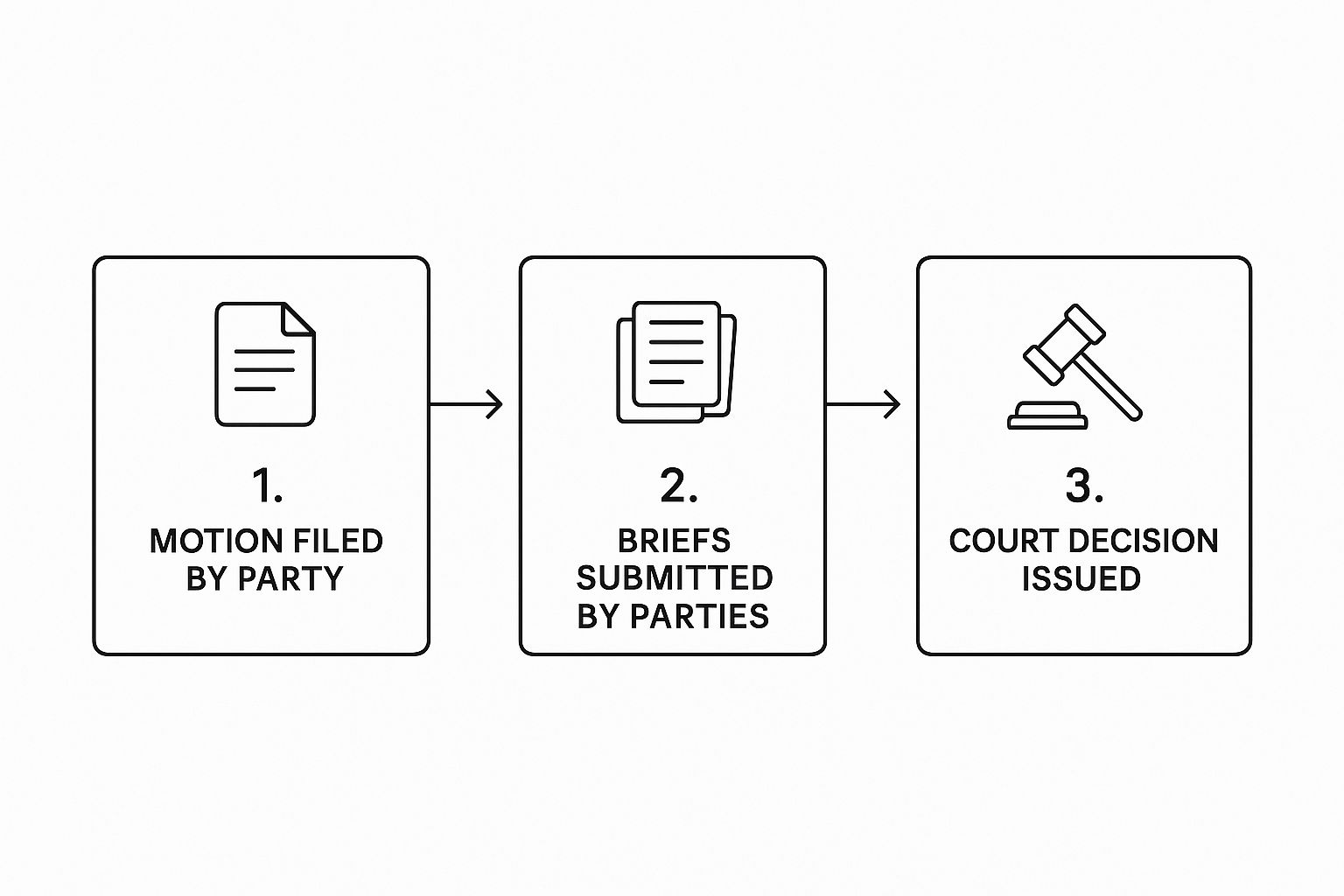
This visual highlights the need for a step-by-step, evidence-based process that moves from the initial action to a final, well-reasoned decision.
During the enquiry, the officer will review all evidence, allow both the management’s representative and the employee to present their cases, permit cross-examination of witnesses, and keep a formal record of everything that happens.
Finally, the officer will write up a report with their findings. This isn’t a recommendation for punishment, but a straightforward verdict on whether the misconduct charges were proven based on the evidence. Only after receiving this report can senior management make a final, informed decision on the penalty—which, if the misconduct is proven, can be summary dismissal.
Managing Termination During Probation
Let’s be honest, terminating an employee during their probation period often feels like a lower-risk move compared to dismissing a confirmed, long-serving team member. Think of probation as the final stage of the interview process—a real-world test drive for both the company and the new hire to see if it’s a good fit. But here’s a common and costly mistake: assuming this period gives you a blank cheque to terminate for any reason, no questions asked.
While you certainly have more wiggle room, the process isn’t a free-for-all. If the issue is simply unsuitability—maybe their skills aren’t quite what you expected, or they just don’t gel with the team culture—letting them go is usually straightforward. This is often called a “simple termination.” You can just state that their services are no longer needed without giving a reason that could be seen as damaging their future prospects.
The Stigma Exception
Things get a lot more complicated if the reason for dismissal is misconduct. If you’re letting a probationer go for something like dishonesty, gross insubordination, or any other serious breach that would be grounds for summary dismissal in a confirmed employee, you are attaching a stigma to their exit.
This “stigmatic dismissal” completely changes the game. Indian courts have been very clear on this: you can’t tarnish someone’s professional reputation without giving them a fair chance to clear their name. In these situations, the probationer suddenly has the same rights to natural justice as a permanent employee.
What does that mean for you? It means you can’t skip the crucial steps:
- Issuing a Show-Cause Notice: You must formally write to the employee, clearly outlining the specific allegations of misconduct against them.
- Holding a Domestic Enquiry: You have to conduct a fair and impartial internal investigation into the charges, giving the employee a proper opportunity to present their side of the story.
Dropping the ball on this process for a stigmatic dismissal is a fast track to a wrongful termination lawsuit you’re likely to lose.
Crafting Compliant Probationary Clauses
Your first line of defence is always the employment contract. A well-worded probation clause is worth its weight in gold, creating clarity for everyone and protecting the organisation. It’s a delicate balance between giving yourself flexibility and staying on the right side of the law.
The key is to have a probationary clause that explicitly states the employer’s right to terminate employment without cause during the probation period, simply by giving the contractual notice or paying them in lieu of notice. This simple language is your best friend for handling non-stigmatic terminations smoothly.
In India, ending employment during probation is common practice, with the typical period lasting from three to six months as set out in the contract. This setup allows companies to quickly move on from hires who aren’t a good fit, which is vital for maintaining an efficient and high-performing workforce. However, the moment misconduct enters the picture, you must give the employee a chance to be heard to ensure fair treatment. You can find more practical insights on termination practices in India from Rippling.com.
At the end of the day, the probationary period is an invaluable assessment window, but it’s not a legal no-man’s-land. A simple termination for unsuitability is one thing. But as soon as the reason for dismissal involves misconduct, the full procedural fairness of a summary dismissal applies—regardless of whether the employee is on probation or has been with you for years.
Minimizing Risks From Improper Dismissal
Let’s be blunt: a wrongful summary dismissal can unleash a storm of negative consequences for any organisation. This isn’t just about one legal dispute; it’s a high-impact event that can trigger expensive lawsuits, poison team morale, and do lasting damage to your employer brand. The shockwaves from one poorly handled termination can spread distrust throughout the entire company.
The most immediate danger is, of course, a wrongful termination lawsuit. These legal battles are a huge drain on resources, racking up significant legal fees and eating up management’s time. They also carry the very real risk of a court ordering you to reinstate the employee with full back pay. Just imagine being forced to re-hire someone you dismissed for serious misconduct and then cutting them a cheque for the entire time they were gone. The financial and cultural costs are simply staggering.
But the damage doesn’t stop there. News of unfair dismissal travels fast, tarnishing your reputation in the talent market and making it much harder to attract the high-calibre people you want. Your current employees are watching these situations very closely. A sense of injustice can quickly sour into disengagement, tanking productivity across the board. This is precisely why a proactive approach to risk management isn’t just a legal checkbox—it’s a core business strategy.
Building A Strong Defence
The best offence here is a good defence. You need to build a robust framework that makes every single summary dismissal defensible. This is about more than just reacting to problems as they happen; it’s about creating a system where fairness and consistency are baked into your daily operations.
Here are the essential pillars of that defence:
- Rigorous Documentation: You must meticulously document every single step of the disciplinary process, from the initial complaint right through to the final decision. This creates a rock-solid evidence trail that proves you followed a fair and just procedure.
- Consistent Policy Enforcement: Your disciplinary policies have to be applied uniformly across all levels and departments. No exceptions. Inconsistency is a massive vulnerability in court, as it can easily be framed as proof that a dismissal was discriminatory or arbitrary.
- Mandatory Manager Training: Give your line managers the training they need to spot potential misconduct and handle those crucial initial disciplinary conversations correctly. One clumsy first response can compromise the entire process down the line.
- Timely Legal Consultation: As soon as a situation looks like it might head towards summary dismissal, get your legal counsel involved. An expert opinion can validate your process and help you spot potential legal landmines before you step on them.
Taking these proactive steps doesn’t just shield your organisation from legal heat; it helps cultivate a positive and fair work environment. A culture of fairness makes it less likely that incidents will escalate in the first place and can have a real, positive impact on retention. For more on this, you might be interested in an overview of employee attrition and how to prevent it.
Ultimately, minimising risk boils down to embedding procedural fairness deep into your company’s DNA. By treating a summary dismissal with the gravity it deserves and sticking to a strict, defensible process, you protect your organisation’s finances, its reputation, and most importantly, its people.
Of course. Here is the rewritten section, crafted to sound completely human-written and natural, following the provided style guide and examples.
Frequently Asked Questions About Summary Dismissal
When you’re in the thick of a summary dismissal, the theory is one thing, but the practical, on-the-ground questions are what really matter. Even the most seasoned HR leaders run into unique situations that need a quick, clear answer. Here are some of the most common questions we get from CHROs.
Can We Summarily Dismiss an Employee for Poor Performance?
Absolutely not. This is a common but critical mistake. Poor performance is a matter of an employee’s capability, not their conduct, and it never falls under the umbrella of gross misconduct. Summary dismissal is a tool reserved for the most severe breaches of trust—think theft, fraud, or violence.
When an employee is underperforming, the right approach is supportive and structured. This is where you bring in a Performance Improvement Plan (PIP), set clear and achievable goals, provide regular feedback, and give them a real chance to get back on track. Reaching for a summary dismissal in a performance case is a fast track to a wrongful termination claim.
Is a Domestic Enquiry Always Mandatory?
Yes, it is non-negotiable. I can’t stress this enough. Even when you have what seems like irrefutable proof—say, crystal-clear video footage of an employee stealing from the company—you still have to conduct a formal domestic enquiry. This step is fundamental to upholding the principles of natural justice.
Skipping the enquiry because the outcome feels like a foregone conclusion is a massive legal blunder. The enquiry isn’t just a formality; it’s your documented proof that you acted fairly, gave the employee every opportunity to state their case, and made your final decision after a proper, unbiased examination of all the evidence.
What Is the Difference Between Absconding and Job Abandonment?
These terms are often used interchangeably, but there are subtle legal differences. Absconding is when an employee is absent without authorisation. Job abandonment goes a step further, implying a clear intention never to return to their job.
But in either scenario, you can’t just assume the employment is over and close the file. You have a process to follow. You must make a genuine effort to contact the employee by sending formal letters to their last known address, requesting an explanation for their absence and asking them to return. Only after you’ve made and documented these attempts can you move forward with termination based on unauthorised absence.
Do We Still Pay Final Dues in a Summary Dismissal?
Yes, you do. An employee who is summarily dismissed is still legally entitled to their statutory dues up to their final day of work. This includes any salary owed for the days they worked and payment for any accrued leave that hasn’t been taken.
The main difference is that there’s no requirement to pay them in lieu of a notice period. Gratuity is another matter. It can sometimes be forfeited if the employee’s misconduct led to a quantifiable financial loss for the company, but that’s a separate legal process and requires solid proof to justify.
The best way to avoid these high-stakes situations is to build a resilient, high-integrity workforce from the very beginning. Taggd specialises in Recruitment Process Outsourcing, helping you find and hire top-tier professionals who align with your company’s values. Learn more about how we can help you build a stronger, more reliable team at https://taggd.in.