Workplace safety has become a boardroom priority rather than just a compliance requirement.
According to the International Labour Organization, nearly 3 million workers die every year due to work-related accidents and diseases globally, while millions more suffer non-fatal injuries.
As industries become more complex and regulations more stringent, organizations are investing heavily in Health, Safety, and Environment leadership to reduce risk, improve compliance, and create safer workplaces.
This growing focus has made HSE Managers indispensable across manufacturing, construction, energy, chemicals, logistics, and infrastructure sectors. The same trend is influencing leadership hiring in renewable energy companies, where safety, sustainability, and operational governance are becoming board-level priorities.
This guide explores the role of an HSE Manager in 2026, including key responsibilities, essential skills, salary trends, interview questions, industry demand, hiring challenges, and career opportunities.
Whether you are planning a career in HSE or hiring safety leaders, this guide provides a comprehensive overview of what the role involves and why it matters.
What is an HSE Manager?
An HSE Manager is a senior safety professional who designs, implements, and oversees an organization’s health, safety, and environmental management systems, ensuring regulatory compliance, reducing incident risk, and building a sustainable safety culture across all operations.
While HSE Managers lead safety strategy at an organizational level, many foundational responsibilities begin with site-level safety professionals. Organizations building stronger safety programs often start by defining clear safety officer roles and responsibilities then scaling those practices into enterprise-wide HSE systems.
Good HSE leaders can challenge plant heads without losing credibility, translate site conditions into management decisions, and connect workforce behaviour to cost, continuity, and governance. That broader talent lens is reflected in resources such as this executive guide for CHROs and talent acquisition leaders, which examine how hiring decisions align with business priorities rather than isolated vacancies.
| An HSE Manager is a specialist who owns the entire safety and environmental risk framework of an organization, converting regulatory requirements and operational hazards into systems, training, and accountability structures that protect people, assets, and business continuity. |
What strong HSE leadership changes
The clearest shift is conceptual:
| Old view | Better view |
| HSE is a compliance cost | HSE is a control system for operational risk |
| Safety reporting is retrospective | Safety reporting informs decisions before failure |
| HSE owns safety alone | Line leaders own risk, HSE sets standards and drives discipline |
| Environmental work is separate | Environmental risk affects continuity, cost, and reputation |
This change has direct hiring implications. Companies that recognise it early do not screen only for certifications or audit exposure. They look for someone who can use data, influence operations leaders, strengthen contractor governance, and convert fragmented site information into a management view that helps the business act faster and with fewer surprises.
Core Operational Tasks of an HSE Manager
HSE Managers keep organizational safety systems functioning, risks controlled, and compliance current. Here is what their day-to-day looks like:
- HSE Management System Oversight
Designing, implementing, and continuously improving HSE management systems aligned with ISO 45001 and ISO 14001, ensuring policies translate into consistent operational practice. - Risk Assessment and Hazard Control
Leading risk assessments across operations, identifying hazards, evaluating control effectiveness, and driving implementation of corrective and preventive measures before incidents occur. - Incident Investigation and Reporting
Leading investigations into incidents and near misses, conducting root cause analysis, and ensuring corrective actions are tracked to verified closure. - Regulatory Compliance and Audit Management
Managing statutory compliance, coordinating regulatory inspections, and preparing the organization for certification audits and third-party assessments. - Training and Safety Culture Development
Designing and delivering HSE training programs, coaching leadership on safety behavior, and driving cultural initiatives that embed safety into daily operations. - HSE Performance Reporting
Tracking leading and lagging safety indicators, preparing management reports, and presenting HSE performance and risk trends to senior leadership regularly.
What Skills Does an HSE Manager Need?
Great HSE Managers are not just compliance experts. They are credible leaders who combine technical risk knowledge with the ability to influence operations, contractors, and senior leadership simultaneously. Here is what the best brings to the table:
| Technical Skills | Soft Skills |
|---|---|
| HSE management systems (ISO 45001 & ISO 14001) | Leadership and decision-making under pressure |
| Risk assessment, hazard identification, and incident investigation | Influencing stakeholders across all organizational levels |
| Regulatory compliance, permit-to-work, and contractor safety management | Communicating safety risks in clear business terms |
| Emergency response and crisis management planning | Coaching, mentoring, and safety culture development |
| HSE data analytics, reporting, and environmental compliance | Continuous improvement and systems thinking |
Modern HSE leadership increasingly requires capabilities beyond traditional compliance management. As regulations evolve and sustainability goals become more prominent, employers are looking for professionals with strong safety compliance, regulatory management, and environmental governance expertise. These capabilities are becoming critical across manufacturing, construction, energy, and infrastructure sectors.
How Data Is Reshaping HSE in India
India’s HSE function is moving from paperwork to proof. Similar workforce transformation challenges can be seen in the workforce planning for semiconductor industry, where operational risk, compliance, and talent readiness must be managed simultaneously.
That change isn’t cosmetic. It alters what HSE managers do each day, how leaders judge performance, and what kind of candidate should be hired into the role.
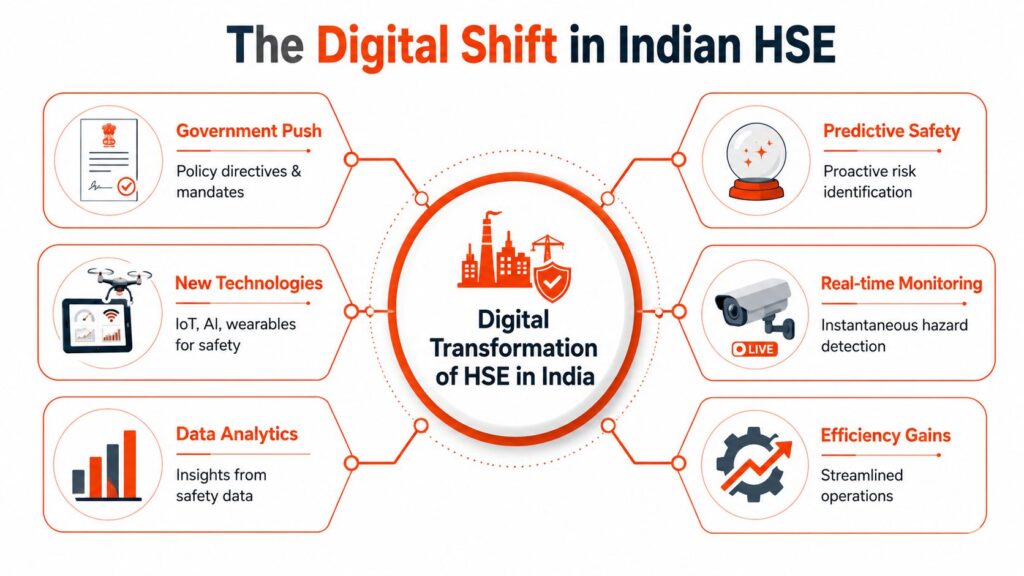
Public policy is part of the reason. India’s push for compliance digitisation through the 2024–25 Budget and MeitY-linked initiatives is creating stronger expectations around digital recordkeeping, risk reporting, and evidence-based inspections, even as much of the workforce still sits in establishments with fragmented safety capability. That gap is exactly where the modern HSE manager becomes valuable.
From registers to risk visibility
A traditional HSE process often depends on lagging information. Digital systems change that. They let HSE managers collect signals earlier, compare sites faster, and escalate exceptions with evidence rather than anecdotes.
In practice, the gains often come from basics done consistently:
- Mobile reporting tools: Supervisors and employees can log hazards, near misses, and observations without waiting for paper forms.
- Central dashboards: Site data can be viewed by plant leadership, HR, operations, and corporate teams in one place.
- Corrective-action workflows: Open issues don’t disappear into email chains. They are assigned, tracked, and reviewed.
- Audit trail integrity: Inspection evidence, photographs, timestamps, and closure records become easier to verify.
The strategic point for CHROs is this. Once the organisation expects traceable data and cleaner records, the HSE manager’s role shifts from record custodian to interpreter of operational risk. That requires a different kind of capability, closer to workforce analytics than many job descriptions currently recognise.
Digital Adoption
Strong digital HSE leadership isn’t about buying software and declaring transformation complete. It is about management discipline. The best HSE managers use tools to improve decisions, not just documentation.
Look for behaviours such as these:
| Weak digital adoption | Strong digital adoption |
| Incident data stored locally | Data reviewed across sites in a common format |
| Audits treated as isolated events | Audit findings grouped into recurring control failures |
| Corrective actions logged but not challenged | Closure quality reviewed, reopened, and escalated when weak |
| Reports built for compliance only | Reports built for line decisions and early intervention |
Key Responsibilities of an HSE Manager
HSE Managers protect organizational safety, compliance, and reputation by building robust systems, leading investigations, and driving a culture where safety is owned at every level.
| Responsibility Area | Key Activities |
|---|---|
| HSE Strategy & Management Systems | Develop HSE strategy, manage ISO 45001/14001 systems, set performance targets, and report outcomes to leadership. |
| Risk & Hazard Management | Lead risk assessments, maintain risk registers, implement controls, and oversee permit-to-work processes. |
| Incident Investigation & Corrective Actions | Investigate incidents and near misses, conduct root cause analysis, and ensure corrective actions are implemented and tracked. |
| Regulatory Compliance & Audits | Ensure compliance with statutory regulations, manage inspections, maintain documentation, and lead audit readiness efforts. |
| Training & Safety Culture | Deliver HSE training, promote behavioral safety, engage employees and contractors, and strengthen safety culture. |
| Enterprise HSE Leadership (Senior Roles) | Oversee multi-site HSE programs, lead crisis preparedness, advise leadership on risk, and manage HSE teams across locations. |
HSE Manager Job Description Template
Job Title: HSE Manager / Health, Safety, and Environment Manager
Department: Health, Safety and Environment / Operations
Reports To: Plant Head / VP of Operations / Chief Operating Officer
Location: [Location]
Employment Type: Full-time
Job Summary: We are looking for an experienced and credible HSE Manager to lead our health, safety, and environmental function. In this role, you will design and manage HSE systems, lead risk assessment and incident investigation programs, ensure regulatory compliance, and build a strong safety culture across operations. You will work closely with plant leadership, contractors, and regulatory bodies to protect our people, assets, and reputation.
Key Responsibilities
- Own and continuously improve the organization-wide HSE management system.
- Lead risk assessments and drive implementation of hazard controls.
- Lead incident investigations and ensure corrective actions reach closure.
- Manage regulatory compliance, statutory inspections, and certification audits.
- Design and deliver HSE training programs across all employee levels.
- Present HSE performance and risk trends to senior leadership regularly.
Required Qualifications
- Degree in Engineering, Environmental Science, or Occupational Safety.
- 8 to 15 years of progressive HSE experience in industrial or manufacturing environments.
- Strong knowledge of ISO 45001, ISO 14001, and applicable statutory requirements.
- Proven track record leading incident investigations and regulatory audits.
- Demonstrated ability to influence senior leadership and operational teams.
Preferred Qualifications
- NEBOSH International Diploma or equivalent advanced safety qualification.
- Experience managing multi-site or multi-contractor HSE programs.
- ISO 45001 / ISO 14001 Lead Auditor certification preferred.
- Exposure to crisis management and emergency response planning.
- Familiar with HSE data platforms and performance reporting tools.
Key Skills
- HSE Management System Design and Oversight
- Risk Assessment and Hazard Control
- Incident Investigation and Root Cause Analysis
- Regulatory Compliance and Audit Management
- Safety Culture and Training Leadership
Hiring Challenges in HSE Manager Recruitment
Talent leaders usually see climate and sustainability as capability themes for strategy, operations, or ESG teams. They often miss the fact that HSE managers sit close to the operational evidence base.
That makes HSE hiring increasingly relevant to green capability planning. A useful adjacent lens appears in this resource on green jobs, sustainability hiring in India, and the green talent gap. If your environmental commitments depend on operational behaviour, the HSE leader is one of the people translating those commitments into real site action.
Organizations in 2026 face a persistent shortage of HSE Managers who combine deep technical compliance knowledge with leadership credibility. Many employers are turning to HR outsourcing services to improve access to specialized HSE talent.
- Influence Without Authority Gap:
Many candidates understand compliance but struggle to influence operational leaders who prioritize production over safety. - Multi-site Experience Scarcity:
Managers with genuine multi-site or multi-geography HSE leadership experience are rare relative to enterprise demand. - Environmental and Safety Combined Expertise:
Finding managers strong in both occupational safety and environmental compliance simultaneously is consistently difficult. - Certification Verification:
Many candidates list certifications without demonstrable depth, making practical scenario-based assessment essential during hiring. - Retention Risk:
Experienced HSE Managers are frequently attracted to multinational organizations and consulting roles offering broader scope and compensation.
The Business Case for Modern HSE
A large share of work-related ill health now comes from stress, anxiety, depression, and musculoskeletal strain, not only from visible incidents. That changes the business case for HSE leadership.
The strongest case for a modern HSE manager is financial and operational. The role influences downtime, insurance exposure, absenteeism, contractor performance, audit readiness, and workforce confidence. In Indian businesses with distributed plants, project sites, and mixed employment models, weak HSE leadership shows up as delay, rework, attrition pressure, and avoidable cost.
Visible incidents still matter. The larger drag often sits elsewhere: fatigue that slows output, poor ergonomic design that increases absence, weak reporting discipline that hides recurring risk, and site conditions that push line managers into reactive firefighting.
Salary Trends of an HSE Manager in 2026
In 2026, HSE Manager salaries in India typically range from INR 6 L – INR 35 L+ per year, with early‑career at INR 6 L – INR 10 L, mid‑level at INR 10 L – INR 18 L, senior at INR 16 L – INR 26 L, and leads at INR 22 L – INR 35 L+. Pay is highest at industrial hubs like Jamnagar, Vadodara, and Chennai, especially in oil & gas, power, and construction, driven by high-risk operations, regulatory compliance, and zero-harm safety goals.
1. By industry
HSE Managers in oil & gas, refineries, and petrochemicals typically earn INR 12 L – INR 28 L. Construction, EPC, and infrastructure pay around INR 10 L – INR 24 L, reflecting broader EPC hiring trends India as large projects continue driving demand for safety leadership, manufacturing, FMCG, and consumer goods INR 9 L – INR 22 L, power plants and utilities INR 10 L – INR 25 L, and pharmaceuticals or chemical plants INR 10 L – INR 23 L.
| Industry sector | Typical salary band (per year) |
|---|---|
| Oil & gas / refineries / petrochemicals | INR 12 L – INR 28 L |
| Construction / EPC / infrastructure | INR 10 L – INR 24 L |
| Manufacturing / FMCG / consumer goods | INR 9 L – INR 22 L |
| Power plants / utilities | INR 10 L – INR 25 L |
| Pharmaceuticals / chemical plants | INR 10 L – INR 23 L |
2. By location
At major industrial hubs like Jamnagar, Vadodara, Dahej, and Chennai, bands are usually INR 11 L – INR 28 L. Mumbai, Bangalore, and Delhi‑NCR commonly range INR 10 L – INR 25 L, other tier‑1 cities INR 8 L – INR 18 L, and tier‑2 cities or plant towns INR 6 L – INR 14 L for similar HSE Manager roles and experience levels.
| Location / city type | Typical salary band (per year) |
|---|---|
| Jamnagar / Vadodara / Dahej / Chennai | INR 11 L – INR 28 L |
| Mumbai / Bangalore / Delhi‑NCR | INR 10 L – INR 25 L |
| Other tier‑1 cities | INR 8 L – INR 18 L |
| Tier‑2 cities / plant towns | INR 6 L – INR 14 L |
3. By experience level
Early‑career HSE officers (4–6 years) generally earn INR 6 L – INR 10 L. Mid‑level HSE managers (7–9 years) often land INR 10 L – INR 18 L. Senior HSE managers (10–13 years) commonly reach INR 16 L – INR 26 L, and HSE directors or heads (14+ years) can command INR 22 L – INR 35 L+ in oil & gas, power, and large industrial firms.
| Experience level | Typical salary band (per year) |
|---|---|
| Early‑career / 4–6 years (HSE officer) | INR 6 L – INR 10 L |
| Mid‑level / 7–9 years (HSE manager) | INR 10 L – INR 18 L |
| Senior / 10–13 years (senior HSE manager) | INR 16 L – INR 26 L |
| Lead / 14+ years (HSE director / head) | INR 22 L – INR 35 L+ |
How to Hire an HSE Manager?
Hiring strong HSE Managers requires scenario-based assessment, leadership credibility evaluation, and specialist recruitment support that goes beyond certificate screening.
- Use Scenario-Based Interviews: Present a real incident or compliance scenario and assess investigation logic, escalation judgment, and influence approach.
- Verify Audit and Certification Experience: Ask for specific examples of audits led and certifications achieved, not just listed credentials.
- Assess Leadership Credibility: Evaluate how candidates have influenced resistant operational leaders in past roles.
- Leverage Specialist HSE Recruiters: Partner with agencies experienced in industrial safety and environmental leadership hiring.
- Evaluate Data-Driven Decision Making: Assess the candidate’s ability to interpret HSE metrics, identify trends, and use data to drive preventive actions and continuous improvement initiatives.
- Check Industry-Specific Experience: Prioritize candidates with experience in similar environments such as manufacturing, construction, energy, chemicals, or logistics, where risk profiles and compliance requirements differ significantly.
Top Interview Questions for an HSE Manager
Strong HSE Managers are expected to balance compliance expertise, operational understanding, and leadership influence. These interview questions help assess a candidate’s ability to manage risk, drive safety culture, handle incidents effectively, and maintain regulatory compliance in complex work environments.
1. Walk me through how you would lead an investigation into a serious incident.
I secure the scene, gather evidence and witness accounts immediately, apply structured root cause analysis to identify systemic failures, and ensure corrective actions are tracked to verified closure.
2. How do you influence a plant head who treats safety as a delay to production?
I present the business and legal risk in clear commercial terms, propose the fastest compliant solution, and escalate further only if resistance continues despite a workable alternative.
3. How do you prepare an organization for an ISO 45001 certification audit?
I conduct a gap assessment against the standard, close documentation and system gaps proactively, train teams on audit expectations, and run a mock audit before the actual certification visit.
4. How do you manage HSE consistency across multiple contractor teams on one site?
I enforce a single induction and permit system, set consistent standards regardless of contractor, and use unannounced field audits to verify compliance across all teams.
5. How do you build a genuine safety culture rather than just a compliant one?
I focus on visible leadership behavior, recognize proactive hazard reporting, and ensure consequences for unsafe shortcuts apply consistently across every level, not just frontline workers.
Hire the candidate who can improve line decisions, not just the candidate who can quote standards.
The right HSE manager for 2026 won’t look like a checklist administrator with a stronger CV. They’ll look like a cross-functional operator who can protect people, improve management discipline, and make risk visible before cost appears.
FAQs
What is an HSE Manager and what do they do?
An HSE Manager designs and oversees an organization’s health, safety, and environmental systems, ensuring regulatory compliance, leading incident investigations, and building a sustainable safety culture across operations.
How is an HSE Manager different from a Safety Officer?
Safety Officers focus on site-level execution including inspections and training. HSE Managers own the entire HSE strategy, system design, regulatory compliance, and senior leadership advisory across the organization.
What qualifications are required to become an HSE Manager in India?
A degree in engineering, environmental science, or occupational safety, combined with significant operational experience and certifications like NEBOSH Diploma or ISO 45001 Lead Auditor.
What is the career outlook for HSE Managers?
Strong and growing. Tightening regulations and ESG scrutiny are driving sustained demand, with experienced HSE Managers fast-tracking into Head of HSE and Chief Risk Officer roles.
Which industries hire the most HSE Managers?
Manufacturing, oil and gas, construction, and pharmaceuticals are the most active hirers, driven by high operational risk and strict regulatory compliance requirements.
If you’re hiring HSE managers who need to operate as strategic leaders rather than compliance coordinators, Taggd can support the search through executive hiring, talent mapping, and role calibration aligned to your business model, site footprint, and workforce risks in India.