63% of service leaders globally report difficulty finding skilled field technicians, according to Salesforce research on field service trends. For Indian CHROs, that is not a hiring footnote. It is a service delivery risk, a revenue risk, and in many sectors, a brand risk.
Field technicians sit at the point where operations, customer experience, and asset performance meet. They install and repair equipment, capture service data, explain issues to customers, and often make judgment calls that affect uptime, compliance, and repeat business. In Indian enterprises with distributed operations, they are often the only employee a customer or site manager meets face-to-face.
That makes this role far more than a blue-collar staffing line item.
In practice, the quality of a field technician team shows up in first-time fix rates, repeat visit costs, SLA performance, customer trust, and the quality of data flowing back into service and operations systems. A weak hire does not only miss a repair target. The business pays through delays, avoidable revisits, poor customer communication, and attrition when the job reality does not match workforce expectations. That gap is especially relevant in India, where mobility, career progression, supervisor quality, and job stability shape frontline retention.
For organisations hiring across manufacturing, telecom, utilities, energy, HVAC, industrial equipment, and multi-site service networks, field technician talent is a strategic asset. The enterprises that treat it that way hire better, retain longer, and serve customers with far less friction.
Why Field Technicians Are Your Hidden Growth Engine
Service businesses do not lose customers only because products fail. They lose them when the first person sent to recover the situation lacks the judgment, speed, or discipline to restore service properly.
That is why field technicians deserve board-level attention.
As noted earlier, installation, maintenance, and repair roles remain a large, durable employment category globally. For Indian enterprises, the point is not a foreign wage benchmark. The signal is sustained demand for technical talent that can work independently, solve problems on-site, and represent the company well under pressure. In India, where service networks are spread across metros, tier-2 cities, industrial clusters, and remote customer locations, that talent is harder to build than many leadership teams assume.
A good technician does more than close calls. The role protects revenue in three ways:
- Keeps operations running: Faster diagnosis and better first-time fixes reduce downtime, missed output, and repeat visits.
- Protects the customer relationship: The technician is often the only in-person company representative a client sees after the sale.
- Improves service intelligence: Accurate notes, fault patterns, and parts history help teams plan maintenance, inventory, and workforce deployment with more precision.
The strategic mistake is familiar. Companies invest in equipment, CRM systems, automation, and sales coverage, then treat field hiring as a volume exercise. That creates an expensive gap between promise and delivery. A weak technician does not just increase service cost. The role can delay collections, trigger penalty clauses, damage renewal odds, and leave poor quality data inside the service system.
Indian employers feel this sharply because field work is shaped by local complexity. Travel time is inconsistent. Customer sites vary widely. Language and relationship management matter. Escalations often depend on how calmly a technician explains the issue to a plant supervisor, hospital admin, distributor, or household customer. This is customer-facing operational work, not a back-end trade slot.
Retention matters here as much as hiring. Field roles have higher friction than desk-based jobs, and attrition rises when route planning is chaotic, managers are weak, safety support is poor, or progression is unclear. People stay longer when the work is organised, the tools function, incentives are fair, and skill growth leads to a better role, not just more calls per day.
CHROs who treat field technicians as a strategic asset usually see the difference early. Better service recovery. Better customer feedback. Better control over uptime, repeat visits, and field productivity. In sectors where every service interaction shapes revenue and reputation, that is growth infrastructure.
What Is a Field Technician?
A modern field technician is not just someone who fixes what is broken. The better description is a brand ambassador with a toolkit. They solve technical problems on-site, but they also interpret conditions, document failures, communicate with dispatch, and shape how the customer judges the company.
From repair role to operational node
Their work usually includes installation, troubleshooting, servicing, replacement, inspection, and reporting. But the modern layer is what changes the value of the role. The technician doesn’t just close a ticket. They feed a maintenance system.
The role’s value lies in a data-driven maintenance loop. Technicians diagnose, repair, and document on-site failures, then feed service history back into preventive maintenance planning. That loop depends on structured reporting of fault codes, corrective actions, parts used, and the operating context of the failure.
That sounds simple until you watch how weak teams operate. A poor technician may restore a machine temporarily and leave with incomplete notes. The next technician returns to the same fault with no usable history, no clarity on prior parts used, and no way to identify patterns. The organisation then mistakes repeat failure for bad luck, when the underlying cause is bad service documentation.
What strong technicians produce
Strong field technicians produce more than a repaired asset. They produce usable operational intelligence.
That usually includes:
- Structured diagnosis: They identify likely causes rather than swapping parts by instinct.
- Clean documentation: They log fault codes, site conditions, actions taken, and unresolved issues in a way another technician can use.
- Real-time coordination: They keep dispatch, stores, and supervisors informed when the job changes.
- Customer translation: They explain the issue in plain language without creating confusion or fear.
For hiring teams, role design matters. If your job description still reads like a generic maintenance post, you’ll attract candidates built for reactive work, not for today’s field environment. A better benchmark is closer to hybrid roles such as those described in site engineer roles and responsibilities, where technical execution and on-ground coordination happen together.
The technician who documents well reduces future downtime even after today’s problem is solved.
That’s why top field technicians often become informal force multipliers. Their service notes improve diagnosis, their customer handling lowers escalations, and their discipline makes preventive maintenance more accurate.
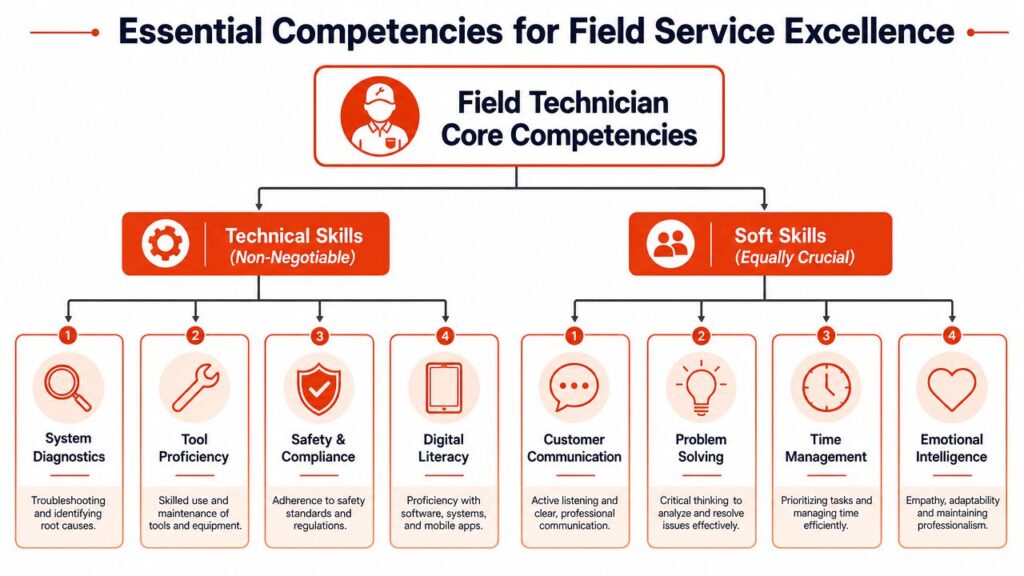
Core Competencies Every Field Technician Needs
Most hiring mistakes happen because organisations screen for only one side of the role. They over-index on hands-on technical familiarity and under-test the behaviours that determine whether the technician can operate independently in the field.
Technical capability that can’t be faked
A credible field technician needs hard skills that stand up under pressure, not just in interviews.
| Competency area | What good looks like in practice |
| Diagnostics | Can isolate probable causes, test logically, and avoid random part replacement |
| Tool proficiency | Uses physical tools, meters, testing devices, and digital job apps correctly |
| Safety and compliance | Follows permit, PPE, equipment, and customer-site protocols consistently |
| Documentation discipline | Records actions and findings in a form the next team can use |
For Indian employers, digital literacy now belongs in this same essential category. If the technician can’t update a mobile work order, capture service notes, or close the loop with accurate field data, the job isn’t complete.
A simple way to sharpen job descriptions is to specify the actual field environment. Mention whether the role involves plant maintenance, telecom assets, industrial equipment, consumer installations, or utility service calls. Generic wording attracts generic applicants.
For safety-heavy roles, it’s also worth aligning the competency model with broader safety, compliance, and regulatory skills expectations. A technician who improvises around safety isn’t resourceful. They’re a risk.
A short training clip can help hiring teams calibrate what they should assess beyond paper qualifications:
Key Responsibilities of a Field Technician
Field technicians are the face of every service organization. 74% of mobile workers say customer expectations are higher than they used to be, making every on-site interaction a brand moment, not just a technical task.
1. Installation and Commissioning
- Set up and configure new equipment at customer or site locations.
- Conduct functional testing and obtain customer sign-off before leaving site.
- Coordinate with site teams on access, utilities, and installation readiness.
- Document installation records accurately in field service management systems.
2. Maintenance and Breakdown Response
- Execute scheduled preventive maintenance within contracted SLA timelines.
- Diagnose and repair faults within defined response windows.
- Replace defective components and verify performance post-repair.
- Escalate complex faults to senior technicians or engineers when needed.
3. Customer Support and Communication
- Guide customers on equipment operation and basic maintenance requirements.
- Handle complaints professionally and escalate unresolved issues promptly.
- Identify upselling opportunities during on-site customer interactions.
- Report recurring complaints to service management with supporting observations.
4. Documentation and Reporting
- Complete job cards, service reports, and work orders after every visit.
- Record parts used, labour time, and outcomes in FSM platforms.
- Submit daily completion summaries to dispatch and service management.
- Maintain equipment service history for warranty and repeat visit tracking.
5. Safety and Compliance
- Follow PPE requirements, permit procedures, and site safety rules consistently.
- Conduct basic risk assessments before starting any installation or repair work.
- Handle materials per safety regulations and manufacturer guidelines.
- Report near misses and unsafe conditions to supervisors immediately.
Additional Scope (Senior Field Technician Roles)
- Mentor junior technicians on technical procedures and customer handling.
- Act as technical escalation point for unresolved faults across the territory.
- Lead complex multi-site installations and coordinate vendor activities.
Latest Trends to Watch in 2026 for Field Technicians
Field technicians in 2026 use mobile apps, AR support, and IoT alerts; demand rises for multi-skilled, certified pros in solar, EV charging, and 5G; gig roles grow, with first time-fix tied to pay.
- Field technicians are increasingly equipped with mobile apps for real-time job dispatch, parts tracking, and digital service reports.
- AR-assisted remote support is helping technicians resolve complex faults with expert guidance from off-site engineers.
- IoT-enabled equipment is shifting field visits from scheduled checks to alert-based predictive service calls.
- Multi-skilled technicians who handle electrical, mechanical, and basic networking issues are in higher demand than single-discipline specialists.
- Solar and EV charging infrastructure growth is creating the fastest new hiring demand for field technicians in India.
- First-time fix rate has become a key performance metric tied directly to technician compensation and bonuses.
- Technicians with manufacturer-specific certifications command premiums of up to 15% over uncertified peers.
- Gig and on-demand field service platforms are expanding flexible work opportunities alongside traditional full-time roles.
- Telecom 5G rollout is driving significant short-term hiring spikes for tower and fiber field technicians across India.
- Field technicians with strong customer service skills are increasingly fast-tracked into field supervisor and trainer roles.
For CHROs, the role stops looking operational and starts looking strategic. Hiring quality in field service shows up in cost-to-serve, but it also affects renewal confidence, service credibility, and the quality of customer data flowing back into the business. Teams trying to make that case internally can borrow the same logic used in broader discussions on how to prove that recruitment adds real business value.
The workforce is not adjacent to delivery here. It is delivery.
Field Technician Job Description Template
Job Title: Field Technician / Field Service Technician
Department: Operations / Field Services / Technical Support
Reports To: Field Service Manager / Operations Manager / Service Supervisor
Location: [Location]
Employment Type: Full-time
Job Summary: We are looking for a skilled and customer-focused Field Technician to join our [Department] team. In this role, you will install, maintain, troubleshoot, and repair equipment and systems at customer or site locations, ensuring service quality, safety compliance, and timely issue resolution. You will work independently across assigned territories while coordinating with dispatch, support teams, and customers to deliver consistent and reliable field service.
Key Responsibilities
- Install, inspect, and maintain equipment at customer or site locations.
- Diagnose and repair technical faults within defined response timeframes.
- Complete service reports, work orders, and documentation accurately.
- Coordinate with dispatch and support teams on job scheduling and parts.
- Educate customers on equipment operation and basic maintenance.
- Follow all safety protocols and PPE requirements at every site.
Required Qualifications
- Diploma or ITI in Electrical, Mechanical, Electronics, or related trade.
- 1 to 5 years of hands-on field service or technical support experience.
- Strong troubleshooting skills across mechanical and electrical systems.
- Ability to work independently with minimal supervision in the field.
- Valid driving license and willingness to travel within assigned territory.
Preferred Qualifications
- Experience with specific equipment categories such as HVAC, telecom, or industrial machinery.
- Familiarity with field service management software and mobile work order apps.
- Manufacturer-specific certification for equipment serviced preferred.
- Exposure to customer-facing service roles with strong communication skills.
- Basic knowledge of safety standards including electrical safety and LOTO procedures.
Key Skills
- Equipment Installation and Troubleshooting
- Field Service Documentation and Reporting
- Customer Communication and Support
- Safety Compliance and PPE Discipline
- Independent Work and Time Management
Industries hiring Field Technicians
Industries Hiring Field Technicians in India
India’s 5G rollout, solar capacity expansion, and industrial automation investment are creating some of the strongest field technician hiring demand the country has seen.
Telecom and Networking
India’s 5G rollout and fiber broadband expansion are driving the highest field technician hiring volumes in the sector’s history.
- Tower, BTS, and base station installation and maintenance
- Fiber optic cable laying, splicing, and fault restoration
- Customer premise equipment installation and troubleshooting
- SLA-driven network downtime response and repair
HVAC and Facility Services
India’s expanding commercial real estate, data centers, and hospital infrastructure are driving strong and consistent HVAC technician demand.
- HVAC unit installation, gas charging, and preventive servicing
- AMC contract and scheduled maintenance visit execution
- Chiller, AHU, and VRF system fault diagnosis and repair
- Energy efficiency checks and component replacement
Renewable Energy and Solar
India targets 500 GW of renewable capacity by 2030, creating significant field technician hiring across rooftop and ground-mounted solar installations nationwide.
- Solar panel, inverter, and mounting structure installation
- Periodic inspection, cleaning, and performance monitoring
- Fault diagnosis on inverters, wiring, and DC junction boxes
- AMC and warranty service visits across distributed locations
Healthcare and Medical Devices
India’s expanding hospital network and medical device import growth are driving field technician demand for biomedical equipment installation and maintenance.
- Medical equipment installation, calibration, and verification
- Preventive maintenance for diagnostic and imaging equipment
- Breakdown response within critical hospital SLA windows
- Biomedical compliance documentation and inspection support
Salary Trends of Fiend Technicians in 2026
In 2026, Field Technician salaries in India typically range from INR 2 L – INR 9 L+ per year, with freshers at INR 2 L – INR 4 L, mid‑level at INR 3 L – INR 5.5 L, seniors at INR 4 L – INR 7 L, and leads at INR 5 L – INR 9 L+. Pay is highest in Bangalore, Mumbai, and Delhi‑NCR, especially in telecom, industrial automation, and medical devices, driven by on‑site service demand, technical expertise, and uptime reliability requirements.
1. By industry
Field Technicians in telecom, IT, and network services typically earn INR 3 L – INR 7 L. Electronics and consumer appliances pay around INR 2.5 L – INR 6 L, industrial machinery and automation INR 3.5 L – INR 8 L, solar and renewable energy INR 3 L – INR 7.5 L, and medical devices or healthcare equipment INR 3.5 L – INR 8.5 L.
| Industry sector | Typical salary band (per year) |
|---|---|
| Telecom / IT / network services | INR 3 L – INR 7 L |
| Electronics / consumer appliances | INR 2.5 L – INR 6 L |
| Industrial machinery / automation | INR 3.5 L – INR 8 L |
| Solar / renewable energy | INR 3 L – INR 7.5 L |
| Medical devices / healthcare equipment | INR 3.5 L – INR 8.5 L |
2. By location
In major urban hubs like Bangalore, Mumbai, and Delhi‑NCR, bands are usually INR 3.5 L – INR 8 L. Hyderabad, Pune, and Chennai commonly range INR 3 L – INR 7 L, other tier‑1 cities INR 2.5 L – INR 6 L, and tier‑2 cities or rural areas INR 2 L – INR 5 L for similar field technician roles and experience levels.
| Location / city type | Typical salary band (per year) |
|---|---|
| Bangalore / Mumbai / Delhi‑NCR | INR 3.5 L – INR 8 L |
| Hyderabad / Pune / Chennai | INR 3 L – INR 7 L |
| Other tier‑1 cities | INR 2.5 L – INR 6 L |
| Tier‑2 cities / rural areas | INR 2 L – INR 5 L |
3. By experience level
Fresher field technicians (0–2 years) generally earn INR 2 L – INR 4 L. Mid‑level technicians (3–5 years) often land INR 3 L – INR 5.5 L. Senior technicians (6–9 years) commonly reach INR 4 L – INR 7 L, and supervisors or lead technicians (10+ years) can command INR 5 L – INR 9 L+ in telecom, industrial, and healthcare sectors.
| Experience level | Typical salary band (per year) |
|---|---|
| Fresher / 0–2 years (junior technician) | INR 2 L – INR 4 L |
| Mid‑level / 3–5 years (technician) | INR 3 L – INR 5.5 L |
| Senior / 6–9 years (senior technician) | INR 4 L – INR 7 L |
| Lead / 10+ years (supervisor / lead) | INR 5 L – INR 9 L+ |
How to hire Field Technicians
Most technician hiring programmes underperform for one reason. They start too late, assess too narrowly, and treat retention as an HR clean-up exercise after the vacancies are filled. The better approach is to design the entire talent lifecycle around how field work functions in India.
Where to source better talent in India
A useful starting point is this. India’s overall unemployment was 3.2% in 2023-24, but the bigger challenge for field roles is a skilling and employability mismatch, which is why vocational pathways such as ITI graduates and apprenticeships are a critical talent pool. In practice, that means many employers are fishing in the wrong pond.
If you’re still relying mostly on standard job portals for field technicians, you’ll often get volume without fit. Better pipelines usually come from tighter channel strategy:
- ITI and diploma institutions: Build recurring relationships instead of one-off campus drives.
- Apprenticeship ecosystems: Use them as a conversion path, not just a compliance path.
- Local referral networks: Strong technicians often know other strong technicians.
- Regional sourcing models: Candidate availability and mobility differ sharply by city tier and industry cluster.
Recruiters also need to localise communication. In many markets, a candidate doesn’t reject the role because the work is difficult. They reject it because the job was sold vaguely, the travel expectations were hidden, or the career path sounded temporary.
How to assess what CVs won’t show you
Most resumes in this segment understate or overstate capability. That is normal. The answer isn’t more keyword screening. It is better evidence.
A thorough assessment process usually includes:
- A practical fault scenario
Give the candidate a realistic equipment problem or service situation. Watch how they think, not just whether they reach the right answer. - A documentation test
Ask them to write a short service note after the scenario. This reveals whether they can support the data loop your operation depends on. - A customer interaction simulation
See whether they can explain delay, risk, or next steps in plain language. - Mobility and conditions check
Confirm site travel, shift tolerance, field safety expectations, and reporting discipline early. Hidden realities create early attrition.
A hiring manager should be able to answer two simple questions after the interview. Can this person solve? Can this person be trusted alone at a customer site?
Hiring for field service without a practical assessment is like hiring a driver based only on a written test.
Retention is built on design, not slogans
Field technicians leave for obvious reasons, but companies often respond with generic engagement language rather than operational fixes. Retention improves when the work becomes more manageable, more respected, and more developmental.
The levers that usually work are concrete:
- Clear progression: Show the path from trainee to specialist, lead technician, planner, supervisor, or reliability role.
- Continuous upskilling: As tools and equipment change, training can’t stop after onboarding.
- Manager quality: Front-line supervisors shape technician retention more than policy decks do.
- Recognition tied to real work: Celebrate quality of diagnosis, documentation, and customer handling, not only ticket closure count.
A brief comparison makes the trade-off clearer:
| What doesn’t work | What works better |
| Hiring only for immediate vacancy closure | Building a rolling pipeline through institutes and apprenticeships |
| Generic induction | Role-specific onboarding with ride-alongs and documentation standards |
| Promotions based only on tenure | Skill-based progression with visible milestones |
| Treating attrition as unavoidable | Fixing scheduling, tools, supervisor quality, and growth clarity |
The gender dimension also deserves direct attention. Independent coverage of what a field technician role involves points to practical changes that can widen access and improve retention, including gender-neutral job descriptions, safer routing, and team-based dispatches when physical lifting is involved. For Indian employers, this isn’t only a diversity conversation. It is a talent supply conversation.
If you want more women in field roles, don’t start with a campaign. Start with job design.
That means checking whether your field policies support safety, whether facilities and shift plans are workable, whether managers know how to onboard inclusively, and whether women can move into supervisory tracks instead of remaining stuck in entry roles. Many firms hire for representation and then lose people because the field environment wasn’t redesigned around retention.
The most reliable retention signal is simple. Good technicians stay where the organisation helps them do good work.
Future-Proofing Your Field Service Workforce
The field technician role has already moved beyond reactive repair. It now sits inside a larger system of mobile workflows, service data, customer experience, and preventive maintenance. Organisations that still hire for yesterday’s version of the role will keep feeling the same pain: weak fix quality, poor documentation, hard-to-fill vacancies, and avoidable attrition.
The next shift will raise the bar further. AI-assisted diagnostics, remote support tools, smarter scheduling, and richer service histories will all change how technicians work. But none of that removes the need for strong people on the ground. It raises the premium on technicians who can combine technical judgement with digital fluency and customer credibility.
For Indian enterprises, the strategic question isn’t whether field service matters. It is whether leadership is willing to treat field technicians as a serious workforce category with differentiated sourcing, stronger assessment, better manager capability, and visible career paths.
The organisations that get this right won’t just close vacancies faster. They’ll build service operations that are more dependable, more scalable, and more trusted by customers.
FAQs
What is a Production Planning Engineer and what do they do?
A Production Planning Engineer develops and manages manufacturing schedules, coordinates material availability, and translates demand forecasts into executable production plans that meet delivery targets and optimize plant resource utilization.
How does a Production Planning Engineer support workforce planning?
Production planners see demand signals before HR does. They translate line capacity, shift coverage, and bottleneck constraints into early hiring requirements, giving talent acquisition teams time to act before vacancies become urgent.
What is the difference between a Production Planner and a Supply Chain Manager?
Production planners focus on translating demand into executable manufacturing schedules within the plant. Supply chain managers oversee the broader end-to-end flow including procurement, logistics, inventory, and supplier relationships across the supply network.
What ERP systems must a Production Planning Engineer know?
SAP PP and SAP APO are the most widely required across large manufacturers. Oracle, Kinaxis, and Infor are also common. MES platform familiarity for real-time production data integration is increasingly expected alongside ERP proficiency.
How does production planning connect to supply chain resilience?
Production planners identify which roles become critical when supply disruptions hit, which lines can absorb schedule changes, and which material shortages will stall throughput, giving HR teams a head start on contingency workforce planning.
What are the top 5 skills for Production Planning Engineers?
Master Production Scheduling, ERP Platform Proficiency, Capacity Planning and Constraint Management, S&OP Process Support, and Data Analytics for Demand Forecasting. These determine hiring success and career progression across all planning roles.
What is the career outlook for Production Planning Engineers in India?
Strong and improving. India’s manufacturing expansion, EV transition, and digital operations adoption are driving sustained demand. Experienced planners with ERP and analytics capability are fast-tracking into S&OP leadership and operations director roles.
How does Lean manufacturing knowledge improve a production planner’s effectiveness?
Lean-trained planners identify waste in scheduling logic, right-size labour demand against actual value-added work, and redesign competency requirements when process improvements change the nature of work on the production floor.
If your organisation is scaling field-heavy operations and needs stronger hiring outcomes across India, Taggd can help you build the right strategy, from talent mapping and sourcing design to high-quality recruitment delivery for hard-to-fill technical roles.