
Recruitment Innovation and Smarter Hiring
Recruitment innovation isn’t just a new buzzword—it’s the strategic move away from outdated, manual hiring processes towards a smarter, data-driven, and technology-powered approach. It’s all about using modern tools and fresh thinking to find, attract, and hire the right people, but doing it far more efficiently and effectively.
The End of Old-School Hiring

Let’s be honest—the old way of hiring is broken. The days of simply posting a job advert and waiting for the perfect candidate to magically appear are long gone. Today’s talent market is a tough battleground, defined by persistent skills gaps, fierce competition, and the new expectations of a remote-first workforce.
Sticking with traditional methods is like casting a wide fishing net and just hoping for the best. Recruitment innovation, on the other hand, is like using advanced sonar to pinpoint the exact talent you need in a vast ocean.
This shift isn’t just about upgrading your software; it’s a fundamental rethink of how businesses build their most valuable asset: their people. It’s about evolving from reactive, administrative tasks to a proactive, strategic talent acquisition function.
The Driving Forces of Change
Several powerful forces are pushing companies to modernise their hiring practices. The rapid adoption of virtual processes, which accelerated dramatically during the COVID-19 pandemic, has set a new standard for speed and convenience.
This digital transformation is reflected in the market’s growth, with the global permanent online recruitment sector projected to hit approximately $85 billion by 2033.
Here are the key drivers pushing this change:
- Persistent Skills Gaps: Finding candidates with specific, high-demand skills requires a much more targeted and intelligent approach than ever before.
- Candidate Expectations: Top talent now expects a seamless, fast, and transparent hiring experience, much like the consumer experiences they have every day.
- Data-Driven Decisions: Business leaders are demanding measurable results and a clear ROI from their talent acquisition teams, moving beyond simple metrics like time-to-fill.
- The Rise of Remote Work: Hiring is no longer limited by geography, which opens up global talent pools but also massively increases the competition.
The core idea behind recruitment innovation is to create a truly candidate-centric process. By focusing on the applicant’s journey, companies not only attract better talent but also build a much stronger employer brand. One emerging strategy that puts this into practice is reverse recruiting, which you can learn more about in our detailed guide on the future of hiring.
Ultimately, this evolution is about making smarter, faster, and more equitable hiring decisions. To make this clear, the table below highlights the practical differences between outdated and modern recruitment.
Traditional Recruiting vs Recruitment Innovation
The shift from legacy methods to innovative talent acquisition is stark. This table breaks down the core differences in mindset, tools, and outcomes.
| Aspect | Traditional Approach | Innovative Approach |
|---|---|---|
| Strategy | Reactive; fills open positions as they arise. | Proactive; builds talent pipelines for future needs. |
| Sourcing | Relies on job boards and inbound applications. | Uses multi-channel sourcing, social media, and referrals. |
| Candidate Experience | Often slow, impersonal, and lacking transparency. | Fast, personalised, and engaging at every touchpoint. |
| Technology | Basic Applicant Tracking Systems (ATS), spreadsheets. | AI-powered tools, CRM, predictive analytics, automation. |
| Decision Making | Based on gut feeling and interview performance. | Data-driven, using assessments and objective metrics. |
| Key Metrics | Time-to-fill, cost-per-hire. | Quality of hire, candidate satisfaction, diversity metrics, ROI. |
As you can see, the innovative approach isn’t just a minor update—it’s a complete operational overhaul designed for the realities of the modern talent market.
The Three Pillars of Modern Recruiting

To really get what makes recruitment innovation tick, you have to look under the bonnet. The engine driving all this change is built on three core technology pillars. They all work together, turning old hiring headaches into new opportunities for a smarter, faster, and more human process.
These aren’t just abstract ideas. They are practical tools giving forward-thinking organisations a serious competitive edge. By weaving them into your talent strategy, you stop just filling seats and start intentionally building a workforce ready for whatever comes next.
Let’s break down each of these foundational technologies.
Artificial Intelligence and Machine Learning
When most people hear AI in recruiting, they immediately think of automated résumé scanners. That’s part of the story, sure, but today’s AI and machine learning (ML) tools are far more sophisticated. Think of them as a powerful co-pilot for your talent acquisition team.
Instead of just matching keywords on a document, modern AI can understand context, infer skills, and spot high-potential candidates who would otherwise fly under the radar. An AI sourcing tool, for instance, can scan professional networks to find a software developer with the perfect coding skills, even if their profile never mentions the exact job title you’re searching for. This is how you unearth those hidden gems—the passive candidates who aren’t looking but are a perfect fit.
This technology helps to:
- Reduce Unconscious Bias: By zeroing in on skills, experience, and potential—not demographic data—AI helps level the playing field and build a more diverse candidate pool.
- Improve Candidate Matching: ML algorithms learn from your past hiring successes and failures, getting progressively smarter at predicting who will truly thrive in a specific role.
- Enhance Engagement: An AI-powered chatbot can answer a candidate’s questions instantly, 24/7, ensuring a great, responsive experience from the very first touchpoint.
Predictive Analytics
If AI is your co-pilot, then predictive analytics is your GPS. It uses your historical and current data to forecast future hiring needs, helping you move from a reactive “firefighting” mode to a proactive talent strategy. Instead of scrambling when someone resigns, you can see the need coming long before it becomes an emergency.
Imagine your analytics platform flags a high turnover rate in your sales department over the last two years, especially among employees with a specific type of enterprise software experience. That insight is your cue to start building a talent pipeline for that role now, before the next person hands in their notice.
Predictive analytics answers the critical question, “What’s next?” It turns your hiring data from a historical record into a strategic forecasting tool, enabling smarter workforce planning and resource allocation.
This data-driven foresight is what separates the leaders from the laggards. It allows you to make informed decisions about where to invest your recruiting budget, which roles to prioritise, and how to get ready for future business growth. It’s the difference between navigating with a map and driving blind.
Intelligent Automation
The final pillar is intelligent automation. This is all about wiping out the repetitive, low-value tasks that bog down recruiters and lead to burnout. Think about all the time spent on manual work like scheduling interviews, chasing feedback, and sending follow-up emails.
Just consider the pain of scheduling a panel interview with four busy internal managers and an external candidate. That can easily spiral into dozens of back-and-forth emails. An automated scheduling tool, however, can sync with everyone’s calendars and find the perfect slot in seconds, sending invites automatically.
This isn’t about replacing recruiters. It’s about freeing them up to focus on the human side of hiring: building relationships with candidates, advising hiring managers, and making strategic talent decisions. By automating the admin grind, you empower your team to be more effective and create a far better experience for candidates. This is how you scale your hiring efforts without scaling your team’s workload.
Navigating the Global Talent Landscape
Let’s face it: hiring isn’t a local game anymore. Thanks to remote work and businesses stretching across borders, what was once a neighbourhood search is now a worldwide competition for talent. The old playbook—the one-size-fits-all strategy that worked for your regional office—just won’t cut it when you’re trying to find, attract, and keep top performers on different continents.
To win in this new arena, you have to get savvy about how different markets work. The challenge of finding a great STEM professional in Germany is worlds away from hiring a specialised contractor in Australia. This is where recruitment innovation steps in, offering the tools and strategies to break down geographical walls and tap into incredible, diverse talent pools.
This isn’t just a fleeting trend; it’s a massive economic shift. The global recruiting market hit an eye-watering $475 billion in 2023, with the average cost to fill a single role standing at $4,700. But even with all that investment, the struggle is real. A staggering 90% of managers can’t find the skilled candidates they need, and roles are sitting empty for an average of 42 days. You can dive deeper into these numbers by exploring the full industry research on recruiting dynamics.
Understanding Regional Nuances
A smart global hiring plan comes down to one word: localisation. And no, just translating a job description doesn’t count. You need to tune your entire approach to local cultural norms, labour laws, and what the talent market is actually demanding.
For example, if you’re chasing software developers in a tech hub like Bengaluru, India, you’re up against fierce competition. Your offer has to be sharp, with competitive pay and a clear path for career growth. But if you’re hiring for that same role in a less crowded market, you might need to lean more on your employer brand and the unique perks of the job to get noticed.
Technology is your best friend here. AI-powered sourcing tools can scan regional job boards, professional networks, and social media to pinpoint exactly where the skills you need are concentrated. This lets you aim your resources with precision, targeting the places where you have the best shot at success.
Key Recruitment Metrics by Global Region
To really see these differences in action, let’s look at some hiring stats from a few major economies. This data makes it crystal clear why a single, standardised approach is destined to fail on the world stage.
| Region | Key Market Statistic | Primary Talent Need | Average Time to Fill |
|---|---|---|---|
| United States | High demand for tech and healthcare roles. | AI specialists, nurses, data scientists. | 35-49 days |
| Germany | Severe shortage in skilled trades and engineering. | Engineers, IT experts, manufacturing specialists. | 120-150 days |
| Australia | Strong need for construction and mining talent. | Skilled trades, project managers, geologists. | 40-55 days |
As the table shows, the US market can move pretty quickly for some roles. Germany, on the other hand, has a major bottleneck for technical experts, meaning you need a much more patient, long-term strategy. It’s all about knowing the local landscape.
Overcoming Geographical Barriers with Technology
Recruitment innovation offers real, practical answers to the logistical and cultural headaches of international hiring.
- Asynchronous Video Interviews: These tools are a lifesaver for dealing with different time zones. Candidates can record their answers whenever it suits them, which means no more scheduling nightmares for your team.
- Virtual Onboarding Platforms: A smooth start is everything for keeping new hires. Modern platforms can deliver consistent training, introduce company culture, and handle all the necessary paperwork digitally. New starters feel connected from day one, no matter where they are.
- Global Payroll and Compliance Solutions: Managing international employment laws is a minefield. Specialised platforms automate this, making sure you stay compliant with local rules without needing a huge in-house legal team.
Adopting a global mindset means seeing the entire world as your talent pool. By mixing smart market knowledge with the right tech, you can build a truly international team that gives you an incredible competitive edge.
Ultimately, navigating the global talent landscape is about being adaptable and staying informed. The right innovations let you stop guessing and start making decisions based on data, turning the world’s talent into your company’s greatest strength.
Your Framework for Implementing Innovation
Knowing you need to change and actually making it happen are two completely different things. A brilliant idea without a solid plan is just a good intention. Think of this section as your practical playbook for turning the concept of recruitment innovation into a reality within your organisation. We’re moving past the abstract theories and into a clear, step-by-step framework designed for talent leaders who need to make smart, confident decisions.
Moving from a familiar process to a new one can feel overwhelming. The key is to approach it methodically—not as one giant leap, but as a series of manageable steps. This ensures you’re solving the right problems, choosing the right tools, and, crucially, bringing your team along for the ride. After all, the most advanced technology is useless if your people don’t understand why it’s needed or how to use it.
Step 1: Start With a Thorough Process Audit
Before you can build something better, you have to get brutally honest about what’s broken. The first step is a deep-dive audit of your current recruitment process. This isn’t about pointing fingers; it’s about identifying the real bottlenecks and friction points that are holding you back.
Where do candidates drop out of your funnel? Which stages drag on the longest? Where are your recruiters sinking most of their time on manual tasks? You need to map out every single step, from the moment a job requisition is raised to the final offer acceptance. Pull the data from your Applicant Tracking System (ATS), but more importantly, talk to your recruiters and hiring managers. Their frontline experience is pure gold.
Step 2: Set Clear and Measurable Objectives
Once you’ve diagnosed the problems, you can define what success actually looks like. Vague goals like “improve hiring” won’t cut it. You need specific, measurable objectives that tie directly back to the wider business goals. Strong objectives give you a clear destination and make it much easier to justify your investment later on.
Here are a few examples of what solid goals look like:
- Reduce time-to-fill for critical tech roles by 20% within the next six months.
- Increase the percentage of hires from underrepresented groups by 15% in the next fiscal year.
- Improve new hire satisfaction scores by 10 points by optimising the onboarding experience.
These kinds of concrete targets will guide every decision you make, from which vendor you choose to how you measure your final return on investment.
Step 3: Evaluate Vendors With a Strategic Eye
The recruitment technology market is noisy and crowded with big promises. To cut through the hype, you have to evaluate potential vendors based on your specific objectives, not just their flashiest features. Create a scorecard that weighs criteria like integration capabilities with your existing HR stack, the user experience for both recruiters and candidates, and the quality of their customer support.
Don’t get distracted by a demo of a single cool feature. A successful recruitment innovation strategy relies on how well a new tool solves your core business problems and fits into your team’s daily workflow. Technology is the tool, not the solution itself.
Always, always ask for case studies from companies of a similar size and in your industry. This helps you see how the technology performs in the real world, not just in a polished sales pitch. A structured evaluation like this stops you from investing in a tool that creates more headaches than it solves. For more on this, you can explore our guide on the essential steps for implementing digital hiring technology.
This visual guide shows a simplified flow for implementing recruitment innovation across different markets.
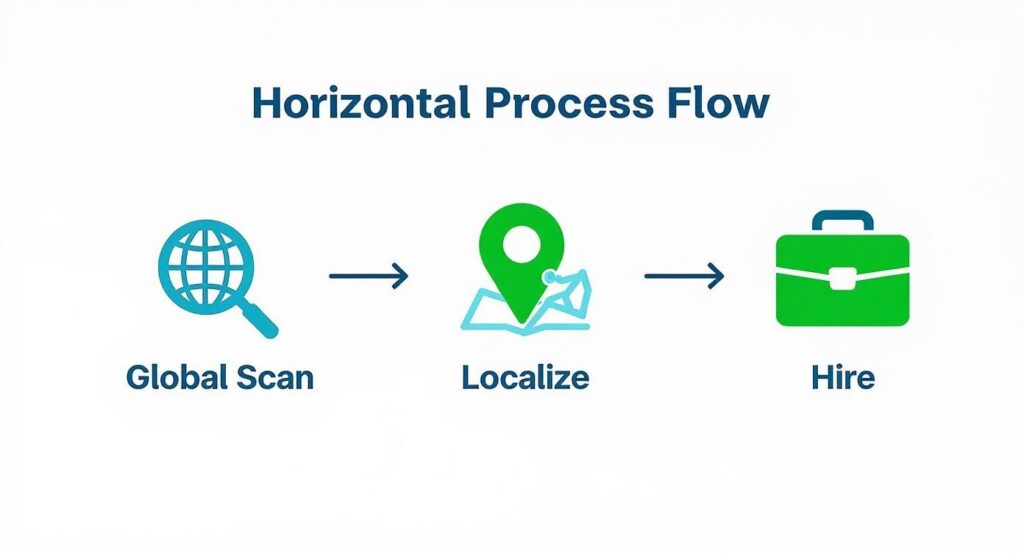
The process highlights the importance of first understanding the global landscape, then adapting your strategy to local needs before executing the hiring plan.
Step 4: Pilot and Prove Value Before Scaling
A full-scale, company-wide rollout of new technology is a huge risk. Don’t do it. Instead, start with a pilot programme involving a small, dedicated team. Pick a specific department or a set of roles to test the new tool or process. This controlled environment lets you iron out any kinks, gather priceless feedback, and build a powerful business case based on real data.
During the pilot, track your pre-defined metrics obsessively. Did that new sourcing tool actually improve candidate quality? Did the scheduling automation really free up recruiters’ time? This hard evidence is what you’ll need to get buy-in from senior leadership and the rest of the organisation for a broader rollout.
Step 5: Focus on Change Management and Adoption
The final, and arguably most critical, step is managing the human side of all this change. Your team needs to understand the “why” behind the new technology. You have to communicate the benefits clearly—not just for the company, but for them. How will this make their jobs easier, more strategic, and more rewarding?
Provide thorough training and ongoing support. Identify champions within the team who are excited about the new system and can help their peers. By focusing on adoption from day one, you ensure your investment actually delivers on its promise and becomes a lasting part of how you attract talent.
How to Measure What Truly Matters
Pouring money into recruitment innovation without a clear way to measure its impact is just an expensive guess. If you want to build a solid business case for more investment, you need to tie your efforts directly to what the business actually cares about. This means looking beyond the usual, surface-level metrics and focusing on the key performance indicators (KPIs) that get the attention of the C-suite.
The whole point is to prove that your new tools and strategies aren’t just making the hiring process different, but making it demonstrably better. It’s about showing tangible value, from boosting productivity to cutting down employee turnover. This is how you change the conversation from cost to genuine value.
Moving Beyond Vanity Metrics
For years, talent acquisition teams have relied on metrics like time-to-hire and cost-per-hire. And while they’re okay for keeping an eye on operational efficiency, they don’t tell the full story. Let’s be honest: hiring someone quickly and cheaply means nothing if they’re gone in six months or can’t perform in their role.
Real recruitment innovation calls for a shift in focus—to metrics that actually reflect the quality and long-term impact of your hiring.
Here are the modern KPIs that really move the needle:
- Quality of Hire: This is the big one. It’s the ultimate measure of success, directly connecting a new employee’s performance back to the hiring process.
- Candidate Satisfaction (CSAT): Think of this as the health check for your candidate experience. A good score is vital for protecting your employer brand.
- Hiring Manager Satisfaction: When your hiring managers are happy, it’s a clear sign you’re delivering the talent they need to hit their goals efficiently and effectively.
- Source of Hire Effectiveness: This tells you which channels are bringing in your top performers, so you can put your sourcing budget where it counts.
A low time-to-hire might look impressive on a report, but a high Quality of Hire is what actually builds a successful company. This shift from speed to impact is the foundation of measuring modern talent acquisition.
By tracking these KPIs, you can start painting a much more compelling picture of your team’s strategic contribution to the business.
Calculating the True Return on Investment
Showing a clear ROI is your ticket to getting budget and executive buy-in. You have to connect the dots between your investment in a new Applicant Tracking System (ATS) or an AI sourcing tool and real financial gains for the business.
Let’s walk through a practical example. Say you invest in a new assessment tool to improve Quality of Hire.
- Establish a Baseline: Before you start, you look at your data and find that 20% of new sales hires are missing their first-year quota.
- Implement and Track: You use the new tool for a year and discover that now, only 10% of new hires are missing their quota.
- Calculate the Impact: That 10% improvement in sales performance translates directly into revenue. If each salesperson has a ₹1 Crore quota, that improvement represents a massive financial gain that almost certainly dwarfs the cost of the software.
You can apply this same logic to other areas, too. Think about calculating the savings from lower employee turnover. If a new onboarding platform improves first-year retention by 5%, you can easily work out the money saved on recruiting and training replacements.
Key Metrics and Simple Formulas
You don’t need a PhD in data science to start tracking what matters. Here are a few straightforward ways to get a handle on your most important KPIs:
| Metric | How to Measure It | Why It Matters |
|---|---|---|
| Quality of Hire | (Avg. Performance Rating of New Hires + % of New Hires Retained After One Year) / 2 | Directly links your hiring success to actual on-the-job performance and business impact. |
| Candidate Satisfaction | Send out post-application and post-interview surveys asking candidates to rate their experience on a simple scale of 1-5. | A bad candidate experience can seriously damage your employer brand and scare off future talent. |
| Hiring Manager Satisfaction | Use simple surveys sent to managers after a role is filled. Ask about the speed of the process, the quality of candidates, and the support from the recruiter. | This shows how well your team is serving its internal customers and meeting the real needs of the business. |
By consistently tracking these metrics, you build a powerful arsenal of hard evidence. This is what you’ll use to prove the value of your recruitment innovation and make a rock-solid case for future investments.
Accelerating Your Transformation with a Partner
Let’s be honest: overhauling your entire recruitment strategy is a massive undertaking. It demands serious expertise, a big investment in new tech, and dedicated people to manage the change—all while your team is still trying to fill mission-critical roles. This is where bringing in a strategic partner can completely change the game.
Trying to go it alone can feel like pushing a boulder uphill. An expert partner is like a turbocharger for your efforts, helping you sidestep common pitfalls and hit your transformation goals much faster than you ever could on your own.
More Than Just a Staffing Agency
First, it’s vital to get one thing straight: a modern Recruitment Process Outsourcing (RPO) partner is not your traditional staffing agency. They are strategic consultants who embed themselves in your organisation to redesign and run your entire talent acquisition function. Think of them less as an outside vendor and more as a seamless extension of your own team.
A true RPO partner brings a potent mix of people, processes, and technology to the table. You get immediate access to a seasoned team of recruiting specialists and a pre-vetted, best-in-class tech stack. This means you can skip the massive upfront capital investment and the painfully long procurement process.
An RPO partnership is about gaining instant access to expertise and infrastructure. It allows you to tap into years of specialised experience in process optimisation and recruitment innovation, drastically shortening your learning curve and time to value.
The Strategic Advantages of Partnership
Working with an RPO provider delivers tangible benefits that directly tackle the challenges of bringing innovation into your recruitment. This strategic move frees up your internal HR team to concentrate on bigger-picture talent management and cultural initiatives, while the RPO handles the nitty-gritty operational side of hiring.
This kind of collaboration can spark significant improvements right across the board. You can dive deeper into the key advantages of having an RPO partner in our detailed article.
Key benefits include:
- Cost Efficiency: RPO providers operate at scale. This efficiency often translates into a lower cost-per-hire and makes your recruiting budget far more predictable.
- Improved Talent Quality: With access to advanced sourcing tools and sprawling talent networks, RPO partners can find and engage high-calibre candidates who aren’t even actively looking for a new role.
- Scalability and Flexibility: Need to ramp up hiring for a new product launch or scale back during a quiet period? An RPO can adjust recruiting capacity on the fly to match your business needs.
- Enhanced Employer Brand: They ensure every candidate has a consistent, professional, and positive experience, which works wonders for your reputation in the talent market.
Frequently Asked Questions
Even the most forward-thinking leaders have questions before overhauling their hiring strategies. We get it. Here are some clear, practical answers to the most common concerns we hear about cost, team adoption, and getting started on your recruitment innovation journey.
Is Recruitment Innovation Too Expensive for Us?
That’s the number one question, but it’s often looking at the problem from the wrong angle. The real focus should be on return on investment, not just the initial price tag. Bringing innovation into your hiring doesn’t always mean a massive, upfront software purchase. You can start small by automating a single, high-volume task—like interview scheduling—and immediately free up your recruiters’ time.
When you do the maths, the ROI often becomes crystal clear. For example, if a new sourcing tool helps you cut down your reliance on expensive recruitment agencies by just 15%, it can easily pay for itself within the first year. The key is to measure the gains in efficiency and quality against the cost.
The real cost isn’t in adopting new technology. It’s the hidden expense of sticking with an inefficient process that leads to poor hires, high turnover, and missed opportunities.
Will My Team Be Able to Adapt?
Change is always a bit daunting, but successful adoption really comes down to communication and training. Let’s be honest, your team is probably already frustrated with the repetitive, administrative tasks that bog them down day after day. You need to frame these new tools for what they are: a way to eliminate that manual grind so they can focus on the strategic, human parts of recruiting that they actually enjoy.
A great way to start is with a pilot programme. Get your most enthusiastic team members involved first. Their success becomes an internal case study and helps generate real excitement. From there, provide thorough, hands-on training and ongoing support to build confidence and make sure everyone feels ready to use the new systems effectively. Remember, adoption is a process, not a one-off event.
How Quickly Can We See Results?
The timeline for seeing tangible results really depends on what you’re measuring. Some benefits, like a massive reduction in the time spent on scheduling interviews, can be almost immediate. You could genuinely see hours saved within the first week of rolling out an automation tool.
However, the bigger, more strategic goals—like improving your quality of hire or boosting first-year employee retention rates—naturally take longer to measure. You can typically start gathering meaningful data on these within six to twelve months. The trick is to establish your baseline metrics before you begin. That way, you can clearly track your progress and demonstrate the value of the changes over time.
Ready to accelerate your hiring transformation with a strategic partner? Taggd, provides the expertise and technology to modernise your talent acquisition. Learn how our RPO solutions can drive your recruitment innovation at Taggd.