When a business is primed for growth, its talent acquisition strategy is what separates ambition from achievement. An Enterprise RPO provides the scalable, expert-led recruitment function needed to accelerate hiring, navigate compliance in new markets, and build a powerful employer brand. It’s more than just filling roles; it’s about building the workforce that fuels expansion without overwhelming your internal HR teams.
The High-Performance Engine for Business Growth
Think of your business as a high-performance car, ready to tear up the track. But what happens if the engine can’t deliver the power you need? That’s a common roadblock for companies in a rapid growth phase—big ideas and market opportunities get stalled simply because they can’t hire the right people fast enough. This is exactly where an Enterprise Recruitment Process Outsourcing (RPO) partner comes in, acting as a specialised engine built for acceleration.

Unlike a traditional recruitment agency that simply fills one-off vacancies, an enterprise RPO provider becomes a seamless extension of your company. They take the reins of the entire talent acquisition lifecycle, from crafting compelling job descriptions and sourcing top-tier candidates to managing interviews and ensuring a smooth onboarding experience.
A Strategic Lever for Scaling Operations
For any organisation launching new products or venturing into new geographic territories, the hiring hurdles can feel immense. You’re suddenly up against fierce local competition for talent, trying to make sense of complex labour laws, and facing the monumental task of building an employer brand from the ground up. An RPO partner is designed to thrive in this complexity.
This strategic partnership frees up your internal HR team from the high-volume, operational grind of recruitment. They can finally shift their focus to core initiatives that create long-term value, such as:
- Employee engagement and retention strategies
- Leadership development programmes
- Organisational culture and design
By taking full ownership of the talent pipeline, an RPO provider ensures a steady stream of qualified candidates is always ready to fuel your growth. This proactive stance transforms recruitment from a reactive chore into a powerful strategic advantage, making it an essential solution for scaling your workforce.
RPO Growth in the Indian Market
The move towards RPO is gaining serious momentum, especially in dynamic economies like India. The market for Recruitment Process Outsourcing in India is booming, projected to hit ₹3,700 crore by 2025 with a compound annual growth rate of roughly 23.3%. This surge is powered by key sectors like IT & Software (40% usage), manufacturing (15%), and BFSI (12%).
This rapid adoption shows just how much businesses are starting to value specialised recruitment support. By partnering with experts, companies can successfully navigate the intense competition for talent and the unique hiring challenges that come with expansion. To get a better sense of how this works in practice, it’s worth exploring the key benefits of Recruitment Process Outsourcing for your organisation.
Strategic Pillars of RPO-Fueled Expansion
Think of an RPO partnership not just as a service agreement, but as installing a high-performance growth engine directly into your business. For any company ready to expand, this partnership is built on a few core pillars that deliver real, measurable results. These aren’t just ideas; they are practical solutions to the biggest headaches that come with scaling a workforce into new markets or industries.

To really get how enterprise RPO supports business expansion, you have to appreciate these fundamental strengths. From hitting the accelerator on hiring to making sure you stay on the right side of the law in unfamiliar places, each pillar solves a critical problem that could otherwise stop your growth plans dead in their tracks.
Accelerated Speed-to-Hire
The moment you decide to open a new office or launch a product, the clock is ticking. Every day a key role sits empty is a day of lost momentum and missed opportunities. An enterprise RPO partner gets this and tackles the problem head-on by building and nurturing warm talent pipelines long before you even have a job to fill.
Imagine you need to hire 50 experienced software developers for a new tech hub. An in-house team would likely be starting from square one, spending weeks just to find people to talk to. Your RPO partner, on the other hand, has probably been mapping out the talent in that city for months, building relationships with passive candidates and getting a feel for the local market.
Because they’ve done the groundwork, they aren’t starting from scratch when you say “go.” They’re activating a ready-made network, which drastically cuts the time it takes to get from a job posting to a signed offer letter. That speed is a massive competitive advantage when you’re expanding.
Scalable Talent Acquisition on Demand
Business growth is never a straight line. One quarter you might need to hire 500 sales reps to crack a new market, and the next, you might need to pull back as things settle down. This kind of up-and-down demand is a huge headache for internal recruitment teams.
Keeping a large in-house team on the payroll just for those peak hiring times is a waste of money; they’ll be sitting idle during the slow periods. This is where the flexibility of an enterprise RPO model really shines.
Your RPO partner can rapidly scale their recruitment resources up or down to match your exact needs. This agility prevents the high fixed overhead costs of a permanent, oversized internal team while ensuring you always have the firepower needed to meet ambitious hiring targets.
This scalability is a cornerstone of how enterprise RPO supports business expansion. It gives you the elasticity you need to jump on market opportunities without being weighed down by long-term financial burdens.
Enhanced Employer Branding in New Markets
When you move into a new city or country, you’re often the new kid on the block. Top talent isn’t going to jump ship from a stable job to join a company they’ve never heard of. A good RPO provider acts as your brand ambassador on the ground, professionally selling your company culture and what makes you a great place to work.
They do a lot more than just collect CVs; they tell your story. This involves:
- Crafting Localised Messaging: Tweaking your employer value proposition (EVP) so it connects with the cultural values and career priorities of the local talent.
- Building Community Presence: Getting your name out there by engaging with candidates through local channels, events, and professional networks.
- Ensuring a Positive Candidate Experience: Every single touchpoint—from the first message to the final offer—shapes how candidates see your brand. A skilled RPO partner makes sure that experience is professional and positive every time.
This brand-building work is absolutely vital for attracting the high-quality people you need to get a strong start in a new region.
Navigating Complex Compliance Landscapes
Expanding across state or national borders throws you into a maze of different labour laws, hiring rules, and compliance headaches. One small mistake in a new jurisdiction can lead to massive legal and financial penalties, bringing your expansion plans to a screeching halt.
Top-tier RPO providers have dedicated compliance teams who live and breathe the specific legal rules of different regions. They handle everything from making sure your job ads are compliant to managing background checks and employment contracts. This specialised expertise lifts a huge administrative and legal weight off your shoulders.
Before diving into a partnership, it’s useful to see how the two approaches stack up side-by-side, especially when growth is the primary goal.
Traditional In-House Recruitment vs Enterprise RPO for Expansion
| Attribute | Traditional In-House Recruitment | Enterprise RPO Model |
|---|---|---|
| Scalability | Rigid structure; slow to scale up or down. High fixed costs. | Highly flexible; resources scale on-demand with hiring needs. |
| Speed-to-Hire | Reactive; starts sourcing when a role opens, leading to longer timelines. | Proactive; builds talent pipelines in advance, shortening hiring cycles. |
| Market Entry | Limited local knowledge and brand presence in new regions. | Deep local market expertise and acts as a brand ambassador. |
| Compliance Risk | High risk; relies on general HR knowledge, often lacking local legal specialisation. | Low risk; dedicated compliance experts manage region-specific regulations. |
| Cost Structure | High fixed overhead (salaries, benefits, tools) regardless of hiring volume. | Variable cost model; you pay for the services you need, when you need them. |
| Expertise | Generalist recruiters handle all roles across the company. | Access to a wide pool of specialised recruiters for niche roles. |
The differences are stark. While an in-house team is invaluable for day-to-day operations, an RPO partner is purpose-built to handle the unique pressures and complexities of rapid, large-scale expansion.
The global RPO market’s projected growth to USD 26.4 billion by 2030 is a testament to this increasing reliance on specialised help. In the Asia-Pacific region, India has become a major hub for RPO services, known for its scalable solutions and deep outsourcing knowledge. With 85% of enterprises globally reporting a better quality of hire through RPO, it’s clear this model is solidifying its role as a critical tool for growth. You can explore more market outlooks for RPO on ansrpo.com.
Real-World Impact of RPO-Driven Growth
It’s one thing to talk about benefits on paper, but the real proof of how enterprise RPO fuels business expansion comes from the front lines. The strategic pillars we’ve discussed—speed, scale, and compliance—truly come alive when you look at companies that have successfully navigated the chaos of growth with an RPO partner by their side. Their stories show just how tangible the impact of outsourcing talent acquisition can be.
Let’s dive into two very different scenarios that show how RPO partnerships deliver real, measurable wins across different industries and growth missions.
Case Study: A Tech Firm’s Rapid Market Entry
Imagine a global tech company trying to launch a new development centre in a fiercely competitive Indian city. Their in-house team was struggling, and the effort was slow and expensive. They just didn’t have the local market knowledge, which meant they couldn’t attract the specialised developers needed to get things moving.
They were facing some serious hurdles:
- A painful time-to-hire of over 90 days for crucial engineering roles, throwing project timelines into disarray.
- Sky-high costs per hire because they had to rely on expensive third-party agencies.
- A virtually non-existent employer brand presence, making it impossible to compete with the well-known tech giants in the area.
Stuck, the firm turned to an enterprise RPO provider. The change was almost immediate. The RPO partner put a dedicated team of tech recruiters on the ground who already knew the local talent pool inside and out. They activated existing candidate pipelines and rolled out a sharp, targeted employer branding campaign.
The results were clear as day. The company slashed its average time-to-hire from 90 to just 45 days—a 50% reduction that put their product roadmap back on the fast track. This was a direct result of the RPO partner’s deep local expertise.
On top of that, the cost-per-hire plummeted. The RPO’s efficient processes and direct sourcing approach meant the company no longer needed to pay multiple, costly agency fees. You can get a deeper look into the long-term results and impact of an RPO partnership in our detailed analysis.
Case Study: Manufacturing Expansion into a New City
But the power of RPO isn’t just for the tech world. Picture a large manufacturing company building a brand-new production facility in a tier-two city. This move was critical for their supply chain, but it came with a whole new set of hiring headaches. They needed to hire hundreds of skilled and semi-skilled workers, from plant managers to technicians, in a place where nobody knew their name.
The RPO partner’s first move was a deep dive into the local talent market. They mapped out the best sourcing channels, figured out the local salary benchmarks, and crafted recruitment messaging that actually connected with the local workforce. This groundwork was everything.
From there, the RPO provider managed the entire hiring process end-to-end. They ran local hiring events, handled initial screenings, and coordinated all the interviews. This hands-on approach created a smooth, positive experience for every candidate, quickly building the company’s reputation as a great place to work. The partner navigated the local culture with ease, building a skilled, ready-to-go workforce just in time for the plant’s launch.
These stories aren’t unique. A global IT provider in the air transport industry, for example, saw a 68% jump in candidate volume and a 40% drop in time-to-hire after bringing on an RPO partner for its Indian expansion. Another great example is a dye manufacturer that achieved 55% recruitment cost savings while expanding across Asia with their RPO partnership. It just goes to show how broadly effective this model can be.
Implementing RPO for Seamless Growth
Knowing what Recruitment Process Outsourcing can do is one thing; making it happen is another game entirely. Bringing an RPO partner on board isn’t a flip-of-the-switch solution. It’s a deliberate, structured process that demands a clear roadmap, the right partner, and seamless integration to make sure your growth ambitions don’t get tangled in hiring bottlenecks.
When done right, a good implementation turns the often-chaotic scramble for talent into a predictable, well-oiled machine that actually fuels your expansion. The journey often looks something like this:
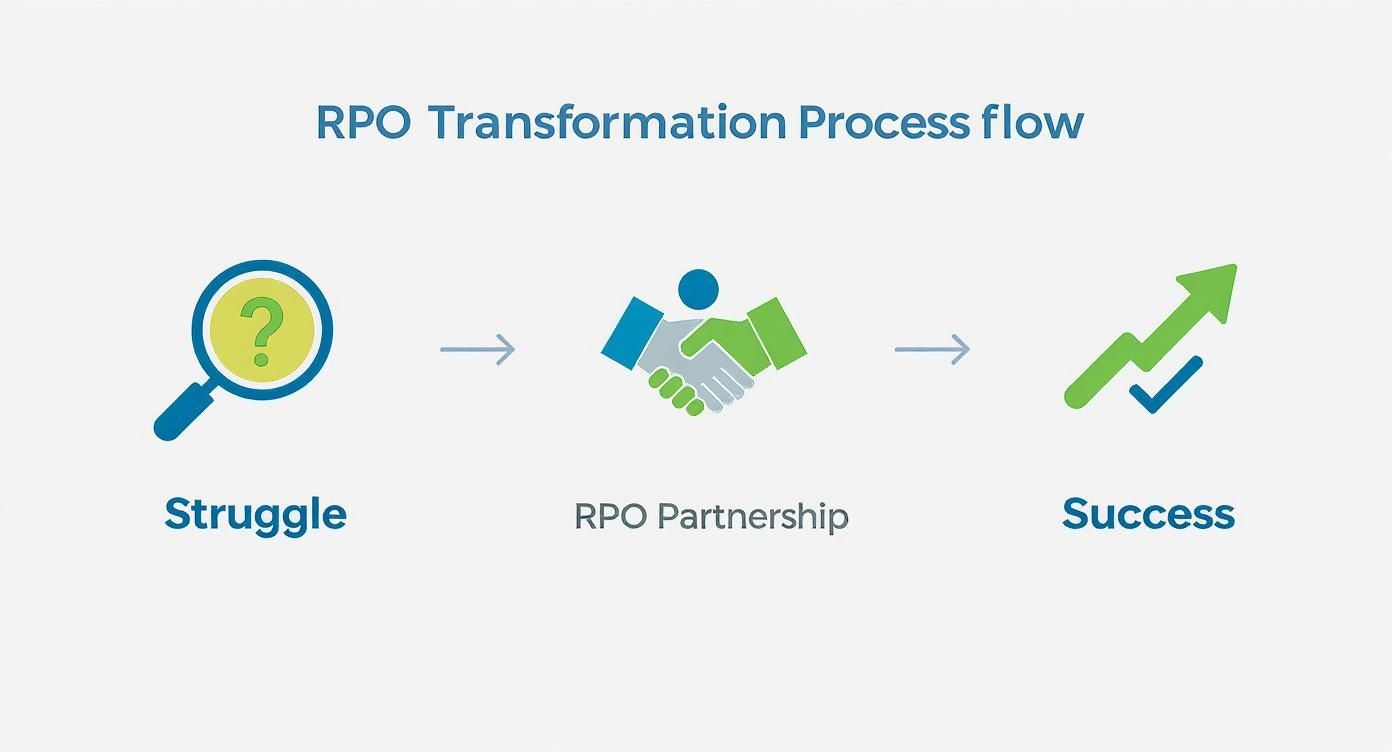
This visual shows a familiar path for many companies—from wrestling with hiring challenges to achieving scalable success by finding a true RPO partner. Let’s walk through the steps to make this happen for your business.
Defining Scope and Objectives
Before you even think about talking to providers, you need to get crystal clear on what success actually looks like for you. This first step is all about asking the tough questions to create a precise blueprint for the partnership. Your goals will ultimately determine the kind of RPO solution you need.
Start by getting specific. Are you trying to:
- Launch a new manufacturing facility and need to hire 300 skilled technicians in the next six months?
- Break into a new tech hub and need 50 senior data scientists with very specific skills?
- Grow your sales team across multiple tier-two cities with a constant, high-volume need for talent?
The sharper your goals, the easier it is to see which partners can actually deliver. This is also where you decide which parts of the recruitment process you want to hand over. You might need a full-cycle RPO that handles everything from sourcing to onboarding, or maybe just a project-based model to fill roles for a new business unit.
Vendor Selection and Due Diligence
With your objectives locked in, the hunt for the right partner begins. This is so much more than just comparing price tags; it’s a deep dive into a provider’s track record, technical muscle, and cultural alignment. You’re essentially hiring a senior leader for your talent acquisition function.
Your checklist should go beyond the basics and dig into their expertise and technology.
A key aspect of how enterprise RPO supports business expansion is the provider’s ability to integrate with your existing systems and culture. A technically proficient partner who doesn’t understand your industry or company values will ultimately fall short.
When you’re vetting potential vendors, don’t be afraid to ask probing questions:
- Industry Expertise: Can they show you case studies from companies in your sector, at a similar scale?
- Geographical Reach: Do they already have a footprint and talent network in the cities or regions you’re expanding into?
- Technology Stack: What Applicant Tracking System (ATS) and sourcing tools are they using? How will their tech talk to yours to keep data flowing smoothly?
For organisations wanting to get ahead, understanding the tech side of things is non-negotiable. Our guide on digital RPO for high-impact hiring dives deeper into how the right tools can completely change the game.
Integration and Change Management
Once you’ve picked your partner, the real work begins: integration. A great RPO relationship is a genuine collaboration, not just a handover of tasks. This means you need a solid change management plan to get your new RPO team and your internal HR department and hiring managers on the same page.
Set up clear communication channels and define who does what from day one. Your internal team has to see the RPO provider as a strategic partner, not a threat. Regular check-ins, shared dashboards, and a collaborative mindset are what build trust.
Most importantly, you need to establish clear, measurable Service Level Agreements (SLAs). These are the metrics that will define what success looks like and keep everyone accountable. A solid SLA turns abstract goals into concrete targets that directly tie back to your expansion plans.
Choosing the Right RPO Partner for Your Journey
Picking an RPO provider isn’t just about signing another vendor contract. It’s a strategic alliance, a partnership that will directly shape how successful your expansion is. The right partner becomes a genuine extension of your team, weaving themselves into your growth plans. But the wrong one? They can become a bottleneck, stalling progress and causing headaches you don’t need.

Making the smart choice means looking past the slick sales pitches and digging into the criteria that actually matter for your specific expansion goals. Think of it like hiring a co-pilot for a long-haul flight. You need someone who has actually flown in the regions you’re heading to, knows the local weather patterns, and is an expert on your specific type of aircraft.
Evaluating Geographical Reach and Local Expertise
The first big test for any potential RPO partner is their real, on-the-ground knowledge of your target markets. A provider that’s a star in big metro cities might be completely lost trying to hire for your new manufacturing plant in a tier-two or tier-three city.
Their expertise has to be more than just a claim; it needs to be proven. A deep, verifiable understanding of the local talent scene is a massive indicator of how enterprise RPO supports business expansion effectively. Without it, you’re essentially flying blind into a new territory.
When you’re talking to potential partners, get specific to see what they really know:
- What does your talent network actually look like in our target cities?
- Can you show us examples of placing roles just like ours in this specific region?
- How do you change your sourcing approach to fit local customs and what candidates there expect?
Assessing the Technology Stack and Integration
Your RPO partner’s tech shouldn’t create more work for you. It should simplify things. A clunky, disconnected system creates data chaos and kills efficiency, defeating the whole purpose of the partnership. The aim is a seamless link-up that gives everyone a single, clear view of the entire talent pipeline.
A modern RPO provider uses technology to create transparency and drive efficiency. Their ability to integrate with your existing Applicant Tracking System (ATS) and Human Resource Information System (HRIS) is non-negotiable for a truly collaborative relationship.
This technical harmony ensures information flows smoothly, giving your leadership team real-time updates on hiring progress. It avoids the sheer frustration of juggling multiple systems and makes sure everyone is working from the same script.
Gauging Cultural Alignment and Industry Acumen
This might just be the most important piece of the puzzle. You need a partner who just “gets” you. Cultural alignment means they understand your company’s values, your mission, and the unique rhythm of how you work. An RPO provider for a fast-and-furious fintech startup will need a totally different playbook than one for a legacy manufacturing firm with decades of history.
This connection has to extend to their industry knowledge. A partner with a solid track record in your sector already speaks your language. They know the niche skills, the right qualifications, and the kind of candidate profiles that thrive in your field. This saves an incredible amount of time and helps you avoid costly hiring mistakes.
To figure out if they’re the right fit, ask yourself these questions during the evaluation:
- Team Composition: Who from their side will be on our dedicated account team? Do they have real experience in our industry?
- Communication Style: What’s their plan for communicating and working with our internal hiring managers and HR team?
- Problem-Solving: Give them a tough, hypothetical hiring challenge that’s specific to your expansion plans. Then, listen carefully to how they’d solve it.
Choosing a partner with the right geographical chops, tech capabilities, and cultural fit ensures your recruitment engine is perfectly tuned to power your journey forward.
Frequently Asked Questions About RPO
When you’re thinking about a strategic move like Recruitment Process Outsourcing, it’s natural to have questions. For any leader focused on scaling up, you need straight answers. Let’s tackle some of the most common queries about what an RPO model actually looks like and what it means for your expansion plans.
How Is Enterprise RPO Different From a Staffing Agency?
This is probably the most important question to ask, and the difference is huge. A staffing agency is transactional. You have an open role, you call them, they find a candidate, and the relationship ends. Think of them as a specialist you bring in for a one-off task.
An Enterprise RPO provider, on the other hand, is a true strategic partner. They don’t just fill jobs; they take ownership of your entire recruitment process. They become a part of your business, managing everything from building your employer brand in a new country to ensuring new hires have a great onboarding experience. It’s a long-term play focused on building a sustainable talent engine, not just plugging a single leak.
What Does a Typical RPO Cost Model Look Like?
RPO pricing is built to be flexible, which is a world away from the high, one-time fees of traditional agencies. While the specifics can be customised, the models that work best for growing businesses usually include:
Cost-Per-Hire: Simple and effective. You pay a set fee for every person successfully brought on board. Your costs are predictable and tied directly to growth.
Management Fee: This is often a monthly retainer that covers the overall management of the recruitment function. It’s frequently paired with a much lower cost-per-hire fee.
Hybrid Models: These are great for custom needs. You might have a management fee that covers ongoing brand building and candidate sourcing, plus a performance fee for each hire.
This flexibility is exactly how enterprise RPO supports business expansion—it lets your recruitment spend scale up or down right alongside your hiring needs.
Will We Lose Control Over Our Hiring Decisions?
This is a common worry we hear, but the answer is a firm no. A good RPO partnership actually gives you more strategic control, because it frees you from the day-to-day operational grind of recruiting. You and your hiring managers will always, always make the final call.
An RPO provider acts as an extension of your team, not a replacement. They operate within your defined cultural framework and hiring standards, presenting you with top-tier, vetted candidates. You retain full authority over who joins your team, ensuring every new hire aligns with your company’s vision and culture.
How Long Does Implementation Take to See Results?
While getting a full RPO solution implemented and fully integrated can take a few weeks, you won’t be waiting long for results. A well-prepared RPO partner with talent pipelines already active in your target market can start sourcing candidates and cutting down your time-to-hire within the very first month.
The deeper, more strategic benefits—like a stronger employer brand and a lower cost-per-hire—naturally take a bit longer. You’ll really start to see that impact solidify within the first two quarters of the partnership.
Ready to build the high-performance workforce that will drive your expansion? Taggd crafts bespoke RPO solutions that scale with your ambition. Learn how we can become your strategic talent partner by visiting us at https://taggd.in.