94% of automotive CEOs are deeply concerned about the availability of critical skills in their workforce. In India’s hyper-accelerated mobility ecosystem, this statistic isn’t just a talent acquisition metric, it is a boardroom risk factor impacting product launch timelines, plant efficiency, and enterprise valuation.
The traditional automotive playbook is being completely rewritten. This is no longer a volume hiring problem dressed up as executive search. It is a complex capability allocation problem in an industry rapidly pivoting toward Electric Vehicle (EV) platforms, software-defined architecture, embedded electronics, and tightly integrated supply chains.
That gap is now expensive. If leadership hiring criteria don’t reflect programme complexity, software intensity, and future skill needs, the organisation doesn’t just risk a slow hire. It risks putting the wrong operating logic into critical roles. That’s why predictive talent analytics has become a board-level enabler rather than a reporting exercise.
Why Automotive Leadership Hiring Has Become a Strategic Business Risk
The pressure on automotive leadership hiring isn’t abstract. It sits at the intersection of workforce scarcity, technical disruption, and execution risk. When automotive CEOs say skill availability is one of their core concerns, that should be read as a direct signal that leadership hiring quality now affects product readiness, plant performance, supplier coordination, and transformation speed.
India adds another layer of difficulty. The sector is modernising faster than many hiring models were designed to handle. Leaders are now expected to understand not only operations and quality discipline, but also software-heavy architectures, digitally enabled programmes, and new skill mix requirements inside engineering and manufacturing teams.
Leadership Insight
High-performing automotive organisations no longer evaluate leaders based only on previous designations or years of experience. They assess whether candidates have successfully managed programme complexity, cross-functional collaboration, supplier ecosystems, and business transformation. In a sector where technology and operating models continue to evolve, leadership capability is defined by execution rather than hierarchy.
The implication for CHROs is straightforward. Intuition-led hiring can’t keep pace with a sector where the capability mix is shifting and where the cost of a leadership mismatch compounds across functions. A hiring process that doesn’t separate traditional operational competence from transformation capability will overvalue familiar backgrounds and undervalue the leaders who can move the business forward.
Three changes typically signal that an organisation needs a benchmark-driven approach:
- Programme complexity has increased: Product, manufacturing, quality, and supplier teams now depend on tighter coordination than legacy structures assumed.
- Leadership roles have become hybrid: The strongest candidates often combine domain depth with digital fluency, not one or the other.
- Business leaders expect foresight: TA can’t remain a requisition service when the business needs succession depth and capability planning.
Data-driven automotive leadership hiring isn’t about adding more dashboards. It’s about selecting the few indicators that reveal whether your hiring system is aligned to the sector you’re operating in.
Why Generic TA Benchmarks Mislead Automotive Leaders
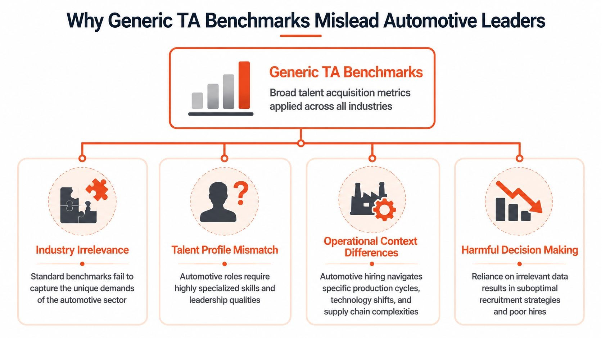
Using generic TA benchmarks for automotive leadership hiring is like using family-sedan performance metrics to evaluate a race car. The dashboard may look familiar, but the variables that determine success are entirely different.
India’s automotive sector employs 29 million people directly and indirectly, and one industry source also notes that demand is shifting toward AI specialists, data analysts, robotics programmers, software engineers, high-tech maintenance technicians, and cybersecurity experts. That scale and capability shift make generic metrics blunt instruments.
Automotive complexity changes what good looks like
In many sectors, leadership hiring can be evaluated through broad indicators such as hiring speed, compensation fit, and early tenure stability. Automotive doesn’t work that way. A senior engineering hire may influence architecture decisions, validation loops, supplier escalation paths, and manufacturing feasibility long before standard post-hire reviews reveal anything useful.
That’s why compensation benchmarking in automotive can’t be treated as a generic market-median exercise. A candidate who can lead a software-defined programme, manage supplier interfaces, and align plant realities with engineering trade-offs sits in a different market from a more traditional operations leader, even if both carry similar titles.
Why standard TA metrics distort decisions
A cross-industry benchmark often creates false diagnoses.
A long time-to-fill, for example, may look like recruiter inefficiency on a standard dashboard. In automotive leadership hiring, it may signal that the role itself is poorly specified. The business may be asking for one leader to carry legacy plant expertise, EV fluency, electronics understanding, and software programme judgment, without recognising that these capabilities rarely sit neatly in a single profile.
A low offer acceptance rate may not point to compensation alone. It can also reflect candidate concern about mandate clarity, reporting structure, transformation maturity, or whether the organisation has committed fully to a new operating model.
Generic benchmarks measure hiring activity. Automotive-specific benchmarks measure whether leadership capability matches programme reality.
The most common errors I see are these:
- Overweighting pedigree: Hiring teams assume a longer OEM background automatically predicts success in a changing technical environment.
- Misreading speed: They push for faster closure without checking whether the search brief reflects actual programme needs.
- Ignoring role architecture: They compare unlike roles because titles match, even when the decision rights and technical demands do not.
When CHROs rely on generic benchmarks, they don’t just get imperfect reporting. They create incentives for the wrong hiring behaviour.
What Leading Automotive Companies Are Doing Differently
The strongest automotive employers have moved beyond viewing recruitment as a reactive function. They use leadership hiring as part of a broader capability-building strategy.
Instead of asking how quickly a vacancy can be filled, they ask more strategic questions.
- Which leadership capabilities will become critical as software and electronics reshape vehicle development?
- Which roles are most likely to constrain future growth if left vacant?
- Which skills should be developed internally, and which require external hiring?
- Which adjacent industries offer transferable leadership talent?
- How should success be measured once a leader joins the organisation?
These questions change the quality of hiring decisions. Recruitment becomes a strategic exercise that aligns leadership capability with future business objectives instead of simply replacing outgoing employees.
The Five Benchmarks for Automotive Leadership Hiring
The right benchmark set for automotive leadership hiring should do one job well. It should tell the organisation whether it is identifying, attracting, selecting, and landing leaders who can operate inside the sector’s current and future complexity.
Mercer’s automotive workforce analysis points to the planning problem clearly. 49% of automotive HR leaders understand the skills they have today, while only 43% have business plans detailed enough to close future skills gaps. That gap is exactly why benchmark design matters.
A benchmarking model built for automotive leadership roles
The five benchmarks below are familiar in name, but they need to be defined differently for this sector.
| Benchmark | Definition | Automotive-Specific Context |
| Time-to-fill | Time from approved role brief to accepted offer | Should be read against role clarity, technical scarcity, and whether the mandate spans legacy operations plus EV or software transformation |
| Quality of hire | Evidence that the leader is delivering against the intended mandate | Should be tied to programme milestones, team capability building, supplier effectiveness, and cross-functional execution |
| Offer acceptance rate | Share of accepted offers relative to formal offers made | Best used to test market competitiveness, role attractiveness, and credibility of the transformation agenda |
| Source quality | Which channels produce shortlisted and hired leaders who succeed in role | More valuable than source volume because niche automotive mandates often depend on precise networks and technical mapping |
| Diversity and inclusion | Representation and slate quality across leadership pipelines | Should assess whether the organisation is expanding the leadership pool rather than recycling the same industry profiles |
A useful companion to these measures is a broader recruitment metrics framework, but automotive leaders should adapt each metric to programme context rather than adopt a standard dashboard unchanged.
To define each benchmark properly:
Time-to-fill
For automotive leadership hiring, time-to-fill is a diagnostic metric before it’s an efficiency metric. If a role takes too long, first test whether the hiring committee agrees on what success looks like. In many Indian automotive businesses, delays start with unresolved questions around transformation scope, reporting authority, and the balance between technical depth and change leadership.
Use this benchmark to ask:
- Is the role brief specific enough: Does it define the technical terrain, stakeholder map, and expected business outcomes?
- Has the business separated must-haves from preferences: Or is it asking for an idealised profile that compresses multiple leadership jobs into one?
- Are interview stages aligned: Or are different panel members selecting for different versions of the role?
Quality of hire
For senior automotive roles, quality of hire isn’t whether the person settles in quickly. It’s whether the person changes the organisation’s execution capacity. That may show up in stronger programme governance, cleaner engineering-manufacturing alignment, or better technical team-building in emerging capability areas.
Board lens: Measure quality of hire against the mandate you approved, not against general leadership behaviours.
If the role was created to support EV expansion, software-heavy product development, or integrated platform delivery, then quality has to be judged through those outcomes. A polished executive who maintains stability but doesn’t shift capability may be a culturally acceptable hire and still a strategic miss.
Offer acceptance rate should test your market story
Offer acceptance in this sector often reflects whether senior candidates believe the company can execute the transformation it describes. Compensation matters, but so do mandate clarity, executive sponsorship, team quality, and the seriousness of the roadmap.
When this metric weakens, examine:
- Narrative credibility: Does the company describe a coherent growth and capability story?
- Decision speed: Are strong candidates losing confidence during prolonged evaluations?
- Leadership alignment: Do interviewers present a consistent mandate?
Source quality
The source that produces the most CVs is rarely the source that produces the right leaders. For automotive mandates, source quality should be tracked through shortlist conversion, interview depth, offer outcome, and post-hire performance against the original brief.
A specialist executive search channel may deliver fewer profiles but stronger fit on programme exposure, stakeholder management, and transformation capacity. That’s superior to broad sourcing that creates panel fatigue and weak comparisons.
Diversity and inclusion
In automotive leadership hiring, D&I should be treated as a capability question as much as a representation question. If every shortlist is built from the same narrow background assumptions, the company keeps reproducing yesterday’s operating model.
This benchmark becomes especially useful when a business is hiring into software-defined, electronics-heavy, or cross-domain roles. Those mandates often require wider talent adjacency thinking than legacy automotive succession patterns allow.
How Automotive Companies Should Turn Recruitment Data into Better Hiring Decisions
Benchmarks only matter when they change decisions. Most TA teams already have data. The core issue is interpretation. A metric in isolation usually tells you very little about why an automotive search is underperforming.
For technical leadership roles, recruiters should map a candidate’s program breadth, including whether they’ve led complete-vehicle integration, single-system development, or supplier/OEM interface work, because that is a better predictor of success than generic seniority (TalentHero on top automotive recruiters and role assessment).
Read combinations, not isolated metrics
A useful automotive hiring dashboard reads patterns across metrics rather than celebrating or punishing single numbers.
Consider a few common combinations:
- Long time-to-fill with weak shortlist conversion: The role brief may be too generic for a highly technical mandate.
- Strong shortlist conversion with low offer acceptance: The market may see risk in the mandate, reporting line, or organisational readiness.
- Healthy acceptance but weak quality of hire later: Selection may be over-indexing on pedigree and under-testing program breadth.
A stronger talent acquisition strategy then becomes operational. The dashboard should prompt action such as rewriting role scorecards, recalibrating interview panels, or redesigning compensation logic for niche segments. It shouldn’t exist only to report monthly activity.
When the data says “slow search”, ask whether the organisation is searching for the right capability, in the right market, with the right decision criteria.
Build governance around business risk
For CHROs, the most effective governance model connects TA metrics to programme and operating risk. A head of manufacturing transformation, an engineering platform lead, and an EV programme executive shouldn’t sit in the same reporting bucket with no distinction in risk weighting.
A practical governance model usually includes:
- Role segmentation by business criticality and technical scarcity.
- Search briefs that define success in operational terms, not only competency language.
- Calibration reviews between TA, HRBPs, and business leaders before market activation.
- Decision dashboards that show bottlenecks by stage, by role family, and by mandate type.
- Post-hire reviews focused on whether the original business problem is being solved.
The most mature teams also blend internal search data with external market intelligence. That can include compensation movement in niche skill pools, availability of adjacent talent, and competitor hiring posture. The objective isn’t perfect prediction. It’s better decision quality.
For the C-suite, that changes the conversation. TA stops reporting vacancies closed and starts reporting execution risk reduced, succession depth strengthened, and strategic capability secured.
The Biggest Hiring Mistake Automotive Companies Continue to Make
The biggest hiring challenge in automotive is not a shortage of talent. It is a lack of clarity about the talent the business actually needs.
Many organisations begin executive searches using role descriptions designed for an industry that looked very different five years ago. They search for a Head of Engineering, Plant Head, or Programme Manager based on legacy responsibilities, while expecting the successful candidate to lead software-driven products, digital manufacturing initiatives, complex supplier ecosystems, and EV transformation.
That disconnect creates unrealistic hiring expectations, longer search cycles, and poor quality of hire.
High-performing organisations take a different approach. Before entering the market, they redefine the role based on future business priorities rather than historical reporting structures. They identify the capabilities that will create competitive advantage over the next three to five years and build assessment frameworks around those requirements.
In automotive leadership hiring, better recruitment starts long before the first candidate is identified. It begins with designing the right mandate.
How Taggd Helps Automotive Companies Build Future-Ready Leadership Teams
The hardest part of automotive leadership hiring in India isn’t generating candidate flow. It’s interpreting the market correctly. Companies need a way to separate surface-fit candidates from leaders who can operate across product engineering, software, supplier ecosystems, and manufacturing realities.
An industry analysis on the sector’s talent war makes the strategic challenge clear. Companies aren’t only hiring for traditional operations. They’re increasingly hiring leaders for software-defined and EV transformation, and the strongest hire may be the one who can bridge product engineering, software, and manufacturing under compressed cycle times.
What specialised support should actually do
A specialised partner in this space should improve signal quality in four places.
First, it should sharpen mandate definition. Many searches fail before sourcing begins because the role combines incompatible expectations. Second, it should read technical adjacency properly. A leader from a pure-play software setting may bring valuable capability, but only if they can operate within automotive validation and production constraints.
Third, it should provide live market context on niche talent pools, compensation ranges, and candidate motivations. Fourth, it should convert all of that into governance, not just candidate lists.
That’s where providers such as Taggd’s EV recruitment case study for an automobile company are relevant to evaluate. The useful question for a CHRO isn’t whether a partner can source faster in general. It’s whether the partner can help the business define, assess, and close complex automotive mandates with greater precision.
A short industry perspective is useful here:
Why the operating model matters as much as the search
In practice, the strongest hiring model combines technology-enabled pattern recognition with on-ground market intelligence. AI can support role parsing, candidate clustering, and pipeline prioritisation. But in automotive leadership hiring, that’s only half the job. Someone still has to judge whether a candidate who looks strong on paper has actually led the kind of cross-functional trade-offs the role demands.
That is why operating model design matters. Executive search, talent mapping, stakeholder calibration, and post-offer risk management need to work as one system. Otherwise the organisation ends up with fragmented data, inconsistent evaluation, and repeated resets during the search.
For Indian automotive businesses, that matters most in transitional roles. These are the roles where the company is still deciding what “good” looks like, while the market is already moving.
Future-Proof Your Automotive Leadership Hiring Strategy
Automotive leadership hiring in India has entered a different era. Old assumptions still fill roles, but they don’t reliably build the leadership bench needed for EV programmes, software-led product strategies, integrated supplier models, and more technically complex operations.
The central mistake isn’t that companies lack hiring effort. It’s that many still evaluate leadership mandates with broad enterprise metrics that were never designed for automotive complexity. The better approach is narrower and more disciplined. Define the few benchmarks that reflect sector reality. Tie them to business outcomes. Read them together. Then use them to improve role design, assessment rigour, and market engagement.
Two ideas should stay with CHROs.
- Benchmark relevance matters more than benchmark volume: A smaller set of sector-specific measures will outperform a crowded dashboard of generic TA metrics.
- Leadership quality must be judged by execution context: In automotive, the right hire is the one who can translate technical and organisational complexity into progress.
Your hiring data should function like a navigation system. It should help leaders choose direction early, not explain mistakes after the programme has drifted.
The organisations that will outperform in the next phase of automotive transformation won’t be the ones that only hire faster. They’ll be the ones that know exactly what capability they need, where to find it, how to assess it, and how to measure whether the hire changed the business.
Is your hiring data a rear-view mirror, or is it the navigation system guiding your future talent destination?
FAQs
What are the most important benchmarks for automotive leadership hiring?
The most valuable benchmarks include time-to-fill, quality of hire, offer acceptance rate, source quality, and leadership diversity. Together, they help organisations measure recruitment effectiveness and long-term business impact.
Why do generic recruitment benchmarks fail in automotive hiring?
Generic recruitment metrics focus on hiring efficiency, while automotive leadership roles require specialised capabilities. Sector-specific benchmarks better reflect programme complexity, technical expertise, transformation readiness, and future leadership requirements.
How can CHROs improve automotive leadership hiring outcomes?
CHROs should define future-focused role requirements, align hiring with business objectives, use structured assessments, leverage market intelligence, and track recruitment benchmarks that measure capability instead of recruitment activity alone.
Why is quality of hire more important than time-to-fill?
Hiring quickly offers little value if leaders cannot deliver business outcomes. Quality of hire measures how effectively executives drive transformation, strengthen teams, improve execution, and support long-term organisational growth.
How does data-driven recruitment improve automotive leadership hiring?
Data-driven recruitment identifies hiring trends, talent availability, compensation movements, and recruitment bottlenecks. These insights enable organisations to make informed hiring decisions, reduce recruitment risks, and strengthen leadership pipelines.
How can Taggd support automotive leadership hiring in India?
Taggd combines industry expertise, talent intelligence, technology-enabled recruitment, and structured assessment frameworks to help organisations identify, evaluate, and hire leaders equipped to drive automotive transformation and sustainable business growth.
If your organisation is rethinking leadership hiring in automotive, Taggd can be assessed as a practical partner for building a more data-backed approach across executive search, talent mapping, RPO, and benchmark-led hiring strategy in India.