Every business deal starts with a handshake. But what protects the organization when things get complicated is a contract. And the person who makes sure that contract works is a Contract Manager.
As organizations scale, outsource more, and operate across increasingly complex regulatory environments, contract management has evolved from a back-office administrative function into one of the most strategically critical roles in modern business. In 2026, the difference between a profitable partnership and a costly dispute often comes down to how well the contract was managed.
This guide explains everything candidates and recruiters need to know about Contract Managers, including responsibilities, required skills, hiring challenges, job descriptions, and recruitment strategies.
What is a Contract Manager?
A Contract Manager is a professional who manages the entire lifecycle of commercial contracts, from initial drafting and negotiation through execution, performance monitoring, and renewal or termination. Unlike legal counsel who focuses on legal risk, contract managers focus on commercial outcomes, ensuring every agreement delivers its intended value while protecting the organization from risk and non-compliance.
| A Contract Manager is a specialist who oversees the creation, negotiation, execution, and performance monitoring of contracts between an organization and its clients, vendors, or partners. |
Contract managers work at the intersection of:
- Contract Drafting and Negotiation
- Commercial Risk Management
- Vendor, supplier, and sourcing manager relationship management.
- Legal and Regulatory Compliance
- Performance Monitoring and Dispute Resolution
In 2026, Contract Managers are responsible for:
- Drafting, reviewing, and negotiating commercial contracts across procurement, sales, and partnerships
- Managing contract repositories and ensuring compliance with contractual obligations
- Identifying and mitigating commercial, legal, and operational risks within contracts
- Monitoring vendor and supplier performance against contractual terms and SLAs
- Supporting dispute resolution, contract variations, and renewal negotiations
Think of a Contract Manager as a combination of:
- Commercial Negotiator
- Legal Risk Advisor
- Vendor Performance Manager
- Compliance Specialist
- Business Process Owner
Why Do Organizations Need a Contract Manager?
In 2026, organizations are managing more contracts than ever across more geographies, more vendors, and more regulatory frameworks. Without dedicated contract management expertise, organizations face revenue leakage, compliance failures, and costly disputes that could have been prevented with proper contract oversight.
| Factor | Why It Matters |
| Contract Volume Growth | Organizations manage hundreds of contracts simultaneously requiring dedicated oversight. |
| Regulatory Complexity | Contracts must comply with increasingly complex legal and regulatory frameworks. |
| Revenue Protection | Poor contract management leads to significant revenue leakage and missed entitlements. |
| Vendor Risk Management | Supplier non-performance needs structured contractual monitoring and enforcement. |
| Digital Transformation | Contract lifecycle management tools require specialist expertise to implement effectively. |
| Cost Control | Optimized contract terms directly reduce procurement costs and commercial exposure. |
| Dispute Prevention | Clear and well-managed contracts prevent costly legal disputes and arbitration. |
| M&A Activity | Contract due diligence and integration require dedicated contract management expertise. |
Core Operational Tasks of a Contract Manager
Contract managers keep commercial agreements on track, compliant, and value-delivering. Here is what their day-to-day looks like:
- Contract Drafting and Review
Preparing, reviewing, and redlining commercial contracts including NDAs, MSAs, SOWs, and vendor agreements to ensure clarity, commercial fairness, and legal compliance. - Negotiation Support
Leading or supporting contract negotiations with vendors, clients, and partners to achieve commercially favorable terms while maintaining positive business relationships. - Contract Repository Management
Maintaining organized and accessible contract databases ensuring all agreements are stored, tracked, and retrievable with key dates and obligations clearly flagged. - Obligation Monitoring
Tracking contractual obligations, milestone dates, renewal deadlines, and performance requirements to ensure all parties meet their commitments on time. - Performance Management
Reviewing vendor and supplier performance against contracted SLAs, KPIs, and deliverable standards and initiating remediation processes when performance falls short. - Risk and Compliance Review
Identifying contractual risks, regulatory compliance gaps, and commercial exposure within existing and proposed agreements and recommending mitigation actions.
Key Responsibilities of a Contract Manager
Contract managers protect organizational commercial interests by managing contract lifecycles, negotiating favorable terms, monitoring performance, and ensuring full compliance with contractual and regulatory obligations across all business relationships.
1. Contract Drafting, Review, and Negotiation
- Draft, review, and redline MSAs, SOWs, NDAs, SLAs, and vendor agreements.
- Lead or support contract negotiations to secure commercially favorable terms.
- Coordinate with legal, finance, and procurement on contract requirements and risk.
- Maintain standard templates, clause libraries, and negotiation playbooks.
2. Contract Lifecycle Management
- Manage end-to-end contract lifecycles from initiation through renewal or termination.
- Maintain a centralized contract repository with accurate records and key dates.
- Track expiry dates, renewal windows, and option deadlines to prevent unintended lapses.
- Implement and manage CLM software to improve contract visibility and compliance.
3. Commercial Risk Management and Compliance
- Identify and mitigate commercial, legal, and operational risks within contracts.
- Ensure all contracts comply with data privacy, anti-bribery, and competition law.
- Conduct regular compliance audits and flag non-compliance issues promptly.
- Advise business units on liability, indemnification, and insurance requirements.
4. Vendor and Supplier Performance Management
- Monitor vendor performance against contracted SLAs, KPIs, and deliverable standards.
- Manage performance improvement processes and formal notices for underperforming vendors.
- Coordinate contract variations and change orders within existing agreements.
- Support procurement specialists in building commercially rigorous and accountable supplier contracts.
5. Dispute Resolution and Contract Closeout
- Manage contractual disputes and claims through structured resolution processes.
- Prepare dispute documentation including breach evidence and financial impact analysis.
- Coordinate contract closeout including final acceptance and payment reconciliation.
- Support legal teams in arbitration proceedings with comprehensive contract history.
Additional Scope (Senior Contract Manager Roles)
- Own enterprise-wide contract management framework, policy, and governance standards.
- Lead a team of contract managers and administrators across multiple business units.
- Present contract portfolio performance and risk exposure to C-suite and board.
- Drive CLM platform selection, implementation, and digital transformation initiatives.
What Skills Does a Contract Manager Need?
Great contract managers are not just legal-minded administrators. They are commercially sharp, analytically rigorous, and skilled negotiators who protect organizational interests while enabling business relationships to thrive. Here is what the best bring to the table:
Technical Skills
- Contract drafting and redlining across commercial agreement types
- Contract lifecycle management platforms (Icertis / Coupa / DocuSign CLM / Ariba)
- Legal and regulatory compliance frameworks
- Risk assessment and commercial exposure analysis
- Vendor performance management and SLA monitoring
- Financial analysis and cost modeling for contract terms
- Data analytics and contract reporting tools
- Procurement and sourcing process knowledge
Soft Skills
- Persuasive negotiation and commercial acumen
- Analytical and detail-oriented thinking
- Clear and precise written and verbal communication
- Stakeholder management and cross-functional collaboration
- Calm and structured approach to dispute resolution
- Adaptability to complex and fast-changing commercial environments
Contract Manager Job Description Template
Job Title: Contract Manager / Senior Contract Manager
Department: Legal / Procurement / Commercial / Operations
Reports To: Head of Legal / Chief Procurement Officer / VP of Commercial
Location: [Location]
Employment Type: Full-time
Job Summary: We are looking for a commercially astute and detail-oriented Contract Manager to join our [Department] team. In this role, you will manage the full lifecycle of commercial contracts across procurement, sales, and vendor relationships, ensuring every agreement protects organizational interests, delivers commercial value, and maintains full legal and regulatory compliance. You will work cross-functionally with legal, finance, procurement, and operations teams to drive contract excellence across the organization.
Key Responsibilities
- Draft, review, and negotiate commercial contracts across all agreement types.
- Manage contract lifecycle from initiation through renewal or termination.
- Maintain centralized contract repository with accurate obligation tracking.
- Identify and mitigate commercial, legal, and operational contract risks.
- Monitor vendor performance against contracted SLAs and KPIs.
- Manage disputes, variations, and escalations through structured resolution processes.
Required Qualifications
- Degree in Law, Business Administration, Commerce, or related discipline.
- 5 to 10 years of experience in contract management, procurement, or commercial roles.
- Proficient in contract drafting, redlining, and negotiation across commercial agreement types.
- Strong analytical skills with ability to identify and mitigate contractual risks effectively.
- Familiar with applicable legal and regulatory frameworks governing commercial contracts.
Preferred Qualifications
- Experience with contract lifecycle management platforms like Icertis, Coupa, or DocuSign CLM.
- Knowledge of international contract law and cross-border commercial agreement management.
- IACCM / World Commerce and Contracting certification or equivalent qualification preferred.
- Exposure to M&A contract due diligence and post-merger contract integration activities.
- Familiar with data privacy, anti-bribery, and competition law requirements in commercial contracts.
Key Skills
- Contract Drafting and Negotiation
- Contract Lifecycle Management
- Commercial Risk Assessment and Mitigation
- Vendor Performance Management
- Dispute Resolution and Escalation Management
How to Become a Contract Manager?
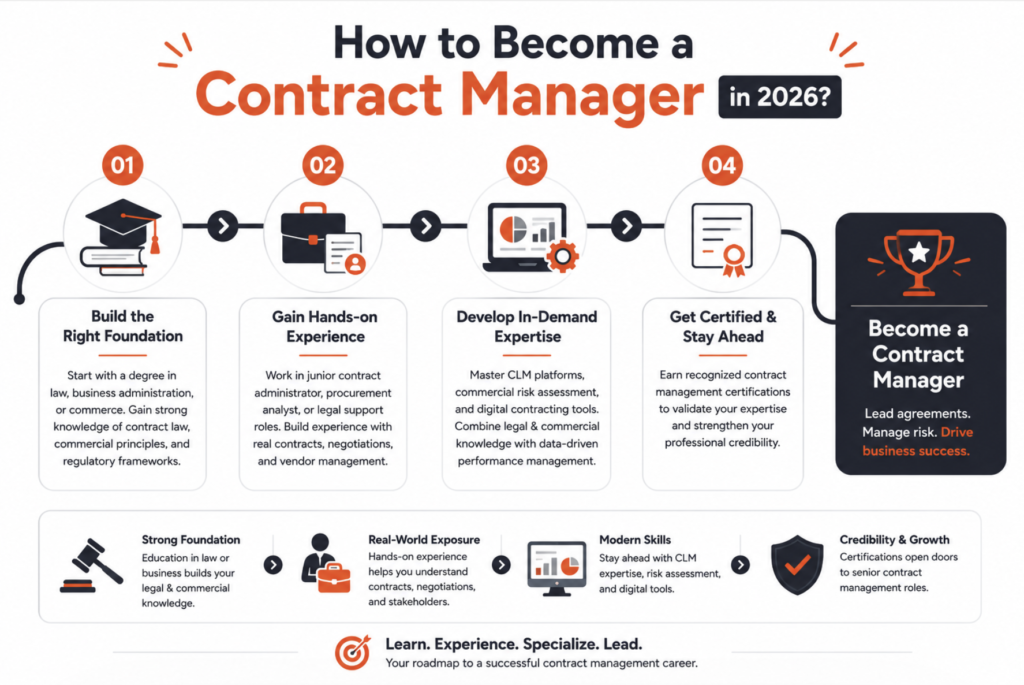
Educational Qualifications and Certifications
Most Contract Managers hold a bachelor’s degree in law, business administration, or commerce. For senior contract management or commercial leadership roles, companies prioritize candidates with postgraduate qualifications or globally recognized contract management certifications.
Educational Background
- LLB / LLM in Contract Law, Commercial Law, or Corporate Law
- BBA / MBA in Business Administration, Commerce, or Supply Chain Management
- B.Com / M.Com in Finance or Commercial Management (for finance-focused contract roles)
- B.Tech / B.E. with Legal or Commercial Specialization (for engineering contract management roles)
- MBA with Procurement or Legal Specialization for Senior Contract Manager or Head of Commercial roles
- Specialized PG Diploma in Contract Management, Commercial Law, or Procurement and Supply
Relevant Certifications
Ahmedabad runs on specialized talent. From USFDA-compliant pharma plants in Vatva to EV suppliers in Sanand and FinTech firms inside GIFT City, generic recruitment doesn’t work here. Taggd is a recruitment agency in Ahmedabad helping you hire for multiple roles in pharma, automotive, BFSI, textiles, and technology with speed, quality, and scalability.
| Certification | Best For | Industry Value |
|---|---|---|
| IACCM / World Commerce and Contracting Certification | End-to-end contract management and commercial excellence | Gold standard certification for contract management professionals globally |
| Certified Commercial Contracts Manager (CCCM) | Commercial contract drafting, negotiation, and management | High demand across procurement, legal, and commercial management roles |
| CIPS Diploma in Procurement and Supply | Procurement-linked contract management and supplier agreements | Essential for contract managers working within procurement functions |
| Icertis / DocuSign CLM Platform Certification | Contract lifecycle management platform proficiency | Critical for organizations using digital CLM tools for contract management |
| Project Management Professional (PMP) | Project-linked contract management and deliverable oversight | High value for contract managers overseeing complex project agreements |
| Certified Risk Manager (CRM) | Commercial risk assessment and contract risk mitigation | Preferred for contract managers in high-value and high-risk commercial environments |
| LLM in Commercial or Contract Law | Advanced legal knowledge for complex international contract management | Essential for senior contract managers handling cross-border and high-value agreements |
Industries Hiring Contract Managers
Contract managers are in demand across every industry where commercial agreements, vendor relationships, and regulatory compliance are central to business operations and risk management. Key industries actively hiring are:
Information Technology and SaaS:
Technology companies manage complex software licensing, SaaS subscription, cloud service, and professional services agreements requiring dedicated contract management expertise across rapidly evolving commercial models.
- Software licensing and SaaS subscription contract management
- Cloud service and managed service provider agreement oversight
- Professional services and consulting contract negotiation and monitoring
- Data privacy and IP protection clause management in technology contracts
Infrastructure and Construction:
Large-scale infrastructure and construction projects involve complex multi-party contracts with significant financial exposure, making contract managers essential for risk allocation, variation management, and dispute prevention.
- EPC and FIDIC contract drafting, review, and administration
- Subcontractor and supplier agreement management and performance monitoring
- Contract variation, extension of time, and claims management
- Dispute resolution and arbitration support for construction contract disputes
Banking and Financial Services:
BFSI organizations manage extensive vendor, technology, outsourcing, and regulatory compliance contracts requiring specialist contract management to protect financial and reputational interests.
- Outsourcing and managed service contract management and compliance
- Financial technology vendor agreement negotiation and oversight
- Regulatory and compliance contract management across jurisdictions
- Loan, facility, and financial instrument agreement management and monitoring
Pharmaceuticals and Healthcare:
Pharma and healthcare organizations manage complex clinical research, manufacturing, distribution, and licensing contracts under strict regulatory frameworks requiring specialized contract management expertise.
- Clinical research organization and CRO contract management
- Manufacturing and supply agreement oversight for regulated pharma products
- Licensing, royalty, and IP agreement management across product portfolios
- Healthcare service provider and hospital contract negotiation and compliance
Latest Trends to Watch in 2026 for Contract Managers
Contract managers in 2026 are commercially critical professionals commanding strong salaries and consistent career growth. CLM platform proficiency, cross-border contract expertise, and commercial risk management capability are the key differentiators driving hiring and compensation across every major industry sector.
Job Role Trends
- Contract Managers are now using AI tools like Kira and Luminance to accelerate contract review and risk identification.
- ESG and sustainability clauses including carbon commitments and ethical sourcing are now standard in major commercial contracts.
- Dynamic contracts with built-in price adjustment mechanisms linked to inflation and sustainability metrics are growing rapidly.
- Contract Managers are expected to own CLM platform configuration, workflow design, and organization-wide user adoption.
- Cross-border contract complexity is making international arbitration and multi-jurisdiction knowledge a growing core requirement.
Hiring Trends
- CLM platform implementation experience is now a primary hiring filter for senior contract manager roles.
- Contract Managers with AI contract review tool experience command significantly stronger hiring interest in 2026.
- T-shaped profiles with deep industry vertical expertise alongside broad commercial knowledge are the most sought-after.
- Organizations are hiring Contract Managers directly into commercial leadership pipelines rather than purely operational roles.
- ESG-linked contract management experience is emerging as a distinct and highly valued specialist hiring profile.
Career and Pay Trends
- Contract Managers demonstrating measurable negotiation savings and dispute prevention are fast-tracking into Head of Commercial.
- CLM platform ownership experience commands salary premiums of up to 25 percent above non-platform peers.
- Performance bonuses tied to contract cycle time reduction and compliance audit outcomes are now standard.
- Contract Managers specializing in technology licensing and infrastructure FIDIC agreements command the highest pay premiums.
- The CCO and VP of Commercial are now emerging in future leadership roles for contract professionals.
Career Path of a Contract Manager
A contract management career grows from maintaining contract repositories as an administrator to owning enterprise commercial strategy as a CCO. Each level builds deeper legal knowledge, negotiation expertise, and commercial leadership capability across one of the most consistently valued professional functions in modern business.
| Career Level | Typical Years of Experience | Core Focus | Key Responsibilities |
|---|---|---|---|
| Level 1: Contract Administrator / Junior Contract Analyst | 0–3 Years | Learning and Administration | Maintaining contract repositories, tracking obligations, and supporting senior contract managers. |
| Level 2: Contract Analyst / Contract Executive | 3–6 Years | Contract Operations | Drafting standard agreements, monitoring performance, and supporting negotiation processes. |
| Level 3: Contract Manager | 6–10 Years | Commercial Ownership | Leading contract negotiations, managing risk, and owning vendor performance management. |
| Level 4: Senior Contract Manager | 10–14 Years | Portfolio Leadership | Overseeing complex contract portfolios, managing disputes, and advising senior stakeholders. |
| Level 5: Head of Contracts / Commercial Manager | 14–18 Years | People and Strategy | Leading contract management function, managing teams, and driving commercial excellence. |
| Level 6: VP of Commercial / Chief Commercial Officer | 18+ Years | Strategic Leadership | Owning enterprise commercial strategy and presenting contract portfolio outcomes to the board. |
Hiring Challenges in Contract Manager Recruitment
Organizations in 2026 face a persistent talent shortage in contract management as commercial complexity grows faster than the profession can produce qualified professionals with the right combination of legal, commercial, and technical skills. Finding managers who can navigate complex agreements, drive commercial outcomes, and manage vendor relationships simultaneously remains the defining hiring challenge.
- Cross-disciplinary Skill Scarcity: Finding candidates who combine contract law knowledge, commercial negotiation skills, CLM platform proficiency, and stakeholder management capability in a single profile is exceptionally rare and competitive.
- CLM Platform Expertise Gap: Most contract management candidates lack hands-on experience with modern contract lifecycle management platforms, creating a significant capability gap in digitally mature organizations.
- Industry-Specific Knowledge Deficit: Contract managers who understand the specific commercial, regulatory, and technical context of industries like pharma, construction, or technology are scarce and heavily competed for.
- Legal vs Commercial Balance: Finding professionals who balance rigorous legal thinking with practical commercial judgment and relationship management skills is consistently one of the hardest hiring challenges in this space.
- High Attrition Risk: Experienced contract managers are frequently attracted by in-house legal team opportunities, consulting roles, and industry-specific commercial positions offering higher compensation and broader scope.
How to Hire a Contract Manager?
Hiring skilled contract managers requires practical contract assessment exercises, internal pipeline development, and specialist commercial recruitment partnerships. Organizations that invest in CLM platform training, law school engagement, and compelling commercial career tracks will consistently attract and retain top contract management talent in 2026.
- Prioritize Practical Contract Assessment Tasks: Design hiring exercises requiring candidates to redline a contract clause, identify commercial risks in a draft agreement, or structure a negotiation strategy to evaluate real contract management competence.
- Build Internal Contract Management Pipelines: Identify commercially strong professionals in procurement, legal support, and project management functions and invest in contract management training and certification sponsorship.
- Invest in CLM Platform Training: Rather than requiring full platform experience upfront, hire candidates with strong contract fundamentals and invest in Icertis, Coupa, or DocuSign CLM onboarding to expand your available talent pool.
- Partner with Law Schools and Business Programs: Engage with commercial law, MBA, and procurement postgraduate programs to access emerging contract management talent entering the profession for the first time.
- Offer Diverse Commercial Exposure: Top contract managers are motivated by working across complex, high-value, and varied commercial agreements, so highlight the scope and strategic importance of your contract portfolio during recruitment.
- Leverage Commercial Law Specialist Recruiters: Partner with agencies focused on legal, commercial, and procurement hiring to access pre-vetted contract management talent and reduce time to hire for urgent senior vacancies.
- Create Clear Commercial Career Tracks: Define transparent progression from contract administrator to Chief Commercial Officer with milestones tied to negotiation complexity, portfolio value, and commercial impact delivery.
Top 10 Interview Questions for a Contract Manager
1. Walk me through how you manage a contract from initiation to execution.
I start by understanding the business requirement and risk appetite, select the appropriate contract template, draft or review the agreement, coordinate legal and commercial sign-off, negotiate terms with the counterparty, obtain all required approvals, and execute the contract while entering it into the CLM system with all key dates flagged.
2. How do you identify and mitigate commercial risks in a contract?
I review key risk areas including liability caps, indemnification provisions, termination rights, IP ownership, data privacy obligations, and payment terms, assess the financial and operational exposure of each risk, propose mitigating clause language, and escalate unacceptable risks to legal and senior management for decision.
3. How do you handle a vendor who is consistently underperforming against contracted SLAs?
I document the performance shortfalls against contractual benchmarks, issue a formal performance notice per the contract terms, schedule a remediation meeting with the vendor, agree a time-bound improvement plan, and escalate to termination or liquidated damages if performance does not improve within the agreed timeline.
4. How do you manage a large portfolio of contracts with overlapping renewal dates?
I maintain a centralized CLM system with automated renewal alerts, categorize contracts by commercial value and risk, prioritize high-value renewals for early renegotiation, assign ownership across the team, and report portfolio status to senior stakeholders on a regular cadence.
5. How do you approach negotiating a contract with a counterparty who has significantly more bargaining power?
I identify the areas of the contract where we have genuine flexibility and focus negotiation energy on the provisions with the highest commercial risk to us. I build a clear negotiation position backed by market benchmarks, understand what matters most to the counterparty, and look for creative solutions that address both parties’ core interests.
6. How do you ensure contracts comply with data privacy regulations like GDPR?
I maintain a standard data processing agreement template compliant with applicable privacy laws, ensure all vendor contracts involving personal data include appropriate DPA clauses, verify vendor data security credentials during onboarding, and coordinate with the data privacy team on any non-standard data processing arrangements.
7. What is your experience with contract lifecycle management platforms?
I have hands-on experience with Icertis and DocuSign CLM, using them to manage contract repositories, automate obligation tracking, generate renewal alerts, run compliance reports, and provide senior management with real-time visibility into contract portfolio status and commercial risk exposure.
8. How do you manage contract variations and change orders during a project?
I ensure all scope changes are documented in writing before work commences, assess the commercial and legal impact of each variation, negotiate fair compensation and timeline adjustments, prepare formal variation orders for execution by both parties, and update the CLM system to reflect the revised contractual position.
9. How do you support dispute resolution when a contractual disagreement escalates?
I compile a comprehensive dispute file including the original contract, relevant correspondence, performance records, and financial impact analysis, work with legal counsel to assess our contractual position, engage in structured negotiation or mediation with the counterparty, and support arbitration or litigation proceedings if the dispute cannot be resolved commercially.
10. How do you build effective working relationships with business stakeholders who see contract management as a bottleneck?
I engage stakeholders early in the contracting process to understand their commercial priorities, set realistic timelines for contract review and negotiation, use standard templates and playbooks to accelerate routine agreements, and demonstrate the commercial value of rigorous contract management through case studies of risks mitigated and disputes prevented.
Why RPO is the Answer to Contract Manager Recruitment
As commercial functions scale, driven by growing contract volumes, increasing regulatory complexity, and digital contracting transformation, traditional recruitment models cannot keep pace with the speed and specialization of contract manager hiring required.
This is where Recruitment Process Outsourcing (RPO) solutions have become a game changer for commercially driven organizations. RPO providers embed themselves within your company to hire qualified contract management talent at a scale.
They bring dedicated commercial and legal sourcing teams, pre-built pools of certified contract management professionals, and practical competency-based assessment frameworks. This allows you to hire elite contract managers without overwhelming your internal HR teams during periods of commercial function expansion.
For contract manager hiring specifically, the best RPO partners bring deep commercial and legal domain expertise. They screen candidates for real contract drafting competence, CLM platform experience, and commercial risk management capability rather than just matching keywords on a CV.
Key benefits of RPO for Contract Manager talent acquisition:
- Faster time-to-hire: RPO cuts hiring timelines for scarce senior contract management and commercial leadership roles significantly.
- Access to passive contract talent: Recruiters reach experienced contract managers not active on job boards but open to the right commercial opportunity.
- Scalable model: Ramp from hiring one contract manager to building an entire contract management function without rebuilding your HR capability.
- Reduced cost-per-hire: Significant savings compared to traditional contingency agencies for specialized commercial and legal recruitment.
- Technical screening support: Expert vetting of contract drafting, CLM platform proficiency, risk management skills, and negotiation experience before candidates reach your interview stage.
- Employer branding: Strategies to position your organization as a top commercial employer, highlighting contract complexity, career growth, and strategic business impact opportunities.
Industries leveraging RPO most actively for Contract Manager hiring: Information Technology and SaaS | Infrastructure and Construction | Banking and Financial Services | Pharmaceuticals and Healthcare | Energy and Utilities | Manufacturing and Industrial Enterprises.
Wrapping Up
The role of a Contract Manager in 2026 has never been more commercially critical or more strategically valued. As organizations manage growing contract volumes across increasingly complex regulatory environments, the professionals who can draft, negotiate, and manage commercial agreements that protect organizational interests and deliver commercial value are becoming indispensable business assets.
Whether you are a commercial professional building a contract management career or an organization looking to hire the right contracting expertise, understanding the skills, certifications, and market dynamics shaping this space is essential for staying competitive and commercially protected in 2026 and beyond.
Ultimately, every successful business relationship is built on a well-managed contract. By embracing continuous learning, CLM platform adoption, and modern recruitment solutions like RPO, both contract managers and forward-thinking organizations can build commercial relationships that consistently deliver value, minimize risk, and stand the test of time.
FAQs
What is a Contract Manager and what do they do?
A Contract Manager oversees the full lifecycle of commercial contracts from drafting and negotiation through execution, performance monitoring, and renewal, protecting organizational commercial interests and ensuring full legal and regulatory compliance across all business agreements.
How is a Contract Manager different from a Legal Counsel?
Legal counsel focuses on legal risk, litigation, and regulatory compliance from a purely legal perspective. Contract managers focus on commercial outcomes, ensuring contracts deliver business value, vendor performance meets commitments, and disputes are prevented or resolved efficiently.
How do I become a Contract Manager in 2026?
Earn a degree in law or business administration, gain hands-on contract administration or procurement experience, develop CLM platform proficiency, and pursue certifications like IACCM or CCCM to build professional credibility and accelerate career progression.
How long does it take to become a Contract Manager?
Typically 5 to 8 years including relevant education and 3 to 5 years of hands-on contract administration or commercial experience. Motivated professionals from legal, procurement, or project management backgrounds can transition into contract management roles within 12 to 18 months with focused upskilling.
What are the top 5 skills for Contract Managers in 2026?
Contract Drafting and Negotiation, CLM Platform Proficiency, Commercial Risk Assessment, Vendor Performance Management, and Dispute Resolution. These skills determine hiring success and career progression across all contract management roles in 2026.
What is the career outlook for Contract Managers?
Exceptionally strong. Growing contract volumes, increasing regulatory complexity, and digital contracting transformation are driving sustained demand for qualified contract managers. Skilled professionals are commanding premium salaries and fast-tracking into Head of Commercial and Chief Commercial Officer roles across every major industry.
Building commercially resilient organizations starts with hiring the right contract management professionals.
Taggd helps organizations hire skilled Contract Managers across information technology, infrastructure, banking, pharmaceuticals, energy, and manufacturing sectors through specialized hiring solutions, talent intelligence, and scalable RPO support.