A CHRO usually realises the ecommerce manager role is under-defined after the first hiring mistake, not before it. The brief says “own online sales”, the business means “fix our website, improve Amazon performance, coordinate supply, support marketing, and grow revenue”, and the candidate hears a narrower digital marketing job. Six months later, everyone thinks the hire underperformed when the actual problem was role architecture.
That’s why a strong ecommerce manager job description matters. In Indian enterprises, this role sits between revenue, operations, technology, customer experience, and channel strategy. If you define it as a tactical website manager, you’ll attract the wrong people. If you define it as a broad digital growth role without clear accountabilities, you’ll create friction with marketing, sales, and supply chain from day one.
The right job description does one thing very well. It makes the business model visible. It tells candidates whether they’re expected to grow owned commerce, manage marketplace operations, or lead both with clear trade-offs. For CHROs, that distinction is where hiring quality improves.
Why Your Ecommerce Manager Hire Is a Revenue Driver Not a Cost Centre
The warning sign is familiar. Revenue from online channels matters, but ownership is fragmented. Marketing drives traffic. Sales wants channel growth. Operations controls fulfilment. Technology owns the platform. The ecommerce manager job description ends up as a stitched-together list of tasks, and the hire walks into a role with responsibility but limited authority.
That setup fails because ecommerce is not a support function. It is a commercial engine.
IBEF reports that India’s ecommerce gross merchandise value reached USD 83 billion in 2022 and is projected to rise to USD 163 billion by 2026, a projection cited in this ecommerce manager market context note. In practice, that means the person leading ecommerce in your business is shaping how much of that demand your company captures, how efficiently online channels convert, and how well channel execution holds under growth.
What CHROs often get wrong
Many job descriptions still treat the role like an upgraded catalogue manager. They focus on uploading products, coordinating promotions, and managing website hygiene. Those tasks matter, but they don’t define business impact.
A better lens is this. Your ecommerce manager is closer to a mini general manager for digital commerce. Like a plant head who doesn’t just watch machines but is accountable for output, quality, and throughput, the ecommerce manager should be tied to revenue outcomes, not just activity levels.
Three practical shifts help:
- Define commercial ownership clearly: State whether the role owns online revenue, conversion improvement, marketplace growth, or a mix of all three.
- Name decision rights: Clarify whether the role can influence pricing, promotions, assortment, and campaign calendars.
- Tie the role to measurable outcomes: Write the job around business results, not only responsibilities.
Practical rule: If the role affects demand generation, conversion, assortment, and fulfilment quality, it belongs in your revenue conversation.
This is the same logic many companies now apply to digital leadership roles such as the Chief Revenue Officer in India. Ecommerce management may sit a layer below that level in some organisations, but the commercial expectation is increasingly similar. The role should be structured as a growth post with operating depth, not a back-office digital function.
What a strong framing sounds like
Instead of saying, “Manage the ecommerce website and online promotions,” say something closer to this:
- Own online channel performance: Drive revenue growth across owned and third-party ecommerce channels.
- Lead cross-functional execution: Align marketing, merchandising, technology, and logistics to improve digital commerce outcomes.
- Improve the buying journey: Increase conversion quality through better assortment, content, experience, and operations.
That change in language does more than improve the posting. It changes who applies, how hiring managers interview, and what success looks like after joining.
Who is an Ecommerce Manager?
The old version of this role was simpler. Keep the site updated. Coordinate product uploads. Run basic promotions. Work with an agency on campaigns. That model no longer reflects how ecommerce works in India.
India had about 432 million internet users in 2016, and by 2023 had more than 880 million internet users, according to ecosystem reporting referenced in this role evolution summary. That expansion changed the shape of digital commerce. The audience became broader, more segmented, and harder to serve with one-channel thinking.
An ecommerce manager now sits in a more complicated operating environment. Customers discover products across search, social platforms, marketplaces, and brand properties. Buying journeys break across devices. Operational friction shows up fast in reviews, returns, and repeat purchase behaviour. The role has moved from website caretaker to channel integrator.
What the role is now
In practical terms, the modern ecommerce manager combines four lenses:
- Commercial lens: Revenue, margins, pricing logic, promotion planning, and channel performance
- Customer lens: Navigation, content quality, conversion path, and post-purchase experience
- Operational lens: Inventory visibility, fulfilment coordination, returns friction, and service issues
- Analytical lens: Traffic quality, campaign performance, merchandising effectiveness, and platform insights
That doesn’t mean the role replaces specialists. It means the manager orchestrates them.
What the role is not
A lot of hiring mistakes happen because companies confuse adjacent roles.
| Role | Primary focus | Where confusion starts |
|---|---|---|
| Ecommerce Manager | Online commercial performance across channels | Business assumes this is only a website role |
| Digital Marketing Manager | Traffic acquisition, media, campaign performance | Candidate may be strong in demand generation but weak in merchandising or operations |
| Marketplace Specialist | Seller dashboards, listings, promotions, platform compliance | Too narrow for a broader revenue ownership role |
| Product Manager for Digital | Features, roadmap, user flows, platform releases | Strong in build decisions, not always in trading decisions |
A digital marketing manager can drive traffic without owning on-site conversion. A marketplace specialist can improve listings without understanding wider channel conflict. A product manager can improve checkout flow but may not own assortment, promotions, or sales planning. The ecommerce manager sits across these seams.
The best candidates don’t just know how to get visitors in. They know where the online buying journey leaks money and which team has to fix it.
Why the Indian market changes the job design
Indian enterprises often operate with a mix of owned ecommerce, marketplaces, offline distribution, and channel partners. That creates role tension. The ecommerce manager may need to grow digital sales without triggering internal conflict over pricing, assortment, or fulfilment priorities.
This is why generic global templates underperform in India. They rarely address channel-mixed realities, especially the overlap between marketplace execution and owned-commerce strategy. Hiring teams that want a sharper demand view can also study India’s ecommerce job patterns to understand how roles have broadened beyond pure digital marketing.
A good definition for the Indian context is straightforward:
The ecommerce manager owns digital commerce performance by aligning revenue strategy, merchandising, customer experience, channel execution, and operational coordination across owned and third-party platforms.
That definition is much harder to misread. Which is exactly the point.
Core Responsibilities of an E-Commerce Manager
The cleanest ecommerce manager job description is built around a few strategic pillars. Not a random shopping list of duties. Not thirty bullets copied from old postings. Pillars force the business to decide what the role really owns.
Sales and revenue management
This is the centre of gravity. If revenue accountability is absent, the role drifts into coordination work.
Key accountabilities include:
- Own channel plans: Build trading calendars for launches, promotions, peak periods, and seasonal pushes.
- Manage assortment decisions: Decide which products, bundles, and packs should be prioritised online.
- Drive pricing and promo hygiene: Work with finance and sales teams to ensure promotions support growth without creating channel chaos.
- Review commercial performance: Track what is selling, what is stalling, and where margin pressure is coming from.
- Improve repeatable revenue routines: Establish weekly reviews on sales, stock positions, campaign impact, and underperforming categories.
A strong ecommerce manager doesn’t only report numbers. They read the commercial story behind them. If a category is growing but customer complaints are increasing, they don’t celebrate too early. If traffic is healthy but product pages are weak, they know demand generation isn’t the bottleneck.
Website performance and user experience
On owned commerce, the site is your digital store, sales rep, shelf, and cashier. If the role owns the website, this pillar must be explicit.
Responsibilities often include:
- Maintain site merchandising: Product pages, navigation, category structures, search results, and landing page quality
- Partner on UX improvements: Reduce friction across browsing, cart, checkout, and post-purchase flows
- Coordinate platform changes: Work with technology teams or agency partners on releases, bugs, and feature priorities
- Protect content quality: Ensure images, copy, attributes, and availability are accurate and current
- Track conversion barriers: Flag site speed issues, broken paths, poor mobile experiences, or mismatched messaging
Think of this pillar like store operations in physical retail. You can run brilliant campaigns, but if shelves are confusing and billing is slow, customers still leave.
Hiring lens: Ask whether the candidate has improved a buying journey by working through data, design, and operational blockers together. That’s different from simply “managing the website”.
Digital marketing and traffic generation
This pillar often creates turf tension. The solution is clarity. The ecommerce manager doesn’t need to own every media channel, but they should influence traffic quality and campaign-to-conversion alignment.
Typical responsibilities include:
- Collaborate on acquisition plans: Align paid media, search, CRM, affiliates, and social campaigns with ecommerce priorities
- Shape campaign landing experiences: Ensure campaign traffic lands on pages built to convert
- Support retention motions: Work with CRM or lifecycle teams on repeat purchase, basket-building, and reactivation journeys
- Translate campaign data into actions: Identify whether weak performance is coming from poor traffic, weak content, or fulfilment issues
- Coordinate content and offers: Align creatives, inventory, and promotional mechanics before campaigns go live
What doesn’t work is giving the ecommerce manager “responsibility” for conversion while leaving all inputs elsewhere with no decision rights. If marketing controls campaigns, design controls pages, and operations controls stock, then the ecommerce manager must at least have authority to escalate and influence.
Operations and supply chain coordination
This pillar is where many job descriptions become vague, and where many ecommerce hires struggle later. Online demand and fulfilment are linked. Customers don’t separate them. Neither should the role design.
Important accountabilities include:
- Coordinate inventory readiness: Align stock availability with campaign and promotion plans
- Partner on fulfilment reliability: Work with logistics and warehouse teams to reduce service failures that hurt online performance
- Manage returns and service feedback loops: Surface recurring product, packaging, or delivery issues
- Support order flow visibility: Ensure the business can identify where purchase journeys fail after checkout
- Prepare for peaks: Align capacity, stock, and customer communication ahead of key trading periods
Here’s a practical distinction. If your online business is still small, this pillar may be mostly coordination. In a larger enterprise, it may require sharp judgement on service-level trade-offs, seller operations, and stock allocation.
A concise responsibility framework for the job description
If you want a compact structure for the posting, use this:
- Own online commercial performance across relevant ecommerce channels.
- Lead merchandising and conversion improvement across digital storefronts.
- Coordinate marketing, technology, and operations to improve end-to-end channel outcomes.
- Translate data into action through regular review of revenue, assortment, customer journey, and service signals.
That framework gives hiring managers enough substance to interview properly, while still leaving room to customise for your operating model.
Essential Skills and Qualifications for an E-Commerce Manager Hire
Most companies over-index on platform familiarity and under-hire for commercial judgement. That’s backwards. You need technical fluency, but the stronger ecommerce managers are valuable because they connect tools, teams, and business choices.
Hard skills that actually matter
An effective shortlist usually includes candidates with a working command of ecommerce platforms, analytics environments, and channel operations. The exact stack depends on your business, but practical fluency matters more than buzzwords.
Look for evidence in areas such as:
- Platform familiarity: Shopify, Magento, WooCommerce, Salesforce Commerce Cloud, or custom commerce stacks
- Analytics capability: Google Analytics, dashboarding tools, campaign reporting, and performance review discipline
- Merchandising control: Product information quality, category logic, search relevance, promotions, and onsite content
- Marketplace fluency: Amazon, Flipkart, or other seller ecosystems where catalogue quality, promotions, and compliance shape performance
- Operational understanding: Inventory visibility, order flows, return patterns, and fulfilment dependencies
A candidate doesn’t need to code. They do need to speak clearly with developers, media teams, designers, and supply chain managers without getting lost in translation.
Business acumen separates managers from coordinators
Many hiring teams often get too soft. An ecommerce manager is not just a digital executor. The person should understand trade-offs.
For example:
- If traffic grows but stock depth is weak, can they challenge the campaign plan?
- If marketplaces are discounting aggressively, can they assess the impact on owned channels?
- If a product page has strong visits but low conversion, can they isolate whether the problem is pricing, trust, content, or fulfilment expectations?
Those are commercial judgement calls. They come from operating maturity, not from a certification badge.
A good candidate knows the dashboard. A strong one knows which number matters first, who needs to act, and what trade-off the business is making.
Soft skills that aren’t optional
For managers, soft skills are operating tools. The role lives in cross-functional friction. That means influence matters as much as expertise.
The strongest candidates tend to show:
| Capability | Why it matters in the role |
|---|---|
| Cross-functional influence | They need marketing, tech, and operations teams to move together |
| Structured communication | Ecommerce work creates dependencies and hand-offs every week |
| Prioritisation | Not every issue needs escalation. Good managers know what changes revenue fastest |
| Problem diagnosis | They must separate symptom from root cause |
| Ownership mindset | The role breaks when candidates say, “That sits with another team” too often |
Qualifications to state in the job description
Keep this part practical. Overloaded requirements reduce applicant quality.
A useful qualification block usually includes:
- Relevant experience in ecommerce, digital commerce, or marketplace-led trading
- Hands-on exposure to platform management, analytics, and merchandising
- Experience working across marketing, technology, operations, and customer-facing teams
- Ability to interpret performance data and turn it into commercial actions
- Comfort operating in fast-changing, cross-functional environments
If you add education, keep it light unless your organisation has a fixed policy. In most cases, evidence of judgement and delivery matters more than formal labels.
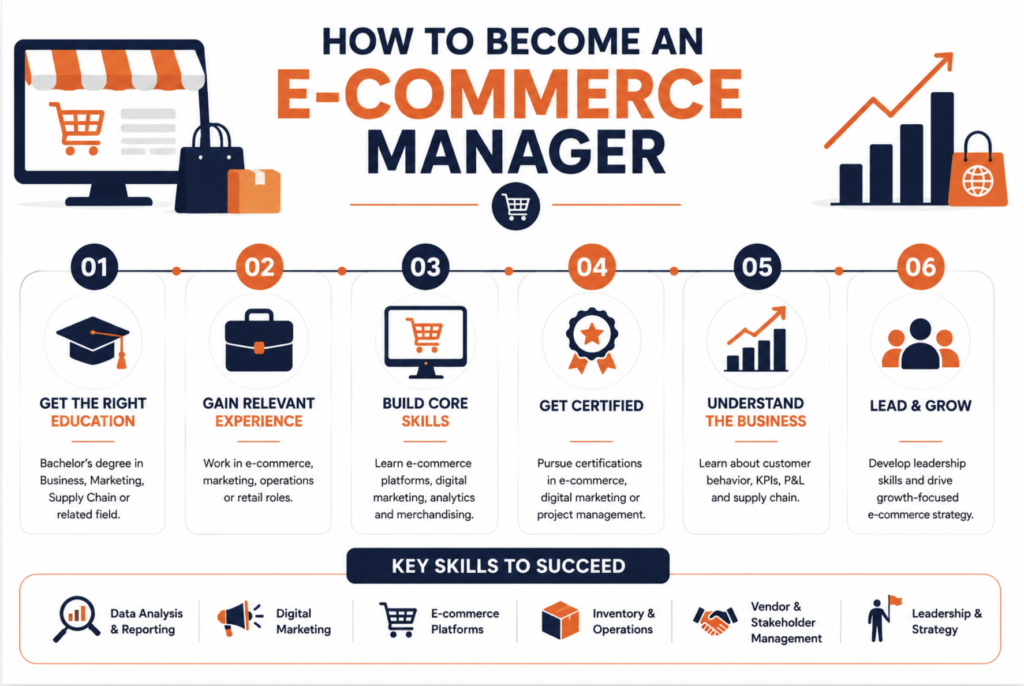
How to become an E-Commerce Manager?
Top e-commerce manager interview questions focus on online sales growth, marketplace management, digital marketing, conversion optimization, customer experience, inventory planning, analytics, SEO, team leadership, and revenue performance. Employers seek candidates who can scale online operations, improve profitability, and drive sustainable growth.
Structuring the Role for Success KPIs
An ecommerce manager job description shouldn’t end at duties and qualifications. If success isn’t measurable, ownership becomes negotiable. That’s usually when the role gets trapped between departments.
Start with KPIs that match the operating model
Not every ecommerce manager should own the same scorecard. A marketplace-heavy role needs a different emphasis from an owned-commerce role. The right approach is to anchor KPIs to what the role can influence directly.
A practical KPI menu includes:
- Revenue performance: Online sales growth, category performance, and channel contribution
- Conversion quality: Conversion rate, cart-to-checkout progression, and checkout completion trends
- Merchandising effectiveness: Product page quality, assortment performance, and stock-backed sell-through
- Traffic efficiency: Quality of sessions, campaign landing performance, and repeat visit behaviour
- Operational execution: Order fulfilment reliability, cancellation patterns, return issues, and service escalations
- Marketplace health: Listing hygiene, promo execution, buy-box consistency where relevant, and seller-side issue resolution
Don’t overload the scorecard. The point is accountability, not dashboard theatre.
Reporting lines change behaviour
Where this role reports shapes how it behaves.
If the ecommerce manager reports into marketing, traffic growth often gets more attention than supply or margin discipline. If the role reports into sales, short-term channel numbers may dominate at the expense of customer experience and platform quality. Reporting into a digital, growth, or business leadership role can create better balance, especially when online revenue is strategically important.
Use a simple test. Ask who can resolve the hardest cross-functional conflicts this role will face. That’s usually the best reporting home.
Salary trends of a Logistics Manager
In 2026, E‑Commerce Manager salaries in India typically range from INR 4 L – INR 35 L+ per year, with associates at INR 5 L – INR 9 L, mid‑level managers at INR 9 L – INR 16 L, seniors at INR 14 L – INR 24 L, and heads reaching INR 20 L – INR 35 L+. Pay is highest in Bangalore, Mumbai, and Delhi‑NCR, in e‑commerce platforms and D2C brands, driven by online growth, digital adoption, and data‑driven marketing expertise.
1. By industry
E‑Commerce Managers on e‑commerce platforms and marketplaces typically earn INR 10 L – INR 25 L. D2C and consumer brands in fashion, beauty, and food pay around INR 9 L – INR 22 L, retail and omnichannel brands INR 8 L – INR 20 L, manufacturing and B2B e‑commerce INR 7 L – INR 18 L, and startups or early‑stage brands INR 6 L – INR 15 L.
| Industry sector | Typical salary band (per year) |
|---|---|
| E‑commerce platforms / marketplaces | INR 10 L – INR 25 L |
| D2C / consumer brands (fashion, beauty, food) | INR 9 L – INR 22 L |
| Retail / omnichannel brands | INR 8 L – INR 20 L |
| Manufacturing / B2B e‑commerce | INR 7 L – INR 18 L |
| Startups / early‑stage brands | INR 6 L – INR 15 L |
2. By location
In digital and commercial hubs like Bangalore, Mumbai, and Delhi‑NCR, bands are usually INR 9 L – INR 25 L. Hyderabad, Pune, and Chennai commonly range INR 7 L – INR 18 L, other tier‑1 cities INR 6 L – INR 14 L, and tier‑2 locations INR 4 L – INR 10 L for similar e‑commerce management roles and experience levels.
| Location / city type | Typical salary band (per year) |
|---|---|
| Bangalore / Mumbai / Delhi‑NCR | INR 9 L – INR 25 L |
| Hyderabad / Pune / Chennai | INR 7 L – INR 18 L |
| Other tier‑1 cities | INR 6 L – INR 14 L |
| Tier‑2 cities | INR 4 L – INR 10 L |
3. By experience level
Associate e‑commerce managers (0–2 years) generally earn INR 5 L – INR 9 L. Mid‑level managers (3–5 years) often land INR 9 L – INR 16 L. Senior managers (6–9 years) commonly reach INR 14 L – INR 24 L, and heads of e‑commerce (10+ years) can command INR 20 L – INR 35 L+ in platforms, D2C brands, and large omnichannel retailers.
| Experience level | Typical salary band (per year) |
|---|---|
| Fresher / 0–2 years (associate manager) | INR 5 L – INR 9 L |
| Mid‑level / 3–5 years (manager) | INR 9 L – INR 16 L |
| Senior / 6–9 years (senior manager) | INR 14 L – INR 24 L |
| Lead / 10+ years (head of e‑commerce) | INR 20 L – INR 35 L+ |
What should influence pay
Without citing unverified numbers, the main compensation drivers are still clear:
- Channel mix: A role owning both marketplaces and owned commerce should be positioned differently from a narrow site role.
- P&L exposure: Greater commercial accountability justifies stronger compensation.
- Team leadership: Managing analysts, merchandisers, and channel specialists expands scope.
- Platform complexity: Multi-brand, multi-category, or multi-region operations raise the level of difficulty.
- Transformation mandate: Hiring someone to build structure from scratch is different from inheriting a stable system.
If you want the role to behave like a revenue leader, the package and incentive logic need to reflect that expectation.
The Complete Ecommerce Manager Job Description Template
A good template should be modular, not generic. The role changes materially depending on whether your business leans on owned commerce, marketplaces, or both.
The most overlooked issue is this: in India, ecommerce performance is often shaped by marketplace dependence, not just website ownership. As noted in this discussion on ecommerce role design in India, many job descriptions fail to define accountability for marketplace assortment, seller performance, or channel conflict. That omission creates hiring problems before the role even starts.
E-commerce Manager Job Description Template
Job Title: E-commerce Manager / Head of E-commerce
Department: E-commerce / Digital / Commercial
Reports To: Chief Commercial Officer / VP of Digital / Head of Marketing
Location: [Location]
Employment Type: Full-time
Job Summary: We are looking for a commercially driven and digitally expert E-commerce Manager to join our [Department] team. In this role, you will own the strategy, operations, and performance of our online sales channels, driving revenue growth through website optimization, digital marketing management, marketplace strategy, and data-driven customer experience improvement. You will work cross-functionally with marketing, technology, supply chain, and finance teams to build a best-in-class e-commerce function that delivers consistent and scalable online revenue growth.
Key Responsibilities
- Own e-commerce strategy across DTC, marketplace, and mobile commerce channels.
- Manage website experience, product listings, and conversion rate optimization.
- Oversee digital marketing budget and performance across all paid and organic channels.
- Coordinate inventory and fulfillment alignment with supply chain and logistics teams.
- Own e-commerce performance analytics and present growth insights to leadership.
- Manage marketplace accounts and optimize listing, pricing, and advertising performance.
Required Qualifications
- Degree in Marketing, Business Administration, or related discipline.
- 5 to 10 years of experience in e-commerce management or digital commerce leadership roles.
- Proven track record owning online revenue targets and managing digital marketing budgets.
- Proficient in e-commerce platforms including Shopify, Magento, or Salesforce Commerce Cloud.
- Strong analytical skills with ability to interpret e-commerce data and drive revenue decisions.
Preferred Qualifications
- Experience managing marketplace seller accounts on Amazon, Flipkart, or equivalent platforms.
- Knowledge of headless commerce, progressive web apps, and modern e-commerce architecture.
- Google Ads, Meta Blueprint, or equivalent digital marketing certification preferred.
- Exposure to AI-powered personalization, product recommendation, and dynamic pricing platforms.
- Familiar with international e-commerce operations across multiple geographies and currencies.
Key Skills
- E-commerce Strategy and Channel Management
- Website Optimization and Conversion Rate Management
- Digital Marketing Performance and Budget Ownership
- Marketplace Management and Seller Performance
- E-commerce Analytics and Revenue Reporting
How to customise it properly
Use these call-outs when tailoring the posting.
If the role is owned-commerce heavy: Increase emphasis on site merchandising, UX, conversion flow, platform coordination, and CRM-led repeat purchase.
If the role is marketplace heavy: Add explicit ownership for catalogue quality, marketplace promotions, seller dashboard performance, issue resolution, and channel conflict management.
If the role spans both: Separate primary from shared accountability. Don’t say “manage all ecommerce channels” unless you also define which decisions belong to this role and which sit elsewhere.
A useful add-on for enterprise hiring
Include a short “decision rights” note in the internal version of the job description, even if it doesn’t appear in the public posting. For example:
- Can the role recommend pricing changes?
- Can the role approve promotional mechanics?
- Can the role escalate stock allocation issues?
- Can the role influence content and landing page priorities?
- Is the role accountable for marketplaces directly, or only in a coordination capacity?
That internal clarity often matters more than another line in the qualifications section.
How to Hire and Scale Your Ecommerce Team Effectively
A polished ecommerce manager job description is only the first win. The harder part is hiring somebody who can operate across conflicting priorities and then giving them enough structure to succeed.
Interview for judgement, not just fluency
Many candidates can speak well about platforms, campaigns, and dashboards. Fewer can diagnose a real business problem under constraint. Your interview process should test commercial thinking and cross-functional maturity.
Useful questions include:
- Channel ownership: “If our marketplace sales are growing but our owned channel is weakening, how would you diagnose the problem?”
- Conversion diagnosis: “Traffic is healthy, but checkout completion is underperforming. What would you review first?”
- Operational judgement: “A major campaign is ready, but inventory confidence is low. Do you proceed, change the plan, or stop it?”
- Stakeholder management: “How have you handled a situation where marketing, sales, and operations each wanted different outcomes?”
- Marketplace versus owned-commerce trade-off: “When should a brand push harder on marketplaces, and when should it invest more in owned channels?”
- Execution discipline: “How do you run weekly reviews, and what actions usually come out of them?”
Strong candidates answer with sequence, not slogans. They tell you what they’d inspect first, which team they’d involve, and where they’d draw the line on risk.
Onboarding should remove ambiguity fast
The first month should not be spent decoding ownership politics.
Give the new hire:
- A channel map: Which platforms matter, who owns what, and where decisions currently stall
- A KPI view: The few metrics that define success in your business
- A stakeholder map: Marketing, supply chain, product, technology, sales, customer support
- A trading calendar: Current promotions, launches, and seasonal moments
- A problem list: Known issues the business expects the role to address first
Don’t onboard an ecommerce manager with a generic HR induction and a dashboard login. Give them the commercial map of the business.
Know when one hire isn’t enough
One ecommerce manager can stabilise and improve a digital commerce function. They can’t be your forever answer if the business is scaling across categories, channels, and regions.
You’re likely ready to build around the role when:
- Execution bottlenecks multiply: Campaign, content, and operations work starts queueing behind one person
- Channels need specialists: Marketplaces, CRM, analytics, or merchandising require deeper ownership
- Leadership time gets consumed: Too much cross-functional issue resolution still depends on senior intervention
- Growth plans accelerate: New categories, platforms, or geographies increase hiring volume and complexity
That’s also the point where many enterprises reconsider their hiring model. Internal teams can manage selective leadership hiring well, but when digital expansion creates sustained demand across multiple roles, specialised hiring support becomes more practical. Companies facing broader growth and capability build-outs often benefit from structured tech team scaling solutions that combine hiring process design, sourcing depth, and execution speed.
Top 10 Interview Questions for an E-commerce Manager
1. How do you develop an e-commerce growth strategy for a brand entering a new online channel?
I start by analyzing the target customer profile, competitive landscape, and channel economics, assess the brand’s existing digital assets and capabilities, define channel-specific revenue targets and investment requirements, design the go-to-market plan covering product selection, pricing, merchandising, and marketing activation, establish KPIs and a measurement framework, and build a phased rollout plan that tests and validates assumptions before scaling investment.
2. How do you improve conversion rate on an underperforming product page?
I start with quantitative analysis using Google Analytics and heatmapping tools to identify where users are dropping off, review the page against best-practice elements including product imagery quality, description clarity, review visibility, pricing presentation, and CTA prominence, develop a hypothesis-led A/B testing plan, implement changes iteratively, measure statistical significance before scaling winning variants, and document learnings for application across the broader product catalog.
3. How do you manage marketplace performance across multiple platforms simultaneously?
I maintain a performance dashboard covering revenue, organic ranking, advertising ROAS, review scores, and fulfillment SLAs for each marketplace, allocate budget and attention based on revenue contribution and growth opportunity, conduct weekly listing audits to maintain content quality and competitive pricing, manage advertising campaigns with platform-specific strategies, and escalate account health issues to platform account managers before they affect visibility.
4. How do you manage a digital marketing budget across multiple channels to maximize ROAS?
I establish baseline ROAS targets for each channel based on historical performance and business objectives, allocate budget proportionally to channels with proven conversion efficiency, monitor performance weekly and reallocate budget from underperforming to outperforming channels dynamically, run incrementality tests to validate true channel contribution, and present monthly budget performance reports with recommendations to commercial leadership.
5. How do you coordinate inventory planning to prevent out-of-stocks during peak trading periods?
I analyze historical sales velocity and seasonal demand patterns at SKU level, develop a peak period inventory plan with safety stock buffers, share forward demand forecasts with supply chain and warehouse teams at least eight weeks before peak, implement real-time inventory monitoring with automated low-stock alerts, establish emergency replenishment protocols, and coordinate with logistics on fulfillment capacity to ensure delivery SLAs are maintained throughout the peak period.
6. How do you use customer data to improve e-commerce personalization and retention?
I segment the customer database by purchase frequency, average order value, category affinity, and lifecycle stage, design personalized email and on-site experience programs for each segment, implement product recommendation algorithms based on browsing and purchase history, run retention campaigns targeting lapsed customers with relevant offers, track cohort retention rates and lifetime value metrics, and optimize personalization programs based on engagement and conversion data.
7. How do you approach a significant drop in organic search traffic to the e-commerce site?
I immediately audit the site for technical SEO issues including crawl errors, page speed problems, and indexation gaps, check Google Search Console for manual actions or algorithm update impacts, analyze which pages and keywords have lost ranking, assess whether the drop reflects a competitive shift or a technical problem, develop a prioritized remediation plan, and implement fixes while monitoring traffic recovery against a weekly baseline.
8. How do you build and lead a high-performing e-commerce team?
I define clear role ownership across platform management, digital marketing, analytics, and marketplace functions, hire for commercial mindset and data fluency alongside technical skills, establish a performance framework with individual and team KPIs connected to revenue outcomes, create a test-and-learn culture where experimentation is encouraged and failure is used constructively, invest in continuous skills development, and maintain a strong team rhythm of weekly performance reviews and monthly strategy sessions.
9. How do you manage the relationship between e-commerce and brick-and-mortar retail within the same organization?
I position e-commerce and physical retail as complementary rather than competing channels, establish clear pricing and promotional consistency policies, share customer and sales data between channels to inform collective commercial decisions, coordinate inventory between online and store fulfillment, align marketing activity to drive both digital and physical traffic, and present a unified commercial view to leadership that reflects total brand revenue rather than channel-specific metrics alone.
10. How do you evaluate whether to invest in a new e-commerce technology or platform?
I define the specific business problem the technology needs to solve and the measurable outcome expected, evaluate vendor options against functional requirements, integration complexity, total cost of ownership, and scalability, conduct reference checks with existing customers in comparable organizations, build a business case with projected ROI and implementation timeline, present the recommendation to commercial and technology leadership with risk assessment, and if approved implement with a phased rollout plan and clear success metrics.
Explore top interview questions with this guide which covers preparation tips across fresher, intermediate, and expert levels & recruiter insights.
FAQs
What is an E-commerce Manager and what do they do?
An E-commerce Manager owns the strategy, operations, and performance of an organization’s online sales channels, driving revenue growth through website optimization, digital marketing management, marketplace strategy, and data-driven customer experience improvement across all digital commerce touchpoints.
How is an E-commerce Manager different from a Digital Marketing Manager?
Digital marketing managers focus on driving traffic and brand awareness through paid and organic channels. E-commerce managers own the full commercial journey from traffic acquisition through conversion, fulfillment, and retention, with direct accountability for online revenue and P&L performance.
How do I become an E-commerce Manager in 2026?
Earn a degree in marketing or business administration, build hands-on experience in digital marketing and e-commerce operations, develop platform and analytics proficiency, and pursue certifications like Google Ads, Meta Blueprint, and Shopify to accelerate progression into e-commerce management roles.
How long does it take to become an E-commerce Manager?
Typically 5 to 8 years including relevant education and progressive digital marketing and e-commerce experience. High-performing digital specialists with strong commercial instincts and platform expertise can accelerate into management roles within 4 to 5 years with focused development.
What are the top 5 skills for E-commerce Managers in 2026?
E-commerce Platform Management, Marketplace Strategy and Optimization, Digital Marketing Budget Management, Conversion Rate Optimization, and E-commerce Analytics and Revenue Reporting. These skills determine hiring success and career progression across all e-commerce management roles.
What is the career outlook for E-commerce Managers?
Exceptionally strong. D2C brand growth, marketplace expansion, and increasing digital commerce investment are driving sustained demand for experienced e-commerce managers. Skilled professionals are commanding higher salaries and fast-tracking into Head of Digital, VP of E-commerce, and Chief Commercial Officer roles.
Is an E-commerce Manager role mostly technical or commercial?
It is both. E-commerce managers balance technical platform management including website optimization, ATS configuration, and marketplace tool management with commercial responsibilities including revenue ownership, budget management, and growth strategy, making it one of the most genuinely hybrid senior roles in modern digital business.
If your organisation is hiring for ecommerce leadership, marketplaces, digital commerce operations, or broader growth roles, Taggd can support the process as an AI-powered RPO and hiring partner. For enterprise CHROs, that means better role design, faster access to relevant talent, and more consistent execution when digital hiring needs to scale.