Most FMCG leaders don’t measure hiring failure the way they should. They count offer rejections, talk about time to fill, and blame talent shortage. What they rarely track is the silent cost: a salesperson who joins, hits month three with doubt, and exits before territory relationships are cemented. That single departure ripples through outlet coverage, distributor confidence, and monthly sales execution.
The numbers tell the story. India’s FMCG sector sees 35% attrition in field sales roles. Average fill time stretches to 75+ days. But the real damage isn’t the vacancy itself. It’s the preventable replacement cycle. When a hiring process breaks down, it usually breaks down at the offer stage, long after sourcing effort and interviewer time have been invested.
This guide is built for hiring leaders, talent acquisition teams, and CHROs managing FMCG sales recruitment at scale. It shows you where the process fails, how to fix it before candidates drop out, and how modern AI powered hiring partners can turn offer to joining into a predictable, repeatable engine. You’ll discover why offer clarity matters more than compensation alone, which sections of your hiring process need redesign, and how to build conviction in candidates before they sign.
The High Stakes of FMCG Sales Recruitment in India
In many FMCG sales teams, the hiring battle is won or lost at the offer stage. By the time a candidate reaches final discussion, the market has already judged your role on payout clarity, territory attractiveness, reporting structure, and joining confidence.
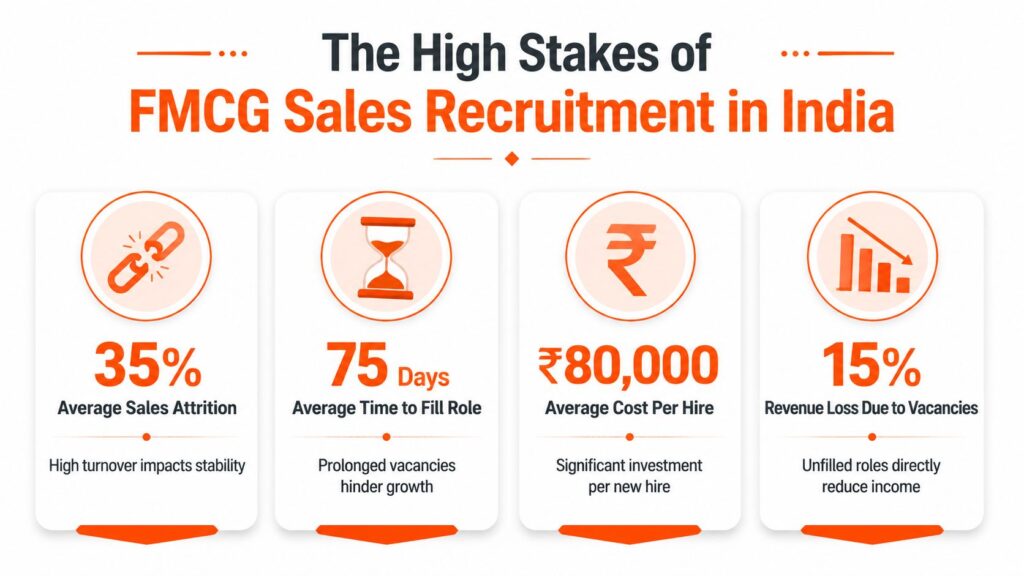
The challenge starts with what’s unique about field sales hiring. A territory vacancy doesn’t just sit empty. It compounds. Outlets lose regular visits. Distributor relationships cool. Competitor activity goes unchecked. In Tier II and Tier III markets, where local relationships often matter more than brand strength, that impact is immediate and measurable.
The operational reality is hard to ignore. A territory can only stay uncovered for so long before sales, visibility, and distributor confidence begin to slip. This urgency creates pressure, and pressure creates shortcuts. Hiring teams rush interviews, compress feedback loops, and skip the work of explaining the role clearly to candidates. Then they wonder why acceptances don’t convert to joiners.
Here’s what makes FMCG sales recruitment different from corporate hiring:
- Speed matters, but quality matters more. You can’t afford a 75-day fill time, and you can’t afford a hire who exits in month four.
- Candidates compare multiple offers simultaneously. They’re testing variable pay logic, territory fairness, manager credibility, and transfer expectations all at once.
- The manager is the decision. Salary and KPI language matter, but whether the candidate believes the hiring manager is credible often tips the scale.
- Role clarity equals conversion. Vague territory definitions, unclear incentive structures, or surprise field intensity kill acceptance rates faster than low compensation.
A useful companion read is Taggd’s view of FMCG recruitment challenges in India, especially for teams dealing with fragmented markets, uneven talent availability, and scale hiring pressure.
Analysts at Monroe Consulting, in their consumer-goods recruitment analysis, point to a market shaped by high-volume hiring and strong demand for talent that can contribute quickly. That has a direct implication for TA leaders. The goal is not to run isolated searches with heroic effort each time. The goal is to build a repeatable system that moves candidates from shortlist to signed offer without confusion or drift.
That system starts much earlier than the offer letter itself. Hiring managers need clear scorecards. Recruiters need market-calibrated compensation ranges. Candidates need honest conversations about route conditions, channel complexity, and growth path before they enter final rounds. Otherwise, the offer stage becomes a clean-up exercise for problems created upstream.
A weak offer process signals a weak operating model upstream. Slow approvals, vague KPI language, inconsistent compensation communication, and unclear territory definitions all surface at the acceptance stage. Candidates rarely describe that as process failure. They describe it as doubt, and doubt is what drives dropouts.
Offer Letter vs Appointment Letter
You’ve likely blurred these two documents before. Most teams do. But in FMCG sales hiring, that blur creates confusion at precisely the moment candidates need confidence most. Understanding the difference between offer and appointment letters isn’t administrative detail. It’s the foundation of a conversion system that works.
Here’s the distinction: The offer letter is your proposal. The appointment letter is the contract.
The mistake most teams make is using the appointment letter to solve an offer conversion problem. By that point, it’s too late. If the candidate still doesn’t understand incentive logic or territory expectations when they receive the offer, acceptance risk is already high.
If your team needs a clean baseline definition, Taggd’s HR glossary entry on offer letters is a useful reference point for recruiters and hiring managers who are standardising process language.
Offer Letter vs. Appointment Letter Key Differences
| Attribute | Letter of Offer | Letter of Appointment |
| Timing | Issued after candidate selection and before joining | Issued at the point of formal employment commencement or onboarding completion |
| Primary purpose | To present the role and secure acceptance | To establish the formal terms of employment |
| Legal function | A conditional employment proposal, subject to stated terms | A formal employment document governing the working relationship |
| Candidate action | Review, negotiate if needed, and accept | Acknowledge and comply as an employee |
| Typical content focus | Role summary, compensation, joining expectations, conditions precedent, acceptance timeline | Detailed employment terms, policies, reporting, duties, conduct, confidentiality, and operational terms |
| Tone | Persuasive and clarifying | Formal and administratively complete |
FMCG Sales Offer Letter Template
Now that you understand the distinction between offer and appointment letters, the real work begins. Most hiring teams build documents when they should build clarity. The best FMCG sales offer letters answer one question every candidate silently asks: “Can I succeed in this job, and will I be rewarded fairly if I do?”
[COMPANY LETTERHEAD]
Date: [Date]
TO: [Candidate Name], [Address]
Subject: Offer of Employment – Sales Executive, [Territory]
Dear [Candidate Name],
POSITION
Sales Executive reporting to [Manager Name]. Based in [City], covering [District/Cluster] with [outlet count] outlets across [channel: general trade/modern trade/key accounts].
COMPENSATION
Fixed Pay: Rs. [Amount]/month
Variable: [X%] of CTC, linked to sales outcomes and execution quality. Payout [monthly/quarterly] within [days] of close.
PERFORMANCE METRICS
Assessment based on:
- Outlet coverage and visit discipline
- Route optimization and execution
- Territory actions from sales data
ROLE SCOPE
Maintain outlet relationships, manage distributor partnerships, execute schemes, capture market insights. Regular field presence required.
ONBOARDING
Joining date: [Date]. Structured induction includes product training, field mentoring, systems orientation, and manager support.
CONDITIONS
Offer subject to:
- Background verification and references
- Medical fitness clearance
- Document verification
- Statutory clearances as applicable
ACCEPTANCE
Please confirm by [Date] by signing below.
ACCEPTANCE
I confirm acceptance of this offer.
Signature: ________________
Date: ________________
Name: ________________
Contact: [HR Contact], [Phone/Email]
For teams hiring at volume, Taggd’s guide on how to hire sales executives is useful because it pushes the discussion beyond resumes and into role fit, field realities, and assessment quality.
The Negotiation Playbook: Closing with Confidence
A strong offer presentation reduces uncertainty and reinforces the candidate’s confidence in the role.
Focus the conversation on four areas:
- Why they were selected: Highlight the skills and experience that made them the preferred choice.
- What success looks like: Set clear expectations for the first 90 days.
- How compensation works: Explain fixed pay, incentives, and earning potential transparently.
- What support they’ll receive: Cover onboarding, training, and manager support.
During negotiations, stay firm on core role requirements but remain flexible on joining timelines and administrative processes where possible. Most importantly, keep communication active through structured follow-ups and manager engagement. The best hiring teams close offers by building clarity, trust, and conviction.
The Pre-Joining Window: Where Dropouts Are Actually Prevented
The offer presentation is now handled well. The candidate has engaged thoughtfully, asked the right questions, and accepted. Most hiring teams stop here. They move to the next candidate. That silence is where dropouts happen. A signed offer is intent. Conversion to joiner happens when the candidate still sees a credible future two weeks later. This window determines whether they show up.
High attrition in FMCG sales disrupts territory continuity, distributor relationships, and monthly execution. Recruitment must be tied to retention from day one. The primary issue isn’t only replacing a person but preventing avoidable replacement hiring through better role design and realistic incentives in the offer, as discussed in Taggd’s analysis of FMCG sales attrition and growth risk.
The diagnostic is usually predictable. Dropouts happen because:
- The role shifted after interviews. Territory, reporting manager, or channel mix changed.
- The earnings story was vague. Candidates heard upside but never learned how to earn it early.
- The hiring manager stayed invisible during the process.
- The company went silent after acceptance.
The primary issue isn’t only replacing a person but preventing avoidable replacement hiring through better role design and realistic incentives in the offer, as discussed in Taggd’s analysis of FMCG sales attrition and growth risk.
Moves that improve joining confidence:
Reconfirm the role before signing:
Align expectations on territory, channel scope, reporting structure, field requirements, and targets. The candidate should hear a consistent message from TA, the hiring manager, and the offer letter.
Make the manager a key conversion driver:
A brief discussion on market realities, team support, and first 90-day expectations often builds more trust than multiple HR follow-ups.
Stay engaged during the pre-joining period:
Maintain regular touchpoints for documentation, onboarding updates, and team introductions. Competing offers often succeed when communication stops.
Demonstrate growth with specifics:
Explain career progression, performance benchmarks, and what it takes to move into larger territories or key account responsibilities.
Pre joining checklist for hiring managers:
- Commercial scope: What channel, geography, and account mix does the role cover?
- Success measures: What does good performance look like in practice?
- Earnings logic: How do fixed and variable components work?
- Manager access: Who guides them in the first phase?
- Joining path: What happens between acceptance and day one?
For teams tightening this part of the funnel, Taggd has a practical guide on how to reduce candidate offer dropout rate.
FMCG Sales Recruitment Roles and Hiring Solutions
Having understood the full hiring playbook, it’s critical to recognize that FMCG sales recruitment isn’t monolithic. Different roles demand different hiring strategies, assessment approaches, and offer designs.
FMCG Sales Recruitment Roles
Territory Sales Executive
Entry-level field role covering 150-250 outlets in defined geography. Requires outlet discipline, route adherence, and relationship building. Assessment focus: outlet prioritization logic, visit consistency mindset, distributor relationship potential. Offer emphasis: territory clarity, early earning potential, manager support. Fill timeline: 30-45 days. Offer acceptance rate: 75-80% when process is clean.
Key Account Manager
Mid-level role managing 20-50 strategic accounts or modern retail channels. Requires negotiation skill, data-driven account planning, and commercial acumen. Assessment focus: account management examples, pricing negotiation, business case thinking. Offer emphasis: territory potential, growth path, decision authority. Fill timeline: 45-60 days. Offer acceptance rate: 80-85% with strong manager involvement.
Area Sales Manager
People leader managing 3-5 territory sales executives across cluster. Requires execution oversight, team coaching, and local market management. Assessment focus: team motivation examples, performance management approach, local market problem-solving. Offer emphasis: team structure, P&L accountability, progression timeline. Fill timeline: 50-70 days. Offer acceptance rate: 85%+ with CHRO involvement.
Regional Sales Lead
Strategic role managing area managers across multi-state region. Requires commercial strategy, talent development, and stakeholder management. Assessment focus: business strategy examples, team scaling experience, sales system thinking. Offer emphasis: strategic scope, revenue responsibility, executive positioning. Fill timeline: 60-90 days. Offer acceptance rate: 90%+ with C-level engagement.
Hiring Solutions by Stakeholder
The solutions differ based on who owns the hiring outcome: TA leaders need operational tools, HR leaders need policy frameworks, and CHROs need strategy and business impact. Here’s how to align hiring approach to role and stakeholder.
FOR TA LEADERS: Operational Efficiency and Assessment Quality
Your primary challenge: Moving candidates fast without quality loss. Your KPIs are time-to-fill and offer acceptance rate.
Solution framework:
- Structured assessment pipeline. Build role-specific scorecards for each position level. Territory Sales Executive scored on outlet logic, KAM scored on account planning, ASM scored on team examples. Consistency across candidates reduces debate and speeds decision-making.
- Offer communication standardization. Create offer presentation templates and checklists. Same core message, territory-specific details. Removes variation in recruiter quality.
- Candidate relationship management system. Track every touchpoint. Pre-interview, post-interview, offer acceptance, pre-joining engagement. Candidates shouldn’t go dark.
- Manager engagement scheduling. Build manager calls into the calendar. First call after shortlist. Second call post-final interview. Third call post-acceptance. Removes friction and ownership ambiguity.
- Pre-joining automation. Document confirmation, onboarding logistics, team introductions all scheduled. Four touches over two weeks. No manual follow-up needed.
Expected outcomes: 40-50 day fill time, 80%+ offer acceptance rate, <10% pre-joining dropout rate.
FOR HR LEADERS: Policy, Compliance, and Retention Framework
Your primary challenge: Ensuring hiring creates sustainable employment relationships, not just filled vacancies.
Solution framework:
- Clear offer-appointment distinction. Build separate templates that serve different jobs. Offer is persuasive. Appointment is compliant. No blurred documents.
- Onboarding policy tied to offer promises. Every offer commitment must map to onboarding reality. If offer promises manager support, induction schedule confirms it. If offer details territory, first assignment reflects it.
- 90-day retention measurement. Track which hires stay versus exit in first quarter. Correlate with offer clarity, manager quality, and role fit. Identify systemic issues early.
- Incentive plan clarity. Ensure offer language matches actual incentive plan documents. Candidates shouldn’t discover plan details after joining. Reduces early disputes and exits.
- Probation and performance management alignment. First-quarter expectations in offer should drive first probation review. Clear linkage builds confidence for both employer and employee.
Expected outcomes: <15% first-quarter attrition, zero offer-vs-reality disputes, sustainable performance management.
FOR CHROS: Strategic Hiring Velocity and Business Impact
Your primary challenge: Filling FMCG sales roles at scale while maintaining talent quality and commercial impact.
Solution framework:
- Sales hiring as commercial planning. Integrate hiring calendar with sales planning. Budget for vacancies. Plan for ramp-up time. Don’t treat hiring as reactive TA event.
- Manager-led hiring ownership. Hold sales leaders accountable for offer conversion and first-90-day performance. Make hiring part of commercial bonus metrics. Shifts mindset from “get someone in the door” to “get someone who succeeds.”
- Talent pool broadening strategy. Stop overvaluing FMCG pedigree. Source from adjacent sales categories. Redesign assessment to test transferable competencies. Expands candidate pool by 30-40%.
- AI-powered hiring partner integration. For companies managing 50+ FMCG sales hires annually, outsourcing to AI-powered RPO like Taggd reduces cost-per-hire by 20-30% while improving quality. Frees internal TA for strategic work.
- Attrition feedback loop. Track why hires exit. Feed findings back to hiring manager coaching, offer design, and onboarding. Continuous improvement cycle.
Expected outcomes: 40–50-day fill time across all FMCG sales levels, 85%+ offer acceptance rate, <12% first-year attrition, 10-15% cost-per-hire reduction.
You’re a TA leader with high volume hiring: Prioritize operational efficiency solutions. Structured assessment, offer automation, manager scheduling, pre-joining discipline. Get time-to-fill down.
You’re an HR leader building sustainable hiring: Prioritize policy and onboarding solutions. Clear offer-appointment distinction, onboarding alignment, 90-day measurement, incentive clarity. Build sustainable employment.
You’re a CHRO managing commercial impact: Prioritize strategic solutions. Sales leader accountability, manager-led hiring ownership, talent pool broadening, AI-powered partnership. Align hiring to business outcomes.
Ideal state: All three work together. TA owns tempo. HR owns sustainability. CHRO owns strategy. AI-powered partner like Taggd handles operational execution across all three dimensions.
Top Interview Questions for FMCG Sales Roles
The right interview questions reveal whether a candidate can execute, not just talk about sales. For FMCG field roles, assessment should test execution judgment, route discipline, and data driven decision making.
1. Walk me through how you’d prioritize outlets in a new territory where you have 200 outlets but limited field time. What data would you use, and how would you allocate visits?
Why it matters: Reveals whether they think about route efficiency, outlet potential, and data driven prioritization, not just volume hustle.
2. Tell me about a time you redesigned a route and saw measurable impact. How did you decide what to change, and what was the outcome?
Why it matters: Tests whether they’ve executed route discipline or just talked about it. Look for specific metrics and decision logic.
3. You inherit a territory where distributor relationships are weak and direct stockist coverage is below standard. How would you approach the first 30 days?
Why it matters: Assesses relationship building, prioritization under constraint, and early execution speed.
4. Describe a situation where a promotion or scheme wasn’t driving the outlet behaviour you expected. How did you diagnose the issue and adjust?
Why it matters: Shows whether they can read market signals, connect retailer motivation to scheme design, and iterate.
5. What would you do if your manager set a target, you believed was unfair or uncontrollable? Walk me through your thinking.
Why it matters: Reveals integrity, data driven judgment, and whether they push back thoughtfully or cave under pressure.
These questions work best when candidates answer in their own words with specific examples. Listen for decision logic, data references, and whether they owned outcomes or blamed external factors.
The Role of AI Powered Talent Fulfilment
You now have the framework: clear interviews, strong offers, solid negotiation, and active pre-joining engagement. But execution at scale requires operational firepower. Offer letters and interview frameworks mean nothing if sourcing is slow, assessment is inconsistent, or pre-joining communication is sporadic. Modern FMCG hiring leaders realize the bottleneck isn’t talent availability. It’s process repeatability. This is where AI-powered partners become critical.
Why traditional RPO isn’t enough anymore:
Traditional recruitment outsourcing brings capacity, not intelligence. It adds bodies to your team to run more searches. But FMCG sales hiring demands something different. It demands a partner who understands field sales execution, can assess for territory readiness, and can manage the entire offer to joining conversion process with enough rigor that dropouts become rare exceptions.
How Taggd Supports FMCG Sales Hiring
- Talent Mapping
We help companies identify relevant FMCG and adjacent-sector talent pools across regions, enabling faster sourcing and broader candidate access. - AI-Powered Hiring Operations
Structured workflows support candidate screening, communication, and pre-joining engagement, helping teams maintain consistency throughout the hiring process. - Role-Fit Assessments
Our assessment approach evaluates capabilities important for FMCG sales roles, including territory management, outlet prioritization, and distributor engagement. - Offer-to-Joining Support
Regular candidate touchpoints, onboarding communication, and manager engagement help improve joining confidence and reduce dropouts. - Pan-India Hiring Reach
With technology-enabled processes and on-ground expertise, we support hiring across metros, Tier II, and Tier III markets while maintaining local market relevance.
Why this matters for your hiring targets:
If you’re a CHRO trying to fill 50 FMCG sales roles across regions in 90 days, traditional hiring can’t deliver consistent quality. You end up choosing between speed and fit. An AI powered partner like Taggd eliminates that tradeoff. You get speed because the system doesn’t wait for email responses and doesn’t lose context between touchpoints. You get quality because every assessment is data informed and every candidate interaction reduces uncertainty instead of creating it.
The result: 40 50-day average fill time, offer acceptance rates above 85%, and pre joining dropout rates below 10%.
Taggd provides AI powered talent fulfilment, RPO, talent mapping, and on ground hiring support in India, which is relevant when companies need repeatable offer management across distributed markets.
FAQs
Why is FMCG sales recruitment more challenging than other hiring functions?
FMCG sales hiring involves high attrition, territory-based roles, and strong competition for talent. Delayed hiring or poor role fit can directly impact sales coverage, distributor relationships, and revenue performance.
What causes candidates to drop out after accepting an FMCG sales offer?
Common reasons include unclear territory expectations, vague incentive structures, poor communication during the pre-joining period, and mismatches between the role discussed and the role offered.
How can FMCG companies improve offer acceptance rates?
Provide clear information on territory scope, compensation, reporting structure, growth opportunities, and onboarding support. Consistent communication from recruiters and hiring managers also strengthens candidate confidence.
Should FMCG companies hire sales talent from outside the industry?
Yes. Candidates from telecom, retail, consumer durables, and financial services often possess transferable sales skills. Assessing competencies rather than industry experience can significantly expand the talent pool.
What metrics should CHROs track in FMCG sales recruitment?
Beyond time-to-fill, track offer acceptance rates, joining ratios, early attrition, territory vacancy duration, and quality-of-hire metrics to measure business impact and hiring effectiveness.
How can AI-powered recruitment improve FMCG sales hiring?
AI-powered hiring helps identify qualified candidates faster, automate engagement, improve assessment consistency, reduce offer dropouts, and support large-scale hiring across multiple markets and territories.
If your team is struggling with FMCG sales recruitment at scale, Taggd can support with RPO, talent mapping, employer branding, and hiring operations designed for India’s fragmented, high-velocity talent markets. The value isn’t in a better template alone. It’s in building a repeatable offer-to-joining engine that hiring managers can trust.