India’s Global Capability Centre (GCC) ecosystem is entering its next phase of growth. The country now hosts more than 1,700 GCCs employing nearly 1.9 million professionals, with the workforce expected to exceed 3.5 million by 2030. As organisations expand into AI, cloud, engineering, cybersecurity, analytics, and product development, the challenge has shifted from creating jobs to building specialised talent at scale.
This evolution has transformed GCC bulk hiring into a strategic business priority. Organisations are no longer recruiting only for volume. They are building capability across multiple functions while balancing hiring speed, candidate quality, cost efficiency, and long-term workforce planning in one of India’s most competitive talent markets.
This guide explores the biggest challenges in GCC bulk hiring, strategies for building scalable hiring engines, sourcing specialist talent, overcoming operational bottlenecks, measuring recruitment success, and creating future-ready talent acquisition models for long-term growth. Taggd’s GCC Report 2025 on growth trends, talent insights and strategies reflects the same shift many hiring leaders are already feeling on the ground.
Why GCC Bulk Hiring Has Become a Competitive Advantage
As GCCs evolve from support centres into global innovation hubs, recruitment has become a strategic differentiator rather than an operational function. Organisations that consistently attract specialised talent can accelerate product development, strengthen digital transformation, and improve business agility across global operations.
The challenge is that hiring at scale is no longer about increasing recruiter capacity. Success depends on building structured hiring systems that combine workforce planning, talent intelligence, market mapping, and streamlined decision-making. The organisations leading the next generation of GCC growth are those that view recruitment as a long-term capability instead of a short-term staffing exercise.
Why GCC Bulk Hiring in India Is Changing
More than 200,000 jobs added in 2025, 1,700-plus GCCs, and a workforce of 1.9 million professionals have pushed GCC hiring in India into a different operating category. At this scale, hiring plans do not fail because demand is weak. They fail because internal hiring systems cannot process demand fast enough or accurately enough.
That shift matters. Bulk hiring in a GCC is no longer a volume exercise built around generic requisitions and standard screening. It is a capability build problem, with pressure to hire specialised talent quickly while keeping compensation discipline, interview quality, and candidate conversion under control.
The biggest hiring risks usually sit inside the process, not at the top of the funnel.
Why Hiring Volume Is No Longer the Biggest Challenge
A GCC can approve aggressive headcount and still miss the business plan by a wide margin. I see the same breakdown points repeatedly in large India ramp-ups. Compensation approvals sit with too many stakeholders. Recruiters are asked to fill roles before must-have skills are defined. Mid-level hiring gets delayed because interviewers are not aligned on what good looks like. Offer rollout starts after final selection instead of being prepared in parallel.
None of these issues looks severe in isolation. Together, they slow time to offer, increase drop-offs, and force teams to restart searches for roles that should have closed in the first cycle.
Practical rule: In GCC bulk hiring, speed comes from shorter decision loops, not from adding more recruiters.
The teams that scale well treat hiring as an operating system. They lock role priorities early, set compensation ranges before sourcing starts, define clear assessment criteria, and reduce approval layers that create avoidable lag. That discipline is what protects momentum when hiring volumes rise and mid-level talent becomes harder to close.
Understanding the New GCC Talent Landscape
The talent market for GCCs in India has moved away from the old IT services hiring model. Demand is now concentrated in a smaller set of specialist roles, while supply at the experienced mid-level has not kept pace. That gap is where bulk hiring plans usually start to slip. Requisitions may look manageable on paper, but conversion drops fast once teams enter the market for cloud architects, data engineers, cyber specialists, product analysts, and AI talent at the same time.
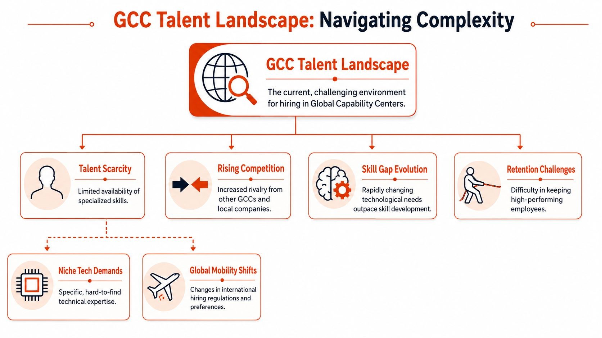
A broader view from Taggd’s analysis of the GCC talent market in India reflects what hiring leaders are seeing across major GCC hubs. The pressure point is not candidate volume alone. It is the shortage of professionals who combine specialist depth, business context, delivery maturity, and salary alignment. Those profiles are limited, and they are usually in multiple processes at once.
This changes how hiring should be planned.
Why Traditional GCC Hiring Models No Longer Work
Traditional bulk hiring models work best when roles are standardised, candidate supply is broad, and process delays can be absorbed without much damage. GCC hiring today does not operate like that. Specialist demand creates thinner qualified shortlists, stricter candidate expectations, and far less tolerance for internal delay.
Several shifts matter immediately:
- Shortlists look healthy until quality is tested: High application numbers often collapse into a very small set of relevant profiles after screening for actual depth.
- Mid-level hiring carries the most strain: Senior leaders can often be bought selectively, and junior roles can be built. The hardest segment is the 4-to-10-year band where execution capability is scarce and expensive.
- Compensation friction shows up early: Market-aligned salary bands that are approved too late force recruiters to restart conversations after candidates are already in process.
- Interview precision matters more: Generic assessments and loosely aligned panels reject viable adjacent talent and slow closure on strong candidates.
- Offer timing becomes a competitive variable: Candidates in high-demand skill clusters will not wait through slow internal approvals.
The company that hires well is usually the one with the fastest clean decision path, not the one with the largest sourcing team.
What GCC Leaders Must Do Differently
For CHROs and GCC business heads, bulk hiring now requires tighter operating discipline at the role-family level. The key questions are practical. Which capabilities are scarce in your target cities? Which roles can absorb adjacent talent? Where will compensation need pre-approved exceptions? Which hiring managers are calibrated enough to assess transferability instead of chasing exact background matches?
These choices shape outcomes long before offer rollout.
A common mistake is to treat market difficulty as the main constraint and process design as a secondary issue. In practice, both interact. Mid-level talent shortages are real. Compensation pressure is real. But internal delays around intake quality, salary approvals, panel availability, and decision rights often turn a difficult hiring plan into a broken one.
A more effective response is to sort demand into three role groups:
- Build roles where strong adjacent talent can be hired and trained with confidence.
- Buy roles where immediate, proven capability is worth paying a premium for.
- Bridge roles where contract, project, or interim hiring protects delivery while permanent pipelines are still forming.
This classification affects far more than sourcing. It changes compensation planning, assessment design, closure strategy, and interviewer expectations. Without that clarity, GCC hiring teams tend to over-index on requisition volume and under-manage the operational bottlenecks that slow scale.
What High-Performing GCCs Do Differently
Leading GCCs treat recruitment as part of business strategy rather than a response to hiring demand. They continuously map talent markets, build specialist talent communities, and forecast capability requirements before business expansion begins.
They also evaluate talent differently. Instead of focusing solely on previous job titles or employer brands, they assess transferable skills, learning agility, technical depth, and long-term business impact.
This proactive approach enables them to scale faster while maintaining recruitment quality and improving employee retention.
How to Build a Scalable GCC Bulk Hiring Strategy
Most GCC hiring programmes fail before sourcing starts. The failure begins when the organisation opens requisitions without deciding how talent decisions will be made. A strategic hiring engine solves that by turning intent into repeatable operating logic.
A useful reference point is this view on how GCCs are building scalable talent engines in India. The central lesson is that scale doesn’t come from adding recruiters alone. It comes from designing a system that can absorb complexity without creating confusion.
Define Role Architecture Before You Scale Hiring
Job descriptions are often too loose for specialist hiring. They list responsibilities, tools, and years of experience, but they don’t define what success looks like in the first six to twelve months. In GCC bulk hiring, that omission creates shortlists that look full but don’t convert.
Build role archetypes instead. For each critical role family, define:
- Core outcomes: What the person must deliver, not just what they’ll do.
- Must-have skills: The capabilities that can’t be compromised.
- Trainable skills: Adjacent competencies that can be developed after joining.
- Context signals: Domain exposure, stakeholder complexity, platform environment, shift readiness, or regulatory sensitivity.
- Failure triggers: The reasons candidates usually don’t work out in this role.
That forces sharper intake discussions. It also gives recruiters language they can use in market conversations, instead of relying on copied job specs.
Build Talent Pipelines Before Hiring Begins
A GCC hiring engine should know where it will search before the first role is posted. That sounds obvious, yet many teams still begin with one-city assumptions and only expand after hit rates collapse.
A practical market map includes:
- Primary cities: Where the role already has proven depth.
- Secondary cities: Where quality is available with a different employer mix or lower hiring noise.
- Adjacent talent pools: Candidates from related industries, product companies, IT services, captives, or digital consultancies.
- Campus feeders: Institutions suited to fresher or early-career pipelines for niche skills.
- Returnship and DEI pools: Talent segments often ignored in urgency-led hiring.
This isn’t only about geography. It’s about deciding in advance where flexibility exists. Can a data engineering role come from BFSI, retail tech, or SaaS? Can a cloud role be hired from implementation backgrounds if architecture potential is strong? Teams that answer these questions early move faster later.
Set up governance before the first offer goes out
A hiring engine needs operating rules. Without them, every recruiter, coordinator, and manager creates a local version of the process. That’s when candidate communication becomes inconsistent and offer decisions drag.
Create governance across five layers:
| Layer | What to define | Why it matters |
|---|---|---|
| Intake | Role brief, assessment path, interview panel, compensation band | Prevents rework and resets |
| Decision rights | Who approves shortlist, interview outcome, compensation exception | Stops approval confusion |
| Service levels | Recruiter response times, interview scheduling windows, feedback deadlines | Protects pipeline momentum |
| Reporting | Funnel views by role family, source, stage, and business unit | Makes bottlenecks visible |
| Escalation | What happens when feedback stalls or offer approval slips | Preserves candidate experience |
One operating choice matters more than most leaders expect. Calibrate hiring managers together before the ramp starts. Review sample profiles, discuss edge cases, and agree on what “good enough to move” looks like. This reduces late-stage disagreement, which is one of the most expensive forms of hiring friction.
Field lesson: If three interviewers are using three different standards for the same role, you don’t have a hiring process. You have a debate disguised as one.
Technology also needs to fit the operating design. An ATS, scheduling layer, assessment platform, and reporting stack should support faster decisions, not create extra handoffs. Some organisations build this internally. Others use project RPO, embedded recruiters, or fulfilment partners such as Taggd when they need market intelligence, on-ground execution, and governed hiring workflows in parallel.
How to Execute a Successful GCC Bulk Hiring Process
Once the engine is designed, execution becomes a workflow discipline. Good GCC bulk hiring doesn’t feel chaotic to the candidate, even when hundreds of applications are moving through the system. That only happens when each stage has a clear purpose and a visible owner.
A practical operating benchmark appears in this guide to bulk hiring processes, strategies, and solutions. The strongest workflows aren’t the most complicated. They’re the ones that remove avoidable waiting time and keep decision quality intact.
Sourcing across metros and emerging cities
Sourcing for GCCs can’t rely on one-city concentration anymore. AI-driven recruitment tools are being used to automate resume parsing and predict candidate success, which can reduce time-to-fill by up to 30%. The same source notes 42% growth in GCC job openings in emerging cities like Coimbatore and Indore.
That matters operationally. Emerging markets can widen the funnel, but only if you redesign sourcing assumptions. A Bangalore-first or Hyderabad-first strategy often inflates competition intensity for roles that may be filled elsewhere with stronger conversion.
Use a mixed-channel model:
- Direct sourcing: Recruiter-led search for specialist and lateral roles.
- Employee referrals: Highly effective when role archetypes are sharply defined.
- Campus programmes: Best for niche roles where trainability matters.
- Talent communities: Warm pools built before demand spikes.
- Location-led campaigns: Targeted outreach in secondary and emerging cities.
Screening that removes noise without losing edge cases
Screening at scale often becomes too blunt. Teams over-filter by exact title, exact product exposure, or a narrow tool stack. That gives a cleaner spreadsheet but a weaker final pipeline.
Use a two-layer screening design. First, automate broad pattern matching for baseline relevance. Second, have trained recruiters review edge-case profiles that show adjacent capability. This approach often yields many quality hires, especially in platform, analytics, and engineering roles where candidates may have transferable depth without identical labels.
A useful recruiter screen usually answers five questions quickly:
- Can this person do the core work?
- Are they likely to succeed in this operating environment?
- Is compensation alignment plausible?
- Is the notice period manageable?
- Is there a credible reason they’d join this GCC?
Assessments that reflect the real job
Assessment design often determines whether a hiring programme scales cleanly or collapses into manager subjectivity. Generic aptitude tests rarely help with specialist GCC roles. The best assessments mirror actual work.
Examples include:
- Case-based problem solving for analytics, product, and consulting-heavy roles.
- Hands-on technical tasks for engineering, cloud, or cybersecurity positions.
- Scenario interviews for stakeholder-heavy roles where communication matters as much as technical depth.
- Panel calibration rubrics that define what strong, acceptable, and weak evidence looks like.
Don’t make every role pass through the same sequence. A standardised process is useful. A rigid process is not. Senior niche roles may need fewer rounds with sharper interviewers. Early-career cohorts may need more structured evaluation because volume is higher.
A fast process isn’t one with fewer interviews. It’s one where every interview produces a decision, not a vague impression.
Background verification and onboarding control points
Background verification becomes more important in GCC hiring because many roles touch sensitive systems, regulated processes, data assets, or global stakeholder environments. Verification should be integrated into the workflow, not pushed to the very end without planning.
Here’s a practical verification matrix:
| Check Type | What It Verifies | Why It’s Critical for GCCs |
|---|---|---|
| Identity verification | Government-issued identity and personal details | Confirms candidate authenticity and supports compliance records |
| Address verification | Current and permanent address history | Helps establish traceability and reduces documentation risk |
| Education verification | Degrees, certifications, institution records | Important for specialist and regulated roles where credentials matter |
| Employment verification | Past employers, tenure, role history | Validates experience claims and capability relevance |
| Criminal record check | Legally permissible record search | Important for trust-sensitive roles and risk management |
| Reference checks | Managerial or professional feedback | Adds context on performance, conduct, and team fit |
| Compensation documents review | Past salary, structure, and benefits where appropriate | Supports offer accuracy and prevents later disputes |
| Global sanctions or watchlist screening | Applicable compliance checks for certain functions | Relevant for regulated, financial, and globally governed environments |
Onboarding should start before day one. Pre-joining engagement, document collection, equipment readiness, manager connection, and first-week planning all influence whether accepted offers convert into productive starts. In bulk programmes, onboarding isn’t an HR handoff. It’s the final stage of recruitment.
Overcoming the Hidden Bottlenecks in GCC Hiring
In GCC bulk hiring, execution breaks more often inside the company than in the market. Demand may be strong, recruiter capacity may be in place, and employer branding may be working, yet hiring still slips because compensation approvals stall, interviewers respond late, or decision rights stay unclear.
The pattern shows up quickly in India scaling programs. Senior leaders plan for sourcing pressure and offer competition. Fewer plan for internal lag between shortlist, compensation approval, final interview, and release of offer. That lag is where mid-level specialists disappear. Product managers, data engineers, platform architects, and finance controllers rarely wait while three functions debate exceptions.
The compensation lag problem many TA leaders underplay
Compensation speed is an operating issue, not only a C&B issue. If recruiters do not know which salary exceptions can clear, they cannot manage candidate expectations with credibility. If hiring managers discover band constraints after final rounds, they lose their advantage late in the process. If finance reviews every specialist hire as a fresh exception, the system slows exactly where the talent market is least forgiving.
Three controls usually reduce this friction:
- Pre-approved compensation corridors: Set role-family ranges and document what qualifies for an exception before search begins.
- Tiered approval routes: Route niche or revenue-critical roles through a faster path than standard replacement hiring.
- Offer simulation at intake: Compare target talent expectations against approved bands before interviews start, not after selection.
At this point, many GCC plans go off track. Leaders assume the bottleneck is sourcing quality. In practice, the delay often starts after the right candidates have already been identified.
A second bottleneck sits one layer below compensation. India’s GCC market has deep entry-level supply, but mid-level execution talent is tighter in many functions. That creates a dangerous mismatch. Companies open large volumes with aggressive timelines, then discover that the hardest roles are not the rarest leadership jobs. They are the experienced builders in the middle who can run pods, manage handoffs, and stabilize delivery.
Operational friction that looks small but scales badly
At small volume, process gaps look manageable. At bulk volume, they become conversion loss.
Common failure points include:
- Unclear interview ownership: Feedback sits idle because no one owns the final decision.
- Panel inconsistency: Each interviewer uses a different bar, so strong candidates receive mixed assessments.
- Notice-period blindness: Teams count offers accepted, but do not model delayed joining or fallout during long notice periods.
- Weak candidate communication: Silence between rounds reduces trust and increases drop-off risk.
- Onboarding disconnects: Candidates sign, then spend weeks with little manager contact or role context.
These are not isolated admin issues. They affect acceptance rate, joining ratio, and business readiness. A recruiter cannot compensate for a hiring manager who submits feedback three days late every week. A sourcer cannot recover a finalist who loses confidence because compensation approval is still pending after verbal closure. A TA leader needs visibility into ageing approvals, pending feedback, and offers at risk before missed targets show up in monthly reviews.
A useful benchmark for building that visibility is a recruitment KPI framework used by RPO teams to track hiring speed, conversion, and quality. The value is not the dashboard alone. The value is the operating discipline behind it.
The same discipline is reinforced in the discussion below. The video is useful because it frames hiring process control as a business execution issue, not an HR reporting exercise. That matters in GCC ramp-ups, where a delayed approval or inconsistent panel can slow an entire build plan.
A practical pre-mortem for GCC bulk hiring
Before a hiring wave starts, run a pre-mortem with TA, business leaders, finance, and HR ops. Assume the programme is six weeks behind target. Then identify what failed first. This simple exercise usually exposes the issues teams avoid during planning, such as approval latency, unrealistic interview capacity, and weak ownership of pre-joining engagement.
Use this checklist:
| Risk area | Early warning sign | Preventive action |
|---|---|---|
| Compensation approvals | Finalists waiting for offer sign-off | Pre-approve ranges and exception paths |
| Role definition | Recruiters bringing irrelevant profiles | Create role archetypes with must-have criteria |
| Interview quality | Feedback is vague or contradictory | Train and calibrate interview panels |
| Candidate conversion | Accepted offers feel fragile | Increase pre-joining touchpoints and manager contact |
| Volume planning | Requisitions open without sourcing capacity | Phase demand by criticality and hiring bandwidth |
| Employer perception | Candidates report confusion or silence | Standardise communication templates and response times |
If your hiring plan depends on weekly recruiter heroics, the operating model is too fragile for GCC scale.
Measuring What Matters KPIs and Cost Drivers
Many GCCs still review bulk hiring through narrow transactional metrics. Time to fill matters. Cost per hire matters. But neither is enough on its own. A hiring programme can appear efficient while producing weak capability outcomes, poor retention, or delayed productivity.
A more useful operating lens is laid out in this guide to recruitment KPIs and how RPO providers track and improve them. The core shift is from measuring activity to measuring business impact.
Move beyond cost per hire alone
In specialist GCC environments, a low cost per hire can hide expensive mistakes. If a role remains open too long, business delivery suffers. If a rushed hire leaves early, replacement costs rise and teams lose continuity. If the wrong profile joins a high-impact function, manager time gets consumed in recovery.
A stronger scorecard usually includes:
- Quality of hire: Are new hires meeting expectations after settling into the role?
- Speed to productivity: How quickly can they contribute independently?
- Offer acceptance for critical roles: Are compensation, brand, and process holding up under competition?
- First-year retention: Did the hiring process produce durable matches?
- Hiring manager confidence: Do business leaders trust the funnel and the decisions?
These are harder metrics to maintain than raw volume counts, but they reflect actual hiring health.
The cost drivers leaders should model
Cost modelling in GCC hiring needs realism because the market for specialist talent has moved. Junior-level employees can expect salary jumps of 20 to 35%, and GCC salaries are typically 15 to 40% higher than comparable IT services roles, especially for engineers, data scientists, and AI specialists.
That means leaders should model more than recruiter spend. Practical cost drivers include:
- Compensation premiums: Especially for specialist roles where the market clears above legacy benchmarks.
- Assessment and tooling: Technical evaluation platforms, scheduling tools, and reporting systems.
- Employer brand and candidate marketing: Important when entering a crowded talent segment.
- Onboarding and training: Necessary when hiring for build-potential rather than exact-fit alone.
- Process waste: Re-interviews, delayed approvals, and offer losses all increase cost indirectly.
A sound hiring plan doesn’t chase the cheapest route. It aims for the lowest total talent acquisition cost relative to business readiness. Sometimes that means paying more upfront for sharper market mapping, stronger process governance, or better assessment design because those choices reduce failure later.
Leaders should ask one hard question every month: are we optimising recruitment spend, or are we optimising the value of the team we’re building?
Future-Proof Your GCC Bulk Hiring Strategy
GCC bulk hiring in India has outgrown the old playbook. The market is larger, more specialised, and less forgiving of internal inefficiency. Leaders who still treat hiring as a requisition-closing exercise will keep running into the same problems: thin specialist pipelines, slow approvals, manager misalignment, weak offer conversion, and avoidable onboarding loss.
The better approach is operationally disciplined. It starts with clear role architecture and realistic market mapping. It depends on an execution workflow where sourcing, screening, assessment, verification, and onboarding are tightly linked. It improves when leaders surface hidden bottlenecks early, especially compensation approval lag and inconsistent decision rights. And it becomes sustainable when success is measured through quality, productivity, retention, and business readiness, not just hire counts.
That’s the fundamental shift. GCC hiring isn’t a one-time ramp anymore. It’s a long-cycle capability build. The organisations that win won’t necessarily be the ones with the biggest budgets or the loudest employer brand. They’ll be the ones that can repeatedly translate business demand into hiring decisions with speed, clarity, and consistency.
For many GCCs, that capability is built internally over time. For others, it’s accelerated through a structured recruitment partner that can bring market intelligence, execution rigour, process governance, and on-ground delivery into one model. Either way, the objective stays the same. Build a talent system that can scale without losing precision.
If you’re leading a GCC in India, the most useful question isn’t “how fast can we hire?” It’s “what operating model lets us keep hiring well as complexity rises?” Once that question is answered thoroughly, the path to scale becomes much clearer.
FAQs
What is GCC bulk hiring?
GCC bulk hiring is the large-scale recruitment of professionals across technology, engineering, finance, analytics, and business functions to support rapid expansion and operational growth within Global Capability Centres.
Why is GCC bulk hiring challenging?
Specialised skill shortages, intense competition, slow hiring processes, and complex approval workflows make GCC bulk hiring more challenging than traditional volume recruitment, especially for mid-level technology and engineering roles.
How can GCCs improve bulk hiring outcomes?
GCCs can improve hiring by strengthening workforce planning, defining clear role architecture, streamlining approvals, using structured assessments, building talent pipelines, and tracking recruitment metrics aligned with business goals.
Which roles are most in demand in GCCs?
Artificial intelligence specialists, cloud engineers, cybersecurity professionals, data scientists, software developers, product managers, analytics experts, finance professionals, and engineering talent remain among the highest-demand GCC roles.
What recruitment metrics should GCCs monitor?
Key metrics include time-to-fill, quality of hire, offer acceptance rate, source quality, first-year retention, hiring manager satisfaction, recruitment cost, and speed-to-productivity for critical business functions.
How does Taggd support GCC bulk hiring?
Taggd provides AI-powered talent fulfilment, RPO, talent mapping, employer branding, workforce planning, and governed recruitment workflows that help GCCs scale hiring efficiently while maintaining quality and candidate experience.
If you’re planning GCC bulk hiring in India and need a more structured execution model, Taggd can support with AI-powered talent fulfilment, project and enterprise RPO, talent mapping, employer branding, and governed hiring workflows built for scale. The value is practical: clearer market visibility, stronger pipeline control, and recruitment operations designed to match business ramp plans.