India’s Global Capability Centre ecosystem is evolving rapidly from operational support to global innovation. With more than 1,700 GCCs employing nearly 1.9 million professionals and continued growth expected through 2030, organisations are competing aggressively for specialised talent across AI, cloud, cybersecurity, engineering, analytics, finance, and product functions.
The challenge for CHROs is no longer identifying which roles are in demand. It is understanding which capabilities their GCC needs at its current stage of maturity and how to build those capabilities before talent shortages slow business growth.
This guide explores the most in-demand GCC roles, why these positions are becoming increasingly difficult to hire, the biggest recruitment challenges organisations face, and the strategies leading GCCs use to build future-ready teams.
Why High-Demand Roles Are Becoming Harder to Fill
The growing demand for specialised GCC talent is not simply the result of industry expansion. It reflects the changing role of Global Capability Centres within multinational organisations. Today’s GCCs are expected to lead product development, artificial intelligence initiatives, cybersecurity programmes, cloud transformation, and enterprise analytics rather than providing operational support alone.
As a result, organisations are competing for a relatively small pool of professionals with advanced technical expertise, business understanding, and global delivery experience. Traditional recruitment approaches built around job postings and reactive hiring are no longer sufficient. Success increasingly depends on proactive workforce planning, talent intelligence, and long-term capability building.
Why Demand for GCC Talent Is Growing
India now houses one of the world’s largest and fastest-evolving GCC talent pools, and the hiring surge is no longer about headcount alone. It is about capability concentration. According to this detailed GCC talent market view, nearly 70% of GCC hiring demand in India is concentrated in AI, analytics, cloud computing, cybersecurity, and other advanced digital capabilities.
CHROs should read that as a structural shift, not a hiring spike. GCCs are being asked to own product decisions, data platforms, cyber resilience, automation programs, and business outcomes. That changes the talent equation. Volume hiring models built for support delivery will fail in this market because the bottleneck is not demand alone. It is the mismatch between what each GCC maturity stage needs and what the talent market can realistically supply.
The pressure is concentrated by location as well. Bengaluru, Hyderabad, Chennai, Pune, Mumbai, and NCR still hold the deepest GCC talent pools. Tier-2 cities are gaining relevance, but they do not solve the problem automatically. They widen access only for employers that can offer clear role scope, strong managers, and credible career paths. Without that, companies merely move competition from one city to another.
This is a market design problem.
Early-stage GCCs often chase brand-name AI or transformation hires before they have built the engineering, platform, and governance base to support them. Mature GCCs make the opposite mistake. They keep hiring as if they are still setting up operations, even when the business now expects product ownership, decision-making quality, and functional depth. Both errors raise hiring costs and push up attrition because the role promise and the operating reality do not match.
What GCC Leaders Should Do Next
| Market reality | What you should do |
|---|---|
| Digital capability demand dominates GCC hiring | Build workforce plans around business capabilities, not raw requisition volume |
| Talent remains concentrated in a few major hubs | Treat location strategy as a business decision affecting hiring speed, quality, and cost |
| GCCs are taking on higher-value mandates | Raise the bar for assessing problem-solving, domain judgment, and delivery ownership |
Practical rule: Hire for the GCC you are building next, not the one you were six quarters ago.
The companies winning in India’s GCC market are not the ones posting the most roles. They are the ones matching talent bets to centre maturity, sequencing hires in the right order, and giving high-value talent a reason to stay.
The Most In-Demand Tech Roles in GCCs
India’s GCC hiring market is not short on demand. It is short on sequencing discipline. CHROs keep seeing the same failure pattern. Centres rush into marquee AI hiring before they have built the data, cloud, platform, and product spine needed to support it.
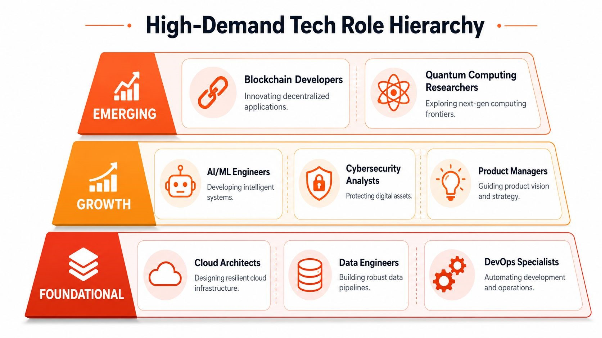
Foundational roles come first
The hierarchy starts with cloud architects, data engineers, platform engineers, and DevOps specialists. These are the roles that determine whether a GCC can scale delivery, standardise execution, and absorb higher-value mandates from the global business. If this layer is weak, every expensive hire above it slows down.
Data engineering deserves special attention. The US Bureau of Labor Statistics projects 36% growth in data scientist roles from 2023 to 2033, far above the average for all occupations, which signals sustained pressure on adjacent data and engineering talent pools worldwide according to the BLS occupational outlook for data scientists. In GCCs, that pressure shows up fast. Good data engineers are no longer support hires. They shape data quality, pipeline reliability, model readiness, and reporting trust.
A useful hiring benchmark appears in product engineering talent trends in India. The right evaluation criteria go beyond tools and frameworks. Test for system design judgment, platform thinking, and the ability to reduce complexity for downstream teams.
Growth roles create business advantage only after the base is stable
The next layer includes AI and ML engineers, cybersecurity analysts, advanced analytics talent, site reliability engineers, and product managers. These roles improve revenue decisions, risk control, release quality, and customer outcomes. They also indicate whether a GCC is moving from execution support to real ownership.
Many hiring plans often go wrong due to a common misconception. Companies treat these roles as universally high priority. They are not. Their value depends on centre maturity.
A GCC still fixing cloud sprawl, fragmented data, and weak release discipline should not hire as if it is already a mature AI-led product hub. That move raises cost per hire, stretches time to productivity, and creates avoidable attrition because top talent joins expecting strategic work but spends months cleaning up basics.
Transformational roles are scarce, expensive, and easy to misuse
The top tier includes GenAI engineers, LLM specialists, RAG architects, model governance talent, and fine-tuning experts. These roles matter. They also get overhired by centres that want market signalling before they have operating readiness.
Use a stricter filter here. Hire these roles when three conditions are already in place:
- Your data layer is governed and usable
- Your cloud and platform architecture can support production-scale experimentation
- Your product, risk, and security teams can turn prototypes into controlled business outcomes
If those conditions are missing, the hiring sequence is wrong. The centre will pay premium compensation for talent that cannot deliver full value.
Hire in layers that match GCC maturity. Foundational roles create execution stability. Growth roles create business impact. Transformational roles create advantage only when the first two layers are already working.
The strongest CHROs do not build hiring plans around what appears cutting-edge in the market. They build around what the centre must be able to own next. That is the difference between a GCC that accumulates expensive titles and one that earns bigger mandates.
Beyond Code The Rise of Critical Functional Expertise
The tech story gets all the attention. It shouldn’t.
As a GCC matures, some of its highest-value hires sit outside pure engineering. That includes global compliance, risk, ESG, strategic finance, procurement governance, and programme leadership. These roles don’t produce flashy headlines, but they determine whether the centre can influence enterprise decisions, absorb more complex mandates, and operate with credibility.
The Biggest Challenges in Hiring High-Demand GCC Talent
Many hiring challenges emerge long before recruiters begin sourcing candidates. Common issues include:
- Competition for AI, cloud, cybersecurity, and product engineering talent.
- Hiring plans that are disconnected from GCC maturity and business priorities.
- Long interview processes that increase candidate drop-offs.
- Limited availability of experienced professionals in niche technology domains.
- Overdependence on traditional sourcing channels for specialist hiring.
- Employer value propositions that fail to differentiate the organisation.
Organisations that address these challenges proactively build stronger talent pipelines while reducing hiring costs and improving long-term retention.
Why mature GCCs need more than engineers
A mature GCC doesn’t just execute tickets from the global headquarters. It owns programmes, controls risk, manages cross-border processes, and shapes business outcomes. That requires leaders who can interpret regulation, standardise governance, and align local teams with global objectives.
Many centres often encounter a significant shortfall. They build strong engineering benches but stay thin in specialist functional roles. The result is predictable. Delivery improves, but decision velocity stalls. Global stakeholders still keep the most sensitive work elsewhere because the centre lacks the right control functions around it.
A useful perspective appears in this overview of top skills in demand. A key differentiator is often not raw technical horsepower. It’s the ability to combine technical execution with domain stewardship.
Functional leaders change decision quality
Consider the difference between these two scenarios:
| GCC profile | What usually happens |
|---|---|
| Strong engineering, weak compliance and programme leadership | Work gets delivered, but strategic ownership stays offshore |
| Balanced engineering plus strong functional expertise | The centre earns trust to own larger, more sensitive mandates |
The underserved hiring category here is hybrid business talent. These are people who can speak to enterprise control, regulation, programme governance, and transformation in the same conversation. They become essential in sectors such as BFSI, pharma, energy, semiconductors, and manufacturing, where the business context matters as much as the technology stack.
A GCC becomes strategic when it can take decisions, not just instructions.
CHROs should stop treating functional hiring as a secondary phase. In many centres, these roles are the bridge between efficient delivery and enterprise relevance.
The GCC Maturity Mismatch Why Most Hiring Strategies Fail
Most GCC hiring doesn’t fail because the market is tough. It fails because leaders hire for the GCC they want to become, not the GCC they currently are.
The core issue is blunt. Early-stage GCCs need adaptable multi-skilled talent, while established centres need deep specialists, yet 60% of Indian GCC hiring fails due to this mismatch. That single point explains a huge share of hiring waste.
What early-stage centres need
An early-stage GCC needs builders. Not just coders. Builders.
These teams need people who can set up processes, work across ambiguous boundaries, manage stakeholders with limited context, and solve problems outside a narrow job description. In practice, that often means:
- Multi-skilled operators who can switch between build, run, and improve work
- Generalist product and programme talent who can translate between local teams and global sponsors
- Managers with setup experience who can create structure without introducing bureaucracy too early
The common mistake is hiring deep specialists too soon. They’re often excellent individually, but they can become frustrated in a centre that still lacks process stability, role clarity, or mature governance.
A deeper view of these patterns appears in this analysis of GCC hiring challenges. The wrong hire at an early stage doesn’t just miss target. It can distort the team model.
Here’s a useful visual summary before you redesign your org chart:
What mature centres should stop getting wrong
A mature GCC has the opposite problem. It often keeps recruiting versatile generalists long after the business has moved into specialist territory.
That’s a bad trade. Mature centres need people who bring depth, pattern recognition, control discipline, and repeatable excellence, such as the specialist in cloud cost optimisation, the leader in enterprise cyber governance, the RAG architect, the semiconductor domain expert, the ESG reporting specialist, or the programme leader who can run global transformation work at scale.
The talent profile that helps you launch a GCC often won’t help you scale it.
Use this diagnostic:
| Maturity stage | Best-fit talent profile | Wrong hire pattern |
|---|---|---|
| Early-stage | Generalists with setup ability | Overspecialised experts hired too early |
| Scaling | Mixed bench of builders and domain specialists | All hiring concentrated in one profile |
| Mature | Deep specialists and optimisation leaders | Continued dependence on broad generalists |
The implication is clear. Stop asking which roles are hottest in the market. Ask which mix of roles fits the centre’s current mandate, governance maturity, and business ambition.
How to Hire High-Demand GCC Talent
GCCs in India are paying a premium for scarce skills, yet many still lose candidates because the hiring model is misaligned with the centre’s maturity, decision rights, and growth path. This is the core problem. Niche hiring fails less on demand and more on fit.
Source for proof
Job boards produce applicants. They do not produce conviction.
For niche GCC roles, start with talent mapping tied to business outcomes. Define the capability markers first, then build target pools around people who have already done the work in comparable environments. If you are hiring an LLM engineer, screen for shipped use cases, model governance exposure, stack choices, and ownership of production architecture. If you are hiring for cyber, finance transformation, or compliance, look for decision-making depth, control ownership, and stakeholder range.
Use channels that match the role. Specialist communities, alumni networks, referrals from top performers, closed leadership networks, university labs, and internal mobility outperform broad-market sourcing for hard-to-fill positions. If your team needs a more disciplined operating model, use this RPO partnership guide for GCCs and GICs.
The recommendation is simple. Build slate quality before you chase funnel size.
Pay at market, but architect the full offer
Compensation gets attention because it is visible. It is rarely the full reason a niche candidate joins.
Mercer’s 2024 India Total Remuneration Survey showed average salary increases in India at 9.3% in 2024, with continued pressure in digital and specialist skill segments. Aon’s Salary Increase and Turnover Study 2024-25 reported projected salary increases of 9.5% for India and attrition easing from peak levels, but still remaining high in high-demand talent pools. For GCC leaders, the implication is direct. You need budget discipline and precision, not blanket offers.
Design the offer around four factors:
- Role authority: State what the person will own, approve, and influence.
- Career path: Show what progression looks like in 12, 24, and 36 months.
- Global exposure: Explain the operating model, reporting lines, and stakeholder access.
- Capability building: Fund learning tied to the role, not generic training credits.
Candidates leave when the sold story and the operating reality do not match. That gap is wider in GCCs that are scaling quickly or shifting from execution support to product, platform, and transformation mandates.
What Leading GCCs Do Differently
High-performing GCCs rarely recruit based solely on current vacancies. Instead, they align hiring decisions with long-term business capability and future operating models.
They continuously map specialist talent markets, build internal capability through upskilling and mobility programmes, and engage passive candidates before demand peaks. They also prioritise structured assessments that evaluate learning agility, business context, and problem-solving ability rather than focusing exclusively on previous job titles.
This approach enables them to secure scarce talent while building sustainable leadership and technical capability for future growth.
Improve Candidate Experience to Increase Retention
A weak hiring process creates early attrition.
LinkedIn’s Future of Recruiting 2024 found that skills-based hiring, internal mobility, and candidate experience are now central recruiting priorities. SHRM’s research on time-to-fill notes that time-to-fill remains a major drag on hiring performance, especially for specialised roles that require multiple stakeholders and tighter assessment. In GCC hiring, long cycles do more than slow growth. They increase drop-offs, trigger compensation resets, and weaken credibility with senior candidates.
Fix the process early.
Keep interview panels small. Involve the business leader in the first serious conversation. Test for motivation, not just competence. Explain what success looks like at six months and one year. Sell the role that exists.
That discipline matters most when the market is tight and your GCC is competing against firms with stronger brand pull, faster decisions, or clearer mandates. The centres that win niche talent do not just pay well. They make it easy for the right candidate to understand the mission, trust the scope, and see a future worth joining.
How to Build a Future-Ready GCC Talent Pipeline
By 2030, India’s GCC workforce is expected to be far larger than it is today. The headline growth matters less than what sits underneath it. Talent supply will expand, but not evenly across maturity-critical roles.
That is the hiring trap many CHROs still miss.
Early-stage centres will keep chasing broad operators. Scaled GCCs will keep chasing niche product, platform, AI, cyber, risk, and transformation talent. Those are different markets with different supply curves. If your workforce plan ignores that maturity gap, you will overhire the wrong profiles, underbuild internal capability, and pay a premium for talent your operating model cannot retain.
The best GCCs are already planning for 2030 in three layers. They build entry talent early, convert adjacent internal talent aggressively, and ring-fence external hiring for roles that require outside expertise.
Build talent before the market gets tighter
University and institute partnerships still matter, but only when they are tied to a real role architecture. Stop treating campus hiring as a volume channel. Use it to build future supply for roles your GCC will need in three to five years, especially in cloud engineering, data platforms, cybersecurity, applied AI, and domain-linked functional work.
That requires specificity.
Map which capabilities your centre must own by its next maturity stage. Then build feeder roles around them. A GCC moving from delivery support to product ownership should not run the same campus strategy as one building a global finance operations hub. The hiring model must match the mandate.
Internal academies deserve the same discipline. Generic learning libraries do not create deployable talent. Conversion pathways do. A data analyst can move into analytics engineering. A cloud operations engineer can move into architecture. A finance process lead can move into transformation governance. Those shifts happen only when business leaders sponsor them, managers are measured on development, and role moves are tied to actual openings.
Treat internal mobility as a supply strategy
Internal mobility is not a retention programme. It is a supply-side answer to scarce hiring markets.
Employees who already understand your systems, stakeholders, and decision cadence usually ramp faster than external laterals. That advantage grows in mature GCCs where role complexity is high and global coordination matters as much as technical skill.
A 2030-ready pipeline usually includes:
- Capability taxonomies linked to business outcomes and maturity stage
- Quarterly talent reviews focused on adjacent-skill conversion, not just succession planning
- Manager scorecards that reward talent export, bench strength, and internal fill rates
Use these mechanisms to reduce dependence on the lateral market. Do not use the market as your default answer for every hard role.
If every niche hire must come from outside, your GCC is not building capability. It is renting it. That works during setup. It fails at scale.
The strategic question for CHROs is simple. What talent must be bought, what talent can be built, and at what maturity stage does that answer change? Centres that answer that well will hire faster, retainbetter, and avoid the common 2030 mistake of building a talent model for the GCC they used to be, not the one the business now needs.
FAQs
How should we define high demand roles in GCC?
Define them by business criticality and scarcity, not by hype. A high-demand role is one that is hard to hire, central to the GCC mandate, and difficult to replace through adjacent talent. In some centres that’s GenAI and data engineering. In others it’s compliance, programme governance, or strategic finance.
Are GCC salaries in India still worth it compared with IT services?
Usually, yes, but only if the role creates enterprise value. Paying a premium for a niche hire makes sense when that person accelerates capability, reduces risk, or enables strategic ownership. It makes no sense when the role design is vague or the centre isn’t mature enough to use that talent properly.
What is the biggest hiring mistake CHROs make in GCCs?
They hire for aspiration instead of operating reality. Early-stage centres often hire narrow specialists too soon. Mature centres often keep hiring broad generalists because that model worked in the setup phase. Both mistakes create poor fit and weak retention.
How should we measure success in GCC hiring?
Use a mix of speed, quality, and staying power. Track time-to-fill for scarce roles, but don’t stop there. Review offer acceptance, hiring manager confidence, role fit after joining, internal mobility contribution, and attrition patterns by talent segment. If your fastest hires keep leaving, the process isn’t working.
What helps retain niche talent besides money?
Three things matter most. Clear scope. Visible growth path. Credible leadership access. People stay when they can see how their work matters, how their role can expand, and who is invested in their development. If those signals are absent, salary only delays exits.
If your GCC is struggling to identify, attract, and retain the right talent mix for its maturity stage, Taggd can help you turn hiring from a reactive process into a business-aligned capability strategy. From talent mapping and leadership hiring to project RPO and enterprise-scale fulfilment, Taggd helps organisations in India hire faster, with sharper fit and stronger long-term outcomes.