GCC hiring in India in 2026 points to a clear shift: hiring is growing, but becoming more selective, capability-led and AI-enabled.
India’s GCC ecosystem now spans 2,117 centres and roughly 2.3 million professionals. But scale is no longer the whole story.
The bigger change is the kind of work GCCs are taking on. As centres move beyond execution into global products, platforms, engineering, data and innovation, their hiring needs are changing too.
That means the question for GCC leaders is no longer simply: “How quickly can we fill this role?”
It is increasingly: “Can we find the right capability for the role?”
Based on Taggd’s GCC Talent Lab Report 2026, which draws on insights from 100+ CHROs and TA leaders across India’s GCC ecosystem, here are the seven hiring shifts HR leaders need to watch.
The 7 GCC Hiring Trends for 2026
| # | Hiring trend | What the data says |
| 1 | Hiring is growing, but becoming more selective | 52% of GCCs plan to increase hiring in FY27, up from 47% |
| 2 | Mid-career talent is gaining ground | Professionals with 6–10 years’ experience account for 28% of expected hiring |
| 3 | GCCs are buying capability, not just building it | 78% Buy vs. 22% Build |
| 4 | Lateral hiring is becoming critical | 41% of external hires come from IT services and 32% from other GCCs |
| 5 | Talent premiums are spreading beyond Tier-1 cities | Tier-2 entry salaries moved from ₹5–9 LPA to ₹7–12 LPA |
| 6 | AI is becoming a hiring tool, not just a hiring target | 90%+ of GCCs use AI somewhere in the hiring funnel |
| 7 | The KPI is shifting from fast hire to right hire | 48% of critical roles still take 60+ days to fill |
Let’s unpack what each shift means for GCC talent strategy.
Trend #1: Hiring is growing, but GCCs are becoming more selective
The GCC hiring outlook for FY27 remains positive.
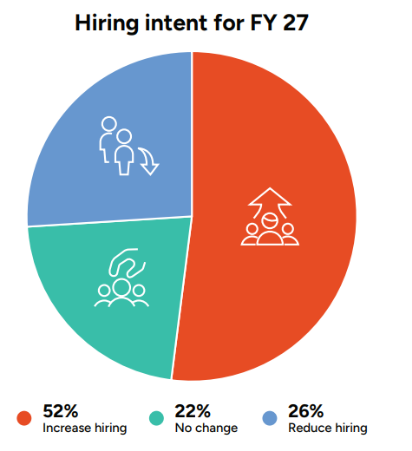
52% of GCCs plan to increase hiring, compared with 47% the previous year. Net hiring intent has also increased from roughly 14% to 17%, while the share expecting headcount cuts has fallen from 36% to 26%.
Together, these signals point to around 1.5 lakh potential new roles.
But higher hiring intent doesn’t mean GCCs are hiring indiscriminately.
The bigger challenge is talent quality.
Around 24% of GCCs identify quality mismatch as their number one hiring constraint, particularly in areas such as AI/ML, cloud and product engineering.
The problem is becoming less about finding someone who matches the keywords on a job description and more about finding someone who has the depth to deliver against the mandate.
What this means for HR leaders
GCC hiring strategies need to move beyond volume metrics.
Instead of asking only: How many people can we hire?
HR leaders need to ask: How much of the capability we need can the market actually supply?
More GCCs are hiring. Not all of them are finding what they need.
Trend #2: Mid-career talent is becoming increasingly important
The rise of experienced talent doesn’t mean GCCs are moving away from early-career hiring.
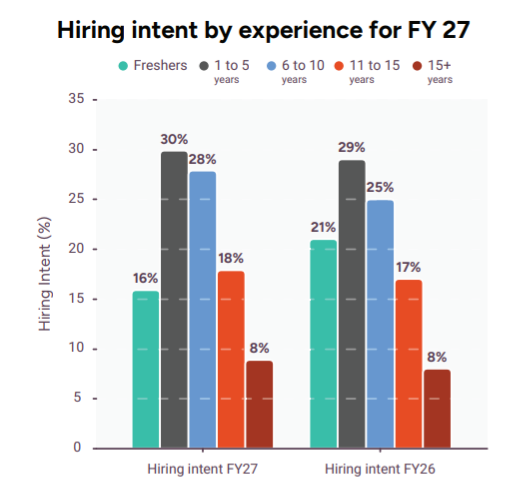
Freshers account for 16% of expected FY27 hiring, while professionals with 1–5 years of experience account for another 30%.
Together, that’s almost half of the expected hiring.
But the 6–10 year experience segment accounts for 28%, making it the largest single experience band in the hiring mix.
Why does this matter?
Because the role of GCCs is changing.
Many centres are moving beyond process execution to owning global products, platforms, architecture and business-critical capabilities.
Those mandates require professionals who can do more than execute predefined work. They need people who can make decisions, solve ambiguous problems and take ownership.
What this means for HR leaders
The experience mix needs to reflect the operating model.
Early-career talent brings scale and future pipeline. Mid-career talent brings capability ownership.
The strongest GCC talent strategies will balance both.
Trend #3: GCCs are choosing “Buy” over “Build” for critical capabilities
One of the clearest GCC hiring trend signals from the Taggd’s GCC Report 2026 is the 78:22 Buy-to-Build split.
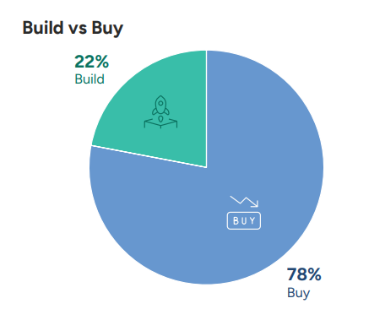
On average, GCCs are choosing to acquire 78% of capability through hiring, while 22% comes through internal capability building.
The logic is straightforward.
When a capability is business-critical, highly specialised or needed immediately, waiting to develop it internally can be too slow.
So GCCs are buying:
- Niche technical expertise
- Credentialed specialists
- Experienced product and engineering talent
- Capabilities that need to contribute from day one
Build, meanwhile, makes more sense for capabilities that GCCs want to own over the long term, such as developing AI/ML fluency across teams, strengthening product engineering depth, building data governance expertise, or creating leadership pipelines.
The strategic trade-off
Buy gives speed. Build gives ownership.
The question for GCC leaders is not whether one is better.
It is knowing which capabilities deserve which approach.
Trend #4: Lateral hiring is becoming critical when speed matters
Building talent internally takes time.
For urgent or highly specialised mandates, GCCs are therefore looking outward.
Among external hiring sources:
- 41% come from IT services
- 32% come from other GCCs
- 27% come from startups and product companies
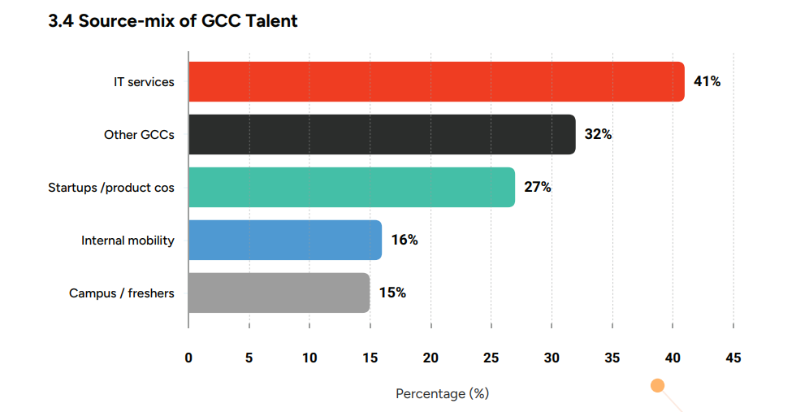
Each talent pool offers something different.
IT services
Provides scale, established processes and a large technology talent base.
The challenge is often transitioning professionals from delivery-led environments into roles requiring greater product ownership or business context.
Other GCCs
Provide professionals who are already familiar with GCC operating models, global stakeholders, and complex technology environments.
This makes the talent highly relevant but also intensifies competition among GCCs for the same people.
Startups and product companies
Can bring strong product thinking, ownership and outcome orientation.
However, GCCs often compete with different compensation structures, equity models, and flatter organizational cultures.
What this means for HR leaders
Lateral hiring is no longer simply a sourcing tactic.
It is becoming a capability acquisition strategy.
The challenge is to know which talent pools offer the closest match to the capability, rather than simply the fastest source of candidates.
Trend #5: GCC talent premiums are spreading beyond Tier-1 cities
GCCs have historically paid a premium for specialized talent.
Today, that premium is increasingly influencing hiring markets beyond India’s traditional technology hubs.
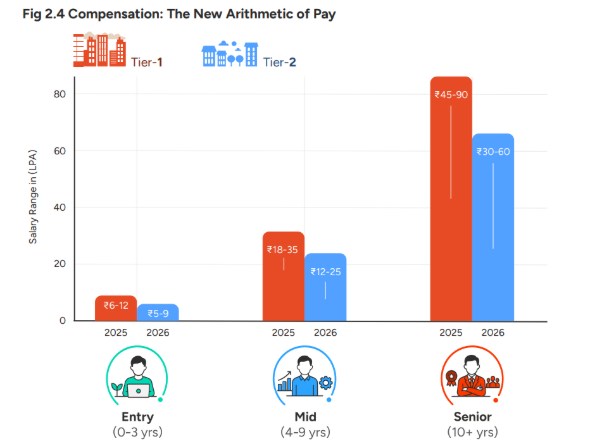
GCC salaries are around 20% higher than equivalent non-GCC roles. Average increments stood at 9.9% in 2025 and are projected at 10.4% for 2026.
But one of the more interesting developments is happening in Tier-2 cities.
Entry-level salaries have moved from around ₹5–9 LPA to ₹7–12 LPA.
That doesn’t mean Tier-2 cities have reached Tier-1 salary levels. Absolute compensation remains lower.
But the pace of movement signals something important:
GCC expansion is changing local talent economics.
As GCC footprints expand into cities such as Ahmedabad, Kochi, and Jaipur, compensation is increasingly becoming part of the location strategy.
What this means for HR leaders
Location strategy can no longer be separated from compensation strategy.
Opening a centre in a lower-cost location may offer a cost advantage initially. But as more GCCs enter the same market, talent competition can quickly narrow down that gap.
Trend #6: AI is moving from the job description to the recruitment process
AI is no longer only something GCCs are hiring for.
They are increasingly using it to hire.
More than 90% of GCCs now use AI somewhere in the recruitment funnel.
But adoption varies significantly by stage.
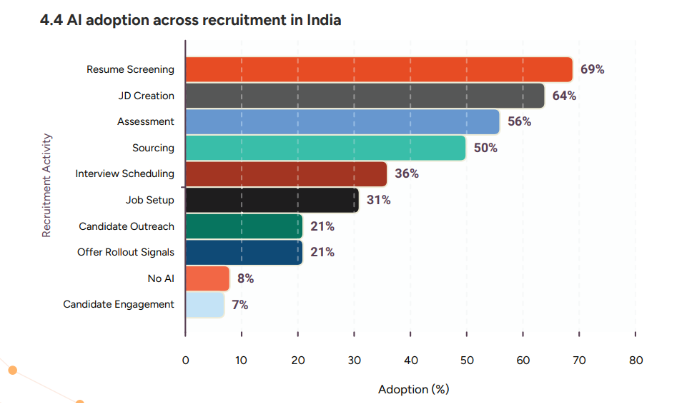
The pattern is revealing.
AI adoption is highest where recruitment involves high-volume, repetitive work.
It declines as the process gets closer to candidates and requires more judgement, trust and human interaction.
And despite widespread adoption, only 20% of GCCs report tangible, measurable impact from their AI use so far. Another 26% say it is too early to tell.
This suggests the next phase of AI adoption will not simply be about adding more tools.
It will be about connecting the hiring workflow.
From point solutions to connected intelligence
A recruiter may already have:
- One AI tool for sourcing
- Another for screening
- Another for assessments
- Another for scheduling
But if these systems operate independently, the intelligence generated at one stage may not improve the next.
The opportunity is to move towards more connected, agentic recruitment systems where AI handles execution across the workflow, and recruiters focus more heavily on judgement, governance and decision-making.
AI stopped being just a skill GCCs hire. It’s now a tool they hire.
Trend #7: Hiring Metric is Changing from Fast Hiring to the Right Hire
This may be the most important shift of all.
On one side, recruitment efficiency is improving.
Offer-to-join conversion has reached roughly 80%, compared with a 70–75% benchmark previously.
Candidates who reach the offer stage are more likely to join.
But the bigger bottleneck happens earlier.
48% of critical roles still take more than 60 days to fill.
The challenge is particularly visible in specialised roles across areas such as:
- AI architecture
- Cybersecurity
- Cloud engineering
The problem is no longer simply candidate drop-off.
It is finding the right candidate in the first place.
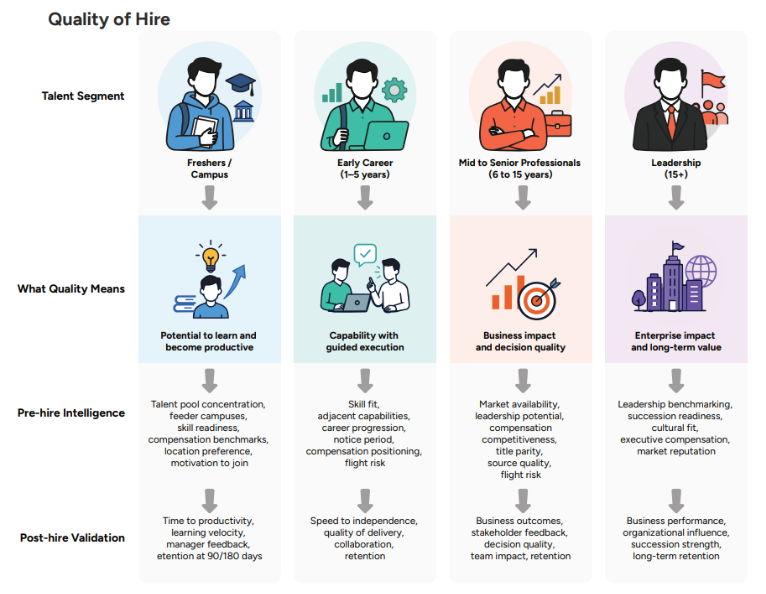
And that changes how recruitment success should be measured.
A 30-day hire is not necessarily a successful hire if the candidate lacks the capability the role requires.
A 60-day hire can be strategically valuable if it secures the expertise needed to build a global product, platform or capability.
The real shift
The hiring funnel is becoming less about speed at any cost and more about speed with precision.
What These GCC HIring Trends Mean for GCC Talent Strategy
Taken together, these trends tell a consistent story.
GCCs are:
Hiring more selectively.
Because demand is rising, but capability gaps remain.
Hiring more experienced talent.
Because GCC mandates are becoming more complex and ownership-led.
Buying capability.
Because some skills cannot be built quickly enough.
Hiring laterally.
Because adjacent talent pools can reduce the time needed to become productive.
Paying for scarcity.
Because specialised capability commands a premium, even outside traditional hubs.
Using AI to hire.
Because recruitment itself is becoming an AI-enabled workflow.
And ultimately:
Optimising for the right hire.
Because filling a role quickly means little if the capability doesn’t match the mandate.
Wrapping Up
The GCC hiring story in India is no longer simply about more jobs, more centres or more talent.
It is about the increasing sophistication of the capability being built in India.
As GCCs take on global products, engineering, technology and innovation mandates, their hiring models have to evolve with them.
The winning question is no longer: “How fast can we fill the role?”
It is: “Can we secure the right capability, at the right time, for the mandate we are building?”
GCC hiring in 2026 is moving from fast hiring to right hiring.
And for CHROs and talent leaders, that shift could define the next phase of GCC growth in India.
FAQs
What are the top GCC hiring trends in India for 2026?
The key trends include selective hiring growth, rising demand for mid-career professionals, a stronger preference for buying critical capabilities, increased lateral hiring, rising talent premiums in Tier-2 cities, greater use of AI in recruitment and a shift from fast hiring to right hiring.
Is GCC hiring increasing in India in 2026?
Yes. 52% of GCCs plan to increase hiring in FY27, compared with 47% the previous year. The report estimates that this could translate into around 1.5 lakh new roles.
Why is talent quality becoming a challenge for GCCs?
Around 24% of GCCs identify talent quality mismatch as their top hiring constraint. The challenge is particularly visible in specialised areas such as AI/ML, cloud and product engineering, where having the right keywords on a resume does not always translate into the required depth of expertise.
Are GCCs hiring more experienced professionals?
Yes. While early-career hiring remains significant, professionals with 6–10 years of experience account for 28% of expected FY27 hiring, making it the largest single experience segment.
Do GCCs prefer to buy or build talent?
GCCs currently lean strongly towards Buy, with 78% of capability coming through hiring compared with 22% through internal capability building. The choice depends on how urgently the capability is required and whether the GCC wants to develop long-term ownership of it.
How are GCCs using AI in recruitment?
More than 90% of GCCs use AI somewhere in the hiring funnel, particularly for resume screening, job description creation, assessments and sourcing. Adoption is lower in candidate-facing activities such as outreach and engagement, where human interaction remains important.
Are GCC salaries increasing in Tier-2 cities?
Yes. Entry-level salaries in Tier-2 locations have moved from approximately ₹5–9 LPA to ₹7–12 LPA. While absolute salaries remain below Tier-1 levels, the pace of compensation growth signals increasing competition for talent in emerging GCC locations.
Want the complete picture?
Explore the GCC Talent Lab Report 2026 for the full FY27 hiring outlook, city-wise talent intelligence, skill-cluster data and compensation benchmarks across 60+ roles.