Where are India’s GCCs placing their talent bets?
Increasingly, the answer isn’t simply Bengaluru, Hyderabad or another established talent hub. It is a combination of skills, locations, talent depth, and scalability.
As GCCs take on more complex mandates across AI, cloud, cybersecurity, data, product engineering and digital engineering, the traditional approach of opening a requisition and searching for an exact profile is becoming less effective.
The challenge is structural. The capabilities a GCC need and the talent available in the market rarely align perfectly across skills, location, experience and scale.
This is where skill mapping for GCCs becomes a strategic sourcing tool.
Instead of asking “Where can we find candidates for this role?”, CHROs and talent leaders can ask:
- Where does this capability actually exist?
- How deep is the available talent pool?
- Which cities have the strongest concentration of this skill?
- Is the adjacent talent pool close enough to develop?
- Can this talent pool support a 50-person team or a 500-person capability?
- What should we Buy from the market, and what should we Build internally?
A well-designed skill map answers these questions before the requisition is opened.
Skill Mapping for GCCs: At a Glance
| What CHROs need to know | What skill mapping helps answer |
| What skills do we need? | Identifies critical capabilities and skill clusters |
| Where is talent? | Maps skills across established and emerging locations |
| How deep is the pool? | Measures addressable talent and scarcity |
| Can we scale? | Assesses supply, trainability, retention and cost |
| What can we build? | Identifies capabilities suitable for reskilling and internal mobility |
| What should we buy? | Identifies skills requiring external expertise |
| Where should we source? | Connects each capability to the right talent markets |
The objective is not simply to create a map.
It is to turn the map into a hiring decision.
What Is Skill Mapping for GCCs?
Skill mapping is the process of identifying the capabilities required for a GCC’s business strategy and mapping them against where those skills are available, how deep the talent pool is, how scarce they are and how scalable they could become.
For GCCs, this goes beyond conventional talent mapping.
A traditional talent search might begin with:
Role → City → Candidates
Skill mapping reverses the process:
Capability → Talent Pool → Location → Scalability → Sourcing Strategy
This distinction matters because a large city-level talent pool does not automatically mean a deep pool for a specific capability.
A city may have thousands of technology professionals, but a much smaller number of people with experience in production-ready GenAI, agentic AI, MLOps, cloud security, distributed systems or AI governance.
Skill mapping helps GCCs identify that difference before it becomes a hiring problem.
Why Is Skill Mapping Becoming the New Sourcing Strategy?
No GCC opens a requisition and finds an exact match waiting next door.
The talent market is fragmented across skills, experience, locations, and industries. A candidate may have 80% of the required technical capabilities but sit in another city. Another may have the technical foundation but need targeted upskilling. A third may have the right experience but be priced out of the GCC’s compensation range.
Skill mapping helps distinguish between these scenarios.
With 70% of job-relevant skills expected to shift by 2030, according to LinkedIn’s 2025 research cited in the source material, GCC talent strategies increasingly need to account for both current and emerging capabilities.
For a GCC, this means mapping each priority role to a specific skill cluster and benchmarking the supply side before opening the requisition.
Done well, skill mapping answers three questions:
1. Does the skill exist?
Identify the addressable talent pool for the capability.
2. Is the skill scalable?
Determine whether the available talent can support sustained hiring rather than a small number of isolated hires.
3. Can the adjacent pool work?
Assess whether candidates with related skills can be trained or transitioned into the role or whether the gap is too significant to justify the approach.
This is where skill mapping moves from a sourcing exercise to a workforce planning tool.
How Can CHROs Turn Skill Mapping into a Hiring Strategy?
A skill map becomes valuable only when it changes what the organization does next.
A practical GCC skill-mapping framework should answer five questions.
1. Define the capability, not just the job title
Start with the business capability the GCC needs to build.
For example, instead of mapping for a generic “AI Engineer” requirement, break the capability into areas such as:
- GenAI and LLM engineering
- Agentic AI
- MLOps
- Applied AI
- AI governance
- Data engineering
- Cloud infrastructure
This creates a more accurate view of the talent market.
2. Map the addressable talent pool
Estimate how much relevant talent exists across India.
But don’t stop at the total number.
Separate the market into:
Available talent → Adjacent talent → Scarce talent
This helps CHROs understand where direct hiring is realistic and where the organization will need a different strategy.
3. Map skills to locations
Identify both established and emerging talent clusters.
The question isn’t:
Which is the best GCC city?
It is:
Which city is best for this capability?
That can produce a very different location strategy.
4. Test scalability
A talent pool may be large enough for 20 hires but insufficient for a 200-person ramp.
Before committing to a hiring plan, assess:
- Talent supply
- Trainability
- Retention
- Career progression
- Cost competitiveness
5. Decide whether to Buy, Build or combine both
Once the talent market is mapped, the final question is strategic:
What should we buy from the market, and what should we build internally?
That decision becomes much easier when the supply-side reality is visible.
Where GCCs Are Placing Their Talent Bets
India’s GCC talent landscape is becoming increasingly distributed.
Established hubs continue to dominate many specialized capabilities, but emerging locations are becoming important extensions of the talent ecosystem.
The key is to stop thinking about cities as generic talent markets and start thinking about them as skill clusters.
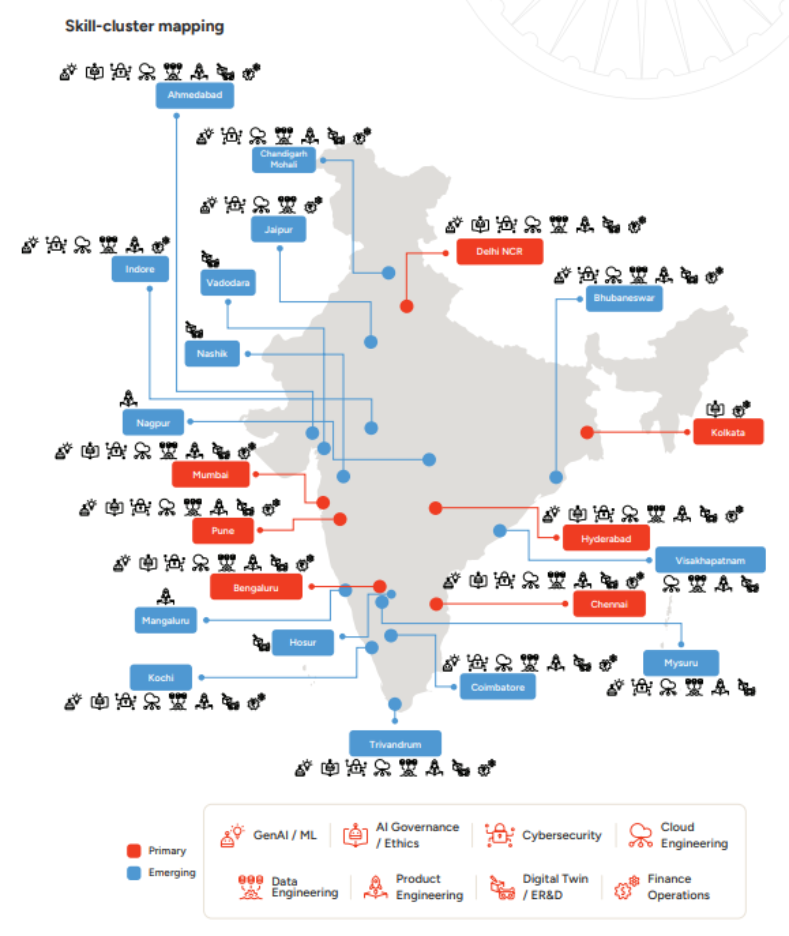
Source: GCC Report 2026, Taggd
GCC Skill Clusters Across India
| Skill cluster | Addressable pool across India | Talent scarcity | Primary hubs | Emerging hubs |
| GenAI / ML | ~9.2L | >0.8L | Bengaluru, Hyderabad, Delhi NCR, Chennai, Mumbai, Pune | Kochi, Coimbatore, Ahmedabad, Jaipur, Bhubaneswar, Thiruvananthapuram, Indore, Chandigarh–Mohali, Mysuru |
| AI Governance / Ethics | Not auditable | High | Bengaluru, Hyderabad, Delhi NCR, Chennai, Mumbai, Pune, Kolkata | Ahmedabad, Kochi, Thiruvananthapuram |
| Cybersecurity | 2.5–3.3L | 0.5–0.9L | Bengaluru, Hyderabad, Delhi NCR, Chennai, Mumbai, Pune | Kochi, Coimbatore, Thiruvananthapuram, Jaipur, Bhubaneswar, Chandigarh–Mohali, Indore |
| Cloud Engineering | 5.2–6.5L | 2–3.7L | Bengaluru, Hyderabad, Delhi NCR, Chennai, Mumbai, Pune | Kochi, Ahmedabad, Coimbatore, Jaipur, Bhubaneswar, Thiruvananthapuram, Indore, Chandigarh–Mohali, Mysuru, Visakhapatnam |
| Data Engineering | 3.6–4.6L | 0.75–1.25L | Bengaluru, Hyderabad, Pune, Delhi NCR, Chennai, Mumbai | Kochi, Coimbatore, Ahmedabad, Jaipur, Bhubaneswar, Thiruvananthapuram, Indore, Chandigarh–Mohali, Mysuru, Visakhapatnam |
| Product Engineering | 16–20L | 1.7–3L | Bengaluru, Hyderabad, Pune, Delhi NCR, Chennai, Mumbai | Kochi, Coimbatore, Ahmedabad, Jaipur, Bhubaneswar, Thiruvananthapuram, Indore, Chandigarh–Mohali, Nagpur, Mangaluru |
| Digital Twin / ER&D | 6.5–8.5L | 0.7–1.3L | Bengaluru, Pune, Chennai, Hyderabad, Delhi NCR, Mumbai | Coimbatore, Mysuru, Ahmedabad, Vadodara, Nashik, Thiruvananthapuram, Jaipur, Kochi, Hosur, Chandigarh–Mohali, Bhubaneswar |
| Finance Operations | 7–9L | 0.4–1L | Bengaluru, Delhi NCR, Pune, Hyderabad, Chennai, Mumbai, Kolkata | Kochi, Coimbatore, Ahmedabad, Jaipur, Thiruvananthapuram, Indore, Chandigarh–Mohali, Visakhapatnam |
What Does This Skill Map Tell CHROs?
Three patterns stand out.
First, talent depth and talent quality are not the same thing.
Product engineering has a large addressable pool, for example, but high-quality backend, distributed systems and staff-engineering talent remains difficult to access.
Second, emerging cities are becoming capability extensions, not simply low-cost alternatives.
Cities such as Kochi, Coimbatore, Ahmedabad, Jaipur, Indore, and Bhubaneswar can expand the sourcing universe for specific capabilities.
Third, scarcity often exists within a skill rather than across an entire function.
Cloud engineering has a large nominal pool, but the available talent becomes materially thinner when the requirement moves toward SRE, platform engineering, Kubernetes, cloud security, or multi-cloud architecture.
That is precisely why GCC talent strategy needs to move from city-level mapping to skill-level mapping.
What Makes a Talent Cluster Scalable for a GCC?
Not every talent pool that looks attractive on paper is ready for large-scale GCC hiring.
A skill cluster is genuinely scalable only when it meets five conditions:
1. Sufficient market supply
There must be enough relevant talent to support current and future hiring requirements.
2. Trainability
The adjacent talent pool should be capable of developing the missing skills within a commercially viable timeframe.
3. Retention
A talent cluster is not scalable if the GCC can hire people but cannot retain them.
4. Career progression
The market needs enough depth across junior, mid and senior levels to create a sustainable talent pyramid.
5. Competitive cost
Compensation must remain viable relative to competing locations and alternative talent markets.
This creates an important CHRO filter:
Is this a hiring problem or an institution-building problem?
If a cluster clears all five conditions, a GCC can build a significant hiring plan around it.
If it clears only three or four, the strategy may require smaller cohorts, higher sourcing investment, and stronger retention interventions.
And if demand exists but the surrounding talent ecosystem does not, the answer may not be more recruitment.
It may require academia partnerships, Centres of Excellence, targeted skilling programmes or long-term capability building.
Build vs Buy: How Are GCCs Accessing These Skills?
Once a GCC knows where a skill cluster exists and how deep it runs, the next decision is whether to build the capability internally or buy it from the market.
The decision increasingly comes down to three factors:
Talent availability + time-to-productivity + cost of waiting.
Capability building is becoming mainstream. Nearly 8 in 10 Indian GCCs run internal GenAI upskilling programmes, reskilling covers almost three-fourths of the workforce, and 70% of centres treat tech-led capability building as a core talent strategy, based on the source material.
The most mature GCCs are increasingly functioning as talent factories- building capabilities they expect to need in the future.
But not every capability can be built internally.
Some roles require:
- Proven expertise
- Niche specialization
- Prior domain exposure
- External perspective
- Immediate program delivery
For these capabilities, buying talent can be the more practical option.
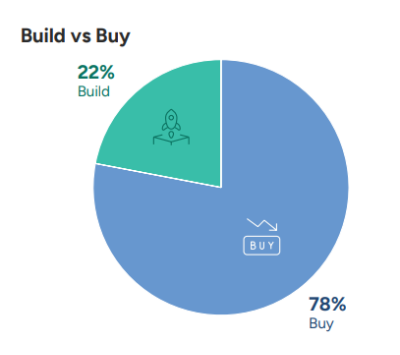
According to the Taggd GCC Report 2026: 78% of hiring is Buy, while 22% is Build.
What Does Buy Mean?
Buy is most relevant where the market already has the expertise GCCs need.
This includes credentialed expertise, niche specialisations, external perspectives and capabilities required immediately.
What Does Build Mean?
Build becomes more relevant when long-term ownership matters.
Examples include:
- AI/ML fluency across functions
- Product engineering depth
- Data governance
- Leadership pipelines
- Internal mobility
- Reskilling and upskilling
The balance also changes as a GCC matures.
Newer GCCs tend to rely more heavily on external hiring to establish capabilities quickly.
Mature GCCs can increasingly invest in academies, mobility and upskilling to reduce long-term dependence on the external market.
The question is therefore no longer simply: “How fast can we hire?”
It is: “What should we buy from the market, and what must we build for sustained advantage?”
Where Are GCCs Buying Talent From?
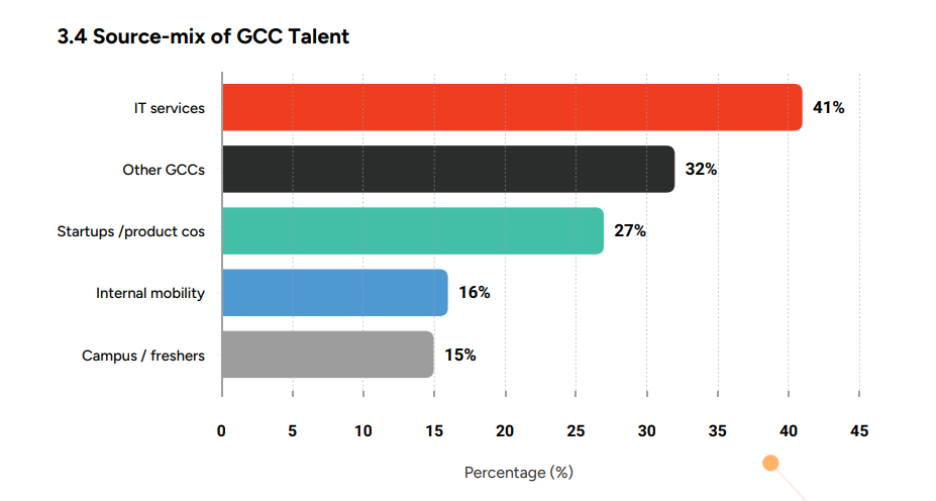
The 78% of talent GCCs buy from the market isn’t one homogeneous pool.
It comes primarily from three ecosystems, and each represents a different kind of capability adjacency.
| Source | Share of external hiring | What GCCs are accessing |
| IT services | 41% | Technical depth, enterprise delivery and scale |
| Other GCCs | 32% | Adjacent GCC experience and specialized capability |
| Startups / product companies | 27% | Product ownership, agility and outcome orientation |
IT Services: The Largest External Talent Pool
IT services account for 41% of external hiring.
Companies such as TCS, Infosys, Wipro and HCL have built large pools of professionals experienced in enterprise delivery, structured processes, client-facing environments and distributed ways of working.
For GCCs, this creates a deep and familiar talent pool.
But there is a transition to manage.
Professionals moving from IT services into GCCs may need to shift from a delivery-led model toward:
- Product ownership
- Business context
- End-to-end accountability
- Outcome orientation
The skill may be adjacent. The operating model may not be.
Other GCCs: The Most Directly Adjacent Pool
Other GCCs contribute 32% of external hiring.
This makes them a highly relevant source of talent because candidates already understand GCC operating environments, global stakeholders, and enterprise processes.
But there is a structural challenge.
When one GCC hires from another, the overall talent pool does not expand.
Talent simply moves between centres.
As competition increases, this can push compensation higher and increase talent circulation across the ecosystem.
Startups and Product Companies: Different Experience, Different Advantage
Startups and product companies contribute 27% of external hiring.
Their value is not necessarily greater in technical proximity.
It is often operating model proximity.
These professionals may bring experience in:
- Product ownership
- Outcome orientation
- End-to-end delivery
- Fast decision-making
- High-ownership environments
This makes the startup/product ecosystem particularly relevant for mid-level and senior hiring.
But GCCs are competing against a different proposition: equity, flatter hierarchies and faster impact.
The sourcing strategy therefore needs to account for more than salary.
How Are GCCs Building Talent Internally?
The Build side of the equation is also changing.
Within internal capability building, the split is nearly even:
- 52% from internal mobility
- 48% from freshers and campus hiring
This creates two parallel talent-building engines.
Internal Mobility
Internal mobility is about moving your employees into new roles within your company. Existing employees already understand the organization, culture, and business context.
With targeted reskilling, they can move into emerging capability areas while reducing external hiring dependence.
Freshers and Campus Talent
Campus hiring provides a different advantage: learning agility and coachability.
GCCs can shape early-career talent closer to their operating context rather than retraining experienced professionals from another operating model.
This is also creating stronger partnerships between GCCs and premier institutions, including efforts to align curricula with emerging capability requirements.
The result is a longer-term shift:
GCCs are not only hiring talent from the market. They are increasingly shaping the talent they will need next.
How Can CHROs Use Skill Mapping to Make Better Hiring Decisions?
A skill map should ultimately change the way the hiring plan is built.
Before opening a large requisition, CHROs and TA leaders can ask:
1. What capability are we actually trying to build?
Move beyond job titles and define the underlying skills.
2. Where does that capability exist today?
Map established and emerging talent clusters.
3. How deep is the talent pool?
Look at addressable supply, scarcity and seniority distribution.
4. What does the adjacent pool look like?
Determine whether related skills can be developed.
5. Can this market support our hiring scale?
A location suitable for 20 hires may not support 200.
6. What should we Buy?
Identify capabilities where external expertise is faster or more economical.
7. What should we Build?
Identify capabilities that should become internal organizational strengths.
8. Where should we build a long-term pipeline?
For structurally scarce capabilities, move beyond requisition-based hiring toward:
- Internal mobility
- Academia partnerships
- Campus programmes
- Upskilling
- Talent communities
- Centres of Excellence
This is how skill mapping becomes a workforce strategy rather than a sourcing exercise.
The Bigger Shift drom Location-Based Hiring to Capability-Based Sourcing
India’s GCC talent advantage has traditionally been described through the depth of its major cities.
That story is no longer enough.
The next phase of GCC growth will depend on understanding which skills exist where, how scalable those skills are, and how GCCs can access them sustainably.
A large talent pool does not automatically mean the right talent pool.
An emerging city does not automatically mean a scalable talent market.
And a scarce skill does not automatically mean it must be bought.
The smarter approach is to connect skill intelligence with location intelligence, talent availability, scalability and Build vs Buy decisions.
For CHROs, the question before opening the next requisition should therefore not be:
“Where can we find these people?”
It should be:
“Where is the ecosystem that can sustain this capability?”
That is the real value of skill mapping for GCCs.
It helps organizations move from searching for candidates to designing the talent supply chain they need to scale.
FAQs
What is skill mapping for GCCs?
Skill mapping for GCCs is the process of identifying the capabilities required by a GCC and mapping them against talent availability, skill clusters, locations, scarcity, scalability, and development potential.
Why is skill mapping important for GCC hiring?
Skill mapping helps GCCs understand where specialized talent exists, how deep the talent pool is, and whether a capability should be sourced externally, developed internally or supported through longer-term ecosystem building.
How does skill mapping help GCCs choose hiring locations?
Instead of selecting cities based only on overall talent availability, skill mapping identifies which locations have the strongest concentration of specific capabilities such as AI/ML, cybersecurity, cloud engineering, data engineering or product engineering.
What is the difference between skill mapping and talent mapping?
Talent mapping typically focuses on identifying available professionals or talent pools. Skill mapping goes deeper by analyzing the specific capabilities within those pools, their scarcity, location, scalability, and potential for development.
Should GCCs Buy or Build talent?
There is no single answer. GCCs can Buy capabilities that require immediate expertise or niche specialization, while Build strategies are better suited to capabilities where long-term ownership, internal mobility and organizational knowledge create strategic value.
How can GCCs identify scalable talent pools?
A scalable talent pool needs sufficient supply, trainability, retention potential, career progression, and competitive costs. A pool that lacks these conditions may require a different sourcing or capability-building strategy.
Which cities are emerging as GCC talent hubs in India?
Beyond established hubs such as Bengaluru, Hyderabad, Delhi NCR, Chennai, Mumbai and Pune, cities including Kochi, Coimbatore, Ahmedabad, Jaipur, Bhubaneswar, Thiruvananthapuram and Indore are becoming relevant for specific skill clusters.
How can GCCs use skill mapping for workforce planning?
GCCs can use skill maps to forecast future capability needs, identify talent gaps, compare Buy vs Build options, prioritize locations, and create pipelines before demand peaks.
Ready to Build a Smarter GCC Talent Strategy?
Knowing where talent exists is only the first step. The real advantage comes from knowing which skills are scalable, where to source them, and what to Buy vs Build.
Explore Taggd’s GCC Talent Intelligence and see how data-led talent mapping can help you make smarter hiring decisions.
Download Taggd’s GCC Talent Lab Report 2026